
Distribution of Uranium Thorium and Potassium in the
Distribution of Uranium, Thorium and Potassium in the Bayer Process Andrei Goronovski, J. Vind, V. Vassiliadou, D. Panias, A. H. Tkaczyk Bauxite Residue Valorisation and Best Practices Conference BR 2018
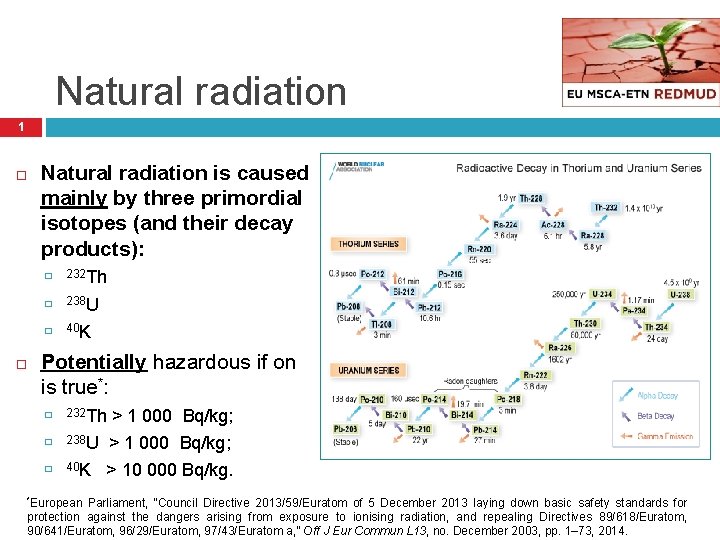
Natural radiation 1 Natural radiation is caused mainly by three primordial isotopes (and their decay products): � 232 Th � 238 U � 40 K Potentially hazardous if on is true*: � 232 Th > 1 000 Bq/kg; � 238 U > 1 000 Bq/kg; � 40 K > 10 000 Bq/kg. *European Parliament, “Council Directive 2013/59/Euratom of 5 December 2013 laying down basic safety standards for protection against the dangers arising from exposure to ionising radiation, and repealing Directives 89/618/Euratom, 90/641/Euratom, 96/29/Euratom, 97/43/Euratom a, ” Off J Eur Commun L 13, no. December 2003, pp. 1– 73, 2014.
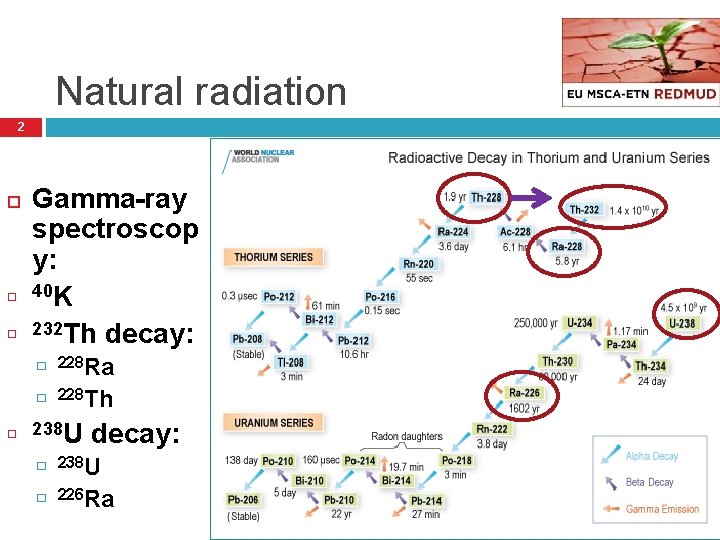
Natural radiation 2 Gamma-ray spectroscop y: 40 K 232 Th decay: � 228 Ra � 228 Th 238 U decay: � 238 U � 226 Ra
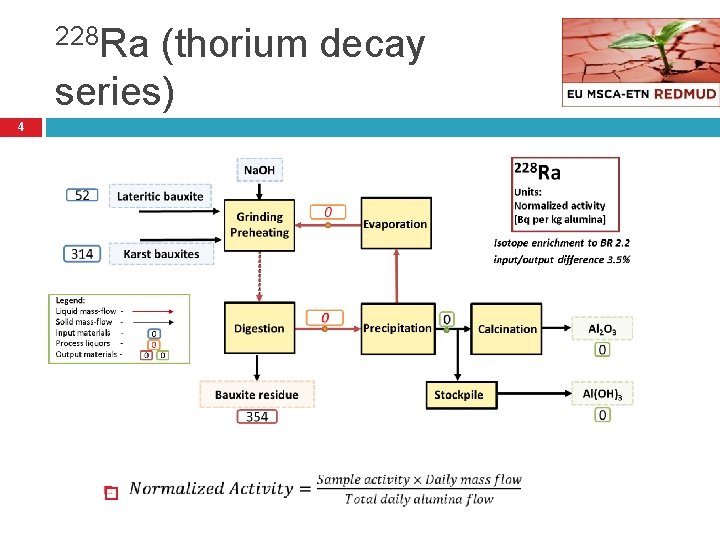
228 Ra (thorium decay series) 4

228 Th (thorium decay series) 5

228 Th (thorium decay series) 6 Thorium has been reported to enter alumina up to 4. 9 ppm* In the current study in remained below minimum detectable amounts, which corresponded to chemical content below 0. 12 and 0. 22 ppm for hydrated and calcined alumina respectively.
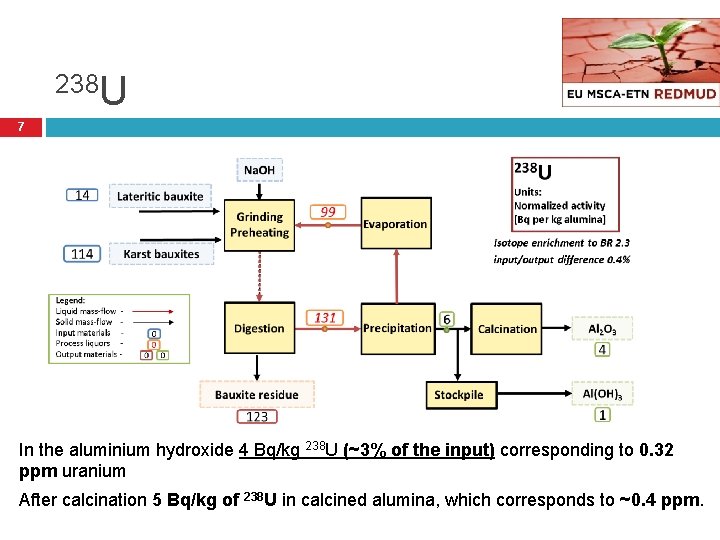
238 U 7 In the aluminium hydroxide 4 Bq/kg 238 U (~3% of the input) corresponding to 0. 32 ppm uranium After calcination 5 Bq/kg of 238 U in calcined alumina, which corresponds to ~0. 4 ppm.
226 Ra (uranium decay series) 8
40 K 9
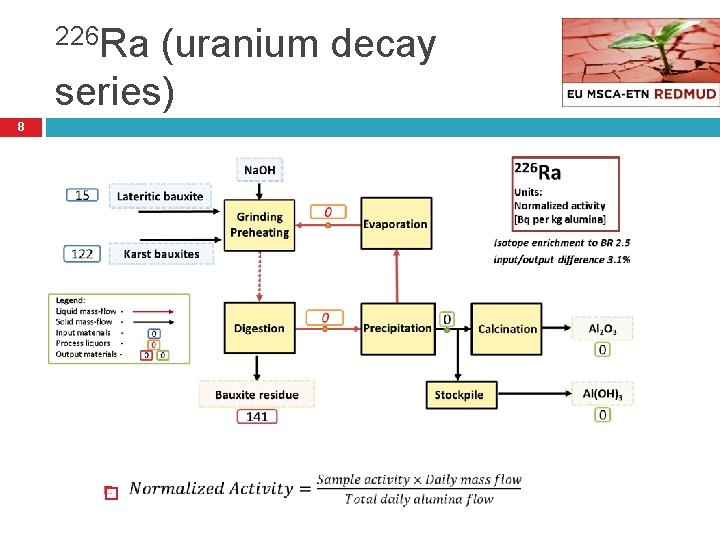
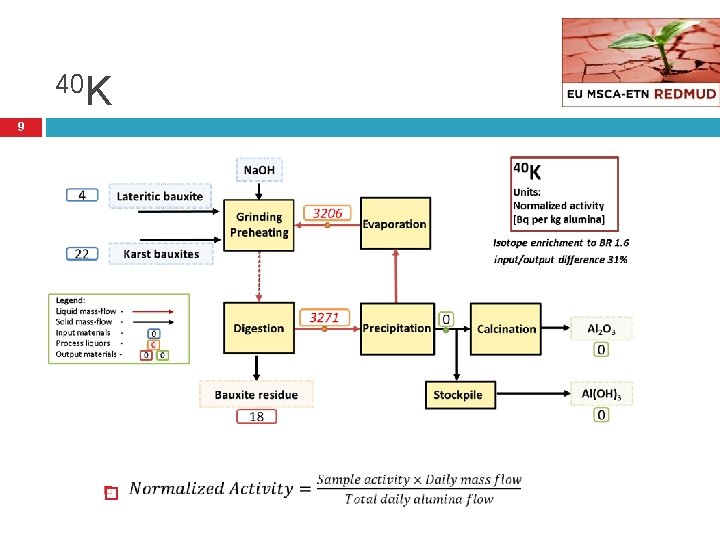
Summary 10 All thorium and its decay products end up in BR, we did not observe any decay products in the process liquors or in alumina; A minor fraction of 238 U was observed in the alumina, as well as some accumulation of this nuclide in the process liquors. In the hydrated alumina 4 Bq/kg 238 U (~3% of the input) was measured, which is equivalent to 0. 32 ppm uranium (it is in agreement with values published in literature 0. 3 - 0. 5 ppm). After calcination 5 Bq/kg of 238 U was measured in calcined alumina, which corresponds to ~0. 4 ppm; Decay products of uranium series 226 Ra was not present in the process liquors and alumina; all the isotopes go to BR. This leads to a conclusion that the uranium decay series equilibrium is disturbed during Bayer process; Accumulation of 40 K was observed in the process liquors, mass balance has shown inconsistency between input of this radionuclide with bauxites and output in the products (in the output 70% 40 K was observed); Radionuclide concentrationsat any process stage remain below legislative limits and there are no risks of increased radiological
Summary 11 All thorium and its decay products end up in BR, we did not observe any decay products in the process liquors or in alumina; A minor fraction of 238 U was observed in the alumina, as well as some accumulation of this nuclide in the process liquors. In the 238 U (~3% of the input) was measured, In comparing these results with other studies, it hydrated alumina 4 Bq/kg is helpful to keep in mind that radionuclide which is equivalent to 0. 32 ppm uranium (it is in agreement with values published in literature 0. 3 - 0. 5 ppm). After calcination 5 Bq/kg content of bauxites and BR is site-specific and 238 of U was measured in calcined alumina, which corresponds to ~0. 4 will differ significantly worldwide. Likewise, ppm. pertinent radiological legislation may vary in 226 Ra was not present in the process Decay products of uranium series different countries of the world; the conclusions liquors and alumina; all the isotopes go to BR. This leads to a demonstrated here are based on the Euratom conclusion that the uranium decay series equilibrium is disturbed BSS, which is applicable in Member States of during Bayer process. the European Union. Accumulation of 40 K was observed in the process liquors, mass balance has shown inconsistency between input of this radionuclide with bauxites and output in the products (in the output 70% 40 K was observed). Radionuclide concentrationsat any process stage remain below legislative limits and there are no risks of increased radiological

12 Thank you for your attention! Questions?
- Slides: 12