
Distribution Management Channel Design Market Segmentation Service Output
Distribution Management Channel Design Market Segmentation Service Output Demand (SOD) 1

Channel Design • What is channel design? – Decisions associated with forming new or altering existing channels • Why are channel design decisions critical? – They directly influence all other marketing decisions like promotions, pricing, profit sharing, packaging, service etc. – Key external resource for many manufacturers ©Mc. Graw-Hill Companies, Inc. 2002 2
Channel Design • For proper channel design, a channel manager must consider three factors: – Who are to be members of channel (Sony products: own outlet, distributors, wholesalers, local retailers, chain retailers) – Identity of channel members (new retailer or prestigious retailer…. more important in overseas marketing) – How many each type of channel members to be included ©Mc. Graw-Hill Companies, Inc. 2002 3

Channel Design Channel Analysis • For effective marketing channel, there are two major concerns: 1. Designing right channel: It includes segmenting market, targeting right segment, producing service outputs for target end-users in most efficient way possible, and choosing right types and numbers of intermediaries (channel structure). 2. Implementing that design: It requires an understanding of each channel member’s sources of power and dependence (allocating task of 8 channel flows among channel members) , managing channel conflict, and executing optimal channel 4

CHANNEL DESIGN AND IMPLEMENTATION Channel Design Process: Channel Implementation Process: SEGMENTATION: Recognize and respond to target customers’ service output demands Decisions About Efficient Channel Response: CHANNEL STRUCTURE: What kinds of intermediaries are in my channel? Who are they? How many of them? SPLITTING THE WORKLOAD: With what responsibilities? DEGREE OF COMMITMENT: Distribution alliance? Vertical integration/ownership? GAP ANALYSIS: What do I have to change? CHANNEL POWER: Identify sources for all channel members CHANNEL CONFLICT: Identify actual and potential sources MANAGE/DEFUSE CONFLICT: Use power sources strategically, subject to legal constraints GOAL: Channel Coordination INSIGHTS FOR SPECIFIC CHANNEL INSTITUTIONS: Retailing, Wholesaling and Logistics, Franchising 5

Market Segmentation • Market Segmentation means splitting market into groups of end-users who are – Maximally similar within group – Maximally different between groups 6

Market Segment § But maximally similar or different based on what criteria? – A marketing channel is also adding value to product marketed through it. – A marketing channel while distributing product or service is adding some ancillary services that defined how product is sold. – For channel manager, segments are best defined on basis of demands for outputs of marketing channel 7

Market Segment • But maximally similar or different based on what criteria? . . continued…… – These value added services are related to service output demands of consumer – For different types of consumers, i. e. , specific market segment, these service output demands are different…. . thus requirements of value added service are different – Thus different marketing channels can meet needs of different market segments 8

Market Segment Importance of Market Segmentation • Optimal channel is determined by channel flows that must be performed to satisfy specific target segment’s service output demands • Each product or service selling situation can have its own unique set of service output demand for each segment • So, importance of different sets of channel flows depends on market segment ©Mc. Graw-Hill Companies, Inc. 2002 9

Market Segment Channel Design Criteria • Assess different segment’s attractiveness • Select segments to target and not to target • Customize the marketing channel for each targeted segment – Create new marketing channels – Modify existing marketing channels 10

Service Output Demand Why need to understand End-Users • A particular product or service can be bought in multiple ways – It depends on customers requirements • It is not product that changes but method of buying and selling product and associated services that accompany product may change – Buying air ticket directly from Singapore Airlines through online and buying the same from travel agent (several customer services are associated with this second buying) ©Mc. Graw-Hill Companies, Inc. 2002 11
Service Output Demand • Why need to understand End-Users…. Continued… – Online railway ticket purchase may be convenient for Railway for cost minimization, so preferable from supply side perspective, but consumers may not be comfortable with this new technology, so may not be a preferable service from demand side perspective. • Therefore, Marketing channel design requires in-depth knowledge about end-users. – What they want to buy – How they want to buy • For different products/services, even for same products/service different segment of end-users may have different service output demands. ©Mc. Graw-Hill Companies, Inc. 2002 12
Service Output Demand (SOD) • An end-user’s decision about where to purchase a product or service depends not just on what enduser is buying but also on how end-user wants to buy it. • Elements of how end-users want to buy and use products and services are called service outputs • SODs are productive outputs of marketing channel that end-users have demand preference. 13

Service Output Demand Bucklin’s Theory • Determining channel structure to meet Service Output Demands • Bucklin (1966) contributed to the issue stating that at distribution, four service output levels are important. • “channel systems remain viable by performing duties that reduce end-users’ search, waiting time, storage and other costs…the service outputs” 14

Service Output Demand Service Output • • Bulk–breaking (Lot size) Spatial convenience (Market decentralization) Wait time (delivery time) Assortment (Product Variety) • According to the author, firms choose channels that minimize the distribution costs associate with delivery time of these outputs. 15
Service Output Demand Bulk-Breaking • Enabling customers to buy in their desired quantities. • The more bulk breaking, i. e. , smaller lot size, the less need to carry inventory (from customer perspective). • The more bulk breaking, the higher the price per unit (usually). • What about DHL or UPS? 16
Service Output Demand Spatial Convenience • While buying any product or service, customers demand some services for convenience • Greater spatial convenience increases customer satisfaction by reducing transportation costs and search costs. • Normally, the more spatial convenience, the higher the costs, hence the price – convenience stores at gas stations – vending machines • What about DHL or UPS? 17
Service Output Demand Waiting Time • Time period between ordering and receiving products and services • Longer waiting times mean customers must be able to predict needs and plan further in advance • Normally, the longer the waiting time, the lower the cost • Price implication with respect to level of inventory – Intensity of demand differs for • Original equipment (→low) • Post-sale-service and parts (→high) • There is often a correlation between bulk-breaking, spatial convenience and waiting-time • What about DHL or UPS? 18

Service Output Demand Product Variety and Assortment • (Breadth of) Variety : breadth of product lines/ categories – Generically different classes of goods • (Depth of) Assortment: number of brands and number of models offered within a category – Normally, the more the variety and assortment, the higher the costs, and hence the price • What about DHL or UPS? 19
Service Output Demand • Another two Service Output Demands are: Customer Service • Easing the shopping and purchase process • Normally, the higher customer service levels, the higher the costs, and hence the price • What about DHL or UPS 20
Service Output Demand Information Provision • Education of customers about: – Product attributes – Product usage capabilities – Solutions retailing – Pre-purchase services – Post-purchase services • What about DHL or UPS 21
Service Output Demand Market Segment Why Channel Manager needs to understand service output demand • Meets target market segment’s demand for service outputs while minimizing cost of performing necessary flows for those service output demands – It’s all about maximizing profitability by maximizing customer satisfaction • How? – Define target markets, understand each target market’s buyer behavior and end-user demands, meet those requirements with maximum utility and minimum cost (more efficiently than competitors) 22
Service Output Demand Market Segmentation • For different customer groups, service output demand is different. • This means segmenting market into groups of end-users who differ not in products they want to buy but also in how they want to buy them. 23
Service Output Demand Market Segmentation……. . • Segmenting market by service output demand is a useful tool for channel design, because based on SOD, some channel can provide best services to meet end-users requirements (For soft drinks/chips, too many retailers are essential but not for cement/washing machine). • Ultimate purpose of SOD analysis is to assess segment attractiveness, target a subset of segments identified, and customized marketing channel system solution used to sell to each targeted segment 24
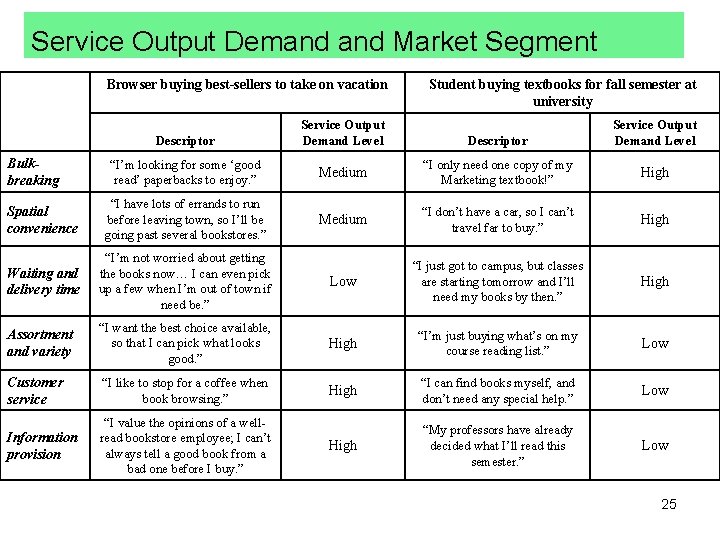
Service Output Demand Market Segment Browser buying best-sellers to take on vacation Student buying textbooks for fall semester at university Service Output Demand Level Descriptor Bulkbreaking Descriptor “I’m looking for some ‘good read’ paperbacks to enjoy. ” Medium “I only need one copy of my Marketing textbook!” High Spatial convenience “I have lots of errands to run before leaving town, so I’ll be going past several bookstores. ” Medium “I don’t have a car, so I can’t travel far to buy. ” High Waiting and delivery time “I’m not worried about getting the books now… I can even pick up a few when I’m out of town if need be. ” Low “I just got to campus, but classes are starting tomorrow and I’ll need my books by then. ” High Assortment and variety “I want the best choice available, so that I can pick what looks good. ” High “I’m just buying what’s on my course reading list. ” Low Customer service “I like to stop for a coffee when book browsing. ” High “I can find books myself, and don’t need any special help. ” Low Information provision “I value the opinions of a wellread bookstore employee; I can’t always tell a good book from a bad one before I buy. ” High “My professors have already decided what I’ll read this semester. ” Low 25
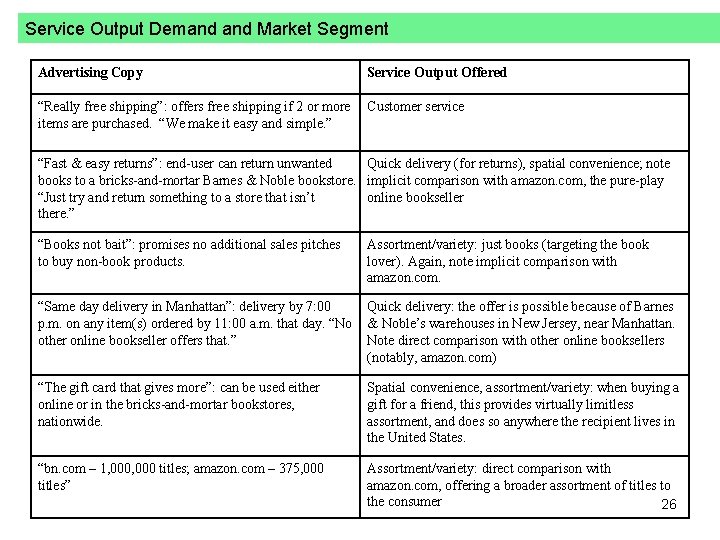
Service Output Demand Market Segment Advertising Copy Service Output Offered “Really free shipping”: offers free shipping if 2 or more items are purchased. “We make it easy and simple. ” Customer service “Fast & easy returns”: end-user can return unwanted Quick delivery (for returns), spatial convenience; note books to a bricks-and-mortar Barnes & Noble bookstore. implicit comparison with amazon. com, the pure-play “Just try and return something to a store that isn’t online bookseller there. ” “Books not bait”: promises no additional sales pitches to buy non-book products. Assortment/variety: just books (targeting the book lover). Again, note implicit comparison with amazon. com. “Same day delivery in Manhattan”: delivery by 7: 00 p. m. on any item(s) ordered by 11: 00 a. m. that day. “No other online bookseller offers that. ” Quick delivery: the offer is possible because of Barnes & Noble’s warehouses in New Jersey, near Manhattan. Note direct comparison with other online booksellers (notably, amazon. com) “The gift card that gives more”: can be used either online or in the bricks-and-mortar bookstores, nationwide. Spatial convenience, assortment/variety: when buying a gift for a friend, this provides virtually limitless assortment, and does so anywhere the recipient lives in the United States. “bn. com – 1, 000 titles; amazon. com – 375, 000 titles” Assortment/variety: direct comparison with amazon. com, offering a broader assortment of titles to the consumer 26
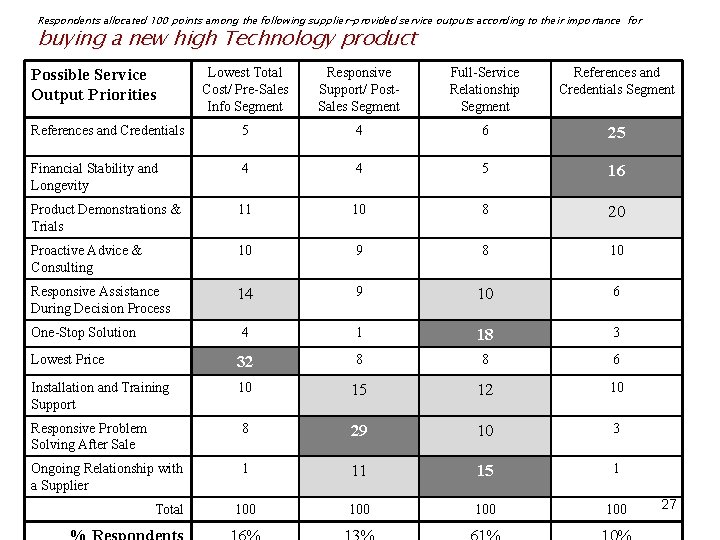
Respondents allocated 100 points among the following supplier-provided service outputs according to their importance for buying a new high Technology product Lowest Total Cost/ Pre-Sales Info Segment Responsive Support/ Post. Sales Segment Full-Service Relationship Segment References and Credentials 5 4 6 25 Financial Stability and Longevity 4 4 5 16 Product Demonstrations & Trials 11 10 8 20 Proactive Advice & Consulting 10 9 8 10 Responsive Assistance During Decision Process 14 9 10 6 4 1 18 3 Lowest Price 32 8 8 6 Installation and Training Support 10 15 12 10 Responsive Problem Solving After Sale 8 29 10 3 Ongoing Relationship with a Supplier 1 11 15 1 100 100 Possible Service Output Priorities One-Stop Solution Total 27
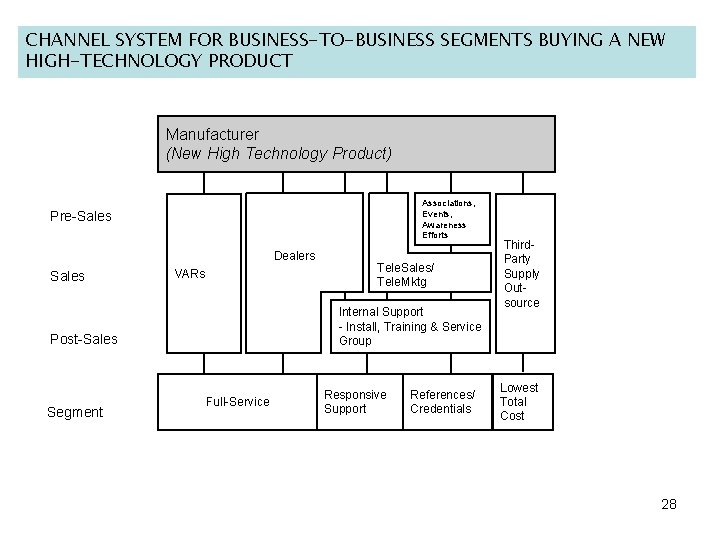
CHANNEL SYSTEM FOR BUSINESS-TO-BUSINESS SEGMENTS BUYING A NEW HIGH-TECHNOLOGY PRODUCT Manufacturer (New High Technology Product) Associations, Events, Awareness Efforts Pre-Sales Dealers Sales VARs Internal Support - Install, Training & Service Group Post-Sales Segment Tele. Sales/ Tele. Mktg Full-Service Responsive Support References/ Credentials Third. Party Supply Outsource Lowest Total Cost 28
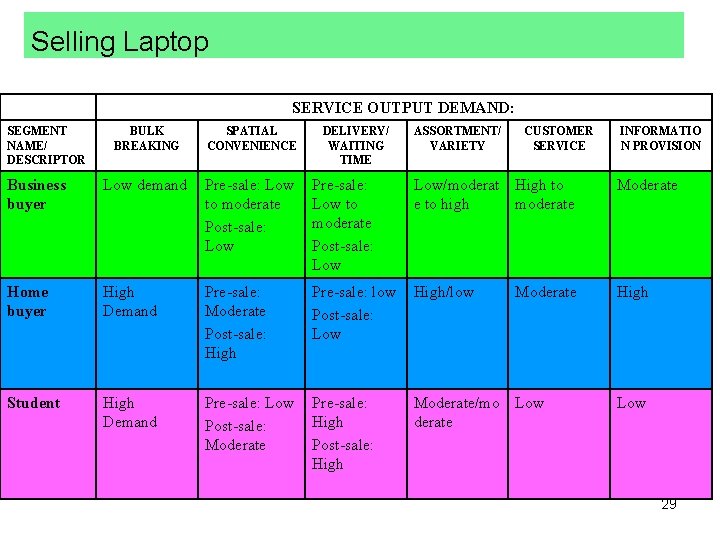
Selling Laptop SERVICE OUTPUT DEMAND: SEGMENT NAME/ DESCRIPTOR BULK BREAKING SPATIAL CONVENIENCE DELIVERY/ WAITING TIME ASSORTMENT/ VARIETY CUSTOMER SERVICE Business buyer Low demand Pre-sale: Low to moderate Post-sale: Low Low/moderat High to e to high moderate Moderate Home buyer High Demand Pre-sale: Moderate Post-sale: High Pre-sale: low Post-sale: Low High/low High Student High Demand Pre-sale: Low Post-sale: Moderate Pre-sale: High Post-sale: High Moderate/mo Low derate Moderate INFORMATIO N PROVISION Low 29
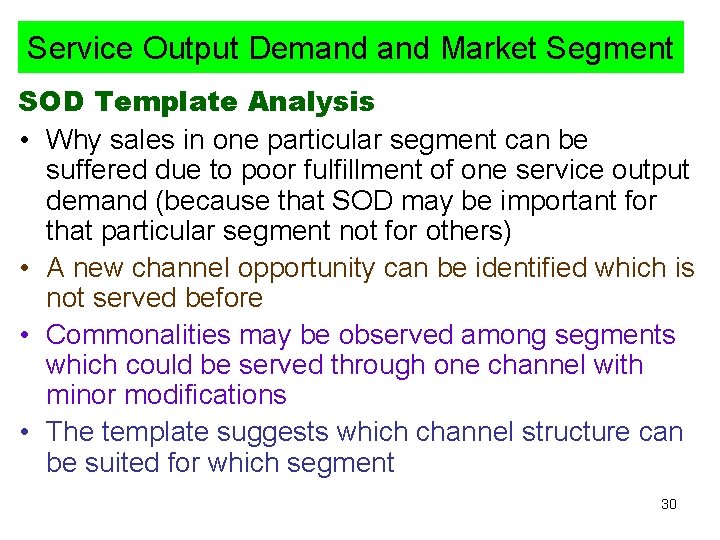
Service Output Demand Market Segment SOD Template Analysis • Why sales in one particular segment can be suffered due to poor fulfillment of one service output demand (because that SOD may be important for that particular segment not for others) • A new channel opportunity can be identified which is not served before • Commonalities may be observed among segments which could be served through one channel with minor modifications • The template suggests which channel structure can be suited for which segment 30
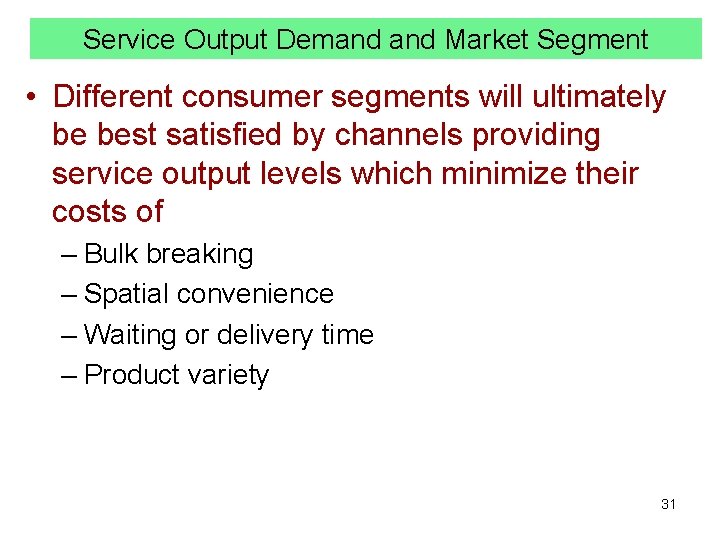
Service Output Demand Market Segment • Different consumer segments will ultimately be best satisfied by channels providing service output levels which minimize their costs of – Bulk breaking – Spatial convenience – Waiting or delivery time – Product variety 31
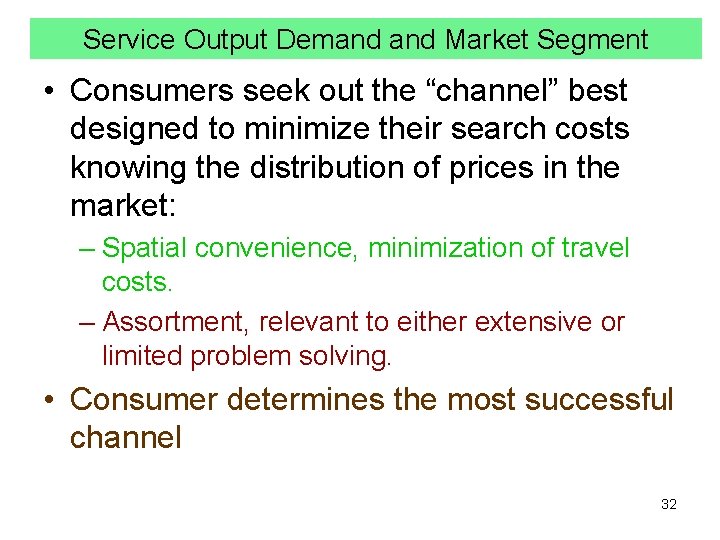
Service Output Demand Market Segment • Consumers seek out the “channel” best designed to minimize their search costs knowing the distribution of prices in the market: – Spatial convenience, minimization of travel costs. – Assortment, relevant to either extensive or limited problem solving. • Consumer determines the most successful channel 32
Service Output Demand Market Segment • Channel Manager determines needs of segment(s) and attractiveness of each group • Segment market and find service output demand for different segments • Design the distribution channel based on SOD 33
- Slides: 33