
DistributedMemory or Graph Models The sea of interconnection
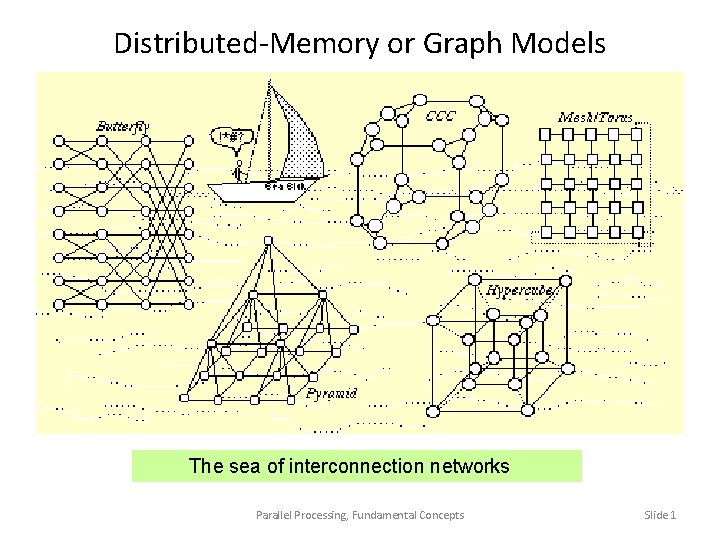
Distributed-Memory or Graph Models The sea of interconnection networks Parallel Processing, Fundamental Concepts Slide 1
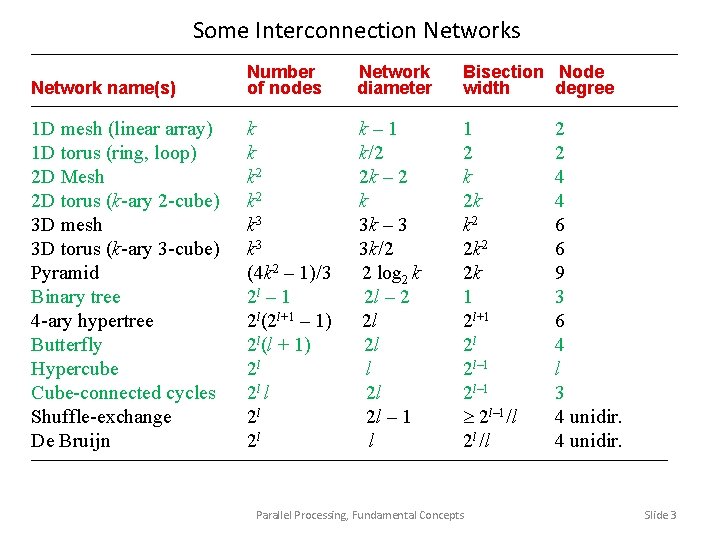
Some Interconnection Networks ––––––––––––––––––––––––––––––––– Network name(s) Number of nodes Network diameter Bisection Node width degree ––––––––––––––––––––––––––––––––– 1 D mesh (linear array) k k– 1 1 2 1 D torus (ring, loop) k k/2 2 2 2 D Mesh k 2 2 k – 2 k 4 2 D torus (k-ary 2 -cube) k 2 k 4 3 D mesh k 3 3 k – 3 k 2 6 3 D torus (k-ary 3 -cube) k 3 3 k/2 2 k 2 6 Pyramid (4 k 2 – 1)/3 2 log 2 k 2 k 9 Binary tree 2 l – 1 2 l – 2 1 3 4 -ary hypertree 2 l(2 l+1 – 1) 2 l 2 l+1 6 Butterfly 2 l(l + 1) 2 l 2 l 4 Hypercube 2 l l 2 l– 1 l Cube-connected cycles 2 l l 2 l 2 l– 1 3 Shuffle-exchange 2 l 2 l – 1 2 l– 1/l 4 unidir. De Bruijn 2 l l 2 l /l 4 unidir. –––––––––––––––––––––––––––––––– Parallel Processing, Fundamental Concepts Slide 3
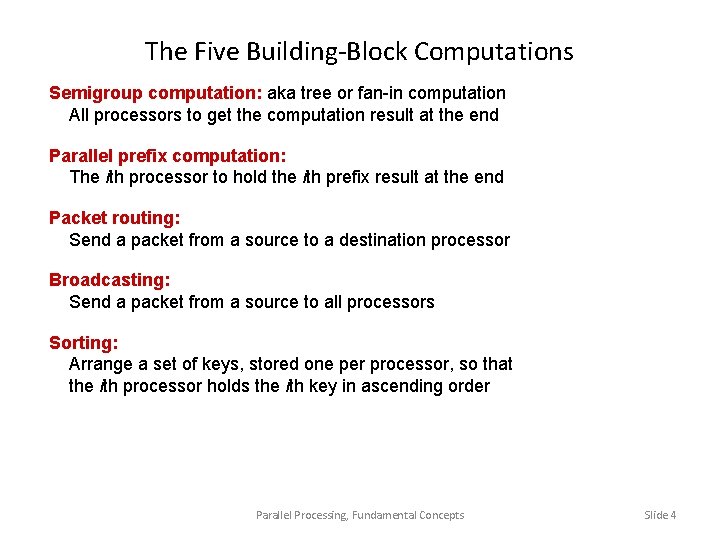
The Five Building-Block Computations Semigroup computation: aka tree or fan-in computation All processors to get the computation result at the end Parallel prefix computation: The ith processor to hold the ith prefix result at the end Packet routing: Send a packet from a source to a destination processor Broadcasting: Send a packet from a source to all processors Sorting: Arrange a set of keys, stored one per processor, so that the ith processor holds the ith key in ascending order Parallel Processing, Fundamental Concepts Slide 4
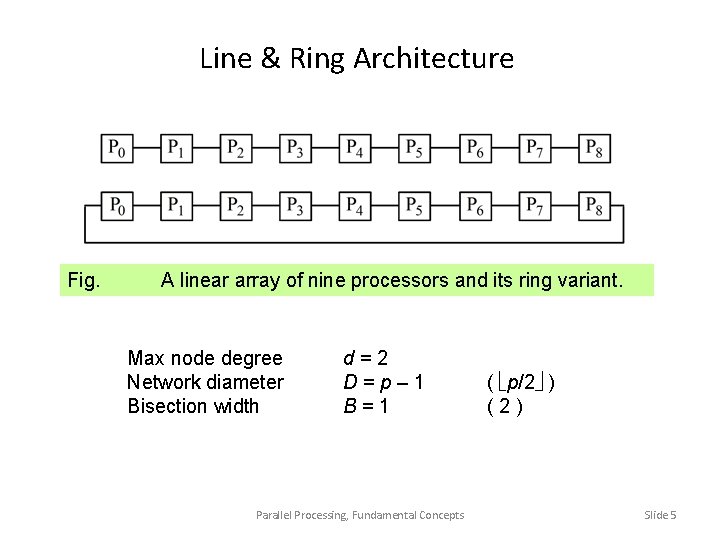
Line & Ring Architecture Fig. A linear array of nine processors and its ring variant. Max node degree Network diameter Bisection width d=2 D=p– 1 B=1 Parallel Processing, Fundamental Concepts ( p/2 ) (2) Slide 5

Two-Dimensional (2 D) Mesh Nonsquare mesh (r rows, p/r col’s) also possible Max node degree Network diameter Bisection width Fig. d=4 D = 2 p – 2 B p ( p ) ( 2 p ) 2 D mesh of 9 processors and its torus variant. Parallel Processing, Fundamental Concepts Slide 6
3 D Mesh
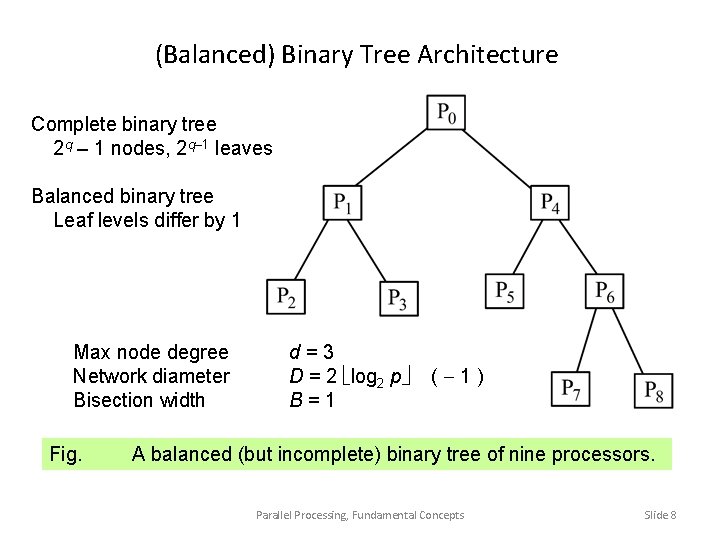
(Balanced) Binary Tree Architecture Complete binary tree 2 q – 1 nodes, 2 q– 1 leaves Balanced binary tree Leaf levels differ by 1 Max node degree Network diameter Bisection width Fig. d=3 D = 2 log 2 p B=1 (-1) A balanced (but incomplete) binary tree of nine processors. Parallel Processing, Fundamental Concepts Slide 8
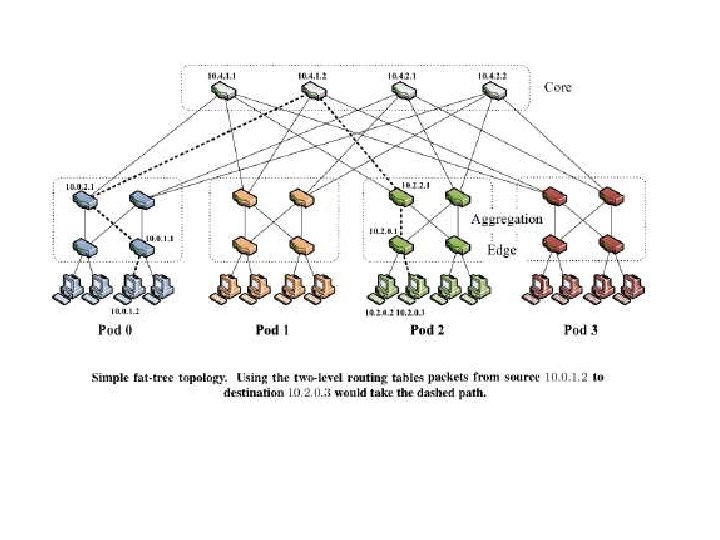
Fat-Tree (Hyper. Tree)
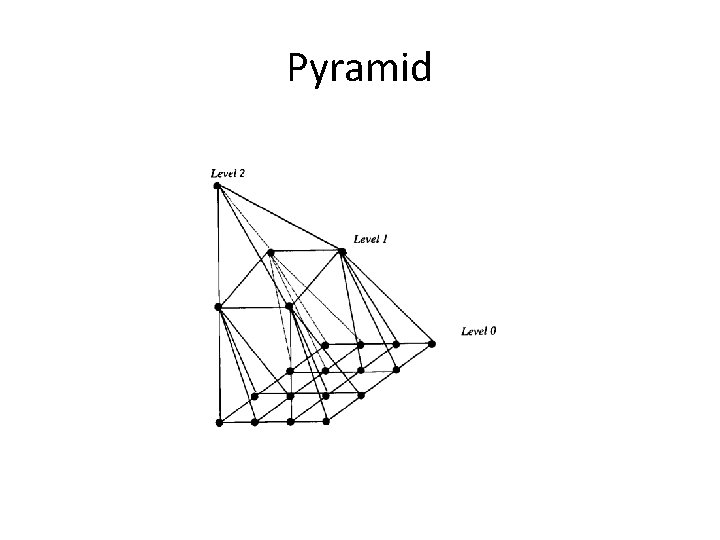
Pyramid
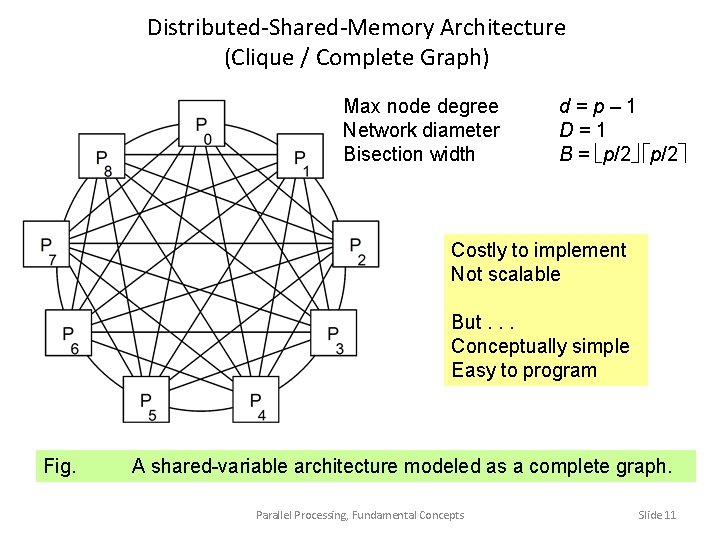
Distributed-Shared-Memory Architecture (Clique / Complete Graph) Max node degree Network diameter Bisection width d=p– 1 D=1 B = p/2 Costly to implement Not scalable But. . . Conceptually simple Easy to program Fig. A shared-variable architecture modeled as a complete graph. Parallel Processing, Fundamental Concepts Slide 11
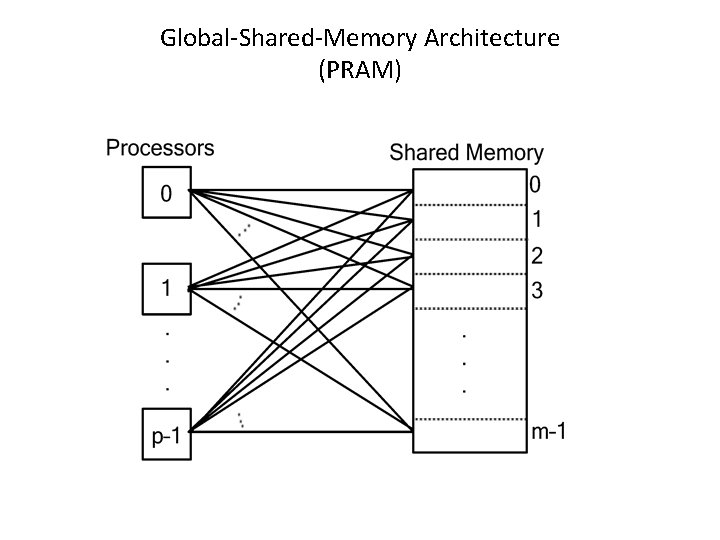
Global-Shared-Memory Architecture (PRAM)

Hyper Cube
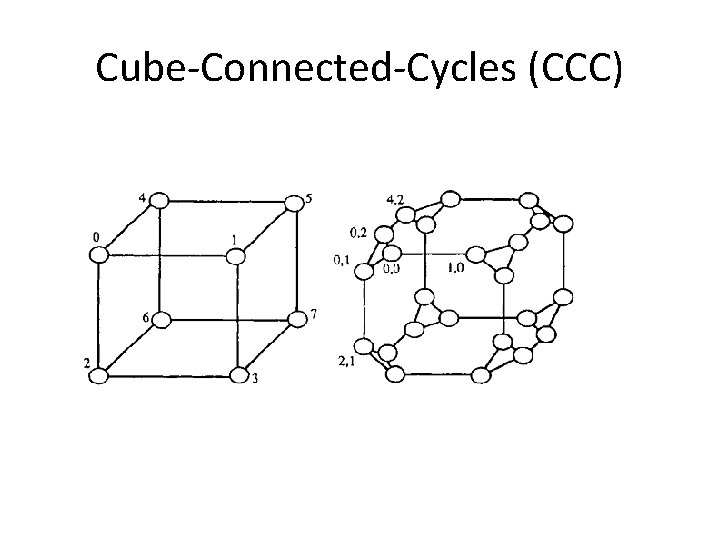
Cube-Connected-Cycles (CCC)
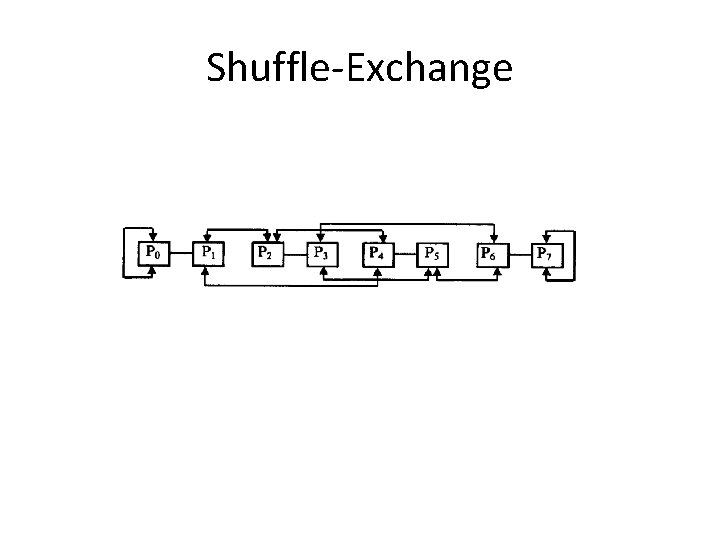
Shuffle-Exchange
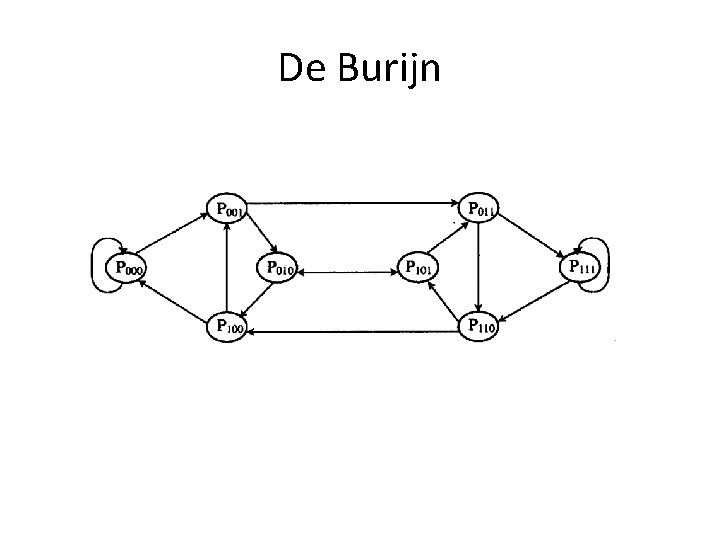
De Burijn
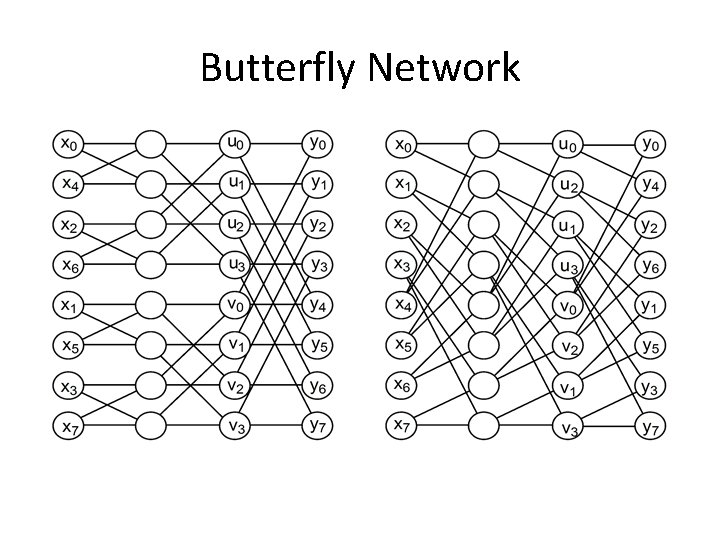
Butterfly Network
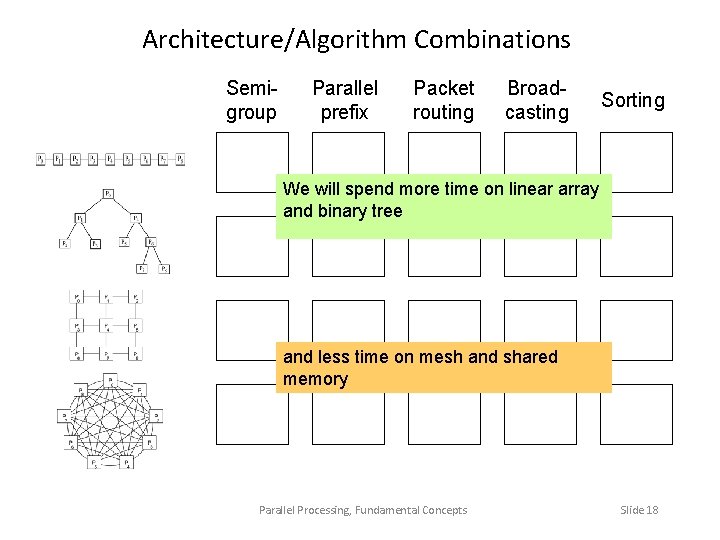
Architecture/Algorithm Combinations Semigroup Parallel prefix Packet routing Broadcasting Sorting We will spend more time on linear array and binary tree and less time on mesh and shared memory Parallel Processing, Fundamental Concepts Slide 18
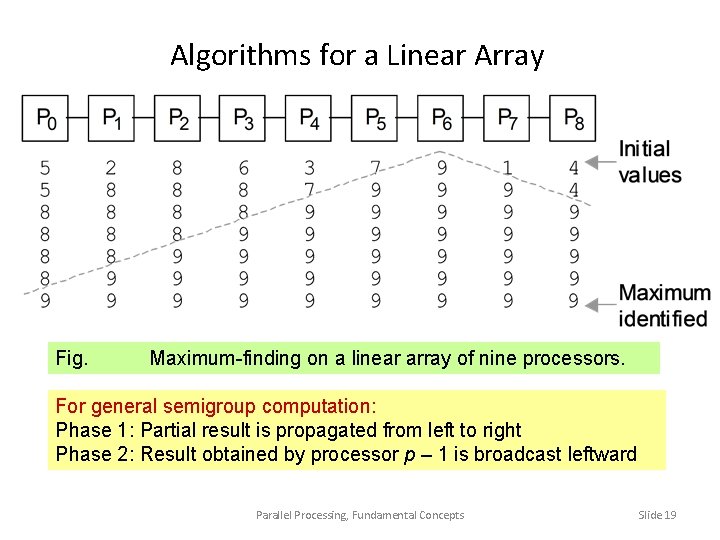
Algorithms for a Linear Array Fig. Maximum-finding on a linear array of nine processors. For general semigroup computation: Phase 1: Partial result is propagated from left to right Phase 2: Result obtained by processor p – 1 is broadcast leftward Parallel Processing, Fundamental Concepts Slide 19
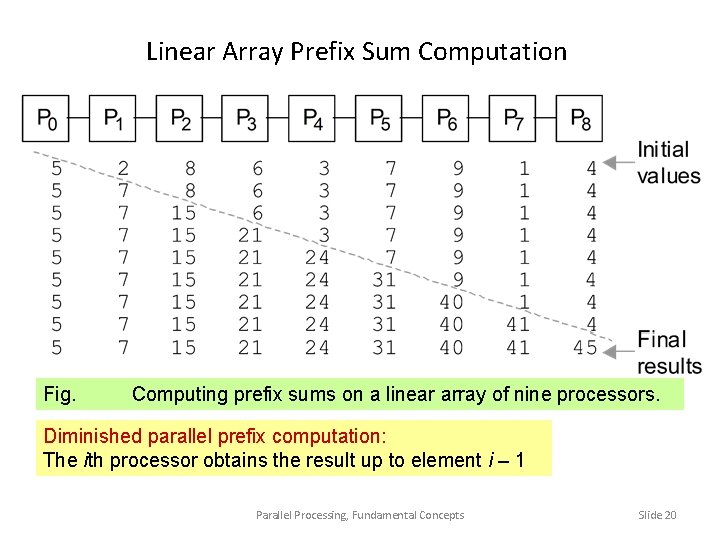
Linear Array Prefix Sum Computation Fig. Computing prefix sums on a linear array of nine processors. Diminished parallel prefix computation: The ith processor obtains the result up to element i – 1 Parallel Processing, Fundamental Concepts Slide 20
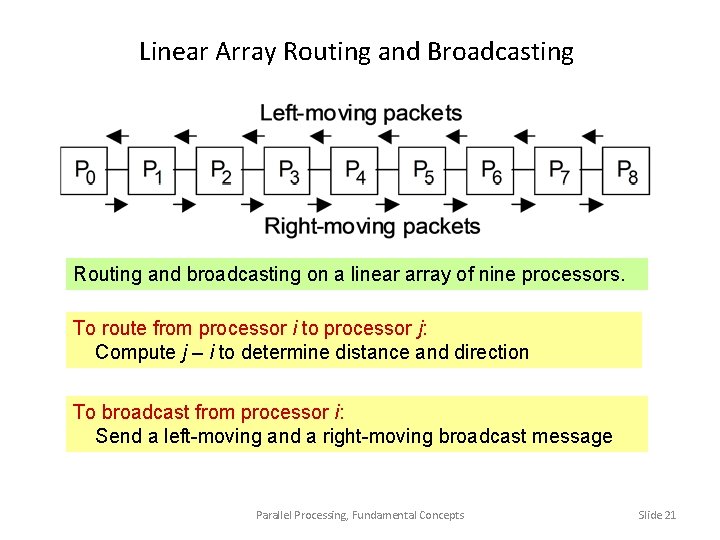
Linear Array Routing and Broadcasting Routing and broadcasting on a linear array of nine processors. To route from processor i to processor j: Compute j – i to determine distance and direction To broadcast from processor i: Send a left-moving and a right-moving broadcast message Parallel Processing, Fundamental Concepts Slide 21
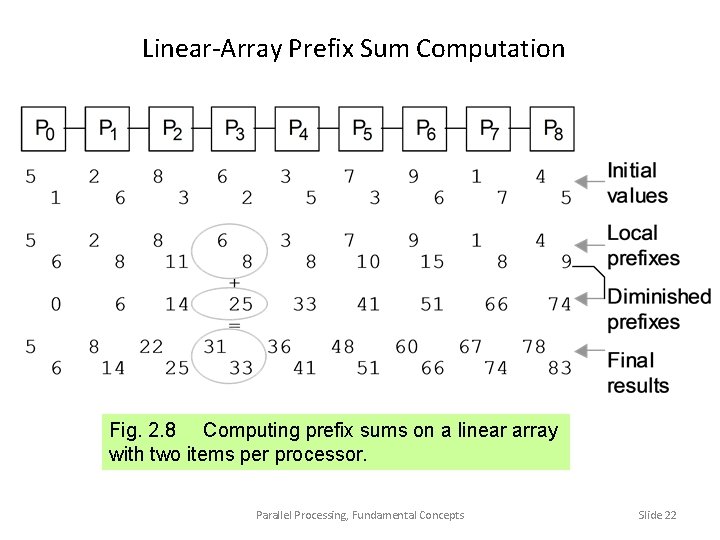
Linear-Array Prefix Sum Computation Fig. 2. 8 Computing prefix sums on a linear array with two items per processor. Parallel Processing, Fundamental Concepts Slide 22
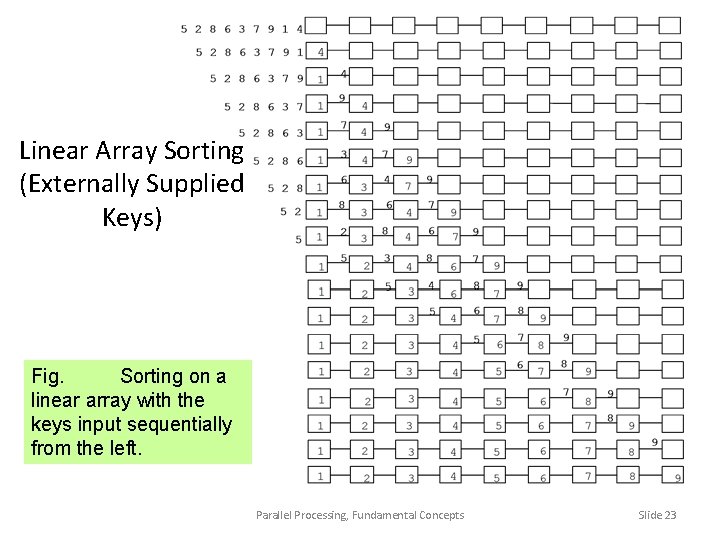
Linear Array Sorting (Externally Supplied Keys) Fig. Sorting on a linear array with the keys input sequentially from the left. Parallel Processing, Fundamental Concepts Slide 23
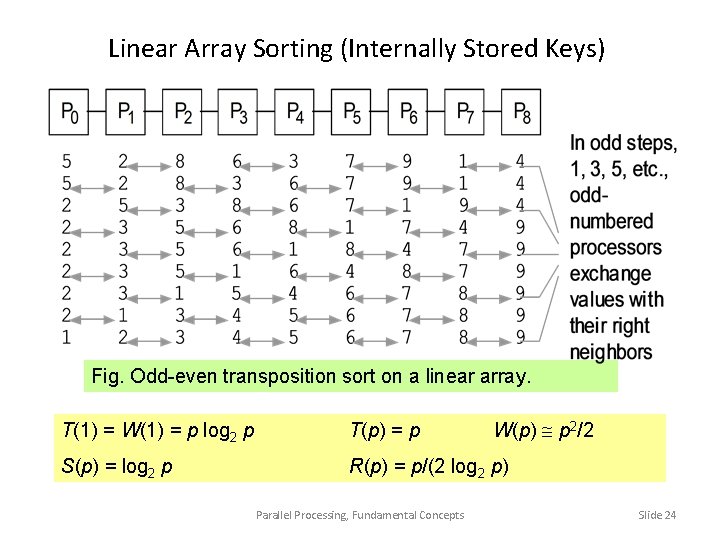
Linear Array Sorting (Internally Stored Keys) Fig. Odd-even transposition sort on a linear array. W(p) p 2/2 T(1) = W(1) = p log 2 p T(p) = p S(p) = log 2 p R(p) = p/(2 log 2 p) Parallel Processing, Fundamental Concepts Slide 24
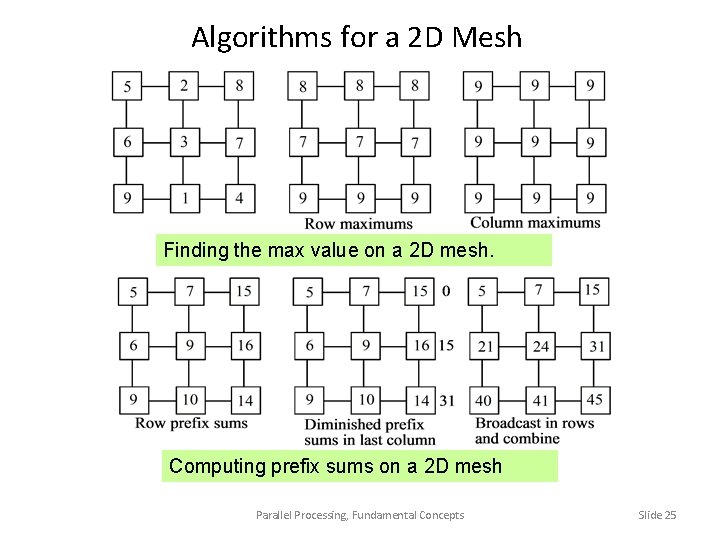
Algorithms for a 2 D Mesh Finding the max value on a 2 D mesh. Computing prefix sums on a 2 D mesh Parallel Processing, Fundamental Concepts Slide 25
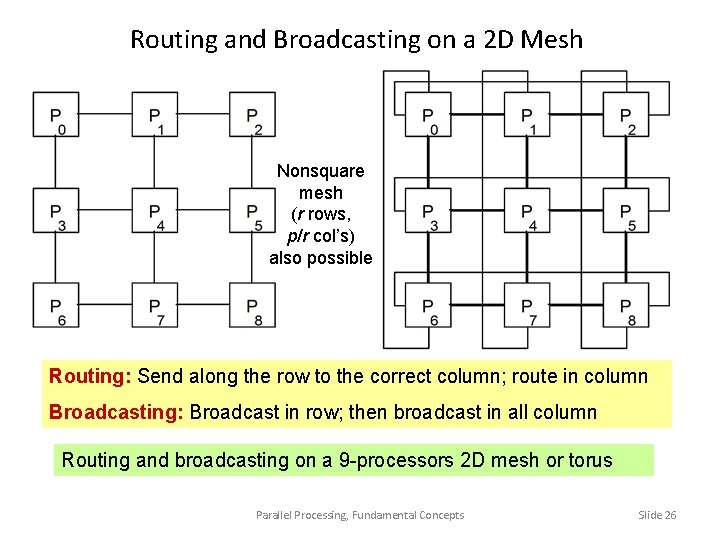
Routing and Broadcasting on a 2 D Mesh Nonsquare mesh (r rows, p/r col’s) also possible Routing: Send along the row to the correct column; route in column Broadcasting: Broadcast in row; then broadcast in all column Routing and broadcasting on a 9 -processors 2 D mesh or torus Parallel Processing, Fundamental Concepts Slide 26
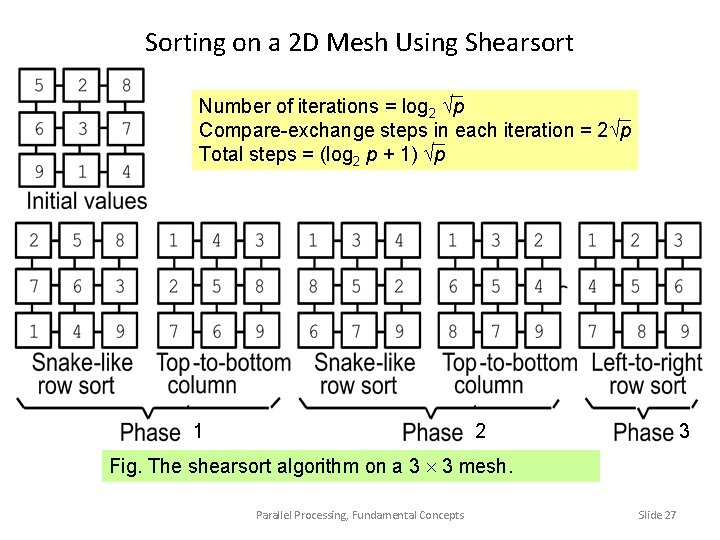
Sorting on a 2 D Mesh Using Shearsort Number of iterations = log 2 p Compare-exchange steps in each iteration = 2 p Total steps = (log 2 p + 1) p 1 2 3 Fig. The shearsort algorithm on a 3 3 mesh. Parallel Processing, Fundamental Concepts Slide 27
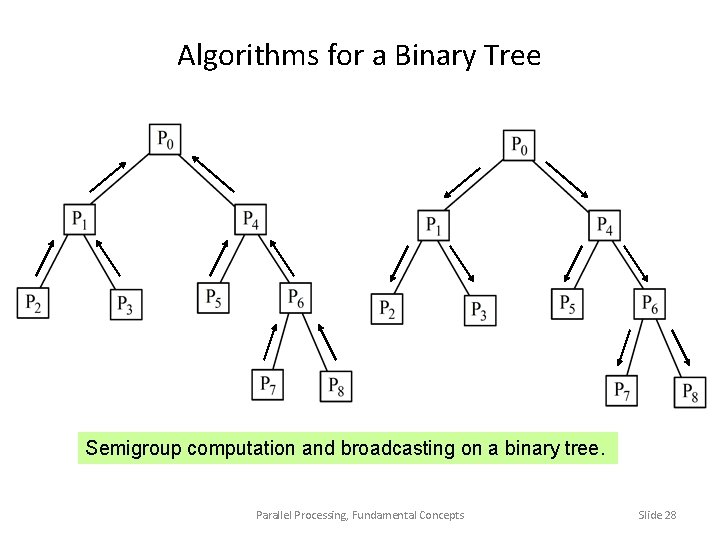
Algorithms for a Binary Tree Semigroup computation and broadcasting on a binary tree. Parallel Processing, Fundamental Concepts Slide 28
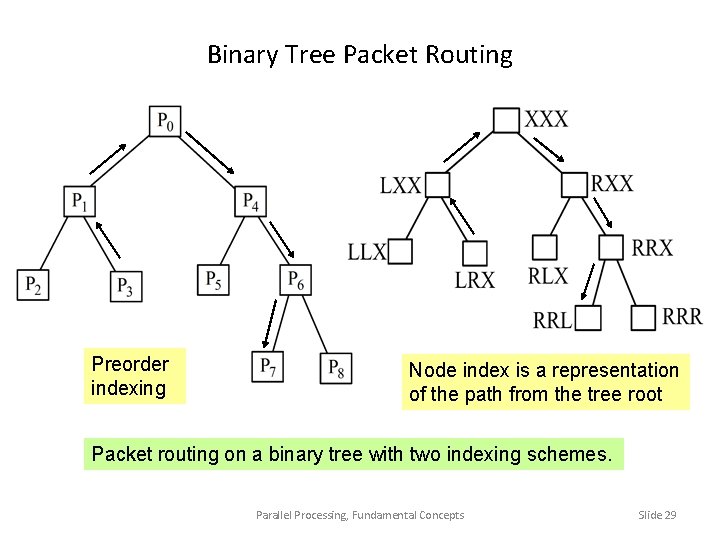
Binary Tree Packet Routing Preorder indexing Node index is a representation of the path from the tree root Packet routing on a binary tree with two indexing schemes. Parallel Processing, Fundamental Concepts Slide 29
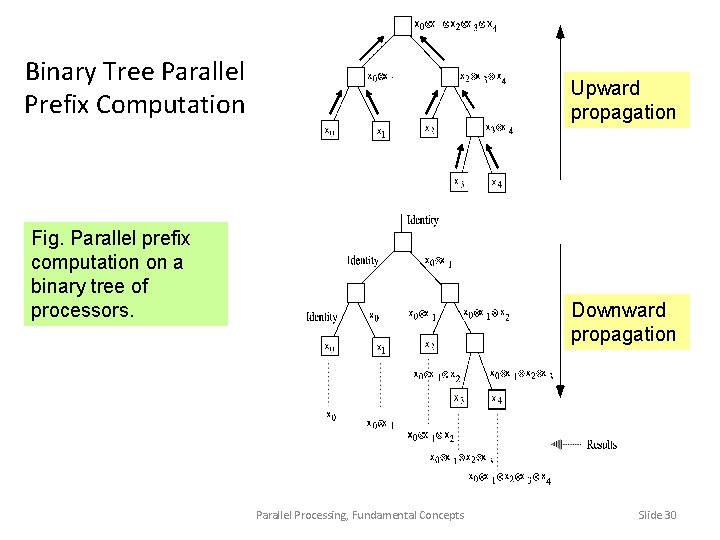
Binary Tree Parallel Prefix Computation Upward propagation Fig. Parallel prefix computation on a binary tree of processors. Downward propagation Parallel Processing, Fundamental Concepts Slide 30
![Node Function in Binary Tree Parallel Prefix [i, k] Two binary operations: one during](http://slidetodoc.com/presentation_image_h/7e02f14e0a52d5a7434fffc7e3a77e8e/image-31.jpg "Node Function in Binary Tree Parallel Prefix [i, k] Two binary operations: one during")
Node Function in Binary Tree Parallel Prefix [i, k] Two binary operations: one during the upward propagation phase, and another during downward propagation Upward propagation Insert latches for systolic operation [0, i – 1] [i, j – 1] [0, i – 1] Parallel Processing, Fundamental Concepts Downward propagation [0, j – 1] [ j, k] Slide 31
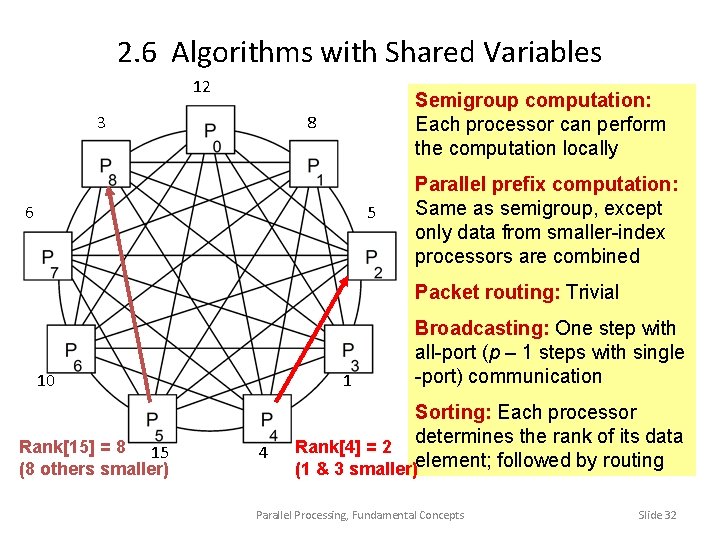
2. 6 Algorithms with Shared Variables 12 3 Semigroup computation: Each processor can perform the computation locally 8 6 5 Parallel prefix computation: Same as semigroup, except only data from smaller-index processors are combined Packet routing: Trivial 10 Rank[15] = 8 15 (8 others smaller) 1 4 Broadcasting: One step with all-port (p – 1 steps with single -port) communication Sorting: Each processor determines the rank of its data Rank[4] = 2 (1 & 3 smaller)element; followed by routing Parallel Processing, Fundamental Concepts Slide 32
- Slides: 32