
DISTRIBUTED SYSTEMS Topology of Networked Systems Communication Architecture
DISTRIBUTED SYSTEMS
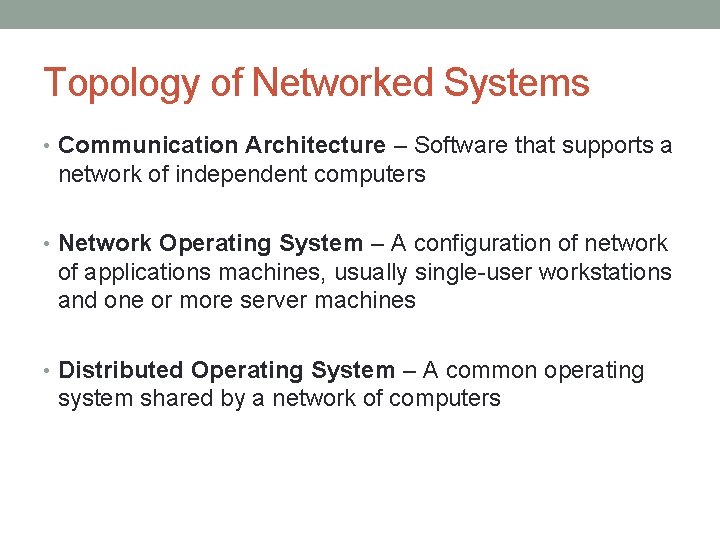
Topology of Networked Systems • Communication Architecture – Software that supports a network of independent computers • Network Operating System – A configuration of network of applications machines, usually single-user workstations and one or more server machines • Distributed Operating System – A common operating system shared by a network of computers
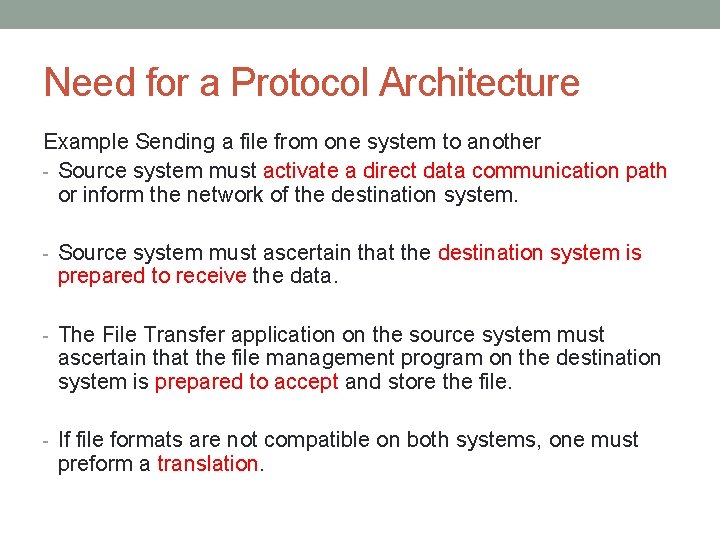
Need for a Protocol Architecture Example Sending a file from one system to another - Source system must activate a direct data communication path or inform the network of the destination system. - Source system must ascertain that the destination system is prepared to receive the data. - The File Transfer application on the source system must ascertain that the file management program on the destination system is prepared to accept and store the file. - If file formats are not compatible on both systems, one must preform a translation.
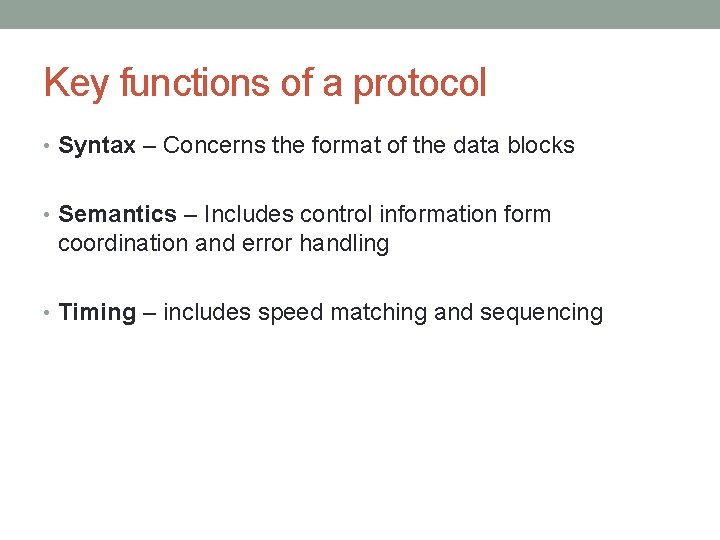
Key functions of a protocol • Syntax – Concerns the format of the data blocks • Semantics – Includes control information form coordination and error handling • Timing – includes speed matching and sequencing
TCP/IP (Transmission Control Protocol over Internet Protocol) TCP/IP is the result of protocol research and development conducted on the experimental packet-switched network, ARPANET, funded by the Defense Advanced Research Project Agency (DARPA) Note: there is no official TCP/IP protocol model as there is with OSI
TCP/IP layers • 1) Application Layer • 2) Host-to-Host (transport) Layer • 3) Internet layer • 4) Network access layer • 5) Physical layer
TCP/IP Physical Layer • Physical interface between a data transmission device (i. e. workstations, computers etc. ) and a transmission medium or network. • This layer is concerned with specifying the characteristics of the transmission medium • - the nature of the signal, • - the data rate

TCP/IP Network Access Layer • Exchange of data between end systems and the network that attaches them • Sending computer provides the • Network address • Priority • Software used depending on the network connection • X. 25 (Packet Switching) • Ethernet (local area networks)
TCP/IP Internet Layer • When data is exchanged between to different network connected to the internet, the Internet Protocol is used to communicate between networks. • A router is a processor that connects two networks and primary function is to route data between them.
TCP/IP Host-to-Host (transport) Layer • Reliable transition • Data arrives to the destination network • Data arrives in the order is was transmitted • TCP (Transmission Control Protocol) is the most commonly used protocol for this function.
TCP/IP Application Layer Logic needed to support various applications - FTP - Web browsers - games

TCP/IP concepts

TCP data units

TCP header
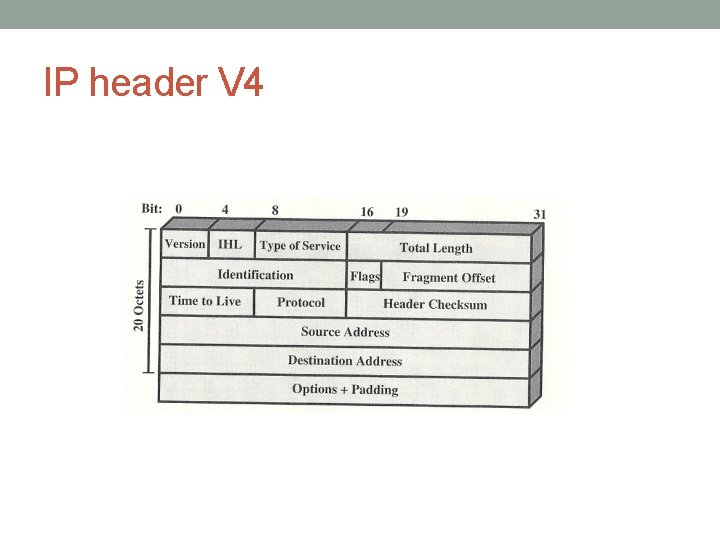
IP header V 4
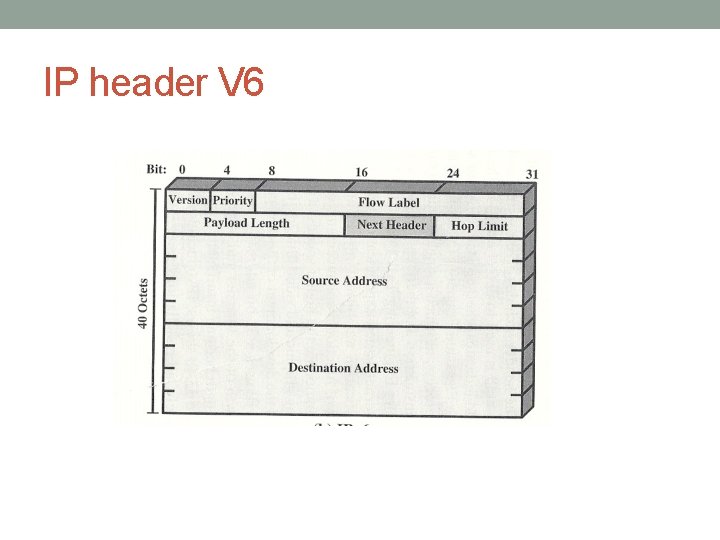
IP header V 6
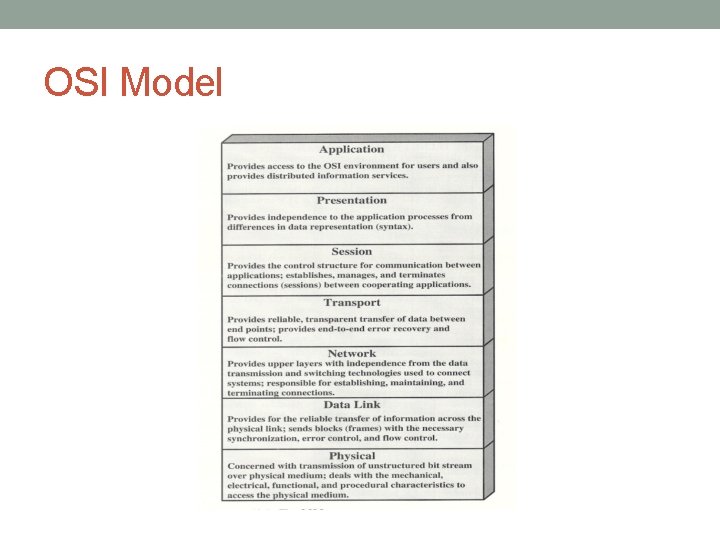
OSI Model
- Slides: 17