
Distributed Systems Time Clocks and Ordering of events
Distributed Systems Time Clocks and Ordering of events Distributed Snapshots – Determining Global States Dinesh Bhat - Advanced Systems (Some slides from 2009 class) CS 6410 – Fall 2010
Time, Clocks, and the Ordering of Events in a distributed System Leslie Lamport
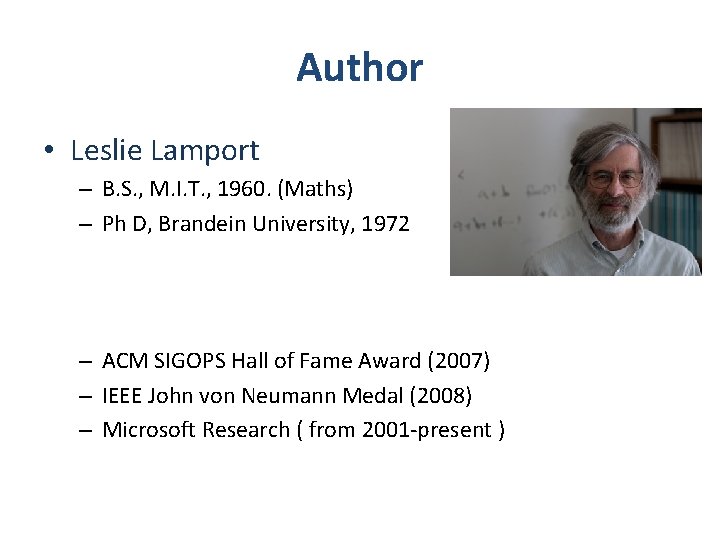
Author • Leslie Lamport – B. S. , M. I. T. , 1960. (Maths) – Ph D, Brandein University, 1972 – ACM SIGOPS Hall of Fame Award (2007) – IEEE John von Neumann Medal (2008) – Microsoft Research ( from 2001 -present )
Outline q. Introduction q. Partial Ordering of Events q. Logical Clocks and Total ordering q. Distributed algorithm: An Example q. Strong Clock Condition using Physical Clocks q. Discussion
Introduction • Defn 1 : Collection of nodes connected via network representing a single coherent system • Defn 2 : Collection of processes within a computer WHY DS ? • Resource sharing/ Load Balancing • Computation speedup • Reliability • SW/HW preference • Data access
Introduction Design issues in building a DS: • Transparency – the distributed system should appear as a conventional, centralized system to the user. • Fault tolerance – the distributed system should continue to function in the face of failure. • Failure detection – in case of asynchronous DS, its hard to differentiate between message delay Vs lost message • Scalability – as demands increase, the system should easily accept the addition of new resources to accommodate the increased demand.
Introduction Complexities in DS implementation : • Unpredictable order of events in a distributed system Problem 1 - Update A needs to occur before update B • No global clock shared by processes – if there was any, FCFS could have solved all issues of event ordering Some ordering could be implicit • Events in a single process happen in order • Message between processes must be sent before they are received WHAT IS THE SOLUTION ? ? ?
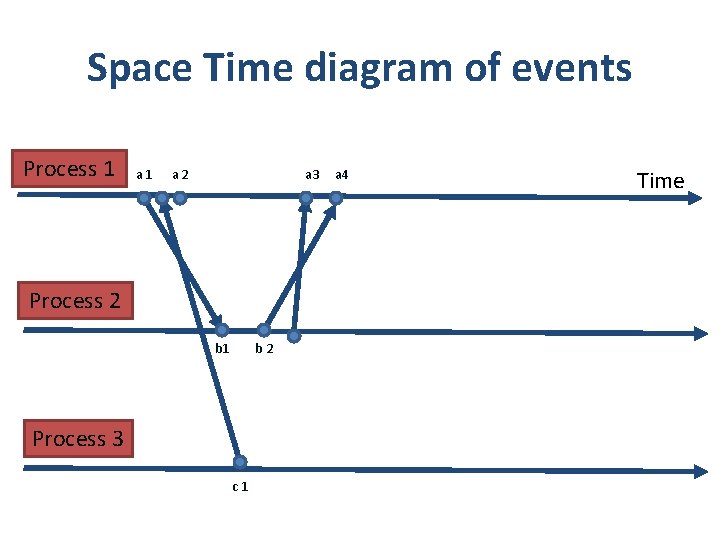
Space Time diagram of events Process 1 a 2 a 3 Process 2 b 1 b 2 Process 3 c 1 a 4 Time
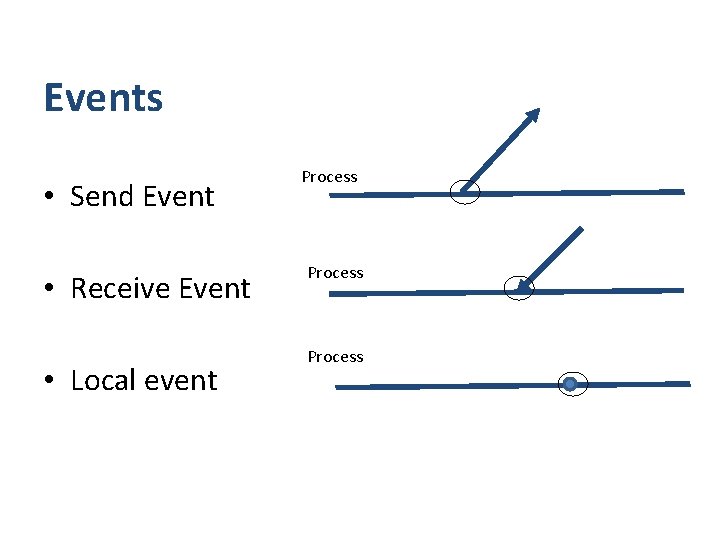
Events • Send Event • Receive Event • Local event Process
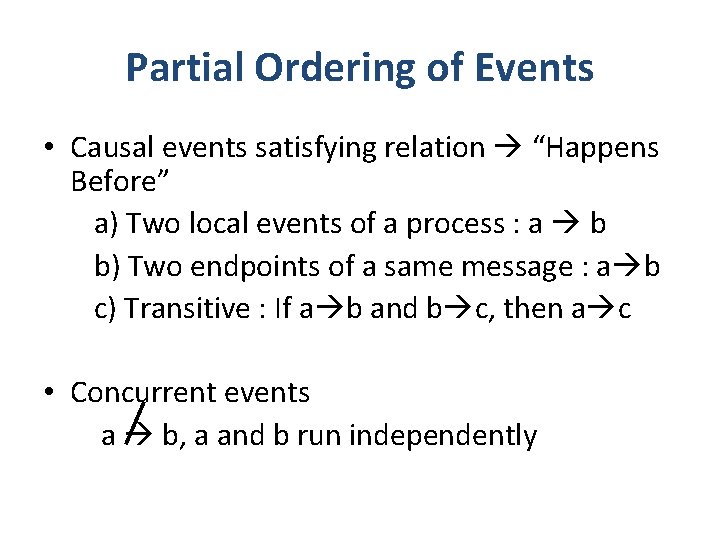
Partial Ordering of Events • Causal events satisfying relation “Happens Before” a) Two local events of a process : a b b) Two endpoints of a same message : a b c) Transitive : If a b and b c, then a c • Concurrent events a b, a and b run independently
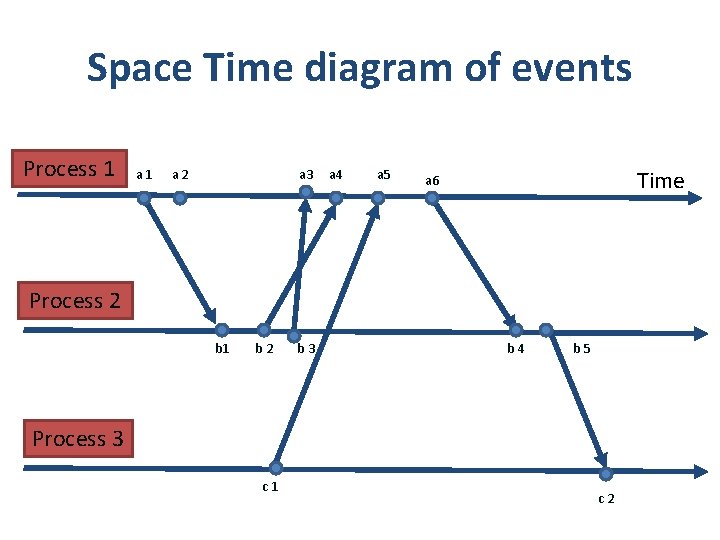
Space Time diagram of events Process 1 a 2 a 3 a 4 a 5 Time a 6 Process 2 b 1 b 2 b 3 b 4 b 5 Process 3 c 1 c 2
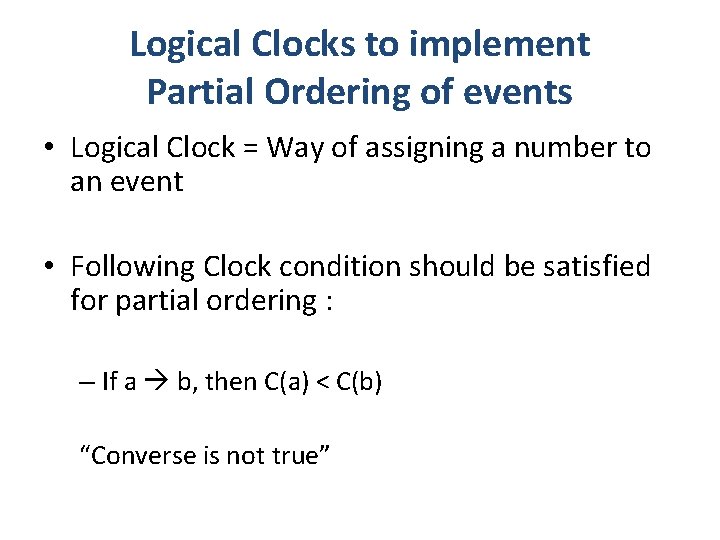
Logical Clocks to implement Partial Ordering of events • Logical Clock = Way of assigning a number to an event • Following Clock condition should be satisfied for partial ordering : – If a b, then C(a) < C(b) “Converse is not true”
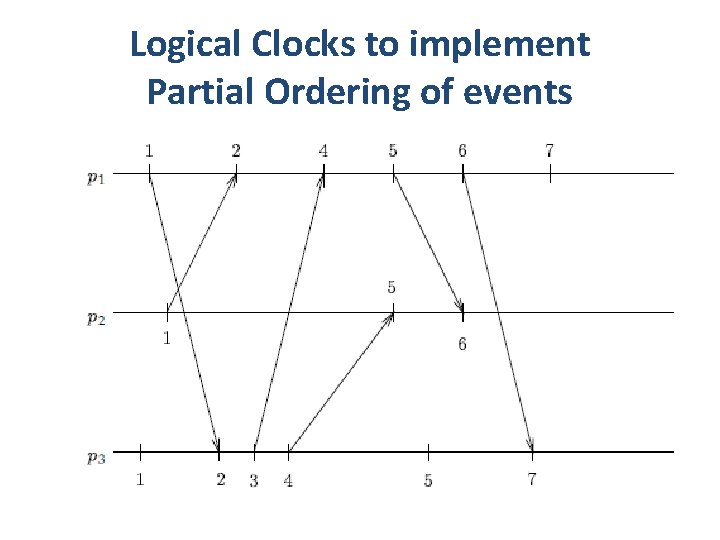
Logical Clocks to implement Partial Ordering of events
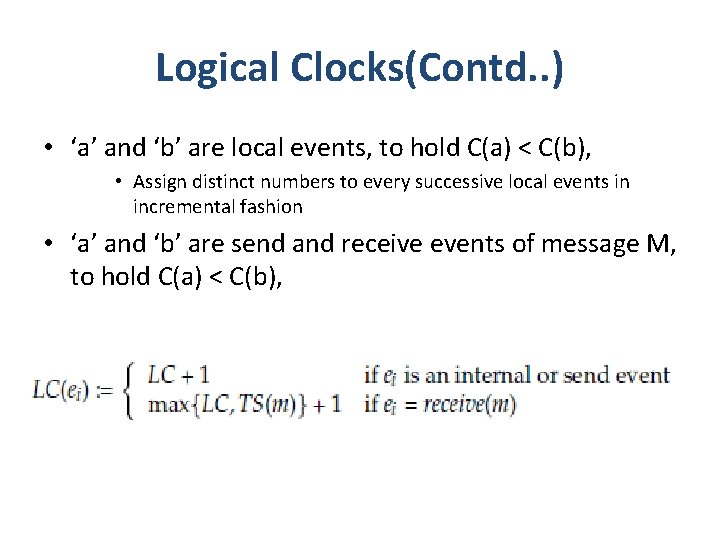
Logical Clocks(Contd. . ) • ‘a’ and ‘b’ are local events, to hold C(a) < C(b), • Assign distinct numbers to every successive local events in incremental fashion • ‘a’ and ‘b’ are send and receive events of message M, to hold C(a) < C(b),
Total ordering of events • Useful in implementing a distributed system • Logical clocks could be extended to obtain total ordering • If C(a) == C(b) && P(a) < P(b), then a => b • Example : mutual exclusion problem – Multiple processes contending for one resource
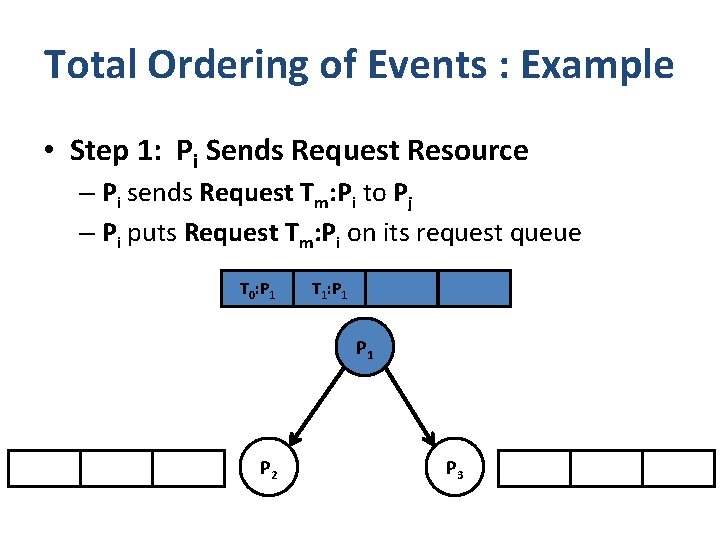
Total Ordering of Events : Example • Step 1: Pi Sends Request Resource – Pi sends Request Tm: Pi to Pj – Pi puts Request Tm: Pi on its request queue T 0: P 1 T 1: P 1 P 2 P 3
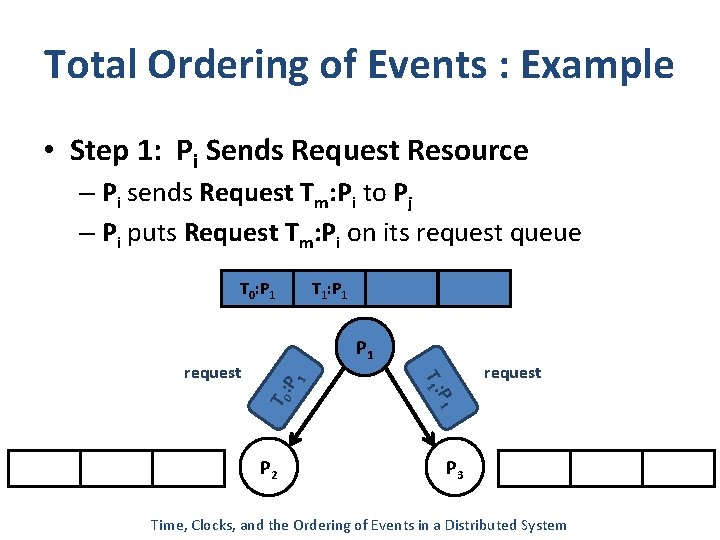
Total Ordering of Events : Example • Step 1: Pi Sends Request Resource – Pi sends Request Tm: Pi to Pj – Pi puts Request Tm: Pi on its request queue T 0: P 1 P 2 request P 1 T 0 : P 1 T 1: request T 1: P 1 P 3 Time, Clocks, and the Ordering of Events in a Distributed System
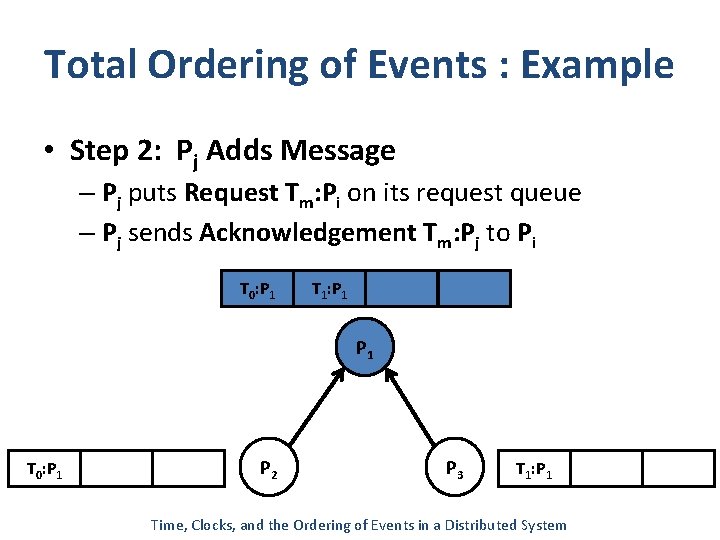
Total Ordering of Events : Example • Step 2: Pj Adds Message – Pj puts Request Tm: Pi on its request queue – Pj sends Acknowledgement Tm: Pj to Pi T 0: P 1 T 1: P 1 T 0: P 1 P 2 P 3 T 1: P 1 Time, Clocks, and the Ordering of Events in a Distributed System
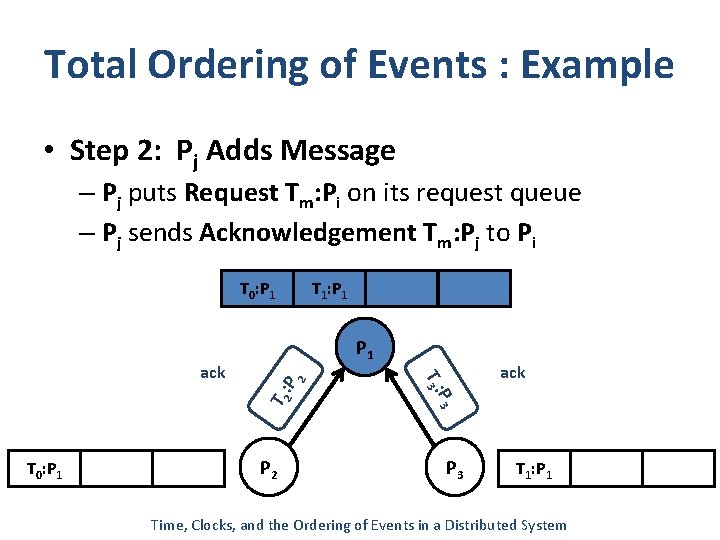
Total Ordering of Events : Example • Step 2: Pj Adds Message – Pj puts Request Tm: Pi on its request queue – Pj sends Acknowledgement Tm: Pj to Pi T 0: P 1 P 2 ack P 3 T 2 : P 2 P 1 T 3: ack T 1: P 1 P 3 T 1: P 1 Time, Clocks, and the Ordering of Events in a Distributed System
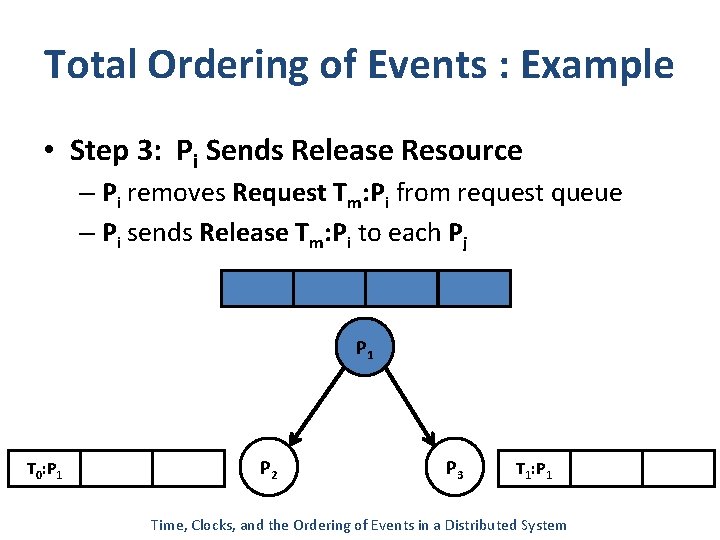
Total Ordering of Events : Example • Step 3: Pi Sends Release Resource – Pi removes Request Tm: Pi from request queue – Pi sends Release Tm: Pi to each Pj P 1 T 0: P 1 P 2 P 3 T 1: P 1 Time, Clocks, and the Ordering of Events in a Distributed System
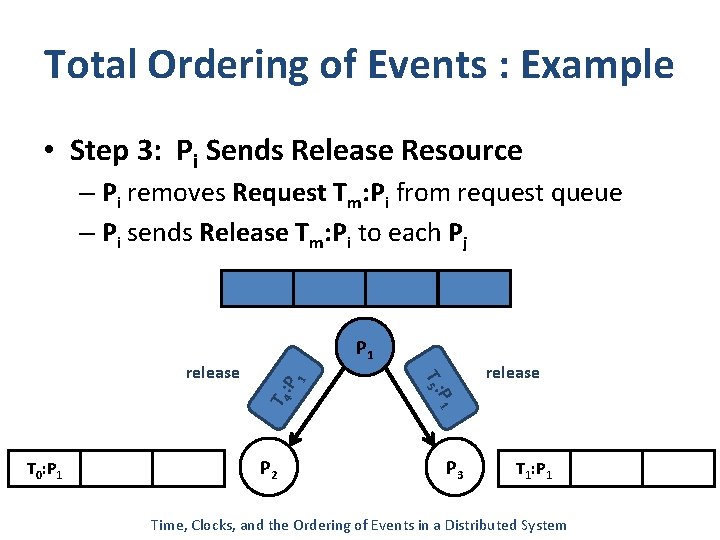
Total Ordering of Events : Example • Step 3: Pi Sends Release Resource – Pi removes Request Tm: Pi from request queue – Pi sends Release Tm: Pi to each Pj 1 P T 4 : P 2 release P 1 T 0: P 1 T 5: release P 1 P 3 T 1: P 1 Time, Clocks, and the Ordering of Events in a Distributed System
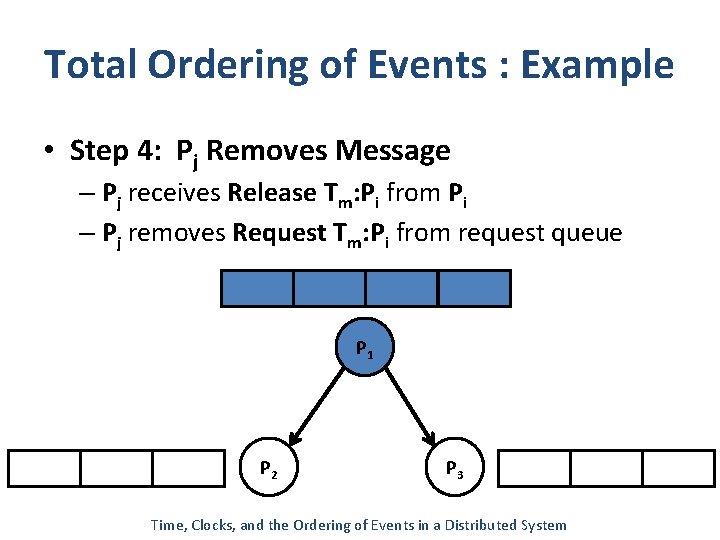
Total Ordering of Events : Example • Step 4: Pj Removes Message – Pj receives Release Tm: Pi from Pi – Pj removes Request Tm: Pi from request queue P 1 P 2 P 3 Time, Clocks, and the Ordering of Events in a Distributed System
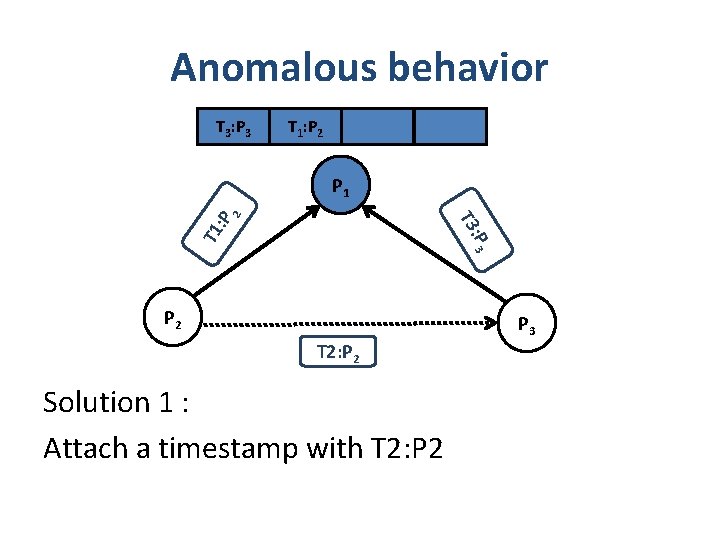
Anomalous behavior T 3: P 3 T 1: P 2 : P 3 T 1 : P T 3 2 P 1 P 2 P 3 T 2: P 2 Solution 1 : Attach a timestamp with T 2: P 2
Solution 2 : Physical Clocks • Board diagram
Discussion • Proof of concept • Defines event ordering in distributed systems • Building systems on top of Specifications, Set of assumptions ( No node failures, reliable channels ) • Logical Clock counters – overflow issues ? • Set of assumptions were strong ?
K. Mani Chandy and Leslie Lamport DISTRIBUTED SNAPSHOTS
Authors • Leslie Lamport • K Mani Chandy – Simon Ramo Professor, Cal. Tech (since 1987) – Ph D, MIT, 1969 – Honeywell, IBM, UT Austin – IEEE Koji Kobayashi Award (1987) – Event driven architecture( marketed by Avaya )
Outline q. Motivation q. Cuts and Consistent cuts q. Distributed system model q. Distributed Snapshots q. Global State Detection Algorithm q. Properties of recorded Global state q. Stability Detection
Motivation and Goals • A process in a DS determines the global state of the system which is useful in detecting stability of the system • Challenges : – Communication delay – Relative speeds of computations differ • Stable properties examples: - Computation is terminated - kth computational phase is terminated - System is deadlocked • State detection algorithm is similar to capturing panoramic view of migrating birds – Composite picture should be meaningful – Moving birds add complexity to the process
Distributed System Model • State of processes and Channels – States of processes and Channels are defined by events and messages respectively • Event e = <p, s, s’, M, c> - process p - s and s’ are states - channel c and message M
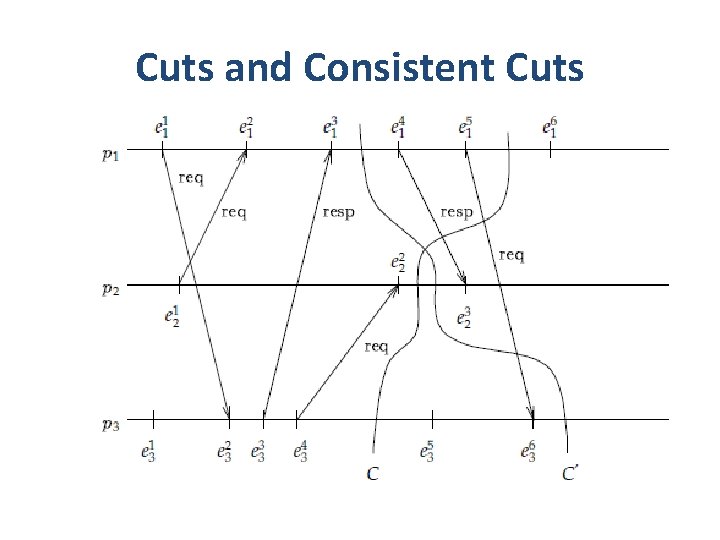
Cuts and Consistent Cuts
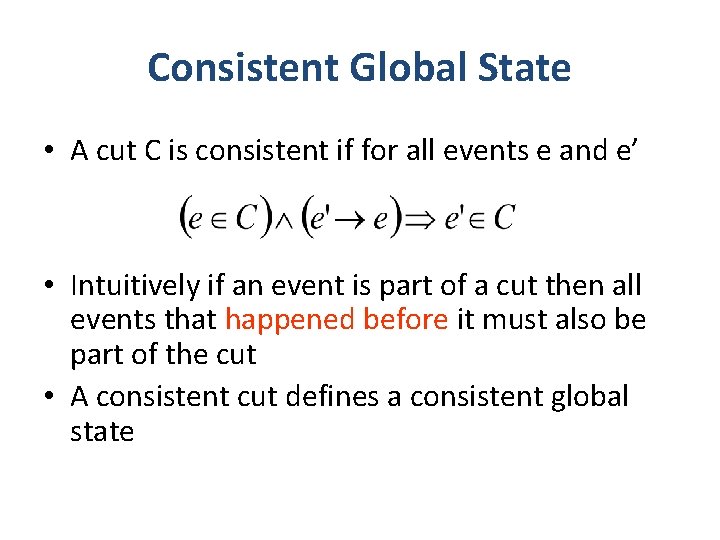
Consistent Global State • A cut C is consistent if for all events e and e’ • Intuitively if an event is part of a cut then all events that happened before it must also be part of the cut • A consistent cut defines a consistent global state
Assumptions • • Processes do not fail Reliable communication channels FIFO delivery between a pair of processes Channels have infinite buffers
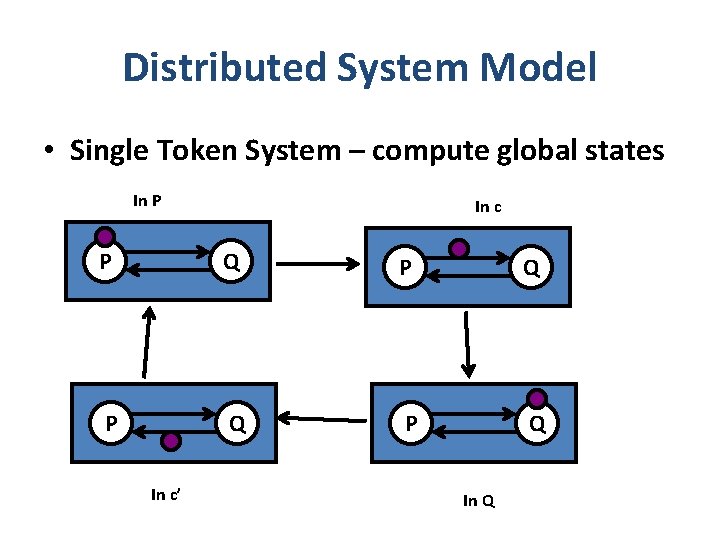
Distributed System Model • Single Token System – compute global states In P In c P Q P Q In c’ In Q
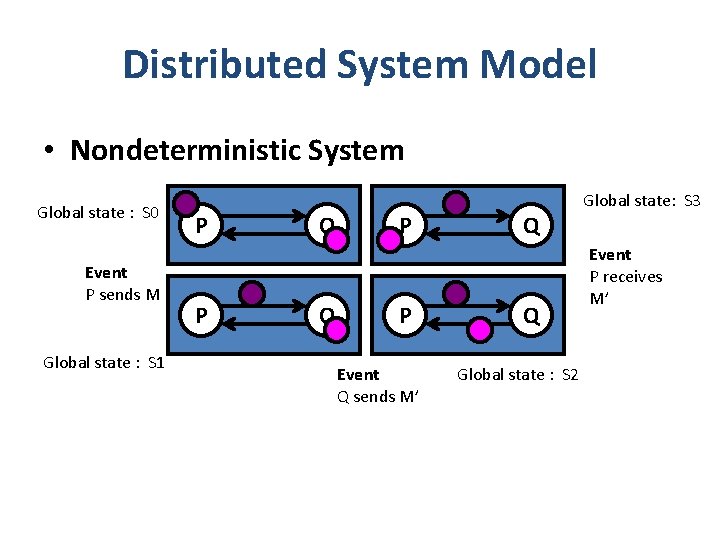
Distributed System Model • Nondeterministic System Global state : S 0 Event P sends M Global state : S 1 P P Q Q P P Event Q sends M’ Q Q Global state : S 2 Global state: S 3 Event P receives M’
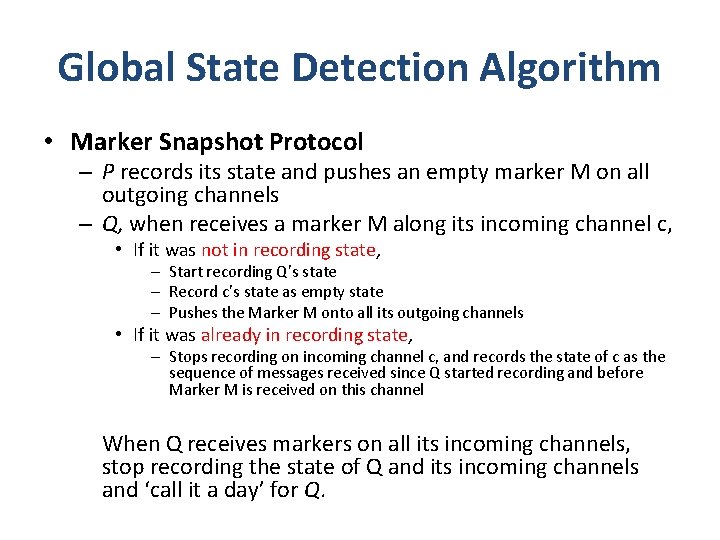
Global State Detection Algorithm • Marker Snapshot Protocol – P records its state and pushes an empty marker M on all outgoing channels – Q, when receives a marker M along its incoming channel c, • If it was not in recording state, – Start recording Q’s state – Record c’s state as empty state – Pushes the Marker M onto all its outgoing channels • If it was already in recording state, – Stops recording on incoming channel c, and records the state of c as the sequence of messages received since Q started recording and before Marker M is received on this channel When Q receives markers on all its incoming channels, stop recording the state of Q and its incoming channels and ‘call it a day’ for Q.
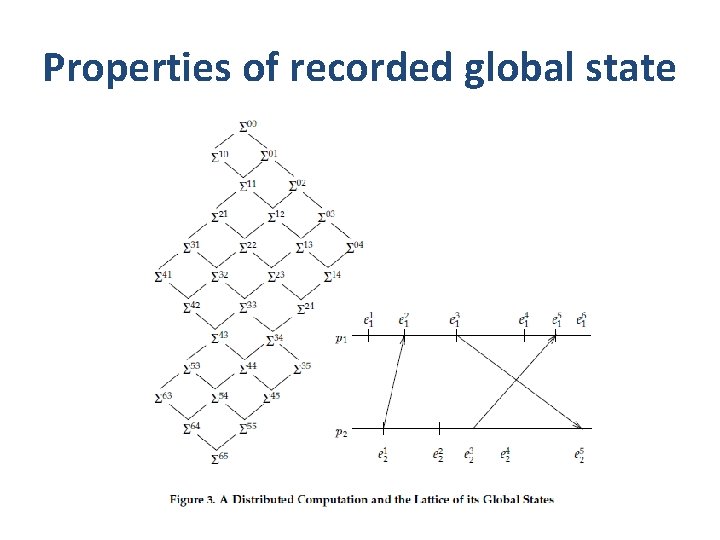
Properties of recorded global state
Stability Detection • Algorithm – Start: definite=false, y(S 0)=false – Repeat: record S*, definite=y(S*) • Implications of “definite” – definite == false: can not say YES/NO stability – definite == true: stable property at termination • Correctness – S 0 can lead to S*, S* can lead to St – for all j: y(Sj) = y(Sj+1)
Discussion ? ? ?
Other References • Wiki. Pedia • http: //www. cs. cornell. edu/courses/cs 4410/2008 fa/ • Consistent Global States of Distributed Systems: Fundamental Concepts and Mechanisms
- Slides: 40