
Distributed Systems Spring 2006 Timo Alanko Sources of
Distributed Systems Spring 2006 Timo Alanko
Sources of material • Tanenbaum, van Steen: Distributed Systems, Principles and Paradigms; Prentice Hall 2002 Web site: www. prenhall. com/tanenbaum • Coulouris, Dollimore, Kindberg: Distributed Systems, Concepts and Design; Addison-Wesley 2005 Web site: www. cdk 4. net 9/9/2020 2

Ch 1. Characterization of Distributed Systems Sources: Tanenbaum, van Steen: Ch 1 Co. Do. Ki: Ch 1, Ch 2 9/9/2020 3
Definition of a Distributed System A distributed system is a collection of independent computers that appears to its users as a single coherent system. 9/9/2020 4
Examples of Distributed Systems, 1 The Internet: net of nets ( Co. Do. Ki, Fig. 1. 1 ) – global access to “everybody” (data, service, other actor; open ended) – enormous size (open ended) – no single authority – communication types • interrogation, announcement, stream • data, audio, video 9/9/2020 5

Figure 1. 1 A typical portion of the Internet intranet ISP backbone satellite link desktop computer: server: network link: Co. Do. Ki, Fig. 1. 1 09 -Sep-20 6
Examples of Distributed Systems, 2 Intranets ( Co. Do. Ki, Fig. 1. 2) – a single authority – protected access • a firewall • total isolation – may be worldwide – typical services: • infrastructure services: file service, name service • application services 9/9/2020 7
Figure 1. 2 A typical intranet Co. Do. Ki, Fig. 1. 2 9/9/2020 8
Examples of Distributed Systems, 3 Mobile and ubiquitous computing ( Co. Do. Ki Fig 1. 3 ) • Portable devices – – laptops handheld devices wearable devices embedded in appliances • Mobile computing • Location-aware computing • Ubiquitous computing, pervasive computing 9/9/2020 9
Figure 1. 3 Portable and handheld devices in a distributed system Co. Do. Ki, Fig. 1. 3 9/9/2020 10
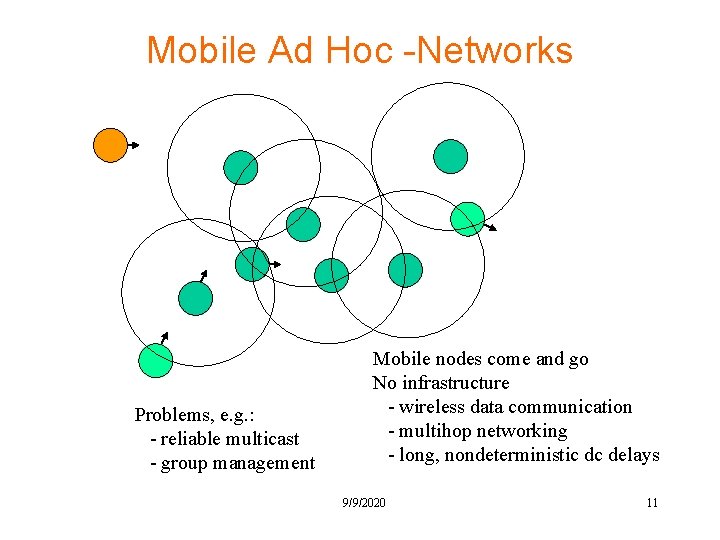
Mobile Ad Hoc -Networks Problems, e. g. : - reliable multicast - group management Mobile nodes come and go No infrastructure - wireless data communication - multihop networking - long, nondeterministic dc delays 9/9/2020 11
Resource Sharing and the Web • Hardware resources (reduce costs) • Data resources (shared usage of information) • Service resources – search engines – computer-supported cooperative working • Service vs. server (node or process ) (palvelu, palvelin, palvelija) 9/9/2020 12
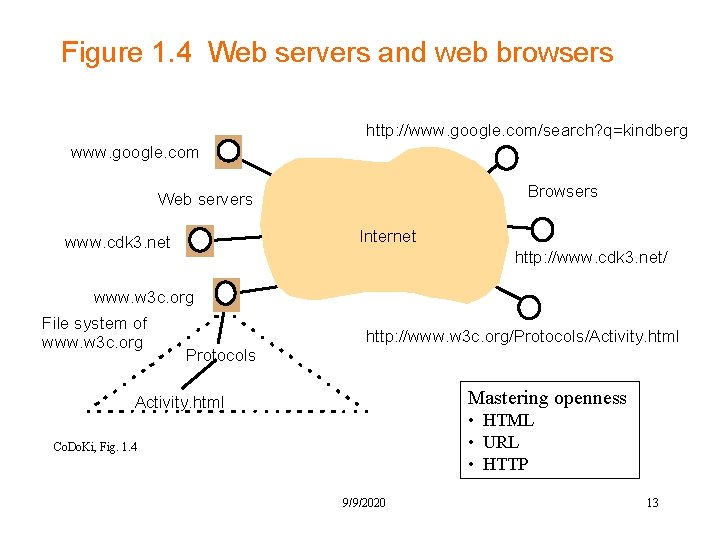
Figure 1. 4 Web servers and web browsers http: //www. google. com/search? q=kindberg www. google. com Browsers Web servers Internet www. cdk 3. net http: //www. cdk 3. net/ www. w 3 c. org File system of www. w 3 c. org Protocols http: //www. w 3 c. org/Protocols/Activity. html Mastering openness Activity. html • HTML • URL • HTTP Co. Do. Ki, Fig. 1. 4 9/9/2020 13
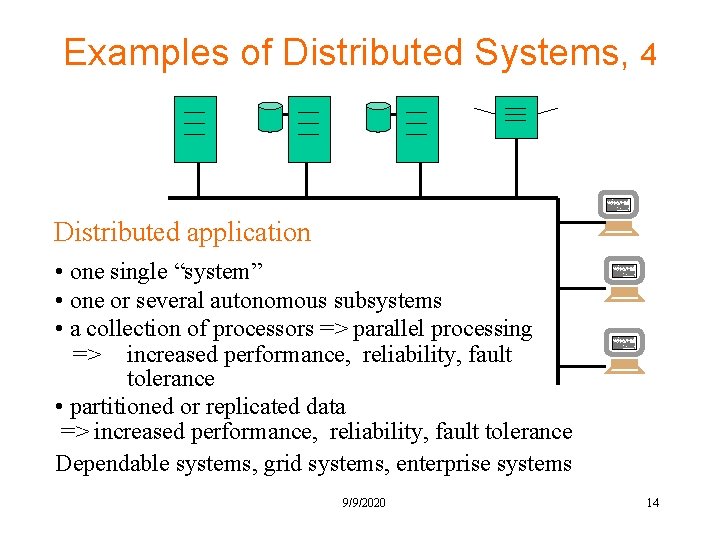
Examples of Distributed Systems, 4 Distributed application • one single “system” • one or several autonomous subsystems • a collection of processors => parallel processing => increased performance, reliability, fault tolerance • partitioned or replicated data => increased performance, reliability, fault tolerance Dependable systems, grid systems, enterprise systems 9/9/2020 14
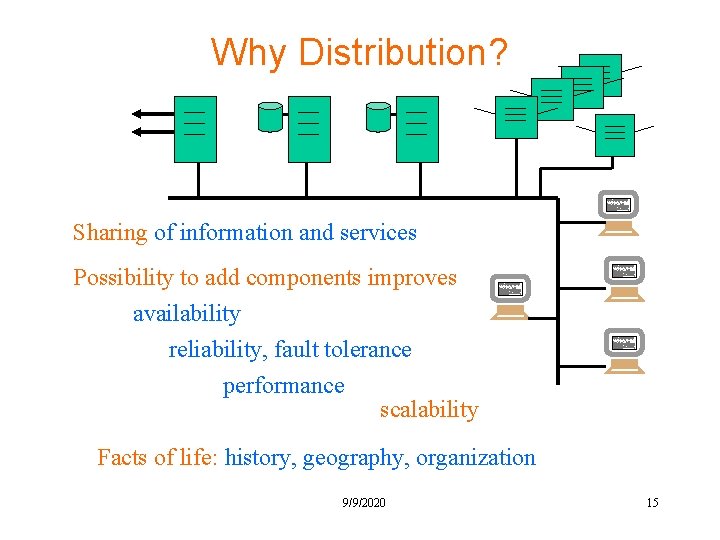
Why Distribution? Sharing of information and services Possibility to add components improves availability reliability, fault tolerance performance scalability Facts of life: history, geography, organization 9/9/2020 15
Challenges: Transparency • The fundamental idea: a collection of independent, autonomous actors • Transparency – concealment of distribution => user’s viewpoint: a single unified system 9/9/2020 16
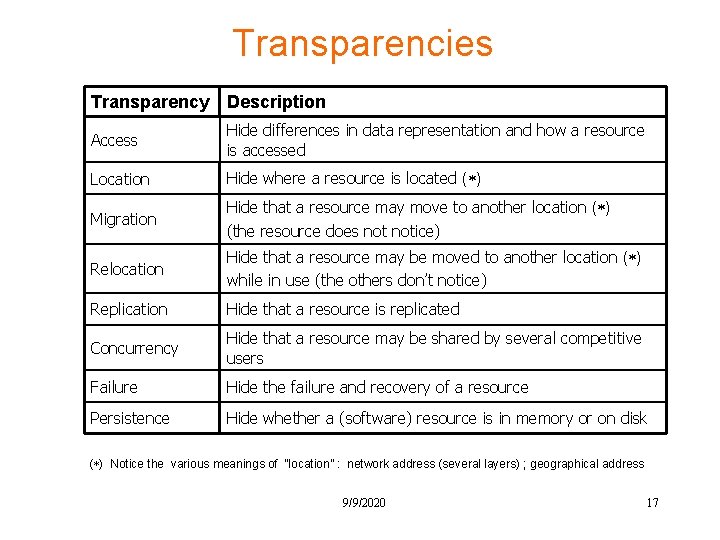
Transparencies Transparency Description Access Hide differences in data representation and how a resource is accessed Location Hide where a resource is located (*) Migration Hide that a resource may move to another location (*) (the resource does notice) Relocation Hide that a resource may be moved to another location (*) while in use (the others don’t notice) Replication Hide that a resource is replicated Concurrency Hide that a resource may be shared by several competitive users Failure Hide the failure and recovery of a resource Persistence Hide whether a (software) resource is in memory or on disk (*) Notice the various meanings of ”location” : network address (several layers) ; geographical address 9/9/2020 17
Challenges: Heterogeneity of – – – networks computer hardware operating systems programming languages implementations of different developers • Portability, interoperability • Mobile code, adaptability (applets, agents) • Middleware (CORBA etc) 9/9/2020 18
Challenges: Openness – needs • extensions: new components • re-implementations (by independent providers) – implementation • public interfaces • standardized communication protocols 9/9/2020 19
Challenges: Scalability The system will remain effective when there is a significant increase in – – number of resources number of users 1) 2) The architecture and the implementation must allow it The algorithms must be efficient under the circumstances to be expected Example: the Internet 9/9/2020 20
Challenges: Scalability (cont. ) • • => § § Controlling the cost of physical resources Controlling performance loss Preventing software resources running out Avoiding performance bottlenecks Mechanisms to implement functions Policies: how to use the mechanisms 9/9/2020 21
Challenges: Failure Handling • More components => increased fault rate • Increased possibilities – more redundancy => more possibilities for fault tolerance – no centralized control => no fatal failure • Issues – – – Detecting failures Masking failures Recovery from failures Tolerating failures Redundancy • New: partial failures 9/9/2020 22
Challenges: Concurrency: – Several simultaneous users => integrity of data • • • – – – mutual exclusion synchronization ext: transaction processing in data bases Replicated data: consistency of information? Partitioned data: how to determine the state of the system? Order of messages? There is no global clock! 9/9/2020 23
Consistency Maintenance • • • Update. . . Replication. . . Cache. . . Failure. . . Clock. . . User interface. . . . consistency 9/9/2020 24
Challenges: Security • Security: confidentiality, integrity, availability • Vulnerable components (Fig. 2. 14) – channels (links <–> end-to-end paths) – processes (clients, servers, outsiders) • Threats – – information leakage integrity violation denial of service illegitimate usage Current issues: denial-of-service attacks, security of mobile code, information flow; open wireless ad-hoc environments 9/9/2020 25
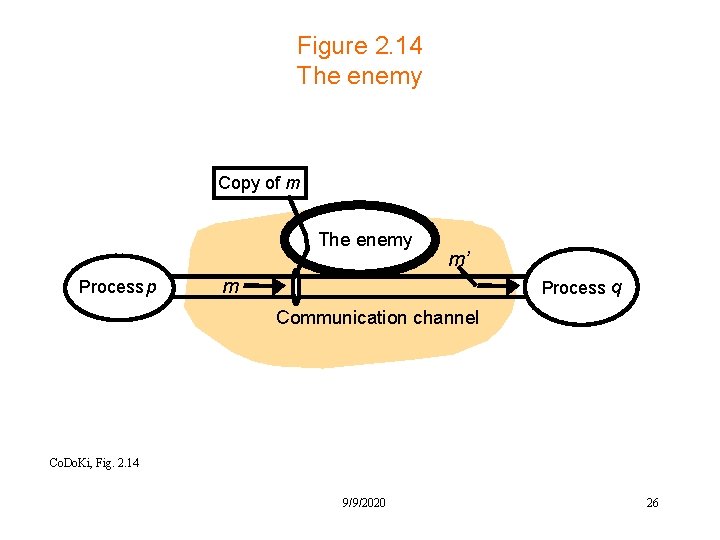
Figure 2. 14 The enemy Copy of m The enemy Process p m’ m Process q Communication channel Co. Do. Ki, Fig. 2. 14 9/9/2020 26
Threats • Threats to channels (Fig. 2. 14) – – eavesdropping (data, traffic) tampering, replaying masquerading denial of service • Threats to processes (Fig. 2. 13) – server: client’s identity; client: server’s identity – unauthorized access (insecure access model) – unauthorized information flow (insecure flow model) 9/9/2020 27
Figure 2. 13 Objects and principals Co. Do. Ki, Fig. 2. 13 9/9/2020 28
Defeating Security Threats • Techniques – cryptography – authentication – access control techniques • intranet: firewalls • services, objects: access control lists, capabilities • Policies – access control models – lattice models – information flow models => secure channels, secure processes, controlled access, controlled flows 9/9/2020 29
Environments A distributed system: • HW / SW components in different nodes • components communicate (using messages) • components coordinate actions (using messages) Distances between nodes vary • in time: from msecs to weeks • in space: from mm’s to Mm’s • in dependability Autonomous independent actors (=> even independent failures!) No global clock 9/9/2020 30
Design Requirements • Performance issues – – responsiveness throughput new: load sharing, load balancing issue: algorithm vs behavior • Quality of service – – – correctness (in nondeterministic environments) reliability, availability, fault tolerance security performance adaptability 9/9/2020 31
- Slides: 31