
DISTRIBUTED SYSTEMS Principles and Paradigms Second Edition ANDREW
DISTRIBUTED SYSTEMS Principles and Paradigms Second Edition ANDREW S. TANENBAUM MAARTEN VAN STEEN Chapter 1 Introduction Tanenbaum & Van Steen, Distributed Systems: Principles and Paradigms, 2 e, (c) 2007 Prentice-Hall, Inc. All rights reserved. 0 -13 -239227 -5
Definition of a Distributed System (1) A distributed system is: A collection of independent computers that appears to its users as a single coherent system. Tanenbaum & Van Steen, Distributed Systems: Principles and Paradigms, 2 e, (c) 2007 Prentice-Hall, Inc. All rights reserved. 0 -13 -239227 -5
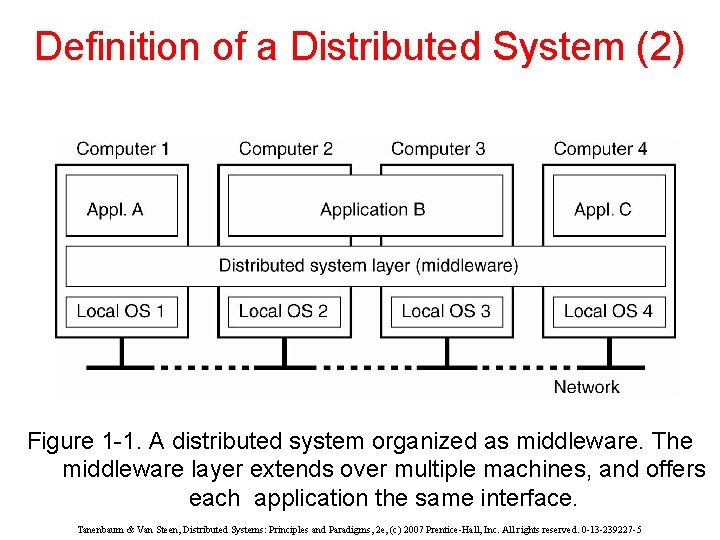
Definition of a Distributed System (2) Figure 1 -1. A distributed system organized as middleware. The middleware layer extends over multiple machines, and offers each application the same interface. Tanenbaum & Van Steen, Distributed Systems: Principles and Paradigms, 2 e, (c) 2007 Prentice-Hall, Inc. All rights reserved. 0 -13 -239227 -5
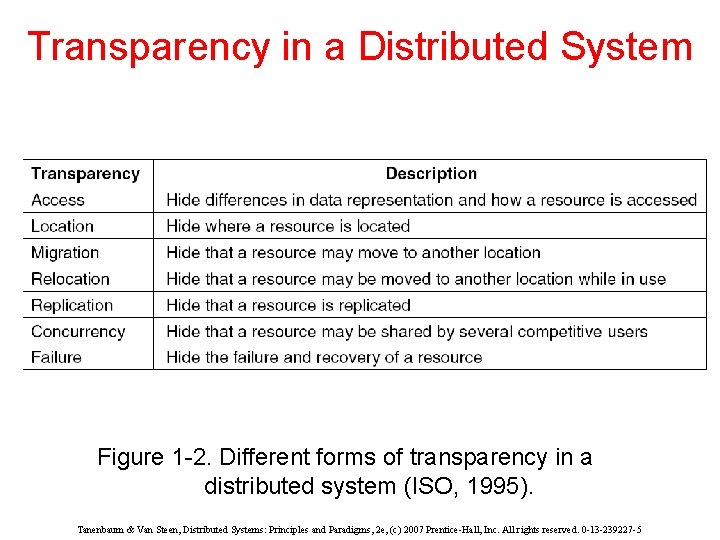
Transparency in a Distributed System Figure 1 -2. Different forms of transparency in a distributed system (ISO, 1995). Tanenbaum & Van Steen, Distributed Systems: Principles and Paradigms, 2 e, (c) 2007 Prentice-Hall, Inc. All rights reserved. 0 -13 -239227 -5

Scalability Problems Figure 1 -3. Examples of scalability limitations. Tanenbaum & Van Steen, Distributed Systems: Principles and Paradigms, 2 e, (c) 2007 Prentice-Hall, Inc. All rights reserved. 0 -13 -239227 -5
Scalability Problems Characteristics of decentralized algorithms: • No machine has complete information about the system state. • Machines make decisions based only on local information. • Failure of one machine does not ruin the algorithm. • There is no implicit assumption that a global clock exists. Tanenbaum & Van Steen, Distributed Systems: Principles and Paradigms, 2 e, (c) 2007 Prentice-Hall, Inc. All rights reserved. 0 -13 -239227 -5
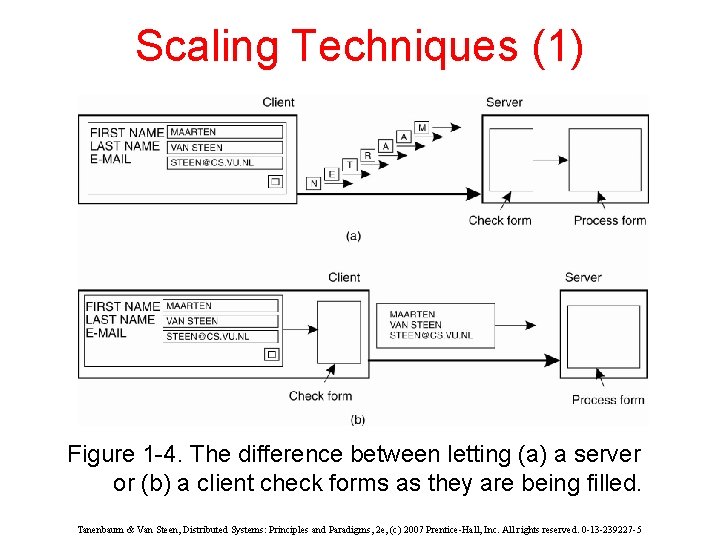
Scaling Techniques (1) Figure 1 -4. The difference between letting (a) a server or (b) a client check forms as they are being filled. Tanenbaum & Van Steen, Distributed Systems: Principles and Paradigms, 2 e, (c) 2007 Prentice-Hall, Inc. All rights reserved. 0 -13 -239227 -5
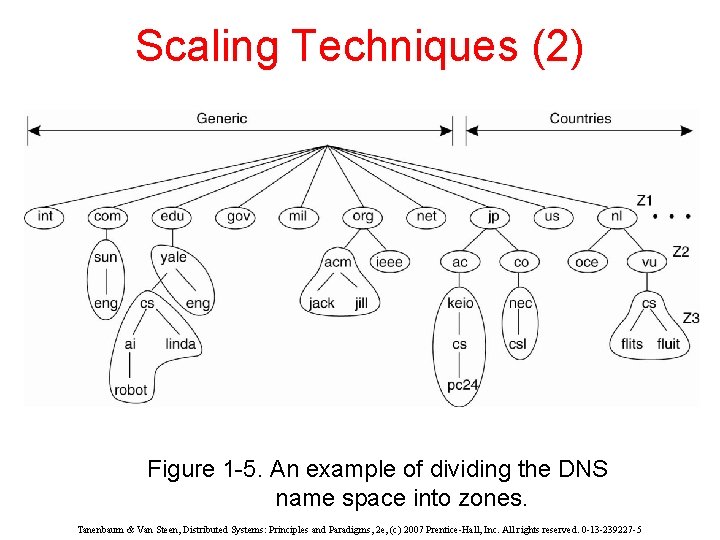
Scaling Techniques (2) Figure 1 -5. An example of dividing the DNS name space into zones. Tanenbaum & Van Steen, Distributed Systems: Principles and Paradigms, 2 e, (c) 2007 Prentice-Hall, Inc. All rights reserved. 0 -13 -239227 -5
Pitfalls when Developing Distributed Systems False assumptions made by first time developer: • The network is reliable. • The network is secure. • The network is homogeneous. • The topology does not change. • Latency is zero. • Bandwidth is infinite. • Transport cost is zero. • There is one administrator. Tanenbaum & Van Steen, Distributed Systems: Principles and Paradigms, 2 e, (c) 2007 Prentice-Hall, Inc. All rights reserved. 0 -13 -239227 -5
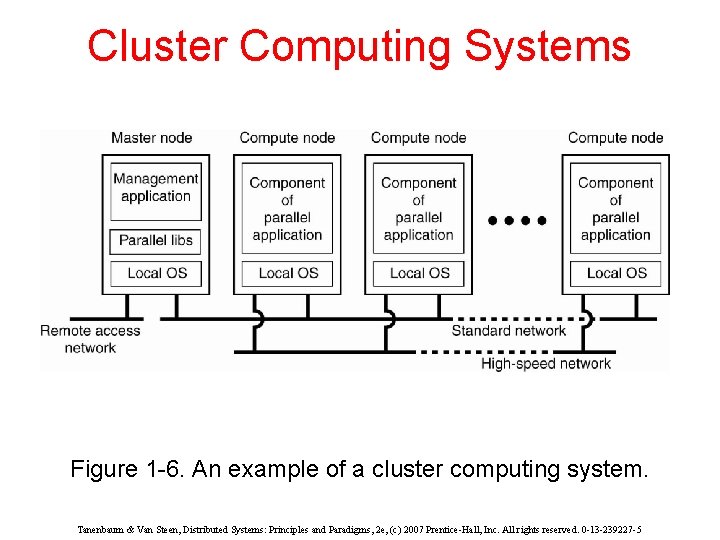
Cluster Computing Systems Figure 1 -6. An example of a cluster computing system. Tanenbaum & Van Steen, Distributed Systems: Principles and Paradigms, 2 e, (c) 2007 Prentice-Hall, Inc. All rights reserved. 0 -13 -239227 -5
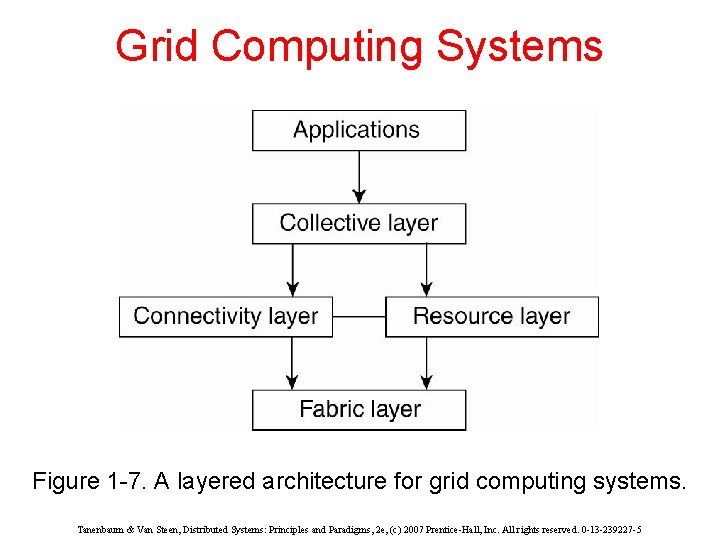
Grid Computing Systems Figure 1 -7. A layered architecture for grid computing systems. Tanenbaum & Van Steen, Distributed Systems: Principles and Paradigms, 2 e, (c) 2007 Prentice-Hall, Inc. All rights reserved. 0 -13 -239227 -5
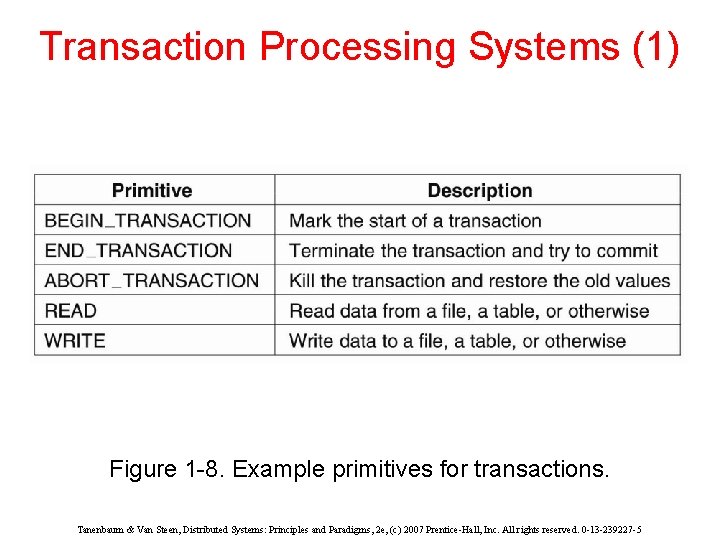
Transaction Processing Systems (1) Figure 1 -8. Example primitives for transactions. Tanenbaum & Van Steen, Distributed Systems: Principles and Paradigms, 2 e, (c) 2007 Prentice-Hall, Inc. All rights reserved. 0 -13 -239227 -5
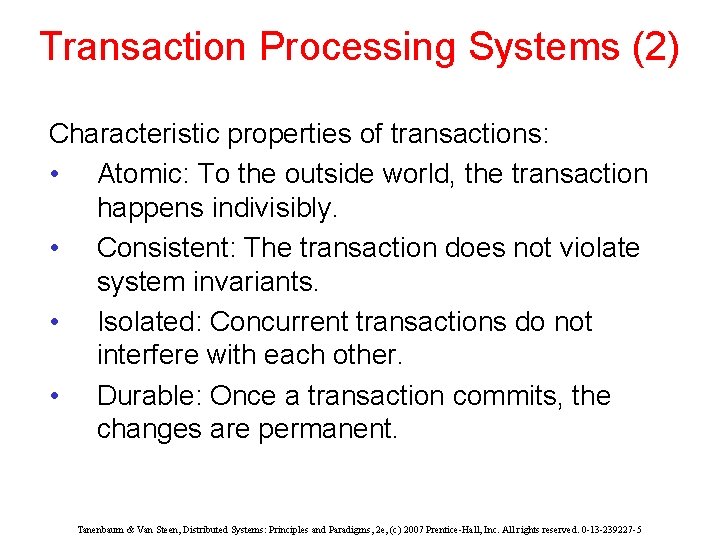
Transaction Processing Systems (2) Characteristic properties of transactions: • Atomic: To the outside world, the transaction happens indivisibly. • Consistent: The transaction does not violate system invariants. • Isolated: Concurrent transactions do not interfere with each other. • Durable: Once a transaction commits, the changes are permanent. Tanenbaum & Van Steen, Distributed Systems: Principles and Paradigms, 2 e, (c) 2007 Prentice-Hall, Inc. All rights reserved. 0 -13 -239227 -5
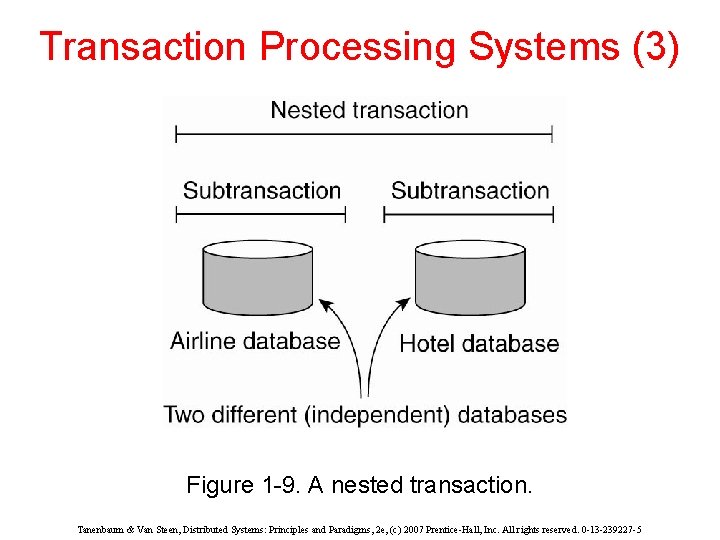
Transaction Processing Systems (3) Figure 1 -9. A nested transaction. Tanenbaum & Van Steen, Distributed Systems: Principles and Paradigms, 2 e, (c) 2007 Prentice-Hall, Inc. All rights reserved. 0 -13 -239227 -5
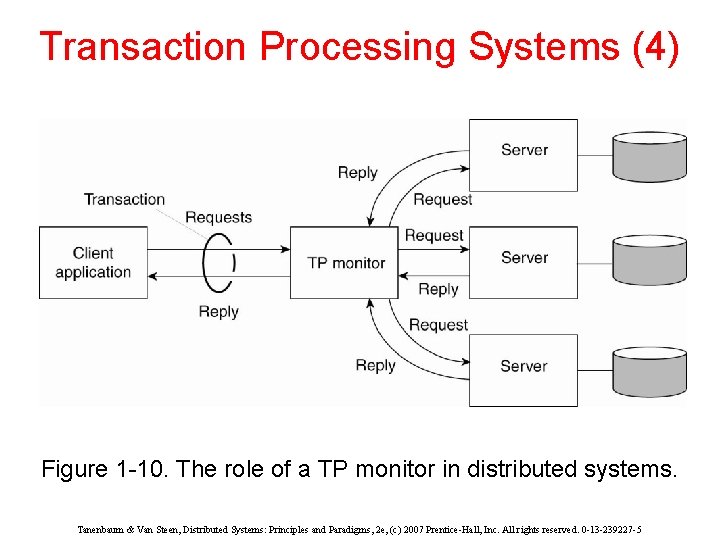
Transaction Processing Systems (4) Figure 1 -10. The role of a TP monitor in distributed systems. Tanenbaum & Van Steen, Distributed Systems: Principles and Paradigms, 2 e, (c) 2007 Prentice-Hall, Inc. All rights reserved. 0 -13 -239227 -5
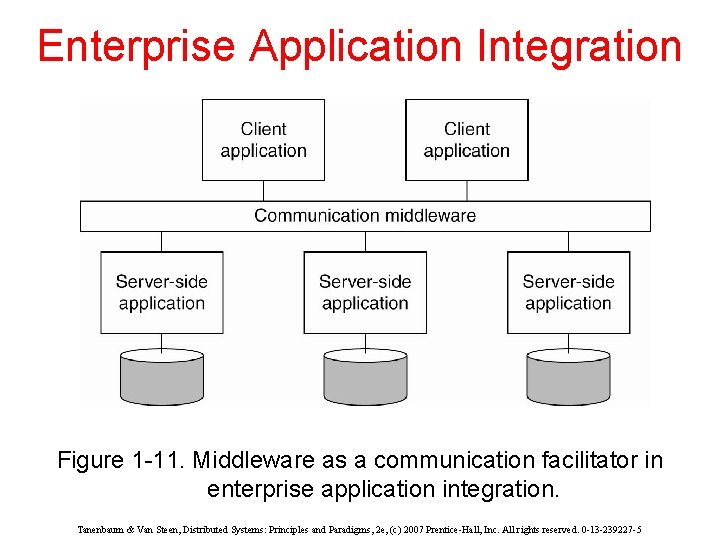
Enterprise Application Integration Figure 1 -11. Middleware as a communication facilitator in enterprise application integration. Tanenbaum & Van Steen, Distributed Systems: Principles and Paradigms, 2 e, (c) 2007 Prentice-Hall, Inc. All rights reserved. 0 -13 -239227 -5
Distributed Pervasive Systems Requirements for pervasive systems • • • Embrace contextual changes. Encourage ad hoc composition. Recognize sharing as the default. Tanenbaum & Van Steen, Distributed Systems: Principles and Paradigms, 2 e, (c) 2007 Prentice-Hall, Inc. All rights reserved. 0 -13 -239227 -5
Electronic Health Care Systems (1) Questions to be addressed for health care systems: • Where and how should monitored data be stored? • How can we prevent loss of crucial data? • What infrastructure is needed to generate and propagate alerts? • How can physicians provide online feedback? • How can extreme robustness of the monitoring system be realized? • What are the security issues and how can the proper policies be enforced? Tanenbaum & Van Steen, Distributed Systems: Principles and Paradigms, 2 e, (c) 2007 Prentice-Hall, Inc. All rights reserved. 0 -13 -239227 -5
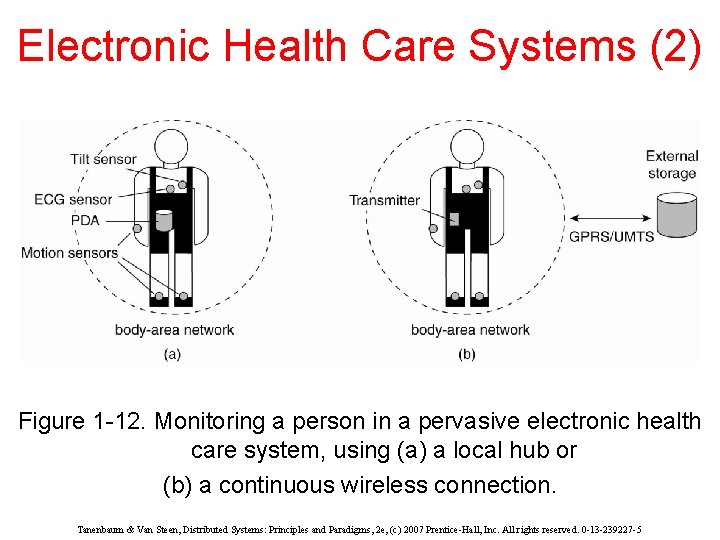
Electronic Health Care Systems (2) Figure 1 -12. Monitoring a person in a pervasive electronic health care system, using (a) a local hub or (b) a continuous wireless connection. Tanenbaum & Van Steen, Distributed Systems: Principles and Paradigms, 2 e, (c) 2007 Prentice-Hall, Inc. All rights reserved. 0 -13 -239227 -5
Sensor Networks (1) Questions concerning sensor networks: • How do we (dynamically) set up an efficient tree in a sensor network? • How does aggregation of results take place? Can it be controlled? • What happens when network links fail? Tanenbaum & Van Steen, Distributed Systems: Principles and Paradigms, 2 e, (c) 2007 Prentice-Hall, Inc. All rights reserved. 0 -13 -239227 -5
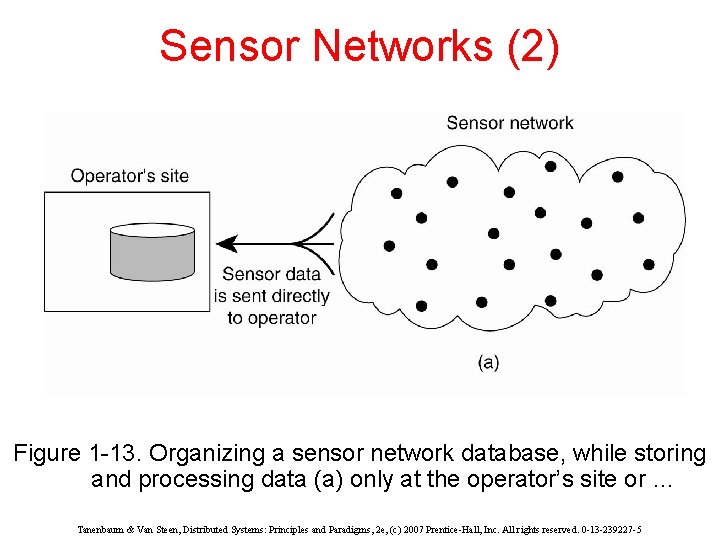
Sensor Networks (2) Figure 1 -13. Organizing a sensor network database, while storing and processing data (a) only at the operator’s site or … Tanenbaum & Van Steen, Distributed Systems: Principles and Paradigms, 2 e, (c) 2007 Prentice-Hall, Inc. All rights reserved. 0 -13 -239227 -5
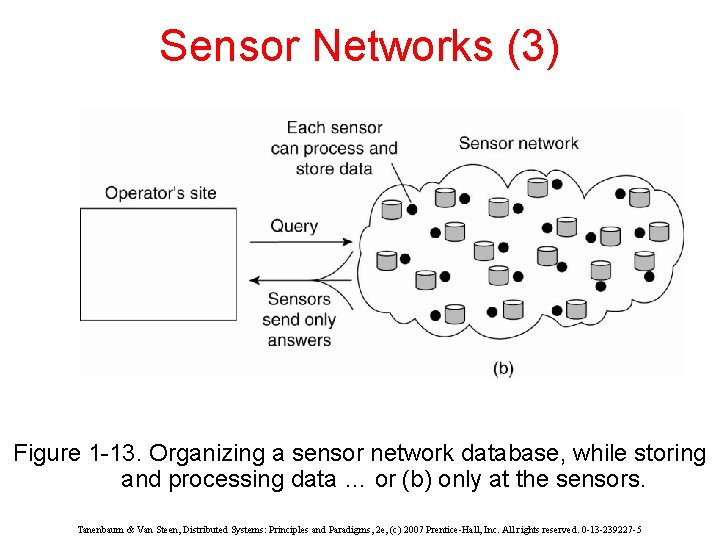
Sensor Networks (3) Figure 1 -13. Organizing a sensor network database, while storing and processing data … or (b) only at the sensors. Tanenbaum & Van Steen, Distributed Systems: Principles and Paradigms, 2 e, (c) 2007 Prentice-Hall, Inc. All rights reserved. 0 -13 -239227 -5
Question (1 -15) Sketch a design for a home system consisting of a separate media server that will allow for the attachment of a wireless client. The latter is connected to (analog) audio/video equipment and transforms the digital media streams to analog output. The server runs on a separate machine , possibly connected to the Internet, but has no keyboard and/or monitor connected. Tanenbaum & Van Steen, Distributed Systems: Principles and Paradigms, 2 e, (c) 2007 Prentice-Hall, Inc. All rights reserved. 0 -13 -239227 -5
- Slides: 23