
DISTRIBUTED SYSTEMS Principles and Paradigms Second Edition ANDREW
DISTRIBUTED SYSTEMS Principles and Paradigms Second Edition ANDREW S. TANENBAUM MAARTEN VAN STEEN Chapter 8 Fault Tolerance Tanenbaum & Van Steen, Distributed Systems: Principles and Paradigms, 2 e, (c) 2007 Prentice-Hall, Inc. All rights reserved. 0 -13 -239227 -5
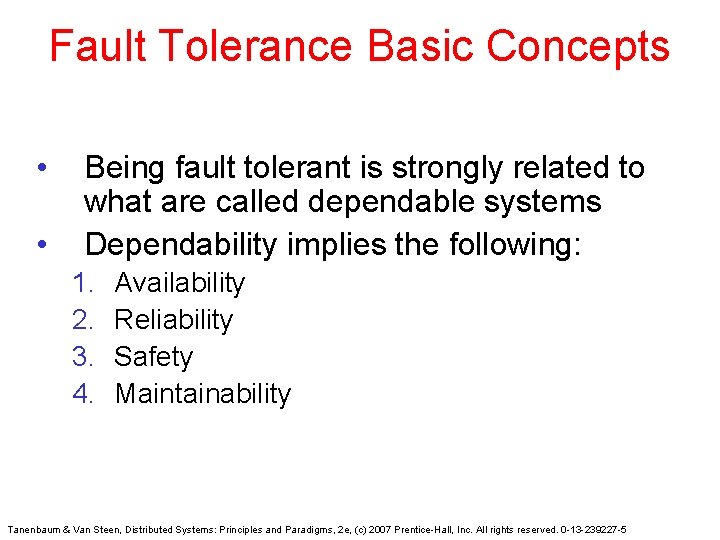
Fault Tolerance Basic Concepts • • Being fault tolerant is strongly related to what are called dependable systems Dependability implies the following: 1. 2. 3. 4. Availability Reliability Safety Maintainability Tanenbaum & Van Steen, Distributed Systems: Principles and Paradigms, 2 e, (c) 2007 Prentice-Hall, Inc. All rights reserved. 0 -13 -239227 -5
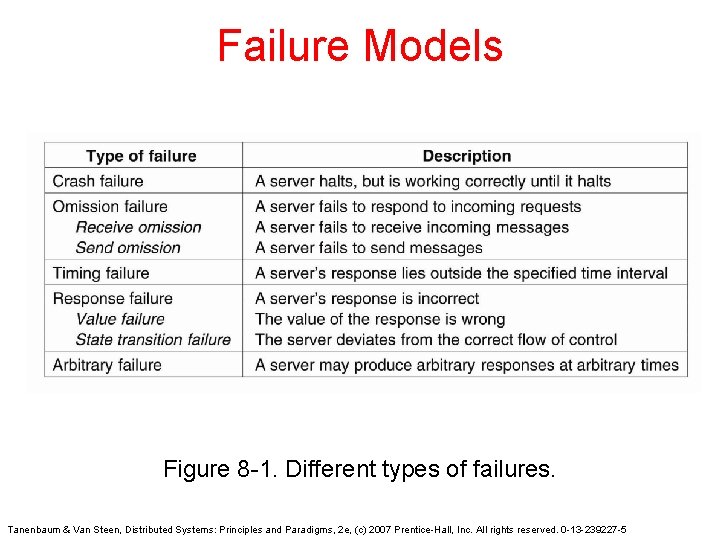
Failure Models Figure 8 -1. Different types of failures. Tanenbaum & Van Steen, Distributed Systems: Principles and Paradigms, 2 e, (c) 2007 Prentice-Hall, Inc. All rights reserved. 0 -13 -239227 -5
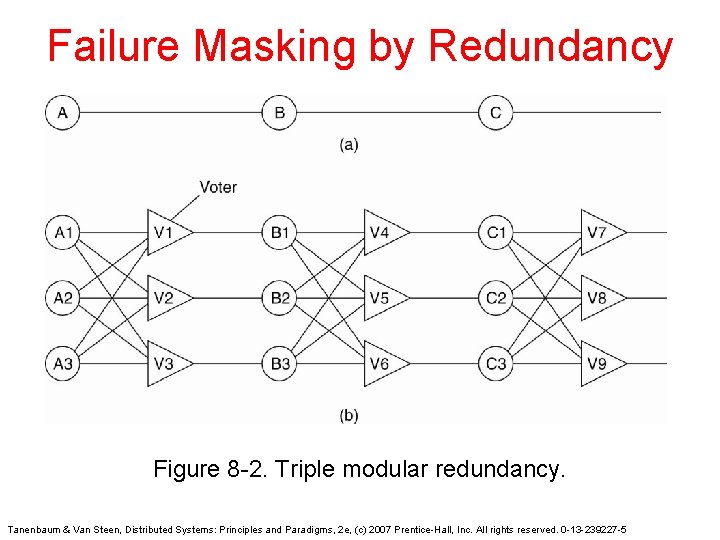
Failure Masking by Redundancy Figure 8 -2. Triple modular redundancy. Tanenbaum & Van Steen, Distributed Systems: Principles and Paradigms, 2 e, (c) 2007 Prentice-Hall, Inc. All rights reserved. 0 -13 -239227 -5
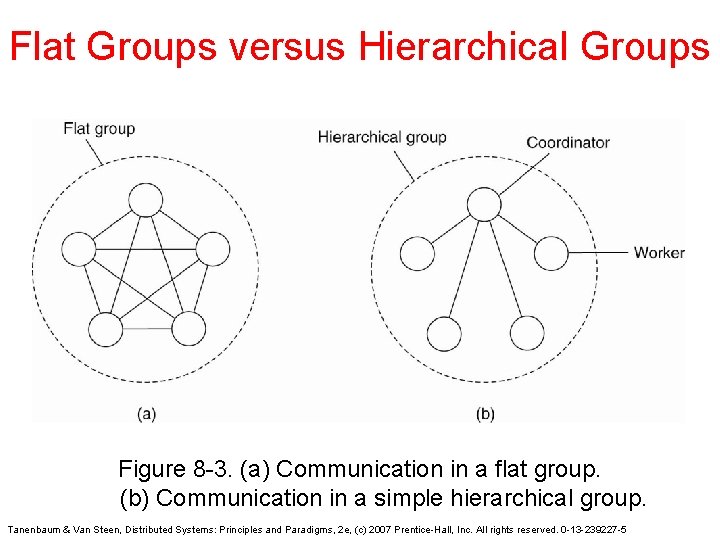
Flat Groups versus Hierarchical Groups Figure 8 -3. (a) Communication in a flat group. (b) Communication in a simple hierarchical group. Tanenbaum & Van Steen, Distributed Systems: Principles and Paradigms, 2 e, (c) 2007 Prentice-Hall, Inc. All rights reserved. 0 -13 -239227 -5
Agreement in Faulty Systems (1) Possible cases: 1. Synchronous versus asynchronous systems. 2. Communication delay is bounded or not. 3. Message delivery is ordered or not. 4. Message transmission is done through unicasting or multicasting. Tanenbaum & Van Steen, Distributed Systems: Principles and Paradigms, 2 e, (c) 2007 Prentice-Hall, Inc. All rights reserved. 0 -13 -239227 -5
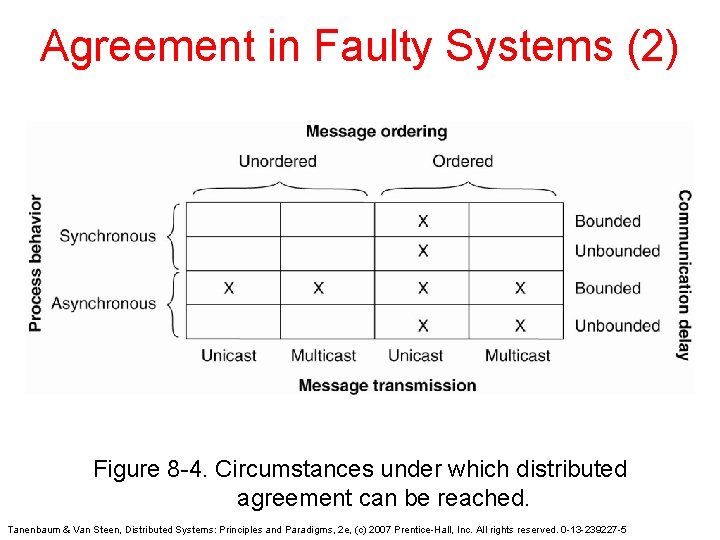
Agreement in Faulty Systems (2) Figure 8 -4. Circumstances under which distributed agreement can be reached. Tanenbaum & Van Steen, Distributed Systems: Principles and Paradigms, 2 e, (c) 2007 Prentice-Hall, Inc. All rights reserved. 0 -13 -239227 -5
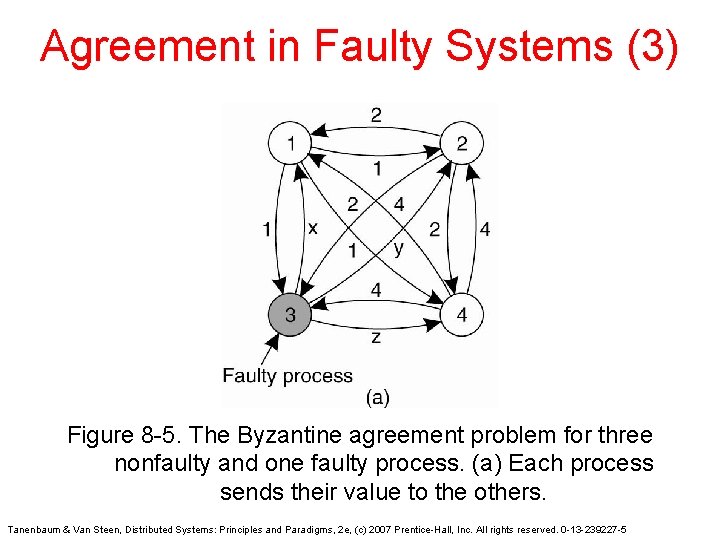
Agreement in Faulty Systems (3) Figure 8 -5. The Byzantine agreement problem for three nonfaulty and one faulty process. (a) Each process sends their value to the others. Tanenbaum & Van Steen, Distributed Systems: Principles and Paradigms, 2 e, (c) 2007 Prentice-Hall, Inc. All rights reserved. 0 -13 -239227 -5
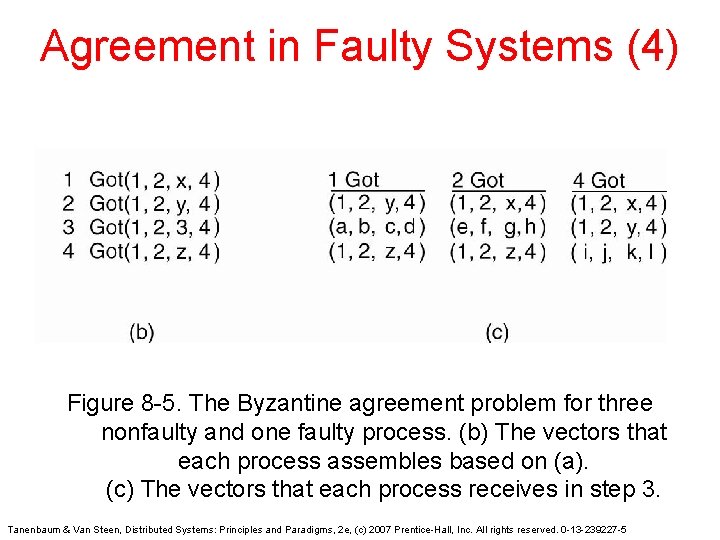
Agreement in Faulty Systems (4) Figure 8 -5. The Byzantine agreement problem for three nonfaulty and one faulty process. (b) The vectors that each process assembles based on (a). (c) The vectors that each process receives in step 3. Tanenbaum & Van Steen, Distributed Systems: Principles and Paradigms, 2 e, (c) 2007 Prentice-Hall, Inc. All rights reserved. 0 -13 -239227 -5
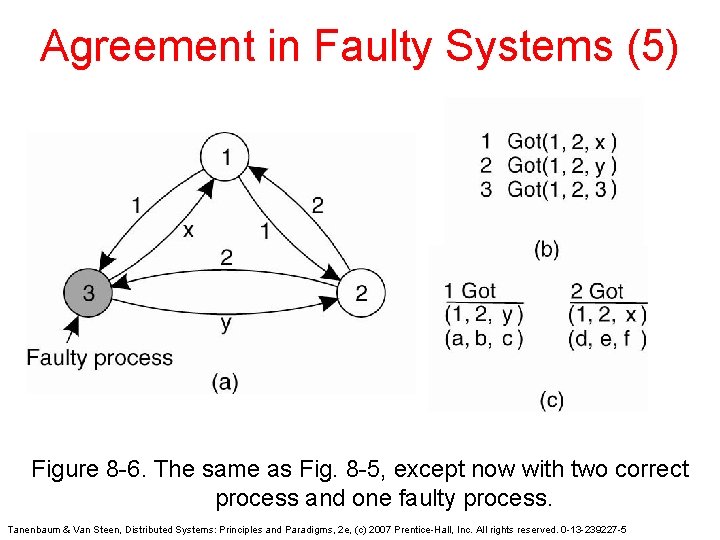
Agreement in Faulty Systems (5) Figure 8 -6. The same as Fig. 8 -5, except now with two correct process and one faulty process. Tanenbaum & Van Steen, Distributed Systems: Principles and Paradigms, 2 e, (c) 2007 Prentice-Hall, Inc. All rights reserved. 0 -13 -239227 -5
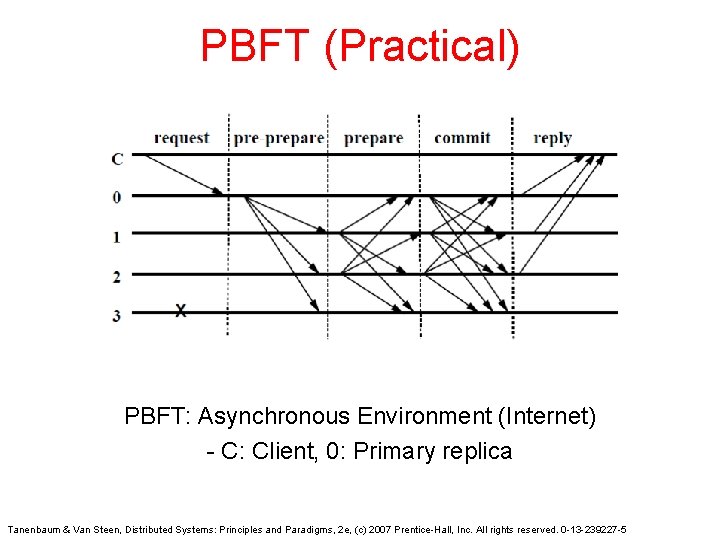
PBFT (Practical) PBFT: Asynchronous Environment (Internet) - C: Client, 0: Primary replica Tanenbaum & Van Steen, Distributed Systems: Principles and Paradigms, 2 e, (c) 2007 Prentice-Hall, Inc. All rights reserved. 0 -13 -239227 -5
RPC Semantics in the Presence of Failures Five different classes of failures that can occur in RPC systems: 1. The client is unable to locate the server. 2. The request message from the client to the server is lost. 3. The server crashes after receiving a request. 4. The reply message from the server to the client is lost. 5. The client crashes after sending a request. Tanenbaum & Van Steen, Distributed Systems: Principles and Paradigms, 2 e, (c) 2007 Prentice-Hall, Inc. All rights reserved. 0 -13 -239227 -5
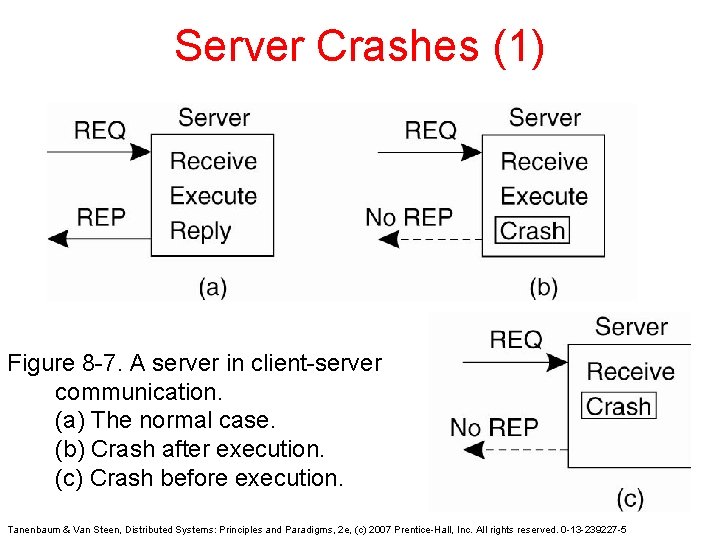
Server Crashes (1) Figure 8 -7. A server in client-server communication. (a) The normal case. (b) Crash after execution. (c) Crash before execution. Tanenbaum & Van Steen, Distributed Systems: Principles and Paradigms, 2 e, (c) 2007 Prentice-Hall, Inc. All rights reserved. 0 -13 -239227 -5
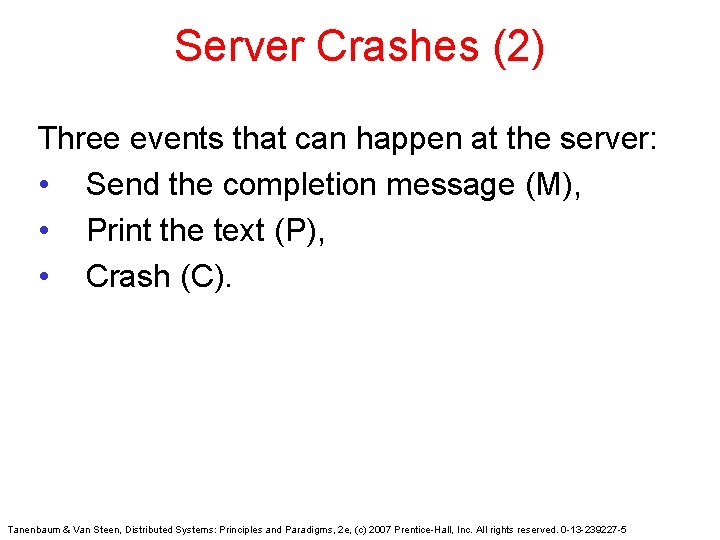
Server Crashes (2) Three events that can happen at the server: • Send the completion message (M), • Print the text (P), • Crash (C). Tanenbaum & Van Steen, Distributed Systems: Principles and Paradigms, 2 e, (c) 2007 Prentice-Hall, Inc. All rights reserved. 0 -13 -239227 -5
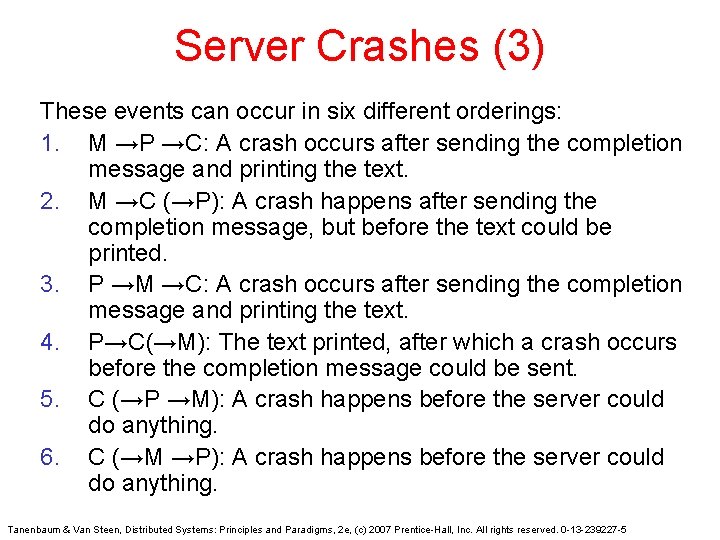
Server Crashes (3) These events can occur in six different orderings: 1. M →P →C: A crash occurs after sending the completion message and printing the text. 2. M →C (→P): A crash happens after sending the completion message, but before the text could be printed. 3. P →M →C: A crash occurs after sending the completion message and printing the text. 4. P→C(→M): The text printed, after which a crash occurs before the completion message could be sent. 5. C (→P →M): A crash happens before the server could do anything. 6. C (→M →P): A crash happens before the server could do anything. Tanenbaum & Van Steen, Distributed Systems: Principles and Paradigms, 2 e, (c) 2007 Prentice-Hall, Inc. All rights reserved. 0 -13 -239227 -5

Server Crashes (4) Figure 8 -8. Different combinations of client and server strategies in the presence of server crashes. Tanenbaum & Van Steen, Distributed Systems: Principles and Paradigms, 2 e, (c) 2007 Prentice-Hall, Inc. All rights reserved. 0 -13 -239227 -5
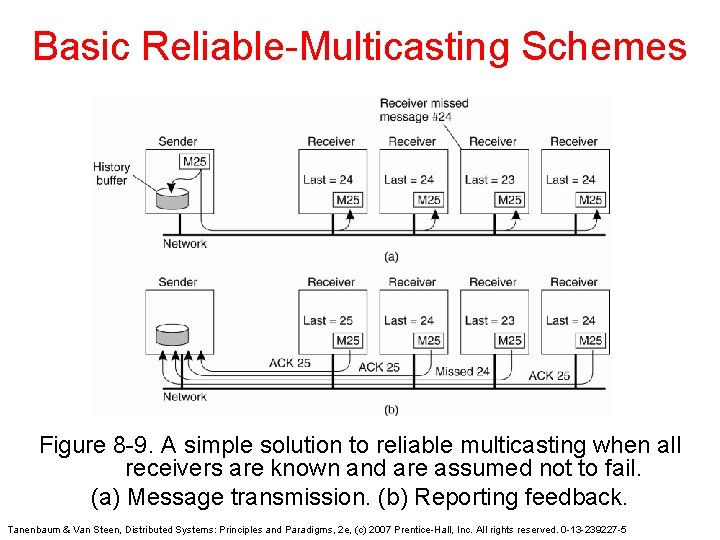
Basic Reliable-Multicasting Schemes Figure 8 -9. A simple solution to reliable multicasting when all receivers are known and are assumed not to fail. (a) Message transmission. (b) Reporting feedback. Tanenbaum & Van Steen, Distributed Systems: Principles and Paradigms, 2 e, (c) 2007 Prentice-Hall, Inc. All rights reserved. 0 -13 -239227 -5
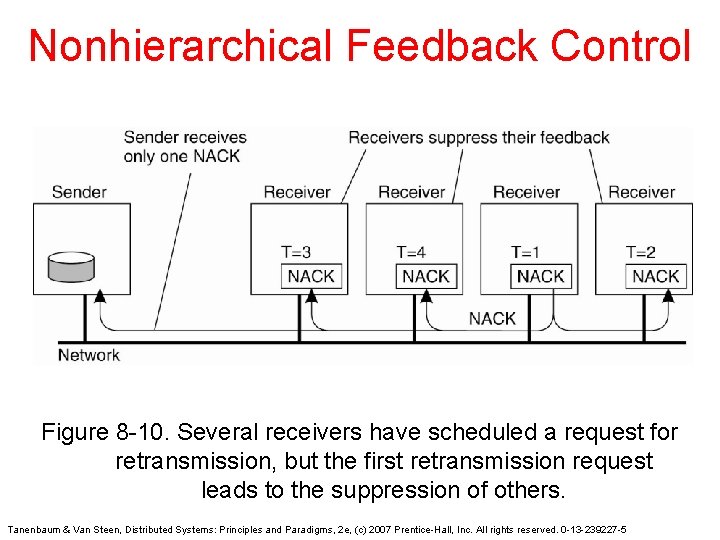
Nonhierarchical Feedback Control Figure 8 -10. Several receivers have scheduled a request for retransmission, but the first retransmission request leads to the suppression of others. Tanenbaum & Van Steen, Distributed Systems: Principles and Paradigms, 2 e, (c) 2007 Prentice-Hall, Inc. All rights reserved. 0 -13 -239227 -5
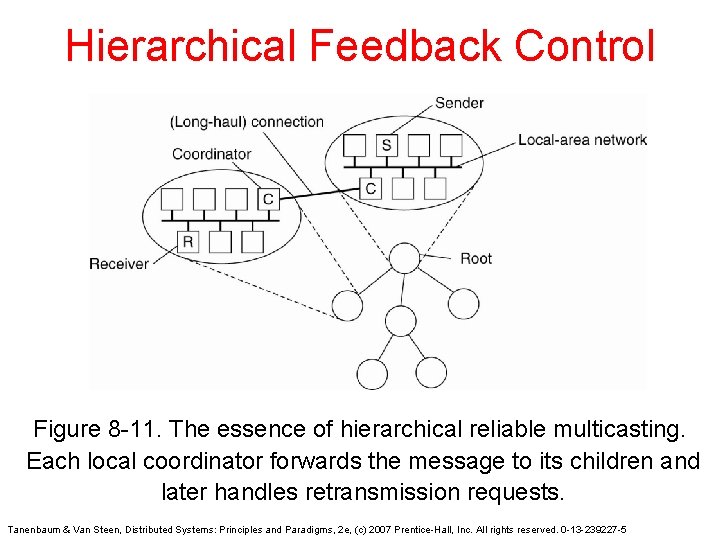
Hierarchical Feedback Control Figure 8 -11. The essence of hierarchical reliable multicasting. Each local coordinator forwards the message to its children and later handles retransmission requests. Tanenbaum & Van Steen, Distributed Systems: Principles and Paradigms, 2 e, (c) 2007 Prentice-Hall, Inc. All rights reserved. 0 -13 -239227 -5
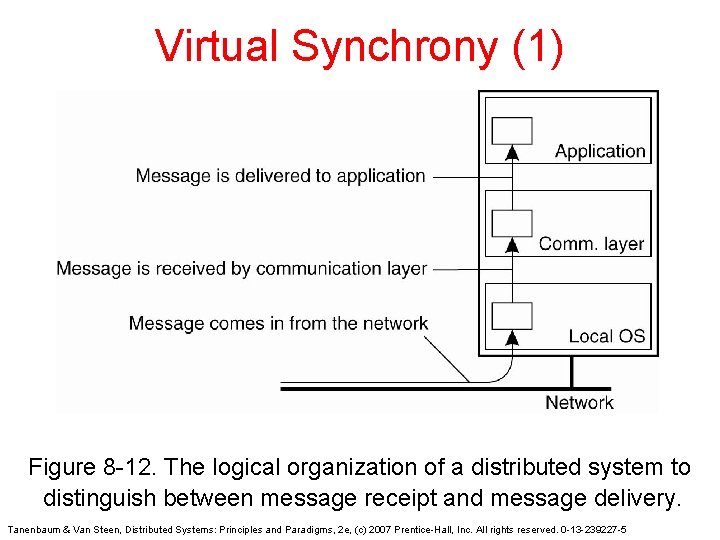
Virtual Synchrony (1) Figure 8 -12. The logical organization of a distributed system to distinguish between message receipt and message delivery. Tanenbaum & Van Steen, Distributed Systems: Principles and Paradigms, 2 e, (c) 2007 Prentice-Hall, Inc. All rights reserved. 0 -13 -239227 -5
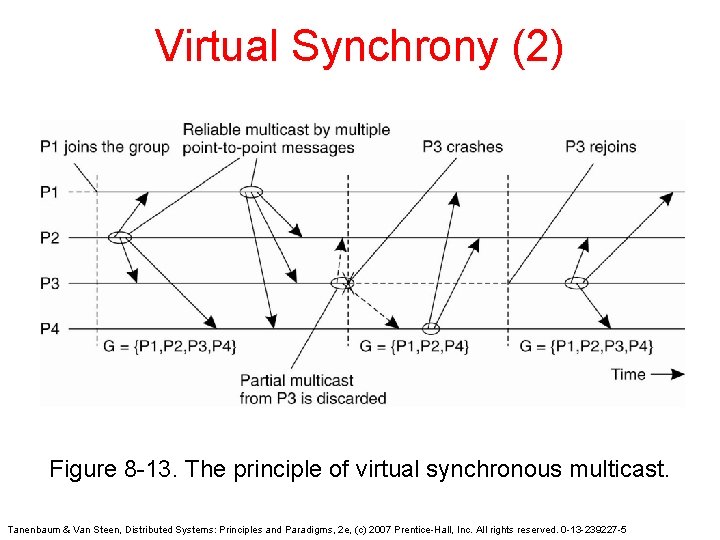
Virtual Synchrony (2) Figure 8 -13. The principle of virtual synchronous multicast. Tanenbaum & Van Steen, Distributed Systems: Principles and Paradigms, 2 e, (c) 2007 Prentice-Hall, Inc. All rights reserved. 0 -13 -239227 -5
Message Ordering (1) Four different orderings are distinguished: • Unordered multicasts • FIFO-ordered multicasts • Causally-ordered multicasts • Totally-ordered multicasts Tanenbaum & Van Steen, Distributed Systems: Principles and Paradigms, 2 e, (c) 2007 Prentice-Hall, Inc. All rights reserved. 0 -13 -239227 -5
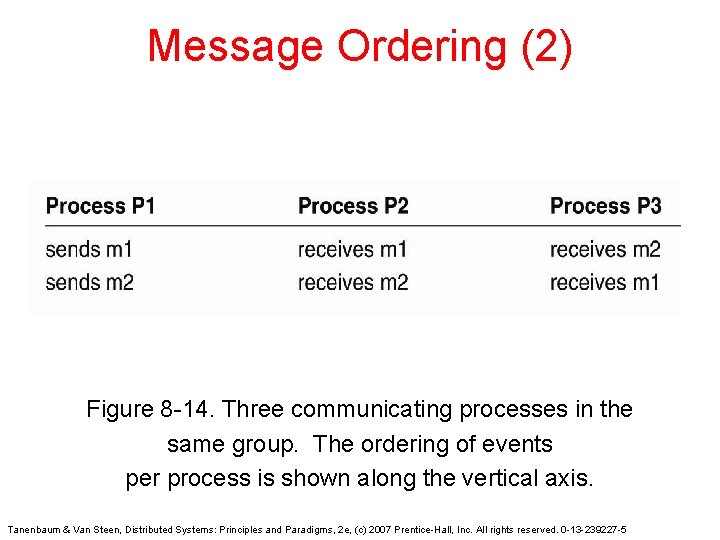
Message Ordering (2) Figure 8 -14. Three communicating processes in the same group. The ordering of events per process is shown along the vertical axis. Tanenbaum & Van Steen, Distributed Systems: Principles and Paradigms, 2 e, (c) 2007 Prentice-Hall, Inc. All rights reserved. 0 -13 -239227 -5
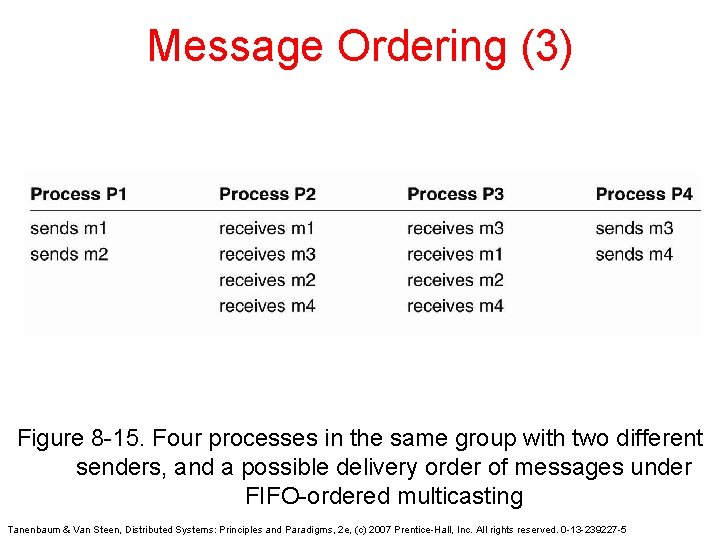
Message Ordering (3) Figure 8 -15. Four processes in the same group with two different senders, and a possible delivery order of messages under FIFO-ordered multicasting Tanenbaum & Van Steen, Distributed Systems: Principles and Paradigms, 2 e, (c) 2007 Prentice-Hall, Inc. All rights reserved. 0 -13 -239227 -5
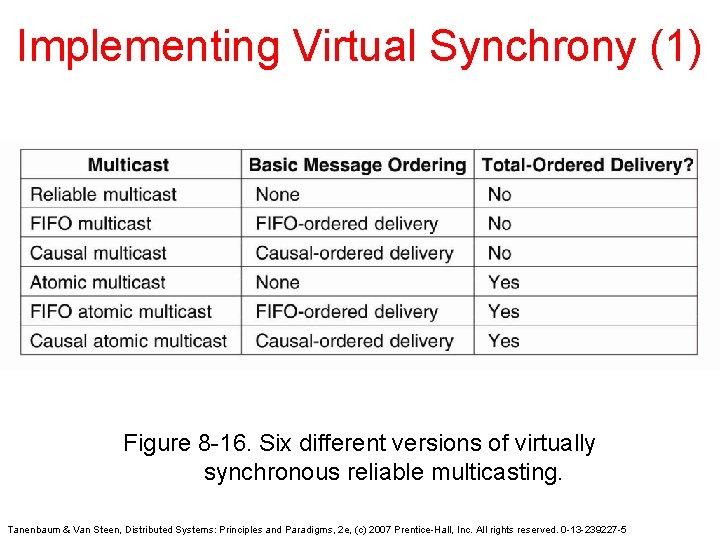
Implementing Virtual Synchrony (1) Figure 8 -16. Six different versions of virtually synchronous reliable multicasting. Tanenbaum & Van Steen, Distributed Systems: Principles and Paradigms, 2 e, (c) 2007 Prentice-Hall, Inc. All rights reserved. 0 -13 -239227 -5
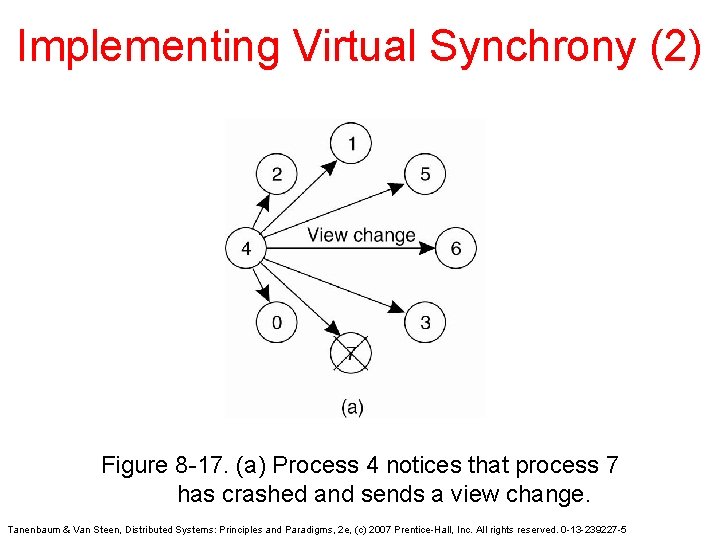
Implementing Virtual Synchrony (2) Figure 8 -17. (a) Process 4 notices that process 7 has crashed and sends a view change. Tanenbaum & Van Steen, Distributed Systems: Principles and Paradigms, 2 e, (c) 2007 Prentice-Hall, Inc. All rights reserved. 0 -13 -239227 -5
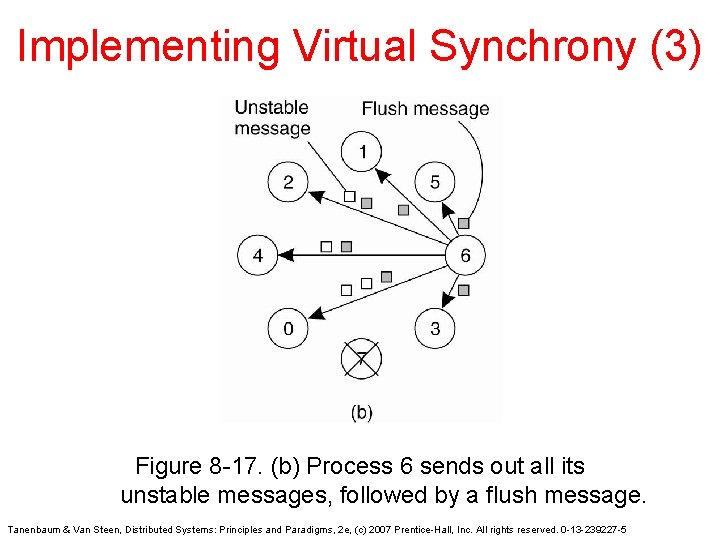
Implementing Virtual Synchrony (3) Figure 8 -17. (b) Process 6 sends out all its unstable messages, followed by a flush message. Tanenbaum & Van Steen, Distributed Systems: Principles and Paradigms, 2 e, (c) 2007 Prentice-Hall, Inc. All rights reserved. 0 -13 -239227 -5
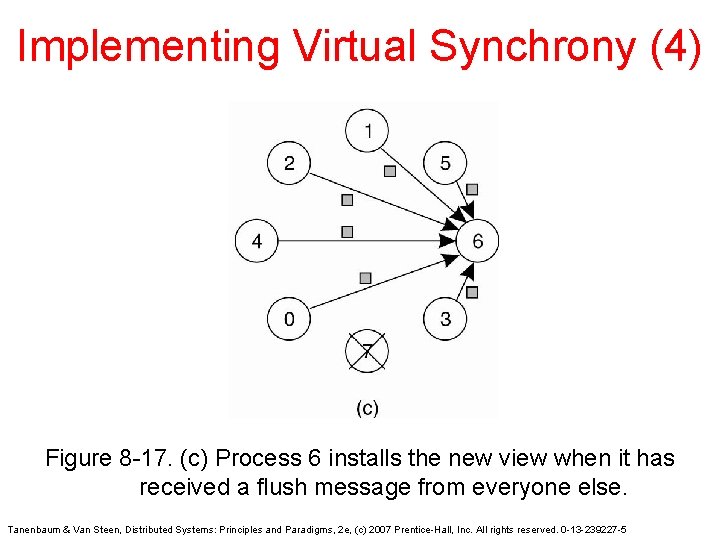
Implementing Virtual Synchrony (4) Figure 8 -17. (c) Process 6 installs the new view when it has received a flush message from everyone else. Tanenbaum & Van Steen, Distributed Systems: Principles and Paradigms, 2 e, (c) 2007 Prentice-Hall, Inc. All rights reserved. 0 -13 -239227 -5
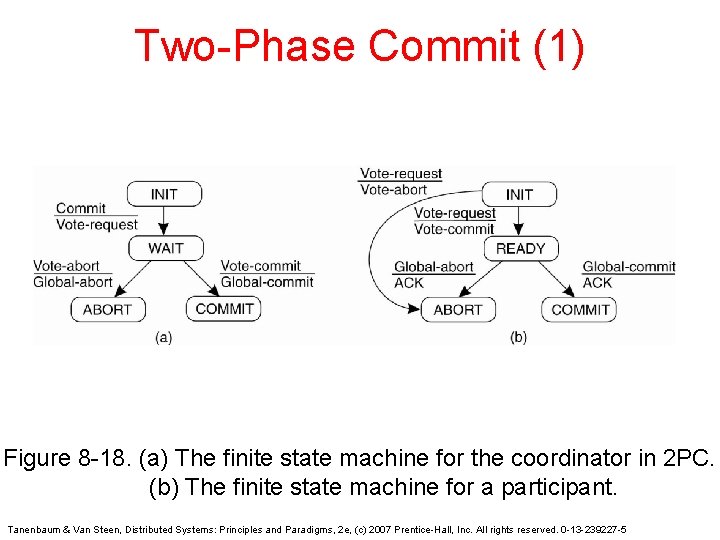
Two-Phase Commit (1) Figure 8 -18. (a) The finite state machine for the coordinator in 2 PC. (b) The finite state machine for a participant. Tanenbaum & Van Steen, Distributed Systems: Principles and Paradigms, 2 e, (c) 2007 Prentice-Hall, Inc. All rights reserved. 0 -13 -239227 -5
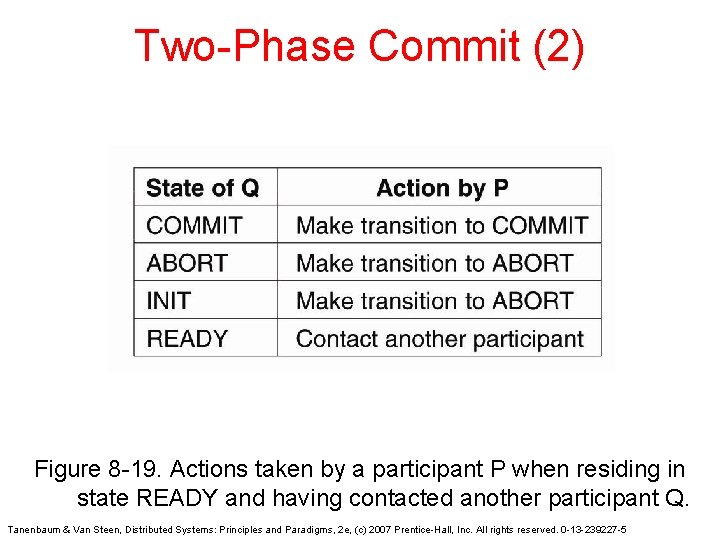
Two-Phase Commit (2) Figure 8 -19. Actions taken by a participant P when residing in state READY and having contacted another participant Q. Tanenbaum & Van Steen, Distributed Systems: Principles and Paradigms, 2 e, (c) 2007 Prentice-Hall, Inc. All rights reserved. 0 -13 -239227 -5
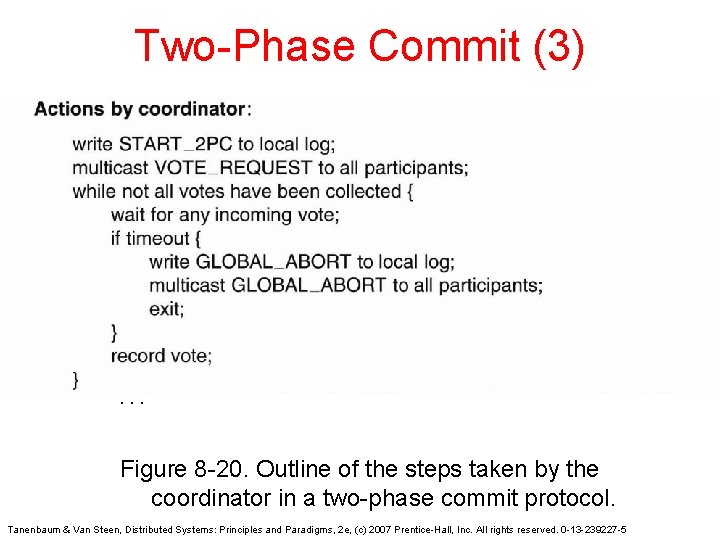
Two-Phase Commit (3) . . . Figure 8 -20. Outline of the steps taken by the coordinator in a two-phase commit protocol. Tanenbaum & Van Steen, Distributed Systems: Principles and Paradigms, 2 e, (c) 2007 Prentice-Hall, Inc. All rights reserved. 0 -13 -239227 -5
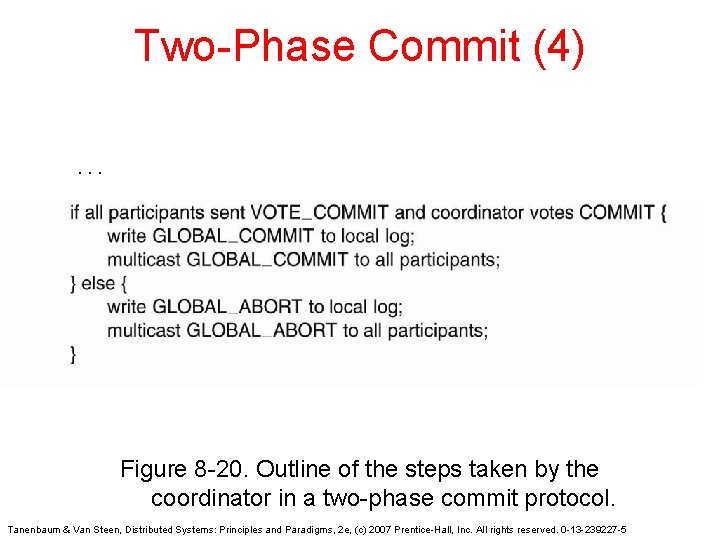
Two-Phase Commit (4). . . Figure 8 -20. Outline of the steps taken by the coordinator in a two-phase commit protocol. Tanenbaum & Van Steen, Distributed Systems: Principles and Paradigms, 2 e, (c) 2007 Prentice-Hall, Inc. All rights reserved. 0 -13 -239227 -5
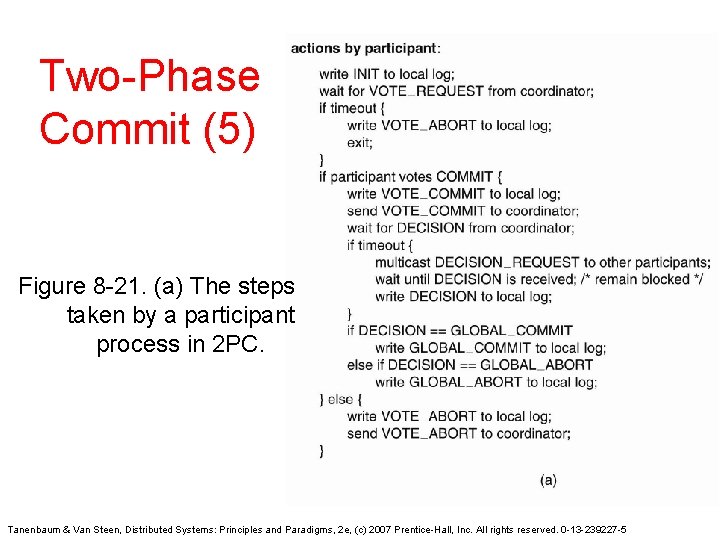
Two-Phase Commit (5) Figure 8 -21. (a) The steps taken by a participant process in 2 PC. Tanenbaum & Van Steen, Distributed Systems: Principles and Paradigms, 2 e, (c) 2007 Prentice-Hall, Inc. All rights reserved. 0 -13 -239227 -5
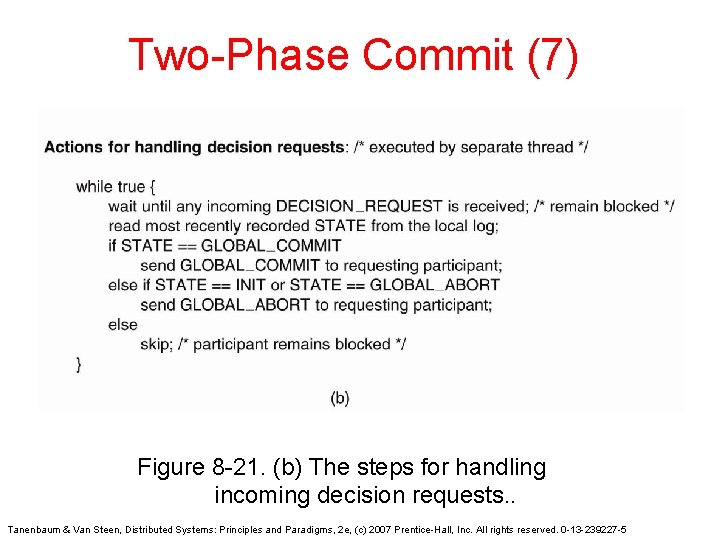
Two-Phase Commit (7) Figure 8 -21. (b) The steps for handling incoming decision requests. . Tanenbaum & Van Steen, Distributed Systems: Principles and Paradigms, 2 e, (c) 2007 Prentice-Hall, Inc. All rights reserved. 0 -13 -239227 -5
Three-Phase Commit (1) The states of the coordinator and each participant satisfy the following two conditions: 1. There is no single state from which it is possible to make a transition directly to either a COMMIT or an ABORT state. 2. There is no state in which it is not possible to make a final decision, and from which a transition to a COMMIT state can be made. Tanenbaum & Van Steen, Distributed Systems: Principles and Paradigms, 2 e, (c) 2007 Prentice-Hall, Inc. All rights reserved. 0 -13 -239227 -5
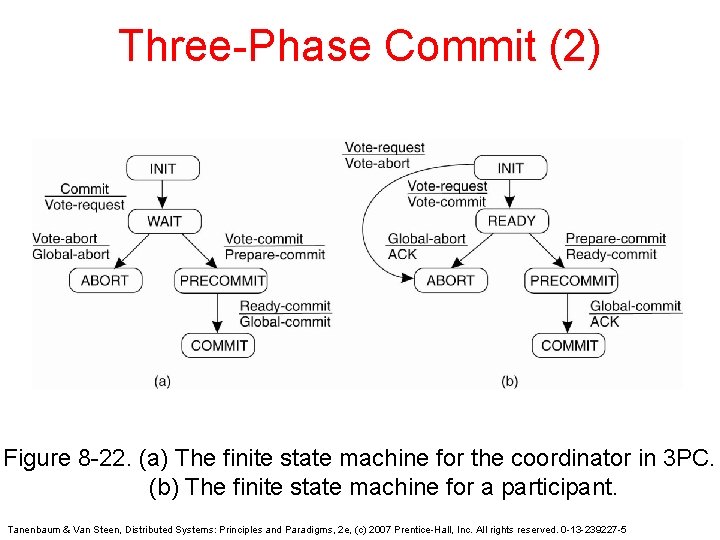
Three-Phase Commit (2) Figure 8 -22. (a) The finite state machine for the coordinator in 3 PC. (b) The finite state machine for a participant. Tanenbaum & Van Steen, Distributed Systems: Principles and Paradigms, 2 e, (c) 2007 Prentice-Hall, Inc. All rights reserved. 0 -13 -239227 -5
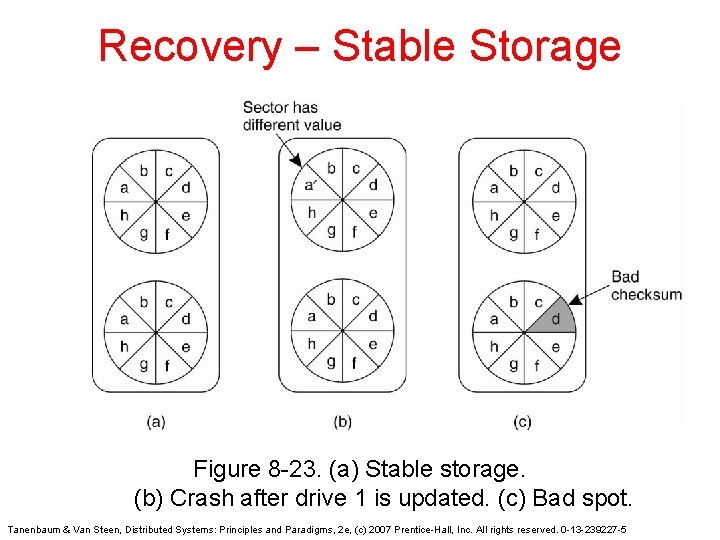
Recovery – Stable Storage Figure 8 -23. (a) Stable storage. (b) Crash after drive 1 is updated. (c) Bad spot. Tanenbaum & Van Steen, Distributed Systems: Principles and Paradigms, 2 e, (c) 2007 Prentice-Hall, Inc. All rights reserved. 0 -13 -239227 -5
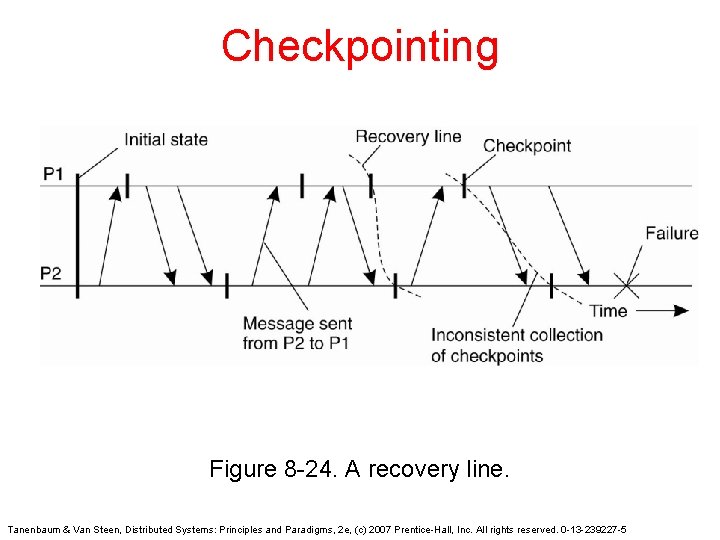
Checkpointing Figure 8 -24. A recovery line. Tanenbaum & Van Steen, Distributed Systems: Principles and Paradigms, 2 e, (c) 2007 Prentice-Hall, Inc. All rights reserved. 0 -13 -239227 -5
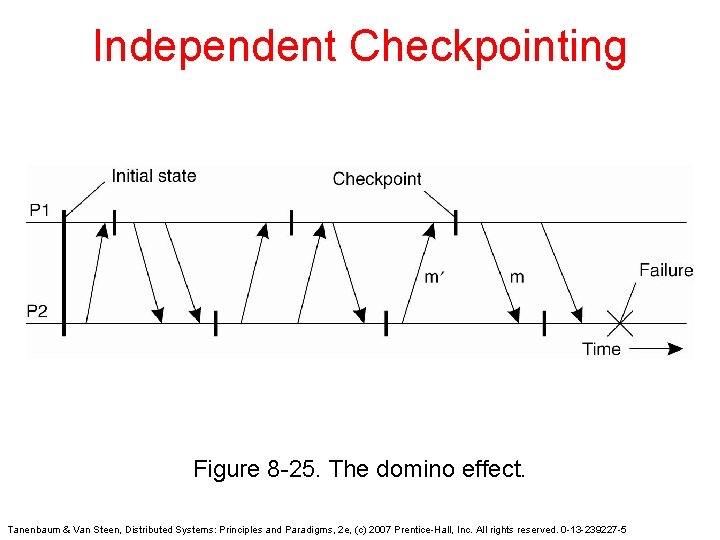
Independent Checkpointing Figure 8 -25. The domino effect. Tanenbaum & Van Steen, Distributed Systems: Principles and Paradigms, 2 e, (c) 2007 Prentice-Hall, Inc. All rights reserved. 0 -13 -239227 -5
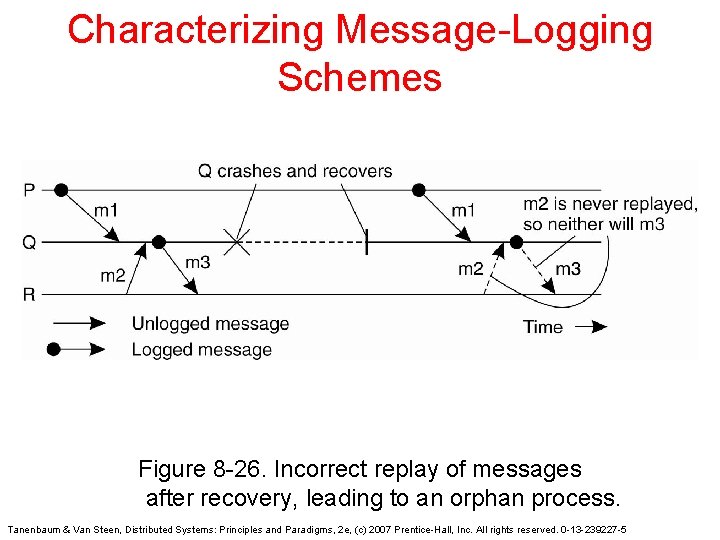
Characterizing Message-Logging Schemes Figure 8 -26. Incorrect replay of messages after recovery, leading to an orphan process. Tanenbaum & Van Steen, Distributed Systems: Principles and Paradigms, 2 e, (c) 2007 Prentice-Hall, Inc. All rights reserved. 0 -13 -239227 -5
- Slides: 40