
Distributed Systems II TDA 297CTH DIT 290 GU
Distributed Systems II TDA 297(CTH), DIT 290 (GU) LP 3 2011 7. 5 hec http: //www. cse. chalmers. se/edu/course/TDA 297 https: //gul. gu. se/public/course. Id/40173/course. Pa th/38407/40149/ecp/lang-sv/public. Page. do

The Teachers n Instructor: Philippas Tsigas n n n E-mail: tsigas@chalmers. se Phone: +46 -31 -772 5409 Office: 5106 Office hours: By appointment Assistants: n n n Andreas Larsson – larandr@chalmers. se Zhang Fu – zhafu@chalmers. se Office hours: To be announced
Reading n 4 th Edition of the book: "Distributed Systems: Concepts and Design" n n n written by: George Coulouris, Jean Dollimore and Tim Kindberg published by Addison-Wesley, ISBN 0 -32126354 -5 Some extra material: Distributed Algorithms (Notes) + papers.
Description Distributed systems are popular and powerful computing paradigms. Their importance increases as networked computers become more common than freestanding ones, especially since many different types of computers can be found in networks. In this course we will see the points of inherent difference and strength of distributed systems compared with sequential or strongly-coupled systems; consequently, we will also study the issues and problems that have to be addressed and solved efficiently for these differences to be taken advantage of, so that the system retains its strength and high potential.
Goals n 1. Replication; The advantages and costs of replicating data: n n n Potential improvement in response times and reliability Extra communication costs involved in keeping data consistent. 2. Fault-tolerant Agreement in Distributed Systems: n n n (a very special and significant problem, since it is a key issue in most synchronisation and coordination problems in distributed systems) Study of the basic impossibility results and discuss their implications Proceed with solutions and protocols for systems with certain strengths and design structures.
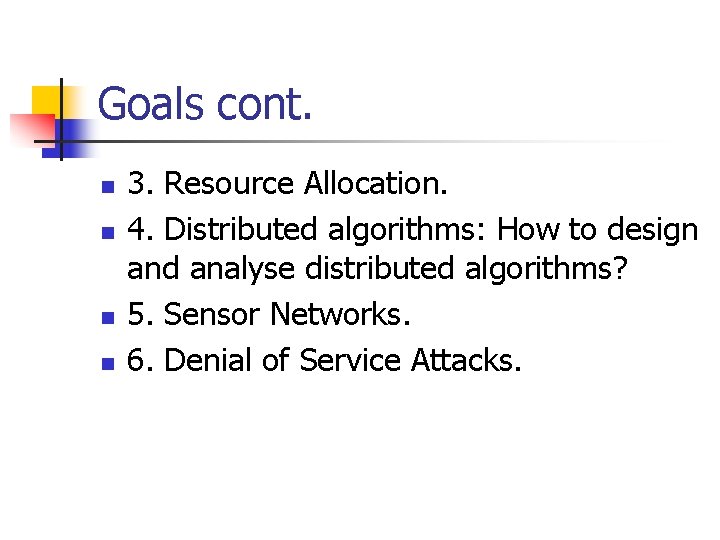
Goals cont. n n 3. Resource Allocation. 4. Distributed algorithms: How to design and analyse distributed algorithms? 5. Sensor Networks. 6. Denial of Service Attacks.
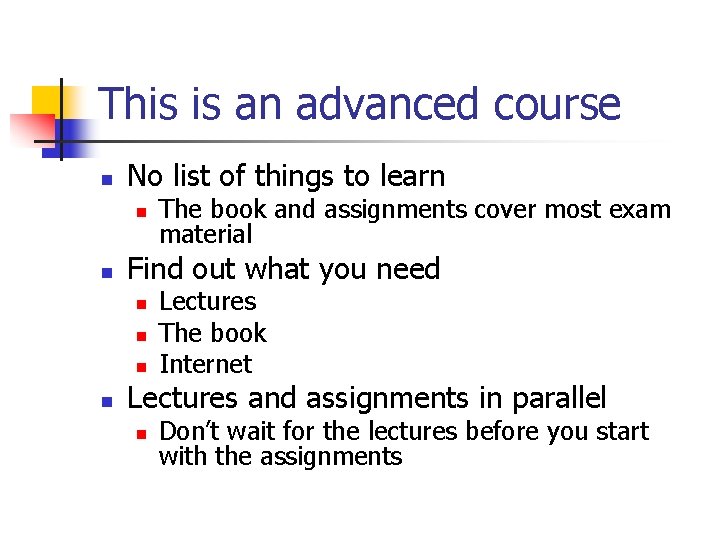
This is an advanced course n No list of things to learn n n Find out what you need n n The book and assignments cover most exam material Lectures The book Internet Lectures and assignments in parallel n Don’t wait for the lectures before you start with the assignments
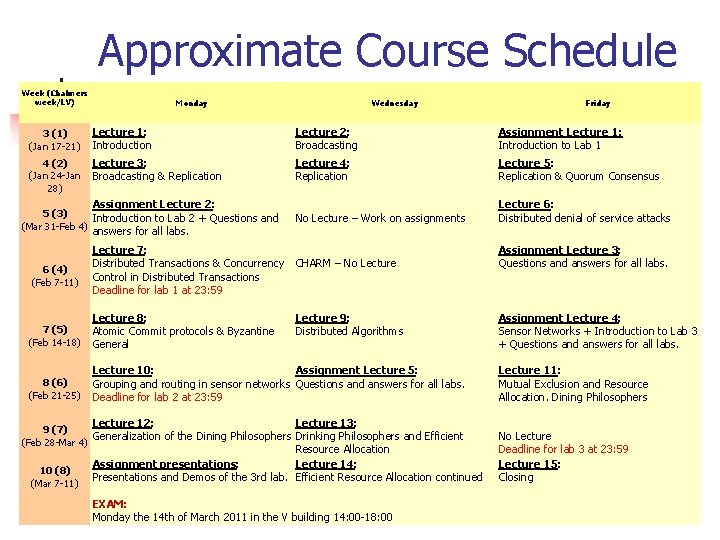
Approximate Course Schedule Week (Chalmers week/LV) Monday Wednesday Friday 3 (1) (Jan 17 -21) Lecture 1: Introduction Lecture 2: Broadcasting Assignment Lecture 1: Introduction to Lab 1 4 (2) (Jan 24 -Jan 28) Lecture 3: Broadcasting & Replication Lecture 4: Replication Lecture 5: Replication & Quorum Consensus No Lecture – Work on assignments Lecture 6: Distributed denial of service attacks CHARM – No Lecture Assignment Lecture 3: Questions and answers for all labs. Assignment Lecture 2: 5 (3) Introduction to Lab 2 + Questions and (Mar 31 -Feb 4) answers for all labs. 6 (4) (Feb 7 -11) Lecture 7: Distributed Transactions & Concurrency Control in Distributed Transactions Deadline for lab 1 at 23: 59 7 (5) (Feb 14 -18) Lecture 8: Atomic Commit protocols & Byzantine General 8 (6) (Feb 21 -25) Lecture 10: Assignment Lecture 5: Grouping and routing in sensor networks Questions and answers for all labs. Deadline for lab 2 at 23: 59 Lecture 12: Lecture 9: Distributed Algorithms Lecture 13: 9 (7) Generalization of the Dining Philosophers Drinking Philosophers and Efficient (Feb 28 -Mar 4) 10 (8) (Mar 7 -11) Resource Allocation Assignment presentations: Lecture 14: Presentations and Demos of the 3 rd lab. Efficient Resource Allocation continued EXAM: Monday the 14 th of March 2011 in the V building 14: 00 -18: 00 Assignment Lecture 4: Sensor Networks + Introduction to Lab 3 + Questions and answers for all labs. Lecture 11: Mutual Exclusion and Resource Allocation. Dining Philosophers No Lecture Deadline for lab 3 at 23: 59 Lecture 15: Closing
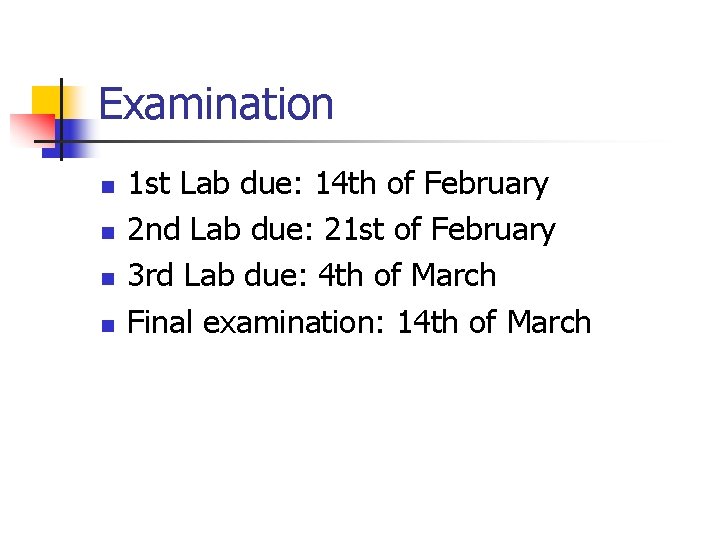
Examination n n 1 st Lab due: 14 th of February 2 nd Lab due: 21 st of February 3 rd Lab due: 4 th of March Final examination: 14 th of March
Resources Full support page for the Coulouris’ book: n http: //www. cdk 4. net/ Slides: n At homepage after lecture n Last years slides available, use them as a reference point before the lecture: http: //www. cse. chalmers. se/edu/year/2010/c ourse/TDA 297/
Resources cont. 1 st Assignment: n Distributed bulletin board n http: //www. cse. chalmers. se/edu/course/TDA 297/labs/lab 1. html
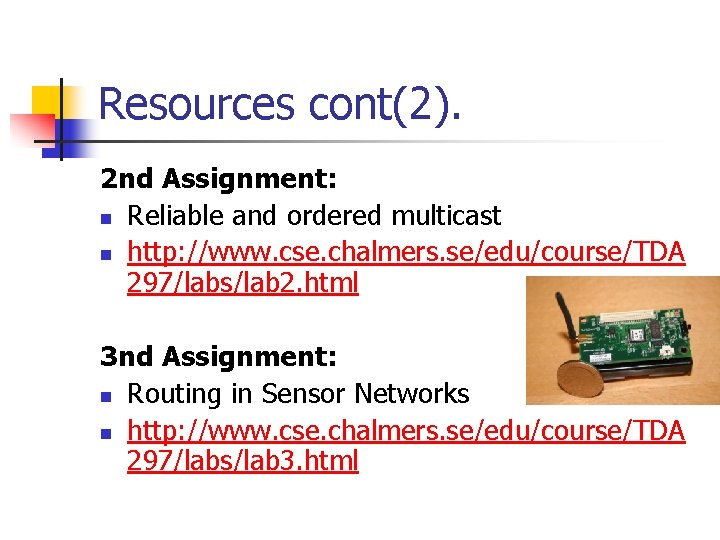
Resources cont(2). 2 nd Assignment: n Reliable and ordered multicast n http: //www. cse. chalmers. se/edu/course/TDA 297/labs/lab 2. html 3 nd Assignment: n Routing in Sensor Networks n http: //www. cse. chalmers. se/edu/course/TDA 297/labs/lab 3. html
Why Distributed Systems? Suggestions?
Because they are there Distributed Applications n n n Automated Banking Systems Tracking Roaming Cellular Telephones Air-Traffic Control Systems Fly-by-wire Systems The World-Wide- Web
Because they have many + Network vs. Centralised Systems n n n Cycles always available Incremental growth Independent failure Heterogeneity Increased Autonomy n n n purchasing management software
Ingredients of D. S. n n Multiple computers Interconnections Shared states
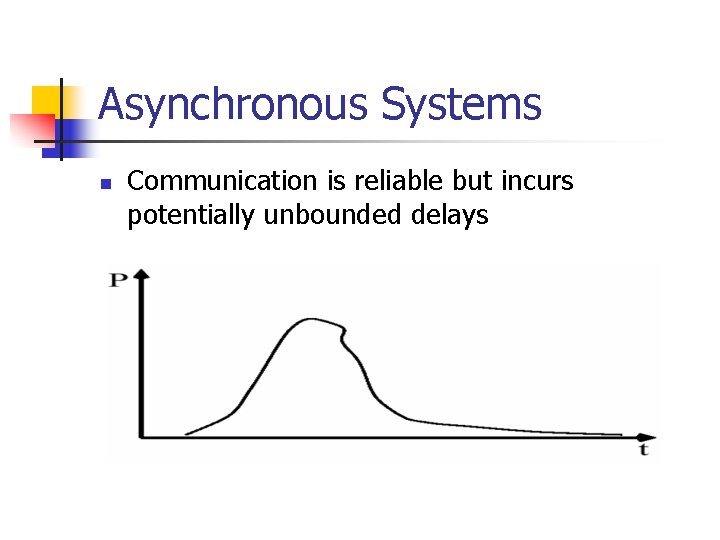
Asynchronous Systems n Communication is reliable but incurs potentially unbounded delays
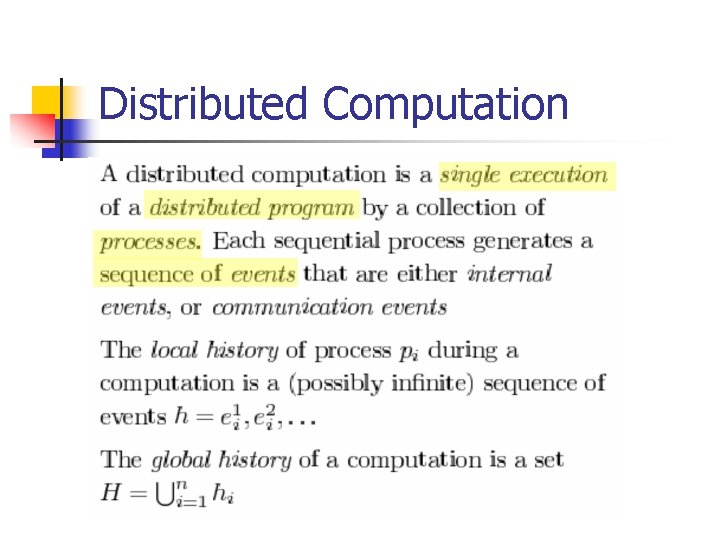
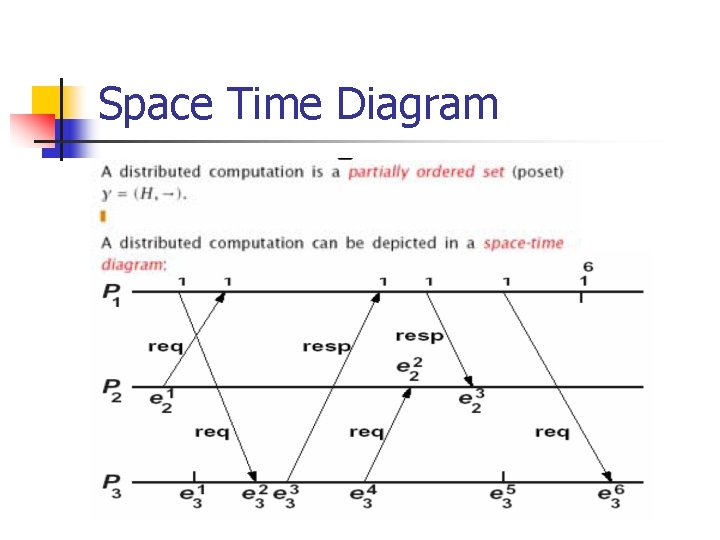
Distributed Computation
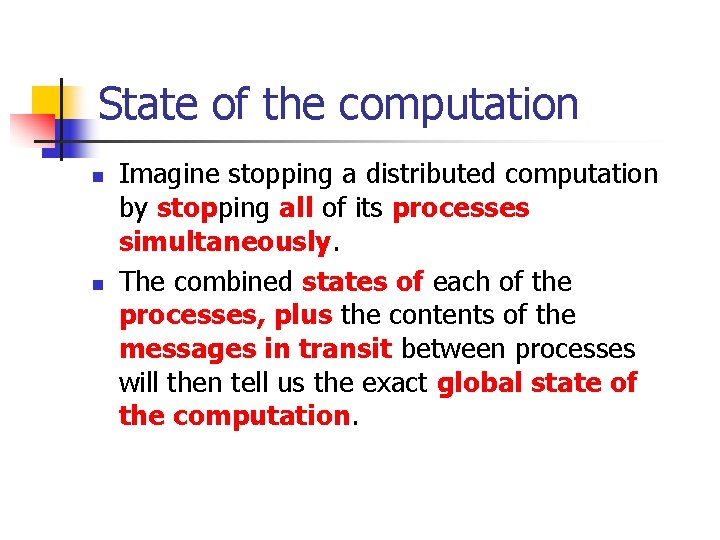
State of the computation n n Imagine stopping a distributed computation by stopping all of its processes simultaneously. The combined states of each of the processes, plus the contents of the messages in transit between processes will then tell us the exact global state of the computation.
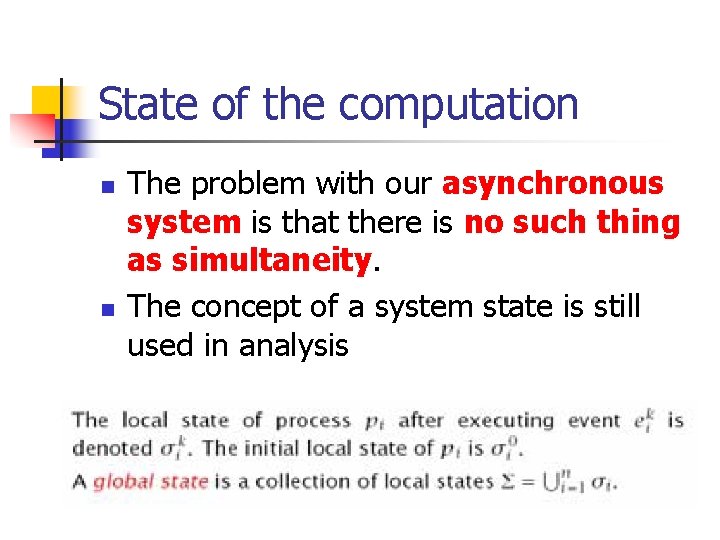
State of the computation n n The problem with our asynchronous system is that there is no such thing as simultaneity. The concept of a system state is still used in analysis
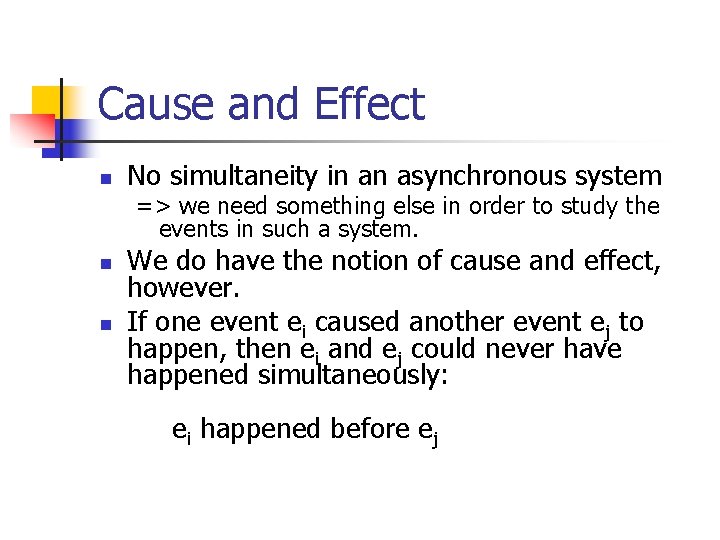
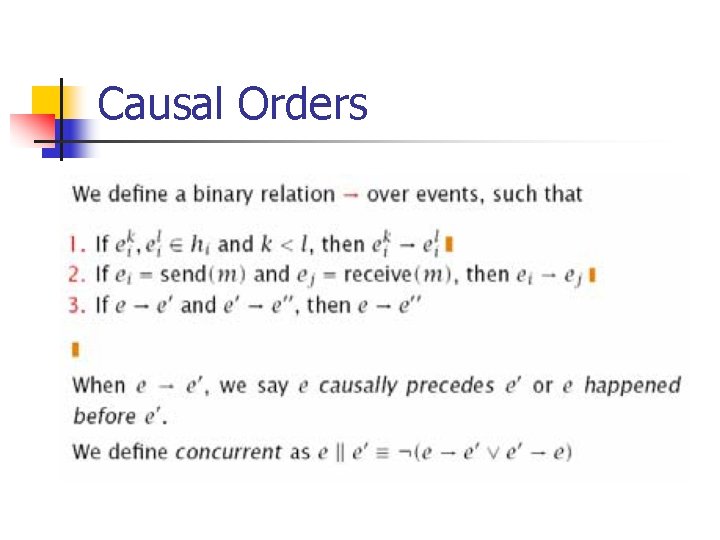
Cause and Effect n No simultaneity in an asynchronous system => we need something else in order to study the events in such a system. n n We do have the notion of cause and effect, however. If one event ei caused another event ej to happen, then ei and ej could never have happened simultaneously: ei happened before ej
Causal Orders
Space Time Diagram
- Slides: 23