
Distributed Systems Design 1 Ian Sommerville 2004 Software
Distributed Systems Design 1 ©Ian Sommerville 2004 Software Engineering, 7 th edition. Chapter 12 Slide 1
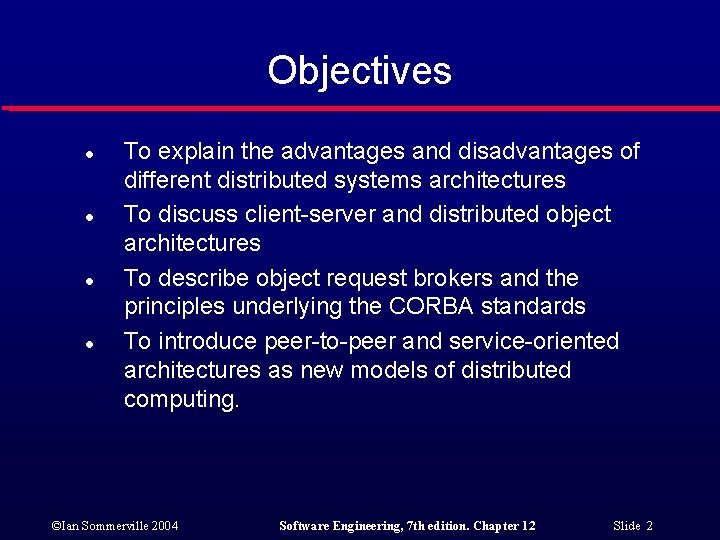
Objectives l l To explain the advantages and disadvantages of different distributed systems architectures To discuss client-server and distributed object architectures To describe object request brokers and the principles underlying the CORBA standards To introduce peer-to-peer and service-oriented architectures as new models of distributed computing. ©Ian Sommerville 2004 Software Engineering, 7 th edition. Chapter 12 Slide 2

Distributed systems l l l Virtually all large computer-based systems are now distributed systems. Information processing is distributed over several computers rather than confined to a single machine. Distributed software engineering is therefore very important for enterprise computing systems. ©Ian Sommerville 2004 Software Engineering, 7 th edition. Chapter 12 Slide 3
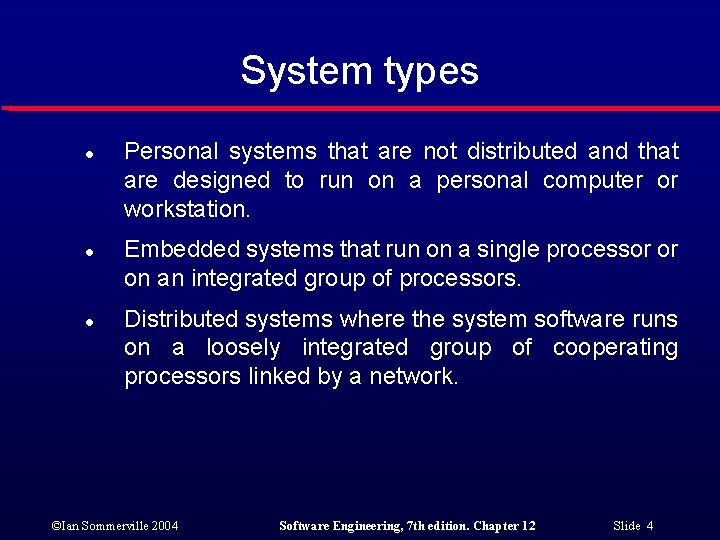
System types l l l Personal systems that are not distributed and that are designed to run on a personal computer or workstation. Embedded systems that run on a single processor or on an integrated group of processors. Distributed systems where the system software runs on a loosely integrated group of cooperating processors linked by a network. ©Ian Sommerville 2004 Software Engineering, 7 th edition. Chapter 12 Slide 4

Distributed system characteristics l Resource sharing • l Openness • l Concurrent processing to enhance performance. Scalability • l Use of equipment and software from different vendors. Concurrency • l Sharing of hardware and software resources. Increased throughput by adding new resources. Fault tolerance • The ability to continue in operation after a fault has occurred. ©Ian Sommerville 2004 Software Engineering, 7 th edition. Chapter 12 Slide 5
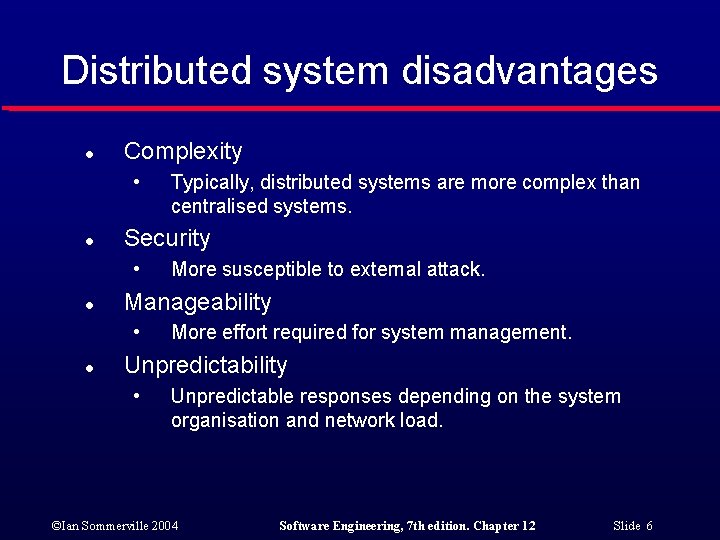
Distributed system disadvantages l Complexity • l Security • l More susceptible to external attack. Manageability • l Typically, distributed systems are more complex than centralised systems. More effort required for system management. Unpredictability • Unpredictable responses depending on the system organisation and network load. ©Ian Sommerville 2004 Software Engineering, 7 th edition. Chapter 12 Slide 6

Distributed systems architectures l Client-server architectures • l Distributed services which are called on by clients. Servers that provide services are treated differently from clients that use services. Distributed object architectures • No distinction between clients and servers. Any object on the system may provide and use services from other objects. ©Ian Sommerville 2004 Software Engineering, 7 th edition. Chapter 12 Slide 7
Middleware l l l Software that manages and supports the different components of a distributed system. In essence, it sits in the middle of the system. Middleware is usually off-the-shelf rather than specially written software. Examples • • • Transaction processing monitors; Data converters; Communication controllers. ©Ian Sommerville 2004 Software Engineering, 7 th edition. Chapter 12 Slide 8
Multiprocessor architectures l l Simplest distributed system model. System composed of multiple processes which may (but need not) execute on different processors. Architectural model of many large real-time systems. Distribution of process to processor may be pre-ordered or may be under the control of a dispatcher. ©Ian Sommerville 2004 Software Engineering, 7 th edition. Chapter 12 Slide 9
A multiprocessor traffic control system ©Ian Sommerville 2004 Software Engineering, 7 th edition. Chapter 12 Slide 10

Client-server architectures l l The application is modelled as a set of services that are provided by servers and a set of clients that use these services. Clients know of servers but servers need not know of clients. Clients and servers are logical processes The mapping of processors to processes is not necessarily 1 : 1. ©Ian Sommerville 2004 Software Engineering, 7 th edition. Chapter 12 Slide 11
A client-server system ©Ian Sommerville 2004 Software Engineering, 7 th edition. Chapter 12 Slide 12
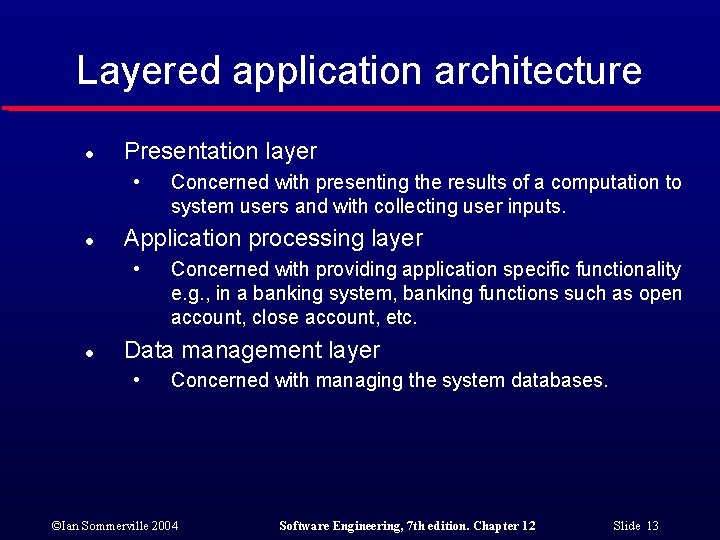
Layered application architecture l Presentation layer • l Application processing layer • l Concerned with presenting the results of a computation to system users and with collecting user inputs. Concerned with providing application specific functionality e. g. , in a banking system, banking functions such as open account, close account, etc. Data management layer • Concerned with managing the system databases. ©Ian Sommerville 2004 Software Engineering, 7 th edition. Chapter 12 Slide 13
Application layers ©Ian Sommerville 2004 Software Engineering, 7 th edition. Chapter 12 Slide 14
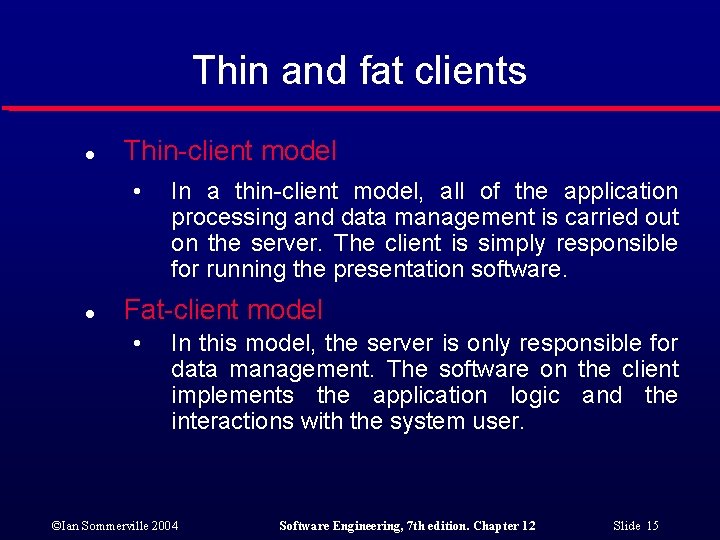
Thin and fat clients l Thin-client model • l In a thin-client model, all of the application processing and data management is carried out on the server. The client is simply responsible for running the presentation software. Fat-client model • In this model, the server is only responsible for data management. The software on the client implements the application logic and the interactions with the system user. ©Ian Sommerville 2004 Software Engineering, 7 th edition. Chapter 12 Slide 15
Thin and fat clients ©Ian Sommerville 2004 Software Engineering, 7 th edition. Chapter 12 Slide 16
Thin client model l Used when legacy systems are migrated to client server architectures. • l The legacy system acts as a server in its own right with a graphical interface implemented on a client. A major disadvantage is that it places a heavy processing load on both the server and the network. ©Ian Sommerville 2004 Software Engineering, 7 th edition. Chapter 12 Slide 17
Fat client model l More processing is delegated to the client as the application processing is locally executed. Most suitable for new C/S systems where the capabilities of the client system are known in advance. More complex than a thin client model especially for management. New versions of the application have to be installed on all clients. ©Ian Sommerville 2004 Software Engineering, 7 th edition. Chapter 12 Slide 18
A client-server ATM system ©Ian Sommerville 2004 Software Engineering, 7 th edition. Chapter 12 Slide 19
Three-tier architectures l l l In a three-tier architecture, each of the application architecture layers may execute on a separate processor. Allows for better performance than a thinclient approach and is simpler to manage than a fat-client approach. A more scalable architecture - as demands increase, extra servers can be added. ©Ian Sommerville 2004 Software Engineering, 7 th edition. Chapter 12 Slide 20
A 3 -tier C/S architecture ©Ian Sommerville 2004 Software Engineering, 7 th edition. Chapter 12 Slide 21
An internet banking system ©Ian Sommerville 2004 Software Engineering, 7 th edition. Chapter 12 Slide 22
Use of C/S architectures ©Ian Sommerville 2004 Software Engineering, 7 th edition. Chapter 12 Slide 23
Key points l l Distributed systems support resource sharing, openness, concurrency, scalability, fault tolerance and transparency. Client-server architectures involve services being delivered by servers to programs operating on clients. User interface software always runs on the client and data management on the server. Application functionality may be on the client or the server. In a distributed object architecture, there is no distinction between clients and servers. ©Ian Sommerville 2004 Software Engineering, 7 th edition. Chapter 12 Slide 24
- Slides: 24