
Distributed Systems CS 15 440 Synchronization Part II

Distributed Systems CS 15 -440 Synchronization – Part II Lecture 09, Oct 7, 2015 Mohammad Hammoud
Today… § Last Session: § Synchronization: UTC, tracking time on a computer, physical clock synchronization § Today’s Session: § Logical Clock Synchronization § Lamport’s and Vector Clocks § Introduction to Distributed Mutual Exclusion § Announcements § Project I is due tomorrow Oct 8 th by midnight § Midterm exam is on Monday, Oct 12 (it is open-books, open-notes) § We will have a midterm overview tomorrow during the recitation
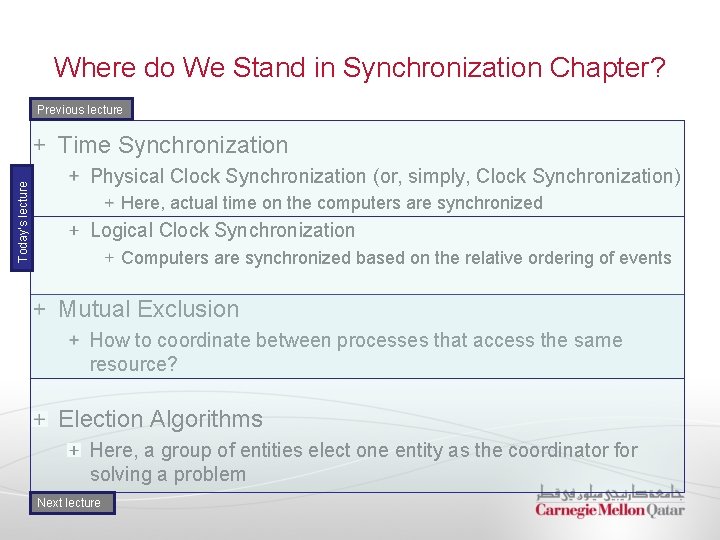
Where do We Stand in Synchronization Chapter? Previous lecture Today’s lecture Time Synchronization Physical Clock Synchronization (or, simply, Clock Synchronization) Here, actual time on the computers are synchronized Logical Clock Synchronization Computers are synchronized based on the relative ordering of events Mutual Exclusion How to coordinate between processes that access the same resource? Election Algorithms Here, a group of entities elect one entity as the coordinator for solving a problem Next lecture

Overview Time Synchronization Clock Synchronization Logical Clock Synchronization Mutual Exclusion Election Algorithms
Why Logical Clocks? Lamport (in 1978) showed that: Clock synchronization is not necessary in all scenarios If two processes do not interact, it is not necessary that their clocks are synchronized Many times, it is sufficient if processes agree on the order in which the events has occurred in a DS For example, for a distributed make utility, it is sufficient to know if an input file was modified before or after its object file
Logical Clocks Logical clocks are used to define an order of events without measuring the physical time at which the events occurred We will study two types of logical clocks 1. Lamport’s Logical Clock (or simply, Lamport’s Clock) 2. Vector Clock
Logical Clocks We will study two types of logical clocks 1. Lamport’s Clock 2. Vector Clock
Lamport’s Logical Clock Lamport advocated maintaining logical clocks at the processes to keep track of the order of events To synchronize logical clocks, Lamport defined a relation called “happened-before” The expression a b (reads as “a happened before b”) means that all entities in a DS agree that event a occurred before event b
The Happened-before Relation The happened-before relation can be observed directly in two situations: 1. If a and b are events in the same process, and a occurs before b, then a b is true 2. If a is an event of message m being sent by a process, and b is the event of m being received by another process, then a b is true. The happened-before relation is transitive If a b and b c, then a c
Time values in Logical Clocks For every event a, assign a logical time value C(a) on which all processes agree Time value for events have the property that If a b, then C(a)< C(b)
Properties of Logical Clock From happened-before relation, we can infer that: If two events a and b occur within the same process and a b, then C(a) and C(b) are assigned time values such that C(a) < C(b) If a is the event of sending the message m from one process, and b is the event of receiving m, then the time values C(a) and C(b) are assigned in a way such that all processes agree that C(a) < C(b) The clock time C must always go forward (increasing), and never backward (decreasing)
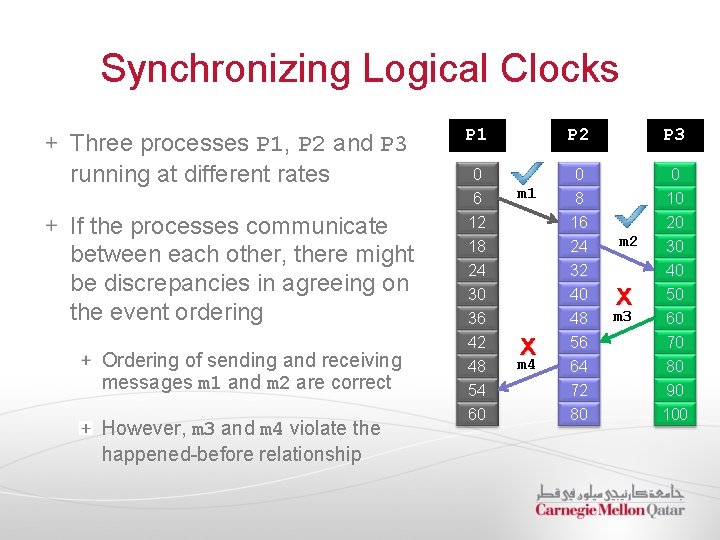
Synchronizing Logical Clocks Three processes P 1, P 2 and P 3 running at different rates P 1 P 2 P 3 0 6 0 8 0 10 If the processes communicate between each other, there might be discrepancies in agreeing on the event ordering 12 18 16 24 20 30 24 32 30 36 42 48 54 60 40 48 56 64 72 80 Ordering of sending and receiving messages m 1 and m 2 are correct However, m 3 and m 4 violate the happened-before relationship m 1 x m 4 m 2 x m 3 40 50 60 70 80 90 100
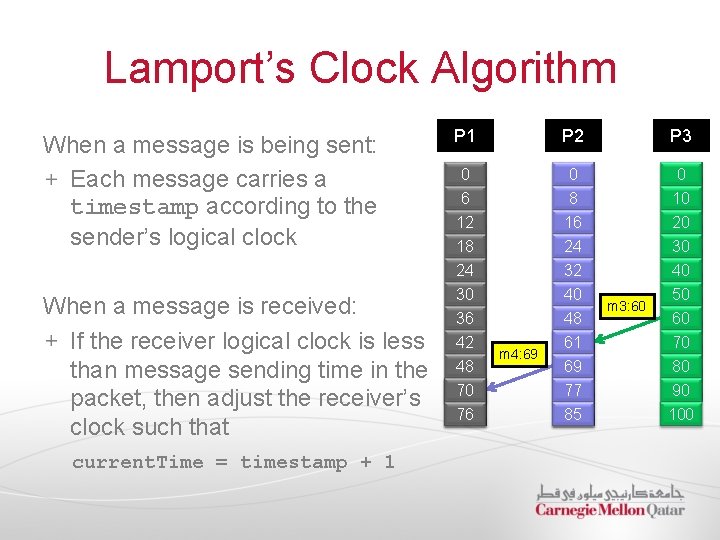
Lamport’s Clock Algorithm When a message is being sent: Each message carries a timestamp according to the sender’s logical clock When a message is received: If the receiver logical clock is less than message sending time in the packet, then adjust the receiver’s clock such that current. Time = timestamp + 1 P 2 P 3 0 6 0 8 0 10 12 18 16 24 20 30 24 32 40 30 36 42 48 54 70 60 76 40 48 56 61 64 69 72 77 80 85 m 4: 69 m 3: 60 50 60 70 80 90 100
Logical Clock Without a Physical Clock Previous examples assumed that there is a physical clock at each computer (probably running at different rates) How to attach a time value to an event when there is no global clock?
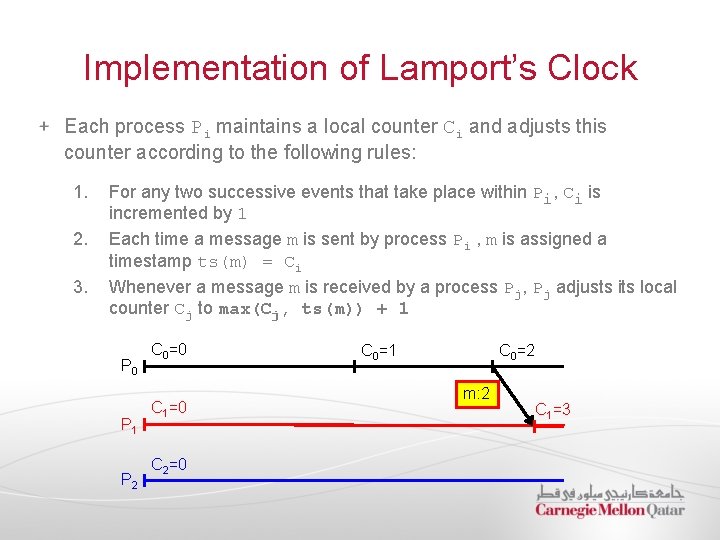
Implementation of Lamport’s Clock Each process Pi maintains a local counter Ci and adjusts this counter according to the following rules: 1. 2. 3. For any two successive events that take place within Pi, Ci is incremented by 1 Each time a message m is sent by process Pi , m is assigned a timestamp ts(m) = Ci Whenever a message m is received by a process Pj, Pj adjusts its local counter Cj to max(Cj, ts(m)) + 1 P 0 P 1 P 2 C 0=0 C 1=0 C 2=0 C 0=1 C 0=2 m: 2 C 1=3
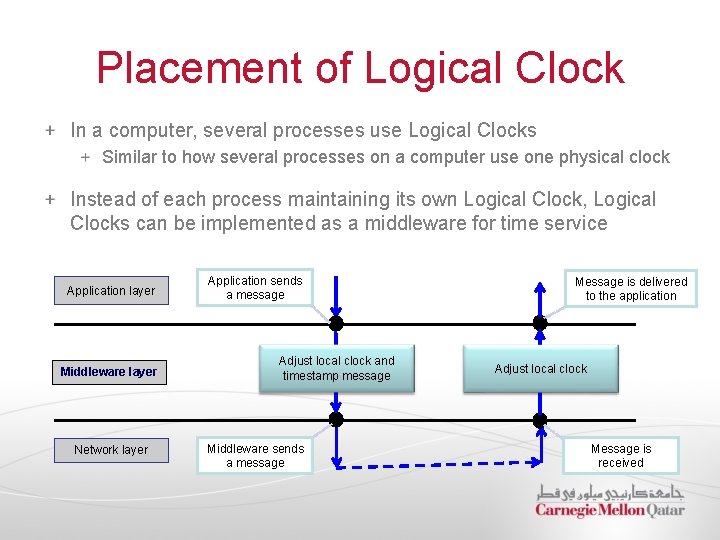
Placement of Logical Clock In a computer, several processes use Logical Clocks Similar to how several processes on a computer use one physical clock Instead of each process maintaining its own Logical Clock, Logical Clocks can be implemented as a middleware for time service Application layer Middleware layer Network layer Application sends a message Adjust local clock and timestamp message Middleware sends a message Message is delivered to the application Adjust local clock Message is received
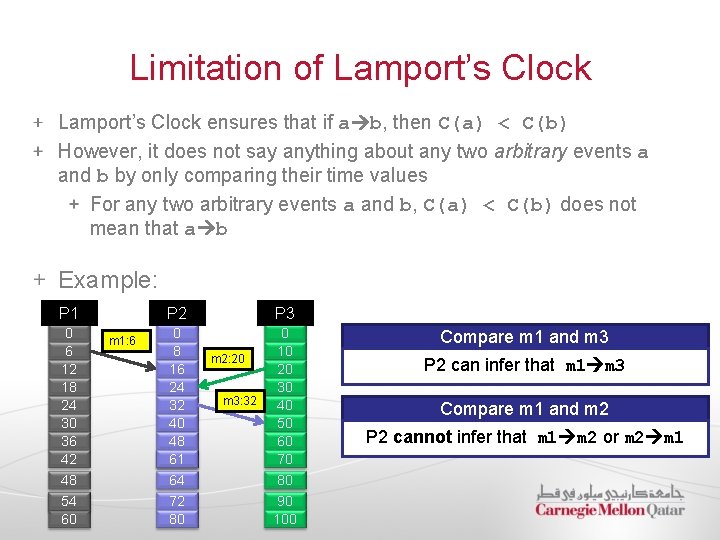
Limitation of Lamport’s Clock ensures that if a b, then C(a) < C(b) However, it does not say anything about any two arbitrary events a and b by only comparing their time values For any two arbitrary events a and b, C(a) < C(b) does not mean that a b Example: P 1 0 6 12 18 24 30 36 42 48 54 60 m 1: 6 P 2 P 3 0 8 16 24 32 40 48 56 61 64 72 80 0 10 20 30 40 50 60 70 80 90 100 m 2: 20 m 3: 32 Compare m 1 and m 3 P 2 can infer that m 1 m 3 Compare m 1 and m 2 P 2 cannot infer that m 1 m 2 or m 2 m 1
Summary of Lamport’s Clock Lamport advocated using logical clocks Processes synchronize based on the time values of their logical clocks rather than the absolute time values of their physical clocks Which applications in DS need logical clocks? Applications with provable ordering of events Perfect physical clock synchronization is hard to achieve in practice. Hence we cannot provably order the events Applications with rare events Events are rarely generated, and physical clock synchronization overhead is not justified However, Lamport’s clock cannot guarantee perfect ordering of events by just observing the time values of two arbitrary events
Logical Clocks We will study two types of logical clocks 1. Lamport’s Clock 2. Vector Clocks
Vector Clocks was proposed to overcome the limitation of Lamport’s clock (i. e. , C(a)< C(b) does not mean that a b) The property of inferring that a occurred before b is known as the causality property A Vector clock for a system of N processes is an array of N integers Every process Pi stores its own vector clock VCi Lamport’s time values for events are stored in VCi(a) is assigned to an event a If VCi(a) < VCi(b), then we can infer that a b (or more precisely, that event a causally precedes event b)
![Updating Vector Clocks Vector clocks are constructed by the following two properties: 1. VCi[i]](http://slidetodoc.com/presentation_image/c8173974ba56185299b1014e1b814fa5/image-21.jpg "Updating Vector Clocks Vector clocks are constructed by the following two properties: 1. VCi[i]")
Updating Vector Clocks Vector clocks are constructed by the following two properties: 1. VCi[i] is the number of events that have occurred at process Pi so far VCi[i] is the local logical clock at process Pi Increment VCi whenever a new event occurs 2. If VCi[j]= k, then Pi knows that k events have occurred at Pj VCi[j] is Pi’s knowledge of the local time at Pj Pass VCj along with the message
![Vector Clock Update Algorithm Whenever there is a new event at Pi, increment VCi[i]](http://slidetodoc.com/presentation_image/c8173974ba56185299b1014e1b814fa5/image-22.jpg "Vector Clock Update Algorithm Whenever there is a new event at Pi, increment VCi[i]")
Vector Clock Update Algorithm Whenever there is a new event at Pi, increment VCi[i] When a process Pi sends a message m to Pj: Increment VCi[i] Set m’s timestamp ts(m) to the vector VCi When message m is received process Pj : VCj[k] = max(VCj[k], ts(m)[k]) ; (for all k) Increment VCj[j] P 0 P 1 P 2 VC 0=(0, 0, 0) VC 1=(0, 0, 0) VC 2=(0, 0, 0) VC 0=(1, 0, 0) m: (2, 0, 0) VC 0=(2, 0, 0) VC 1=(2, 1, 0)
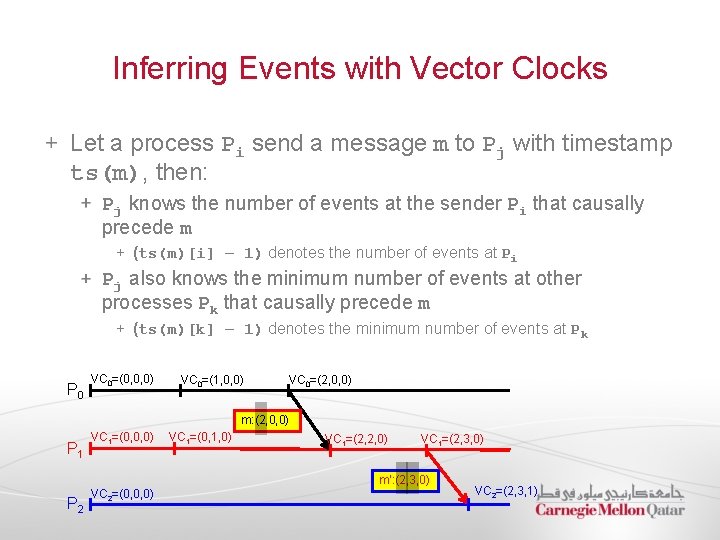
Inferring Events with Vector Clocks Let a process Pi send a message m to Pj with timestamp ts(m), then: Pj knows the number of events at the sender Pi that causally precede m (ts(m)[i] – 1) denotes the number of events at Pi Pj also knows the minimum number of events at other processes Pk that causally precede m (ts(m)[k] – 1) denotes the minimum number of events at Pk P 0 VC 0=(0, 0, 0) VC 0=(1, 0, 0) VC 0=(2, 0, 0) m: (2, 0, 0) P 1 P 2 VC 1=(0, 0, 0) VC 2=(0, 0, 0) VC 1=(0, 1, 0) VC 1=(2, 2, 0) VC 1=(2, 3, 0) m’: (2, 3, 0) VC 2=(2, 3, 1)
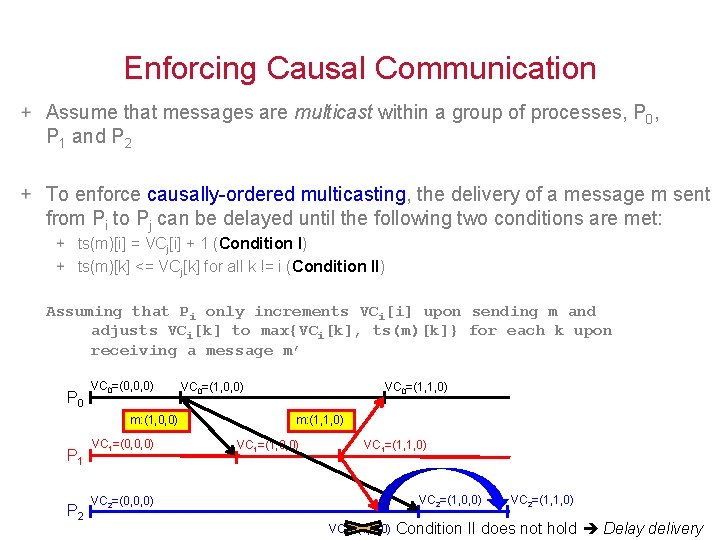
Enforcing Causal Communication Assume that messages are multicast within a group of processes, P 0, P 1 and P 2 To enforce causally-ordered multicasting, the delivery of a message m sent from Pi to Pj can be delayed until the following two conditions are met: ts(m)[i] = VCj[i] + 1 (Condition I) ts(m)[k] <= VCj[k] for all k != i (Condition II) Assuming that Pi only increments VCi[i] upon sending m and adjusts VCi[k] to max{VCi[k], ts(m)[k]} for each k upon receiving a message m’ P 0 VC 0=(0, 0, 0) m: (1, 0, 0) P 1 P 2 VC 1=(0, 0, 0) VC 0=(1, 1, 0) m: (1, 1, 0) VC 1=(1, 0, 0) VC 1=(1, 1, 0) VC 2=(1, 0, 0) VC 2=(0, 0, 0) VC 2=(1, 1, 0) Condition II does not hold Delay delivery
Summary – Logical Clocks are employed when processes have to agree on relative ordering of events, but not necessarily actual time of events Two types of Logical Clocks Lamport’s Logical Clocks Supports relative ordering of events across different processes by using the happened-before relationship Vector Clocks Supports causal ordering of events
Overview Time Synchronization Clock Synchronization Logical Clock Synchronization Mutual Exclusion Election Algorithms 26
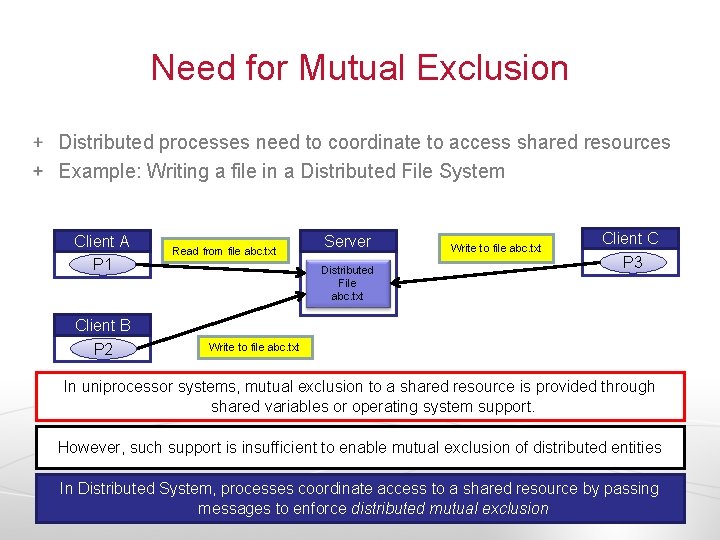
Need for Mutual Exclusion Distributed processes need to coordinate to access shared resources Example: Writing a file in a Distributed File System Client A P 1 Client B P 2 Read from file abc. txt Server Distributed File abc. txt Write to file abc. txt Client C P 3 Write to file abc. txt In uniprocessor systems, mutual exclusion to a shared resource is provided through shared variables or operating system support. However, such support is insufficient to enable mutual exclusion of distributed entities In Distributed System, processes coordinate access to a shared resource by passing 27 messages to enforce distributed mutual exclusion
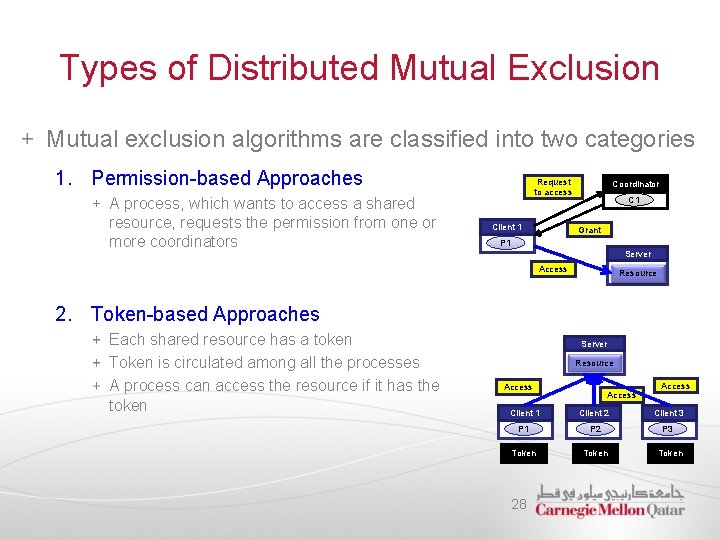
Types of Distributed Mutual Exclusion Mutual exclusion algorithms are classified into two categories 1. Permission-based Approaches A process, which wants to access a shared resource, requests the permission from one or more coordinators Request to access Client 1 Coordinator C 1 Grant P 1 Server Access Resource 2. Token-based Approaches Each shared resource has a token Token is circulated among all the processes A process can access the resource if it has the token Server Resource Access Client 1 Client 2 Client 3 P 1 P 2 P 3 Token 28
Overview Time Synchronization Clock Synchronization Logical Clock Synchronization Mutual Exclusion Permission-based Approaches Token-based Approaches Election Algorithms 29
Permission-based Approaches There are two types of permission-based mutual exclusion algorithms a. Centralized Algorithms b. Decentralized Algorithms We will study an example of each type of algorithms 30
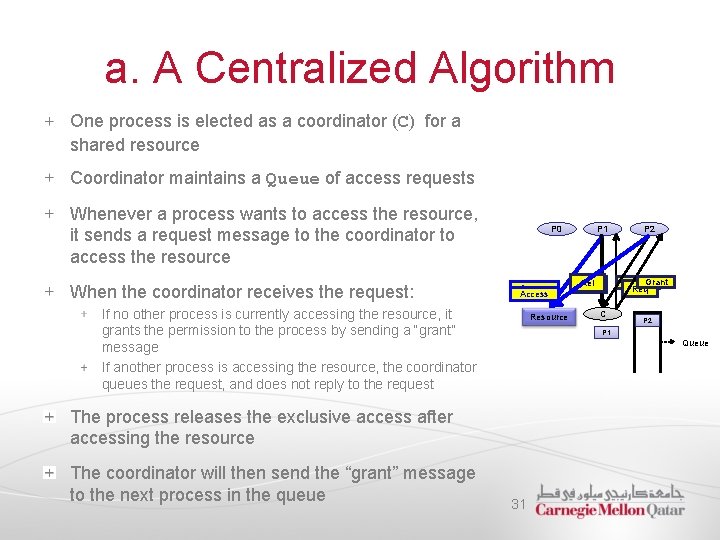
a. A Centralized Algorithm One process is elected as a coordinator (C) for a shared resource Coordinator maintains a Queue of access requests Whenever a process wants to access the resource, it sends a request message to the coordinator to access the resource When the coordinator receives the request: P 0 Access If no other process is currently accessing the resource, it grants the permission to the process by sending a “grant” message If another process is accessing the resource, the coordinator queues the request, and does not reply to the request Resource P 2 Grant Req Rel Req C P 2 P 1 Queue The process releases the exclusive access after accessing the resource The coordinator will then send the “grant” message to the next process in the queue P 1 31
Discussion about Centralized Algorithm Blocking vs. Non-blocking Requests The coordinator can block the requesting process until the resource is free Otherwise, the coordinator can send a “permission-denied” message back to the process The process can poll the coordinator at a later time, or The coordinator queues the request. Once the resource is released, the coordinator will send an explicit “grant” message to the process The algorithm guarantees mutual exclusion, and is simple to implement Fault-Tolerance: Centralized algorithm is vulnerable to a single-point of failure (at coordinator) Processes cannot distinguish between dead coordinator and request blocking Performance Bottleneck: In a large system, single coordinator can be overwhelmed with requests 32

Next Class Mutual Exclusion How to coordinate between processes that access the same resource? Election Algorithms Here, a group of entities elect one entity as the coordinator for solving a problem
References http: //en. wikipedia. org/wiki/Causality
- Slides: 34