
Distributed Systems CS 15 440 Fault Tolerance Part
Distributed Systems CS 15 -440 Fault Tolerance- Part III Lecture 15, Oct 26, 2011 Majd F. Sakr, Mohammad Hammoud and. Vinay Kolar 1
Today… § Last session § Fault Tolerance – Part II § Reliable communication § Today’s session § Fault Tolerance – Part III § Reliable communication § Atomicity § Recovery § Announcement: § Project 3 has been posted. DR is due on Monday Oct 31 2
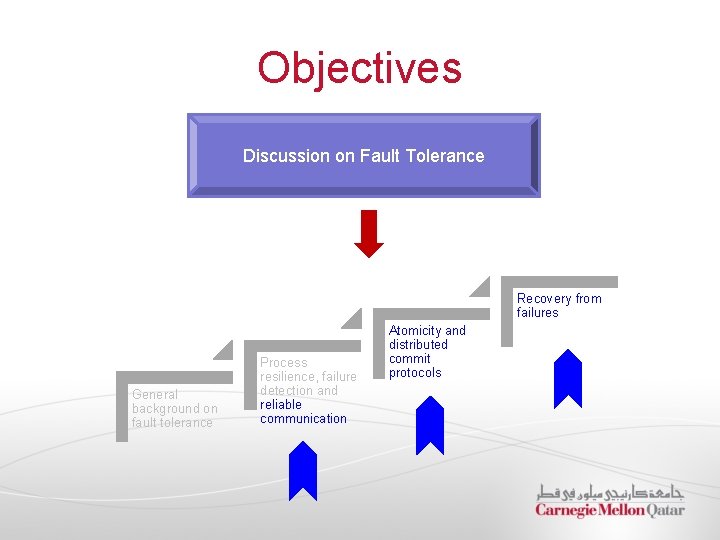
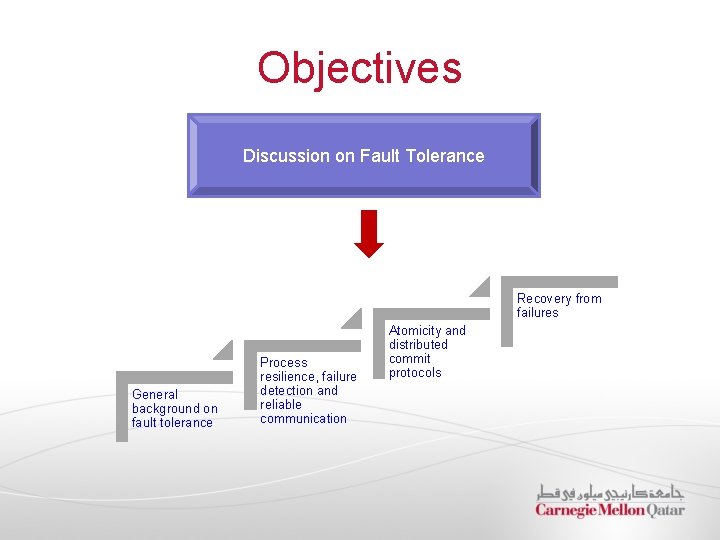
Objectives Discussion on Fault Tolerance Recovery from failures General background on fault tolerance Process resilience, failure detection and reliable communication Atomicity and distributed commit protocols
Objectives Discussion on Fault Tolerance Recovery from failures General background on fault tolerance Process resilience, failure detection and reliable communication Atomicity and distributed commit protocols
Reliable Communication Reliable Request-Reply Communication Reliable Group Communication 5

Reliable Group Communication § A Basic Reliable-Multicasting Scheme § Scalability in Reliable Multicasting § Atomic Multicast 6
Reliable Group Communication § A Basic Reliable-Multicasting Scheme (Recap) § Scalability in Reliable Multicasting § Atomic Multicast 7
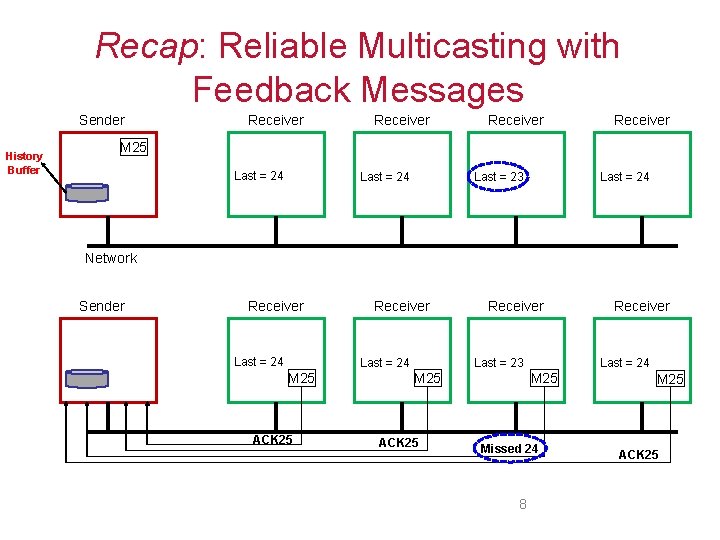
Recap: Reliable Multicasting with Feedback Messages Sender History Buffer Receiver M 25 Last = 24 Last = 23 Last = 24 Network Sender Receiver Last = 24 M 25 ACK 25 Receiver Last = 23 ACK 25 Last = 24 M 25 Missed 24 8 Receiver M 25 ACK 25
Reliable Group Communication § A Basic Reliable-Multicasting Scheme § Scalability in Reliable Multicasting § Atomic Multicast 9

Scalability Issues with a Feedback. Based Scheme § If there are N receivers in a multicasting process, the sender must be prepared to accept at least N ACKs § This might cause a feedback implosion § Instead, we can let a receiver return only a NACK § Limitations: § No hard guarantees can be given that a feedback implosion will not happen § It is not clear for how long the sender should keep a message in its history buffer 10
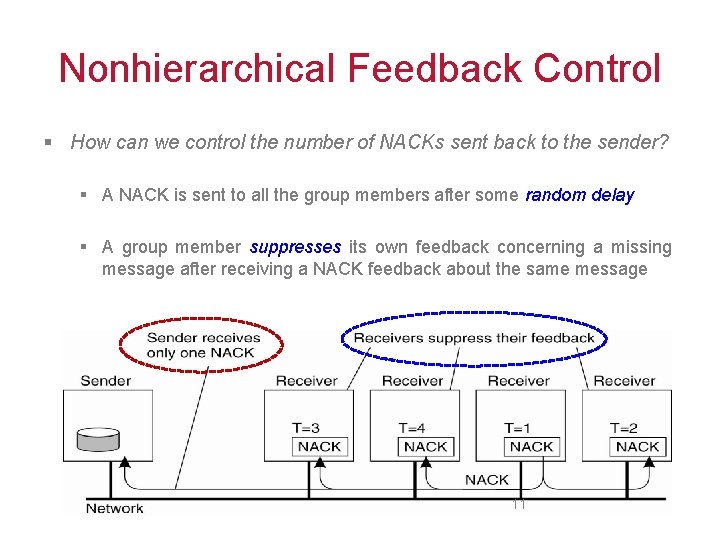
Nonhierarchical Feedback Control § How can we control the number of NACKs sent back to the sender? § A NACK is sent to all the group members after some random delay § A group member suppresses its own feedback concerning a missing message after receiving a NACK feedback about the same message 11
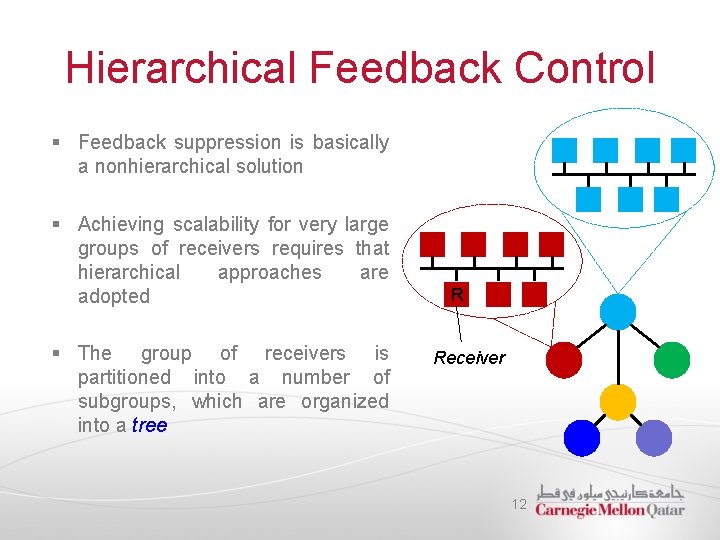
Hierarchical Feedback Control § Feedback suppression is basically a nonhierarchical solution § Achieving scalability for very large groups of receivers requires that hierarchical approaches are adopted § The group of receivers is partitioned into a number of subgroups, which are organized into a tree R Receiver 12
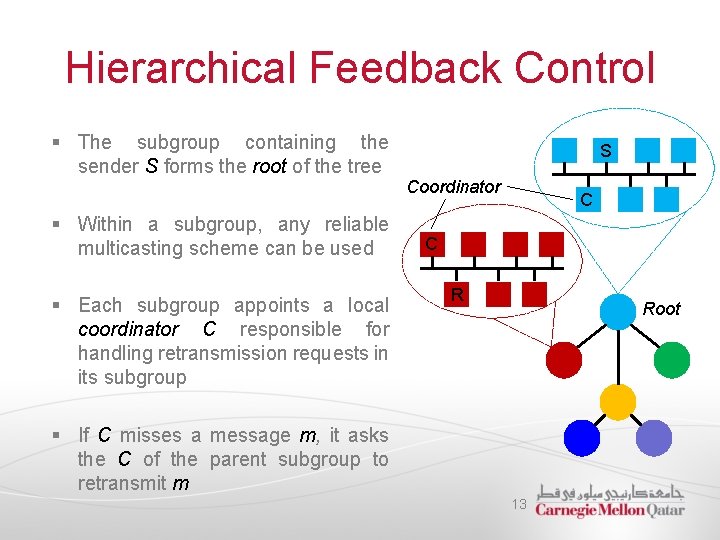
Hierarchical Feedback Control § The subgroup containing the sender S forms the root of the tree § Within a subgroup, any reliable multicasting scheme can be used § Each subgroup appoints a local coordinator C responsible for handling retransmission requests in its subgroup S Coordinator C C R Root § If C misses a message m, it asks the C of the parent subgroup to retransmit m 13
Reliable Group Communication § A Basic Reliable-Multicasting Scheme § Scalability in Reliable Multicasting § Atomic Multicast 14
Atomic Multicast § P 1: What is often needed in a distributed system is the guarantee that a message is delivered to either all processes or to none at all § P 2: It is also generally required that all messages are delivered in the same order to all processes § Satisfying P 1 and P 2 results in an atomic multicast § Atomic multicast: § Ensures that non-faulty processes maintain a consistent view § Forces reconciliation when a process recovers and rejoins the group 15
Virtual Synchrony (1) § A multicast message m is uniquely associated with a list of processes to which it should be delivered § This delivery list corresponds to a group view (G) A reliable multicast with this property is said to be virtually § There is only one case in which delivery of m is allowed to fail: synchronous § When a group-membership-change is the result of the sender of m crashing § In this case, m may either be delivered to all remaining processes, or ignored by each of them 16
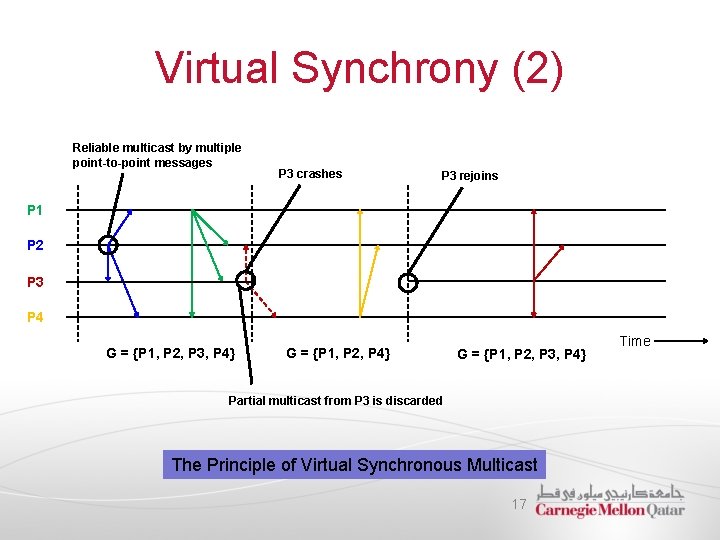
Virtual Synchrony (2) Reliable multicast by multiple point-to-point messages P 3 crashes P 3 rejoins P 1 P 2 P 3 P 4 G = {P 1, P 2, P 3, P 4} Partial multicast from P 3 is discarded The Principle of Virtual Synchronous Multicast 17 Time
Message Ordering § Four different virtually synchronous multicast orderings are distinguished: 1. Unordered multicasts 2. FIFO-ordered multicasts 3. Causally-ordered multicasts 4. Totally-ordered multicasts 18
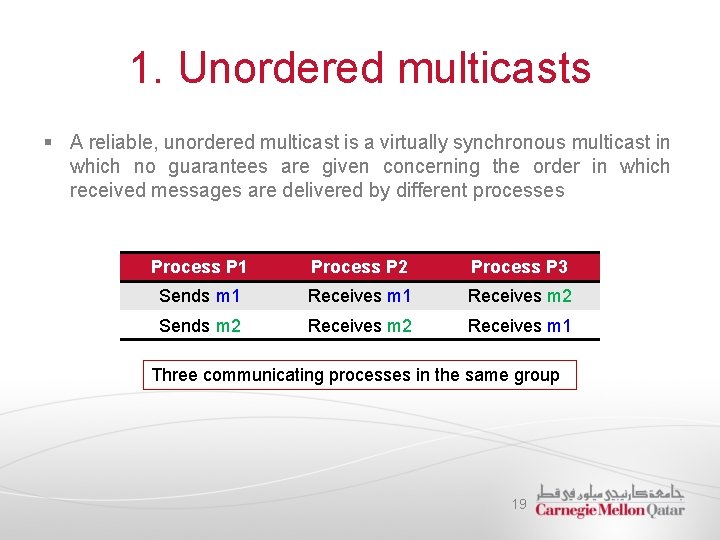
1. Unordered multicasts § A reliable, unordered multicast is a virtually synchronous multicast in which no guarantees are given concerning the order in which received messages are delivered by different processes Process P 1 Process P 2 Process P 3 Sends m 1 Receives m 2 Sends m 2 Receives m 1 Three communicating processes in the same group 19
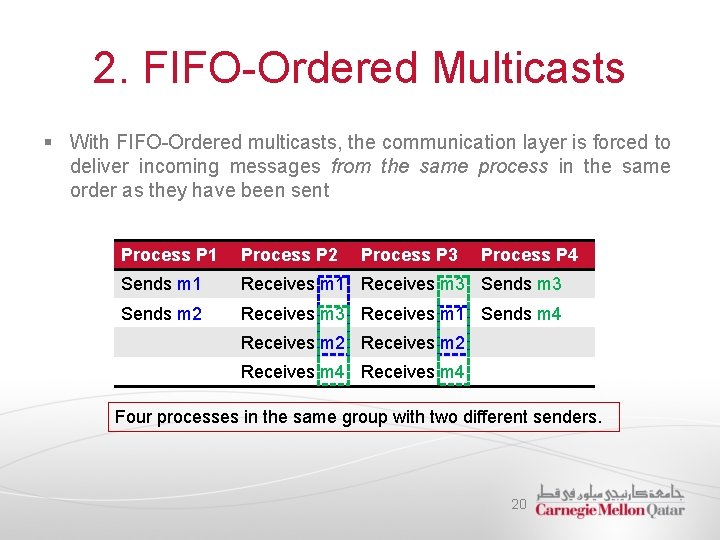
2. FIFO-Ordered Multicasts § With FIFO-Ordered multicasts, the communication layer is forced to deliver incoming messages from the same process in the same order as they have been sent Process P 1 Process P 2 Process P 3 Process P 4 Sends m 1 Receives m 3 Sends m 2 Receives m 3 Receives m 1 Sends m 4 Receives m 2 Receives m 4 Four processes in the same group with two different senders. 20
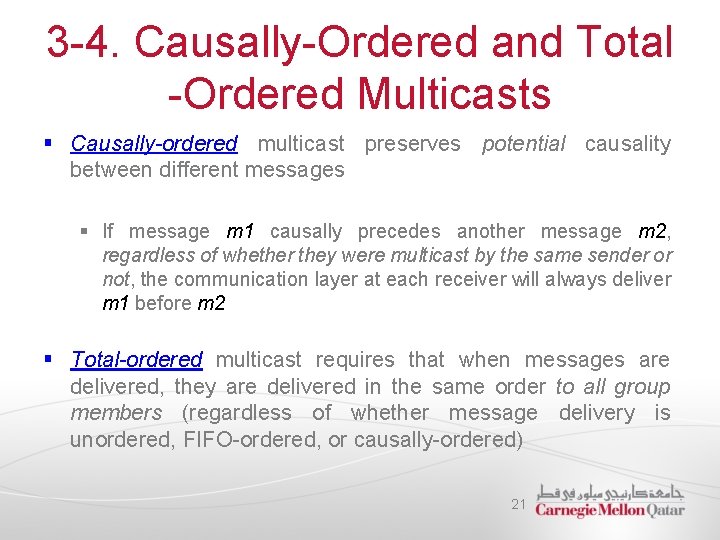
3 -4. Causally-Ordered and Total -Ordered Multicasts § Causally-ordered multicast preserves potential causality between different messages § If message m 1 causally precedes another message m 2, regardless of whether they were multicast by the same sender or not, the communication layer at each receiver will always deliver m 1 before m 2 § Total-ordered multicast requires that when messages are delivered, they are delivered in the same order to all group members (regardless of whether message delivery is unordered, FIFO-ordered, or causally-ordered) 21
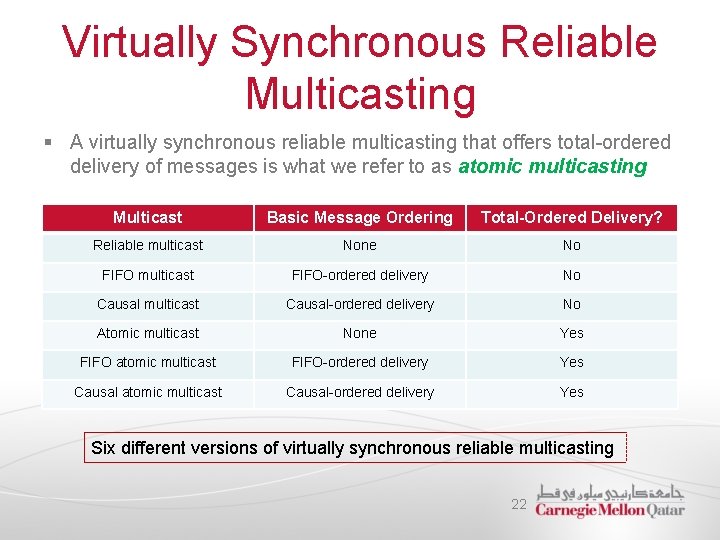
Virtually Synchronous Reliable Multicasting § A virtually synchronous reliable multicasting that offers total-ordered delivery of messages is what we refer to as atomic multicasting Multicast Basic Message Ordering Total-Ordered Delivery? Reliable multicast None No FIFO multicast FIFO-ordered delivery No Causal multicast Causal-ordered delivery No Atomic multicast None Yes FIFO atomic multicast FIFO-ordered delivery Yes Causal atomic multicast Causal-ordered delivery Yes Six different versions of virtually synchronous reliable multicasting 22
Implementing Virtual Synchrony (1) § We will consider a possible implementation of virtual synchrony appeared in Isis [Birman et al. 1991] § Isis assumes a FIFO-ordered multicast § Isis makes use of TCP, hence, each transmission is guaranteed to succeed § Using TCP does not guarantee that all messages sent to a view G are delivered to all non-faulty processes in G before any view change 23

Implementing Virtual Synchrony (2) § The solution adopted by Isis is to let every process in G keeps a message m until it knows for sure that all members in G have received it § If m has been received by all members in G, m is said to be stable § Only stable messages are allowed to be delivered 24
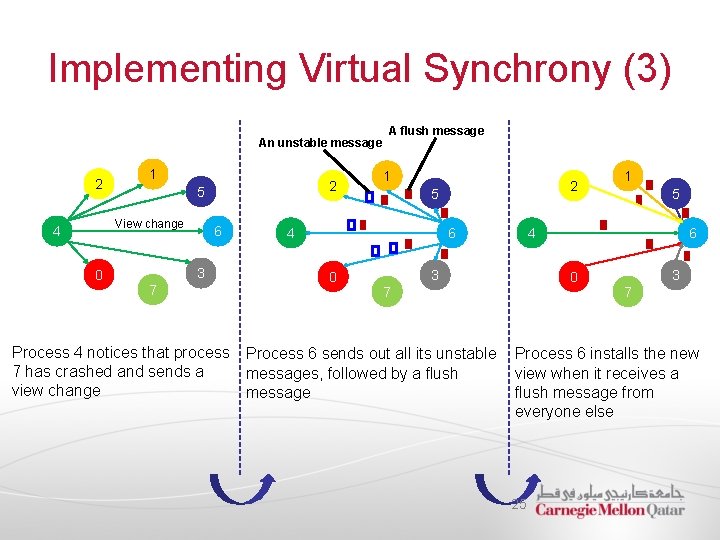
Implementing Virtual Synchrony (3) An unstable message 2 1 5 View change 4 0 2 6 3 7 A flush message 1 2 5 4 6 0 5 4 3 6 0 7 Process 4 notices that process Process 6 sends out all its unstable 7 has crashed and sends a messages, followed by a flush view change message 1 3 7 Process 6 installs the new view when it receives a flush message from everyone else 25
Distributed Commit § Atomic multicasting problem is an example of a more general problem, known as distributed commit § The distributed commit problem involves having an operation being performed by each member of a process group, or none at all § With reliable multicasting, the operation is the delivery of a message § With distributed transactions, the operation may be the commit of a transaction at a single site that takes part in the transaction § Distributed commit is often established by means of a coordinator and participants 26
One-Phase Commit Protocol § In a simple scheme, a coordinator can tell all participants whether or not to (locally) perform the operation in question § This scheme is referred to as a one-phase commit protocol § The one-phase commit protocol has a main drawback that if one of the participants cannot actually perform the operation, there is no way to tell the coordinator § In practice, more sophisticated schemes are needed. The most common utilized one is the two-phase commit protocol 27
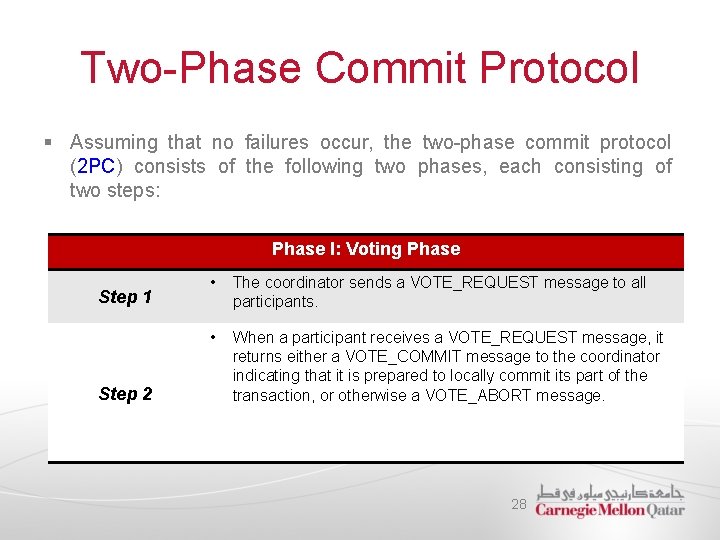
Two-Phase Commit Protocol § Assuming that no failures occur, the two-phase commit protocol (2 PC) consists of the following two phases, each consisting of two steps: Phase I: Voting Phase Step 1 Step 2 • The coordinator sends a VOTE_REQUEST message to all participants. • When a participant receives a VOTE_REQUEST message, it returns either a VOTE_COMMIT message to the coordinator telling the coordinator that it is prepared to locally commit its indicating that it is prepared to locally commit its part of the transaction, or otherwise a VOTE_ABORT message 28
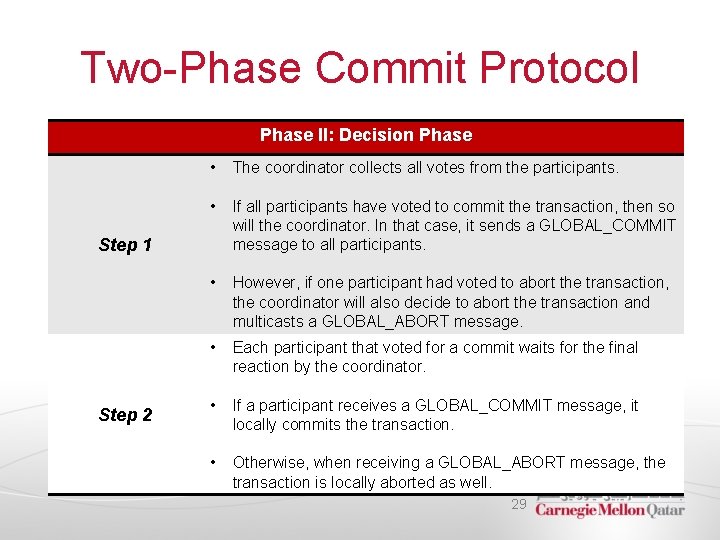
Two-Phase Commit Protocol Phase II: Decision Phase • The coordinator collects all votes from the participants. • If all participants have voted to commit the transaction, then so will the coordinator. In that case, it sends a GLOBAL_COMMIT message to all participants. • However, if one participant had voted to abort the transaction, the coordinator will also decide to abort the transaction and multicasts a GLOBAL_ABORT message. • Each participant that voted for a commit waits for the final reaction by the coordinator. • If a participant receives a GLOBAL_COMMIT message, it locally commits the transaction. • Otherwise, when receiving a GLOBAL_ABORT message, the transaction is locally aborted as well. Step 1 Step 2 29
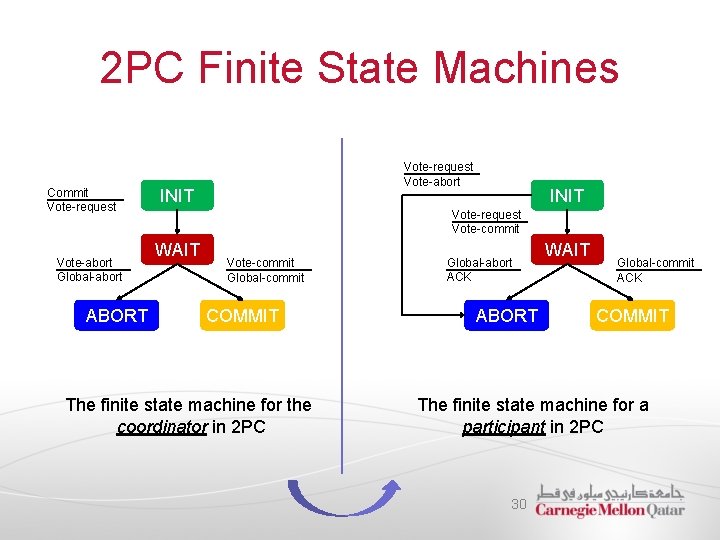
2 PC Finite State Machines Commit Vote-request Vote-abort Global-abort ABORT Vote-request Vote-abort INIT Vote-request Vote-commit WAIT Vote-commit Global-commit COMMIT The finite state machine for the coordinator in 2 PC Global-abort ACK ABORT WAIT Global-commit ACK COMMIT The finite state machine for a participant in 2 PC 30
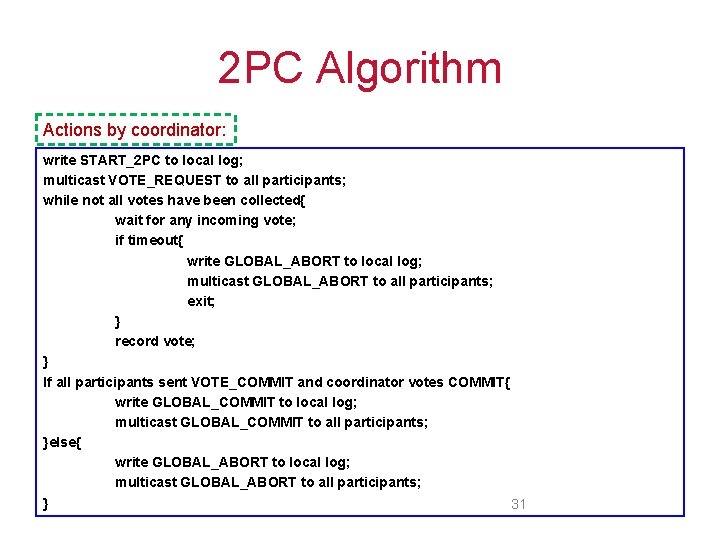
2 PC Algorithm Actions by coordinator: write START_2 PC to local log; multicast VOTE_REQUEST to all participants; while not all votes have been collected{ wait for any incoming vote; if timeout{ write GLOBAL_ABORT to local log; multicast GLOBAL_ABORT to all participants; exit; } record vote; } If all participants sent VOTE_COMMIT and coordinator votes COMMIT{ write GLOBAL_COMMIT to local log; multicast GLOBAL_COMMIT to all participants; }else{ write GLOBAL_ABORT to local log; multicast GLOBAL_ABORT to all participants; } 31
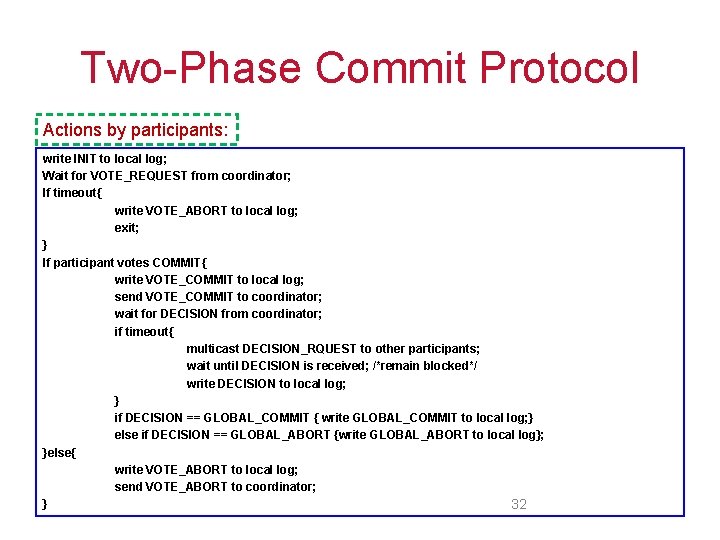
Two-Phase Commit Protocol Actions by participants: write INIT to local log; Wait for VOTE_REQUEST from coordinator; If timeout{ write VOTE_ABORT to local log; exit; } If participant votes COMMIT{ write VOTE_COMMIT to local log; send VOTE_COMMIT to coordinator; wait for DECISION from coordinator; if timeout{ multicast DECISION_RQUEST to other participants; wait until DECISION is received; /*remain blocked*/ write DECISION to local log; } if DECISION == GLOBAL_COMMIT { write GLOBAL_COMMIT to local log; } else if DECISION == GLOBAL_ABORT {write GLOBAL_ABORT to local log}; }else{ write VOTE_ABORT to local log; send VOTE_ABORT to coordinator; } 32
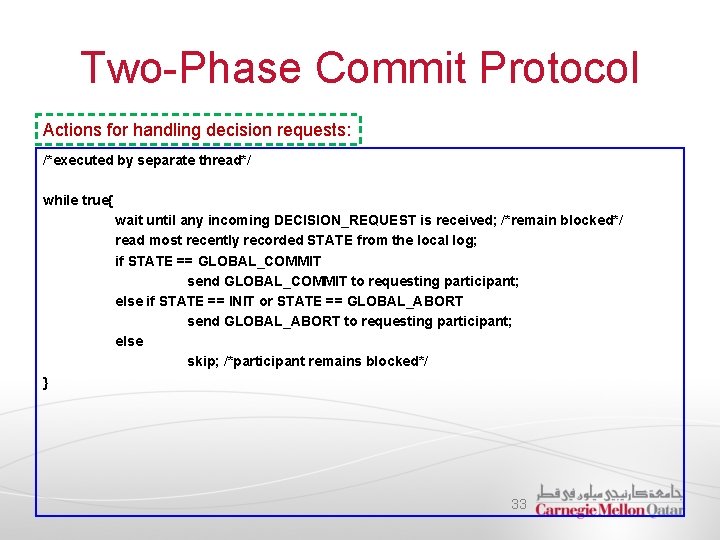
Two-Phase Commit Protocol Actions for handling decision requests: /*executed by separate thread*/ while true{ wait until any incoming DECISION_REQUEST is received; /*remain blocked*/ read most recently recorded STATE from the local log; if STATE == GLOBAL_COMMIT send GLOBAL_COMMIT to requesting participant; else if STATE == INIT or STATE == GLOBAL_ABORT send GLOBAL_ABORT to requesting participant; else skip; /*participant remains blocked*/ } 33
Objectives Discussion on Fault Tolerance Recovery from failures General background on fault tolerance Process resilience, failure detection and reliable communication Atomicity and distributed commit protocols
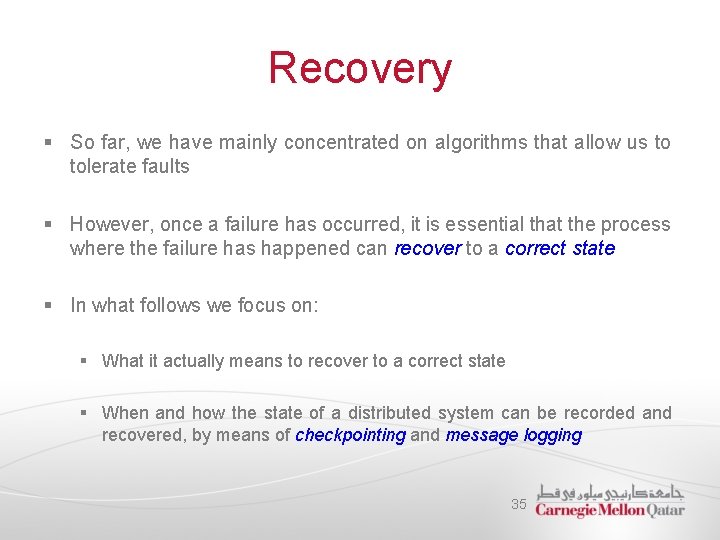
Recovery § So far, we have mainly concentrated on algorithms that allow us to tolerate faults § However, once a failure has occurred, it is essential that the process where the failure has happened can recover to a correct state § In what follows we focus on: § What it actually means to recover to a correct state § When and how the state of a distributed system can be recorded and recovered, by means of checkpointing and message logging 35

Recovery § Error Recovery § Checkpointing § Message Logging 36
Recovery § Error Recovery § Checkpointing § Message Logging 37
Error Recovery § Once a failure has occurred, it is essential that the process where the failure has happened can recover to a correct state § Fundamental to fault tolerance is the recovery from an error § The idea of error recovery is to replace an erroneous state with an error-free state § There are essentially two forms of error recovery: 1. Backward recovery 2. Forward recovery 38
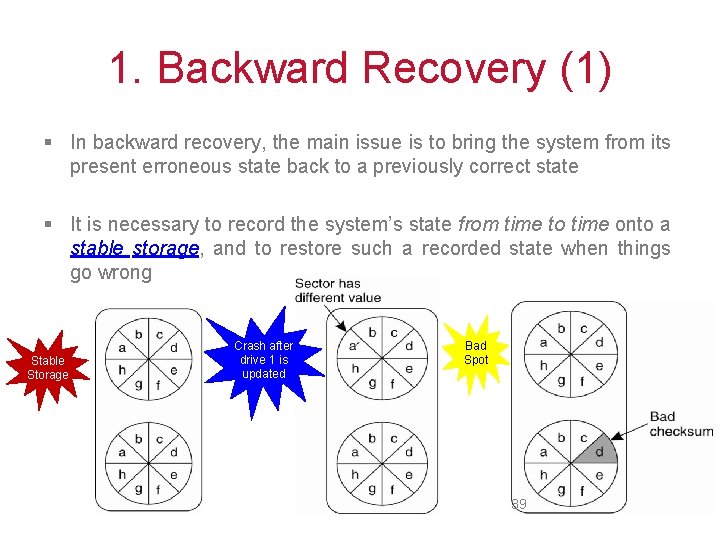
1. Backward Recovery (1) § In backward recovery, the main issue is to bring the system from its present erroneous state back to a previously correct state § It is necessary to record the system’s state from time to time onto a stable storage, and to restore such a recorded state when things go wrong Stable Storage Crash after drive 1 is updated Bad Spot 39
1. Backward Recovery (2) § Each time (part of) the system’s present state is recorded, a checkpoint is said to be made § Problems with backward recovery: § Restoring a system or a process to a previous state is generally expensive in terms of performance § Some states can never be rolled back (e. g. , typing in UNIX rm –fr *) 40
2. Forward Recovery § When the system detects that it has made an error, forward recovery reverts the system state to error time and corrects it, to be able to move forward § Forward recovery is typically faster than backward recovery but requires that it has to be known in advance which errors may occur § Some systems make use of both forward and backward recovery for different errors or different parts of one error 41
Recovery § Error Recovery § Checkpointing § Message Logging 42
Why Checkpointing? § In a fault-tolerant distributed system, backward recovery requires that the system regularly saves its state onto a stable storage § This process is referred to as checkpointing § In particular, checkpointing consists of storing a distributed snapshot of the current application state (i. e. , a consistent global state), and later on, use it for restarting the execution in case of a failure 43
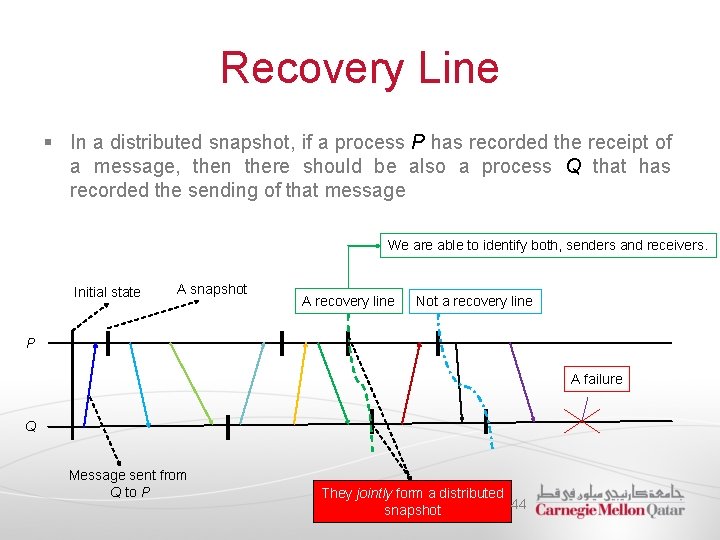
Recovery Line § In a distributed snapshot, if a process P has recorded the receipt of a message, then there should be also a process Q that has recorded the sending of that message We are able to identify both, senders and receivers. Initial state A snapshot A recovery line Not a recovery line P A failure Q Message sent from Q to P They jointly form a distributed 44 snapshot

Checkpointing § Checkpointing can be of two types: 1. Independent Checkpointing: each process simply records its local state from time to time in an uncoordinated fashion 2. Coordinated Checkpointing: all processes synchronize to jointly write their states to local stable storages 45
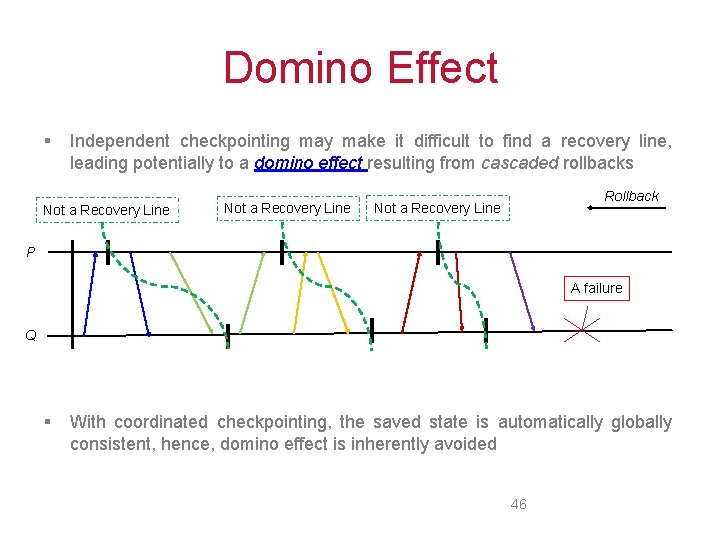
Domino Effect § Independent checkpointing may make it difficult to find a recovery line, leading potentially to a domino effect resulting from cascaded rollbacks Not a Recovery Line Rollback Not a Recovery Line P A failure Q § With coordinated checkpointing, the saved state is automatically globally consistent, hence, domino effect is inherently avoided 46
Recovery § Error Recovery § Checkpointing § Message Logging 47
Why Message Logging? § Considering that checkpointing is an expensive operation, techniques have been sought to reduce the number of checkpoints, but still enable recovery § An important technique in distributed systems is message logging § The basic idea is that if transmission of messages can be replayed, we can still reach a globally consistent state but without having to restore that state from stable storage § In practice, the combination of having fewer checkpoints and message logging is more efficient than having to take many checkpoints 48
Message Logging § Message logging can be of two types: 1. Sender-based logging: A process can log its messages before sending them off 2. Receiver-based logging: A receiving process can first log an incoming message before delivering it to the application § When a sending or a receiving process crashes, it can restore the most recently checkpointed state, and from there on replay the logged messages (important for non-deterministic behaviors) 49
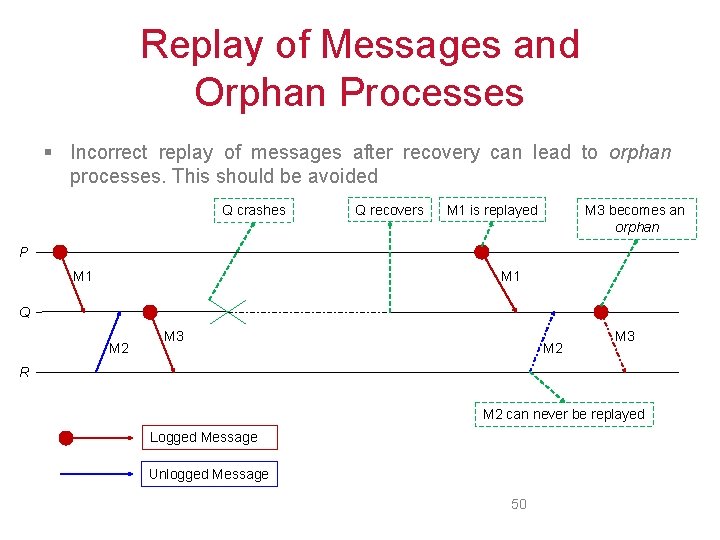
Replay of Messages and Orphan Processes § Incorrect replay of messages after recovery can lead to orphan processes. This should be avoided Q crashes Q recovers M 1 is replayed M 3 becomes an orphan P M 1 Q M 2 M 3 R M 2 can never be replayed Logged Message Unlogged Message 50
Objectives Discussion on Fault Tolerance Recovery from failures General background on fault tolerance Process resilience, failure detection and reliable communication Atomicity and distributed commit protocols

Next Class Programming Models-Part I Thanks You! 52
- Slides: 52