
Distributed Systems CS 15 440 Architectures Lecture 6
Distributed Systems CS 15 -440 Architectures Lecture 6, September 13, 2017 Mohammad Hammoud

Today… § Last Session: § Remote Procedure Calls § Today’s Session: § Conclude Remote Procedure Calls § Architectures § Announcements: § Project I is due on Oct 1 st – Design report is due on Sept 14 § All lectures (and recitations) will be held from now on at room 1031
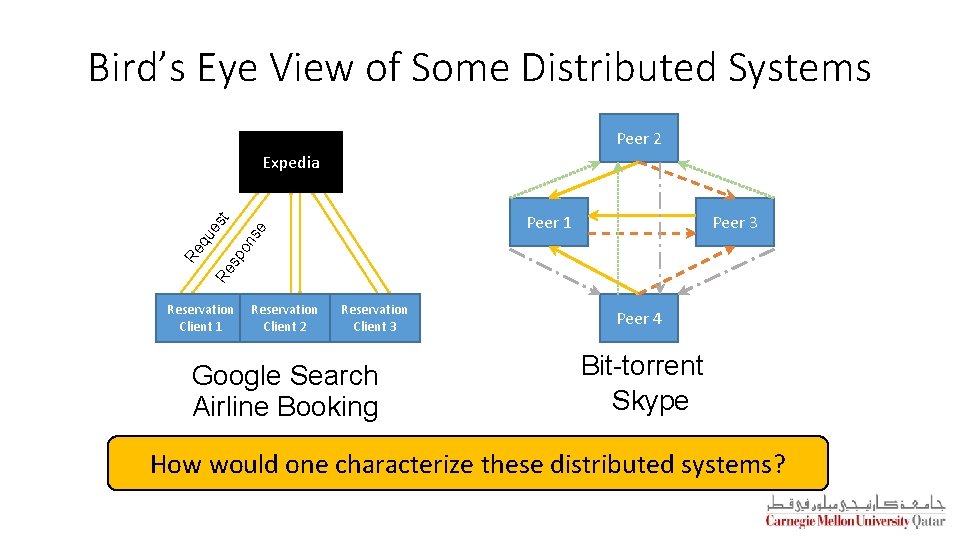
Bird’s Eye View of Some Distributed Systems Peer 2 Peer 3 on se Peer 1 Re sp Re q ue st Google Expedia Server Search Reservation Client 1 1 Client Search Reservation Client 2 2 Client Search Reservation Client 33 Client Google Search Airline Booking Peer 4 Bit-torrent Skype How would one characterize these distributed systems?
Simple Characterization of Distributed Systems • What are the entities that are communicating in a DS? a) Communicating entities (system-oriented vs. problem-oriented entities) • How do the entities communicate? b) Communication paradigms (sockets and RPC– we will see study more paradigms later) • What roles and responsibilities do the entities have? c) This could lead to different organizations (referred, henceforth, to as architectures)
Architectures • Two main architectures: • Master-Slave architecture • Roles of entities are asymmetric • Peer-to-Peer architecture • Roles of entities are symmetric
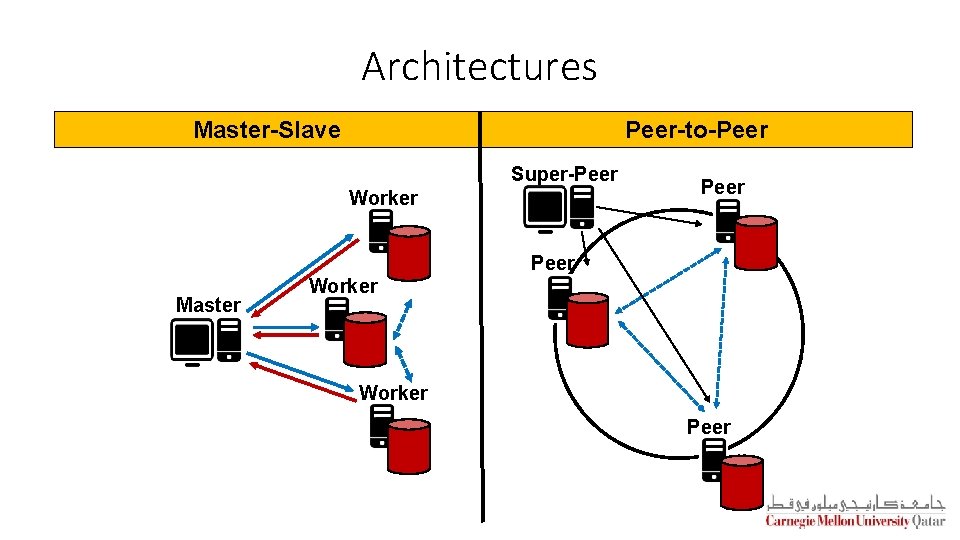
Architectures Peer-to-Peer Master-Slave Super-Peer Worker Peer Master Worker Peer

Master-Slave Architecture § A master-slave architecture can be characterized as follows: 1) Nodes are unequal (there is a hierarchy) § Vulnerable to Single-Point-of-Failure (SPOF) 2) The master acts as a central coordinator § Decision making becomes easy 3) The underlying system cannot scale out indefinitely § The master can render a performance bottleneck as the number of workers is increased
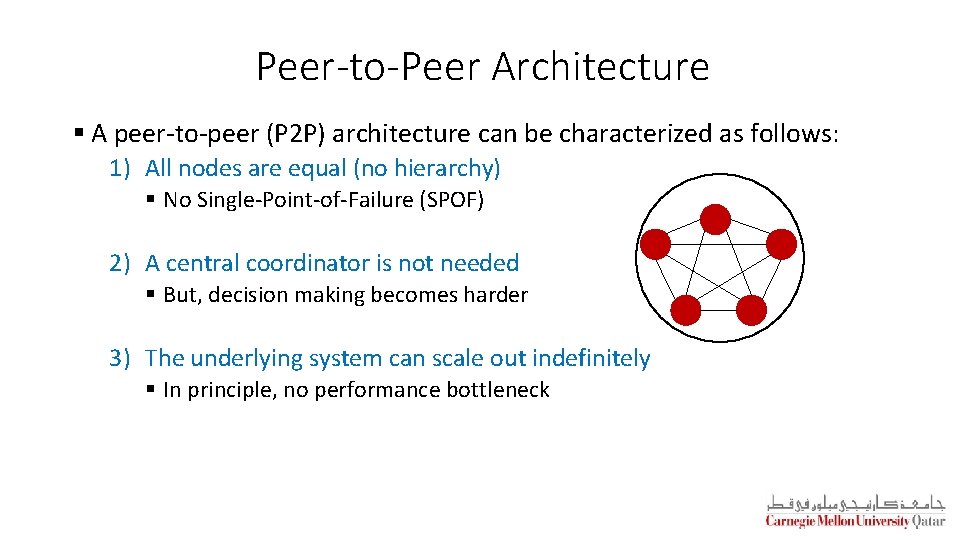
Peer-to-Peer Architecture § A peer-to-peer (P 2 P) architecture can be characterized as follows: 1) All nodes are equal (no hierarchy) § No Single-Point-of-Failure (SPOF) 2) A central coordinator is not needed § But, decision making becomes harder 3) The underlying system can scale out indefinitely § In principle, no performance bottleneck

Peer-to-Peer Architecture § A peer-to-peer (P 2 P) architecture can be characterized as follows: 4) Peers can interact directly, forming groups and sharing contents (or offering services to each other) § At least one peer should share the data, and this peer should be accessible § Popular data will be highly available (it will be shared by many) § Unpopular data might eventually disappear and become unavailable (as more users/peers stop sharing them) 5) Peers can form a virtual overlay network on top of a physical network topology § Logical paths do not usually match physical paths (i. e. , higher latency) § Each peer plays a role in routing traffic through the overlay network
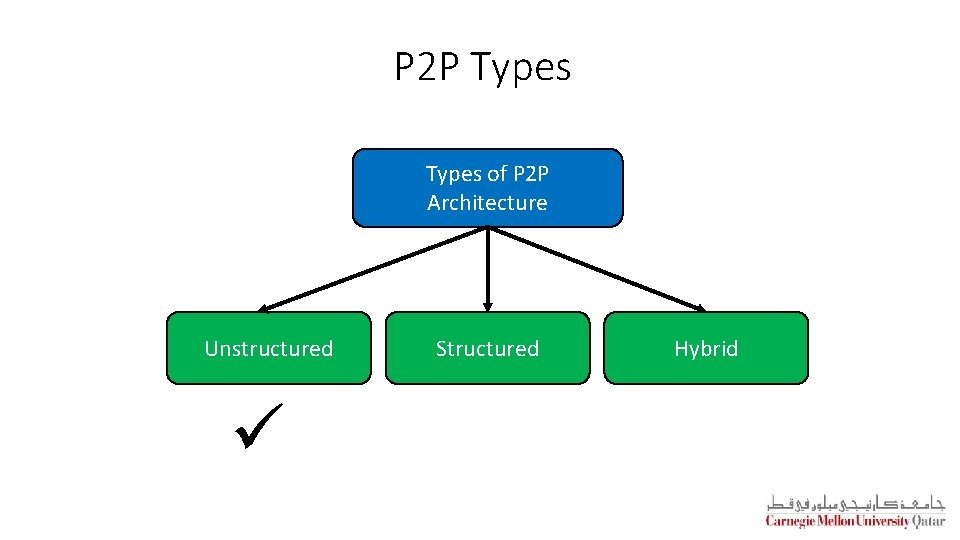
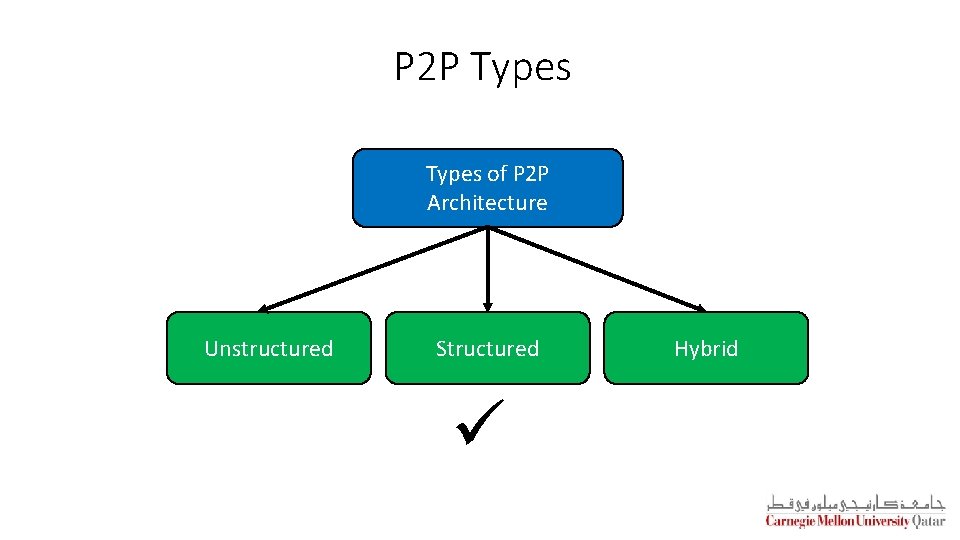
P 2 P Types of P 2 P Architecture Unstructured ü Structured Hybrid
P 2 P Types § Unstructured P 2 P: § The architecture does not impose any particular structure on the overlay network § Advantages: § Easy to build § Highly robust against high rates of churn (i. e. , when a great deal of peers frequently join and leave the network) § Main disadvantage: § Peers and contents are loosely-coupled, creating a data location problem § Searching for data might require broadcasting
P 2 P Types of P 2 P Architecture Unstructured Structured ü Hybrid
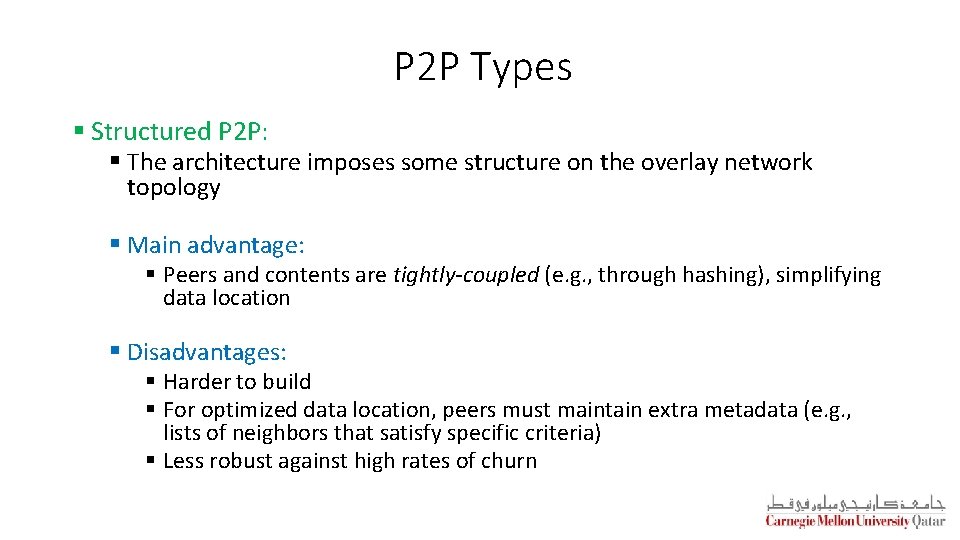
P 2 P Types § Structured P 2 P: § The architecture imposes some structure on the overlay network topology § Main advantage: § Peers and contents are tightly-coupled (e. g. , through hashing), simplifying data location § Disadvantages: § Harder to build § For optimized data location, peers must maintain extra metadata (e. g. , lists of neighbors that satisfy specific criteria) § Less robust against high rates of churn
P 2 P Types of P 2 P Architecture Unstructured Structured Hybrid ü
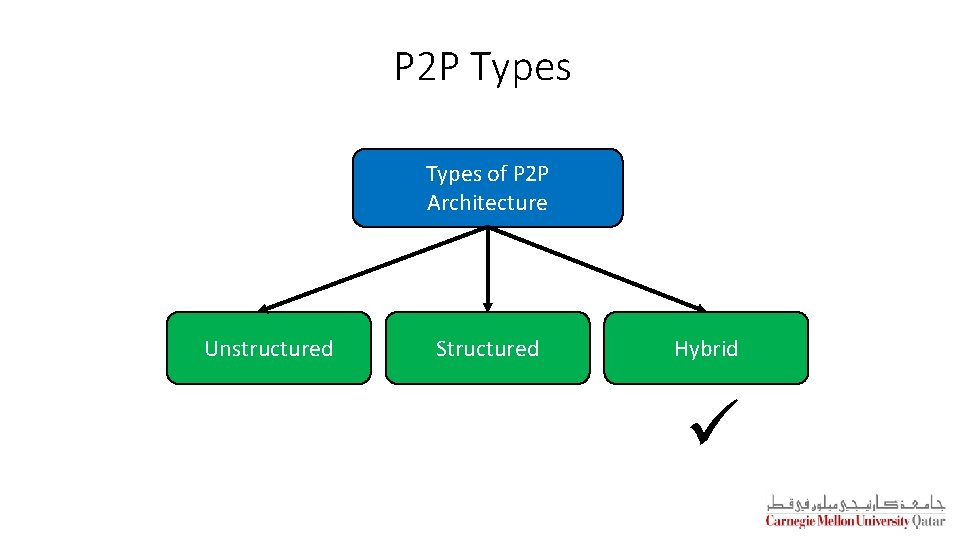
P 2 P Types § Hybrid P 2 P: § The architecture can use some central servers to help peers locate each other § A combination of P 2 P and master-slave models § It offers a trade-off between the centralized functionality provided by the master-slave model and the node equality afforded by the pure P 2 P model § In other words, it combines the advantages of the master-slave and P 2 P models and precludes their disadvantages
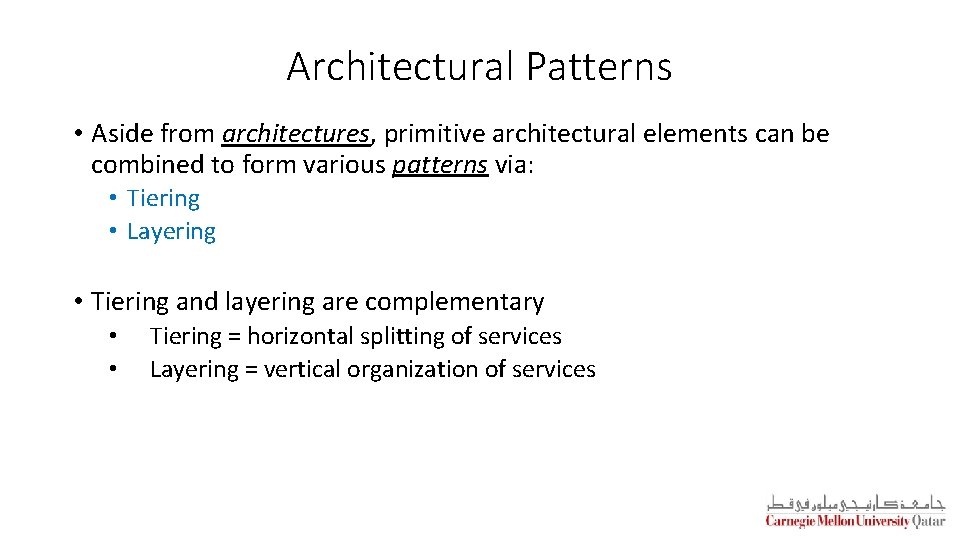
Architectural Patterns • Aside from architectures, primitive architectural elements can be combined to form various patterns via: • Tiering • Layering • Tiering and layering are complementary • • Tiering = horizontal splitting of services Layering = vertical organization of services
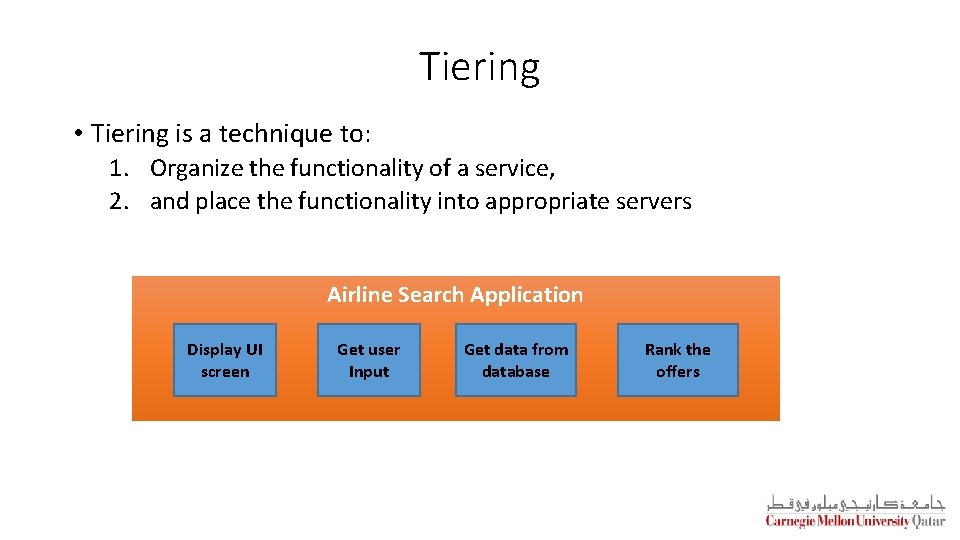
Tiering • Tiering is a technique to: 1. Organize the functionality of a service, 2. and place the functionality into appropriate servers Airline Search Application Display UI screen Get user Input Get data from database Rank the offers
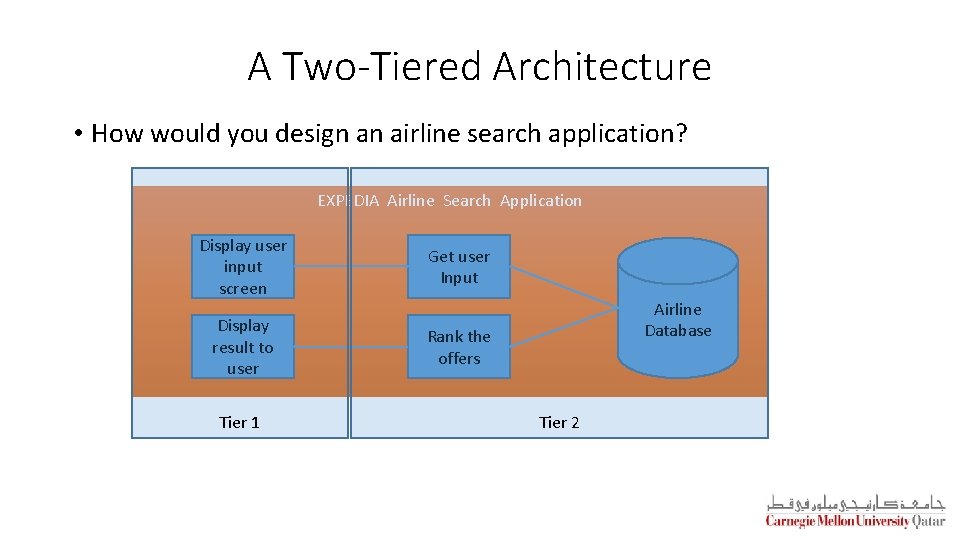
A Two-Tiered Architecture • How would you design an airline search application? EXPEDIA Airline Search Application Display user input screen Get user Input Display result to user Rank the offers Tier 1 Airline Database Tier 2

A Three-Tiered Architecture • How would you design an airline search application? EXPEDIA Airline Search Application Display user input screen Get user Input Display result to user Rank the offers Tier 1 Tier 2 Airline Database Tier 3
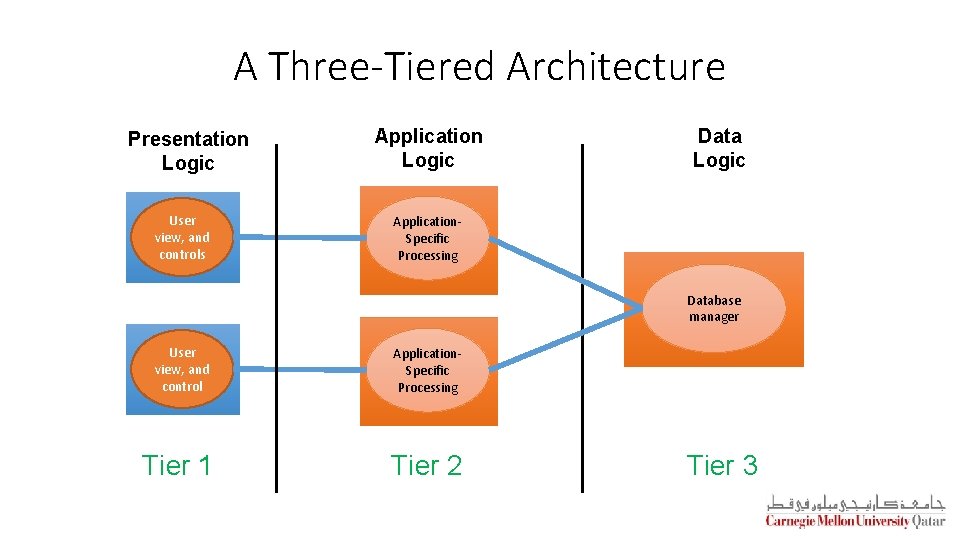
A Three-Tiered Architecture Presentation Logic User view, and controls Application Logic Data Logic Application. Specific Processing Database manager User view, and control Application. Specific Processing Tier 1 Tier 2 Tier 3
Three-Tiered Architecture: Pros and Cons • Advantages: • Enhanced maintainability of the software (one-to-one mapping from logical elements to physical servers) • Each tier has a well-defined role • Disadvantages: • Added complexity due to managing multiple servers • Added network traffic • Added latency

Layering • A complex system is partitioned into layers • Upper layer utilizes the services of the lower layer • A vertical organization of services • Layering simplifies the design of complex distributed systems by hiding the complexity of below layers • Control flows from layer to layer Layer 3 Request flow Layer 2 Layer 1 Response flow

Layering – Platform and middleware • Distributed systems can be organized into three layers: 1. Platform • Low-level hardware and software layers • Provides common services for higher layers 2. Middleware • Masks heterogeneity and provides convenient programming models to application programmers • Typically, it simplifies application programming Applications by abstracting communication mechanisms Middleware 3. Applications Platform Operating system Computer and network hardware
Next Class • Naming
- Slides: 24