
Distributed Small Scale Power Plant DSSPP in Indonesia
Distributed Small Scale Power Plant (DSSPP) in Indonesia By : Ir. Djuwarno, MM Chairman INDONESIAN RENEWABLE ENERGY SOCIATY (IRES) Jl. Duren Tiga No. 101 – Pancoran – Jakarta 12760 Ph. 62 -21 -79198581, Fax. 62 -21 -79198581 E-mail : metiires@centrin. net. id Indonesian Renewable Energy Society 1
Government’s Policy on Renewable Energy • Electricity Law No. 20/2002 states that Renewable Energy is the first priority for providing electricity in the country. • Utilization of Renewable Energy will be part of Government’s policy in promoting “Green Energy Program” under the proposed “Energy Law”. Indonesian Renewable Energy Society 2
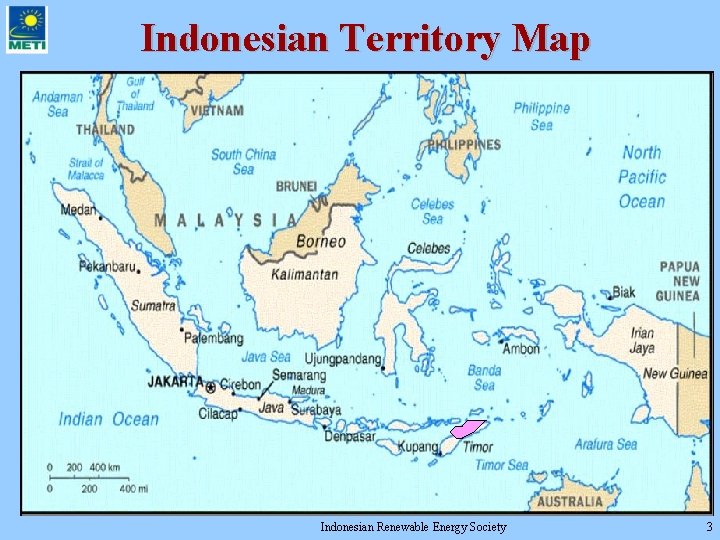
Indonesian Territory Map Indonesian Renewable Energy Society 3
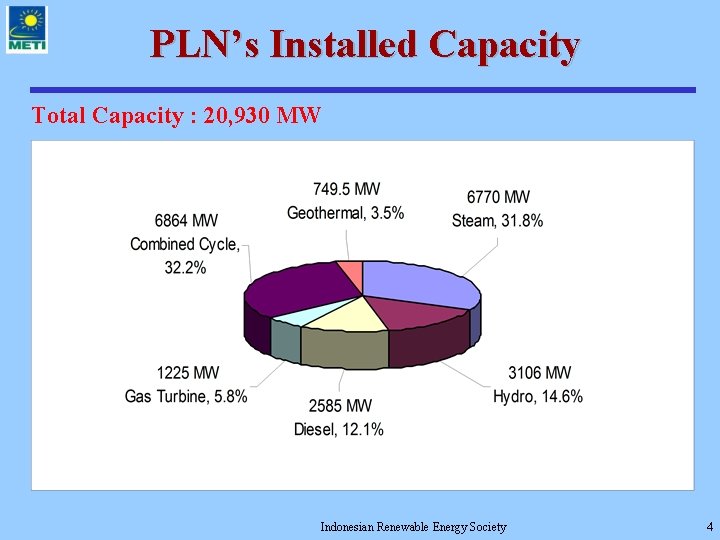
PLN’s Installed Capacity Total Capacity : 20, 930 MW Indonesian Renewable Energy Society 4
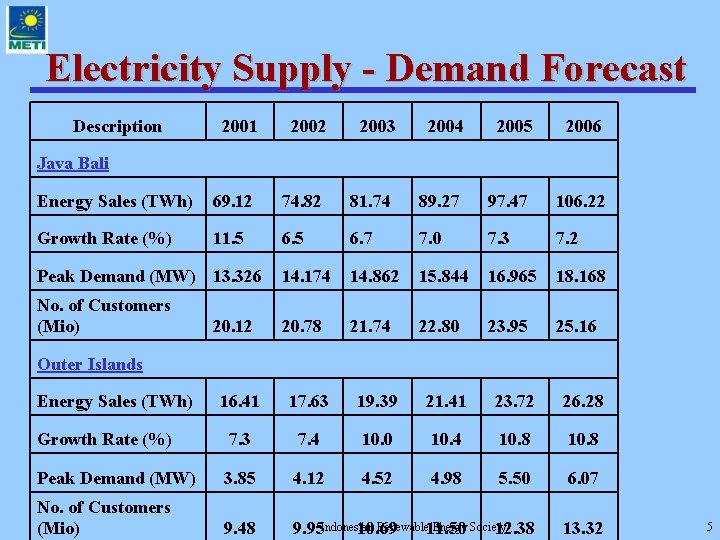
Electricity Supply - Demand Forecast Description 2001 2002 2003 2004 2005 2006 Energy Sales (TWh) 69. 12 74. 82 81. 74 89. 27 97. 47 106. 22 Growth Rate (%) 11. 5 6. 7 7. 0 7. 3 7. 2 Peak Demand (MW) 13. 326 14. 174 14. 862 15. 844 16. 965 18. 168 No. of Customers (Mio) 20. 78 21. 74 22. 80 23. 95 25. 16 Java Bali 20. 12 Outer Islands Energy Sales (TWh) 16. 41 17. 63 19. 39 21. 41 23. 72 26. 28 Growth Rate (%) 7. 3 7. 4 10. 0 10. 4 10. 8 Peak Demand (MW) 3. 85 4. 12 4. 52 4. 98 5. 50 6. 07 No. of Customers (Mio) 9. 48 Renewable 11. 50 Energy Society 9. 95 Indonesian 10. 69 12. 38 13. 32 5
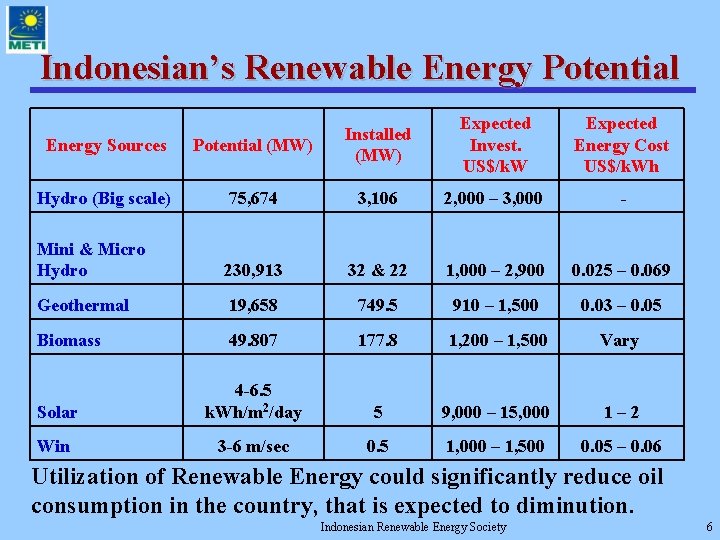
Indonesian’s Renewable Energy Potential Expected Invest. US$/k. W Expected Energy Cost US$/k. Wh Energy Sources Potential (MW) Installed (MW) Hydro (Big scale) 75, 674 3, 106 2, 000 – 3, 000 - Mini & Micro Hydro 230, 913 32 & 22 1, 000 – 2, 900 0. 025 – 0. 069 Geothermal 19, 658 749. 5 910 – 1, 500 0. 03 – 0. 05 Biomass 49. 807 177. 8 1, 200 – 1, 500 Vary Solar 4 -6. 5 k. Wh/m 2/day 5 9, 000 – 15, 000 1– 2 Win 3 -6 m/sec 0. 5 1, 000 – 1, 500 0. 05 – 0. 06 Utilization of Renewable Energy could significantly reduce oil consumption in the country, that is expected to diminution. Indonesian Renewable Energy Society 6
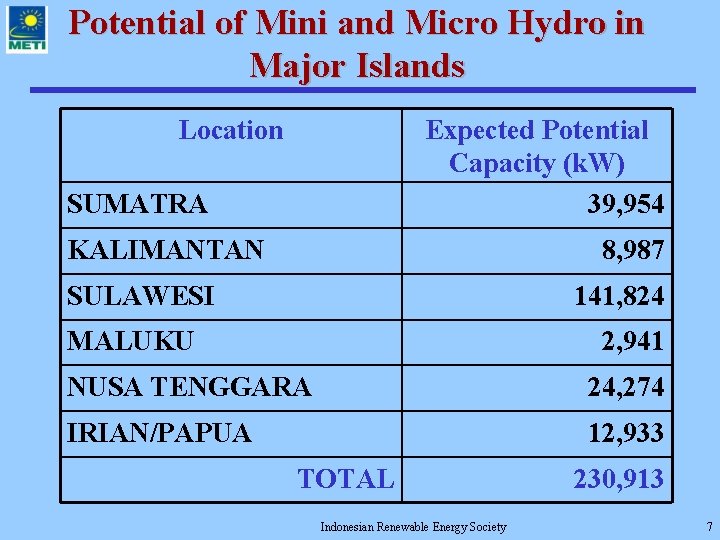
Potential of Mini and Micro Hydro in Major Islands Location Expected Potential Capacity (k. W) 39, 954 SUMATRA KALIMANTAN 8, 987 SULAWESI 141, 824 MALUKU 2, 941 NUSA TENGGARA 24, 274 IRIAN/PAPUA 12, 933 TOTAL Indonesian Renewable Energy Society 230, 913 7
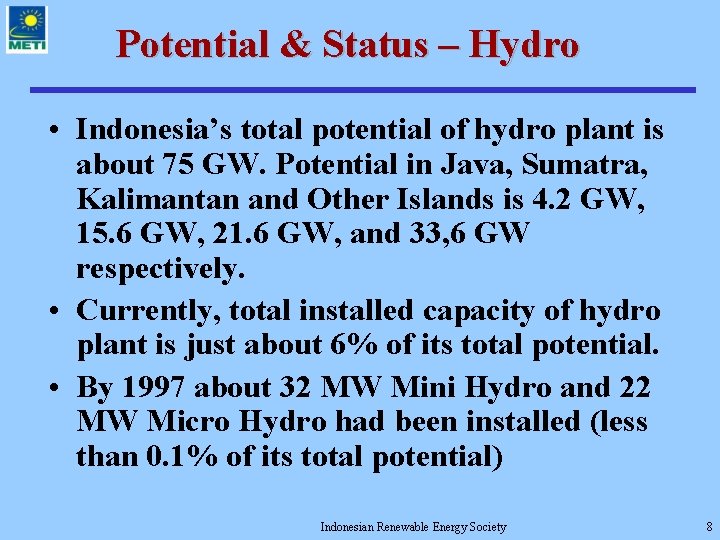
Potential & Status – Hydro • Indonesia’s total potential of hydro plant is about 75 GW. Potential in Java, Sumatra, Kalimantan and Other Islands is 4. 2 GW, 15. 6 GW, 21. 6 GW, and 33, 6 GW respectively. • Currently, total installed capacity of hydro plant is just about 6% of its total potential. • By 1997 about 32 MW Mini Hydro and 22 MW Micro Hydro had been installed (less than 0. 1% of its total potential) Indonesian Renewable Energy Society 8
Potential & Status – Geothermal • Mostly located in Java, Sumatra, Bali, Nusa Tenggara, Sulawesi and Maluku. • Total identified potential of 70 fields is about 19. 658 MW. • Total Installed capacity, currently is 749, 5 MW, mostly they are interconnected into PLN’s network system at 55 MW sizes. Indonesian Renewable Energy Society 9
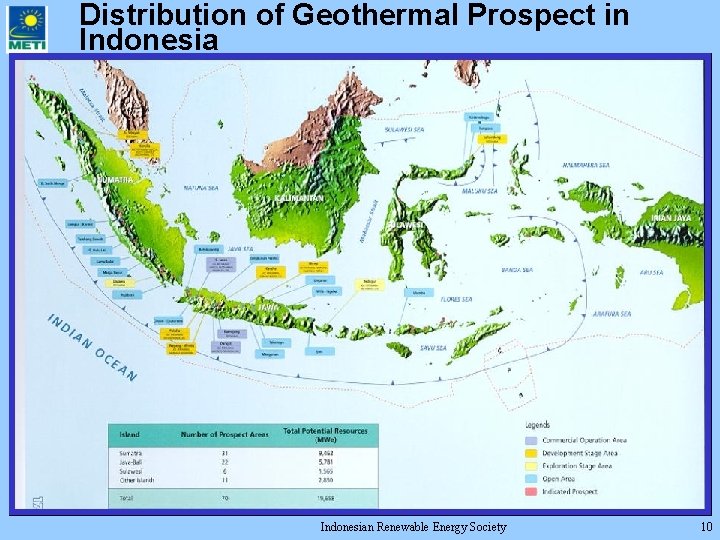
Distribution of Geothermal Prospect in Indonesian Renewable Energy Society 10
Potential & Status – Biomass • Total potential is 48, 807. 3 MW. • Mostly for electricity generation utilizing farming/plantation waste (rice Husk skin, coconut shell, empty palm oil bunch, bagasse), woods, garbage, etc • Total potential in Sumatra, Kalimantan, Java, and others Islands is 1800 MW, 500 MW, 800 MW, 380 MW and 120 MW, respectively. • Total installed capacity, currently is 177, 98 MW. Indonesian Renewable Energy Society 11
Potential & Status – Solar • Most area in Sulawesi, Bali and Irian Jaya has a high heat radiation of 6 – 6. 5 k. Wh/m 2/day. • Mountain area in Irian Jaya, Sulawesi Java, has an average heat radiation of 4. 5 – 5. 5 k. Wh/m 2/day. • Low terrain area in Kalimantan, Java, and Sumatera, has an average heat radiation of 4 – 5 k. Wh/m 2/day. • Total installed capacity is about 5 MW, mostly used for households. Indonesian Renewable Energy Society 12
Potential & Status – Wind • Most of equatorial area is likely to have less wind • Total potential is 448 MW. • Total current installed capacity is 0, 5 MW, mostly used for electricity, pumping, refrigeration and batteraycharging. • Most potential area such as Nusa Tenggara and Sulawesi have potential of wind energy at about 10 – 100 k. W sizes. Indonesian Renewable Energy Society 13
Benefits of Developing DSSPP • Create a better social life to local community surrounding the Project (Better Irrigation for Farming, Fishery, etc). • Gives more sustainable electricity supply in the long run. • Give mutual benefit to local community, local government as well as investors. Indonesian Renewable Energy Society 14
Community Based Development • Benefits of Developing DSSPP under Community Based Development Concept : – Give mutual benefit to local community, investor and government. – More Oriented to encourage participation of local community. Indonesian Renewable Energy Society 15
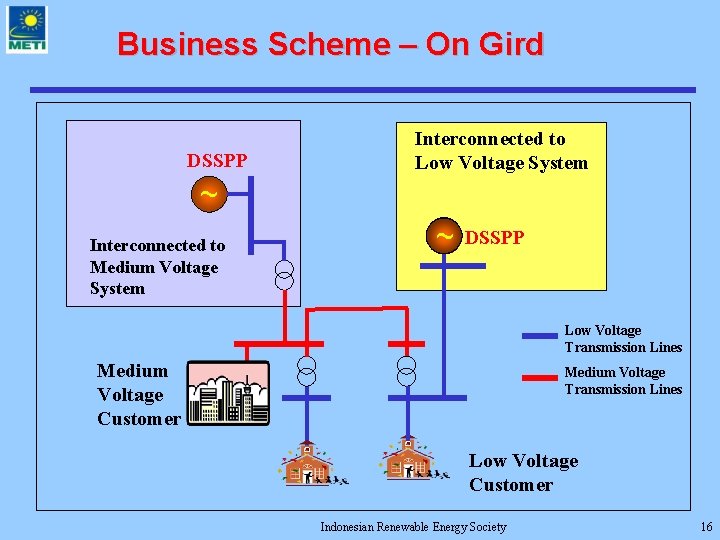
Business Scheme – On Gird DSSPP Interconnected to Low Voltage System ~ Interconnected to Medium Voltage System ~ DSSPP Low Voltage Transmission Lines Medium Voltage Customer Medium Voltage Transmission Lines Low Voltage Customer Indonesian Renewable Energy Society 16
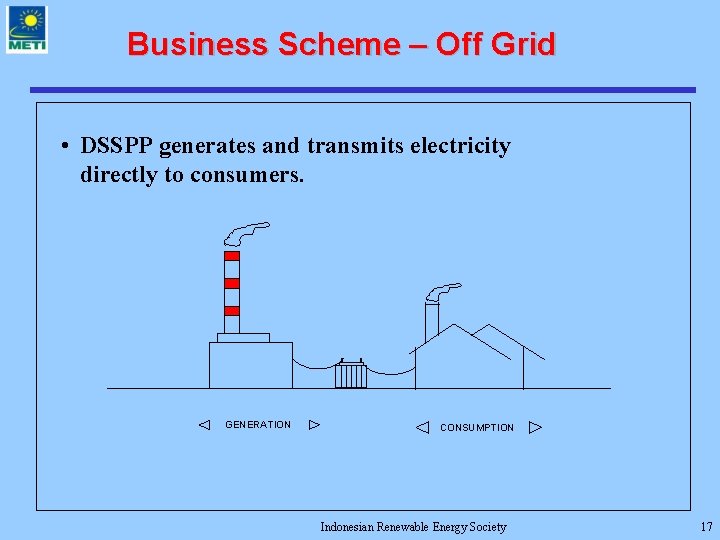
Business Scheme – Off Grid • DSSPP generates and transmits electricity directly to consumers. GENERATION CONSUMPTION Indonesian Renewable Energy Society 17
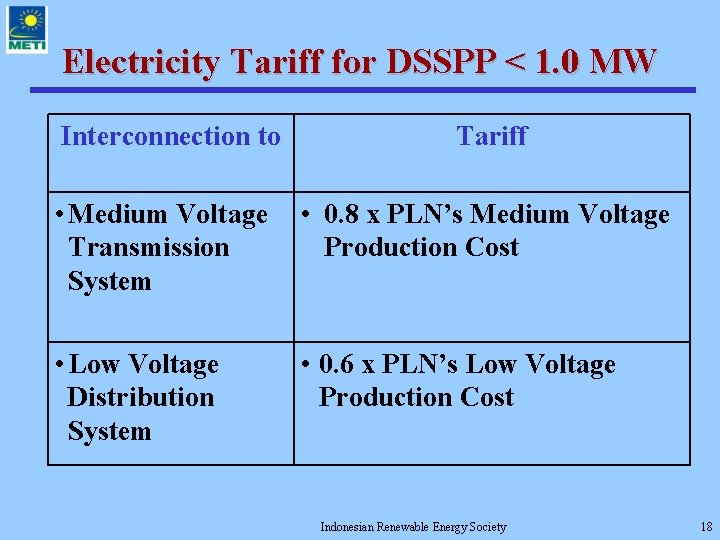
Electricity Tariff for DSSPP < 1. 0 MW Interconnection to Tariff • Medium Voltage Transmission System • 0. 8 x PLN’s Medium Voltage Production Cost • Low Voltage Distribution System • 0. 6 x PLN’s Low Voltage Production Cost Indonesian Renewable Energy Society 18
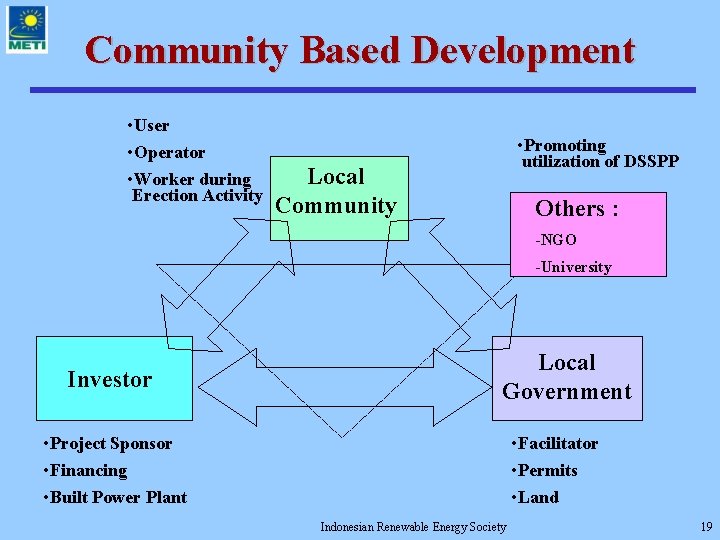
Community Based Development • User • Operator • Worker during Erection Activity • Promoting utilization of DSSPP Local Community Others : -NGO -University Investor Local Government • Project Sponsor • Financing • Built Power Plant • Facilitator • Permits • Land Indonesian Renewable Energy Society 19
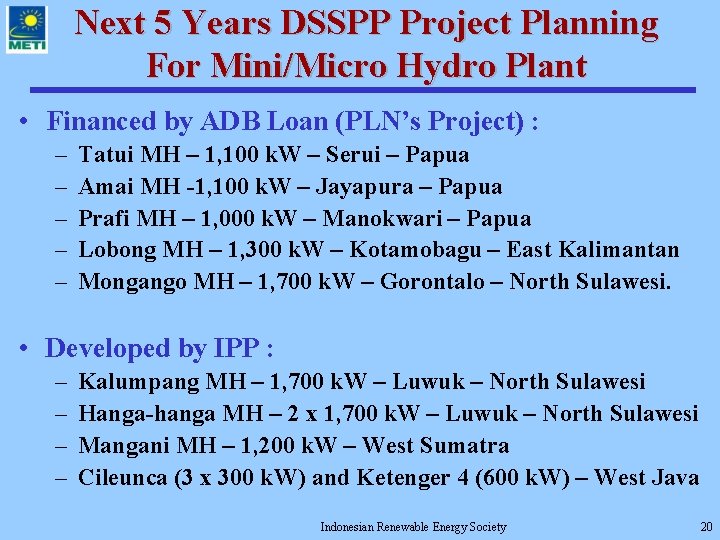
Next 5 Years DSSPP Project Planning For Mini/Micro Hydro Plant • Financed by ADB Loan (PLN’s Project) : – – – Tatui MH – 1, 100 k. W – Serui – Papua Amai MH -1, 100 k. W – Jayapura – Papua Prafi MH – 1, 000 k. W – Manokwari – Papua Lobong MH – 1, 300 k. W – Kotamobagu – East Kalimantan Mongango MH – 1, 700 k. W – Gorontalo – North Sulawesi. • Developed by IPP : – – Kalumpang MH – 1, 700 k. W – Luwuk – North Sulawesi Hanga-hanga MH – 2 x 1, 700 k. W – Luwuk – North Sulawesi Mangani MH – 1, 200 k. W – West Sumatra Cileunca (3 x 300 k. W) and Ketenger 4 (600 k. W) – West Java Indonesian Renewable Energy Society 20
Identified Constrain in Developing DSSPP • Mostly located in an isolated area : – – Limited access road Limited infrastructure. Limited well educated people to operate power plant. Mostly for Households having limited purchasing power. • After economic crisis, Government have very limited financing to support development of DSSPP. It is very welcome to private company to participate in developing DSSPP. Indonesian Renewable Energy Society 21

THANK YOU FOR YOUR KIND ATTENTION Indonesian Renewable Energy Society 22
- Slides: 22