
Distributed Query Processing Agenda Recap of query optimization
Distributed Query Processing
Agenda • Recap of query optimization • Transformation rules for P&D systems • Memoization • Query evaluation strategies • Eddies
Introduction • Alternative ways of evaluating a given query – Equivalent expressions – Different algorithms for each operation (Chapter 13) • Cost difference between a good and a bad way of evaluating a query can be enormous – Example: performing a r X s followed by a selection r. A = s. B is much slower than performing a join on the same condition • Need to estimate the cost of operations – Depends critically on statistical information about relations which the database must maintain – Need to estimate statistics for intermediate results to compute cost of complex expressions
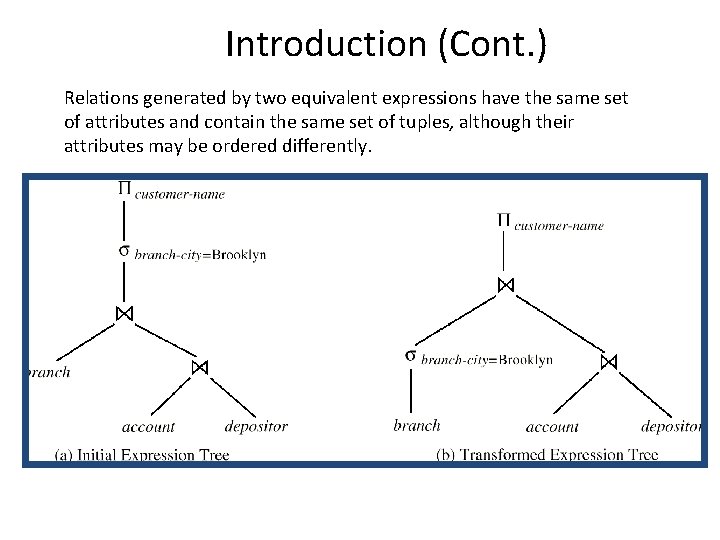
Introduction (Cont. ) Relations generated by two equivalent expressions have the same set of attributes and contain the same set of tuples, although their attributes may be ordered differently.
Introduction (Cont. ) • Generation of query-evaluation plans for an expression involves several steps: 1. Generating logically equivalent expressions • Use equivalence rules to transform an expression into an equivalent one. 2. Annotating resultant expressions to get alternative query plans 3. Choosing the cheapest plan based on estimated cost • The overall process is called cost based optimization.
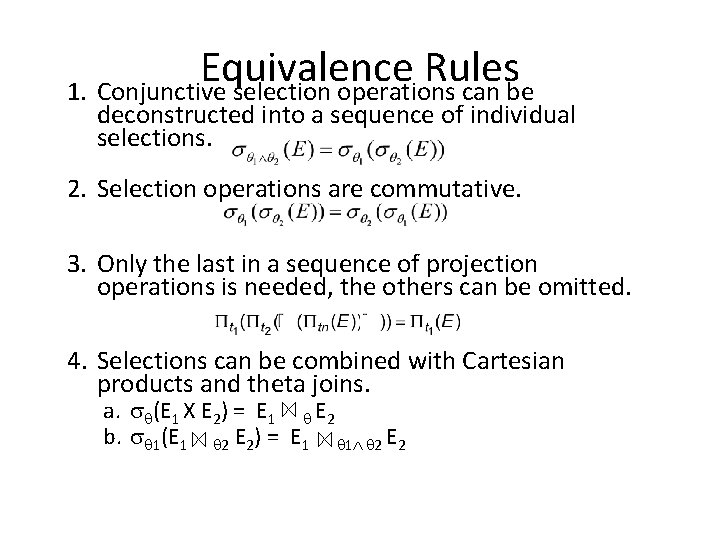
Equivalence Rules 1. Conjunctive selection operations can be deconstructed into a sequence of individual selections. 2. Selection operations are commutative. 3. Only the last in a sequence of projection operations is needed, the others can be omitted. 4. Selections can be combined with Cartesian products and theta joins. a. (E 1 X E 2) = E 1 E 2 b. 1(E 1 2 E 2) = E 1 1 2 E 2
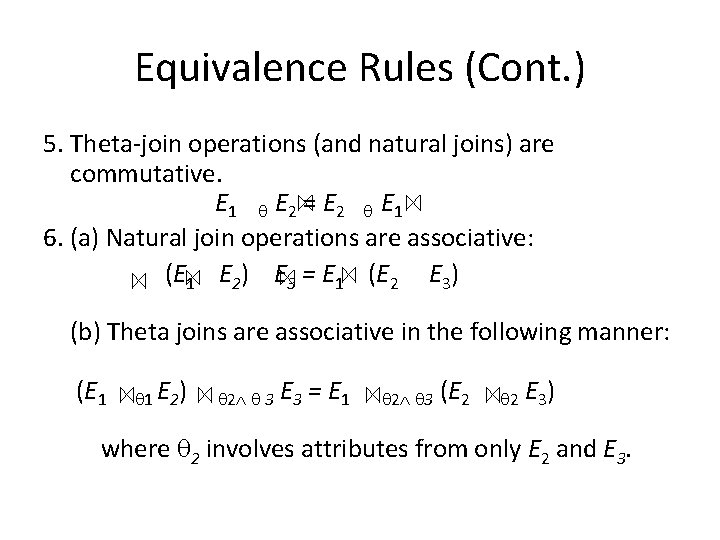
Equivalence Rules (Cont. ) 5. Theta-join operations (and natural joins) are commutative. E 1 E 2 = E 2 E 1 6. (a) Natural join operations are associative: (E 1 E 2) E 3 = E 1 (E 2 E 3) (b) Theta joins are associative in the following manner: (E 1 1 E 2) 2 3 E 3 = E 1 2 3 (E 2 2 E 3 ) where 2 involves attributes from only E 2 and E 3.
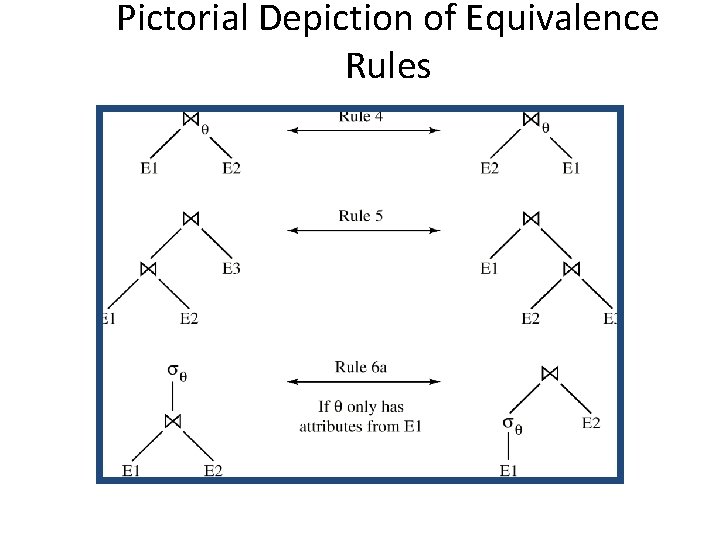
Pictorial Depiction of Equivalence Rules
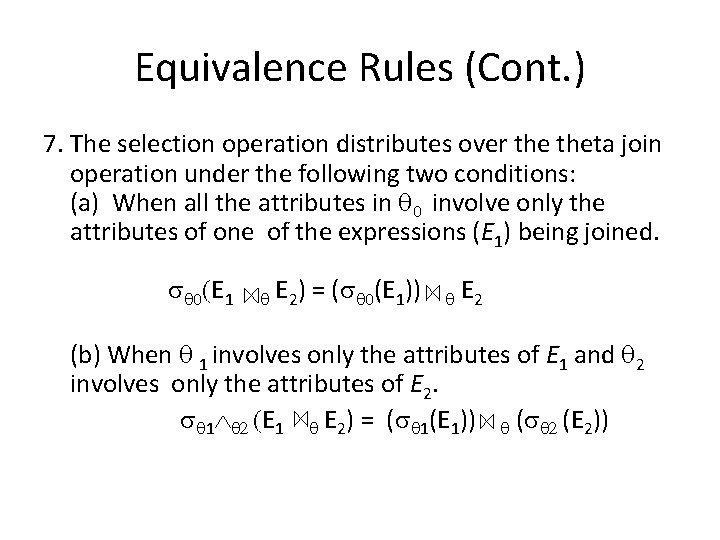
Equivalence Rules (Cont. ) 7. The selection operation distributes over theta join operation under the following two conditions: (a) When all the attributes in 0 involve only the attributes of one of the expressions (E 1) being joined. 0 E 1 E 2) = ( 0(E 1)) E 2 (b) When 1 involves only the attributes of E 1 and 2 involves only the attributes of E 2. 1 E 1 E 2) = ( 1(E 1)) ( (E 2))
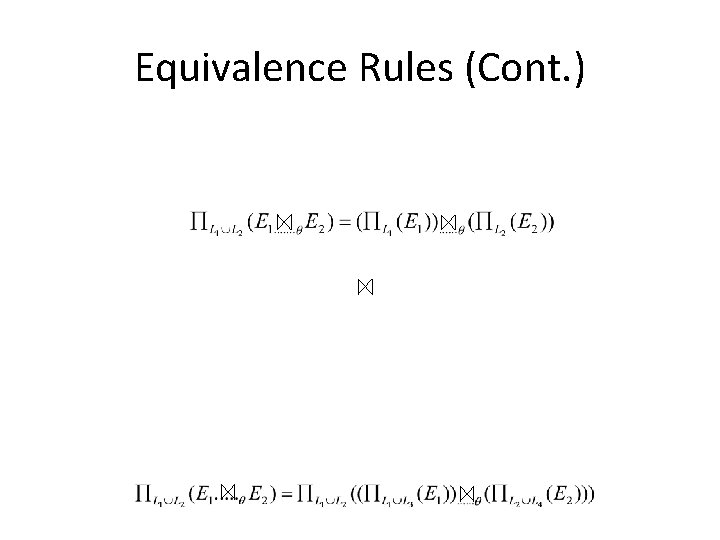
Equivalence Rules (Cont. )
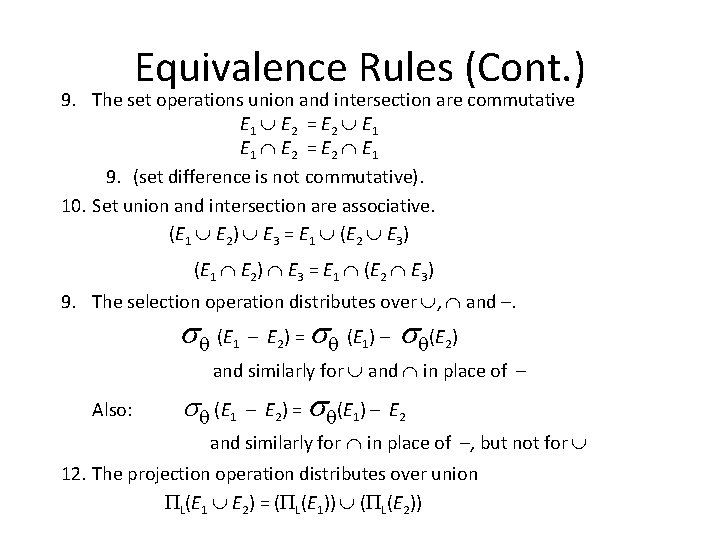
Equivalence Rules (Cont. ) 9. The set operations union and intersection are commutative E 1 E 2 = E 2 E 1 9. (set difference is not commutative). 10. Set union and intersection are associative. (E 1 E 2) E 3 = E 1 (E 2 E 3) 9. The selection operation distributes over , and –. (E 1 – E 2 ) = (E ) – (E ) 1 2 and similarly for and in place of – Also: (E 1 – E 2 ) = (E ) – E 1 2 and similarly for in place of –, but not for 12. The projection operation distributes over union L(E 1 E 2) = ( L(E 1)) ( L(E 2))
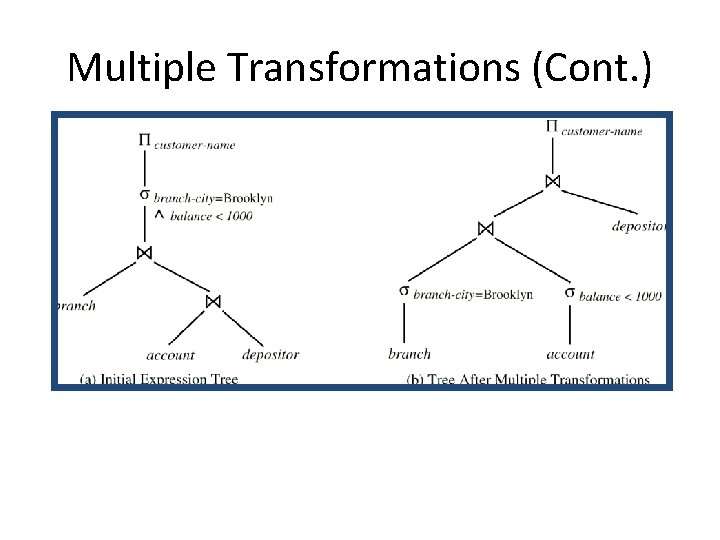
Multiple Transformations (Cont. )
Optimizer strategies • Heuristic – Apply the transformation rules in a specific order such that the cost converges to a minimum • Cost based – Simulated annealing – Randomized generation of candidate QEP – Problem, how to guarantee randomness
Memoization Techniques • How to generate alternative Query Evaluation Plans? – Early generation systems centred around a tree representation of the plan – Hardwired tree rewriting rules are deployed to enumerate part of the space of possible QEP – For each alternative the total cost is determined – The best (alternatives) are retained for execution – Problems: very large space to explore, duplicate plans, local maxima, expensive query cost evaluation. – SQL Server optimizer contains about 300 rules to be deployed.
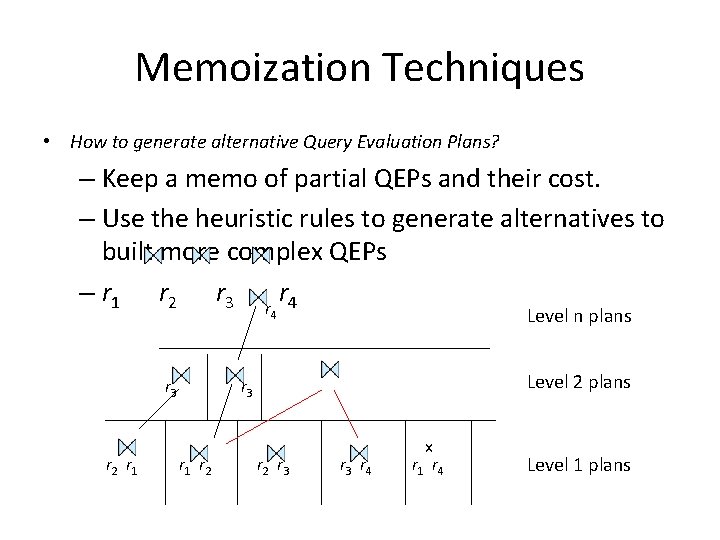
Memoization Techniques • How to generate alternative Query Evaluation Plans? – Keep a memo of partial QEPs and their cost. – Use the heuristic rules to generate alternatives to built more complex QEPs – r 1 r 2 r 3 r r 4 Level n plans 4 r 3 r 2 r 1 Level 2 plans r 3 r 1 r 2 r 3 r 4 x r 1 r 4 Level 1 plans
Distributed Query Processing • For centralized systems, the primary criterion for measuring the cost of a particular strategy is the number of disk accesses. • In a distributed system, other issues must be taken into account: – The cost of a data transmission over the network. – The potential gain in performance from having several sites process parts of the query in parallel.
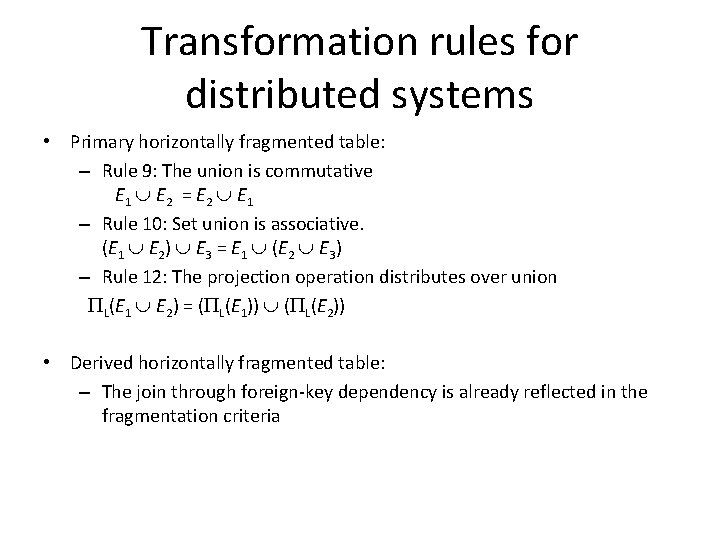
Transformation rules for distributed systems • Primary horizontally fragmented table: – Rule 9: The union is commutative E 1 E 2 = E 2 E 1 – Rule 10: Set union is associative. (E 1 E 2) E 3 = E 1 (E 2 E 3) – Rule 12: The projection operation distributes over union L(E 1 E 2) = ( L(E 1)) ( L(E 2)) • Derived horizontally fragmented table: – The join through foreign-key dependency is already reflected in the fragmentation criteria
Transformation rules for distributed systems Vertical fragmented tables: – Rules: Hint look at projection rules
Optimization in Par & Distr • Cost model is changed!!! – Network transport is a dominant cost factor • The facilities for query processing are not homogenous distributed – Light-resource systems form a bottleneck – Need for dynamic load scheduling
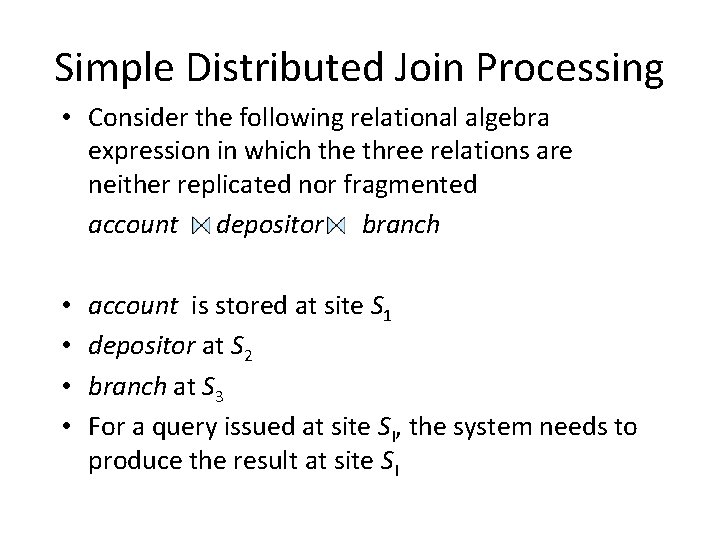
Simple Distributed Join Processing • Consider the following relational algebra expression in which the three relations are neither replicated nor fragmented account depositor branch • • account is stored at site S 1 depositor at S 2 branch at S 3 For a query issued at site SI, the system needs to produce the result at site SI
Possible Query Processing Strategies • Ship copies of all three relations to site SI and choose a strategy for processing the entire locally at site SI. • Ship a copy of the account relation to site S 2 and compute temp 1 = account depositor at S 2. Ship temp 1 from S 2 to S 3, and compute temp 2 = temp 1 branch at S 3. Ship the result temp 2 to SI. • Devise similar strategies, exchanging the roles S 1, S 2, S 3 • Must consider following factors: – amount of data being shipped – cost of transmitting a data block between sites – relative processing speed at each site
Semijoin Strategy • Let r 1 be a relation with schema R 1 stores at site S 1 Let r 2 be a relation with schema R 2 stores at site S 2 • Evaluate the expression r 1 r 2 and obtain the result at S 1. Compute temp 1 R 2 (r 1) at S 1. 2. Ship temp 1 from S 1 to S 2. 3. Compute temp 2 r 2 temp 1 at S 2 4. Ship temp 2 from S 2 to S 1. 5. Compute r 1 temp 2 at S 1. This is the same as r 1 r 2.
Formal Definition • The semijoin of r 1 with r 2, is denoted by: r 1 r 2 • it is defined by: R 1 (r 1 r 2) • Thus, r 1 r 2 selects those tuples of r 1 that contributed to r 1 r 2. • In step 3 above, temp 2=r 2 r 1. • For joins of several relations, the above strategy can be extended to a series of semijoin steps.
Join Strategies that Exploit Parallelism • Consider r 1 r 2 r 3 r 4 where relation ri is stored at site Si. The result must be presented at site S 1. • r 1 is shipped to S 2 and r 1 r 2 is computed at S 2: simultaneously r 3 is shipped to S 4 and r 3 r 4 is computed at S 4 • S 2 ships tuples of (r 1 S 4 ships tuples of (r 3 r 2) to S 1 as they produced; r 4) to S 1 • Once tuples of (r 1 r 2) and (r 3 r 4) arrive at S 1 (r 1 r 2) (r 3 r 4) is computed in parallel with the computation of (r 1 r 2) at S 2 and the computation of (r 3 r 4) at S 4.
Query plan generation • Apers-Aho-Hopcroft – Hill-climber, repeatedly split the multi-join query in fragments and optimize its subqueries independently • Apply centralized algorithms and rely on costmodel to avoid expensive query execution plans.
Query evaluators
Query evaluation strategy • Pipe-line query evaluation strategy – Called Volcano query processing model – Standard in commercial systems and My. SQL • Basic algorithm: – Demand-driven evaluation of query tree. – Operators exchange data in units such as records – Each operator supports the following interfaces: – open, next, close • open() at top of tree results in cascade of opens down the tree. • An operator getting a next() call may recursively make next() calls from within to produce its next answer. • close() at top of tree results in cascade of close down the tree
Query evaluation strategy • Pipe-line query evaluation strategy – Evaluation: • Oriented towards OLTP applications – Granule size of data interchange • Items produced one at a time • No temporary files – Choice of intermediate buffer size allocations • Query executed as one process • Generic interface, sufficient to add the iterator primitives for the new containers. • CPU intensive • Amenable to parallelization
Query evaluation strategy • Materialized evaluation strategy – Used in Monet. DB – Basic algorithm: • for each relational operator produce the complete intermediate result using materialized operands – Evaluation: • Oriented towards decision support queries • Limited internal administration and dependencies • Basis for multi-query optimization strategy • Memory intensive • Amendable for distributed/parallel processing
Eddies: Continuously Adaptive Query processing R. Avnur, J. M. Hellerstein UCB ACM Sigmod 2000
Problem Statement • Context: large federated and shared-nothing databases • Problem: assumptions made at query optimization rarely hold during execution • Hypothesis: do away with traditional optimizers, solve it thru adaptation
Problem Statement Refinement • Large scale systems are unpredictable, because – Hardware and workload complexity, • bursty servers & networks, heterogenity, hardware characteristics – Data complexity, • Federated database often come without proper statistical summaries – User Interface Complexity
The Idea • Relational algebra operators consume a stream from multiple sources to produce a new stream • A priori you don’t now how selective- how fast - tuples are consumed/produced • You have to adapt continuously and learn this information on the fly
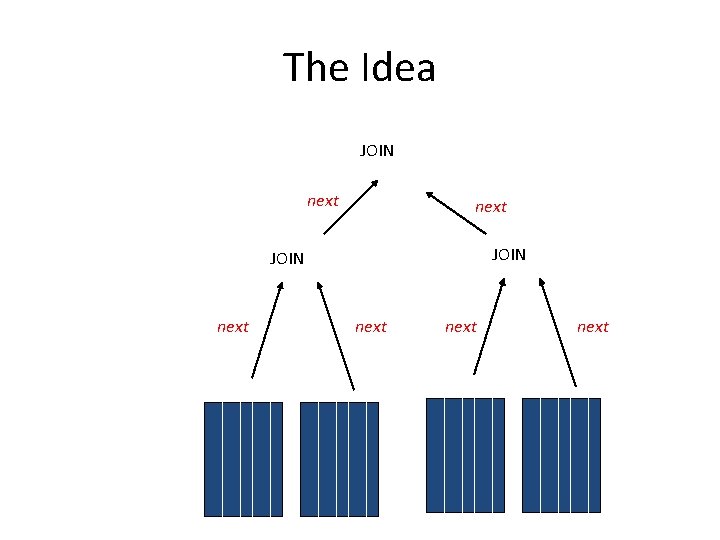
The Idea JOIN next next
The Idea • Standard method: derive a spanning tree over the query graph • Pre-optimize a query plan to determine operator pairs and their algorithm, e. g. to exploit access paths • Re-optimization a query pipeline on the fly requires careful state management, coupled with – Synchronization barriers • Operators have widely differing arrival rates for their operands – This limits concurrency, e. g. merge-join algorithm – Moments of symmetry • Algorithm provides option to exchange the role of the operands without too much complications – E. g switching the role of R and S in a nested-loop join
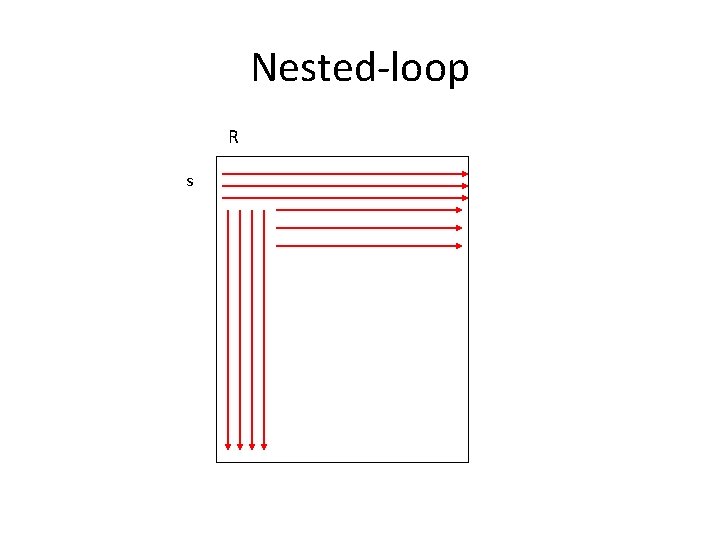
Nested-loop R s
Join and sorting • Index-joins are asymmetric, you can not easily change their role – Combine index-join + operands as a unit in the process • Sorting requires look-ahead – Merge-joins are combined into unit • Ripple joins – Break the space into smaller pieces and solve the join operation for each piece individually – The piece crossings are moments of symmetry
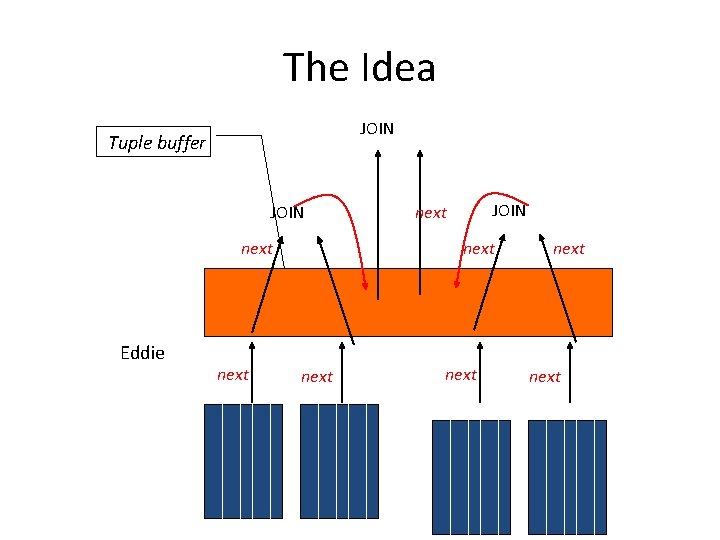
The Idea JOIN Tuple buffer JOIN next Eddie next JOIN next next
Rivers and Eddies are tuple routers that distribute arriving tuples to interested operators – What are efficient scheduling policies? • Fixed strategy? Random ? Learning? Static Eddies • Delivery of tuples to operators can be hardwired in the Eddie to reflect a traditional query execution plan Naïve Eddie • Operators are delivered tuples based on a priority queue • Intermediate results get highest priority to avoid buffer congestion
Observations for selections • Extended priority queue for the operators – Receiving a tuple leads to a credit increment – Returning a tuple leads to a credit decrement – Priority is determined by “weighted lottery” • Naïve Eddies exhibit back pressure in the tuple flow; production is limited by the rate of consumption at the output • Lottery Eddies approach the cost of optimal ordering, without a need to a priory determine the order • Lottery Eddies outperform heuristics – Hash-use first, or Index-use first, Naive
Observations • The dynamics during a run can be controlled by a learning scheme – Split the processing in steps (‘windows’) to re-adjust the weight during tuple delivery • Initial delays can not be handled efficiently • Research challenges: – Better learning algorithms to adjust flow – Aggressive adjustments – Remove pre-optimization – Balance ‘hostile’ parallel environment – Deploy eddies to control degree of partitioning (and replication)
- Slides: 41