
Distributed Networked Forces operating in Complex Adaptive Environments
Distributed Networked Forces operating in Complex Adaptive Environments CDR Gregory Glaros, USN Office of the Secretary of Defense Office of Force Transformation gregory. glaros@osd. mil
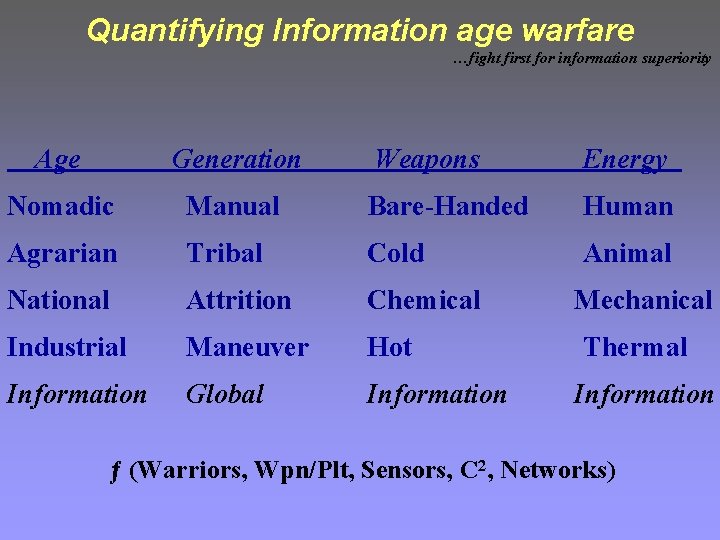
Quantifying Information age warfare …fight first for information superiority Age Generation Weapons Energy Nomadic Manual Bare-Handed Human Agrarian Tribal Cold Animal National Attrition Chemical Industrial Maneuver Hot Information Global Information Mechanical Thermal Information ƒ (Warriors, Wpn/Plt, Sensors, C 2, Networks)
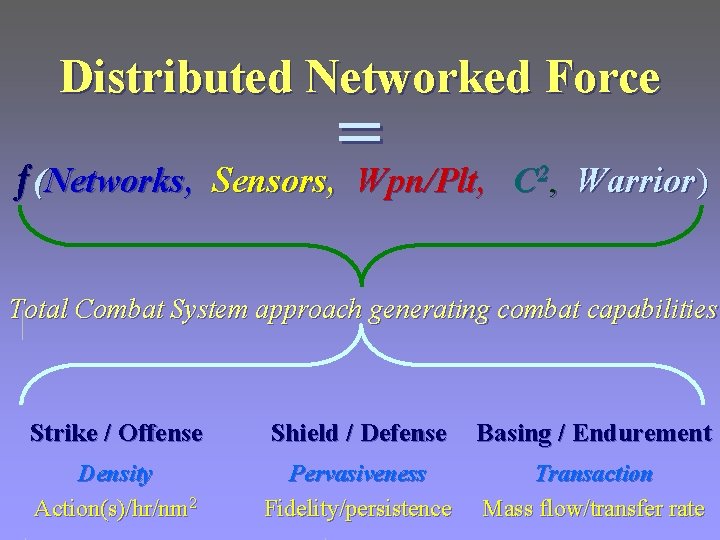
Distributed Networked Force = ƒ(Networks, Sensors, Wpn/Plt, C 2, Warrior) Total Combat System approach generating combat capabilities Strike / Offense Shield / Defense Basing / Endurement Density Action(s)/hr/nm 2 Pervasiveness Fidelity/persistence Transaction Mass flow/transfer rate
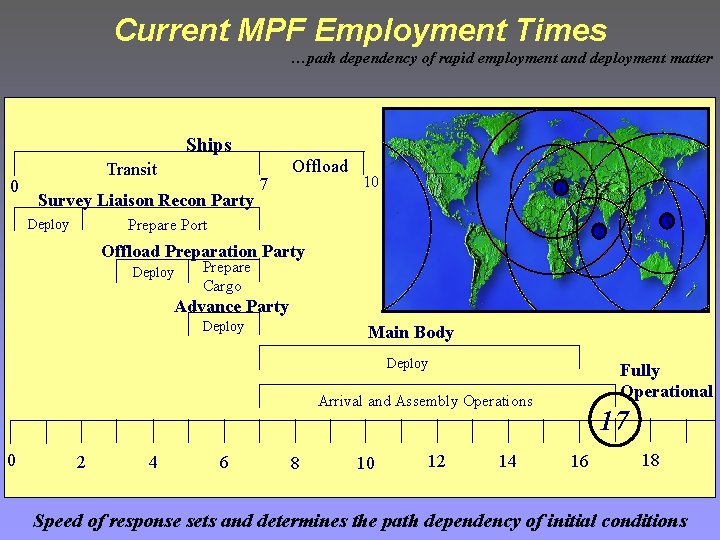
Current MPF Employment Times …path dependency of rapid employment and deployment matter Ships 0 Transit Survey Liaison Recon Party 7 Offload 10 1 Prepare Port Deploy Offload Preparation Party Deploy 3 2 Prepare Cargo Advance Party Deploy Main Body Deploy Fully Operational Arrival and Assembly Operations 0 2 4 6 8 10 12 14 17 16 18 Speed of response sets and determines the path dependency of initial conditions
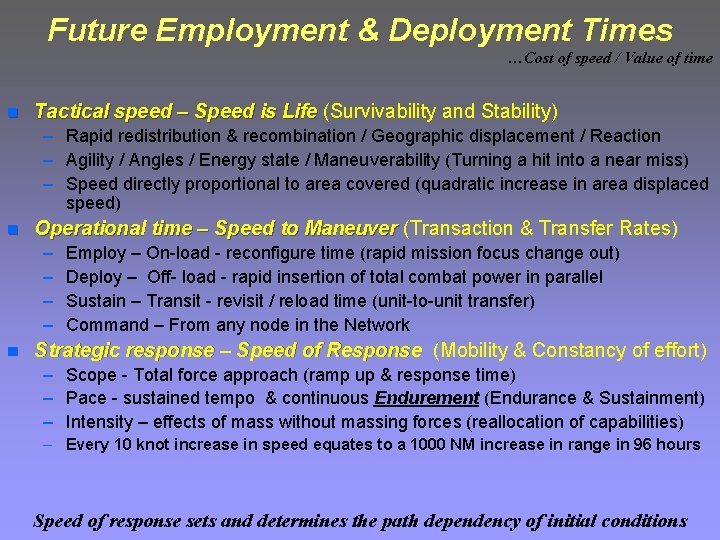
Future Employment & Deployment Times …Cost of speed / Value of time n Tactical speed – Speed is Life (Survivability and Stability) – Rapid redistribution & recombination / Geographic displacement / Reaction – Agility / Angles / Energy state / Maneuverability (Turning a hit into a near miss) – Speed directly proportional to area covered (quadratic increase in area displaced speed) n Operational time – Speed to Maneuver (Transaction & Transfer Rates) – – n Employ – On-load - reconfigure time (rapid mission focus change out) Deploy – Off- load - rapid insertion of total combat power in parallel Sustain – Transit - revisit / reload time (unit-to-unit transfer) Command – From any node in the Network Strategic response – Speed of Response (Mobility & Constancy of effort) – Scope - Total force approach (ramp up & response time) – Pace - sustained tempo & continuous Endurement (Endurance & Sustainment) – Intensity – effects of mass without massing forces (reallocation of capabilities) – Every 10 knot increase in speed equates to a 1000 NM increase in range in 96 hours Speed of response sets and determines the path dependency of initial conditions
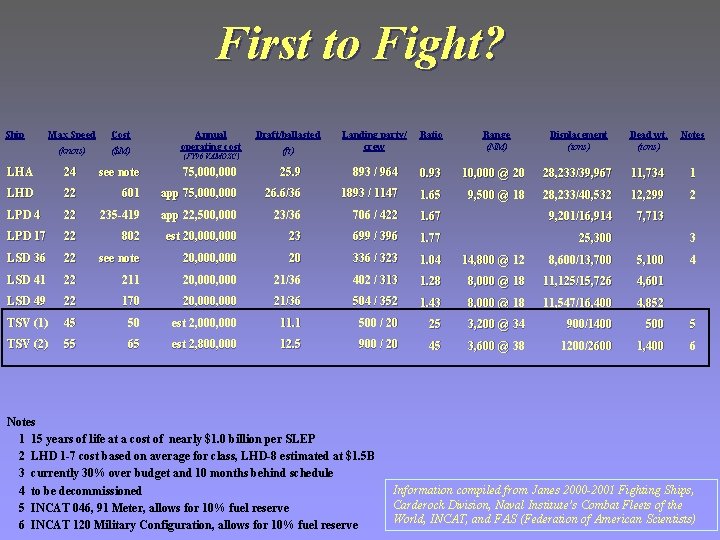
First to Fight? Ship Max Speed Cost (knots) ($M) Annual operating cost Ratio Range (NM) Displacement (tons) Dead wt. (tons) Notes (ft) Landing party/ crew LHA 24 see note 75, 000 25. 9 893 / 964 0. 93 10, 000 @ 20 28, 233/39, 967 11, 734 1 LHD 22 601 app 75, 000 26. 6/36 1893 / 1147 1. 65 9, 500 @ 18 28, 233/40, 532 12, 299 2 LPD 4 22 235 -419 app 22, 500, 000 23/36 706 / 422 1. 67 9, 201/16, 914 7, 713 LPD 17 22 802 est 20, 000 23 699 / 396 1. 77 25, 300 LSD 36 22 see note 20, 000 20 336 / 323 1. 04 14, 800 @ 12 8, 600/13, 700 5, 100 LSD 41 22 211 20, 000 21/36 402 / 313 1. 28 8, 000 @ 18 11, 125/15, 726 4, 601 LSD 49 22 170 20, 000 21/36 504 / 352 1. 43 8, 000 @ 18 11, 547/16, 400 4, 852 TSV (1) 45 50 est 2, 000 11. 1 500 / 20 25 3, 200 @ 34 900/1400 5 TSV (2) 55 65 est 2, 800, 000 12. 5 900 / 20 45 3, 600 @ 38 1200/2600 1, 400 6 (FY 96 VAMOSC) Draft/ballasted Notes 1 15 years of life at a cost of nearly $1. 0 billion per SLEP 2 LHD 1 -7 cost based on average for class, LHD-8 estimated at $1. 5 B 3 currently 30% over budget and 10 months behind schedule 4 to be decommissioned 5 INCAT 046, 91 Meter, allows for 10% fuel reserve 6 INCAT 120 Military Configuration, allows for 10% fuel reserve 3 4 Information compiled from Janes 2000 -2001 Fighting Ships, Carderock Division, Naval Institute’s Combat Fleets of the World, INCAT, and FAS (Federation of American Scientists)
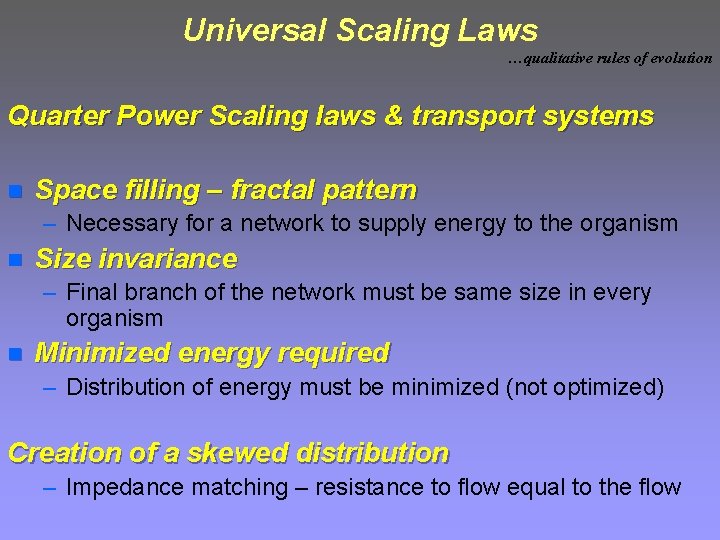
Universal Scaling Laws …qualitative rules of evolution Quarter Power Scaling laws & transport systems n Space filling – fractal pattern – Necessary for a network to supply energy to the organism n Size invariance – Final branch of the network must be same size in every organism n Minimized energy required – Distribution of energy must be minimized (not optimized) Creation of a skewed distribution – Impedance matching – resistance to flow equal to the flow

Organizing Principals for Distributed Networked Forces …Combat power generated by Information • What must Distributed Networked Forces give the Nation? • A difference in kind, orders of magnitude improvement in combat power and a broadened base of available capabilities • What must Distributed Networked Forces give the Combatant Commanders? • Variance in options through recombination of fractal, scale invariant assets operating as a networked, distributed Joint combat force • What must Distributed Networked Forces give the Service? • A Total Combat Systems approach for evaluating service’s contribution to Joint Warfighting
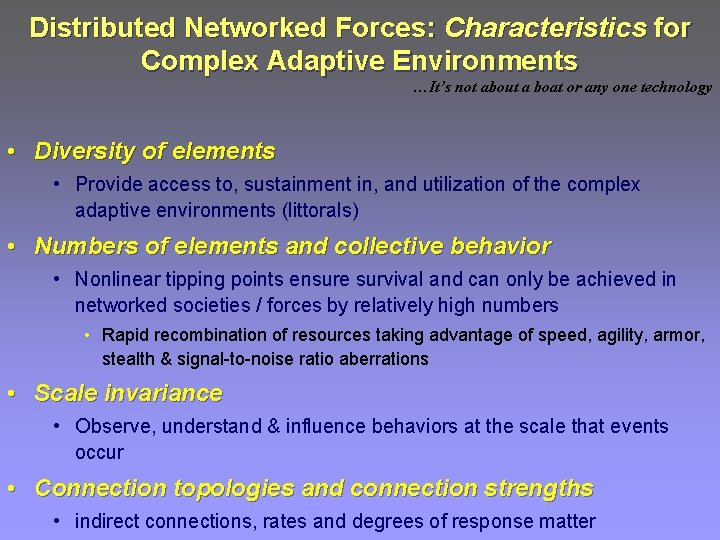
Distributed Networked Forces: Characteristics for Complex Adaptive Environments …It’s not about a boat or any one technology • Diversity of elements • Provide access to, sustainment in, and utilization of the complex adaptive environments (littorals) • Numbers of elements and collective behavior • Nonlinear tipping points ensure survival and can only be achieved in networked societies / forces by relatively high numbers • Rapid recombination of resources taking advantage of speed, agility, armor, stealth & signal-to-noise ratio aberrations • Scale invariance • Observe, understand & influence behaviors at the scale that events occur • Connection topologies and connection strengths • indirect connections, rates and degrees of response matter
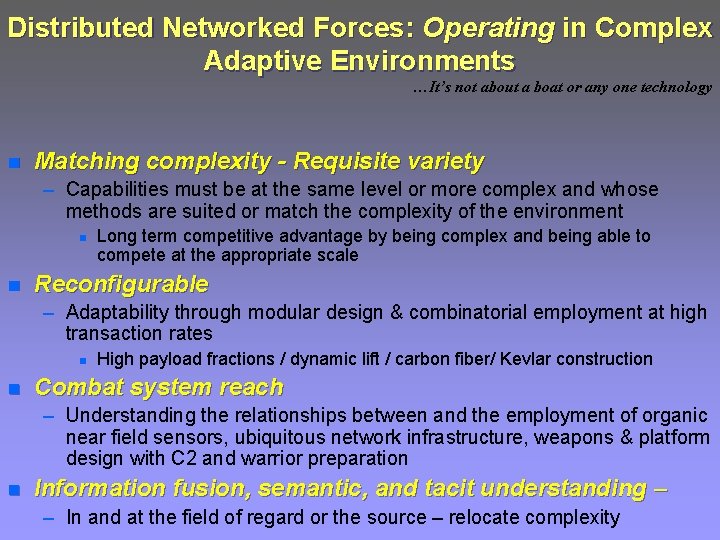
Distributed Networked Forces: Operating in Complex Adaptive Environments …It’s not about a boat or any one technology n Matching complexity - Requisite variety – Capabilities must be at the same level or more complex and whose methods are suited or match the complexity of the environment n n Long term competitive advantage by being complex and being able to compete at the appropriate scale Reconfigurable – Adaptability through modular design & combinatorial employment at high transaction rates n n High payload fractions / dynamic lift / carbon fiber/ Kevlar construction Combat system reach – Understanding the relationships between and the employment of organic near field sensors, ubiquitous network infrastructure, weapons & platform design with C 2 and warrior preparation n Information fusion, semantic, and tacit understanding – – In and at the field of regard or the source – relocate complexity
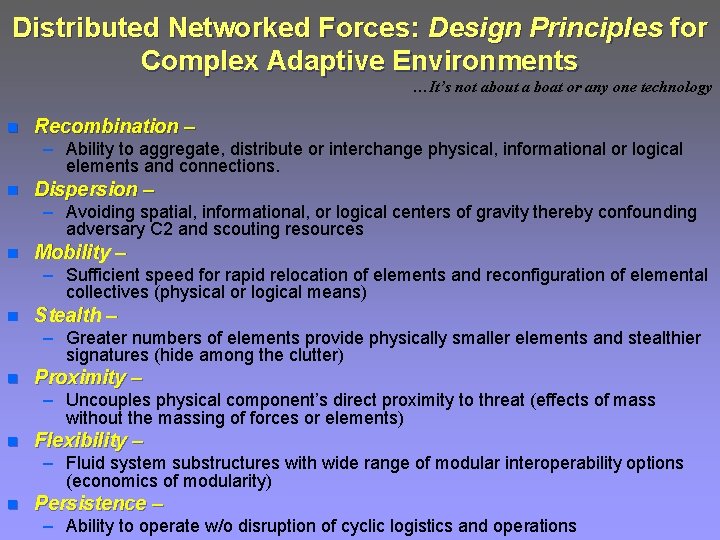
Distributed Networked Forces: Design Principles for Complex Adaptive Environments …It’s not about a boat or any one technology n Recombination – – Ability to aggregate, distribute or interchange physical, informational or logical elements and connections. n Dispersion – – Avoiding spatial, informational, or logical centers of gravity thereby confounding adversary C 2 and scouting resources n Mobility – – Sufficient speed for rapid relocation of elements and reconfiguration of elemental collectives (physical or logical means) n Stealth – – Greater numbers of elements provide physically smaller elements and stealthier signatures (hide among the clutter) n Proximity – – Uncouples physical component’s direct proximity to threat (effects of mass without the massing of forces or elements) n Flexibility – – Fluid system substructures with wide range of modular interoperability options (economics of modularity) n Persistence – – Ability to operate w/o disruption of cyclic logistics and operations
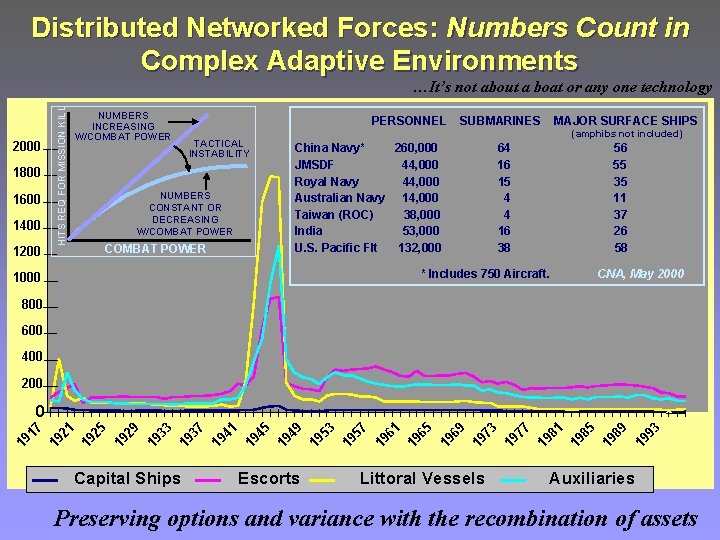
Distributed Networked Forces: Numbers Count in Complex Adaptive Environments HITS REQ FOR MISSION KILL …It’s not about a boat or any one technology 2000 1800 1600 1400 1200 NUMBERS INCREASING W/COMBAT POWER PERSONNEL SUBMARINES MAJOR SURFACE SHIPS (amphibs not included) TACTICAL INSTABILITY China Navy* 260, 000 JMSDF 44, 000 Royal Navy 44, 000 Australian Navy 14, 000 Taiwan (ROC) 38, 000 India 53, 000 U. S. Pacific Flt 132, 000 NUMBERS CONSTANT OR DECREASING W/COMBAT POWER 64 16 15 4 4 16 38 56 55 35 11 37 26 58 CNA, May 2000 * Includes 750 Aircraft. 1000 800 600 400 200 Capital Ships Escorts Littoral Vessels 93 19 89 19 85 19 81 19 77 19 73 19 69 19 65 19 61 19 57 19 53 19 49 19 45 19 41 19 37 19 33 19 29 19 25 19 21 19 19 17 0 Auxiliaries Preserving options and variance with the recombination of assets
Real Options Analysis n Preserve Flexibility n Hedge against Contingencies n Mitigate Volatility All three seek to manage UNCERTAINTY
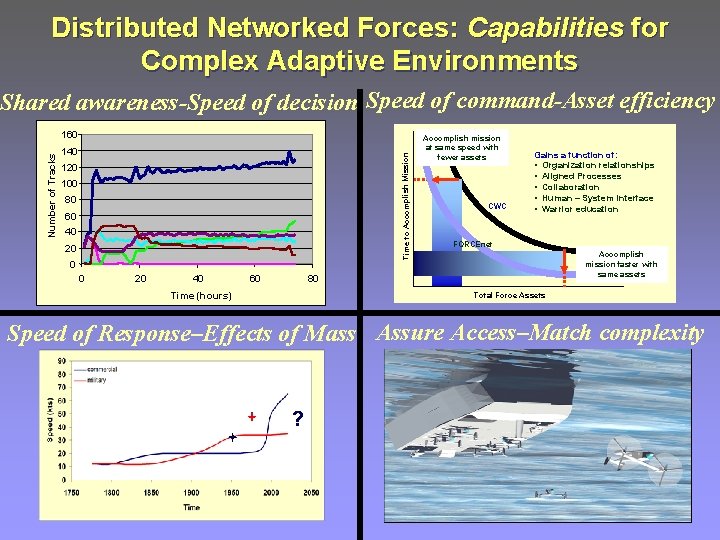
Distributed Networked Forces: Capabilities for Complex Adaptive Environments Shared awareness-Speed of decision Speed of command-Asset efficiency 140 Time to Accomplish Mission Number of Tracks 160 120 100 80 60 40 20 0 0 20 40 60 Accomplish mission at same speed with fewer assets CWC Gains a function of: • Organization relationships • Aligned Processes • Collaboration • Human – System interface • Warrior education FORCEnet Accomplish mission faster with same assets 80 Time (hours) Total Force Assets Speed of Response–Effects of Mass Assure Access–Match complexity ?
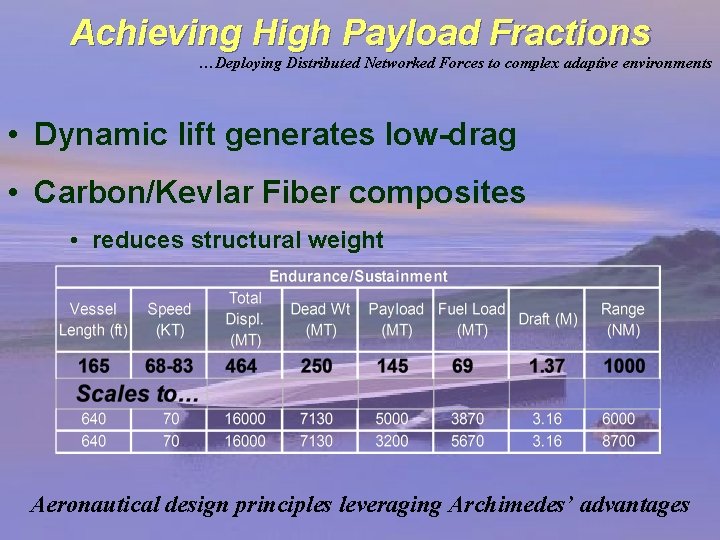
Achieving High Payload Fractions …Deploying Distributed Networked Forces to complex adaptive environments • Dynamic lift generates low-drag • Carbon/Kevlar Fiber composites • reduces structural weight Aeronautical design principles leveraging Archimedes’ advantages
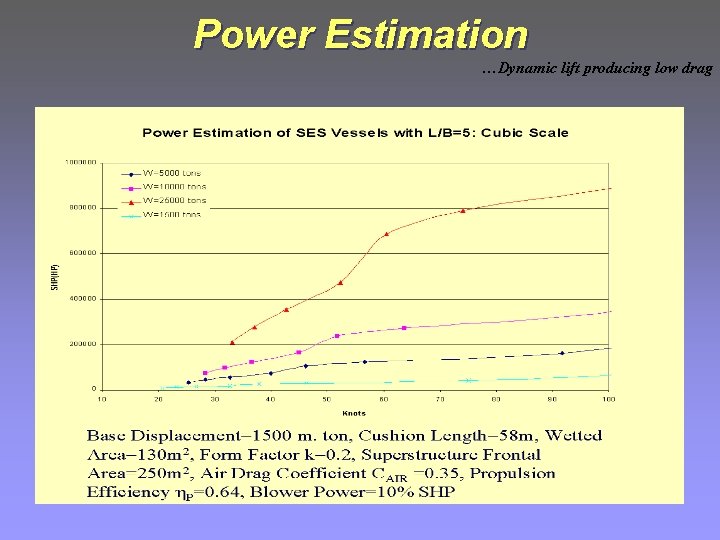
Power Estimation …Dynamic lift producing low drag
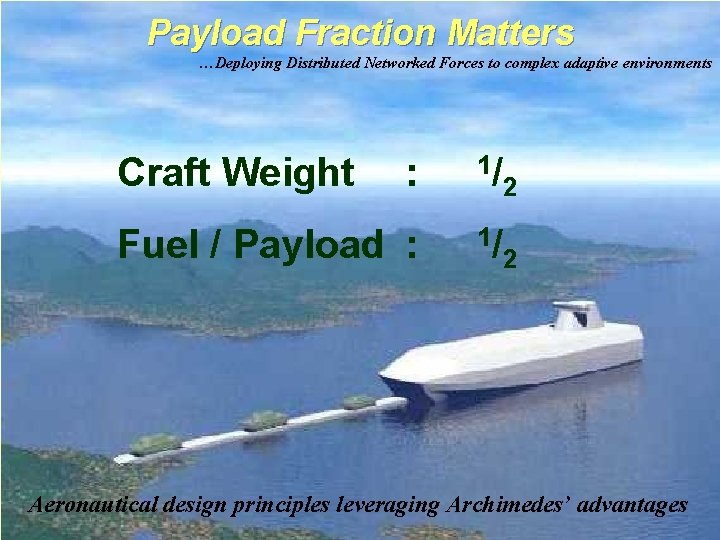
Payload Fraction Matters …Deploying Distributed Networked Forces to complex adaptive environments Craft Weight : 1/ 2 Fuel / Payload : 1/ 2 Aeronautical design principles leveraging Archimedes’ advantages
Economics of Modularity n Standards, protocols and interfaces – Don’t limit design to mere modular construction n Mission adaptability & reconfiguration – Family of chassis across the scale of employment n Recombination of Assets – Creating numerous nodes within an existing network that supports the burgeoning trend of demand network logistics & just in time delivery Providing a spectrum of options for the Combatant Commanders
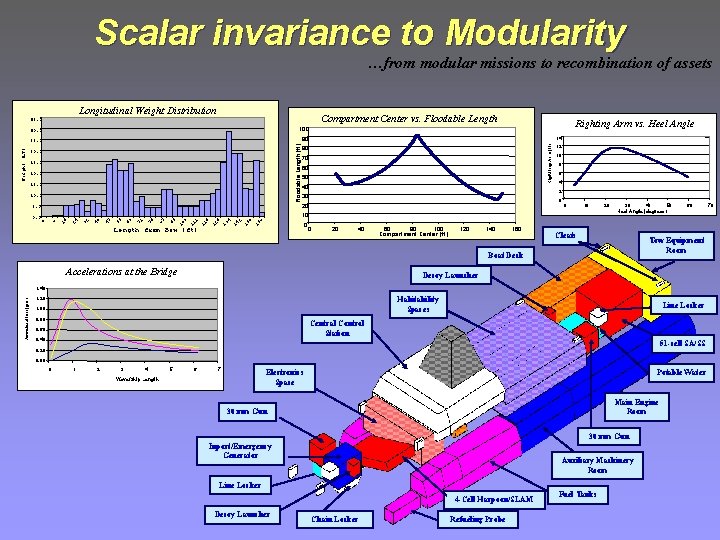
Scalar invariance to Modularity …from modular missions to recombination of assets Longitudinal Weight Distribution 45. 0 Compartment Center vs. Floodable Length Righting Arm (ft) Floodable Length (ft) 80 30. 0 70 25. 0 60 20. 0 50 15. 0 40 95 10 3 11 1 11 9 12 6 13 4 14 2 15 0 15 8 87 79 63 71 47 55 40 32 24 10 8 0. 0 16 5. 0 20 0 Length from Bow (ft) 12 10 8 6 4 2 30 10. 0 0 14 90 35. 0 Weight (LT) Righting Arm vs. Heel Angle 100 40. 0 0 0 20 40 60 80 100 Compartment Center (ft) 120 140 160 0 10 20 30 40 50 Heel Angle (degrees) Cleats Tow Equipment Room Boat Deck Accelerations at the Bridge 60 Decoy Launcher Acceleration (g's) 1. 40 Habitability Spaces 1. 20 1. 00 0. 80 Line Locker Central Control Station 0. 60 0. 40 51 -cell SA/SS 0. 20 0. 00 0 1 2 3 4 5 6 7 Electronics Space Wave/Ship Length Potable Water Main Engine Room 30 mm Gun Inport/Emergency Generator Auxiliary Machinery Room Line Locker 4 -Cell Harpoon/SLAM Decoy Launcher Chain Locker Refueling Probe Fuel Tanks 70
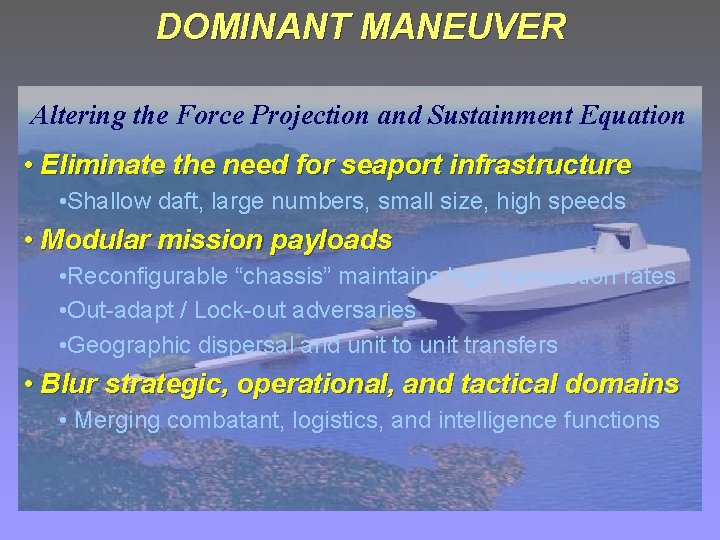
DOMINANT MANEUVER Altering the Force Projection and Sustainment Equation • Eliminate the need for seaport infrastructure • Shallow daft, large numbers, small size, high speeds • Modular mission payloads • Reconfigurable “chassis” maintains high transaction rates • Out-adapt / Lock-out adversaries • Geographic dispersal and unit to unit transfers • Blur strategic, operational, and tactical domains • Merging combatant, logistics, and intelligence functions
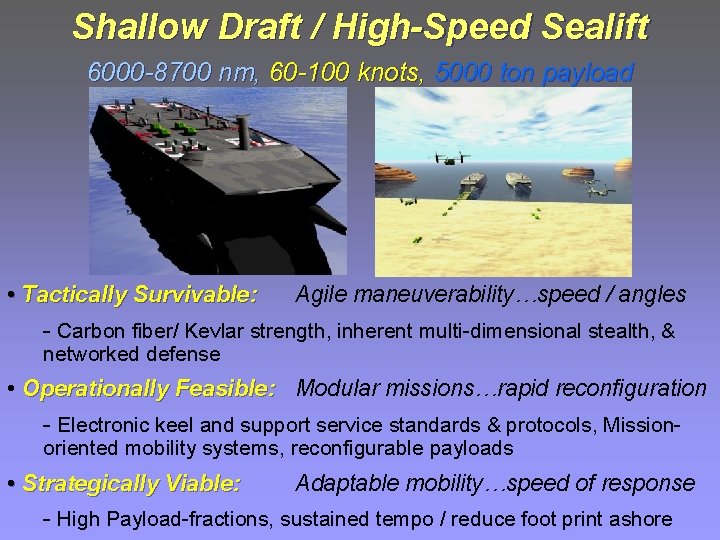
Shallow Draft / High-Speed Sealift 6000 -8700 nm, 60 -100 knots, 5000 ton payload • Tactically Survivable: Agile maneuverability…speed / angles - Carbon fiber/ Kevlar strength, inherent multi-dimensional stealth, & networked defense • Operationally Feasible: Modular missions…rapid reconfiguration - Electronic keel and support service standards & protocols, Missionoriented mobility systems, reconfigurable payloads • Strategically Viable: Adaptable mobility…speed of response - High Payload-fractions, sustained tempo / reduce foot print ashore
Transformational patterns …holistic approach Evolutionary economics n Seamlessness – Not just Joint interoperability but n 2 n transactions n Diversity – Numerous options / family of capabilities / scale invariance n Continuous change – Adapting to the fitness landscape – Continuous learning n Persistent innovative steps – Small jumps and big bets – Continuous experimentation with incessant feedback
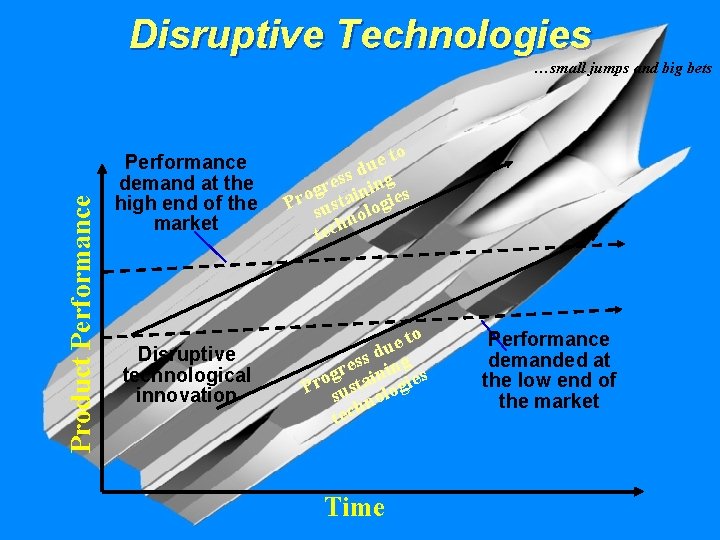
Disruptive Technologies Product Performance …small jumps and big bets Performance demand at the high end of the market Disruptive technological innovation to e du s s e ning r g Pro sustai logies no h c te to e u d g s s re inin s g o Pr susta logie no h c te Time Performance demanded at the low end of the market
- Slides: 23