
Distributed Modeling in Hydrology using Digital Data and
Distributed Modeling in Hydrology using Digital Data and Geographic Information Systems David Tarboton Utah State University Course presented at the University of Padua May 15 to 26, 2000
Course Outline • • • Introduction and use of Arc. View Watershed and stream network delineation DEM Based Hydrologic Modeling [Computer lab] Integration of Computer Modeling and GIS
Introduction and use of Arc. View • GIS Data Structures • Hydrology Data Model Definitions • Geodesy, Map Projections and Coordinate Systems • Arc. View demo
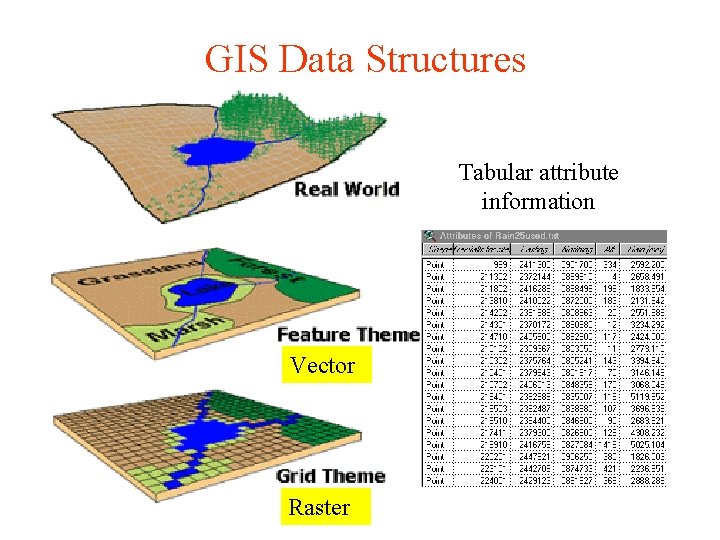
GIS Data Structures Tabular attribute information Vector Raster
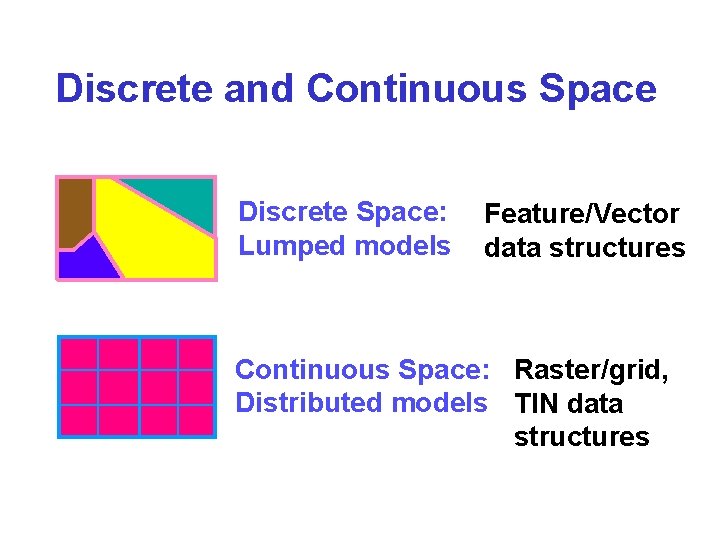
Discrete and Continuous Space Discrete Space: Lumped models Feature/Vector data structures Continuous Space: Raster/grid, Distributed models TIN data structures
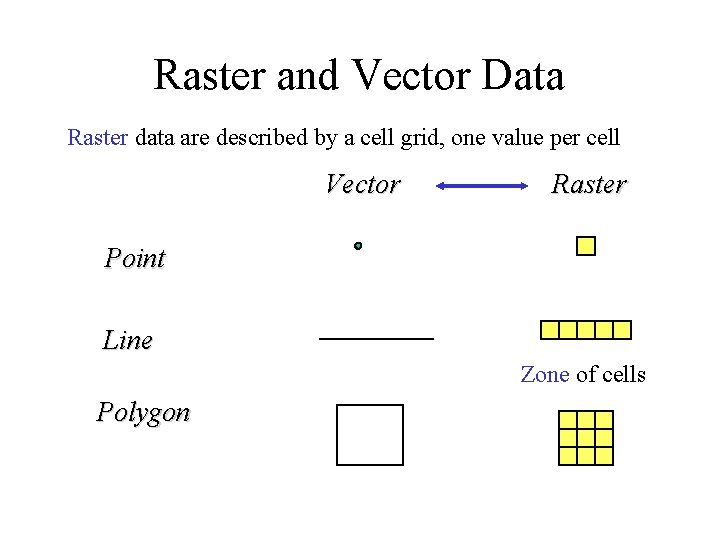
Raster and Vector Data Raster data are described by a cell grid, one value per cell Vector Raster Point Line Zone of cells Polygon
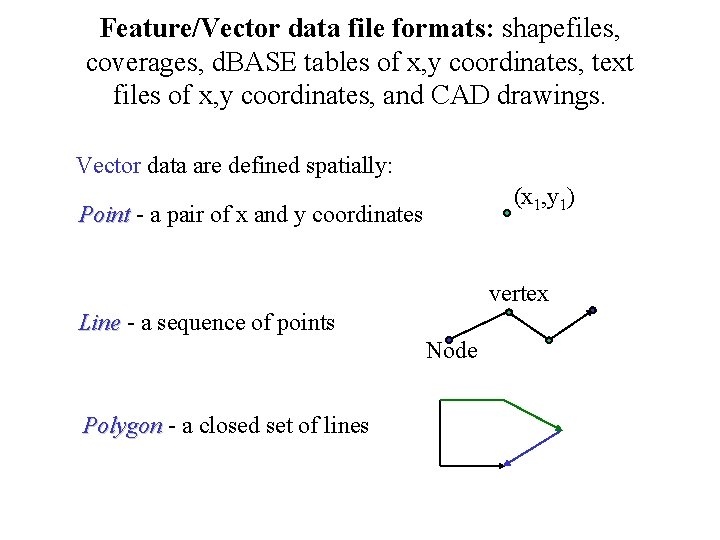
Feature/Vector data file formats: shapefiles, coverages, d. BASE tables of x, y coordinates, text files of x, y coordinates, and CAD drawings. Vector data are defined spatially: (x 1, y 1) Point - a pair of x and y coordinates vertex Line - a sequence of points Node Polygon - a closed set of lines
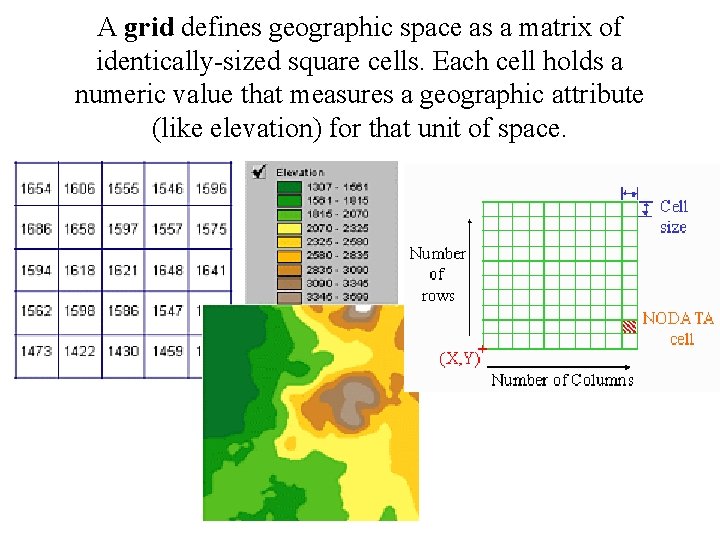
A grid defines geographic space as a matrix of identically-sized square cells. Each cell holds a numeric value that measures a geographic attribute (like elevation) for that unit of space.
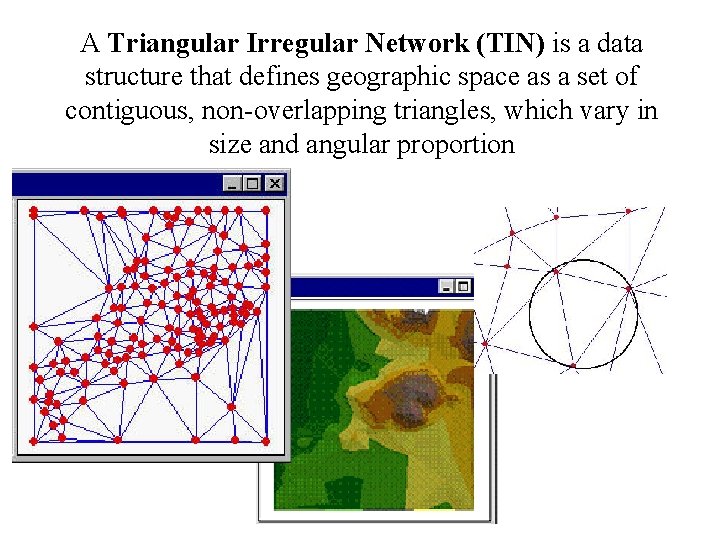
A Triangular Irregular Network (TIN) is a data structure that defines geographic space as a set of contiguous, non-overlapping triangles, which vary in size and angular proportion
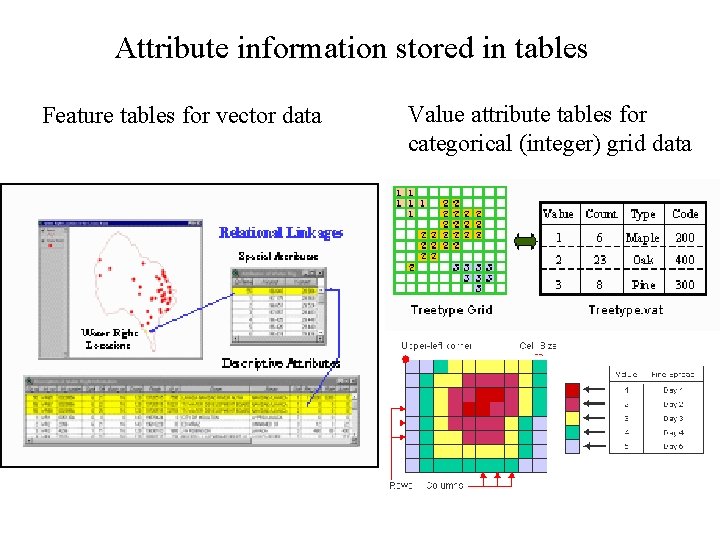
Attribute information stored in tables Feature tables for vector data Value attribute tables for categorical (integer) grid data
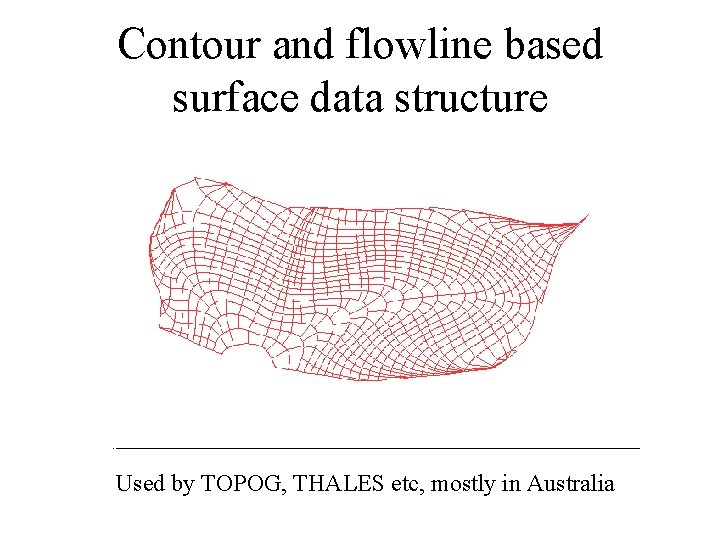
Contour and flowline based surface data structure Used by TOPOG, THALES etc, mostly in Australia
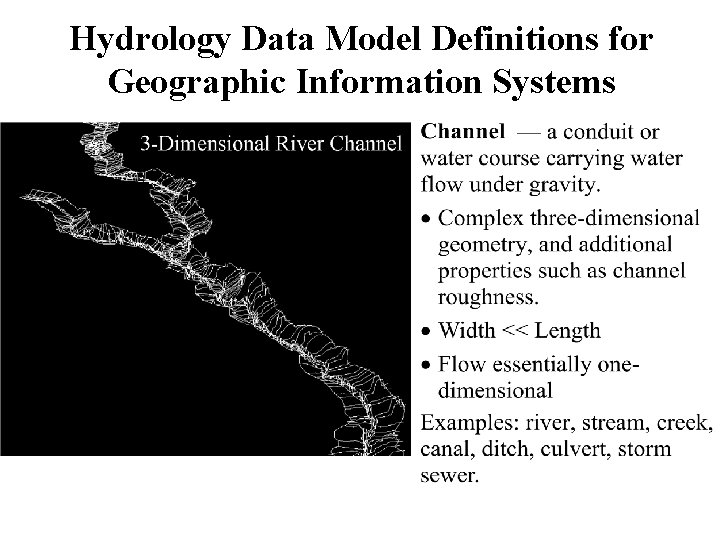
Hydrology Data Model Definitions for Geographic Information Systems
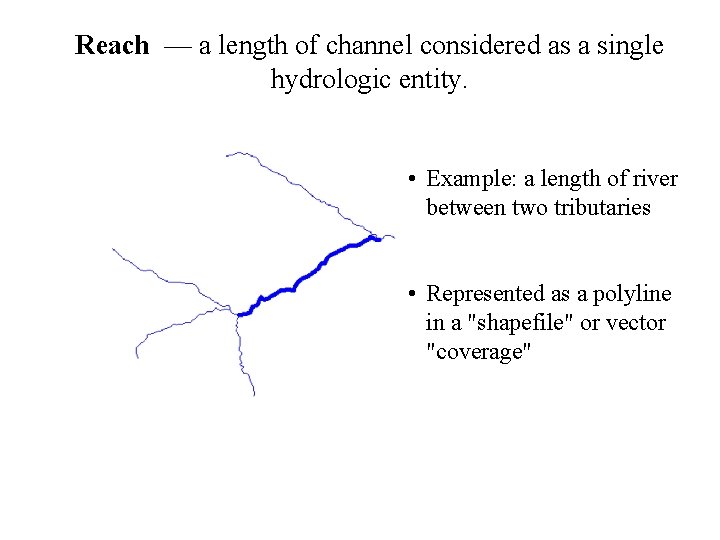
Reach — a length of channel considered as a single hydrologic entity. • Example: a length of river between two tributaries • Represented as a polyline in a "shapefile" or vector "coverage"
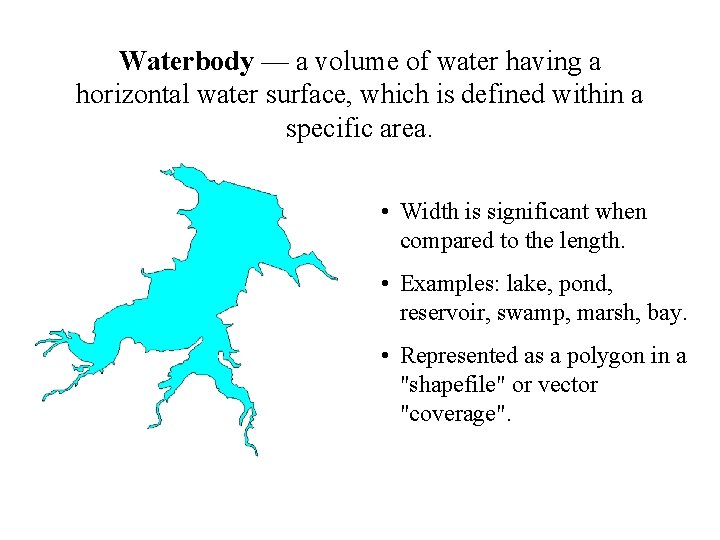
Waterbody — a volume of water having a horizontal water surface, which is defined within a specific area. • Width is significant when compared to the length. • Examples: lake, pond, reservoir, swamp, marsh, bay. • Represented as a polygon in a "shapefile" or vector "coverage".
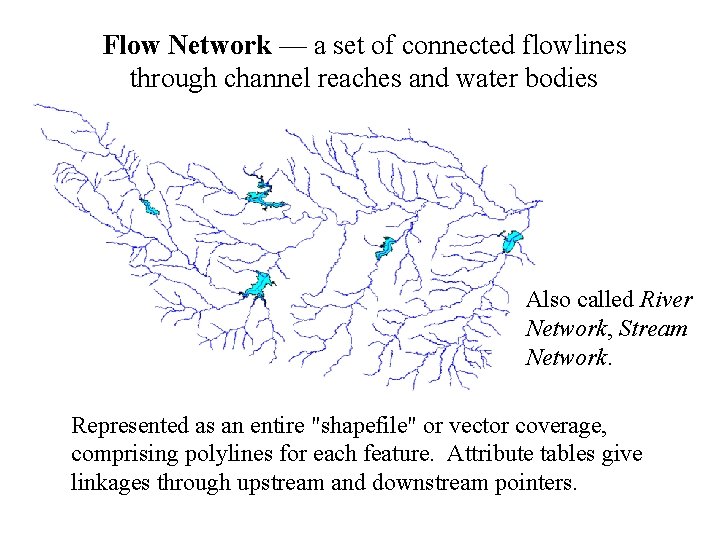
Flow Network — a set of connected flowlines through channel reaches and water bodies Also called River Network, Stream Network. Represented as an entire "shapefile" or vector coverage, comprising polylines for each feature. Attribute tables give linkages through upstream and downstream pointers.
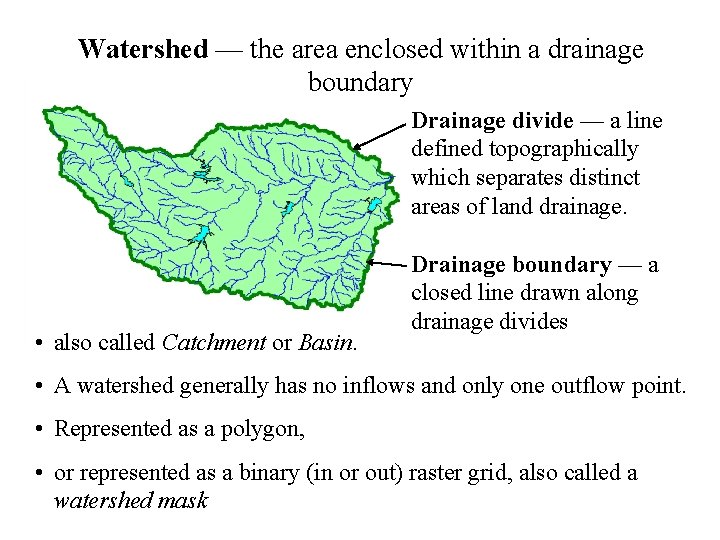
Watershed — the area enclosed within a drainage boundary Drainage divide — a line defined topographically which separates distinct areas of land drainage. • also called Catchment or Basin. Drainage boundary — a closed line drawn along drainage divides • A watershed generally has no inflows and only one outflow point. • Represented as a polygon, • or represented as a binary (in or out) raster grid, also called a watershed mask
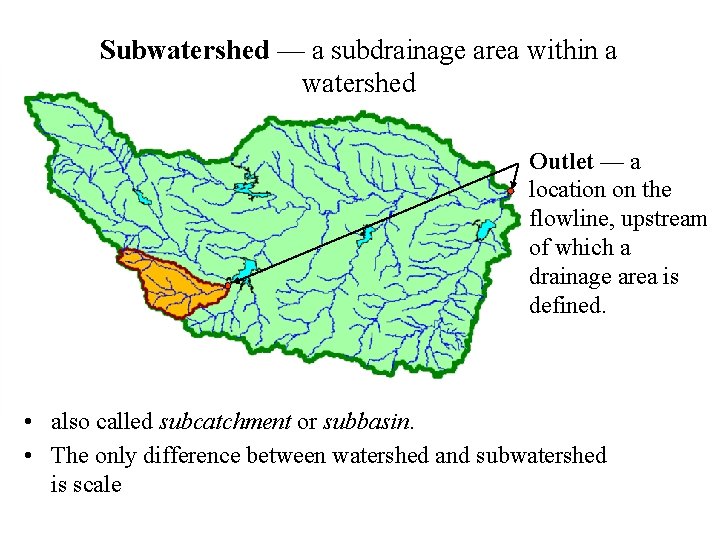
Subwatershed — a subdrainage area within a watershed Outlet — a location on the flowline, upstream of which a drainage area is defined. • also called subcatchment or subbasin. • The only difference between watershed and subwatershed is scale
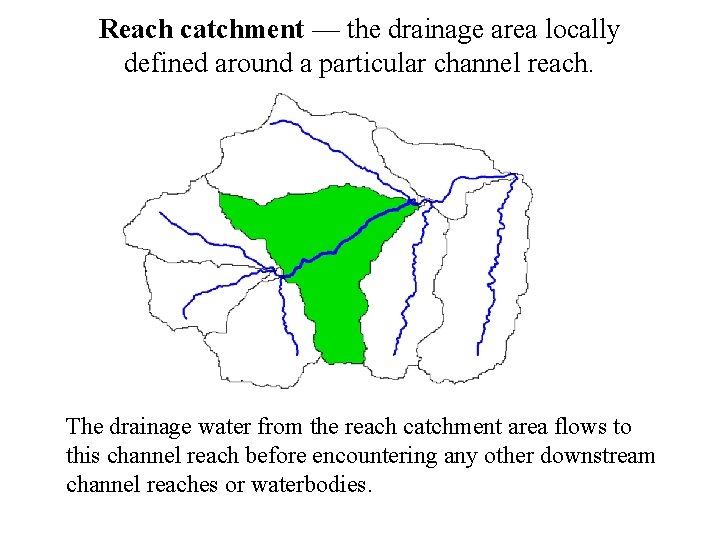
Reach catchment — the drainage area locally defined around a particular channel reach. The drainage water from the reach catchment area flows to this channel reach before encountering any other downstream channel reaches or waterbodies.
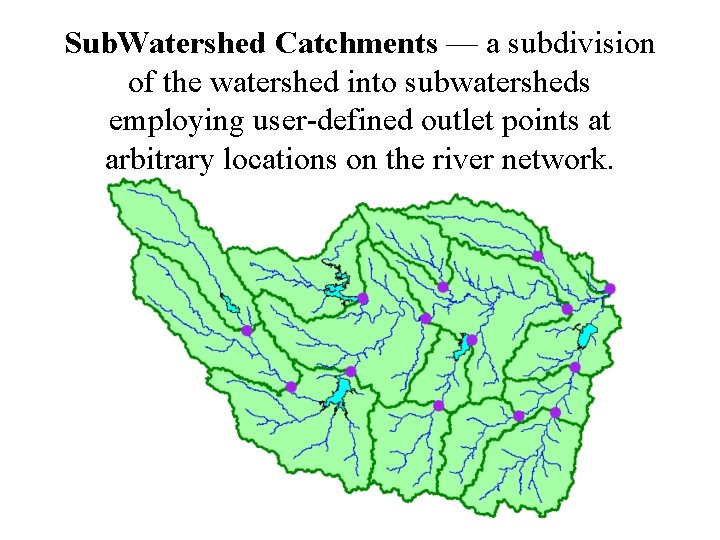
Sub. Watershed Catchments — a subdivision of the watershed into subwatersheds employing user-defined outlet points at arbitrary locations on the river network.
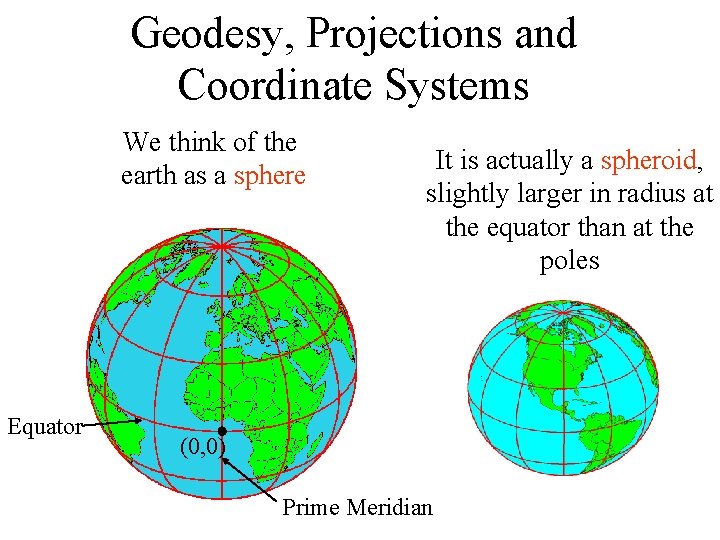
Geodesy, Projections and Coordinate Systems We think of the earth as a sphere Equator It is actually a spheroid, slightly larger in radius at the equator than at the poles (0, 0) Prime Meridian
Geodesy and Map Projections • Geodesy - the shape of the earth and definition of earth datums • Map Projection - the transformation of a curved earth to a flat map • Coordinate systems - (x, y) coordinate systems for map data
Types of Coordinate Systems • (1) Global Cartesian coordinates (x, y, z) for the whole earth • (2) Geographic coordinates (f, , z) • (3) Projected coordinates (x, y, z) on a local area of the earth’s surface • The z-coordinate in (1) and (3) is defined geometrically; in (2) the z-coordinate is defined gravitationally
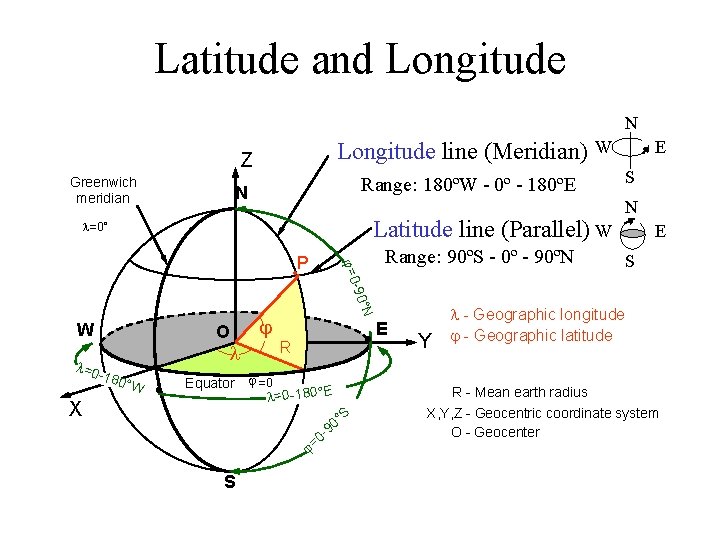
Latitude and Longitude N Longitude line (Meridian) Z Greenwich meridian W Range: 180ºW - 0º - 180ºE N Latitude line (Parallel) W =0° Range: 90ºS - 0º - 90ºN S N E S W =0 O -180 X °W • • Equator °N -90 =0 P • E • R =0 =0 -180°E °S 0 -9 0 = S E Y - Geographic longitude - Geographic latitude R - Mean earth radius X, Y, Z - Geocentric coordinate system O - Geocenter
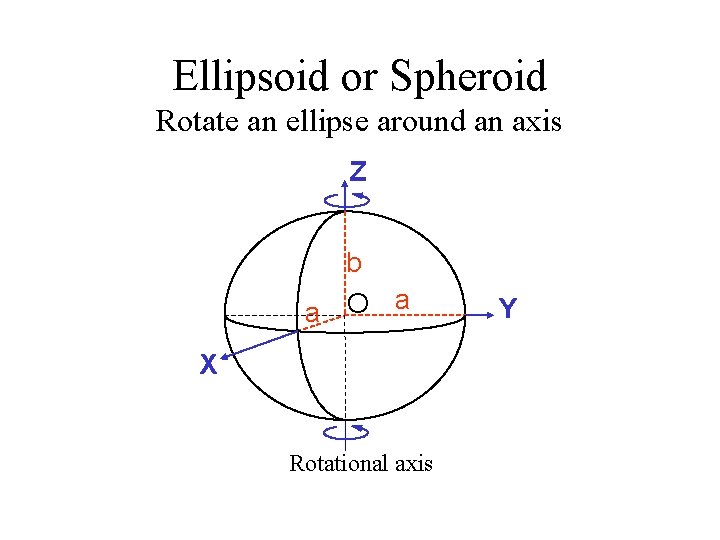
Ellipsoid or Spheroid Rotate an ellipse around an axis Z b a O a X Rotational axis Y
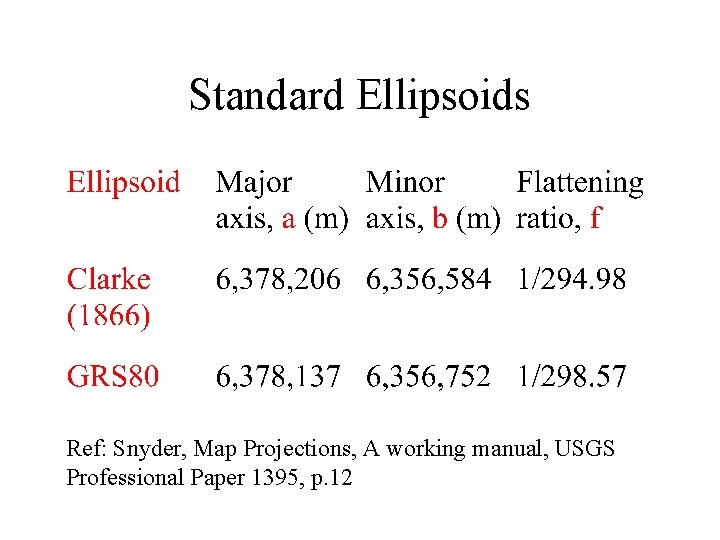
Standard Ellipsoids Ref: Snyder, Map Projections, A working manual, USGS Professional Paper 1395, p. 12
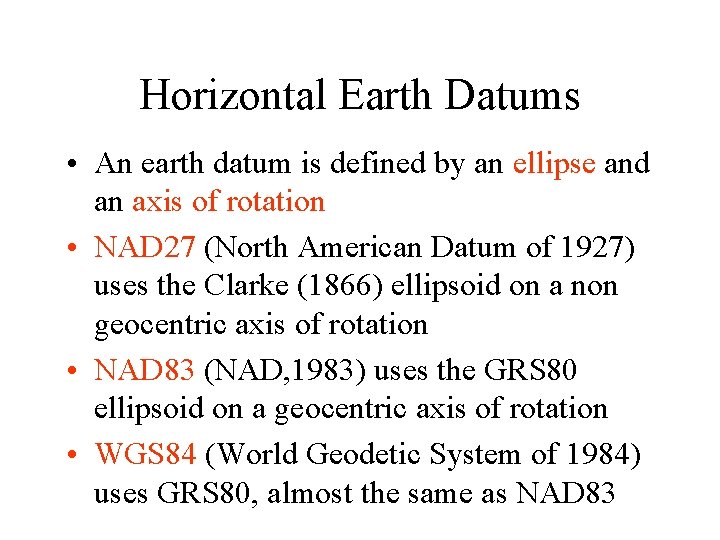
Horizontal Earth Datums • An earth datum is defined by an ellipse and an axis of rotation • NAD 27 (North American Datum of 1927) uses the Clarke (1866) ellipsoid on a non geocentric axis of rotation • NAD 83 (NAD, 1983) uses the GRS 80 ellipsoid on a geocentric axis of rotation • WGS 84 (World Geodetic System of 1984) uses GRS 80, almost the same as NAD 83
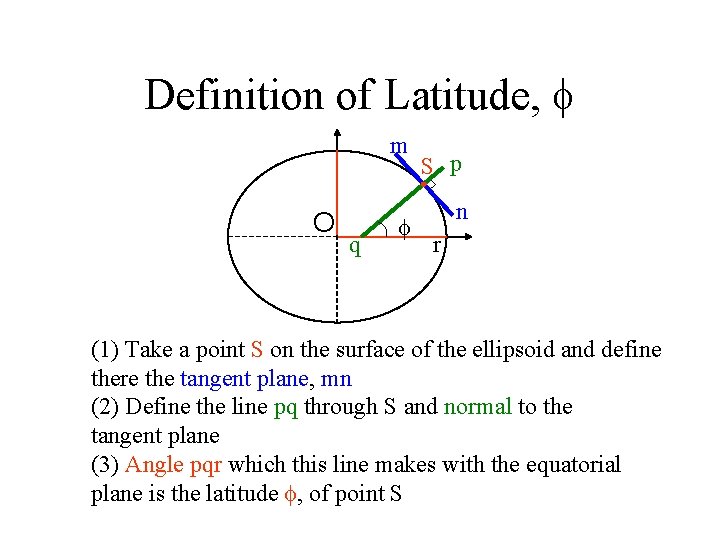
Definition of Latitude, f m O q f S p n r (1) Take a point S on the surface of the ellipsoid and define there the tangent plane, mn (2) Define the line pq through S and normal to the tangent plane (3) Angle pqr which this line makes with the equatorial plane is the latitude f, of point S
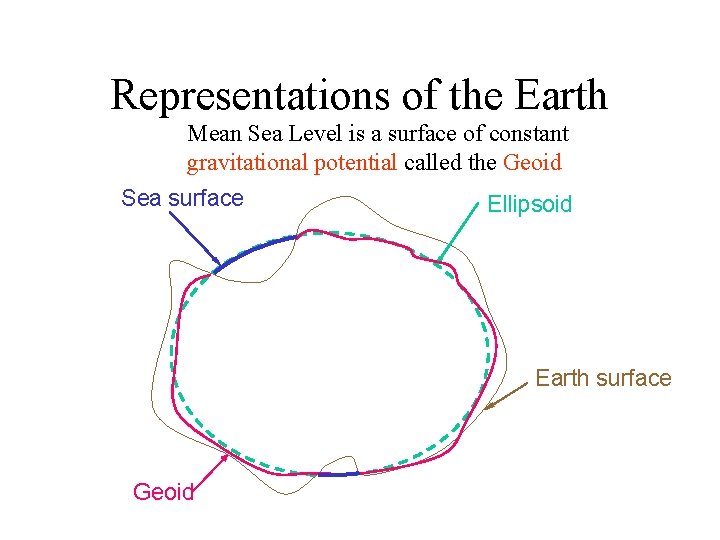
Representations of the Earth Mean Sea Level is a surface of constant gravitational potential called the Geoid Sea surface Ellipsoid Earth surface Geoid
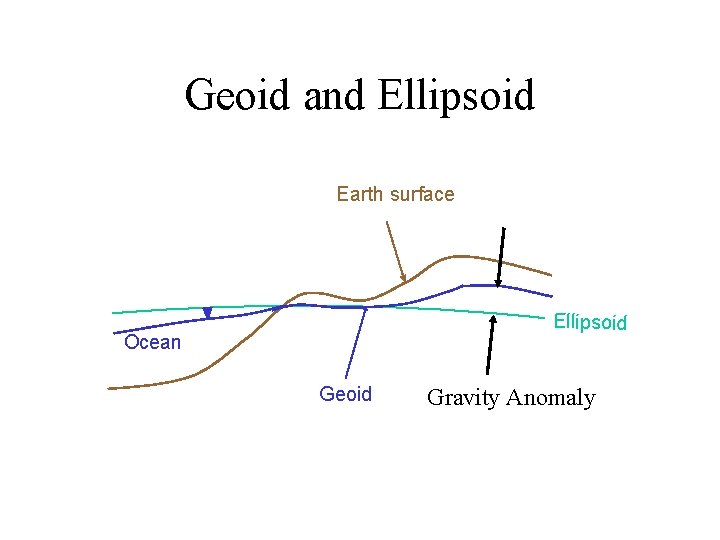
Geoid and Ellipsoid Earth surface Ellipsoid Ocean Geoid Gravity Anomaly
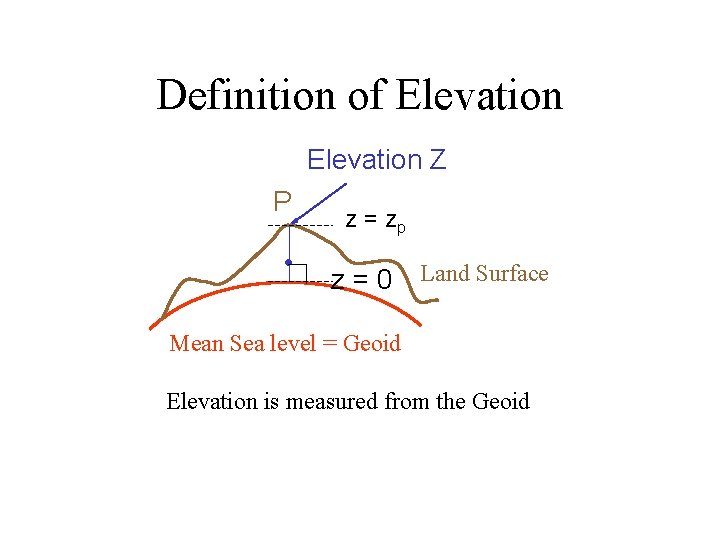
Definition of Elevation Z P • z = zp z = 0 Land Surface Mean Sea level = Geoid Elevation is measured from the Geoid
Vertical Earth Datums • A vertical datum defines elevation, z • NGVD 29 (National Geodetic Vertical Datum of 1929) • NAVD 88 (North American Vertical Datum of 1988) • takes into account a map of gravity anomalies between the ellipsoid and the geoid
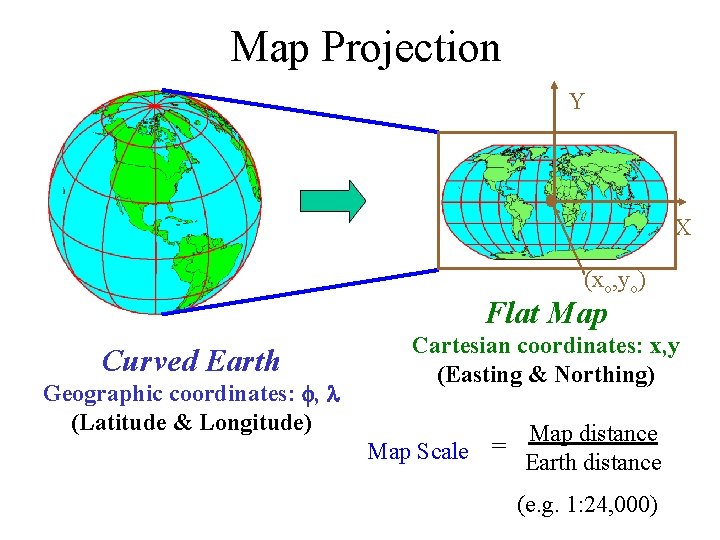
Map Projection Y X (xo, yo) Flat Map Curved Earth Geographic coordinates: f, l (Latitude & Longitude) Cartesian coordinates: x, y (Easting & Northing) Map distance = Map Scale Earth distance (e. g. 1: 24, 000)
Types of Projections • Conic (Albers Equal Area, Lambert Conformal Conic) - good for East-West land areas • Cylindrical (Transverse Mercator) - good for North-South land areas • Azimuthal (Lambert Azimuthal Equal Area) - good for global views
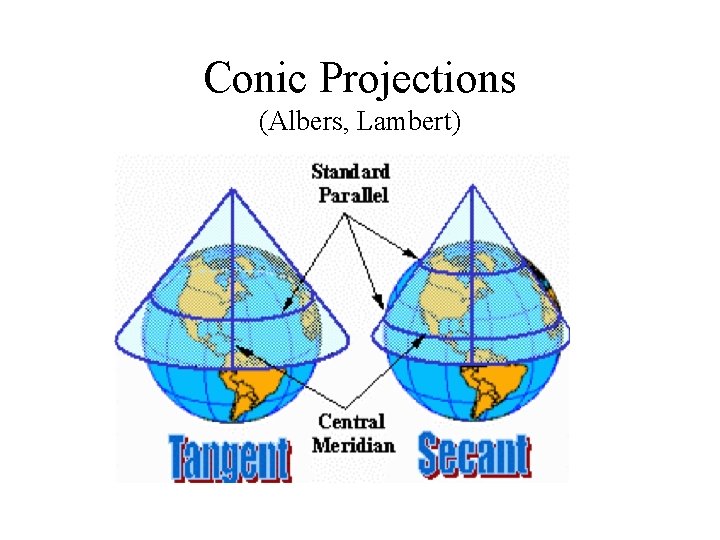
Conic Projections (Albers, Lambert)
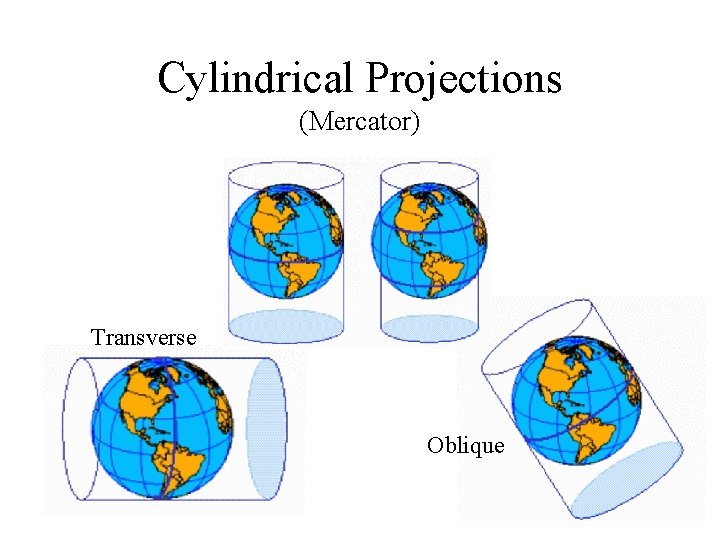
Cylindrical Projections (Mercator) Transverse Oblique
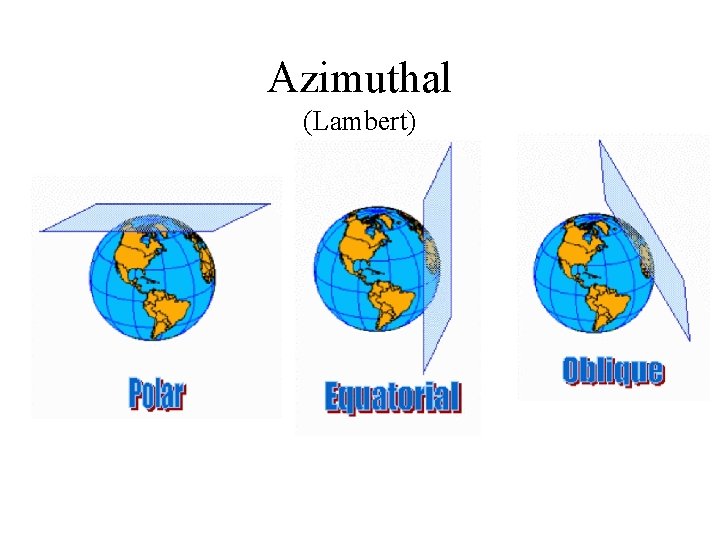
Azimuthal (Lambert)
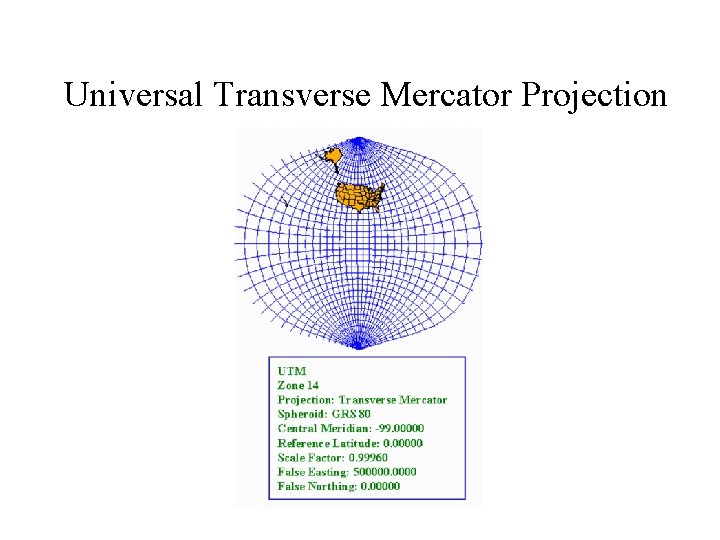
Universal Transverse Mercator Projection
Projections Preserve Some Earth Properties • Area - correct earth surface area (Albers Equal Area) important for mass balances • Shape - local angles are shown correctly (Lambert Conformal Conic) • Direction - all directions are shown correctly relative to the center (Lambert Azimuthal Equal Area) • Distance - preserved along particular lines • Some projections preserve two properties
Coordinate Systems • Universal Transverse Mercator (UTM) - a global system developed by the US Military Services • State Plane Coordinate System - civilian system for defining legal boundaries • Texas State Mapping System - a statewide coordinate system for Texas
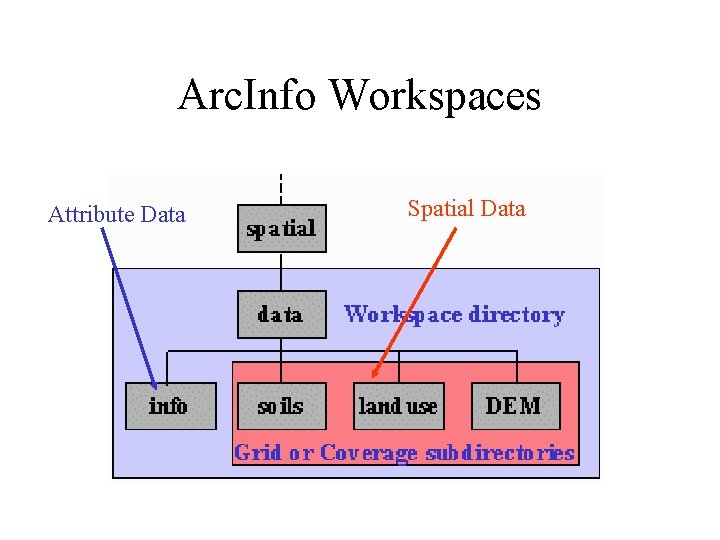
Arc. Info and Arc. View files • Arc. View Shapefiles – vector data in a simplified format (. shx, . dbf, etc) • Arc. Info Coverage files – vector data in a more complex format, separate directories for spatial and attribute data (Info) • Arc. Info Grid files – same structure as coverage files • File Manager in Arc. View – use this to copy Arc. Info files rather than Explorer
Arc. Info Workspaces Attribute Data Spatial Data
Arc. View Spatial Analyst Extension • A package of Avenue programs that extends Arc. View’s capabilities • Allows you to work with Grid files • Does Map Algebra • Allows interpolation of point data onto surfaces and construction of contouring and shaded maps
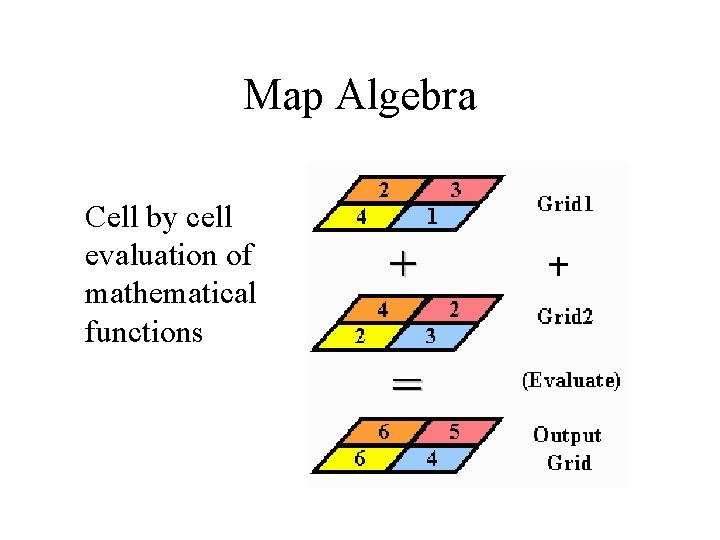
Map Algebra Cell by cell evaluation of mathematical functions
Concept Summary • A region can be considered spatially discrete or spatially continuous • Discrete space is represented by features (vectors or shapes, i. e. points, lines and polygons) and continuous space by elements (grid cells) • Features have descriptive attributes stored in an attribute table • Attribute tables can be linked or joined to related tables using a key field.
- Slides: 44