
Distributed Local Recovery from Multiple Link Failures in
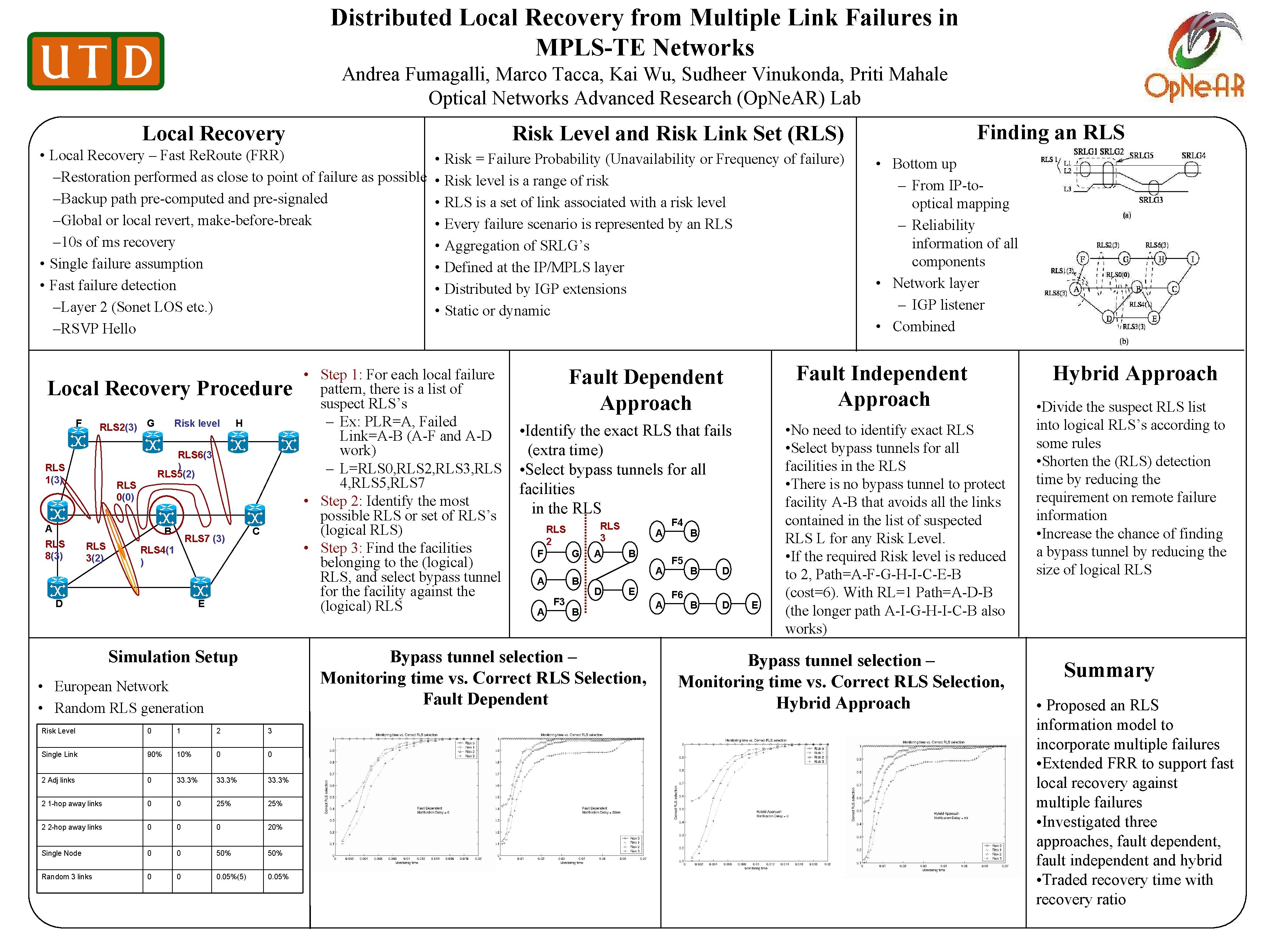
Distributed Local Recovery from Multiple Link Failures in MPLS-TE Networks Andrea Fumagalli, Marco Tacca, Kai Wu, Sudheer Vinukonda, Priti Mahale Optical Networks Advanced Research (Op. Ne. AR) Lab Local Recovery • Local Recovery – Fast Re. Route (FRR) – Restoration performed as close to point of failure as possible – Backup path pre-computed and pre-signaled – Global or local revert, make-before-break – 10 s of ms recovery • Single failure assumption • Fast failure detection – Layer 2 (Sonet LOS etc. ) – RSVP Hello Local Recovery Procedure F RLS 2(3) G Risk level RLS 6(3 ) RLS 5(2) RLS 1(3) RLS 0(0) A B RLS 8(3) H RLS 3(2) RLS 7 (3) C RLS 4(1 ) D E Simulation Setup • • Risk = Failure Probability (Unavailability or Frequency of failure) Risk level is a range of risk RLS is a set of link associated with a risk level Every failure scenario is represented by an RLS Aggregation of SRLG’s Defined at the IP/MPLS layer Distributed by IGP extensions Static or dynamic • Step 1: For each local failure pattern, there is a list of suspect RLS’s – Ex: PLR=A, Failed Link=A-B (A-F and A-D work) – L=RLS 0, RLS 2, RLS 3, RLS 4, RLS 5, RLS 7 • Step 2: Identify the most possible RLS or set of RLS’s (logical RLS) • Step 3: Find the facilities belonging to the (logical) RLS, and select bypass tunnel for the facility against the (logical) RLS • Identify the exact RLS that fails (extra time) • Select bypass tunnels for all facilities in the RLS 3 RLS 2 F G A A B F 3 A A B A D E B Risk Level 0 1 2 3 Single Link 90% 10% 0 0 2 Adj links 0 33. 3% 2 1 -hop away links 0 0 25% 2 2 -hop away links 0 0 0 20% Single Node 0 0 50% Random 3 links 0 0 0. 05%(5) 0. 05% A F 4 F 5 F 6 B B D • Bottom up – From IP-tooptical mapping – Reliability information of all components • Network layer – IGP listener • Combined Fault Independent Approach Fault Dependent Approach Bypass tunnel selection – Monitoring time vs. Correct RLS Selection, Fault Dependent • European Network • Random RLS generation Finding an RLS Risk Level and Risk Link Set (RLS) E • No need to identify exact RLS • Select bypass tunnels for all facilities in the RLS • There is no bypass tunnel to protect facility A-B that avoids all the links contained in the list of suspected RLS L for any Risk Level. • If the required Risk level is reduced to 2, Path=A-F-G-H-I-C-E-B (cost=6). With RL=1 Path=A-D-B (the longer path A-I-G-H-I-C-B also works) Bypass tunnel selection – Monitoring time vs. Correct RLS Selection, Hybrid Approach • Divide the suspect RLS list into logical RLS’s according to some rules • Shorten the (RLS) detection time by reducing the requirement on remote failure information • Increase the chance of finding a bypass tunnel by reducing the size of logical RLS Summary • Proposed an RLS information model to incorporate multiple failures • Extended FRR to support fast local recovery against multiple failures • Investigated three approaches, fault dependent, fault independent and hybrid • Traded recovery time with recovery ratio
- Slides: 1