
Distributed light path control based on destination routing
Distributed light path control, based on destination routing in wavelength routed WDM networks Jun Zheng Hussein T. Mouftah
Summary of Topics o o Architecture of Wavelength Routed WDM Network Distributed light path establishment Issues Destination routing light path control and its properties Case analysis and simulation study
Wavelength-Routed WDM Network o o o Circuit switched network Limitation in the number of available wavelengths To achieve good network performance a light path control mechanism needed
Light path control could be centralized or distributed Under Centralized control o Global state information maintained at a central controller o Simple to implement o Works well for static traffic o Not feasible for large networks with dynamic traffic
Under distributed control o o o Network state information maintained at each node Highly preferred as it improves reliability and scalability However, increases the difficulty and complexity in implementation
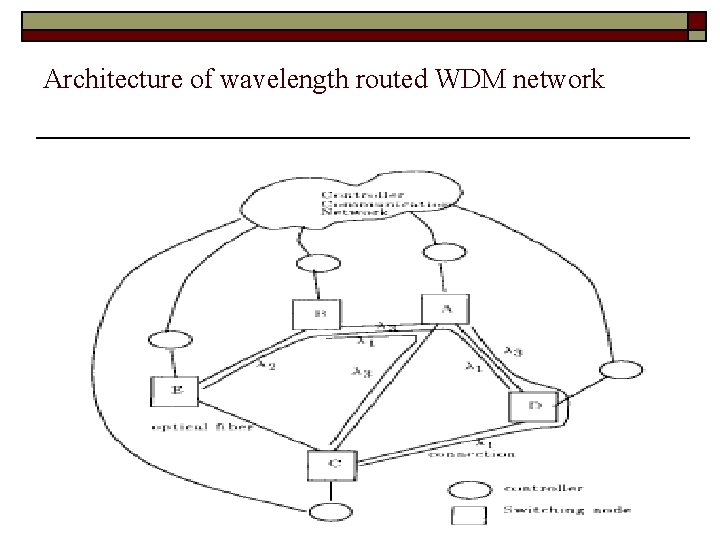
Architecture of wavelength routed WDM network
Architecture of wavelength routed WDM network o o Network nodes interconnected by WDM links Each node consists of optical switch and a controller or control unit(CU) Optical switch performs wavelength switching optically CU controls the optical switch
Architecture of wavelength routed WDM network Logically comprises of 2 networks Data network o Optical switches and data channels Control network o CU s and control channels
Distributed light path establishment o Source routing mechanism commonly used o Source could maintain local wavelength usage o Hence higher probability of a connection request to be blocked
Distributed light path establishment An effective way to address to this problem: o o Each node maintains global wavelength usage information Wavelength reservation failures minimized
Distributed light path establishment Basically, three types of wavelength routing approaches o o o Fixed routing Fixed alternate routing Adaptive routing
Distributed light path establishment o Once the route is decided, a distributed reservation protocol employed for wavelength reservation o Two types of reservation protocols - Forward Reservation Protocol - Backward Reservation Protocol
Wavelength reservation protocols characterized by its aggressiveness as o o Aggressive reservation Conservative reservation
Wavelength Reservation Protocols A wavelength on a link could be in one the following three states o AVAIL o LOCK o BUSY For LOCK or BUSY connection id maintained Set of wavelengths in state AVAIL denoted by Avail(l) for a link l
Forward reservation protocols There are four types of control packets o Every control packet has a field packet. cid a connection identifier o The four types of control packets are: -Reservation packets(RES) - contains a field RES. wave_set -Acknowledgement packets(ACK), contains ACK. channel field -Negative Ack Packets(NAK) -Release Packets(RES) o
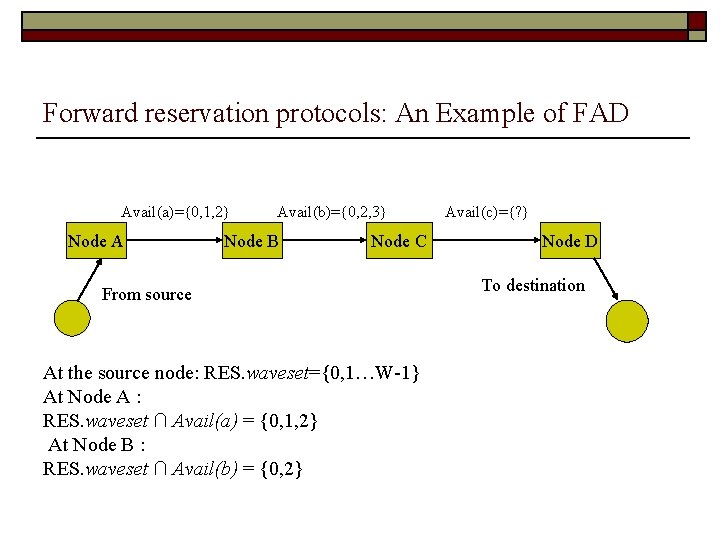
Forward reservation protocols: An Example of FAD Avail(a)={0, 1, 2} Node A Avail(b)={0, 2, 3} Node B Node C From source At the source node: RES. waveset={0, 1…W-1} At Node A : RES. waveset ∩ Avail(a) = {0, 1, 2} At Node B : RES. waveset ∩ Avail(b) = {0, 2} Avail(c)={? } Node D To destination
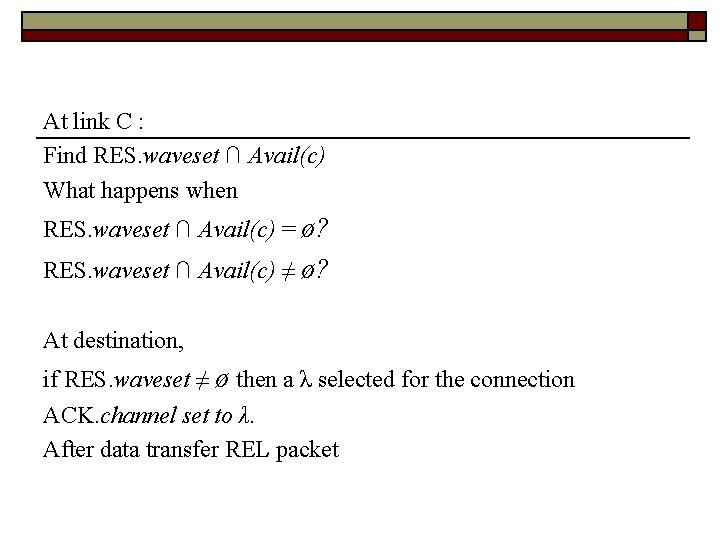
At link C : Find RES. waveset ∩ Avail(c) What happens when RES. waveset ∩ Avail(c) = ø? RES. waveset ∩ Avail(c) ≠ ø? At destination, if RES. waveset ≠ ø then a λ selected for the connection ACK. channel set to λ. After data transfer REL packet
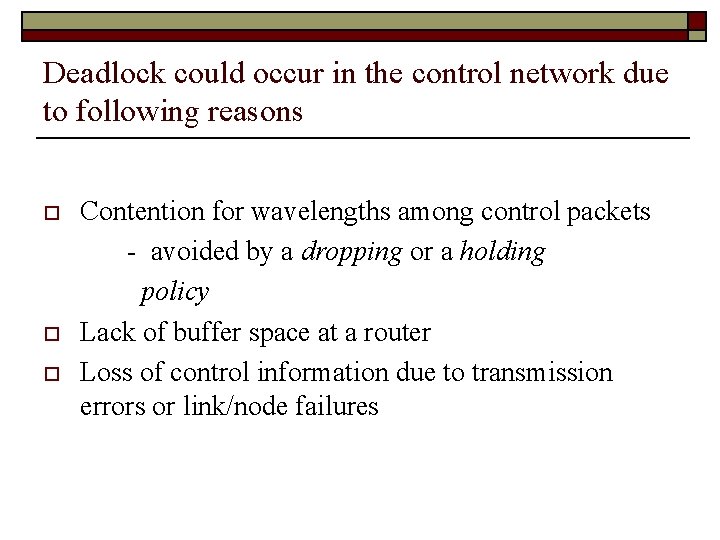
Deadlock could occur in the control network due to following reasons o o o Contention for wavelengths among control packets - avoided by a dropping or a holding policy Lack of buffer space at a router Loss of control information due to transmission errors or link/node failures
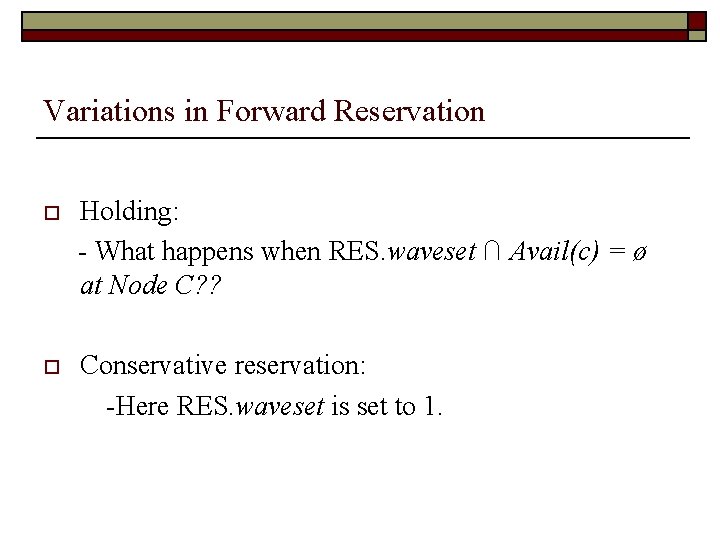
Variations in Forward Reservation o Holding: - What happens when RES. waveset ∩ Avail(c) = ø at Node C? ? o Conservative reservation: -Here RES. waveset is set to 1.
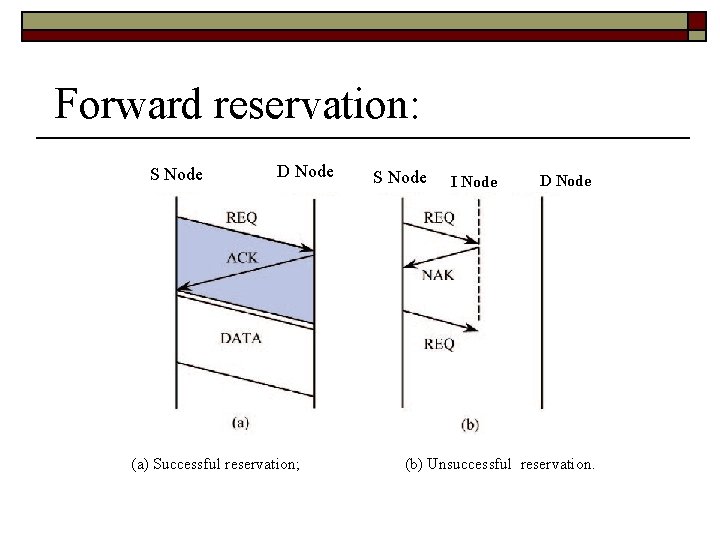
Forward reservation: S Node D Node (a) Successful reservation; S Node I Node D Node (b) Unsuccessful reservation.
Drawback of Forward Reservation: Forward Aggressive protocol: o Decrease in wavelength utilization Forward Conservative protocol: o Lower probability of successful connection How to address this problem? ? A simple way – Use Backward Reservation Protocol
Backward reservation Protocol Five types of control packets involved o o o Probe packets (PROB): Reservation packets(RES) : - contains a RES. channel field Fail packets(FAIL) Negative acknowledgement packets(NAK): Release packets(REL):
Backward reservation Protocol with dropping To establish connection: o PROB packet sent o At an intermediate node, - find l , the next outgoing link - PROB. wave_set updated to PROB. wave_set ∩ AVAIL(l) - If PROB. wave_set ∩ AVAIL(l) = ø What happens?
Backward reservation Protocol with dropping o o At destination, RES composed with RES. channel set to λ At an I-node, if reservation failure -NAK sent to source -FAIL sent to destination Data transfer takes place On completion, REL sent
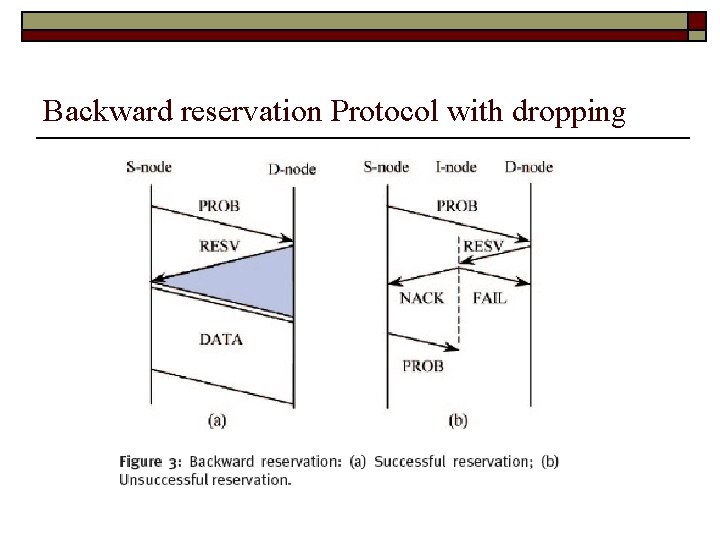
Backward reservation Protocol with dropping
Backward reservation Protocol o o Reduces bandwidth wastage greatly Under dynamic traffic- problematic Hence need to use most recent network state information How can this be achieved? ?
Solution o o Destination routing mechanism - destination decides the route In addition, an intermediate node reroutes connection on a reservation failure
Destination routing light path control protocol Assumption: o o o Global network state information maintained at each node Routing decision made by the destination Also an intermediate node reroutes connection on a reservation failure
Destination routing light path control protocol Protocol description: Control packets used o S-REQ o D-RES o S-ACK o N-ACK o I-FAIL
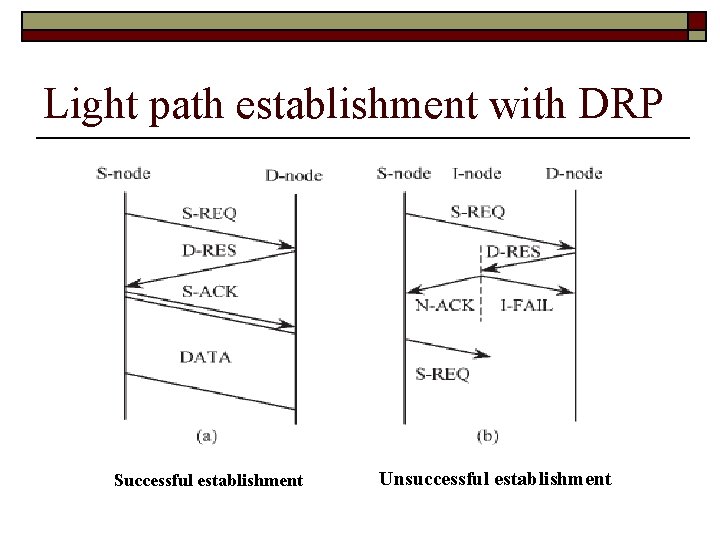
Light path establishment with DRP Successful establishment Unsuccessful establishment
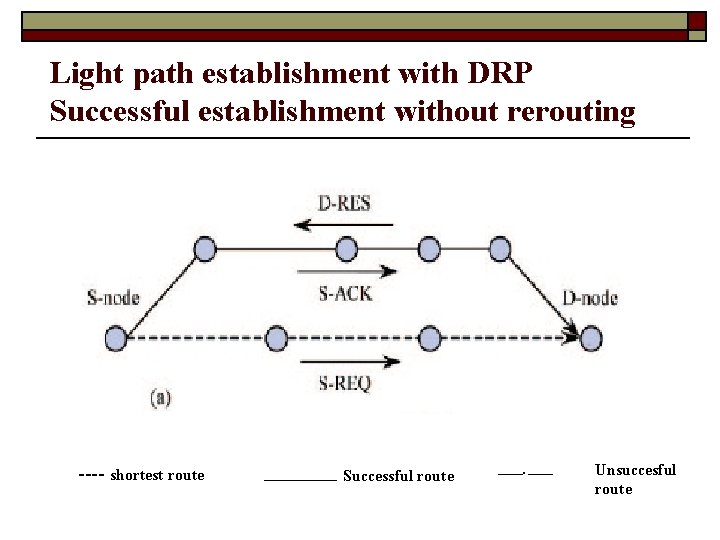
Light path establishment with DRP Successful establishment without rerouting ---- shortest route Successful route . Unsuccesful route
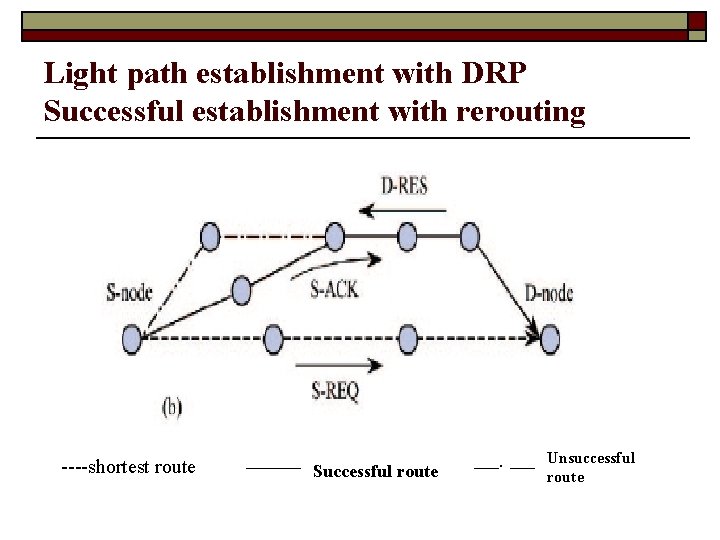
Light path establishment with DRP Successful establishment with rerouting ----shortest route Successful route . Unsuccessful route
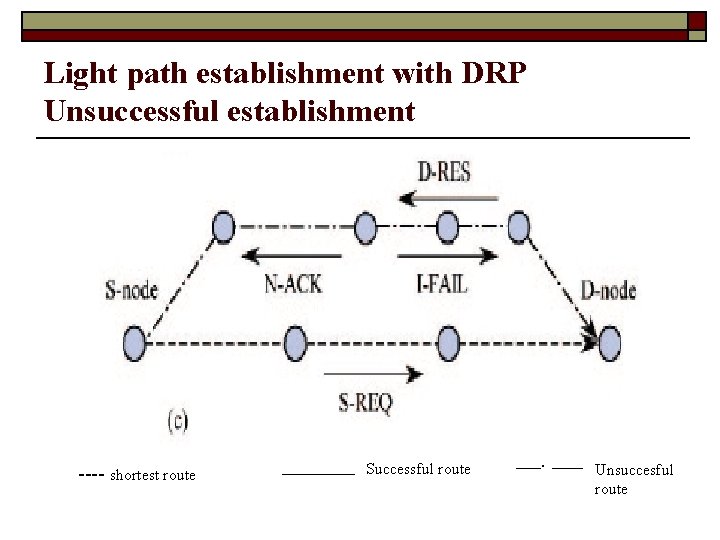
Light path establishment with DRP Unsuccessful establishment ---- shortest route Successful route . Unsuccesful route
Significant properties o o o Route decided by destination node Intermediate node reroutes connection on a wavelength reservation failure SREQ does not necessarily take the same path as light path
Performance evaluation o o Compare the destination-routing light path control protocol(DRP) with SRP in terms of - request blocking probability - connection setup time For SRP, BRP is considered. Assumption: SRP and DRP use the same route computing algorithm
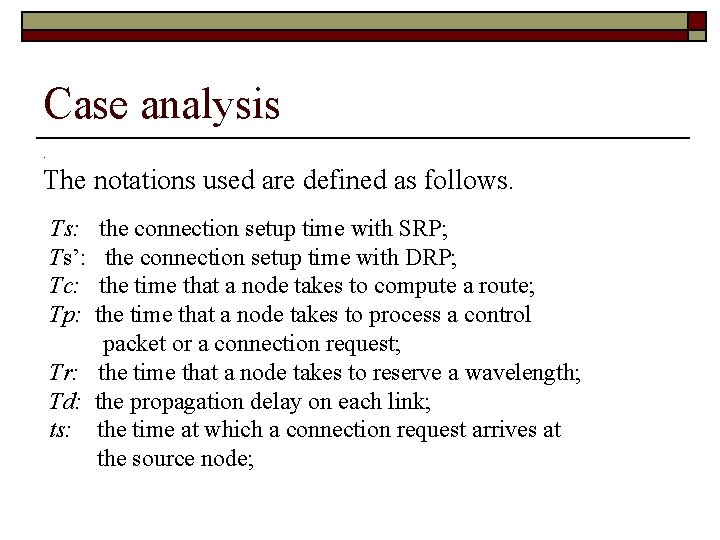
Case analysis. The notations used are defined as follows. Ts: Ts’: Tc: Tp: the connection setup time with SRP; the connection setup time with DRP; the time that a node takes to compute a route; the time that a node takes to process a control packet or a connection request; Tr: the time that a node takes to reserve a wavelength; Td: the propagation delay on each link; ts: the time at which a connection request arrives at the source node;
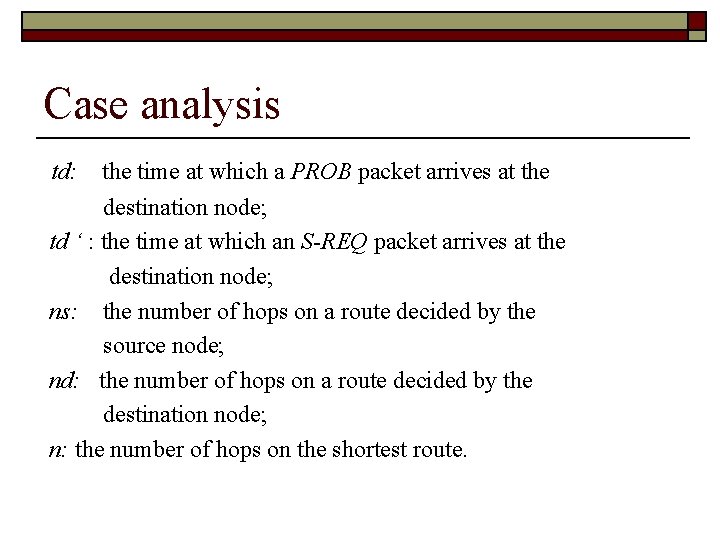
Case analysis td: the time at which a PROB packet arrives at the destination node; td ‘ : the time at which an S-REQ packet arrives at the destination node; ns: the number of hops on a route decided by the source node; nd: the number of hops on a route decided by the destination node; n: the number of hops on the shortest route.
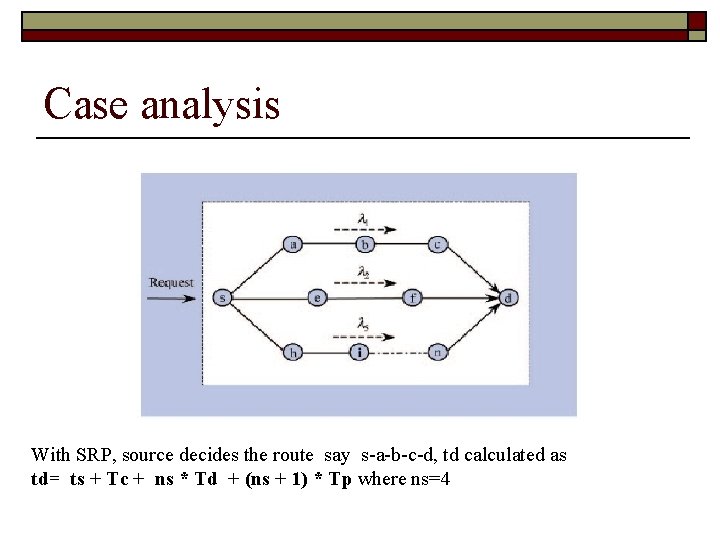
Case analysis With SRP, source decides the route say s-a-b-c-d, td calculated as td= ts + Tc + ns * Td + (ns + 1) * Tp where ns=4
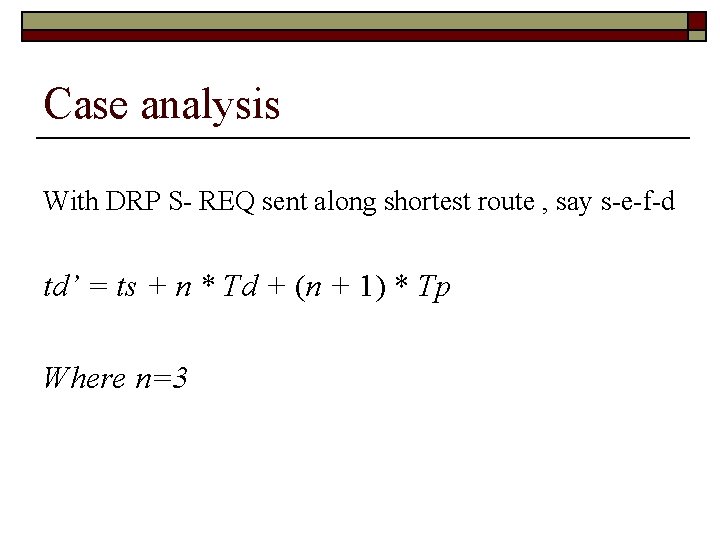
Case analysis With DRP S- REQ sent along shortest route , say s-e-f-d td’ = ts + n * Td + (n + 1) * Tp Where n=3
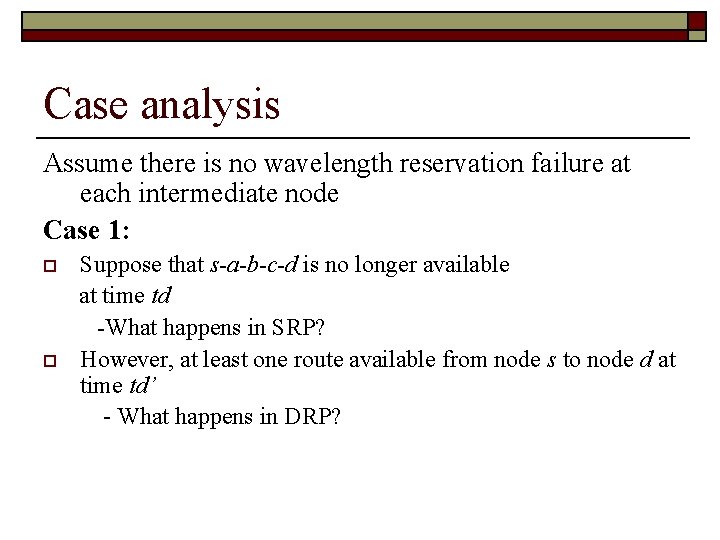
Case analysis Assume there is no wavelength reservation failure at each intermediate node Case 1: o o Suppose that s-a-b-c-d is no longer available at time td -What happens in SRP? However, at least one route available from node s to node d at time td’ - What happens in DRP?
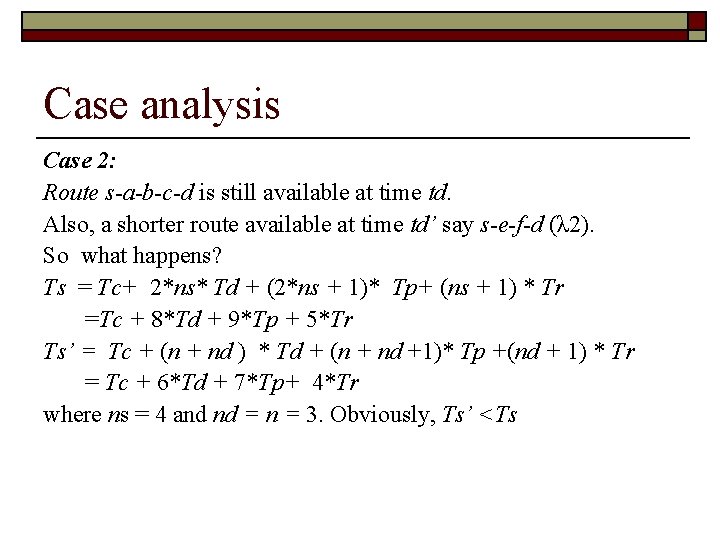
Case analysis Case 2: Route s-a-b-c-d is still available at time td. Also, a shorter route available at time td’ say s-e-f-d (λ 2). So what happens? Ts = Tc+ 2*ns* Td + (2*ns + 1)* Tp+ (ns + 1) * Tr =Tc + 8*Td + 9*Tp + 5*Tr Ts’ = Tc + (n + nd ) * Td + (n + nd +1)* Tp +(nd + 1) * Tr = Tc + 6*Td + 7*Tp+ 4*Tr where ns = 4 and nd = n = 3. Obviously, Ts’ <Ts
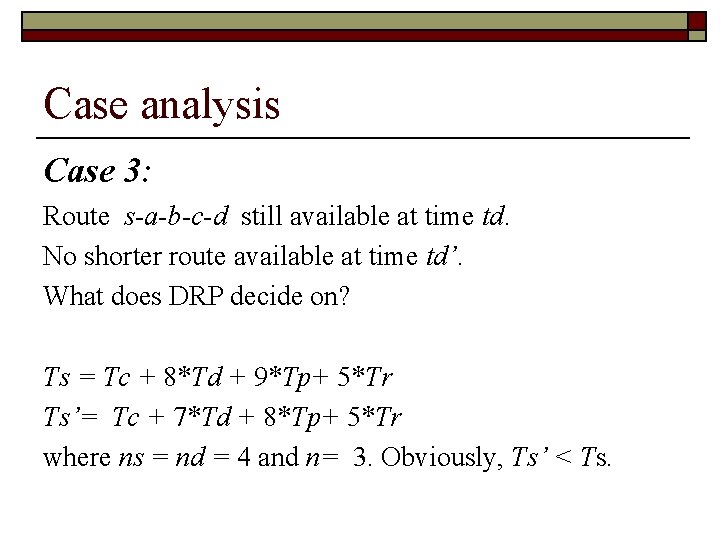
Case analysis Case 3: Route s-a-b-c-d still available at time td. No shorter route available at time td’. What does DRP decide on? Ts = Tc + 8*Td + 9*Tp+ 5*Tr Ts’= Tc + 7*Td + 8*Tp+ 5*Tr where ns = nd = 4 and n= 3. Obviously, Ts’ < Ts.
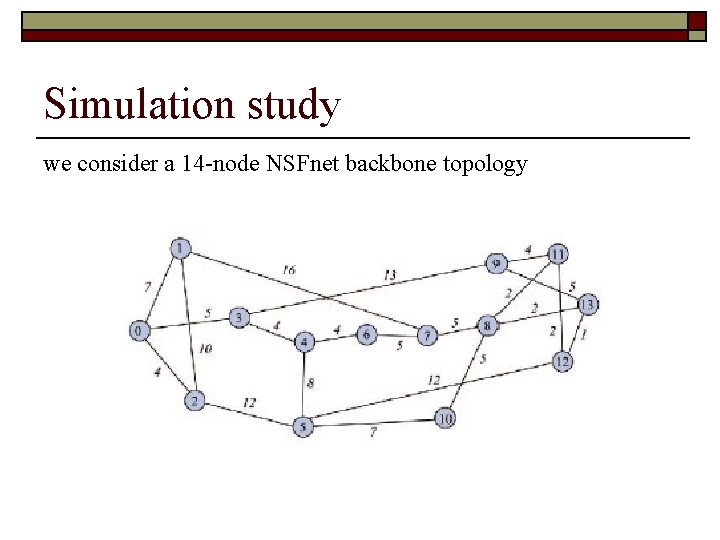
Simulation study we consider a 14 -node NSFnet backbone topology
Simulation study o Assume fixed-alternative routing with first-fit wavelength assignment o Blocked requests dropped o No wavelength conversion considered. o An event-driven broadcast mechanism simulated for updating the network state information maintained at each node.
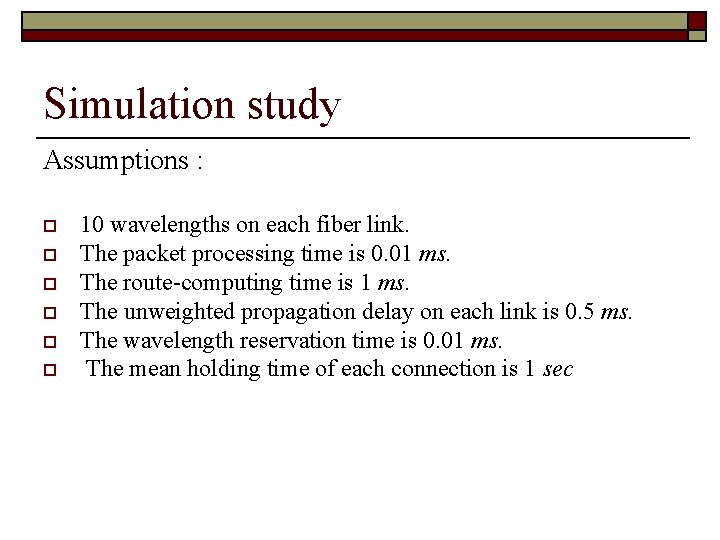
Simulation study Assumptions : o o o 10 wavelengths on each fiber link. The packet processing time is 0. 01 ms. The route-computing time is 1 ms. The unweighted propagation delay on each link is 0. 5 ms. The wavelength reservation time is 0. 01 ms. The mean holding time of each connection is 1 sec
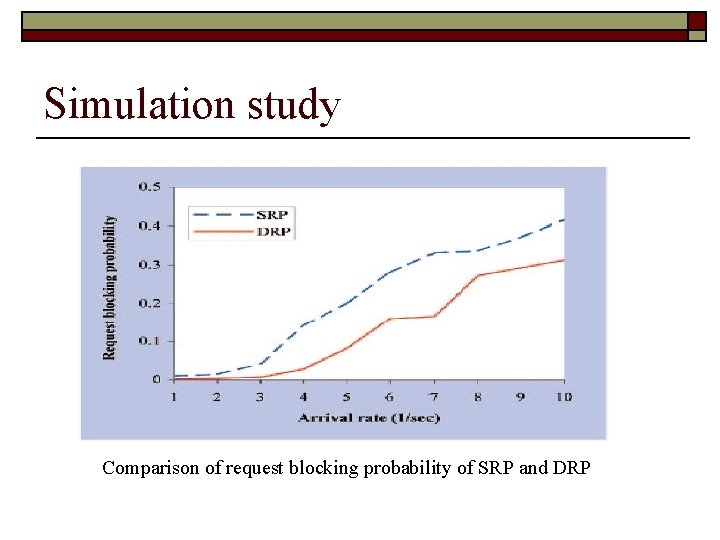
Simulation study Comparison of request blocking probability of SRP and DRP
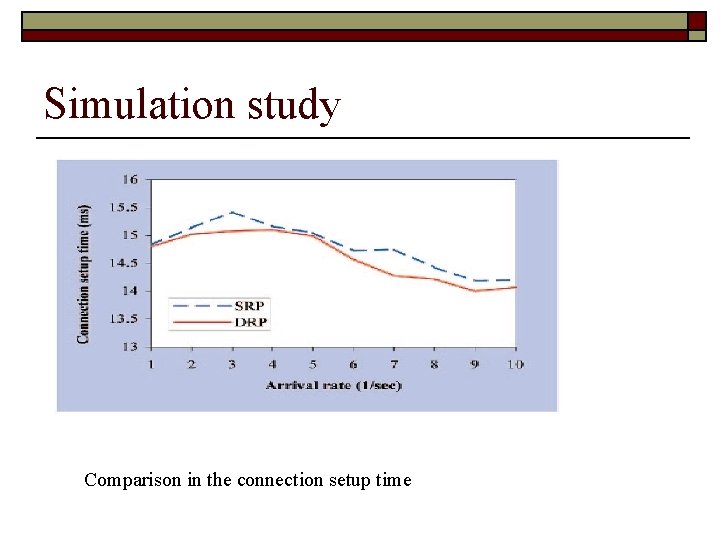
Simulation study Comparison in the connection setup time
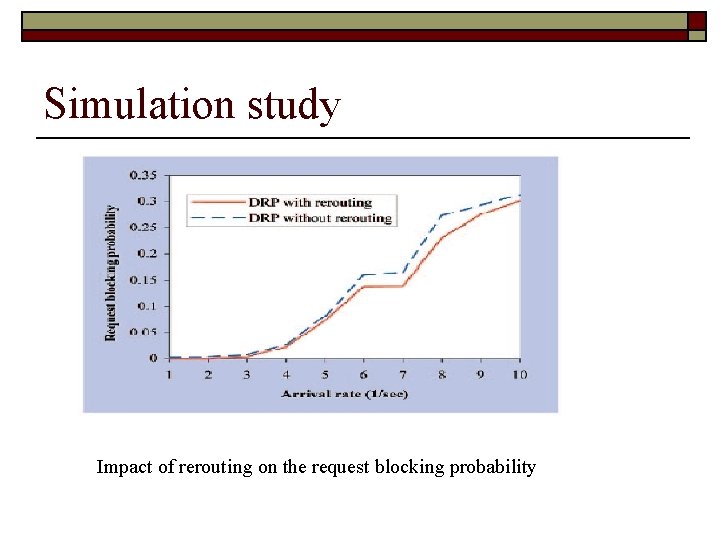
Simulation study Impact of rerouting on the request blocking probability
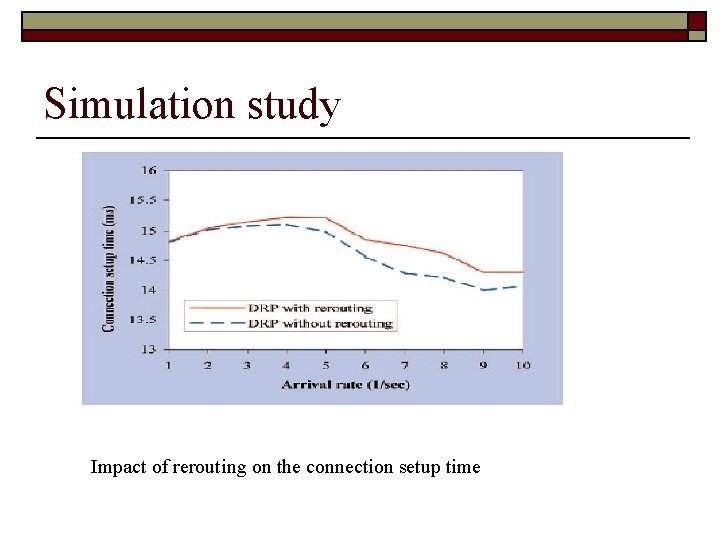
Simulation study Impact of rerouting on the connection setup time
Conclusion o o o Source routing protocol using: - forward reservation - backward reservation Destination routing light path control Destination routing reduces the blocking probability and the connection setup time Rerouting mechanism at an intermediate node Comparison of SRP and DRP through Case analysis and Simulation shows that DRP performs better
- Slides: 50