
Distributed Ledger Technologies Alexandre Kech Head of Securities
Distributed Ledger Technologies Alexandre Kech, Head of Securities Markets & Standards May 2016 v 01
What are Distributed Ledger Technologies How do they work DLT, what, why, how, who 2
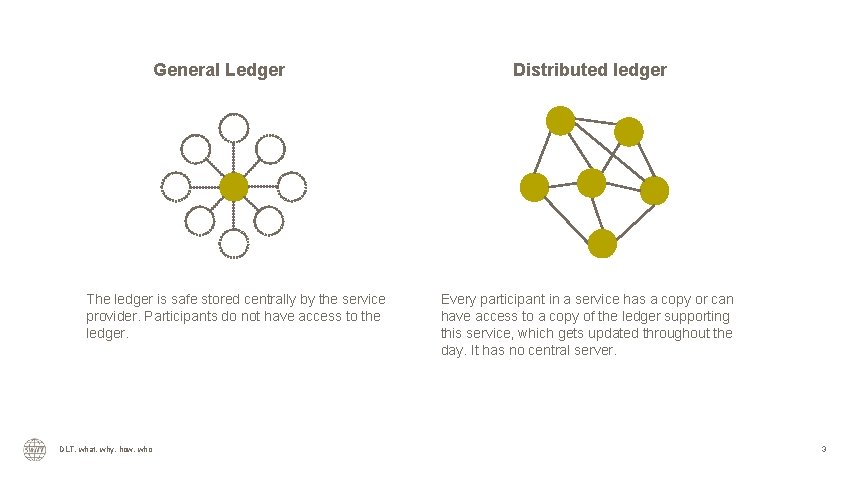
General Ledger The ledger is safe stored centrally by the service provider. Participants do not have access to the ledger. DLT, what, why, how, who Distributed ledger Every participant in a service has a copy or can have access to a copy of the ledger supporting this service, which gets updated throughout the day. It has no central server. 3
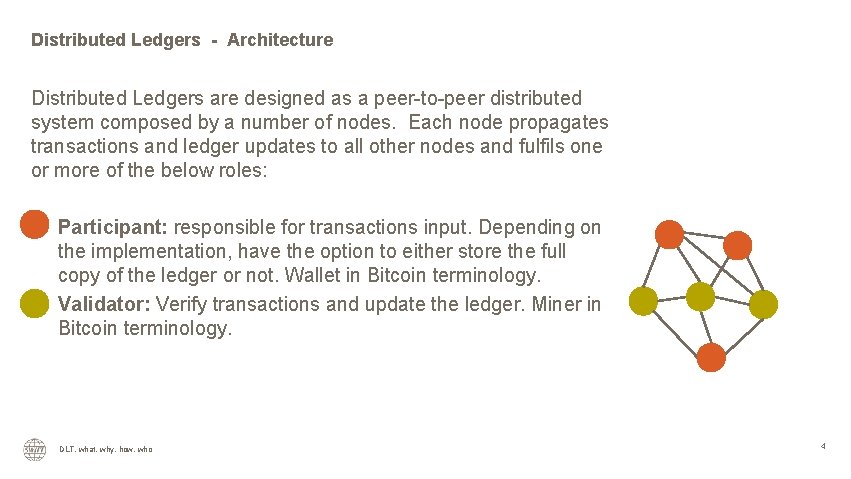
Distributed Ledgers - Architecture Distributed Ledgers are designed as a peer-to-peer distributed system composed by a number of nodes. Each node propagates transactions and ledger updates to all other nodes and fulfils one or more of the below roles: • Participant: responsible for transactions input. Depending on the implementation, have the option to either store the full copy of the ledger or not. Wallet in Bitcoin terminology. • Validator: Verify transactions and update the ledger. Miner in Bitcoin terminology. DLT, what, why, how, who 4
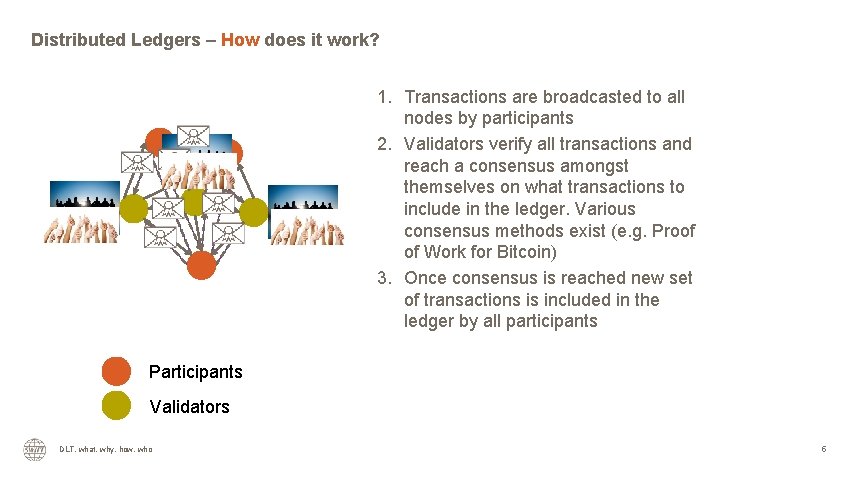
Distributed Ledgers – How does it work? 1. Transactions are broadcasted to all nodes by participants 2. Validators verify all transactions and reach a consensus amongst themselves on what transactions to include in the ledger. Various consensus methods exist (e. g. Proof of Work for Bitcoin) 3. Once consensus is reached new set of transactions is included in the ledger by all participants Participants Validators DLT, what, why, how, who 5
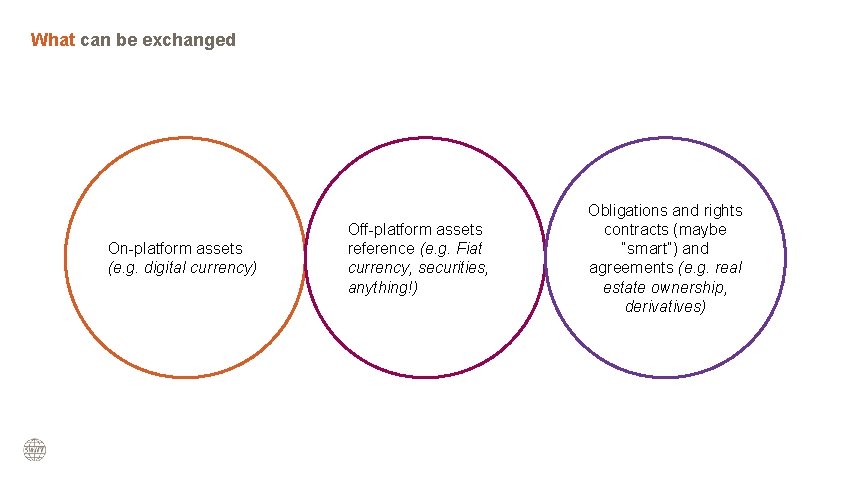
What can be exchanged On-platform assets (e. g. digital currency) Off-platform assets reference (e. g. Fiat currency, securities, anything!) Obligations and rights contracts (maybe “smart”) and agreements (e. g. real estate ownership, derivatives)
Public versus permissioned ledgers Public Ledger : anyone, without permission, may submit and validate transactions (eg, bitcoin) Permissioned Ledger : only known and trusted actors may submit and/or validate transactions Permissioned how? Validation by consensus, not proof-of-work Validators chosen by contract, reputation, organization Faster, more efficient than proof-of-work Faster (but less secure) than POW algorithm Requires high level of trust between participants
Why is DLT maybe the next revolution after the creation of internet Why not : challenges DLT, what, why, how, who 8
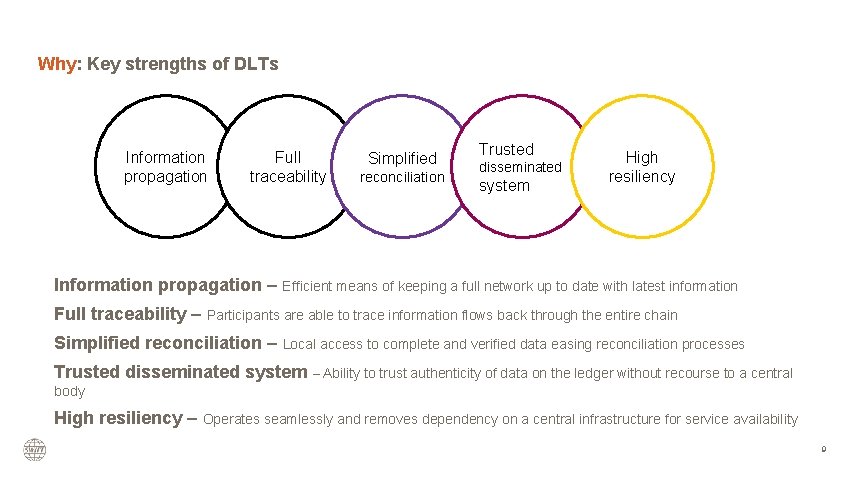
Why: Key strengths of DLTs Information propagation Full traceability Simplified reconciliation Trusted disseminated system High resiliency Information propagation – Efficient means of keeping a full network up to date with latest information Full traceability – Participants are able to trace information flows back through the entire chain Simplified reconciliation – Local access to complete and verified data easing reconciliation processes Trusted disseminated system – Ability to trust authenticity of data on the ledger without recourse to a central body High resiliency – Operates seamlessly and removes dependency on a central infrastructure for service availability 9
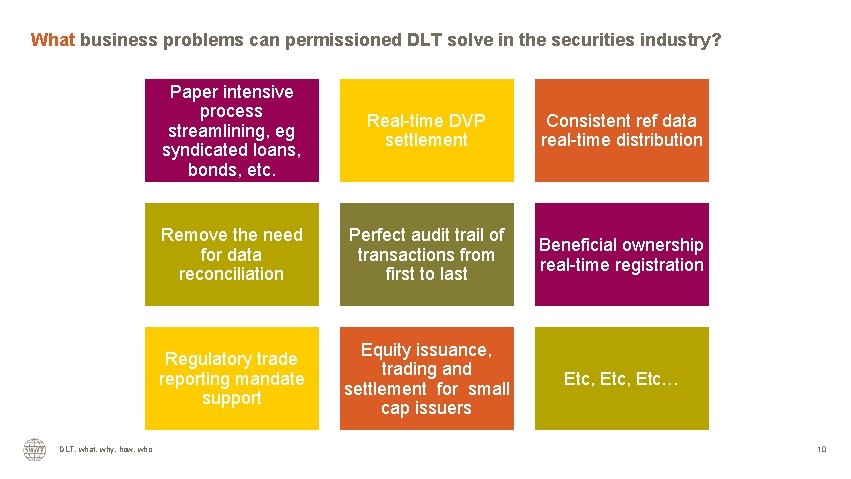
What business problems can permissioned DLT solve in the securities industry? DLT, what, why, how, who Paper intensive process streamlining, eg syndicated loans, bonds, etc. Real-time DVP settlement Consistent ref data real-time distribution Remove the need for data reconciliation Perfect audit trail of transactions from first to last Beneficial ownership real-time registration Regulatory trade reporting mandate support Equity issuance, trading and settlement for small cap issuers Etc, Etc… 10
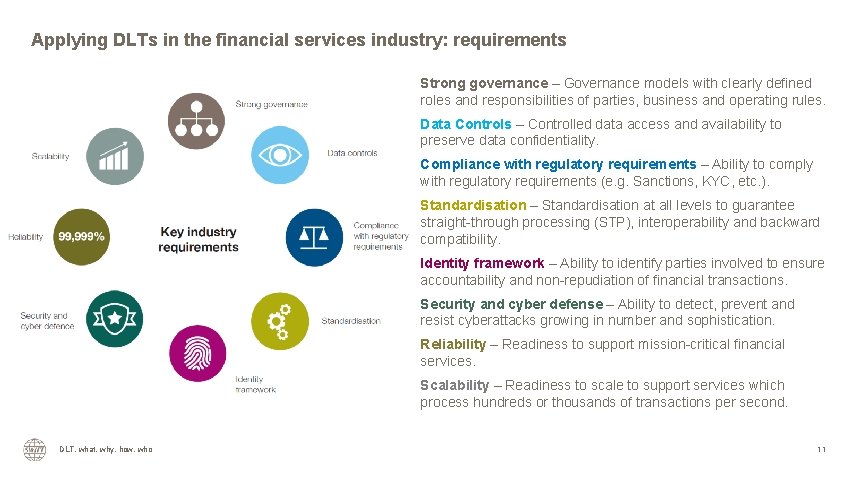
Applying DLTs in the financial services industry: requirements Strong governance – Governance models with clearly defined roles and responsibilities of parties, business and operating rules. Data Controls – Controlled data access and availability to preserve data confidentiality. Compliance with regulatory requirements – Ability to comply with regulatory requirements (e. g. Sanctions, KYC, etc. ). Standardisation – Standardisation at all levels to guarantee straight-through processing (STP), interoperability and backward compatibility. Identity framework – Ability to identify parties involved to ensure accountability and non-repudiation of financial transactions. Security and cyber defense – Ability to detect, prevent and resist cyberattacks growing in number and sophistication. Reliability – Readiness to support mission-critical financial services. Scalability – Readiness to scale to support services which process hundreds or thousands of transactions per second. DLT, what, why, how, who 11
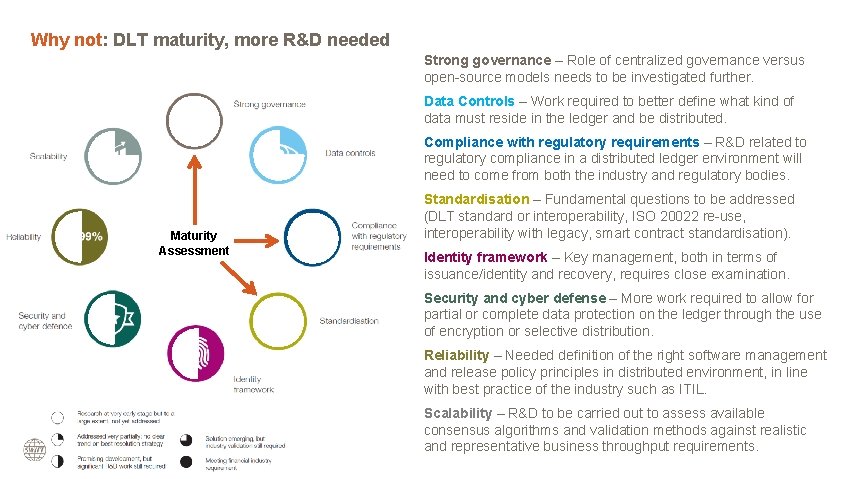
Why not: DLT maturity, more R&D needed Strong governance – Role of centralized governance versus open-source models needs to be investigated further. Data Controls – Work required to better define what kind of data must reside in the ledger and be distributed. Compliance with regulatory requirements – R&D related to regulatory compliance in a distributed ledger environment will need to come from both the industry and regulatory bodies. Maturity Assessment Standardisation – Fundamental questions to be addressed (DLT standard or interoperability, ISO 20022 re-use, interoperability with legacy, smart contract standardisation). Identity framework – Key management, both in terms of issuance/identity and recovery, requires close examination. Security and cyber defense – More work required to allow for partial or complete data protection on the ledger through the use of encryption or selective distribution. Reliability – Needed definition of the right software management and release policy principles in distributed environment, in line with best practice of the industry such as ITIL. DLT, what, why, how, who Scalability – R&D to be carried out to assess available consensus algorithms and validation methods against realistic and representative business throughput requirements. 12

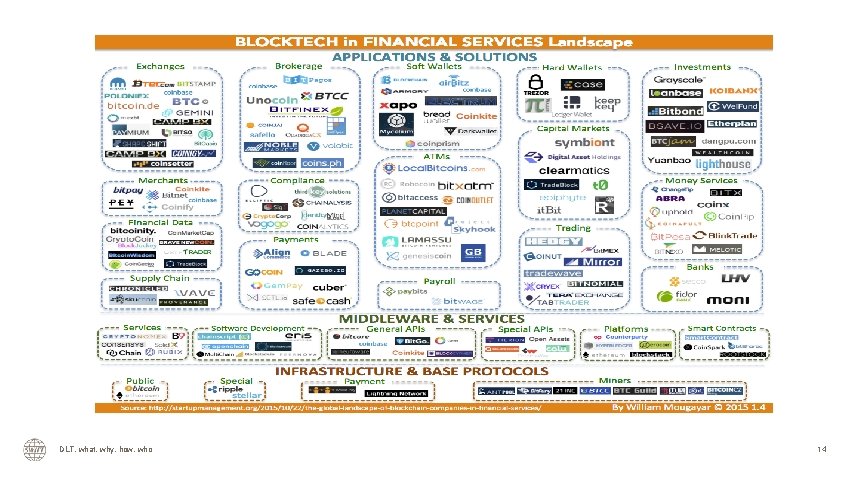
Who is doing what DLT, what, why, how, who 13
DLT, what, why, how, who 14
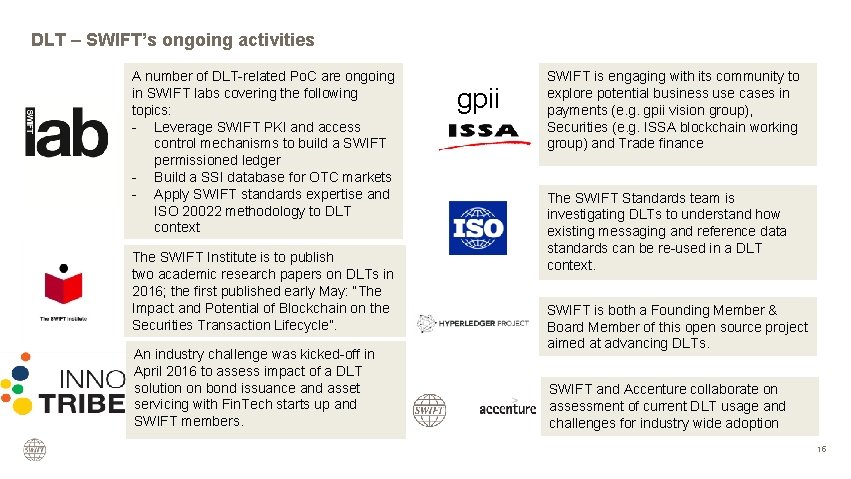
DLT – SWIFT’s ongoing activities A number of DLT-related Po. C are ongoing in SWIFT labs covering the following topics: - Leverage SWIFT PKI and access control mechanisms to build a SWIFT permissioned ledger - Build a SSI database for OTC markets - Apply SWIFT standards expertise and ISO 20022 methodology to DLT context The SWIFT Institute is to publish two academic research papers on DLTs in 2016; the first published early May: “The Impact and Potential of Blockchain on the Securities Transaction Lifecycle”. An industry challenge was kicked-off in April 2016 to assess impact of a DLT solution on bond issuance and asset servicing with Fin. Tech starts up and SWIFT members. gpii SWIFT is engaging with its community to explore potential business use cases in payments (e. g. gpii vision group), Securities (e. g. ISSA blockchain working group) and Trade finance The SWIFT Standards team is investigating DLTs to understand how existing messaging and reference data standards can be re-used in a DLT context. SWIFT is both a Founding Member & Board Member of this open source project aimed at advancing DLTs. SWIFT and Accenture collaborate on assessment of current DLT usage and challenges for industry wide adoption 15
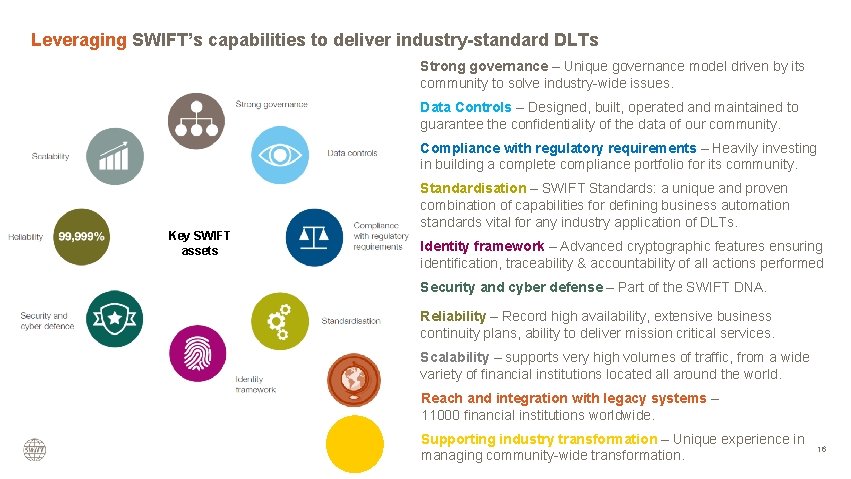
Leveraging SWIFT’s capabilities to deliver industry-standard DLTs Strong governance – Unique governance model driven by its community to solve industry-wide issues. Data Controls – Designed, built, operated and maintained to guarantee the confidentiality of the data of our community. Compliance with regulatory requirements – Heavily investing in building a complete compliance portfolio for its community. Key SWIFT assets Standardisation – SWIFT Standards: a unique and proven combination of capabilities for defining business automation standards vital for any industry application of DLTs. Identity framework – Advanced cryptographic features ensuring identification, traceability & accountability of all actions performed Security and cyber defense – Part of the SWIFT DNA. Reliability – Record high availability, extensive business continuity plans, ability to deliver mission critical services. Scalability – supports very high volumes of traffic, from a wide variety of financial institutions located all around the world. Reach and integration with legacy systems – 11000 financial institutions worldwide. Supporting industry transformation – Unique experience in managing community-wide transformation. 16
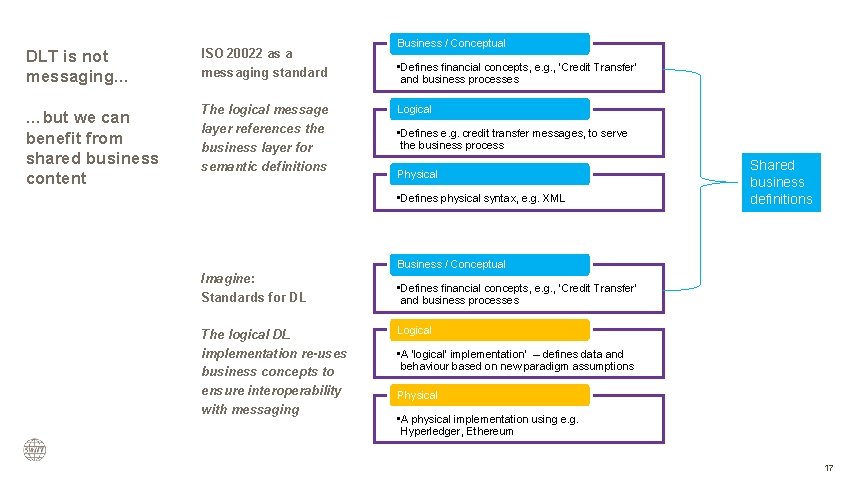
DLT is not messaging. . . ISO 20022 as a messaging standard …but we can benefit from shared business content The logical message layer references the business layer for semantic definitions Business / Conceptual • Defines financial concepts, e. g. , ‘Credit Transfer’ and business processes Logical • Defines e. g. credit transfer messages, to serve the business process Physical • Defines physical syntax, e. g. XML Shared business definitions Business / Conceptual Imagine: Standards for DL The logical DL implementation re-uses business concepts to ensure interoperability with messaging • Defines financial concepts, e. g. , ‘Credit Transfer’ and business processes Logical • A ‘logical’ implementation’ – defines data and behaviour based on new paradigm assumptions Physical • A physical implementation using e. g. Hyperledger, Ethereum 17
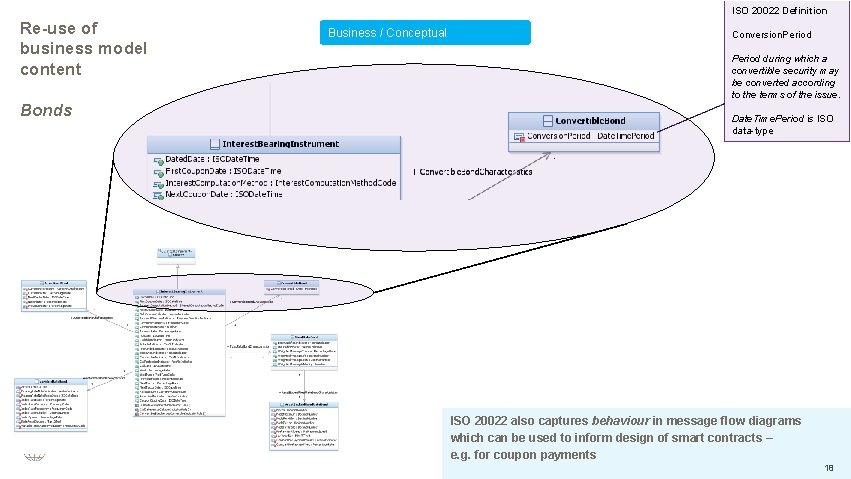
ISO 20022 Definition Re-use of business model content Bonds Business / Conceptual Conversion. Period during which a convertible security may be converted according to the terms of the issue. Date. Time. Period is ISO data-type ISO 20022 also captures behaviour in message flow diagrams which can be used to inform design of smart contracts – e. g. for coupon payments 18
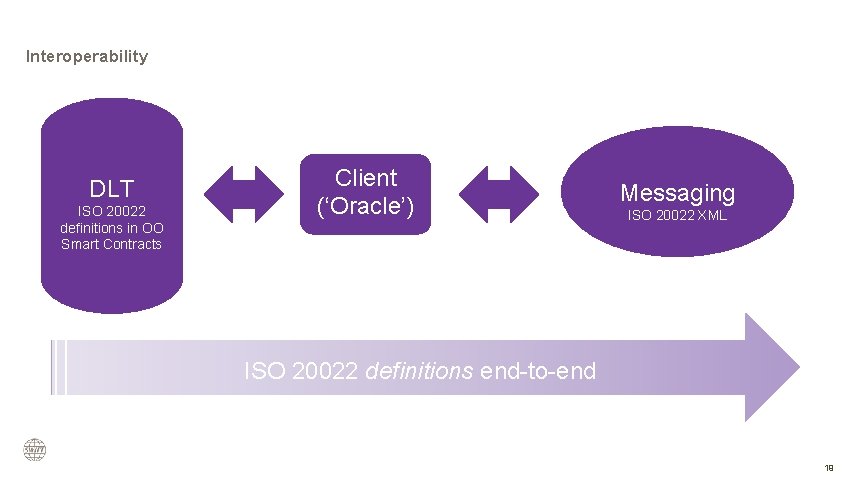
Interoperability DLT ISO 20022 definitions in OO Smart Contracts Client (‘Oracle’) Messaging ISO 20022 XML ISO 20022 definitions end-to-end 19
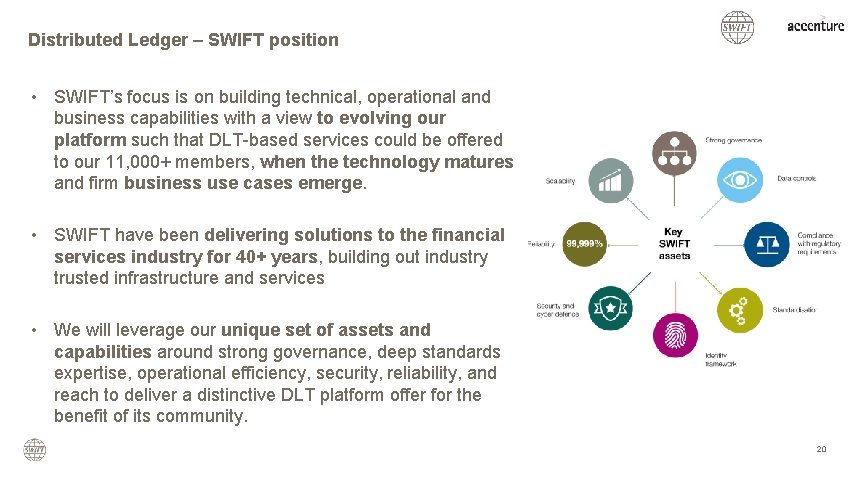
Distributed Ledger – SWIFT position • SWIFT’s focus is on building technical, operational and business capabilities with a view to evolving our platform such that DLT-based services could be offered to our 11, 000+ members, when the technology matures and firm business use cases emerge. • SWIFT have been delivering solutions to the financial services industry for 40+ years, building out industry trusted infrastructure and services • We will leverage our unique set of assets and capabilities around strong governance, deep standards expertise, operational efficiency, security, reliability, and reach to deliver a distinctive DLT platform offer for the benefit of its community. 20

- Slides: 21