
Distributed Information Processing 2016 Fall The Google File
Distributed Information Processing 2016 Fall The Google File System Sanjay Ghemawat, Howard Gobioff, and Shun-Tak Leung Google SOSP’ 03, October 19– 22, 2003, New York, USA Hyeon-Gyu Lee, and Yeong-Jae Woo Memory & Storage Architecture Lab. School of Computer Science and Engineering Seoul National University
Outline § Design overview § Assumptions § Interface § Architecture § Single master § Chunk size § Metadata § Consistency model § System interactions § Master operation § Fault tolerance § Measurements § Conclusion Distributed Information Processing 2016 Fall 2
Assumptions § The system is built from many inexpensive commodity components § The system stores a modest number of large files § A few million files, each typically 100 MB or larger § The workloads primarily consist of § Large sequential reads and small random reads § Large sequential writes that append data to files § The system must efficiently implement semantics for clients that concurrently append to the same file § High sustained bandwidth is more important than low latency Distributed Information Processing 2016 Fall 3
Interface § Files are organized in directories and identified by pathnames § File operations § Create, delete, open, close, read, and write § Snapshot • Creates a copy of a file or a directory tree § Record append • Allows multiple clients to append data to the same file concurrently while guaranteeing the atomicity Distributed Information Processing 2016 Fall 4
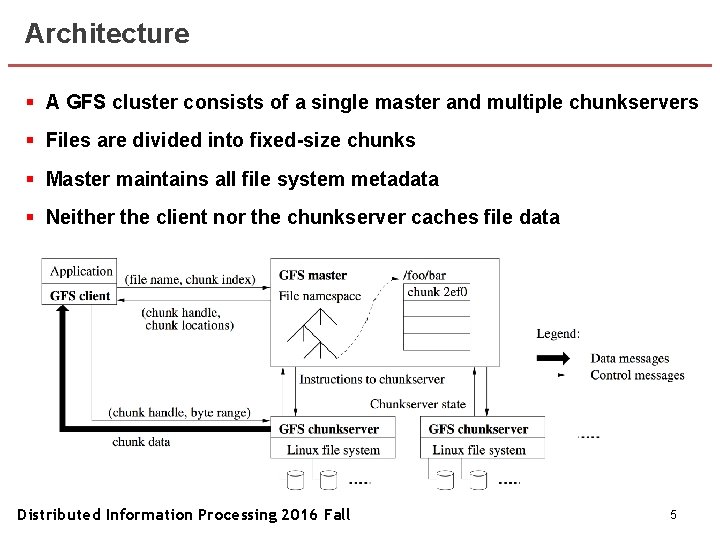
Architecture § A GFS cluster consists of a single master and multiple chunkservers § Files are divided into fixed-size chunks § Master maintains all file system metadata § Neither the client nor the chunkserver caches file data Distributed Information Processing 2016 Fall 5
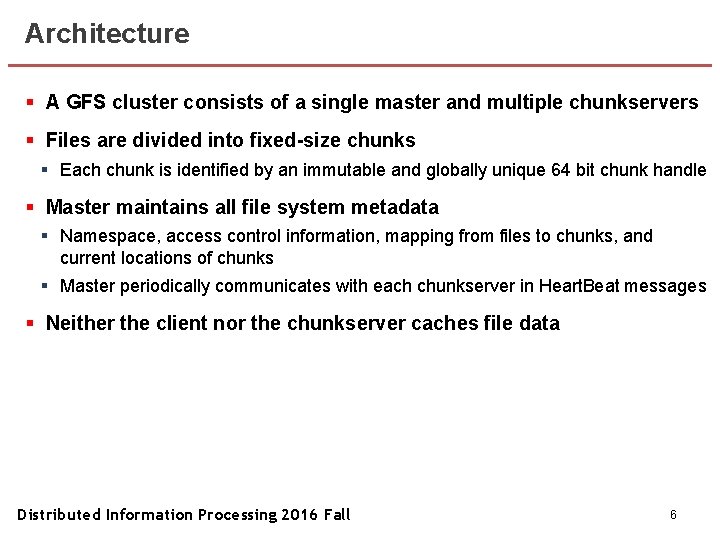
Architecture § A GFS cluster consists of a single master and multiple chunkservers § Files are divided into fixed-size chunks § Each chunk is identified by an immutable and globally unique 64 bit chunk handle § Master maintains all file system metadata § Namespace, access control information, mapping from files to chunks, and current locations of chunks § Master periodically communicates with each chunkserver in Heart. Beat messages § Neither the client nor the chunkserver caches file data Distributed Information Processing 2016 Fall 6
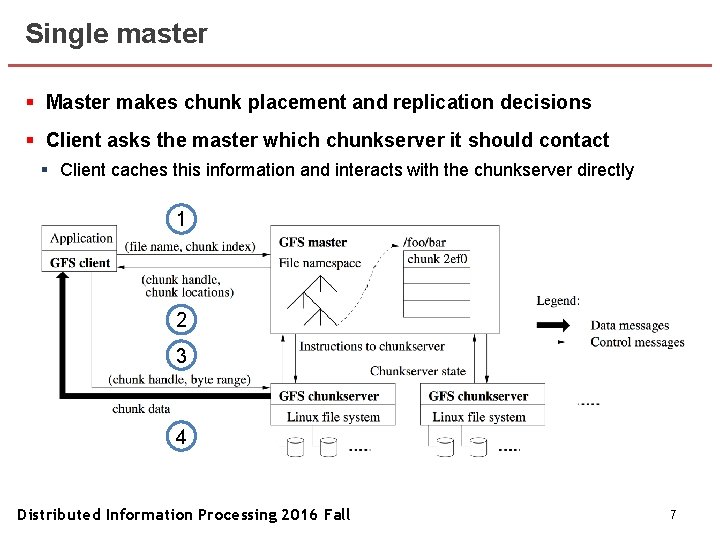
Single master § Master makes chunk placement and replication decisions § Client asks the master which chunkserver it should contact § Client caches this information and interacts with the chunkserver directly 1 2 3 4 Distributed Information Processing 2016 Fall 7
Chunk size § Large chunk size (64 MB) § Pros • Reduces clients’ need to interact with the master • Reduces network overhead since client is likely to perform many operations on a large chunk • Reduces the size of the metadata stored on the master § Cons • If many clients are accessing the same small file, chunkservers may become hot spots - Ex) an executable single-chunk file - Sol) Stores such files with a higher replication factor Distributed Information Processing 2016 Fall 8
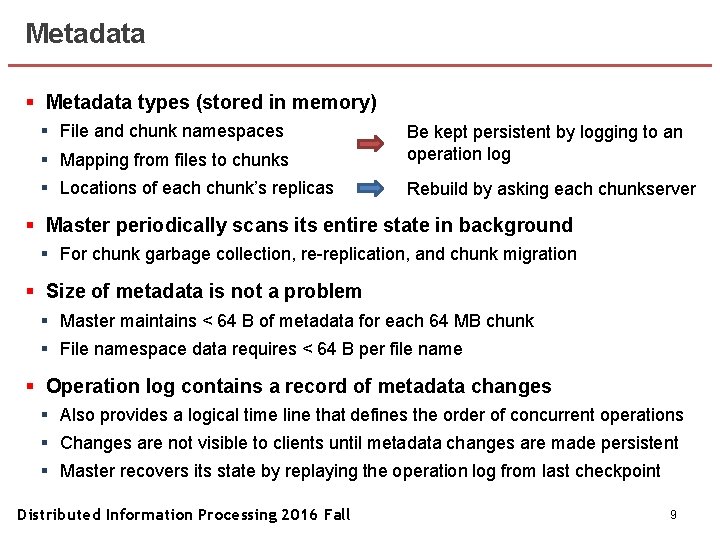
Metadata § Metadata types (stored in memory) § File and chunk namespaces § Mapping from files to chunks Be kept persistent by logging to an operation log § Locations of each chunk’s replicas Rebuild by asking each chunkserver § Master periodically scans its entire state in background § For chunk garbage collection, re-replication, and chunk migration § Size of metadata is not a problem § Master maintains < 64 B of metadata for each 64 MB chunk § File namespace data requires < 64 B per file name § Operation log contains a record of metadata changes § Also provides a logical time line that defines the order of concurrent operations § Changes are not visible to clients until metadata changes are made persistent § Master recovers its state by replaying the operation log from last checkpoint Distributed Information Processing 2016 Fall 9
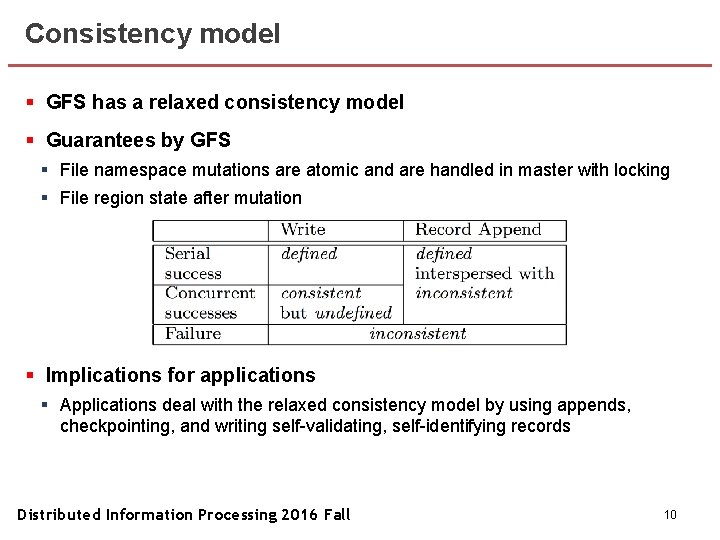
Consistency model § GFS has a relaxed consistency model § Guarantees by GFS § File namespace mutations are atomic and are handled in master with locking § File region state after mutation § Implications for applications § Applications deal with the relaxed consistency model by using appends, checkpointing, and writing self-validating, self-identifying records Distributed Information Processing 2016 Fall 10
Outline § Design overview § System interactions § Leases and mutation order § Data flow § Atomic record appends § Snapshot § Master operation § Fault tolerance § Measurements § Conclusion Distributed Information Processing 2016 Fall 11
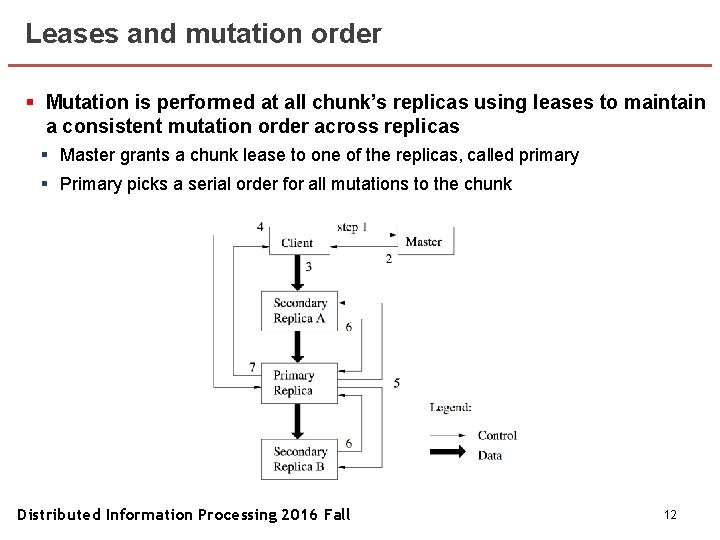
Leases and mutation order § Mutation is performed at all chunk’s replicas using leases to maintain a consistent mutation order across replicas § Master grants a chunk lease to one of the replicas, called primary § Primary picks a serial order for all mutations to the chunk Distributed Information Processing 2016 Fall 12
Data flow § GFS decouples the data flow from the control flow § Each machine forwards the data to the “closest” machine in the network topology that has not received it § Distances can be estimated from IP addresses § GFS minimizes the latency by pipelining the data transfer over TCP connections Distributed Information Processing 2016 Fall 13
Atomic record appends § GFS appends the data to the file at least once atomically at an offset of GFS’s choosing and returns that offset to the client § Algorithm of atomic record append § Client pushes the data to all replicas of the last chunk of the file § Client sends the append request to the primary § Primary checks to see if data causes chunk to exceed the maximum size • If so, pads chunk to the maximum size and tells secondaries to do same, then tells client to retry on the next chunk • If the record fits, primary appends data to its replica, tells secondaries to write at the exact offset where it has Distributed Information Processing 2016 Fall 14
Snapshot § Snapshot operation makes a copy of a file or a directory tree almost instantaneously § GFS uses copy-on-write technique to implement snapshots § Revokes any outstanding leases on the chunks to snapshot § Logs the snapshot operation to disk and duplicates the metadata § If a client wants to write, creates a new chunk and tells secondaries to do same Distributed Information Processing 2016 Fall 15
Outline § Design overview § System interactions § Master operation § Namespace management and locking § Replicas § Garbage collection § Fault tolerance § Measurements § Conclusion Distributed Information Processing 2016 Fall 16
Namespace management and locking § GFS allows multiple operations to be active and uses locks to ensure serialization § Namespace is represented as a lookup table mapping full pathnames to metadata § Represented as a tree in memory with prefix compression § Each node has an associated read-write lock and each master operation acquires locks before it runs § Locks are acquired in a total order to prevent deadlock § Ordered by level in the namespace tree and lexicographically in the same level Distributed Information Processing 2016 Fall 17
Replicas § GFS spreads chunk replicas across racks § This ensures that some replicas will survive even if an entire rack is damaged § This can exploit the aggregate bandwidth of multiple racks § Replicas are created for chunk creation, re-replication, and rebalancing § Places new replicas on chunkservers with below-average disk space utilization § Re-replicates a chunk when the number of available replicas falls below a userspecified goal § Rebalances replicas periodically for better disk space and load balancing Distributed Information Processing 2016 Fall 18
Garbage collection § GFS reclaims the storage for deleted files lazily via garbage collection at the file and chunk levels § File level • When a file is deleted, master logs the deletion and renames the file to a hidden name that includes the deletion timestamp • During the master’s scan, hidden files are removed if they have existed for more than 3 days § Chunk level • Each chunkserver reports a subset of chunks it has and master identifies and replies with orphaned chunks • Each chunkserver deletes orphaned chunks Distributed Information Processing 2016 Fall 19
Outline § Design overview § System interactions § Master operation § Fault tolerance § High availability § Data integrity § Measurements § Conclusion Distributed Information Processing 2016 Fall 20
High availability § Fast recovery § Master and chunkserver are designed to restore their state and start in seconds § Chunk replication § Each chunk is replicated on multiple chunkservers on different racks § Users can specify different replication levels • The default is 3 § Master replication § Operation logs and checkpoints are replicated on multiple machines § One master process is in charge of all mutations and background activities § Shadow masters provide read-only access to the file system when the primary master is down Distributed Information Processing 2016 Fall 21
Data integrity § Each chunkserver uses checksumming to detect data corruption § A chunk is broken up into 64 KB blocks § Each block has a corresponding 32 bit checksum § Chunkserver verifies the checksum of data blocks for reads § During idle period, chunkservers scan and verify the inactive chunks Distributed Information Processing 2016 Fall 22
Outline § Design overview § System interactions § Master operation § Fault tolerance § Measurements § Micro-benchmarks § Real world clusters § Conclusion Distributed Information Processing 2016 Fall 23
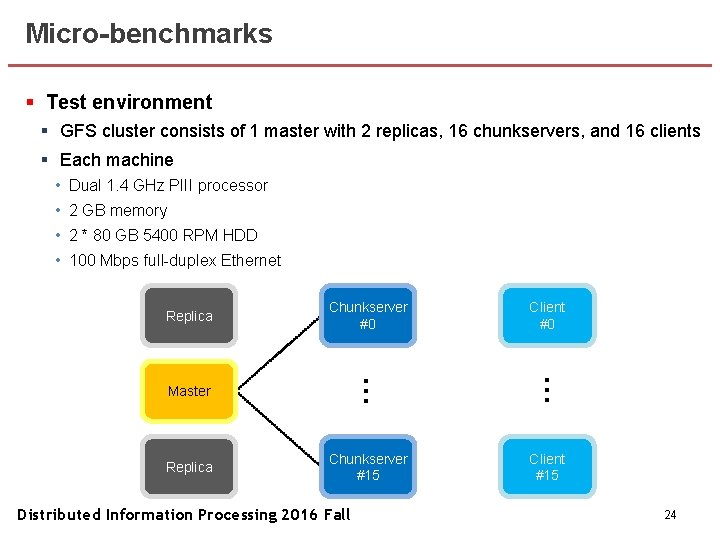
Micro-benchmarks § Test environment § GFS cluster consists of 1 master with 2 replicas, 16 chunkservers, and 16 clients § Each machine • Dual 1. 4 GHz PIII processor • 2 GB memory • 2 * 80 GB 5400 RPM HDD • 100 Mbps full-duplex Ethernet Replica Chunkserver #0 Replica Chunkserver #15 Distributed Information Processing 2016 Fall … … Master Client #0 Client #15 24
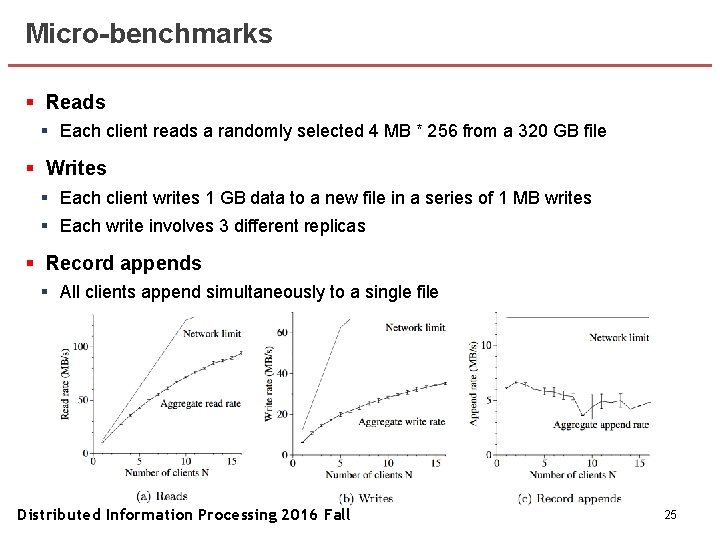
Micro-benchmarks § Reads § Each client reads a randomly selected 4 MB * 256 from a 320 GB file § Writes § Each client writes 1 GB data to a new file in a series of 1 MB writes § Each write involves 3 different replicas § Record appends § All clients append simultaneously to a single file Distributed Information Processing 2016 Fall 25
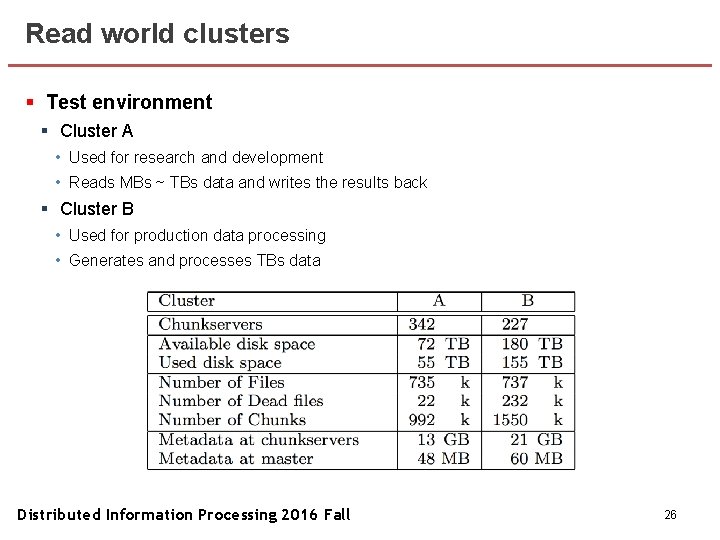
Read world clusters § Test environment § Cluster A • Used for research and development • Reads MBs ~ TBs data and writes the results back § Cluster B • Used for production data processing • Generates and processes TBs data Distributed Information Processing 2016 Fall 26
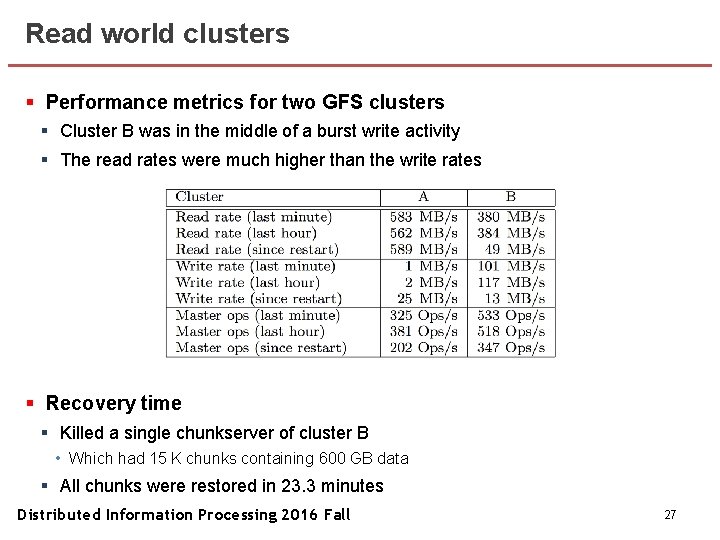
Read world clusters § Performance metrics for two GFS clusters § Cluster B was in the middle of a burst write activity § The read rates were much higher than the write rates § Recovery time § Killed a single chunkserver of cluster B • Which had 15 K chunks containing 600 GB data § All chunks were restored in 23. 3 minutes Distributed Information Processing 2016 Fall 27
Outline § Design overview § System interactions § Master operation § Fault tolerance § Measurements § Conclusion Distributed Information Processing 2016 Fall 28
Conclusion § GFS treats component failures as the norm rather than the exception § GFS optimizes for huge files that are appended to and then read § GFS provides fault tolerance by replication and fast recovery § Replication to tolerate against chunkserver failures § Checksumming to detect data corruption § GFS delivers high throughput to many concurrent clients § By separating file system control from data transfer § Master involvement in common operation is minimized § By a large chunk size § By chunk leases § GFS is widely used within Google as the storage platform Distributed Information Processing 2016 Fall 29
- Slides: 29