
Distributed Hash Table CS 780 3 Lecture Notes
Distributed Hash Table CS 780 -3 Lecture Notes In courtesy of Heng Yin 1
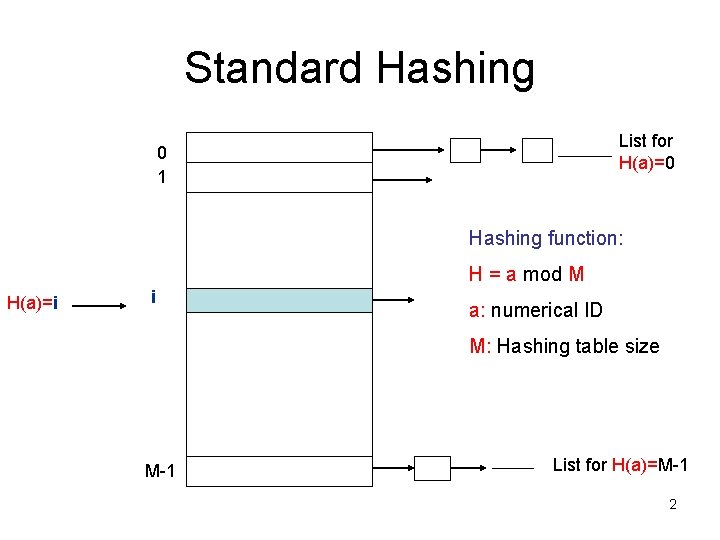
Standard Hashing List for H(a)=0 0 1 Hashing function: H = a mod M H(a)=i i a: numerical ID M: Hashing table size M-1 List for H(a)=M-1 2
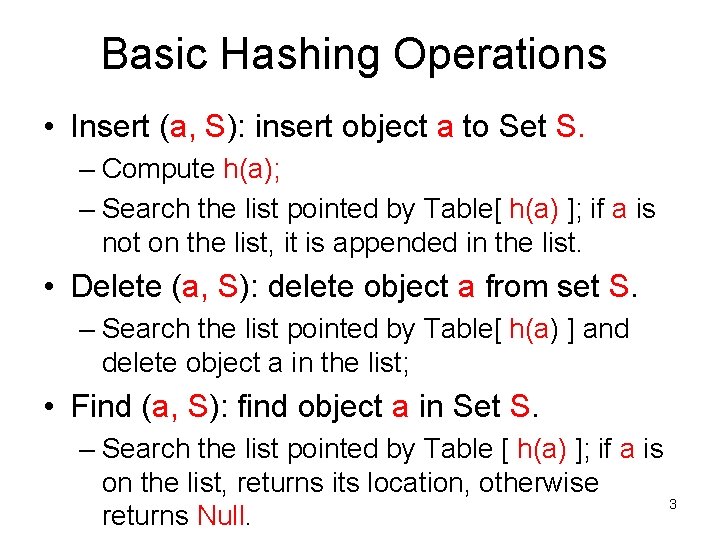
Basic Hashing Operations • Insert (a, S): insert object a to Set S. – Compute h(a); – Search the list pointed by Table[ h(a) ]; if a is not on the list, it is appended in the list. • Delete (a, S): delete object a from set S. – Search the list pointed by Table[ h(a) ] and delete object a in the list; • Find (a, S): find object a in Set S. – Search the list pointed by Table [ h(a) ]; if a is on the list, returns its location, otherwise 3 returns Null.

Distributed Hash Table (DHT) • Problem: given an object stored in a node or multiple nodes, find it. • The Lookup problem (Find (a, S)): S is distributed and stored in many nodes. – Returns the network location of the node currently responsible for the given key. • Take a 2 -d CAN as an example (a Ph. D. dissertation at Berkeley) 4

From Hash Table to DHT kv (k 1, v 1) K V ? K V K V Retrive(k 1) Insert(k 1, v 1) a. Hash table b. Distributed hash table 5
From Hash Table to DHT (cont) “Core” questions when introducing “distributed”: • How to divide a whole hash table to multiple distributed hash tables? • How to reach the hash table who has the key I want, if I cannot find it from the local hash table? Requirements: • Data should be identified using unique numeric keys using hash function such as SHA-1 • Nodes should be willing to store keys for each other. 6
Content Addressable Network • The overlay nodes are built on a 2 -D coordinate space. • Join: a new peer node – Chooses a random point P in the 2 -D space; – Asks a node in P 2 P to find node n in P; – Node n splits the zone into two, assigns ½ to the new nodes; • Insert: a key is hashed on to a point in the 2 -D space, and is stored at the node whose zone contains the point’s space. • Routing Table: each node contains the logic locations of all its neighbors in the 2 -D space. 7
2 -D CAN (continued) • Lookup: after a peer joins, it forwards the request (a hashed location) along a routing path to the node storing the key. – a move instruction is made based on the routing table. • Each node maintains O(d) states, lookup cost is O(d. N^(1/d)), where d = dimension, N = # of nodes. 8
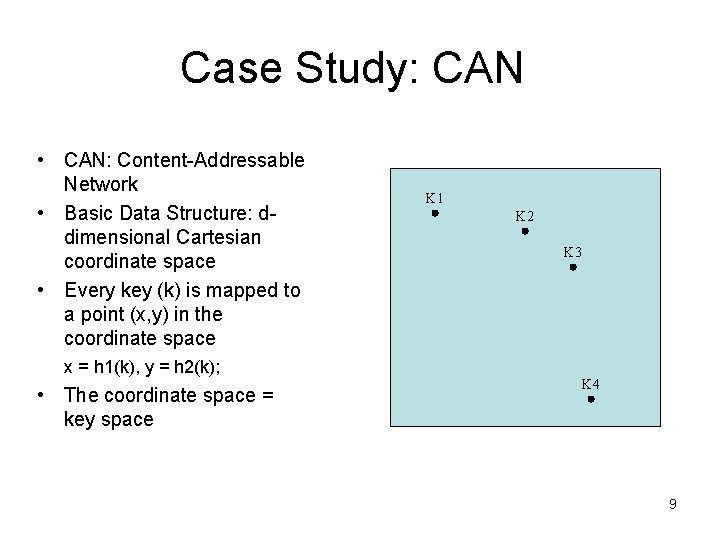
Case Study: CAN • CAN: Content-Addressable Network • Basic Data Structure: ddimensional Cartesian coordinate space • Every key (k) is mapped to a point (x, y) in the coordinate space x = h 1(k), y = h 2(k); • The coordinate space = key space K 1 K 2 K 3 K 4 9
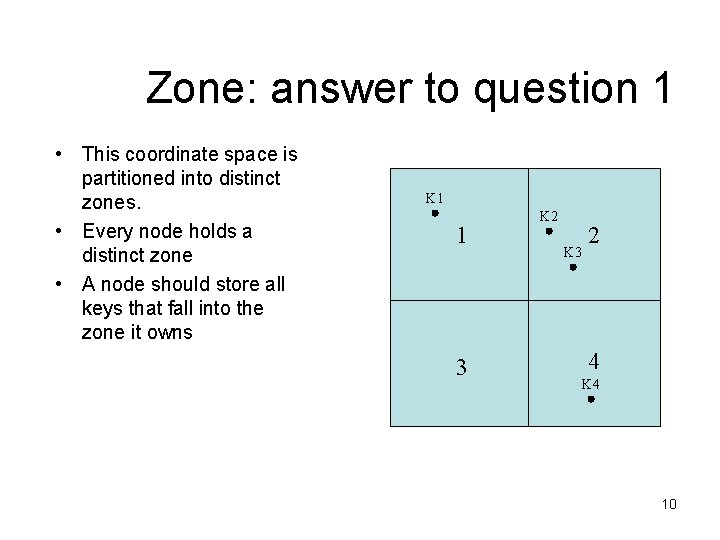
Zone: answer to question 1 • This coordinate space is partitioned into distinct zones. • Every node holds a distinct zone • A node should store all keys that fall into the zone it owns K 1 1 3 K 2 K 3 2 4 K 4 10
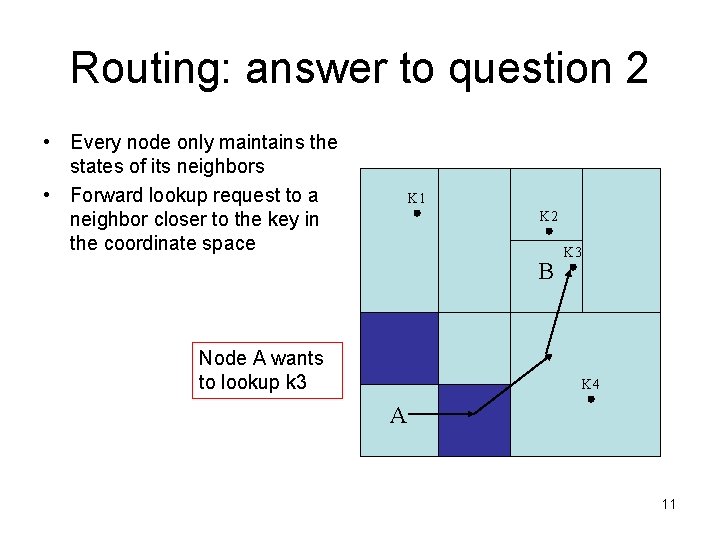
Routing: answer to question 2 • Every node only maintains the states of its neighbors • Forward lookup request to a neighbor closer to the key in the coordinate space K 1 K 2 B Node A wants to lookup k 3 K 4 A 11
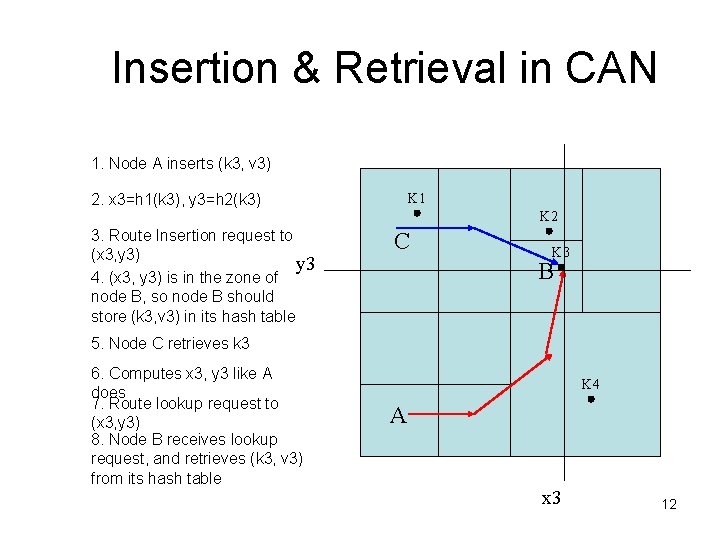
Insertion & Retrieval in CAN 1. Node A inserts (k 3, v 3) K 1 2. x 3=h 1(k 3), y 3=h 2(k 3) K 2 3. Route Insertion request to (x 3, y 3) y 3 4. (x 3, y 3) is in the zone of node B, so node B should store (k 3, v 3) in its hash table C K 3 B 5. Node C retrieves k 3 6. Computes x 3, y 3 like A does 7. Route lookup request to (x 3, y 3) 8. Node B receives lookup request, and retrieves (k 3, v 3) from its hash table K 4 A x 3 12
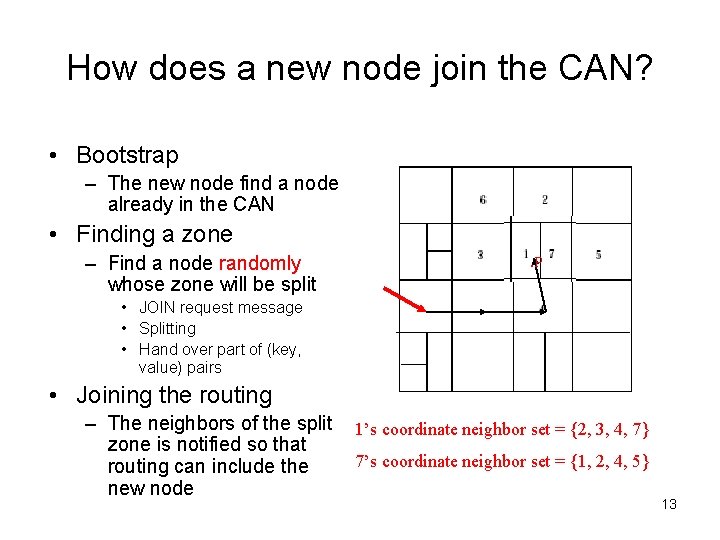
How does a new node join the CAN? • Bootstrap – The new node find a node already in the CAN • Finding a zone – Find a node randomly whose zone will be split . P 1 • JOIN request message • Splitting • Hand over part of (key, value) pairs • Joining the routing – The neighbors of the split zone is notified so that routing can include the new node 1’s coordinate neighbor set = {2, 3, 4, 7} 1’s coordinate neighbor set = {2, 3, 4, 5} 7’s coordinate neighbor set = {1, 2, 4, 5} 13
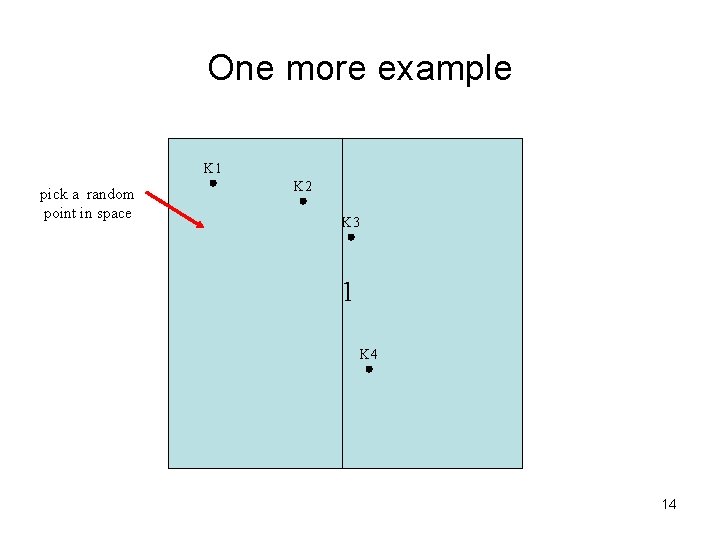
One more example K 1 pick a random point in space K 2 K 3 1 K 4 14
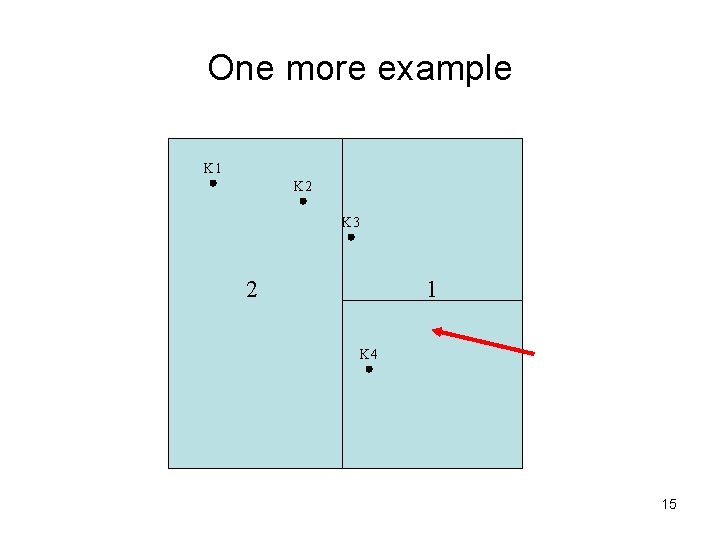
One more example K 1 K 2 K 3 2 1 K 4 15
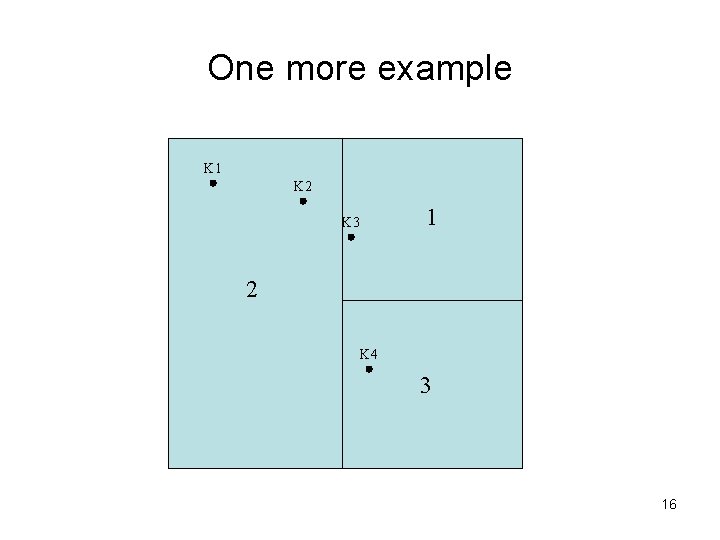
One more example K 1 K 2 1 K 3 2 K 4 3 16
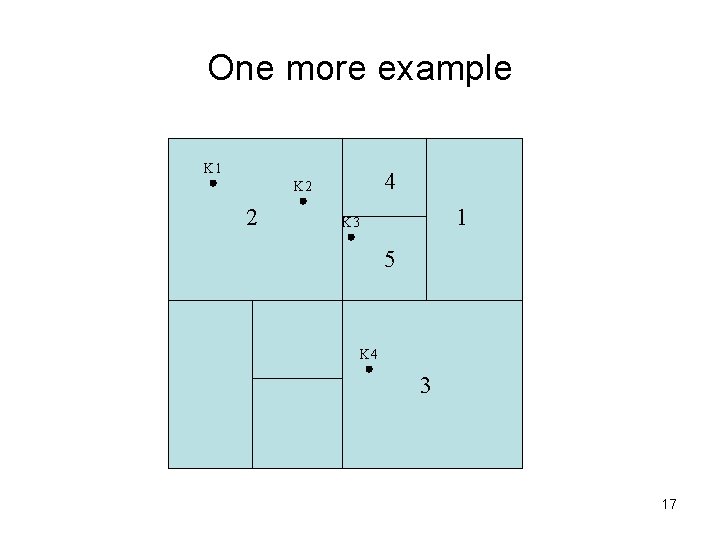
One more example K 1 4 K 2 2 1 K 3 5 K 4 3 17
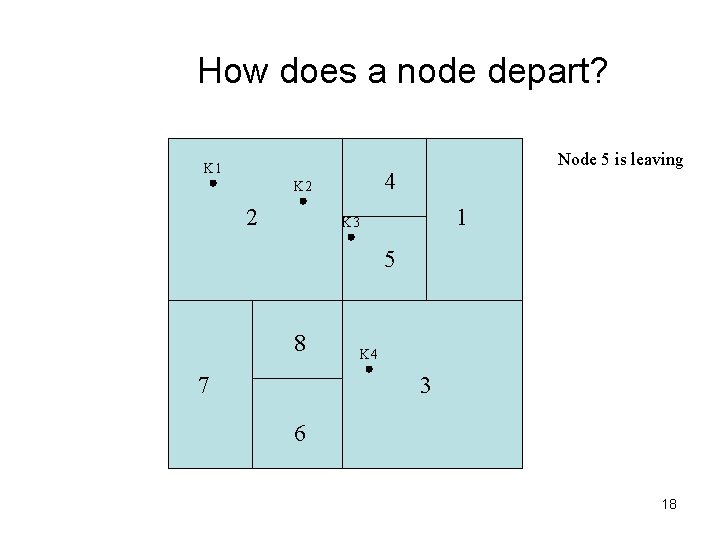
How does a node depart? K 1 4 K 2 2 Node 5 is leaving 1 K 3 5 8 7 K 4 3 6 18
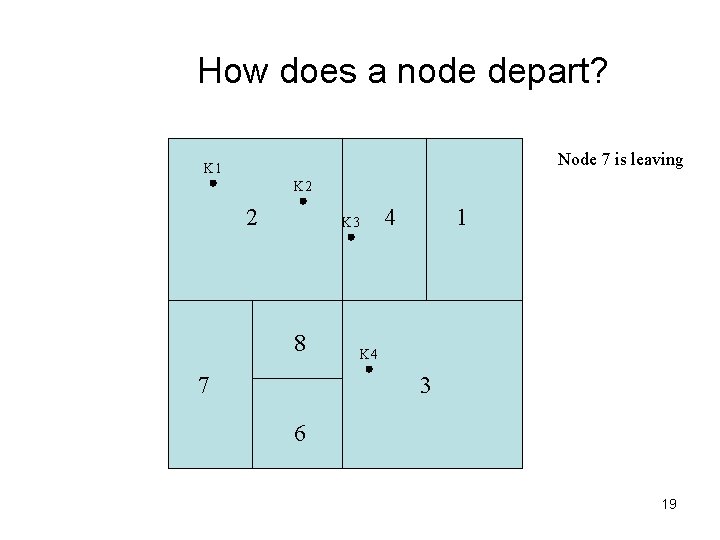
How does a node depart? Node 7 is leaving K 1 K 2 2 4 K 3 8 7 1 K 4 3 6 19
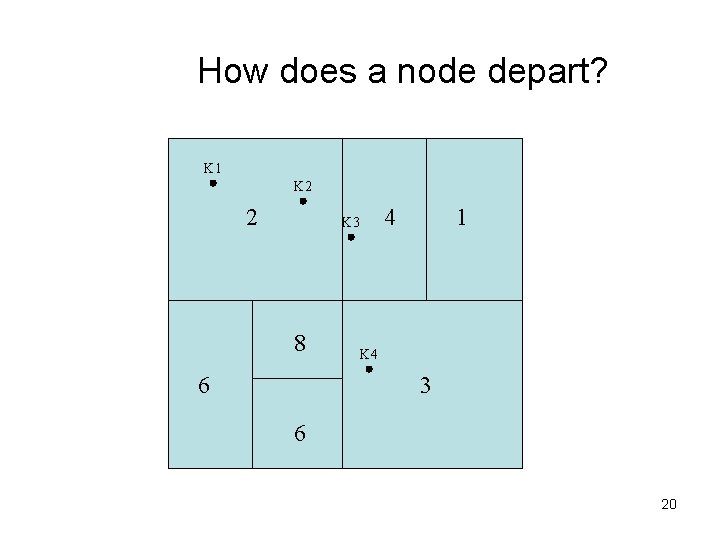
How does a node depart? K 1 K 2 2 4 K 3 8 6 1 K 4 3 6 20
CAN: node failures Detect failures – Send periodic update message to neighbors Need to repair the space – recover database • soft-state updates • use replication, rebuild database from replicas – repair routing • takeover algorithm 21
CAN: takeover algorithm • Simple failures – know your neighbor’s neighbors – when a node fails, one of its neighbors takes over its zone • More complex failure modes – simultaneous failure of multiple adjacent nodes – scoped flooding to discover neighbors – hopefully, a rare event 22
Why Unstructured P 2 P Co-exists? • When peers are highly dynamic and transient, maintenance and updating of DHT will be too expensive to afford. Little effect to U-P 2 P. • DHT only provides information of ``needles”, not ``hails”, which can only provided by U-P 2 P. • DHT only provides ``key word” search. The search in U-P 2 P can be very vague, leave a large space for a wide range of development, such as semantic Web. 23
- Slides: 23