
Distributed Generation The Regulatory Future of Clean Reliable
Distributed Generation The Regulatory Future of Clean, Reliable Energy Dennis Arfmann & Tiffany Joye Hogan Lovells, LLP February 1, 2012
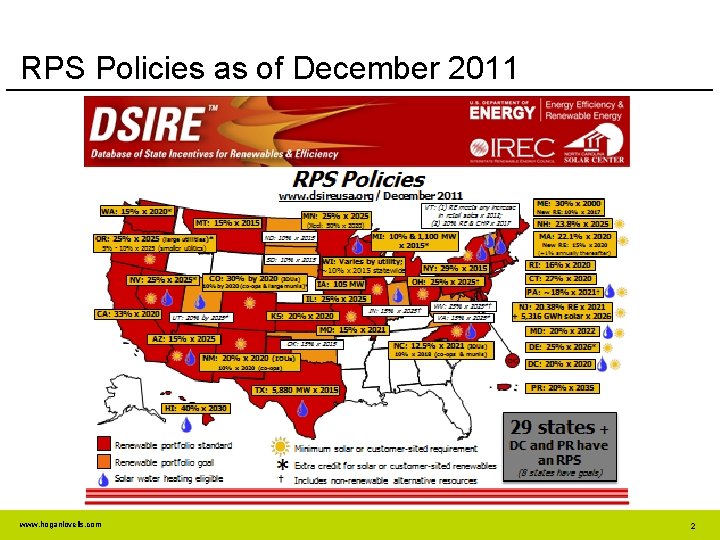
RPS Policies as of December 2011 www. hoganlovells. com 2
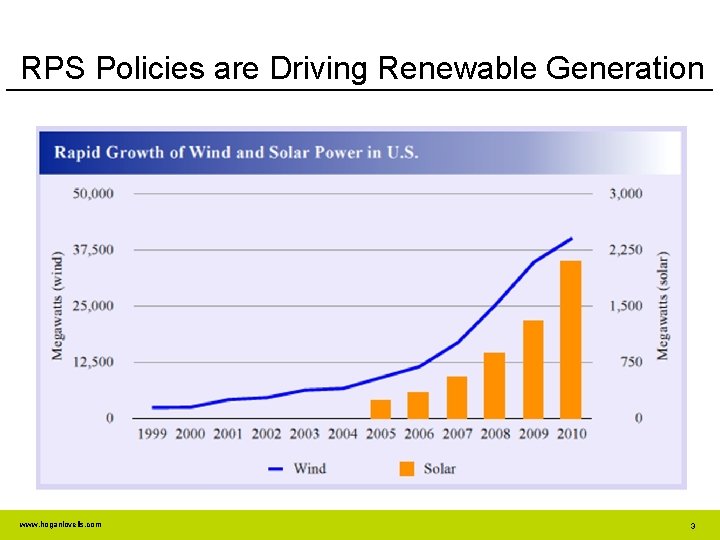
RPS Policies are Driving Renewable Generation www. hoganlovells. com 3
What is Distributed Generation (“DG”)? • “Electric power source connected directly to the distribution network or on the customer side of the meter. ” Swedish Royal Institute of Technology, Dep’t of Electric Power Engineering definition • DG electric-generating technologies include renewable generation: – – – Combined heat and power Small wind installations Small solar plants Engines, Turbines, Fuel cells Storage Generation (hydro and battery storage) www. hoganlovells. com 4
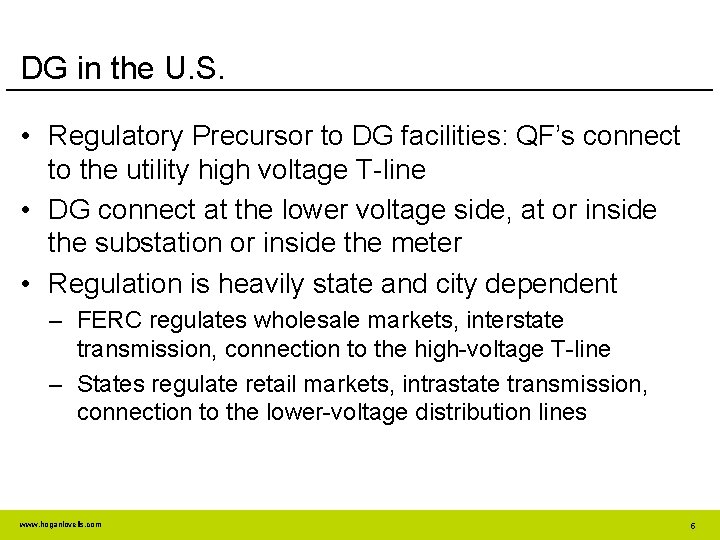
DG in the U. S. • Regulatory Precursor to DG facilities: QF’s connect to the utility high voltage T-line • DG connect at the lower voltage side, at or inside the substation or inside the meter • Regulation is heavily state and city dependent – FERC regulates wholesale markets, interstate transmission, connection to the high-voltage T-line – States regulate retail markets, intrastate transmission, connection to the lower-voltage distribution lines www. hoganlovells. com 5
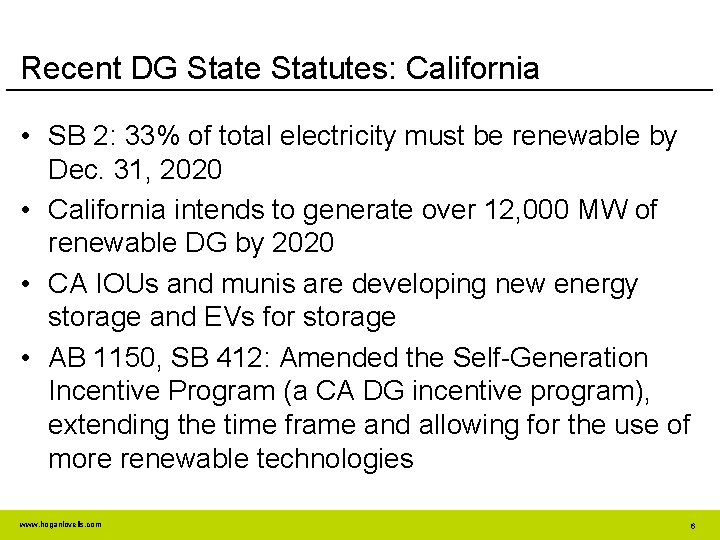
Recent DG State Statutes: California • SB 2: 33% of total electricity must be renewable by Dec. 31, 2020 • California intends to generate over 12, 000 MW of renewable DG by 2020 • CA IOUs and munis are developing new energy storage and EVs for storage • AB 1150, SB 412: Amended the Self-Generation Incentive Program (a CA DG incentive program), extending the time frame and allowing for the use of more renewable technologies www. hoganlovells. com 6
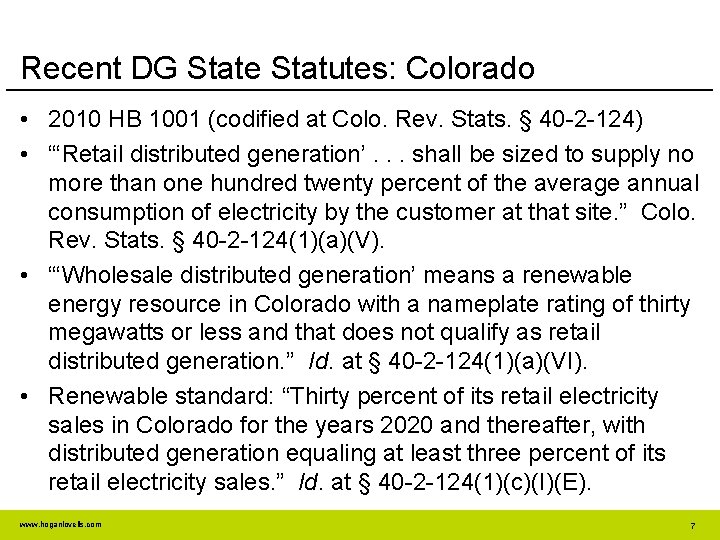
Recent DG State Statutes: Colorado • 2010 HB 1001 (codified at Colo. Rev. Stats. § 40 -2 -124) • “‘Retail distributed generation’. . . shall be sized to supply no more than one hundred twenty percent of the average annual consumption of electricity by the customer at that site. ” Colo. Rev. Stats. § 40 -2 -124(1)(a)(V). • “‘Wholesale distributed generation’ means a renewable energy resource in Colorado with a nameplate rating of thirty megawatts or less and that does not qualify as retail distributed generation. ” Id. at § 40 -2 -124(1)(a)(VI). • Renewable standard: “Thirty percent of its retail electricity sales in Colorado for the years 2020 and thereafter, with distributed generation equaling at least three percent of its retail electricity sales. ” Id. at § 40 -2 -124(1)(c)(I)(E). www. hoganlovells. com 7
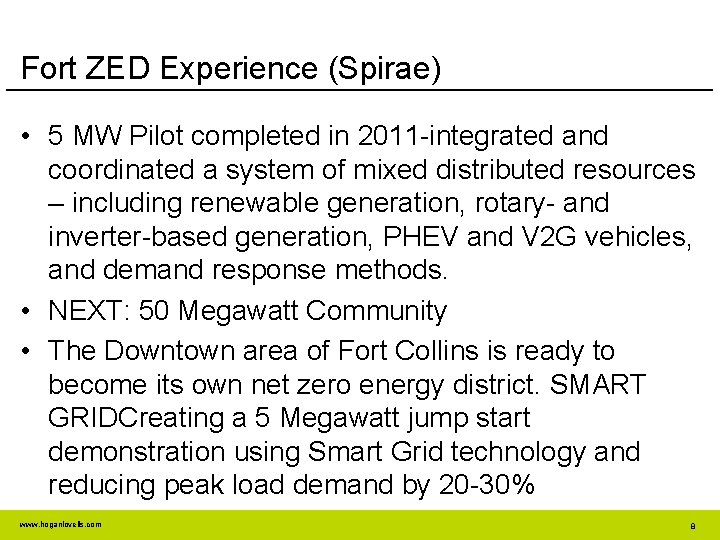
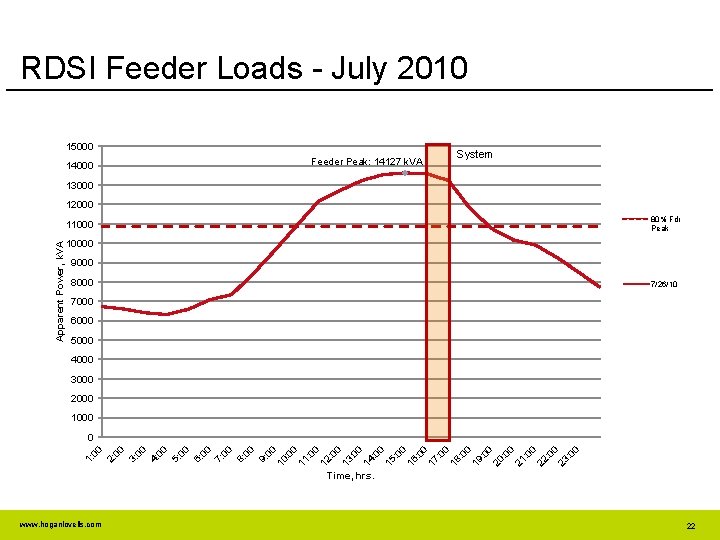
Fort ZED Experience (Spirae) • 5 MW Pilot completed in 2011 -integrated and coordinated a system of mixed distributed resources – including renewable generation, rotary- and inverter-based generation, PHEV and V 2 G vehicles, and demand response methods. • NEXT: 50 Megawatt Community • The Downtown area of Fort Collins is ready to become its own net zero energy district. SMART GRIDCreating a 5 Megawatt jump start demonstration using Smart Grid technology and reducing peak load demand by 20 -30% www. hoganlovells. com 8
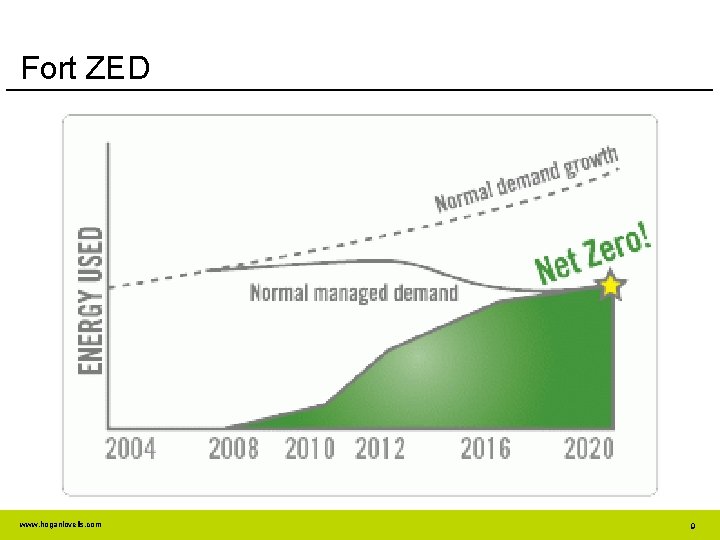
Fort ZED www. hoganlovells. com 9
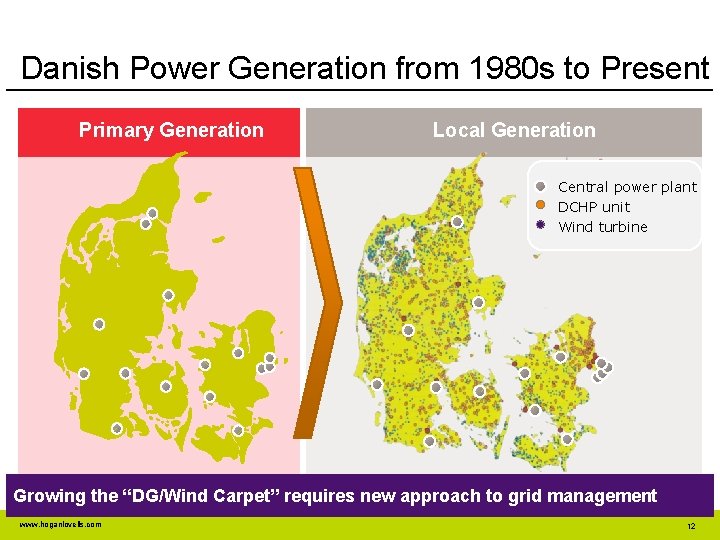
Danish Power Generation from 1980 s to Present Primary Generation Local Generation Central power plant DCHP unit Wind turbine Source: Energinet. dk Growing the “DG/Wind Carpet” requires new approach to grid management 9/26/2020 www. hoganlovells. com 12
Denmark’s Energy Supply Goals EU members have 2020 goals for renewable energy use: • Denmark’s goal is for 42% renewable energy use • Amounts to a 33% reduction in fossil fuel from 2009 levels • To achieve this number, goal is for 62% of electricity used to come from renewable sources In addition, Denmark has a 2050 goal of complete fossil-fuel independence www. hoganlovells. com 13
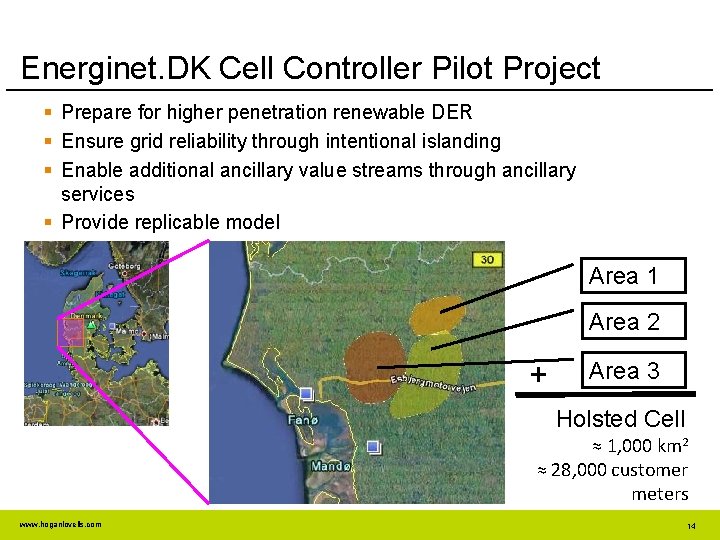
Energinet. DK Cell Controller Pilot Project § Prepare for higher penetration renewable DER § Ensure grid reliability through intentional islanding § Enable additional ancillary value streams through ancillary services § Provide replicable model Area 1 Area 2 + Area 3 Holsted Cell ≈ 1, 000 km 2 ≈ 28, 000 customer meters www. hoganlovells. com 14
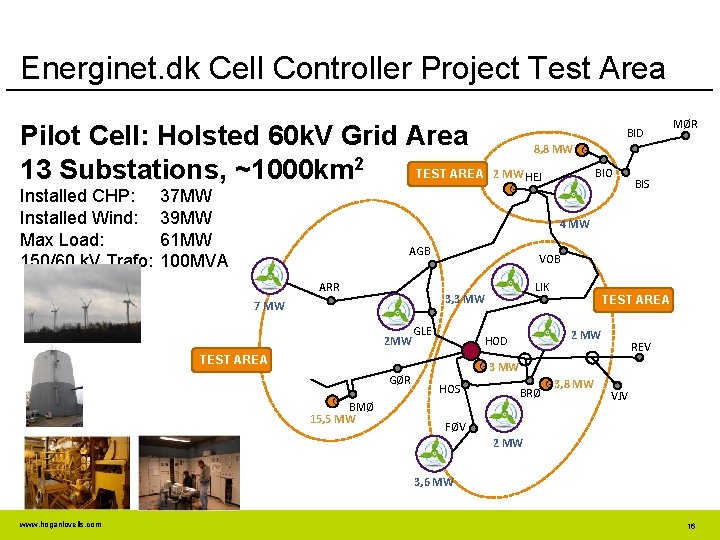
Energinet. dk Cell Controller Project Test Area Pilot Cell: Holsted 60 k. V Grid Area 8, 8 MW G BIO TEST AREA 12 MW 13 Substations, ~1000 km 2 HEJ Installed CHP: Installed Wind: Max Load: 150/60 k. V Trafo: BID G 37 MW 39 MW 61 MW 100 MVA MØR BIS 4 MW AGB ARR 7 MW VOB LIK 3, 3 MW 2 MW GLE G 3 MW TEST AREA 3 GØR G BMØ 15, 5 MW 2 MW HOD HOS TEST AREA 2 BRØ G 3, 8 MW REV VJV FØV 2 MW 3, 6 MW www. hoganlovells. com 16
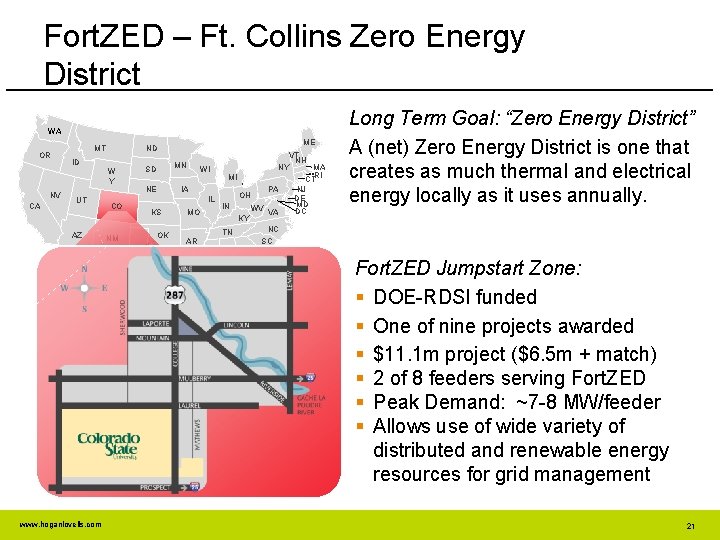
Fort. ZED – Ft. Collins Zero Energy District WA OR MT ID W Y NV CA UT AZ ME ND CO NM VT NH MN NY MA SD WI RI MI CT NE IA PA NJ OH DE IL MD IN WV VA DC KS MO KY NC TN OK AR SC TX LA MS AL GA FL www. hoganlovells. com Long Term Goal: “Zero Energy District” A (net) Zero Energy District is one that creates as much thermal and electrical energy locally as it uses annually. Fort. ZED Jumpstart Zone: § DOE-RDSI funded § One of nine projects awarded § $11. 1 m project ($6. 5 m + match) § 2 of 8 feeders serving Fort. ZED § Peak Demand: ~7 -8 MW/feeder § Allows use of wide variety of distributed and renewable energy resources for grid management 21
RDSI Feeder Loads - July 2010 15000 Feeder Peak: 14127 k. VA 14000 System 13000 12000 80% Fdr Peak Apparent Power, k. VA 110000 9000 8000 7/26/10 7000 6000 5000 4000 3000 2000 1000 0 8: 00 9: 00 10 : 0 0 11 : 0 0 12 : 0 0 13 : 0 0 14 : 0 0 15 : 0 0 16 : 0 0 17 : 0 0 18 : 0 0 19 : 0 0 20 : 0 0 21 : 0 0 22 : 0 0 23 : 0 0 0 7: 0 0 6: 0 0 5: 0 0 4: 0 0 3: 0 2: 0 1: 0 0 0 Time, hrs. www. hoganlovells. com 22
Fort. ZED/RDSI Project Sites and Resources Spirae’s platform enables DER to be automatically dispatched for real time grid management www. hoganlovells. com 23
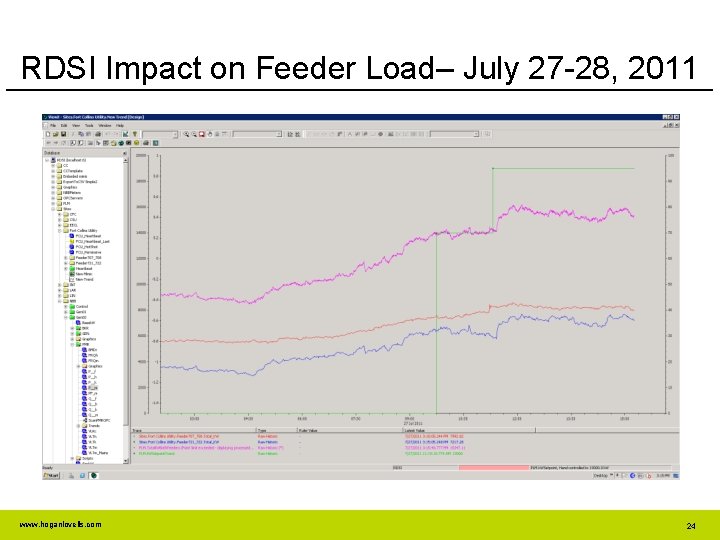
RDSI Impact on Feeder Load– July 27 -28, 2011 www. hoganlovells. com 24
Why is DG important? • • Increased feasibility of local renewable generation Increased transmission efficiency Increased system generation capacity Increased grid and capacity control Decreased costs for consumers Decreased transmission and distribution bottlenecks Decreased emissions www. hoganlovells. com 25
Hindrances impeding distributed generation: regulatory and technical • • • Interconnection regulations Net-metering regulations Volt-Var management Watt-Volt management Renewable Curtailment Watt-frequency management Voltage Sag ride-through Dynamic grid stabilization Stranded existing centralized generation IPP & Utility assets Impacts of variable renewable resources in distribution feeder voltage and harmonic levels • Redesign of distribution systems www. hoganlovells. com 26
Policies supporting distributed generation • • • Well-designed interconnection standards Net-metering standards Public benefit funds/clean energy funds Feed-in tariffs FERC Order 2006 (standardized procedures for interconnection of small QF generators) • FERC Order 755 (October 20, 2011) • Recent FERC order in Iberdrola Renewables, Inc. , et al. v. Bonneville Power Admin. , 137 FERC 61, 185 (Dec. 7, 2011) www. hoganlovells. com 27
FERC Order 755 • Final rules for Energy Storage used for Regulation Service • Two-part compensation: – Capacity payment (incl. opportunity cost for providers to stand by) – Market-based performance payment • ESS’ regulation service will benefit more from wholesale market • 15 min. and 1 hour frequency regulation in the wholesale market www. hoganlovells. com 28
Recent FERC Order-Iberdrola v. BPA (2011) • Petitioners alleged BPA was discriminating against wind generators in implementing the Environmental Redispatch Policy, which provides for curtailment in violation of BPA’s OATT and Petitioners’ LGIAs • FERC, under the authority granted by FPA 211 A, ordered BPA to file tariff revisions that are not unduly discriminatory or preferential – Must provide transmission service on terms and conditions that are comparable to those under which BPA provides transmission service to itself www. hoganlovells. com 29
Implication of the Recent FERC Orders • FERC Order 755—Opens the door to wind/solar independent generators to add Energy Storage. • Iberdrola—Provides a framework and a background for distributed generation projects across the U. S. to request equal, nondiscriminatory treatment from the transmission interconnection agreements www. hoganlovells. com 30
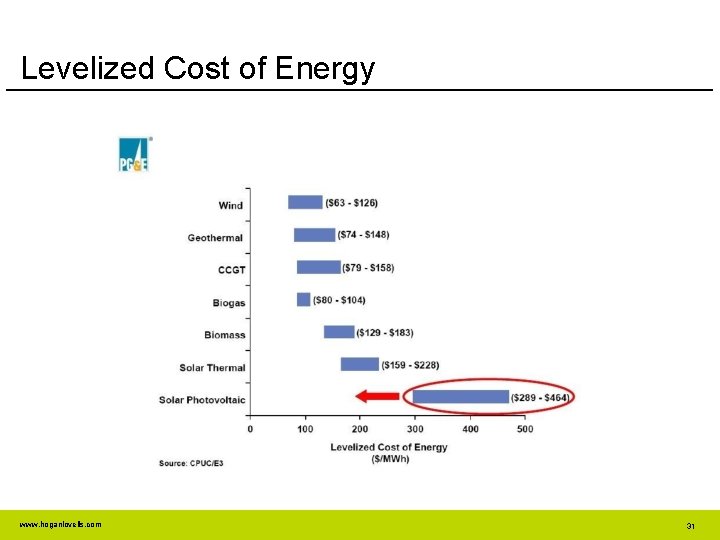
Levelized Cost of Energy www. hoganlovells. com 31
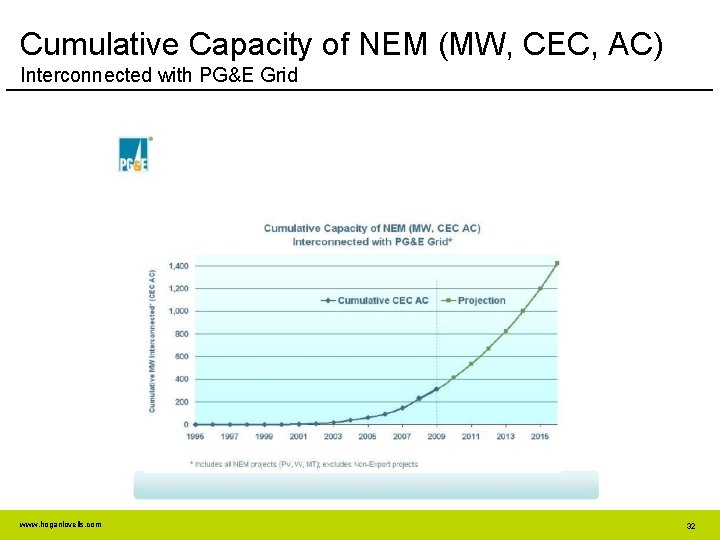
Cumulative Capacity of NEM (MW, CEC, AC) Interconnected with PG&E Grid www. hoganlovells. com 32
www. hoganlovells. com Hogan Lovells has offices in: Abu Dhabi Alicante Amsterdam Baltimore Beijing Berlin Brussels Budapest* Caracas Colorado Springs Denver Dubai Dusseldorf Frankfurt Hamburg Hanoi Ho Chi Minh City Hong Kong Houston Jeddah* London Los Angeles Madrid Miami Milan Moscow Munich New York Northern Virginia Paris Philadelphia Prague Riyadh* Rome San Francisco Shanghai Silicon Valley Singapore Tokyo Ulaanbaatar Warsaw Washington DC Zagreb* "Hogan Lovells" or the "firm" is an international legal practice that includes Hogan Lovells International LLP and Hogan Lovells US LLP. The word "partner" is used to refer to a member of Hogan Lovells International LLP or a partner of Hogan Lovells US LLP, or an employee or consultant with equivalent standing and qualifications, and to a partner, member, employee or consultant in any of their affiliated businesses who has equivalent standing. Where case studies are included, results achieved do not guarantee similar outcomes for other clients. Attorney Advertising. © Hogan Lovells 2011. All rights reserved. *Associated offices
- Slides: 26