
Distributed File Systems Remote Storage Caching Distributed File
Distributed File Systems Remote Storage & Caching
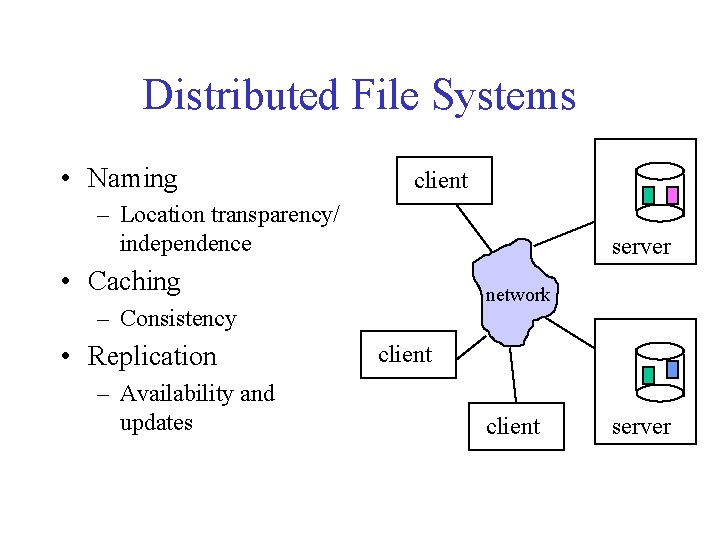
Distributed File Systems • Naming client – Location transparency/ independence server • Caching network – Consistency • Replication – Availability and updates client server

Cache Consistency • Location of cache on client disk or memory • Update policy client server – write through – delayed writeback – write-on-close • Consistency – Client does validity check, contacting server – Server call-backs network client server
File Cache Consistency • Caching is a key technique in distributed systems. • The cache consistency problem: cached data may become stale if cached data is updated elsewhere in the network. • Solutions: – Timestamp invalidation (NFS). • Timestamp each cache entry, and periodically query the server: “has this file changed since time t? ”; invalidate cache if stale. – Callback invalidation (AFS). • Request notification (callback) from the server if the file changes; invalidate cache on callback. – Leases (NQ-NFS) [Gray&Cheriton 89]
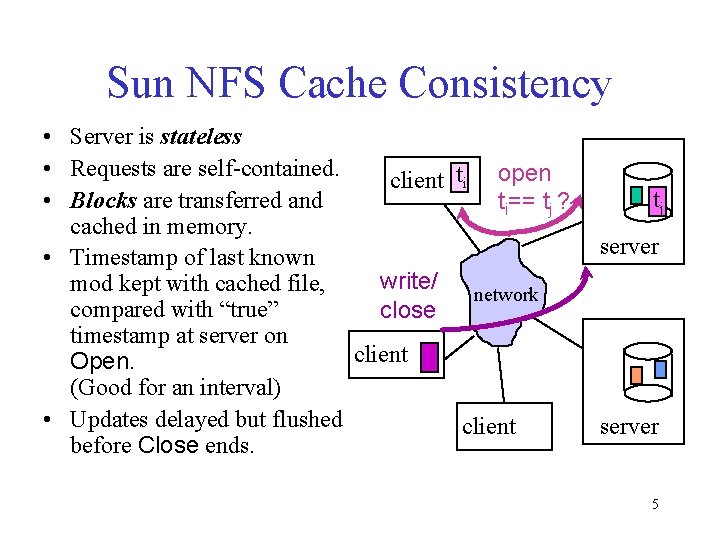
Sun NFS Cache Consistency • Server is stateless • Requests are self-contained. client ti open • Blocks are transferred and ti== tj ? cached in memory. • Timestamp of last known write/ mod kept with cached file, network compared with “true” close timestamp at server on client Open. (Good for an interval) • Updates delayed but flushed client before Close ends. tj server 5
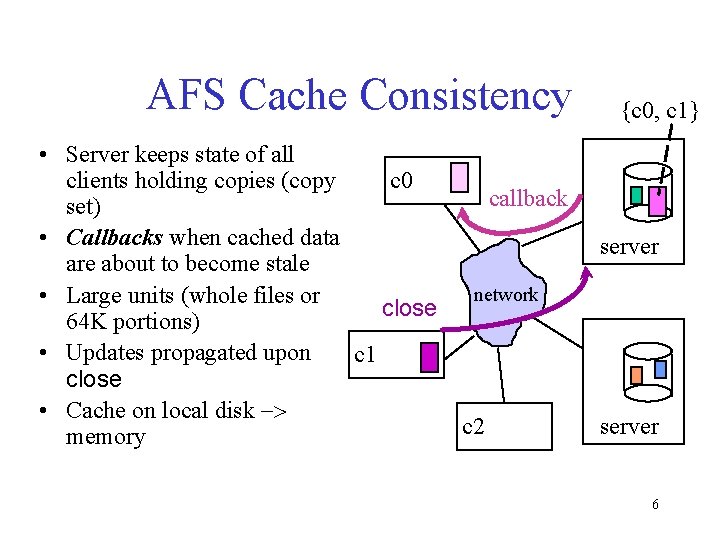
AFS Cache Consistency • Server keeps state of all c 0 clients holding copies (copy callback set) • Callbacks when cached data are about to become stale network • Large units (whole files or close 64 K portions) • Updates propagated upon c 1 close • Cache on local disk -> c 2 memory {c 0, c 1} server 6
NQ-NFS Leases • In NQ-NFS, a client obtains a lease on the file that permits the client’s desired read/write activity. – “A lease is a ticket permitting an activity; the lease is valid until some expiration time. ” - temporary statefulness – A read-caching lease allows the client to cache clean data. • Guarantee: no other client is modifying the file. – A write-caching lease allows the client to buffer modified data for the file. Must push data before expiration • Guarantee: no other client has the file cached. • Leases may be revoked by the server if another client requests a conflicting operation (server sends eviction notice). Push in write_slack period.
Explicit First-class Replication • File name maps to set of replicas, one of which will be used to satisfy request – Goal: availability • Update strategy – Atomic updates - all or none – Primary copy approach – Voting schemes – Optimistic, then detection of conflicts
Optimistic vs. Pessimistic • High availability Conflicting updates are the potential problem - requiring detection and resolution. • Avoids conflicts by holding of shared or exclusive locks. • How to arrange when disconnection is involuntary? • Leases [Gray, SOSP 89] puts a time-bound on locks but what about expiration?
- Slides: 10