
Distributed DB architectures An Introduction Dario Della Monica
Distributed DB architectures: An Introduction Dario Della Monica These slides are a modified version of the slides provided with the book Özsu and Valduriez, Principles of Distributed Database Systems (3 rd Ed. ), 2011 The original version of the slides is available at: extras. springer. com Distributed DBMS © M. T. Özsu & P. Valduriez Ch. 1/1
Outline (distributed DB) • Introduction (Ch. 1) ⋆ ➡ What is a distributed DBMS ➡ Distributed DBMS Architecture • Distributed Database Design (Ch. 3) ⋆ • Distributed Query Processing (Ch. 6 -8) ⋆ • Distributed Transaction Management (Ch. 10 -12) ⋆ ⋆ Özsu and Valduriez, Principles of Distributed Database Systems, 3 rd edition, 2011 Distributed DBMS © M. T. Özsu & P. Valduriez Ch. 1/2
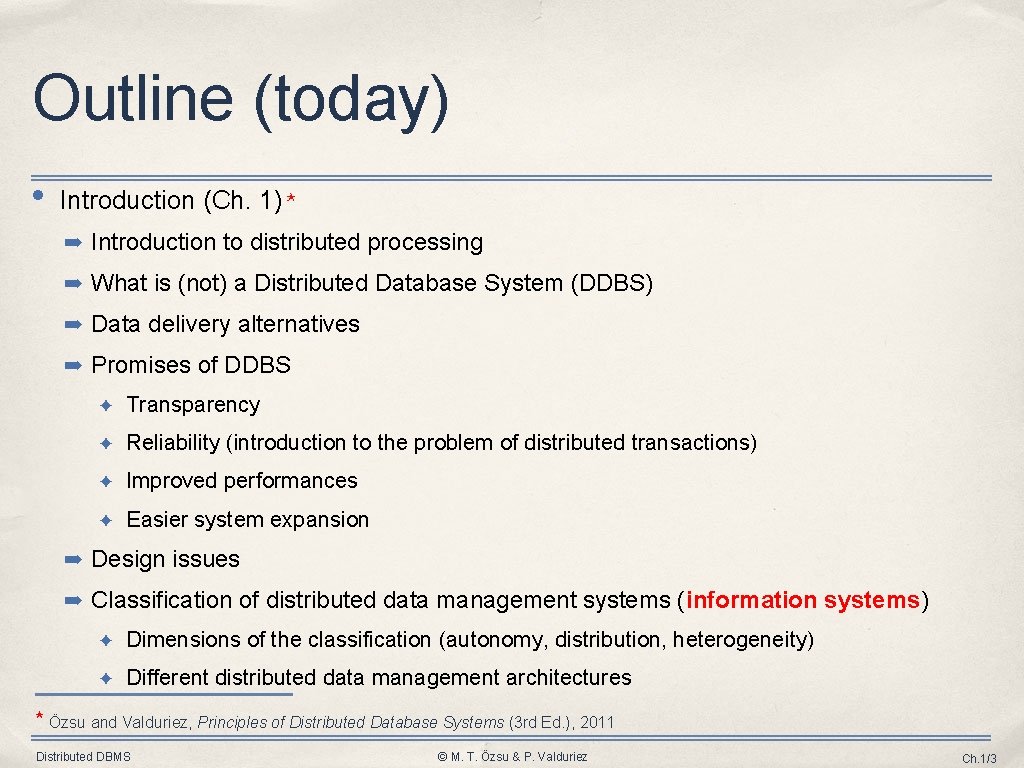
Outline (today) • Introduction (Ch. 1) ⋆ ➡ Introduction to distributed processing ➡ What is (not) a Distributed Database System (DDBS) ➡ Data delivery alternatives ➡ Promises of DDBS ✦ Transparency ✦ Reliability (introduction to the problem of distributed transactions) ✦ Improved performances ✦ Easier system expansion ➡ Design issues ➡ Classification of distributed data management systems (information systems) ✦ Dimensions of the classification (autonomy, distribution, heterogeneity) ✦ Different distributed data management architectures ⋆ Özsu and Valduriez, Principles of Distributed Database Systems (3 rd Ed. ), 2011 Distributed DBMS © M. T. Özsu & P. Valduriez Ch. 1/3
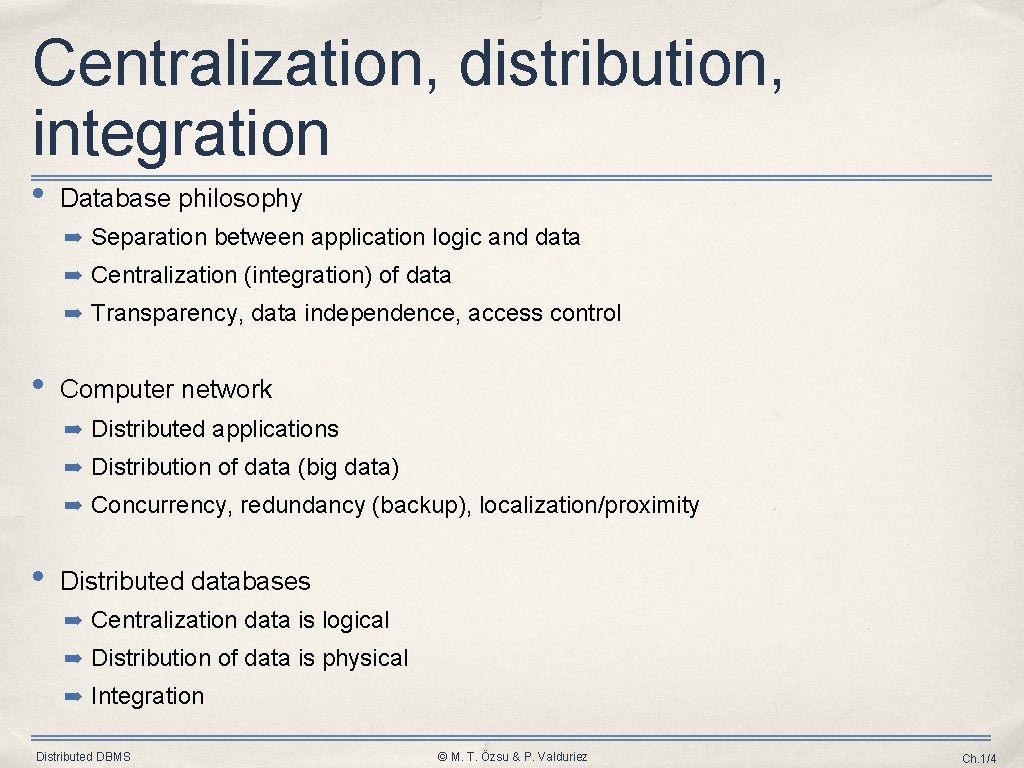
Centralization, distribution, integration • Database philosophy ➡ Separation between application logic and data ➡ Centralization (integration) of data ➡ Transparency, data independence, access control • Computer network ➡ Distributed applications ➡ Distribution of data (big data) ➡ Concurrency, redundancy (backup), localization/proximity • Distributed databases ➡ Centralization data is logical ➡ Distribution of data is physical ➡ Integration Distributed DBMS © M. T. Özsu & P. Valduriez Ch. 1/4
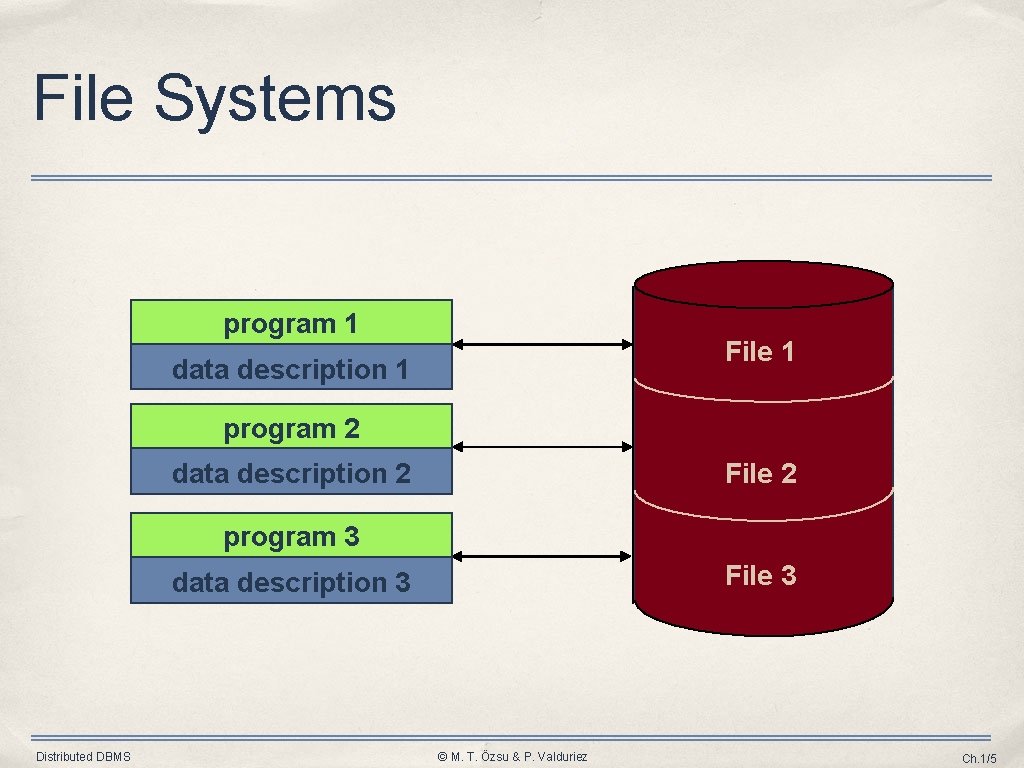
File Systems program 1 File 1 data description 1 program 2 File 2 data description 2 program 3 File 3 data description 3 Distributed DBMS © M. T. Özsu & P. Valduriez Ch. 1/5
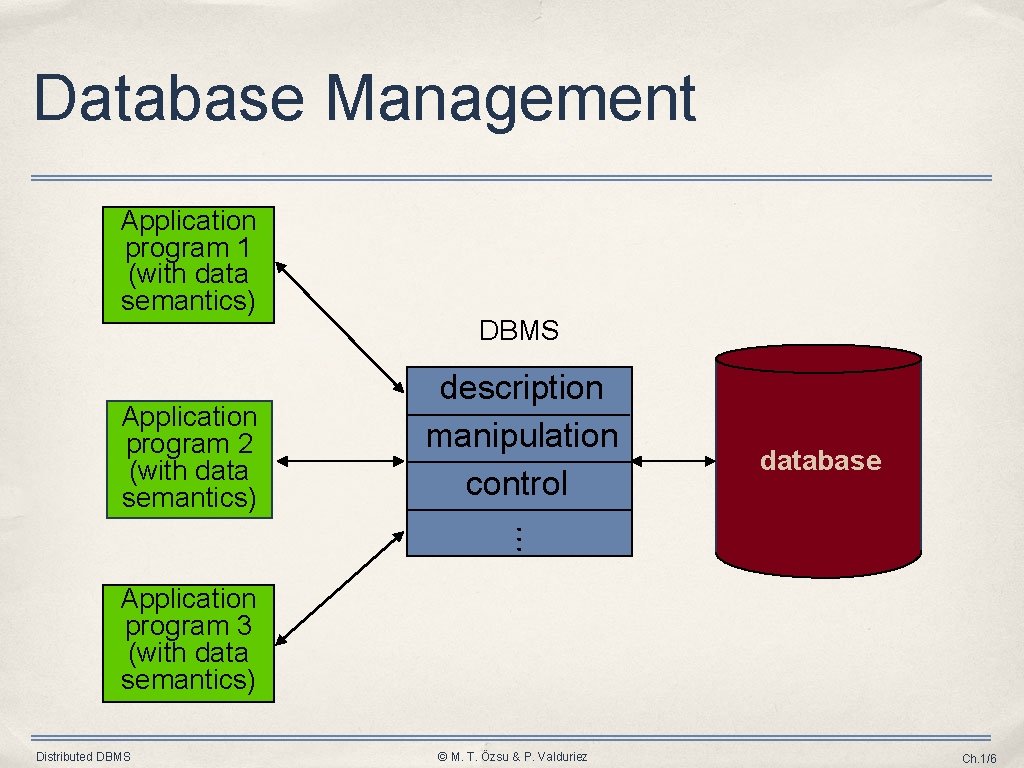
Database Management Application program 1 (with data semantics) Application program 2 (with data semantics) DBMS description manipulation control database Application program 3 (with data semantics) Distributed DBMS © M. T. Özsu & P. Valduriez Ch. 1/6
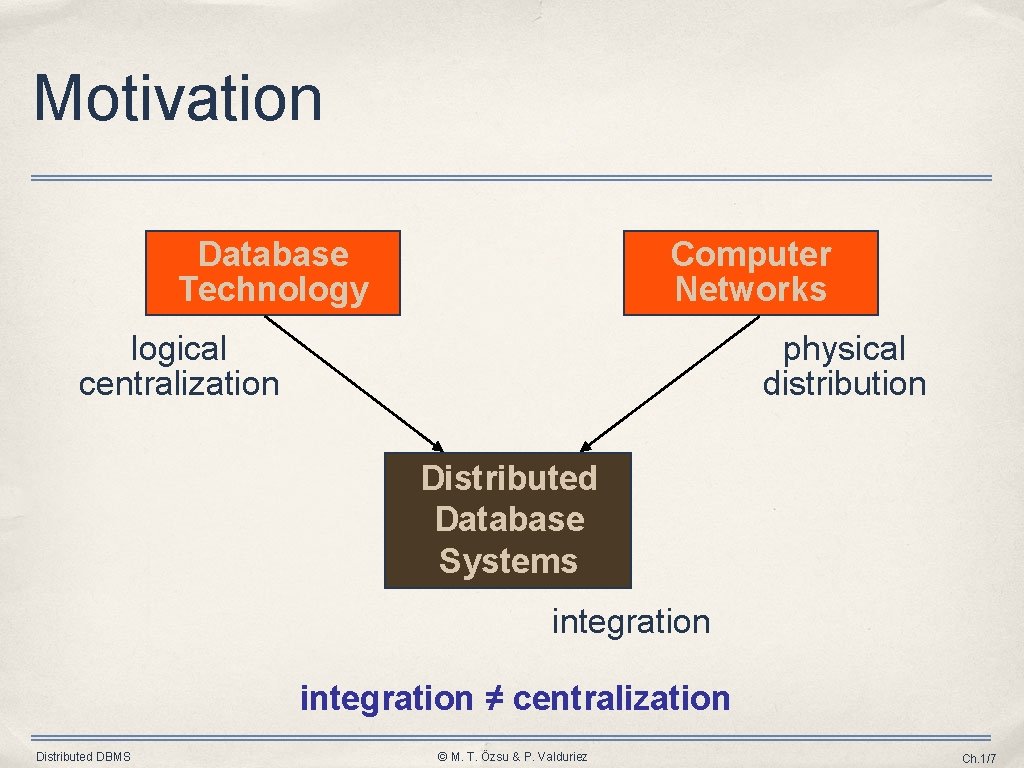
Motivation Database Technology Computer Networks logical centralization physical distribution Distributed Database Systems integration ≠ centralization Distributed DBMS © M. T. Özsu & P. Valduriez Ch. 1/7
Distributed Computing • Some forms of distributed processing are everywhere (CPU vs. I/O, parallel computation, multi-processor, multi-core) • Definition (distributed computing). A number of autonomous processing elements (not necessarily homogeneous) that are interconnected by a computer network and that cooperate in performing their assigned tasks Distributed DBMS © M. T. Özsu & P. Valduriez Ch. 1/8
Distribution: what and why? • What is being distributed? ➡ Processing logic (processing elements, processing devices) ➡ Function (tasks that are specific to a piece of hardware or software) ➡ Data ➡ Control (supervision, management of tasks) • Why to distribute? ➡ Widely distributed (physically) enterprises ➡ Reliability ➡ More responsive systems ➡ More importantly: nowadays applications are intrinsically distributed and so is the data (web-based, e-commerce, social) ➡ In one word (actually two): big data divide-et-impera (divide-and-conquer) distr. DB systems : distr. processing = DB systems : centr. processing Distributed DBMS © M. T. Özsu & P. Valduriez Ch. 1/9
What is a Distributed Database System? A distributed database (DDB) is a collection of multiple, logically interrelated databases distributed over a computer network. A distributed database management system (D–DBMS) is the software that manages the DDB and provides an access mechanism that makes this distribution transparent to the users. Distributed database system (DDBS) = DDB + D–DBMS Distributed DBMS © M. T. Özsu & P. Valduriez Ch. 1/10
What is not a DDBS? • Files distributed over a network (missing structure and common logical access interface) logical interrelation is missing • A number of related DB that reside on the same system physical distribution is missing (not necessarily over a wide area, network communication) • A loosely coupled multiprocessor system even though communication issues are similar to the one over network (no disk or memory shared), they are not enough heterogeneous (identical processors and OS’s) ➡ these are rather parallel DB systems • A database system which resides at one of the nodes of a network of computers – this is a centralized database on a network node multiple DB ➡ these are rather client/server DB systems Distributed DBMS © M. T. Özsu & P. Valduriez Ch. 1/11
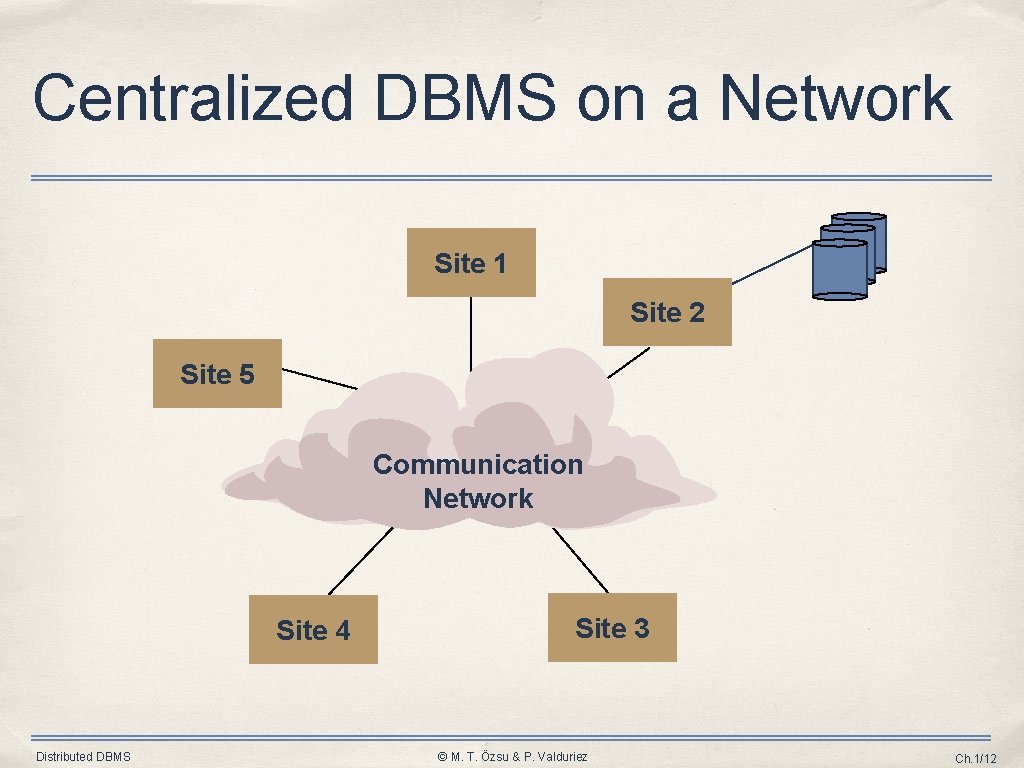
Centralized DBMS on a Network Site 1 Site 2 Site 5 Communication Network Site 4 Distributed DBMS Site 3 © M. T. Özsu & P. Valduriez Ch. 1/12
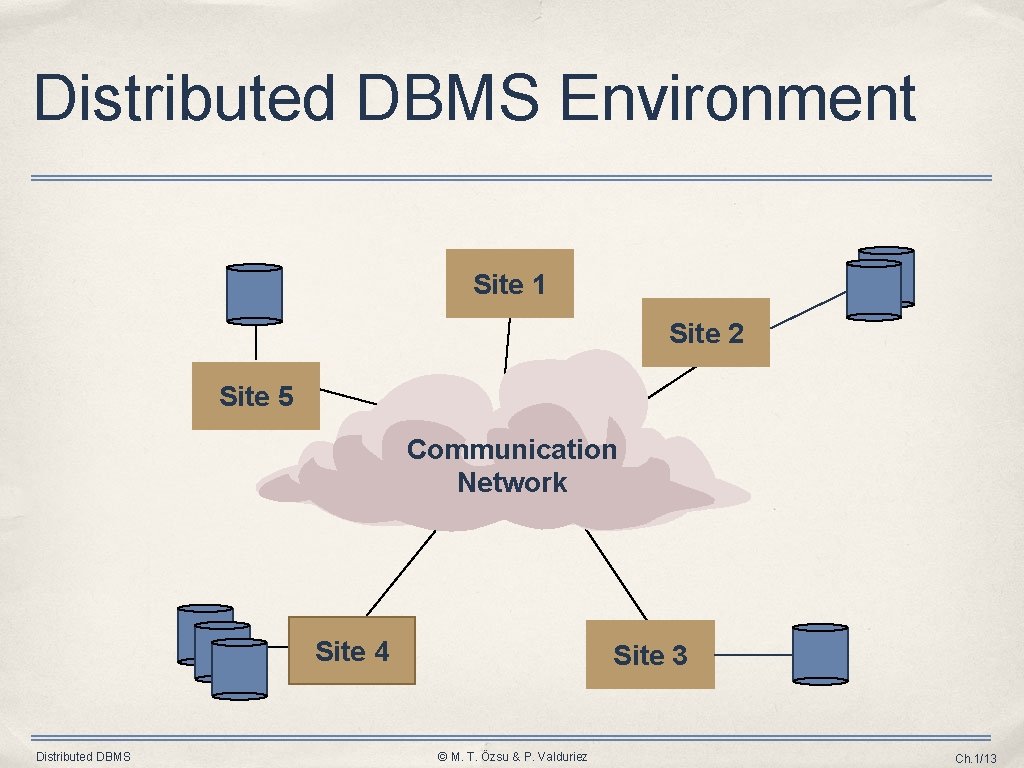
Distributed DBMS Environment Site 1 Site 2 Site 5 Communication Network Site 4 Distributed DBMS Site 3 © M. T. Özsu & P. Valduriez Ch. 1/13
Implicit Assumptions • Data stored at a number of sites each site logically consists of a single processor • Processors at different sites are interconnected by a computer network not a multiprocessor system ➡ Parallel database systems • Distributed database is a database, not a collection of files data logically related as exhibited in the users’ access patterns ➡ Relational data model • D-DBMS is a full-fledged DBMS ➡ Not remote file system, not a TP system Distributed DBMS © M. T. Özsu & P. Valduriez Ch. 1/14
Data Delivery Alternatives • Delivery modes ➡ Pull-only ➡ Push-only • ➡ Hybrid Frequency ➡ Periodic ➡ Conditional • ➡ Ad-hoc or irregular Communication Methods ➡ Unicast • • ➡ One-to-many Note: not all combinations make sense We focus on pull-only, ad-hoc, unicast communication Distributed DBMS © M. T. Özsu & P. Valduriez Ch. 1/15
Distributed DBMS Promises Transparent management of distributed, fragmented, and replicated data Improved reliability/availability through distributed transactions (distributed transactions implement protocols for, e. g. , distributed concurrent access and tolerance to network communication failure) Improved performance Easier and more economical system expansion Distributed DBMS © M. T. Özsu & P. Valduriez Ch. 1/16
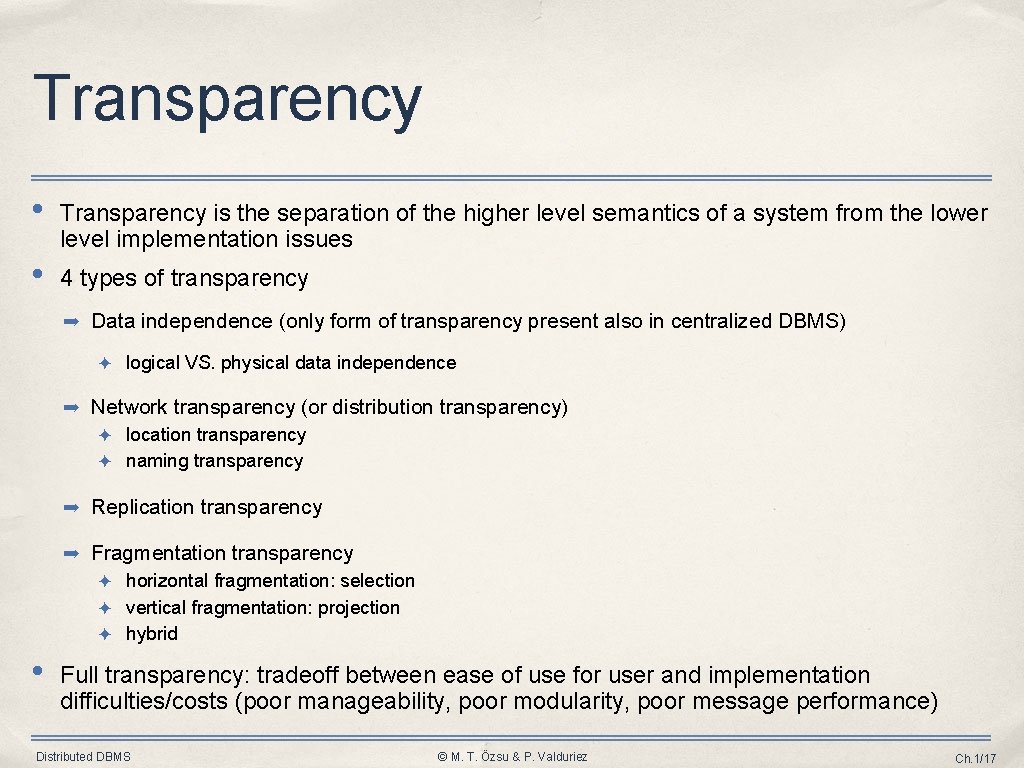
Transparency • Transparency is the separation of the higher level semantics of a system from the lower level implementation issues • 4 types of transparency ➡ Data independence (only form of transparency present also in centralized DBMS) ✦ logical VS. physical data independence ➡ Network transparency (or distribution transparency) ✦ location transparency ✦ naming transparency ➡ Replication transparency ➡ Fragmentation transparency ✦ horizontal fragmentation: selection ✦ vertical fragmentation: projection ✦ hybrid • Full transparency: tradeoff between ease of use for user and implementation difficulties/costs (poor manageability, poor modularity, poor message performance) Distributed DBMS © M. T. Özsu & P. Valduriez Ch. 1/17
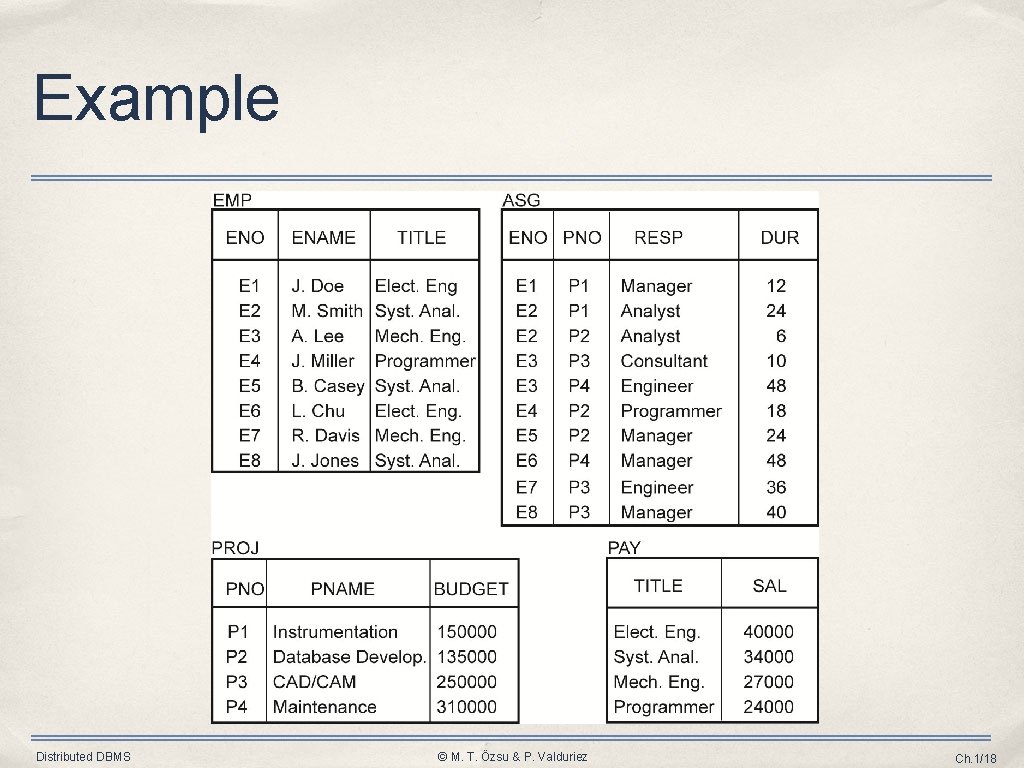
Example Distributed DBMS © M. T. Özsu & P. Valduriez Ch. 1/18
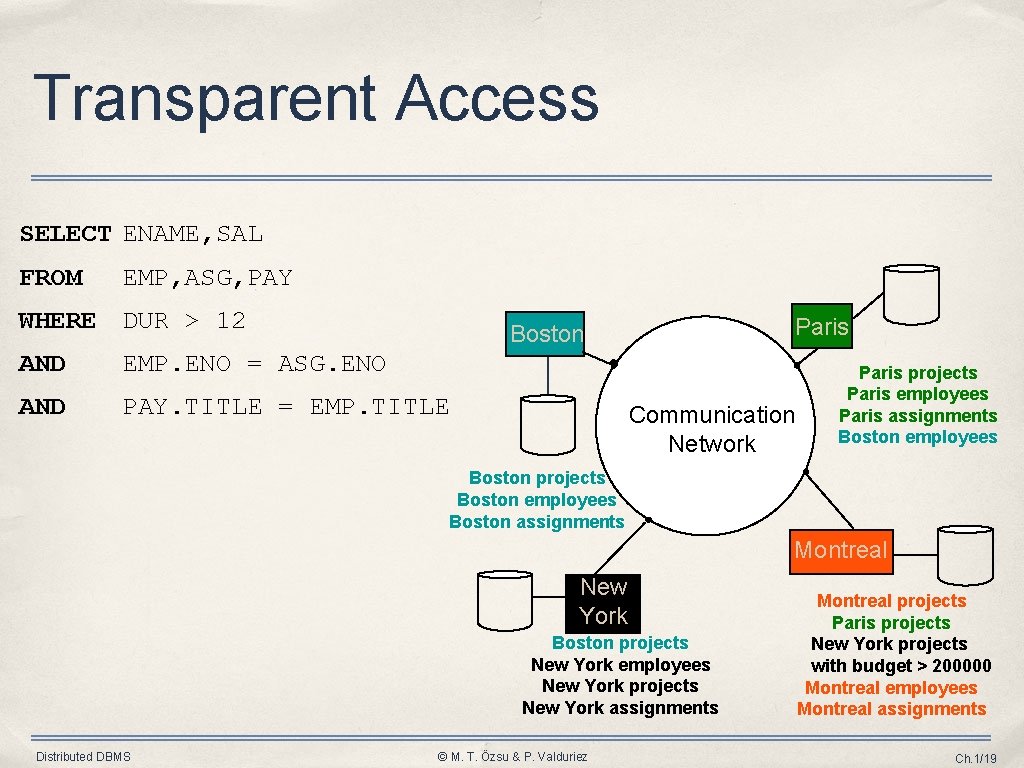
Transparent Access SELECT ENAME, SAL FROM EMP, ASG, PAY WHERE DUR > 12 Paris Boston AND EMP. ENO = ASG. ENO AND PAY. TITLE = EMP. TITLE Communication Network Paris projects Paris employees Paris assignments Boston employees Boston projects Boston employees Boston assignments Montreal New York Boston projects New York employees New York projects New York assignments Distributed DBMS © M. T. Özsu & P. Valduriez Montreal projects Paris projects New York projects with budget > 200000 Montreal employees Montreal assignments Ch. 1/19
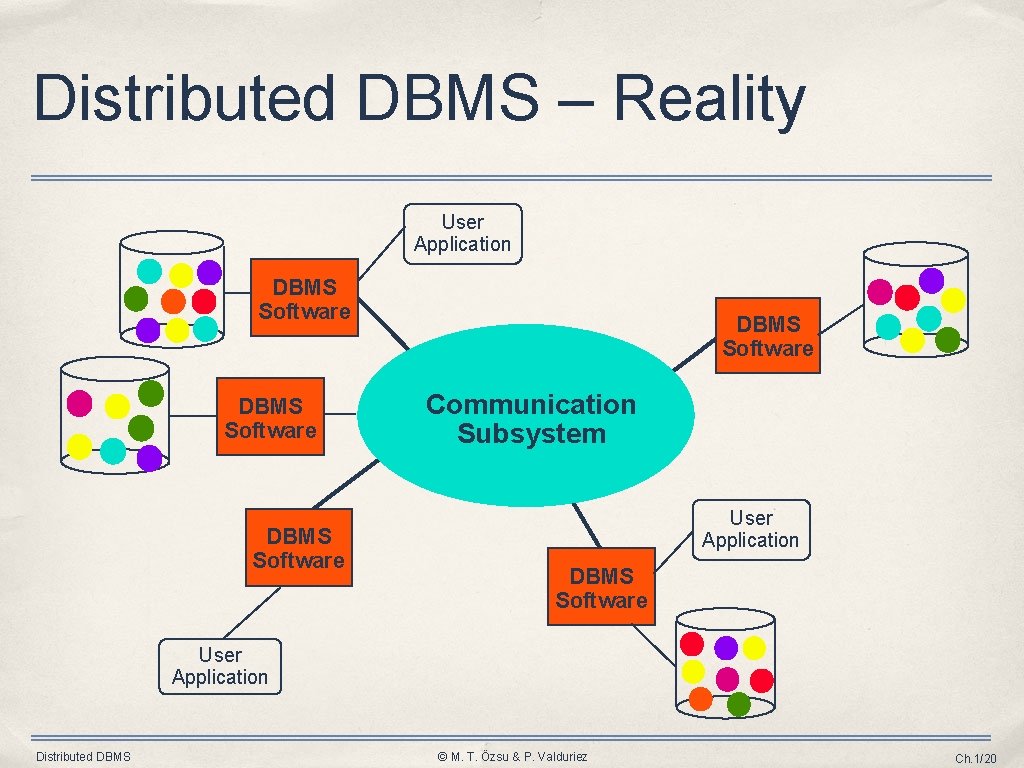
Distributed DBMS – Reality User Application DBMS Software Communication Subsystem User Application DBMS Software User Application Distributed DBMS © M. T. Özsu & P. Valduriez Ch. 1/20
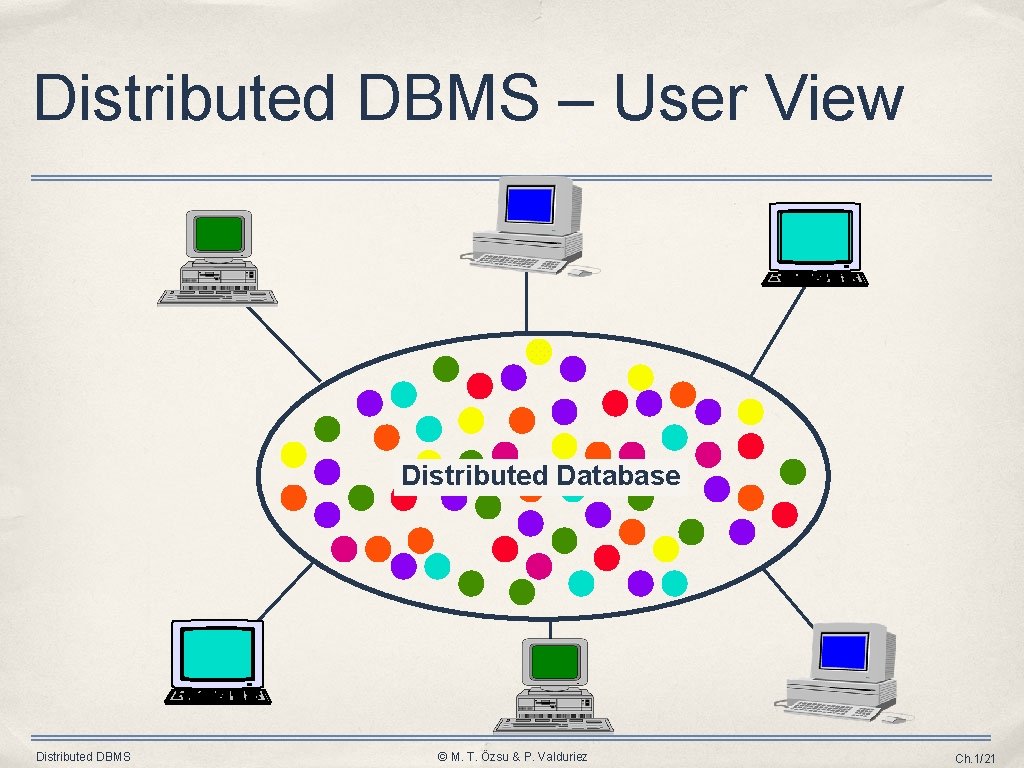
Distributed DBMS – User View Distributed Database Distributed DBMS © M. T. Özsu & P. Valduriez Ch. 1/21
Reliability Through Transactions • Reliability: DB behaves as expected (consistency, availability, partition tolerance) • Replicated components and data should make distributed DBMS more reliable (no single points of failure) • (Distributed) transactions provide reliability ➡ bring the DB from a consistent state to another consistent one even in presence of concurrent accesses (concurrency transparency) or failures (failure atomicity) • Distributed transaction support requires implementation of ➡ Distributed concurrency control protocols ➡ Distributed reliability protocols (commit and recovery protocols) • Data replication (we will not deal with it) ➡ Great for read-intensive workloads, problematic for updates ➡ Replication protocols Distributed DBMS © M. T. Özsu & P. Valduriez Ch. 1/22
Potentially Improved Performance • Proximity of data to its points of use (data localization) – thanks to replication and fragmentation ➡ Less contention for CPU and I/O services ➡ Less delay related to network communication • Distributed systems improve parallelism (inter- and intra-query parallelism) – thanks to replication and fragmentation • Requires some support for fragmentation and replication (distribution of computation) Distributed DBMS © M. T. Özsu & P. Valduriez Ch. 1/23
Easier System Expansion • Issue is database scaling • Expansion: as easy as adding a new node in the network (with its own DBMS) ➡ Easy thanks to transparency • Expanding a centralized DBMS is more difficult than adding a new one Distributed DBMS © M. T. Özsu & P. Valduriez Ch. 1/24
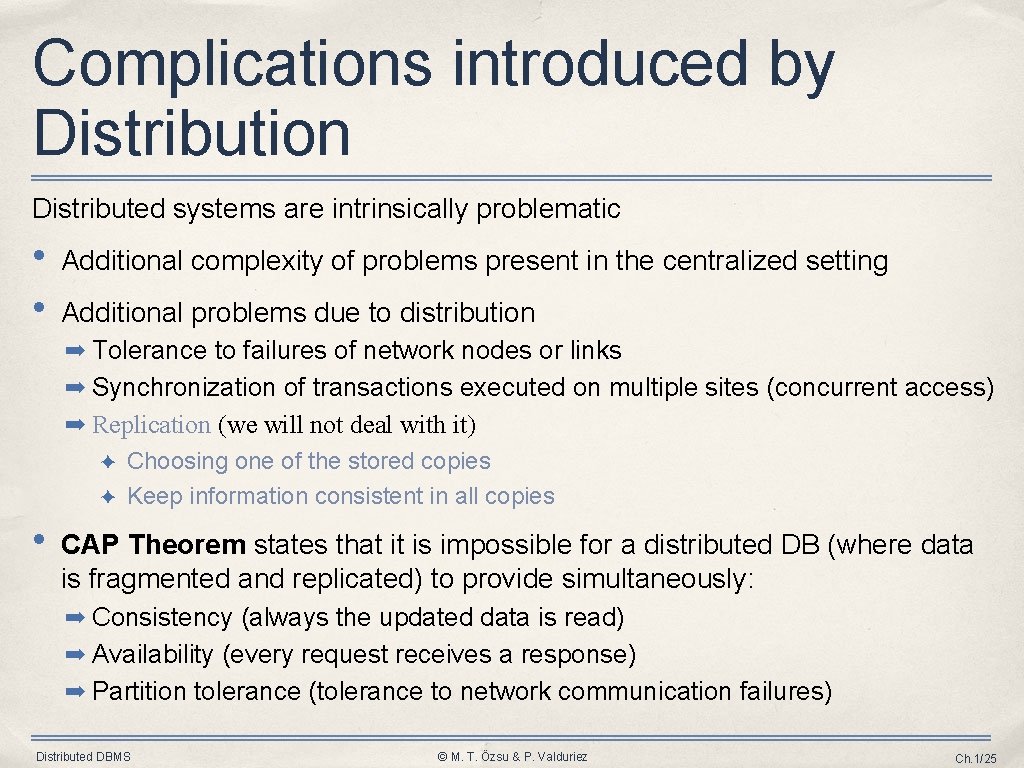
Complications introduced by Distribution Distributed systems are intrinsically problematic • • Additional complexity of problems present in the centralized setting Additional problems due to distribution ➡ Tolerance to failures of network nodes or links ➡ Synchronization of transactions executed on multiple sites (concurrent access) ➡ Replication (we will not deal with it) Choosing one of the stored copies ✦ Keep information consistent in all copies ✦ • CAP Theorem states that it is impossible for a distributed DB (where data is fragmented and replicated) to provide simultaneously: ➡ Consistency (always the updated data is read) ➡ Availability (every request receives a response) ➡ Partition tolerance (tolerance to network communication failures) Distributed DBMS © M. T. Özsu & P. Valduriez Ch. 1/25
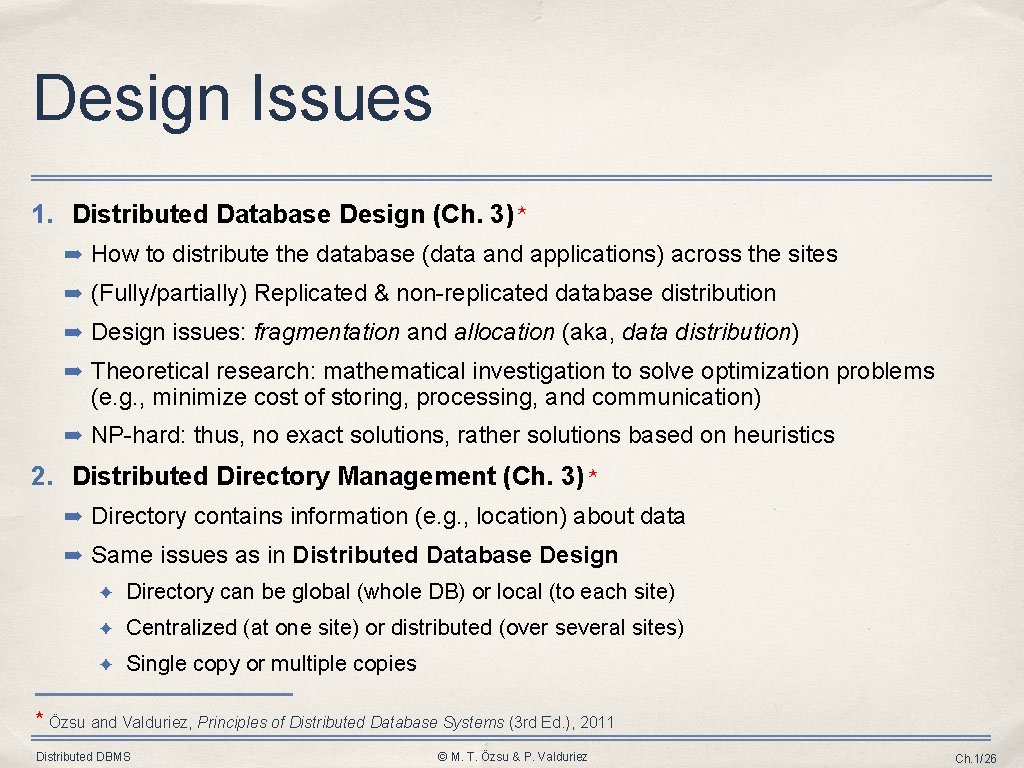
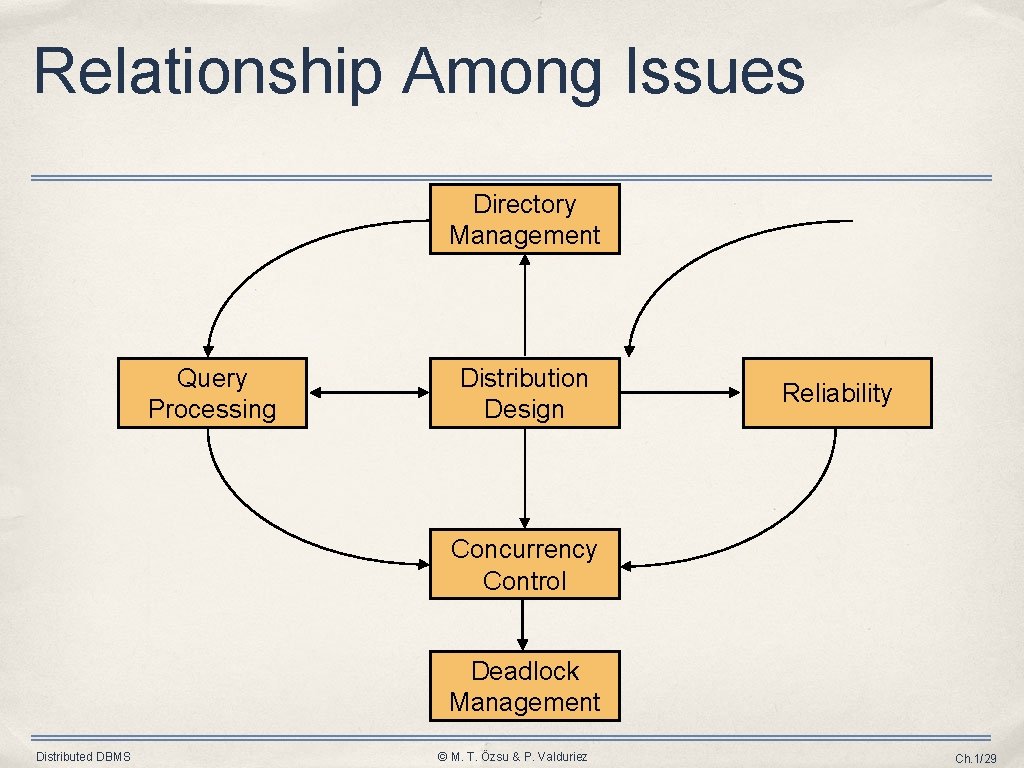
Design Issues 1. Distributed Database Design (Ch. 3) ⋆ ➡ How to distribute the database (data and applications) across the sites ➡ (Fully/partially) Replicated & non-replicated database distribution ➡ Design issues: fragmentation and allocation (aka, data distribution) ➡ Theoretical research: mathematical investigation to solve optimization problems (e. g. , minimize cost of storing, processing, and communication) ➡ NP-hard: thus, no exact solutions, rather solutions based on heuristics 2. Distributed Directory Management (Ch. 3) ⋆ ➡ Directory contains information (e. g. , location) about data ➡ Same issues as in Distributed Database Design ✦ Directory can be global (whole DB) or local (to each site) ✦ Centralized (at one site) or distributed (over several sites) ✦ Single copy or multiple copies ⋆ Özsu and Valduriez, Principles of Distributed Database Systems (3 rd Ed. ), 2011 Distributed DBMS © M. T. Özsu & P. Valduriez Ch. 1/26
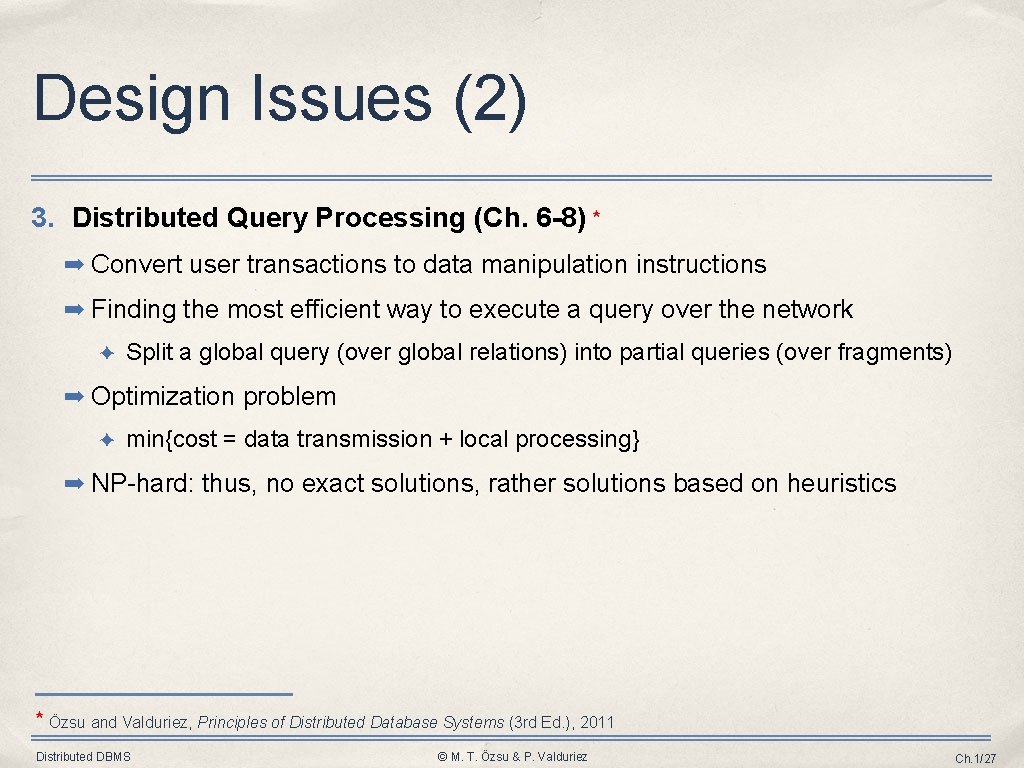
Design Issues (2) 3. Distributed Query Processing (Ch. 6 -8) ⋆ ➡ Convert user transactions to data manipulation instructions ➡ Finding the most efficient way to execute a query over the network ✦ Split a global query (over global relations) into partial queries (over fragments) ➡ Optimization problem ✦ min{cost = data transmission + local processing} ➡ NP-hard: thus, no exact solutions, rather solutions based on heuristics ⋆ Özsu and Valduriez, Principles of Distributed Database Systems (3 rd Ed. ), 2011 Distributed DBMS © M. T. Özsu & P. Valduriez Ch. 1/27
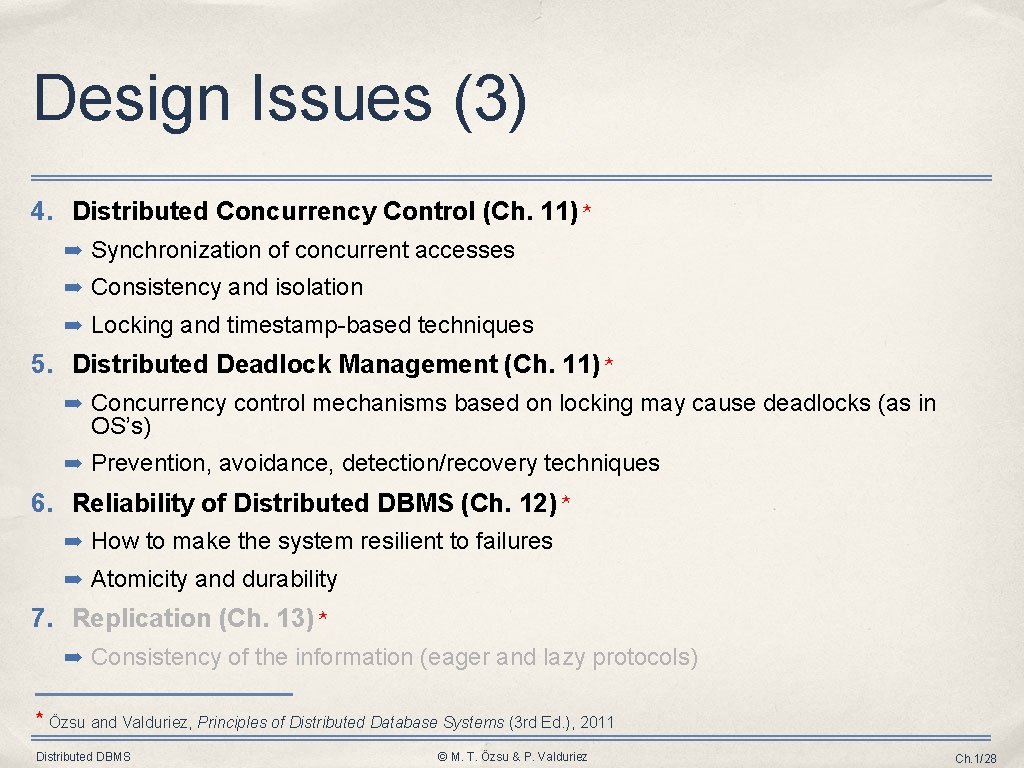
Design Issues (3) 4. Distributed Concurrency Control (Ch. 11) ⋆ ➡ Synchronization of concurrent accesses ➡ Consistency and isolation ➡ Locking and timestamp-based techniques 5. Distributed Deadlock Management (Ch. 11) ⋆ ➡ Concurrency control mechanisms based on locking may cause deadlocks (as in OS’s) ➡ Prevention, avoidance, detection/recovery techniques 6. Reliability of Distributed DBMS (Ch. 12) ⋆ ➡ How to make the system resilient to failures ➡ Atomicity and durability 7. Replication (Ch. 13) ⋆ ➡ Consistency of the information (eager and lazy protocols) ⋆ Özsu and Valduriez, Principles of Distributed Database Systems (3 rd Ed. ), 2011 Distributed DBMS © M. T. Özsu & P. Valduriez Ch. 1/28
Relationship Among Issues Directory Management Query Processing Distribution Design Reliability Concurrency Control Deadlock Management Distributed DBMS © M. T. Özsu & P. Valduriez Ch. 1/29
Architecture • Defines the structure of the system ➡ components ➡ functions of each component ➡ interrelationships and interactions between components • • First standard: ANSI/SPARC Architecture (70 s) Reference architectures for distributed data management ➡ client/server ➡ peer-to-peer (classic and modern) – in the terminology used in the textbook classic peer-to-peer systems correspond to Distributed DBMS we deal with in this course ➡ multidatabase systems (MDBS) Distributed DBMS © M. T. Özsu & P. Valduriez Ch. 1/30
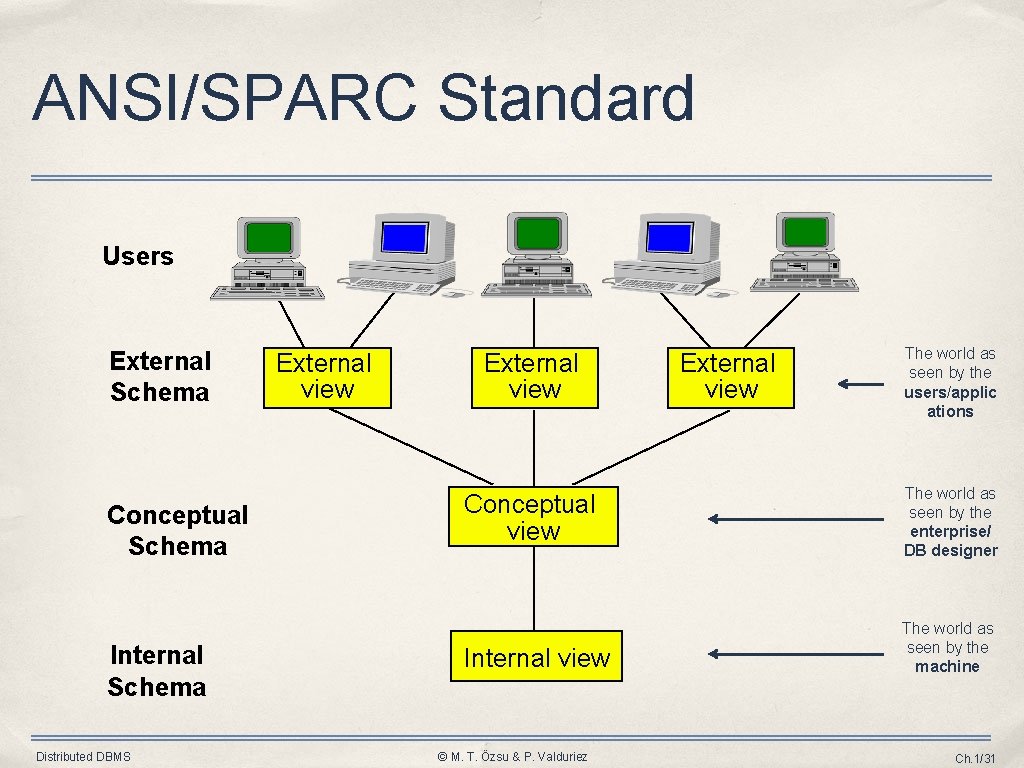
ANSI/SPARC Standard Users External Schema Conceptual Schema Internal Schema Distributed DBMS External view Conceptual view Internal view © M. T. Özsu & P. Valduriez External view The world as seen by the users/applic ations The world as seen by the enterprise/ DB designer The world as seen by the machine Ch. 1/31
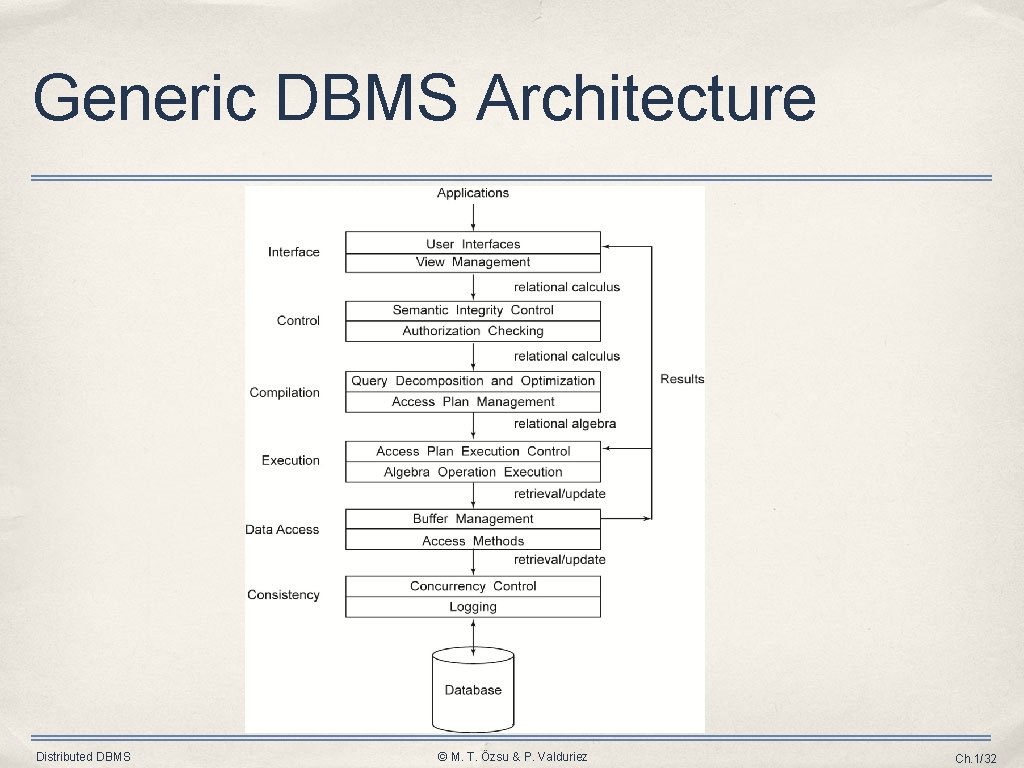
Generic DBMS Architecture Distributed DBMS © M. T. Özsu & P. Valduriez Ch. 1/32
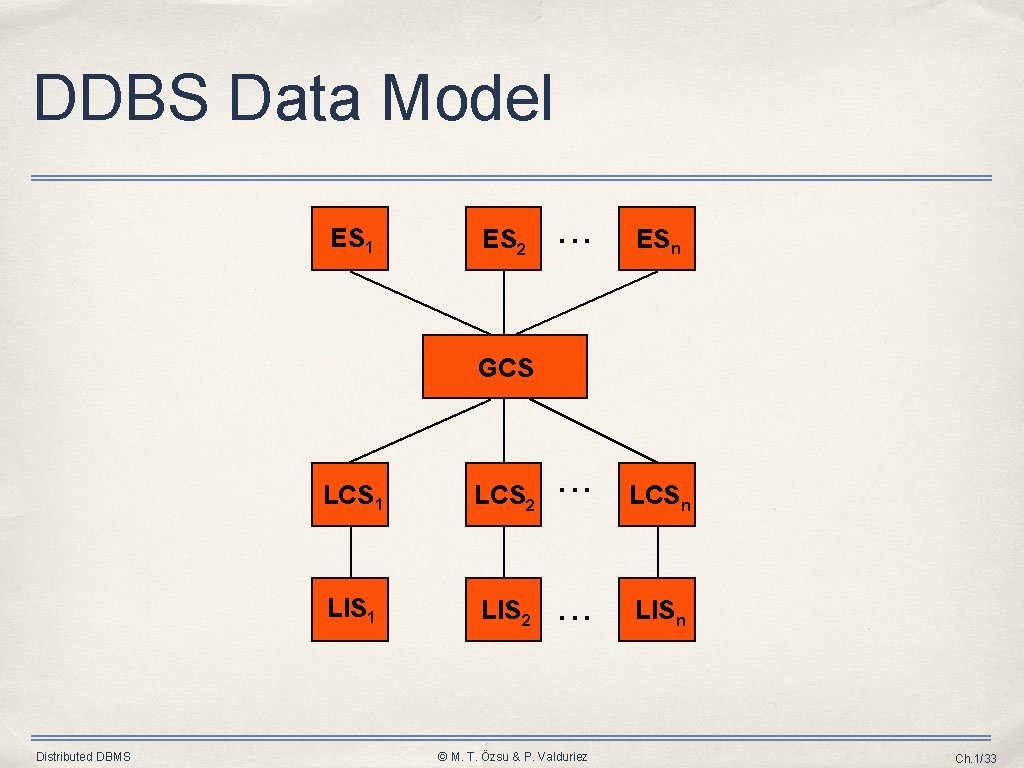
DDBS Data Model ES 1 ES 2 . . . ESn LCSn LISn GCS Distributed DBMS LCS 1 LCS 2 . . . LIS 1 LIS 2 . . . © M. T. Özsu & P. Valduriez Ch. 1/33
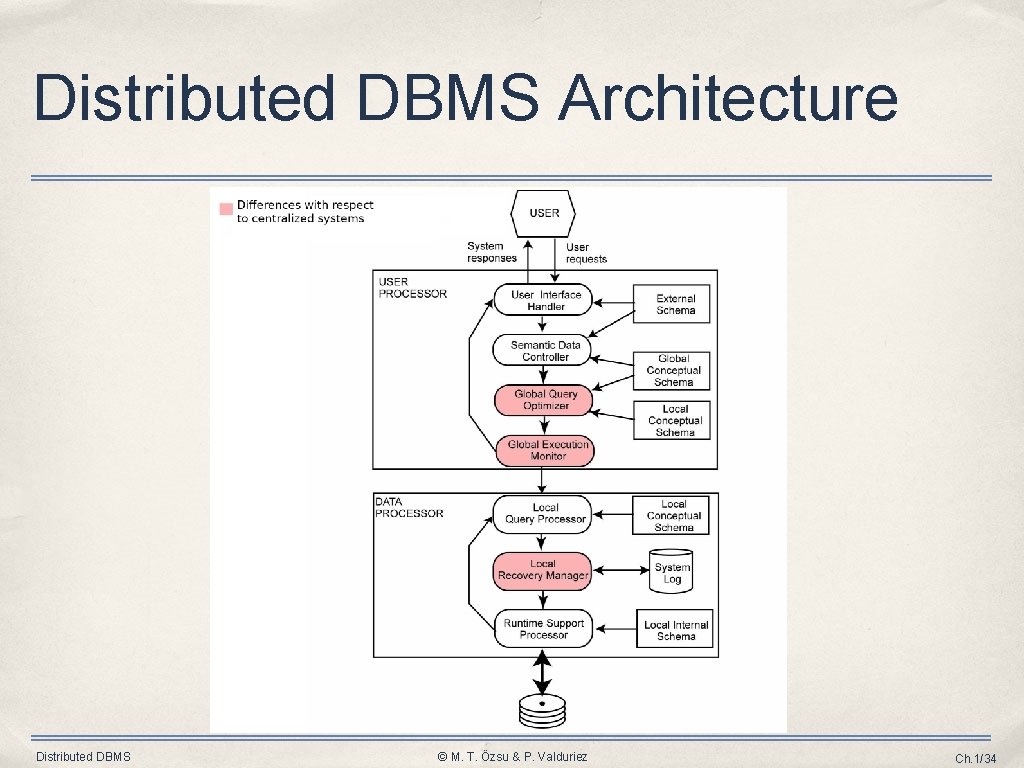
Distributed DBMS Architecture Distributed DBMS © M. T. Özsu & P. Valduriez Ch. 1/34
A classification of data management systems • Distribution (of data and control) – non-distributed VS. client-server VS. fully distributed ➡ Degree of distribution of data over multiple machines (sites) • Heterogeneity – homogeneous VS. heterogeneous ➡ data model: different expressive power ➡ query language: different languages, SQL comes in different implementations ➡ transaction management: different protocols and policies • Autonomy (degree of synchronization) – tight integration VS. semiautonomous VS. total isolation ➡ Degree to which single DBMS can operate independently Design autonomy: ability to decide on design issues (data models, transaction management, …) ✦ Communication autonomy: ability to decide what information to share and how to communicate ✦ Execution autonomy: ability to execute transactions in any manner ✦ ➡ Levels of autonomy Tight integration (one unique logical view of the DB, data manager (DM) do not operate independently, they collaborate to execute user request) ✦ Semiautonomous (DM act independently, selective data sharing, common communication protocols) ✦ Total isolation (multidatabase systems – totally independent, unaware of each other and of communication systems, no global control, no unified DB view, each DB decides what to share with who) ✦ Distributed DBMS © M. T. Özsu & P. Valduriez Ch. 1/35
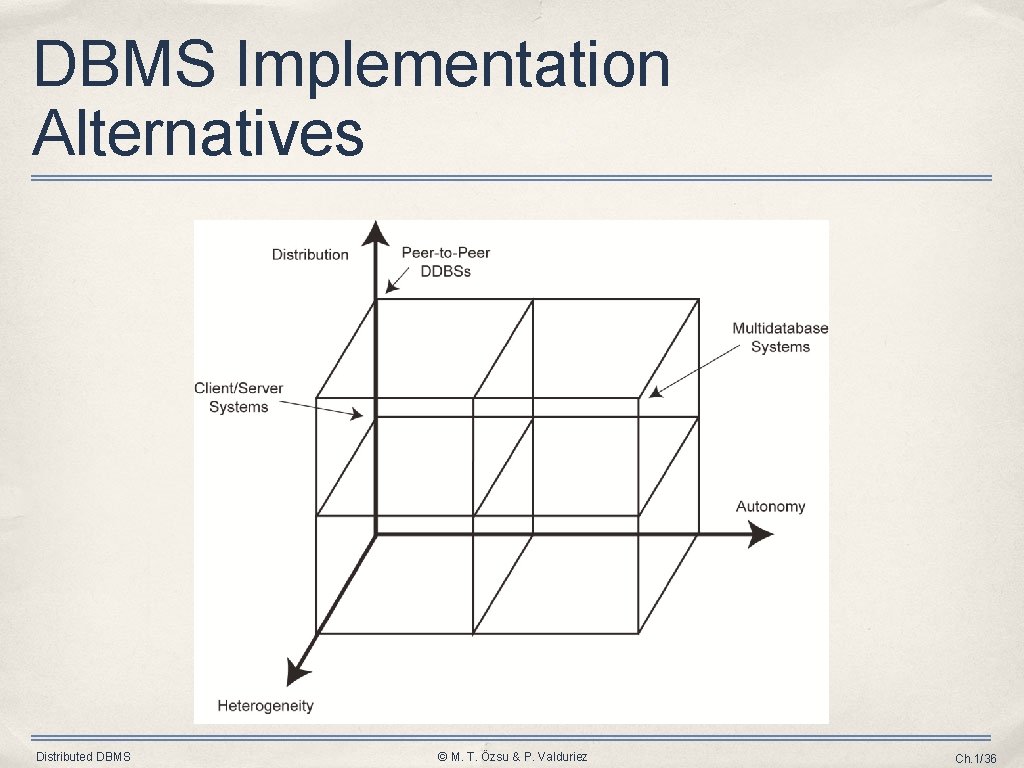
DBMS Implementation Alternatives Distributed DBMS © M. T. Özsu & P. Valduriez Ch. 1/36
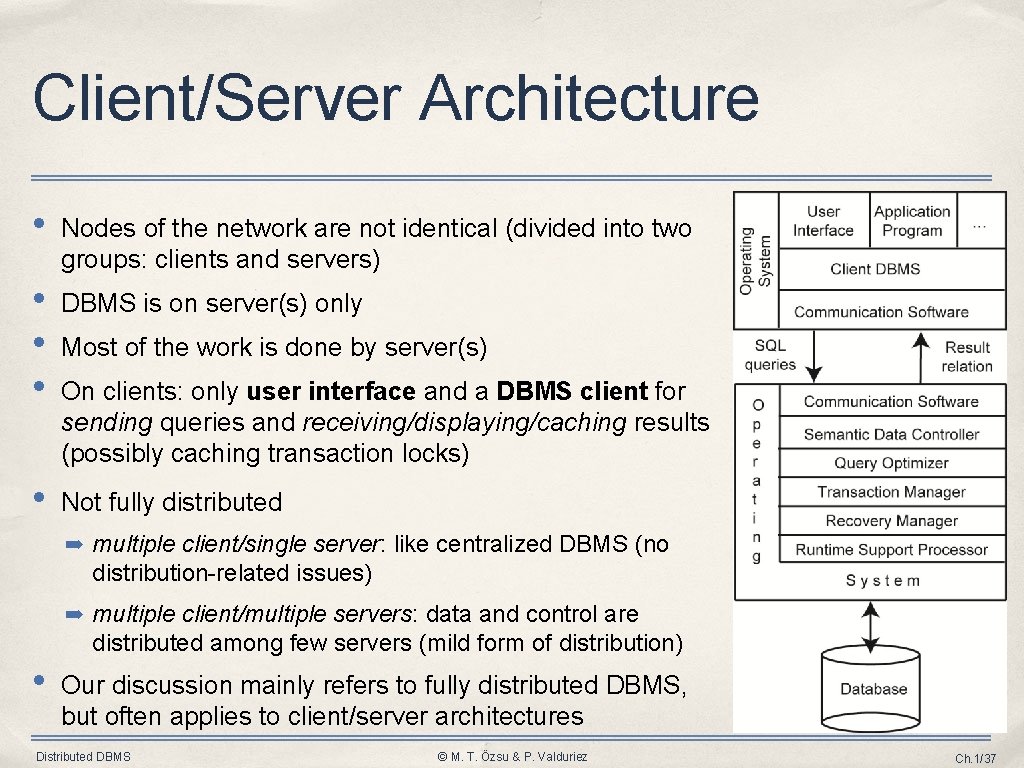
Client/Server Architecture • Nodes of the network are not identical (divided into two groups: clients and servers) • • • DBMS is on server(s) only • Not fully distributed Most of the work is done by server(s) On clients: only user interface and a DBMS client for sending queries and receiving/displaying/caching results (possibly caching transaction locks) ➡ multiple client/single server: like centralized DBMS (no distribution-related issues) ➡ multiple client/multiple servers: data and control are distributed among few servers (mild form of distribution) • Our discussion mainly refers to fully distributed DBMS, but often applies to client/server architectures Distributed DBMS © M. T. Özsu & P. Valduriez Ch. 1/37
Multidatabase system architecture • • Multidatabase system (MDBS) are beyond the scope of this course In a nutshell ➡ Characterized by presence of several fully autonomous, independent, and heterogeneous ➡ ➡ ➡ ➡ • DBMS that are located apart from each other Unaware of each other existence Systems do not know how to communicate with other ones No (explicit) interrelation between DBMS Each DBMS provides an export schema to make (some of) its data available to (some of) the other systems Control and coordination is implemented by a multidatabase layer which uses such export schema and provide interface (transparency) to the users In DDBS: unique conceptual view of the entire DB (GCS, providing transparency) results from the “union“ local conceptual schemas (LCS) of parts of DB stored locally at each node of the network In MDBS: not even a clear notion of “entire DB” Architecture design is built bottom-up, from LCS to a GCS (in DDBS it is built top-down, opposite direction) If interested, see the discussions at Ch. 1. 10, 4, 9 ⋆ ⋆ Özsu and Valduriez, Principles of Distributed Database Systems (3 rd Ed. ), 2011 Distributed DBMS © M. T. Özsu & P. Valduriez Ch. 1/38
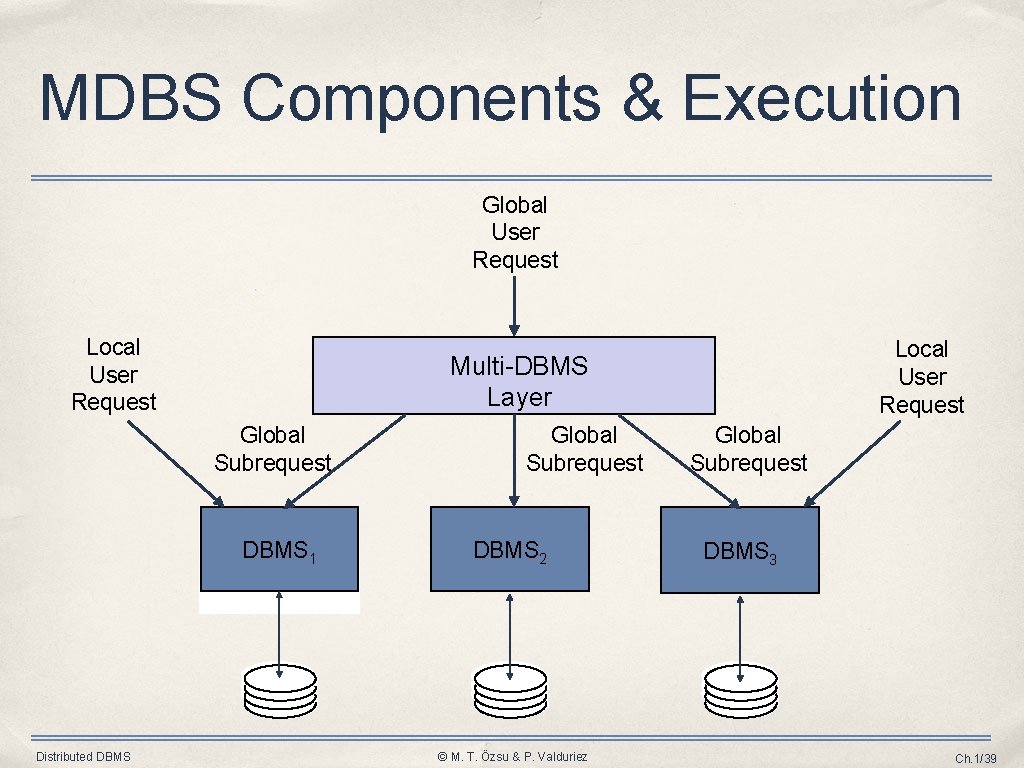
MDBS Components & Execution Global User Request Local User Request Multi-DBMS Layer Global Subrequest DBMS 1 Distributed DBMS Local User Request Global Subrequest DBMS 2 © M. T. Özsu & P. Valduriez Global Subrequest DBMS 3 Ch. 1/39
Recent Developments • • So far, and in the rest of the course: focus on “traditional” DDBS Recent directions ➡ Multidatabase systems, aka federated databases, aka data integration systems – not in this course (Ch. 1. 7. 10, 4, 9) ⋆ ✦ Heterogeneity of data source ➡ Peer-to-peer “reloaded” and web data management – not in this course (Ch. 16, 17 ) ⋆ ✦ Rethinking of an old architecture, oriented to needs of data sharing over the web ➡ Parallel databases – not in this course (Ch. 14 ) ⋆ ✦ Specific issues (not really distributed) ⋆ Özsu and Valduriez, Principles of Distributed Database Systems (3 rd Ed. ), 2011 Distributed DBMS © M. T. Özsu & P. Valduriez Ch. 1/40
Terminology disambiguation • • In our discussion, by distributed DBMS and DDBS we mostly refer to fully distributed, peer-to-peer data management systems In particular, the term “peer-to-peer” (like many terms, e. g. , client/server, …) is overloaded in the book and in the literature. It is used to refer to: ➡ ”traditional” peer-to-peer DBMS (also referred to as fully distributed DBMS) our focus is on these systems ➡ “modern” peer-to-peer data management systems [we refer to this meaning in the slide titled “Recent developments”] These refer to an evolution of the traditional peer-to-peer architecture, to cope with the need of data sharing, e. g. , over the web ✦ Ongoing research area, related issues still being investigated ✦ Out of the scope of this course (see Ch. 16) ⋆ ✦ ⋆ Özsu and Valduriez, Principles of Distributed Database Systems (3 rd Ed. ), 2011 Distributed DBMS © M. T. Özsu & P. Valduriez Ch. 1/41
- Slides: 41