
Distributed Databases CS 347 Lecture 16 June 6
Distributed Databases CS 347 Lecture 16 June 6, 2001 1
Topics for the day • Reliability – Three-phase commit (3 PC) – Majority 3 PC • Network partitions – Committing with partitions – Concurrency control with partitions 2
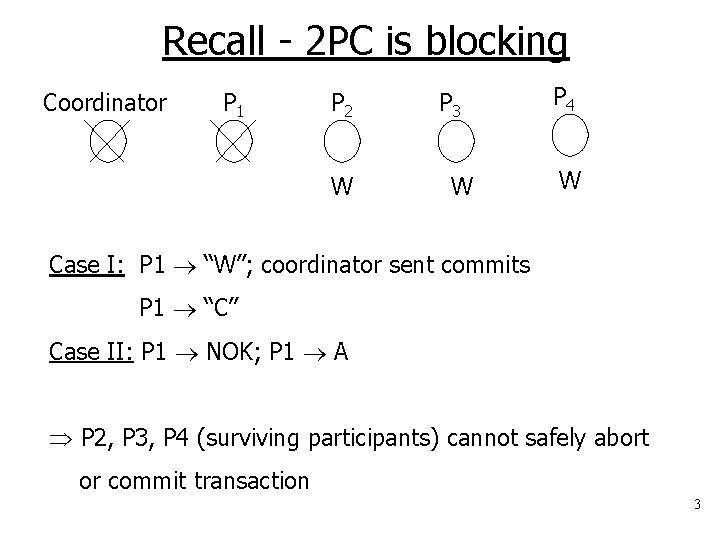
Recall - 2 PC is blocking Coordinator P 1 P 2 W P 3 W P 4 W Case I: P 1 “W”; coordinator sent commits P 1 “C” Case II: P 1 NOK; P 1 A P 2, P 3, P 4 (surviving participants) cannot safely abort or commit transaction 3
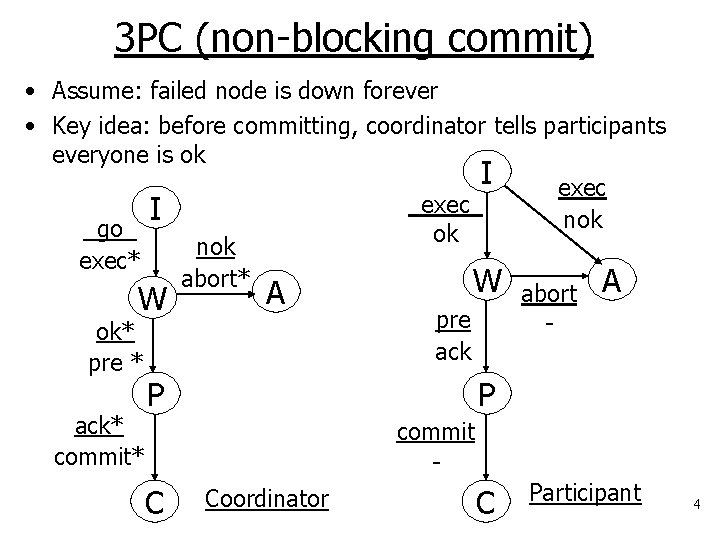
3 PC (non-blocking commit) • Assume: failed node is down forever • Key idea: before committing, coordinator tells participants everyone is ok I exec _exec_ I nok _go_ ok nok exec* abort* W abort A A W pre ok* ack pre * ack* commit* P P commit - C Coordinator C Participant 4
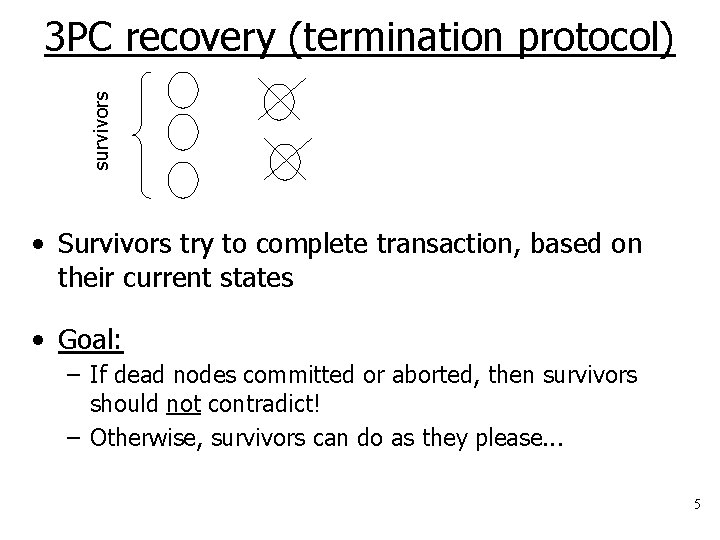
survivors 3 PC recovery (termination protocol) • Survivors try to complete transaction, based on their current states • Goal: – If dead nodes committed or aborted, then survivors should not contradict! – Otherwise, survivors can do as they please. . . 5
Termination rules • Let {S 1, S 2, …Sn} be survivor sites. Make decision on commit/abort based on following rules: • If one or more Si = COMMIT T • If one or more Si = ABORT T • If one or more Si = PREPARE COMMIT T (T could not have aborted) • If no Si = PREPARE (or COMMIT) ABORT T (T could not have committed) 6
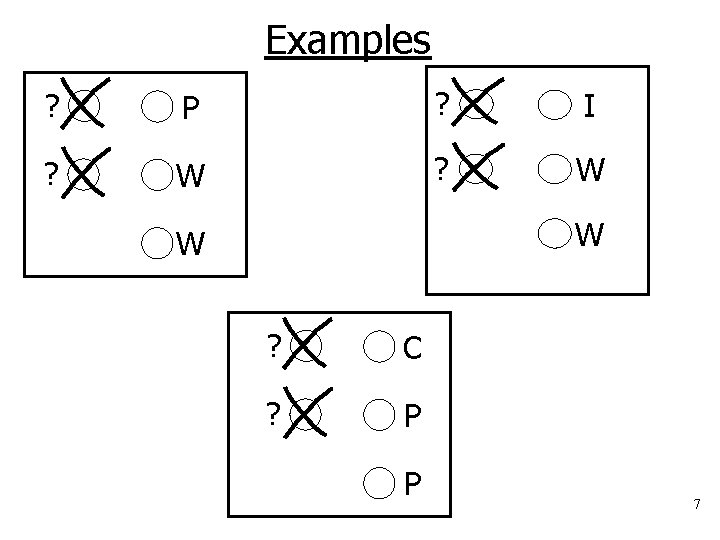
Examples ? P ? I ? W W W ? C ? P P 7
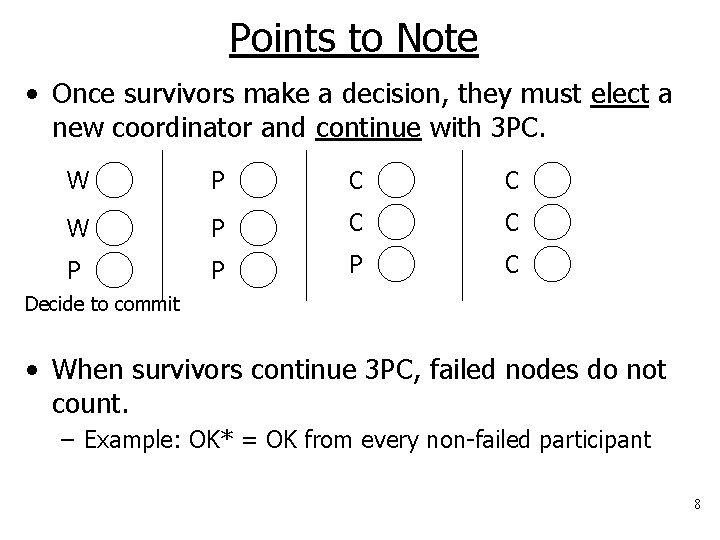
Points to Note • Once survivors make a decision, they must elect a new coordinator and continue with 3 PC. W P C C P P P C Decide to commit • When survivors continue 3 PC, failed nodes do not count. – Example: OK* = OK from every non-failed participant 8
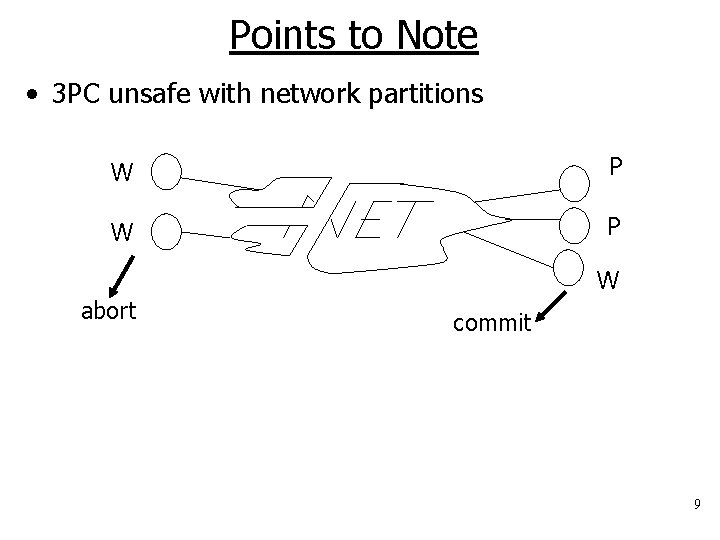
Points to Note • 3 PC unsafe with network partitions W P W abort commit 9
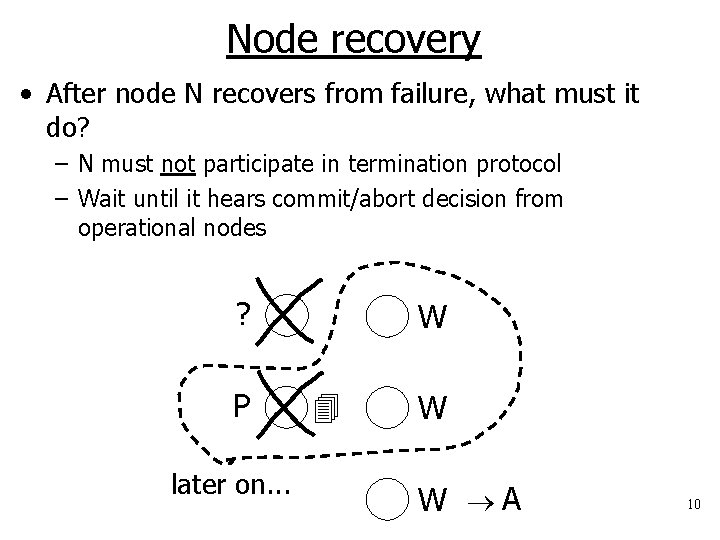
Node recovery • After node N recovers from failure, what must it do? – N must not participate in termination protocol – Wait until it hears commit/abort decision from operational nodes ? P later on. . . W W W A 10
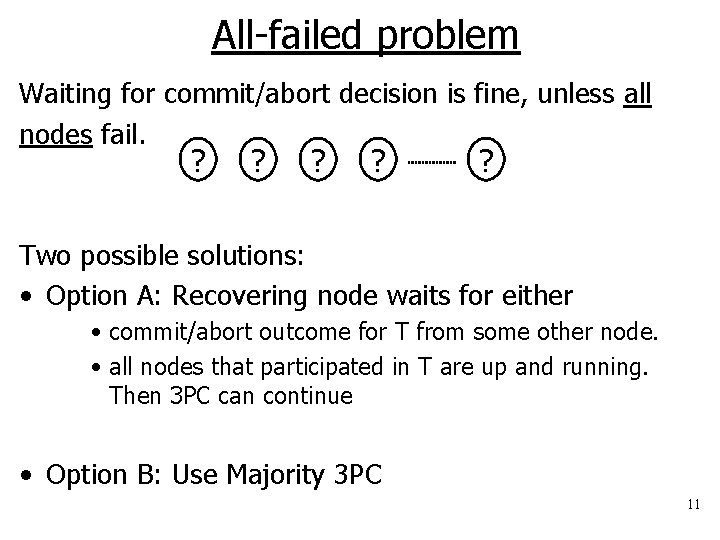
All-failed problem Waiting for commit/abort decision is fine, unless all nodes fail. ? ? ? Two possible solutions: • Option A: Recovering node waits for either • commit/abort outcome for T from some other node. • all nodes that participated in T are up and running. Then 3 PC can continue • Option B: Use Majority 3 PC 11
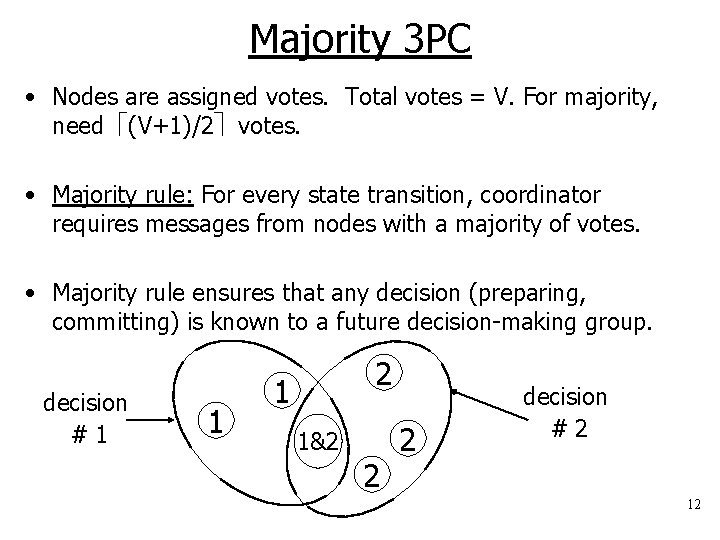
Majority 3 PC • Nodes are assigned votes. Total votes = V. For majority, need (V+1)/2 votes. • Majority rule: For every state transition, coordinator requires messages from nodes with a majority of votes. • Majority rule ensures that any decision (preparing, committing) is known to a future decision-making group. decision #1 1 2 1 1&2 2 2 decision #2 12
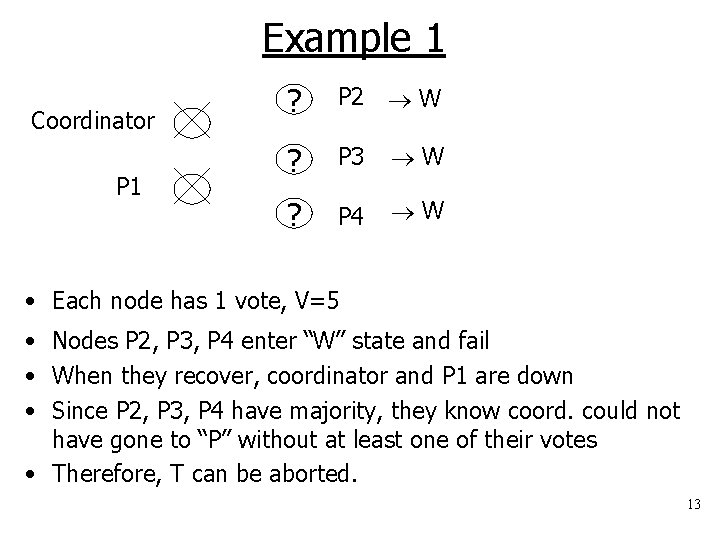
Example 1 Coordinator P 1 ? P 2 W ? P 3 W ? P 4 W • Each node has 1 vote, V=5 • Nodes P 2, P 3, P 4 enter “W” state and fail • When they recover, coordinator and P 1 are down • Since P 2, P 3, P 4 have majority, they know coord. could not have gone to “P” without at least one of their votes • Therefore, T can be aborted. 13
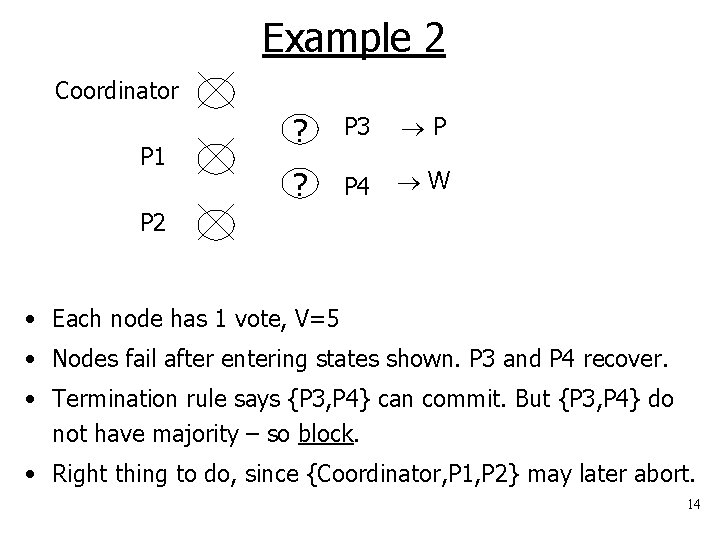
Example 2 Coordinator P 1 ? P 3 P ? P 4 W P 2 • Each node has 1 vote, V=5 • Nodes fail after entering states shown. P 3 and P 4 recover. • Termination rule says {P 3, P 4} can commit. But {P 3, P 4} do not have majority – so block. • Right thing to do, since {Coordinator, P 1, P 2} may later abort. 14
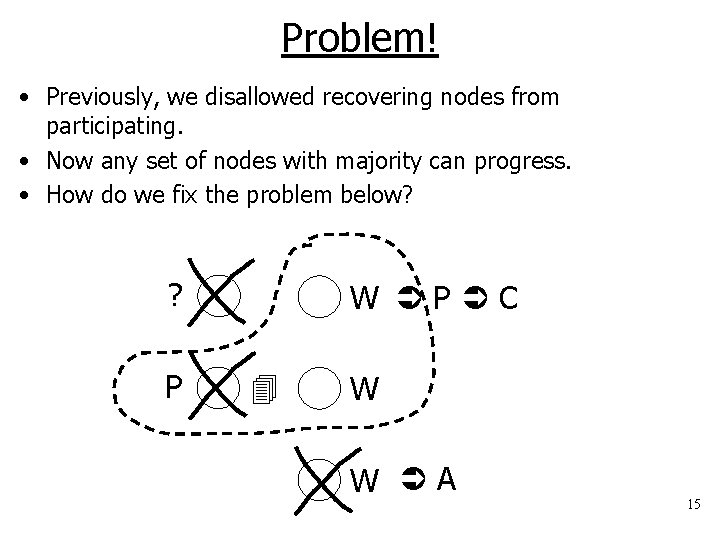
Problem! • Previously, we disallowed recovering nodes from participating. • Now any set of nodes with majority can progress. • How do we fix the problem below? ? P W P C W W A 15
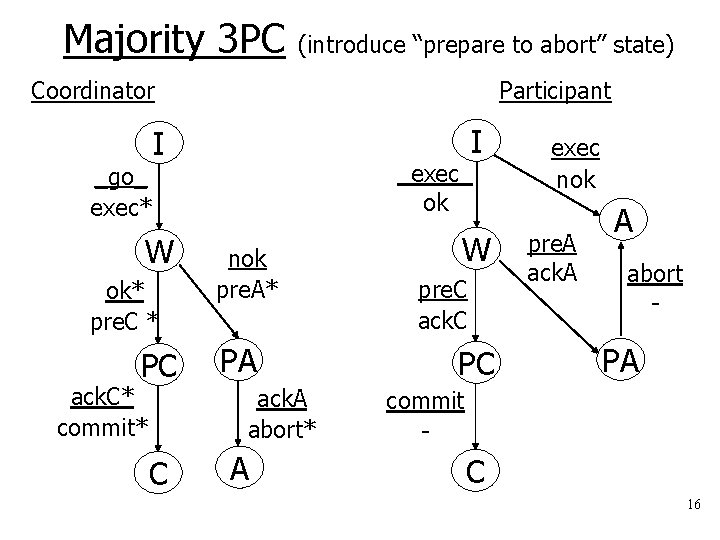
Majority 3 PC (introduce “prepare to abort” state) Coordinator _go_ exec* Participant I I W ok* pre. C * PC ack. C* commit* C _exec_ ok nok pre. A* PA ack. A abort* A W pre. C ack. C PC exec nok pre. A ack. A A abort - PA commit - C 16
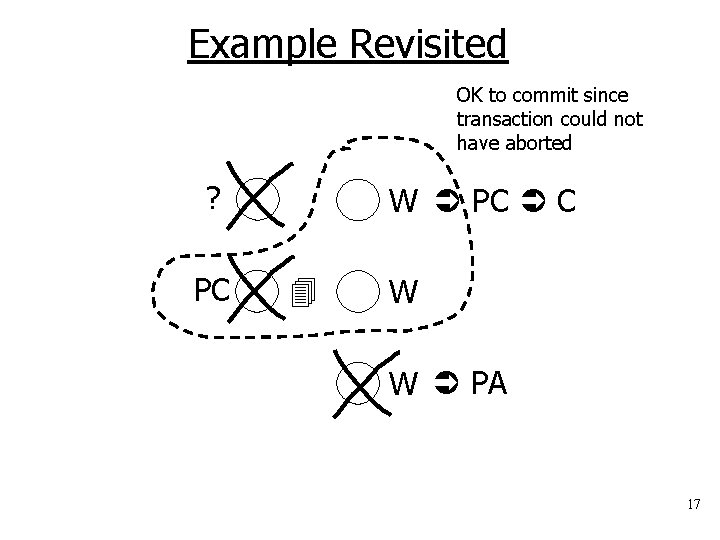
Example Revisited OK to commit since transaction could not have aborted ? PC W PC C W W PA 17
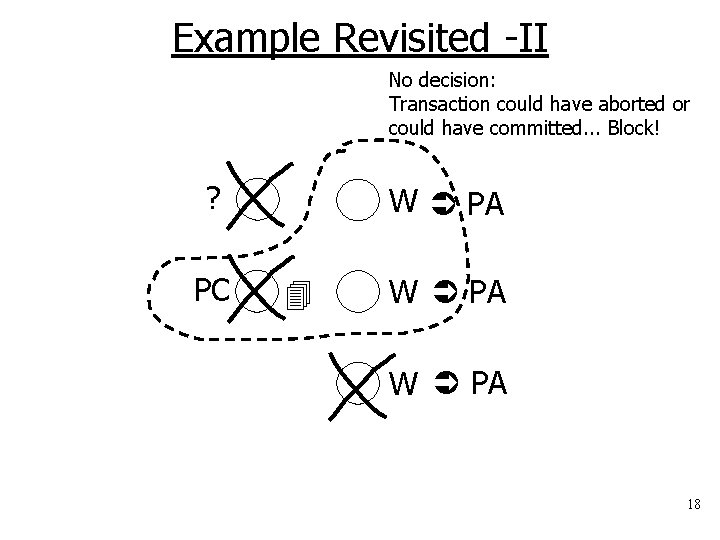
Example Revisited -II No decision: Transaction could have aborted or could have committed. . . Block! ? PC W PA 18
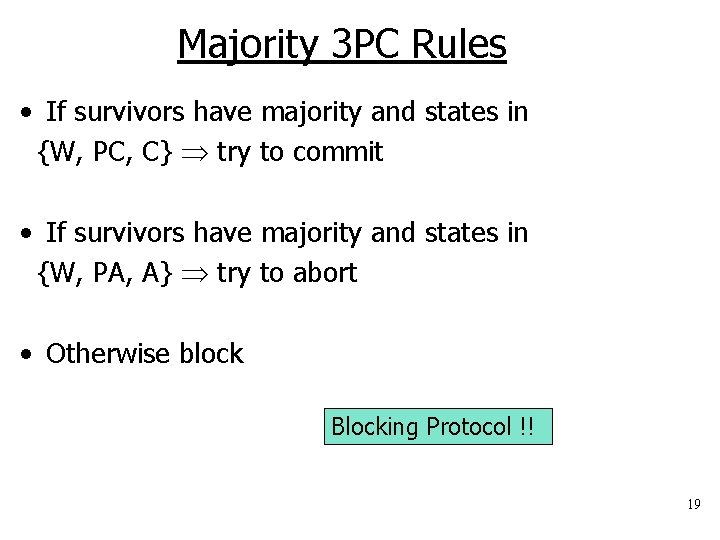
Majority 3 PC Rules • If survivors have majority and states in {W, PC, C} try to commit • If survivors have majority and states in {W, PA, A} try to abort • Otherwise block Blocking Protocol !! 19
Summarizing commit protocols • 2 PC – Blocking protocol – Key: coordinator does not move to “C” state unless every participant is in “W” state • 3 PC – Non-blocking protocol – Key: coordinator broadcasts that “all are ok” before committing. Failed nodes must wait. – Any set of non-failed nodes can terminate transaction (even a single node) – If all nodes fail, must wait for all to recover 20
Summarizing commit protocols • Majority 3 PC – Blocking protocol – Key: Every state transition requires majority of votes – Any majority group of active+recovered nodes can terminate transaction 21
Network partitions • Groups of nodes may be isolated or may be slow in responding • When are partitions of interest? – True network partitions (disaster) – Single node failure cannot be distinguished from partition (e. g. , NIC fails) – Loosely-connected networks • Phone-in, wireless 22
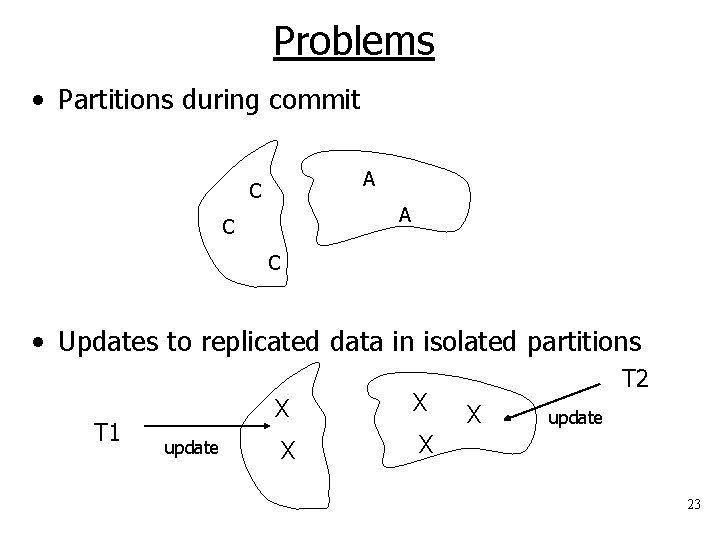
Problems • Partitions during commit A C C • Updates to replicated data in isolated partitions T 1 update X X T 2 X update 23
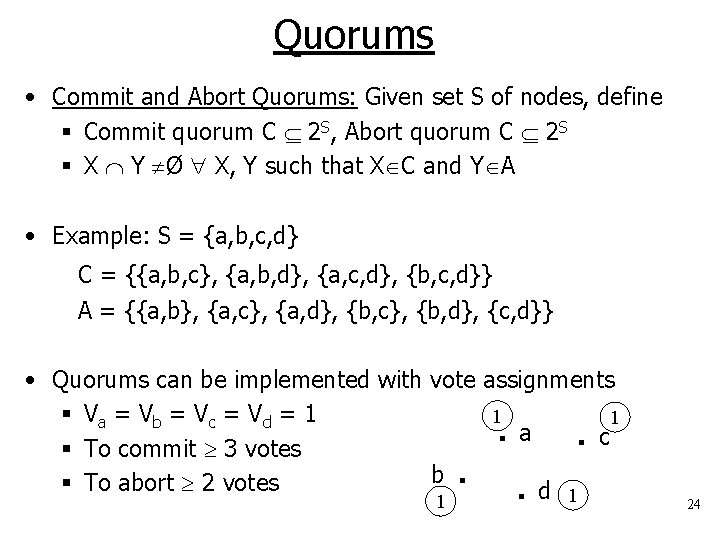
Quorums • Commit and Abort Quorums: Given set S of nodes, define § Commit quorum C 2 S, Abort quorum C 2 S § X Y Ø X, Y such that X C and Y A • Example: S = {a, b, c, d} C = {{a, b, c}, {a, b, d}, {a, c, d}, {b, c, d}} A = {{a, b}, {a, c}, {a, d}, {b, c}, {b, d}, {c, d}} • Quorums can be implemented with vote assignments § Va = V b = V c = V d = 1 1 1. a. c § To commit 3 votes b. § To abort 2 votes. d 1 1 24
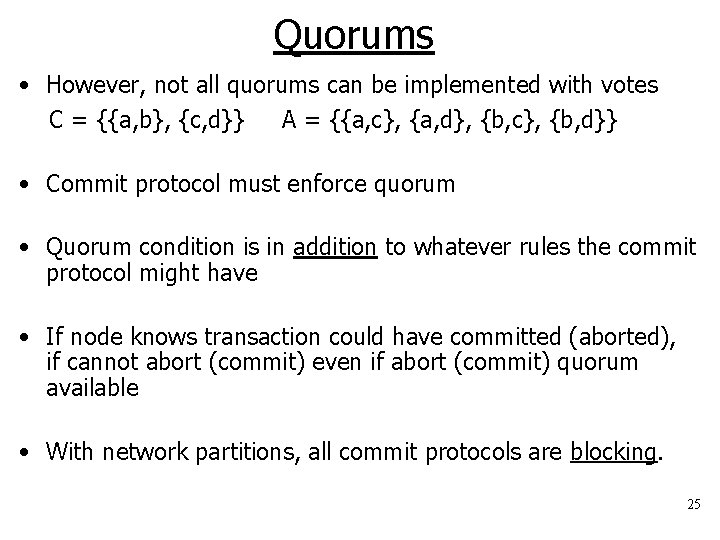
Quorums • However, not all quorums can be implemented with votes C = {{a, b}, {c, d}} A = {{a, c}, {a, d}, {b, c}, {b, d}} • Commit protocol must enforce quorum • Quorum condition is in addition to whatever rules the commit protocol might have • If node knows transaction could have committed (aborted), if cannot abort (commit) even if abort (commit) quorum available • With network partitions, all commit protocols are blocking. 25
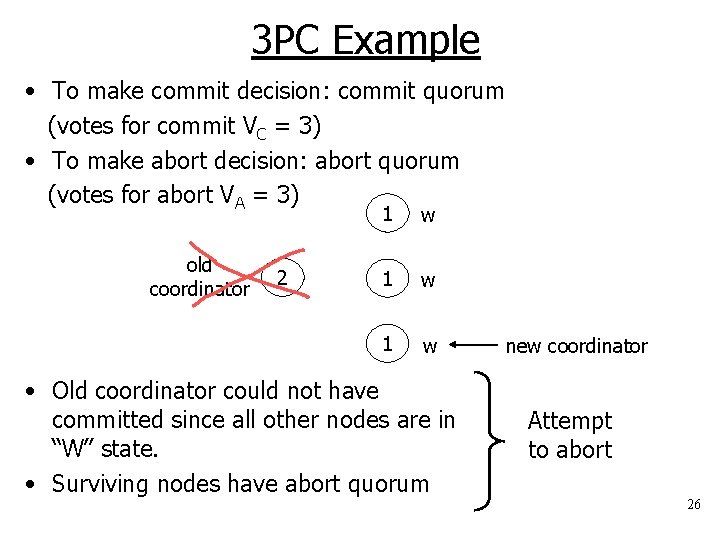
3 PC Example • To make commit decision: commit quorum (votes for commit VC = 3) • To make abort decision: abort quorum (votes for abort VA = 3) old coordinator 2 1 w 1 w • Old coordinator could not have committed since all other nodes are in “W” state. • Surviving nodes have abort quorum new coordinator Attempt to abort 26
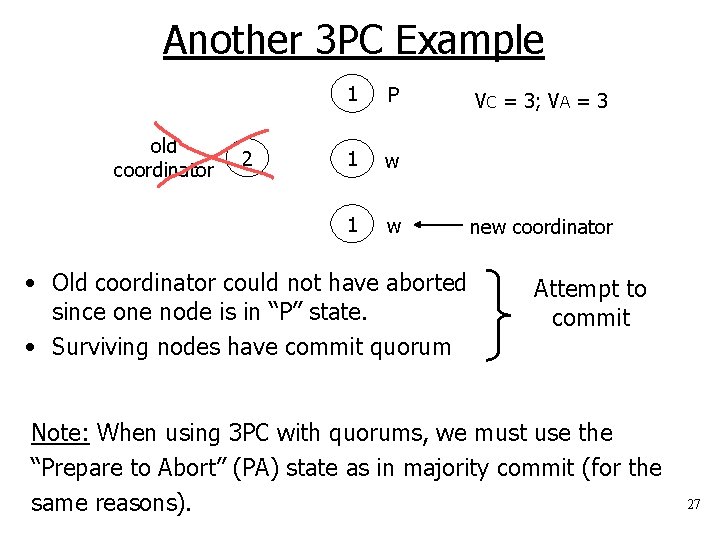
Another 3 PC Example old coordinator 2 1 P 1 w • Old coordinator could not have aborted since one node is in “P” state. • Surviving nodes have commit quorum VC = 3; VA = 3 new coordinator Attempt to commit Note: When using 3 PC with quorums, we must use the “Prepare to Abort” (PA) state as in majority commit (for the same reasons). 27
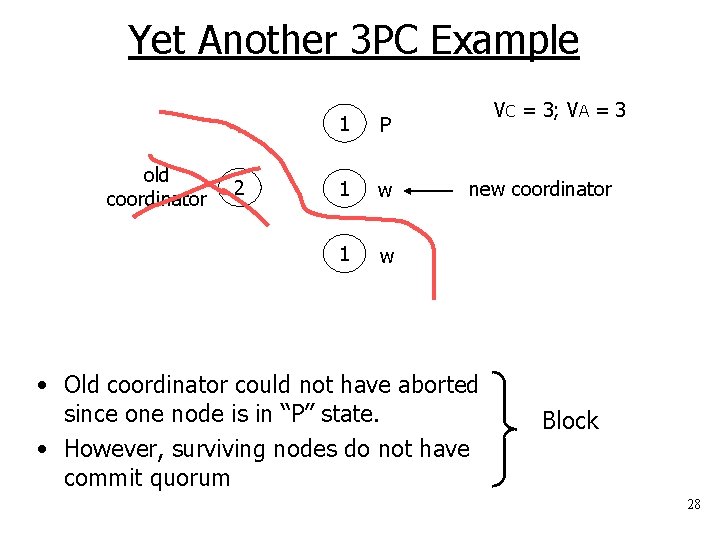
Yet Another 3 PC Example old coordinator 2 1 P 1 w VC = 3; VA = 3 new coordinator • Old coordinator could not have aborted since one node is in “P” state. • However, surviving nodes do not have commit quorum Block 28
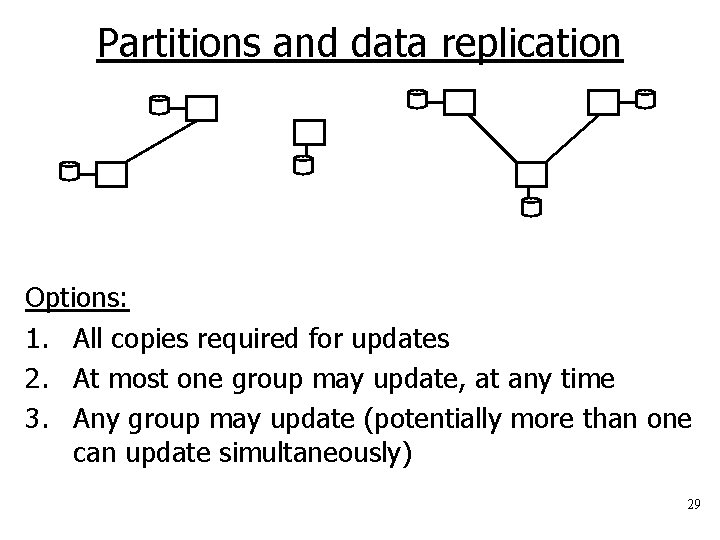
Partitions and data replication Options: 1. All copies required for updates 2. At most one group may update, at any time 3. Any group may update (potentially more than one can update simultaneously) 29
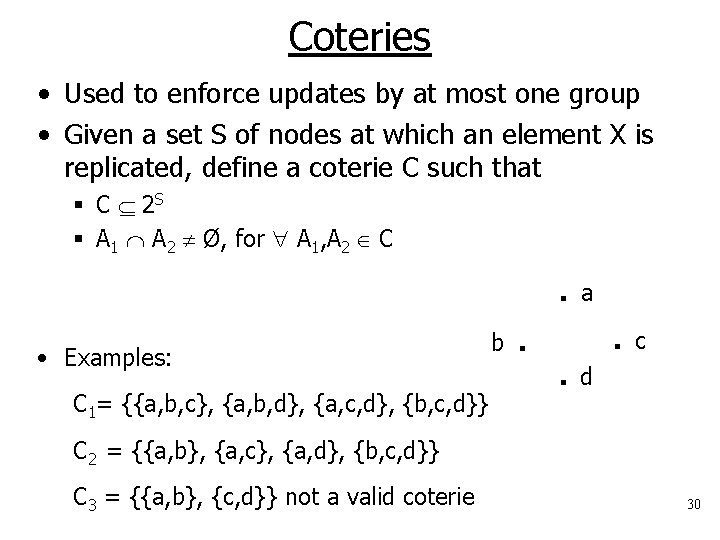
Coteries • Used to enforce updates by at most one group • Given a set S of nodes at which an element X is replicated, define a coterie C such that § C 2 S § A 1 A 2 Ø, for A 1, A 2 C . a • Examples: C 1= {{a, b, c}, {a, b, d}, {a, c, d}, {b, c, d}} . c b. . d C 2 = {{a, b}, {a, c}, {a, d}, {b, c, d}} C 3 = {{a, b}, {c, d}} not a valid coterie 30
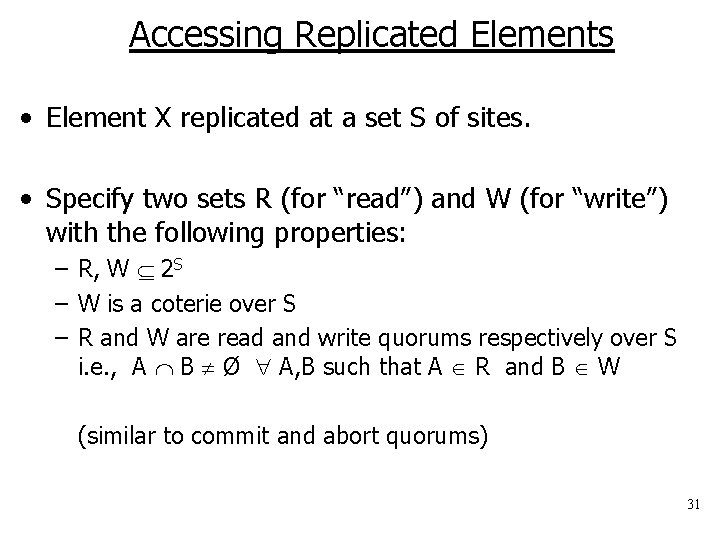
Accessing Replicated Elements • Element X replicated at a set S of sites. • Specify two sets R (for “read”) and W (for “write”) with the following properties: – R, W 2 S – W is a coterie over S – R and W are read and write quorums respectively over S i. e. , A B Ø A, B such that A R and B W (similar to commit and abort quorums) 31
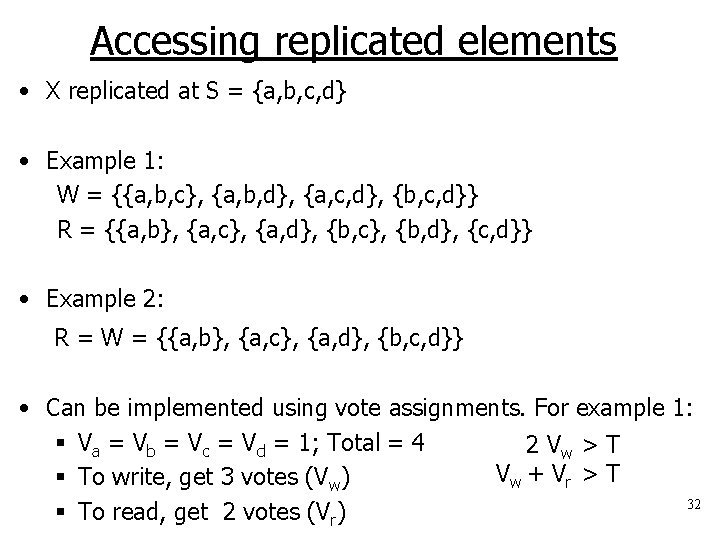
Accessing replicated elements • X replicated at S = {a, b, c, d} • Example 1: W = {{a, b, c}, {a, b, d}, {a, c, d}, {b, c, d}} R = {{a, b}, {a, c}, {a, d}, {b, c}, {b, d}, {c, d}} • Example 2: R = W = {{a, b}, {a, c}, {a, d}, {b, c, d}} • Can be implemented using vote assignments. For example 1: § Va = Vb = Vc = Vd = 1; Total = 4 2 Vw > T Vw + V r > T § To write, get 3 votes (Vw) 32 § To read, get 2 votes (Vr)
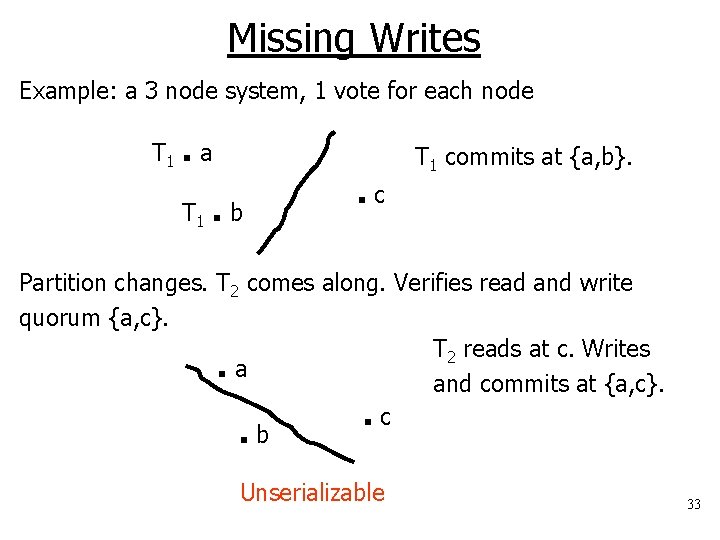
Missing Writes Example: a 3 node system, 1 vote for each node T 1 . a T 1 . b . c T 1 commits at {a, b}. Partition changes. T 2 comes along. Verifies read and write quorum {a, c}. T 2 reads at c. Writes. a and commits at {a, c}. . c. b Unserializable 33
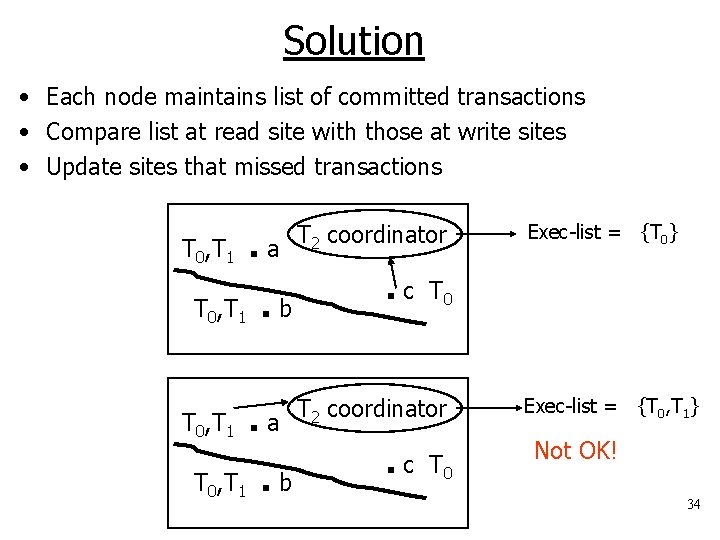
Solution • Each node maintains list of committed transactions • Compare list at read site with those at write sites • Update sites that missed transactions T 0, T 1 . a. b T 2 coordinator . c T 0 T 2 coordinator . c Exec-list = {T 0} T 0 Exec-list = {T 0, T 1} Not OK! 34
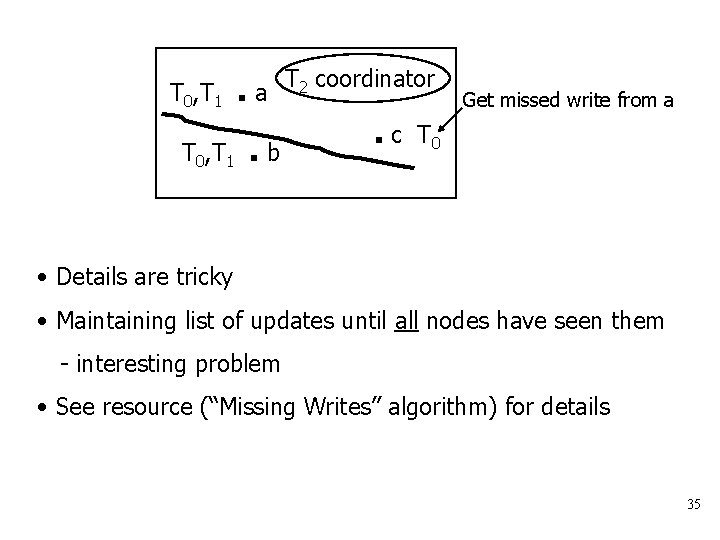
T 0, T 1 . a. b T 2 coordinator . c Get missed write from a T 0 • Details are tricky • Maintaining list of updates until all nodes have seen them - interesting problem • See resource (“Missing Writes” algorithm) for details 35
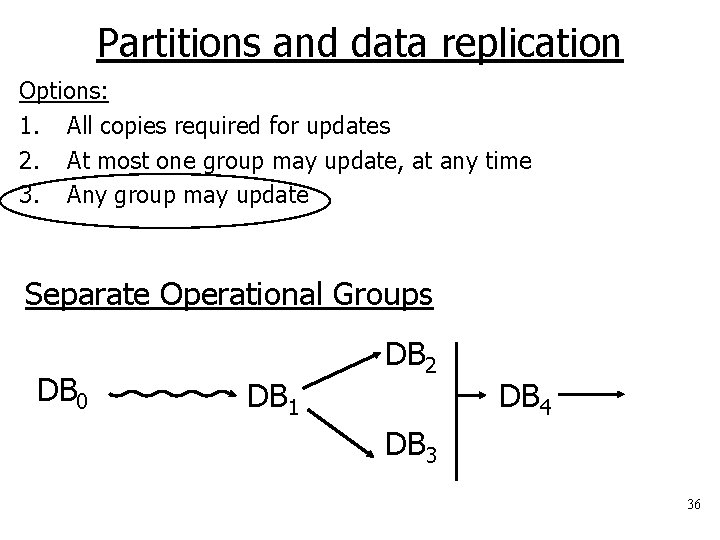
Partitions and data replication Options: 1. All copies required for updates 2. At most one group may update, at any time 3. Any group may update Separate Operational Groups DB 0 DB 1 DB 2 DB 4 DB 3 36
Integrating Diverged DBs 1. Compensate transactions to make schedules equivalent 2. Data-patch: semantic fix 37
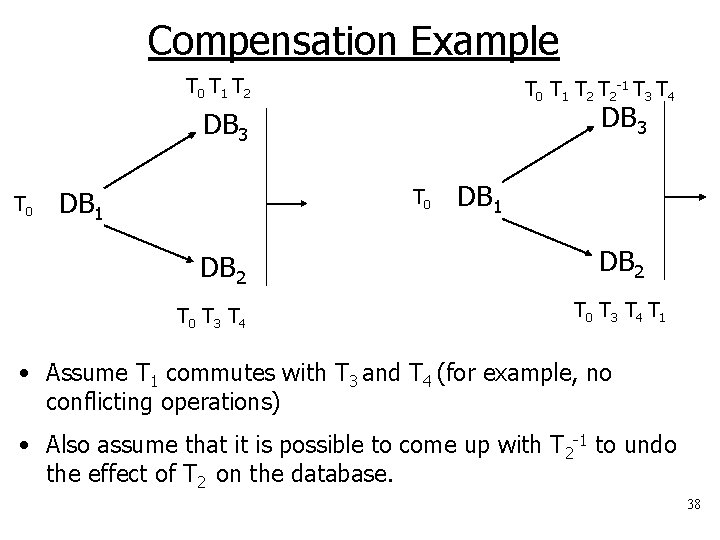
Compensation Example T 0 T 1 T 2 T 2 -1 T 3 T 4 DB 3 T 0 DB 1 DB 2 T 0 T 3 T 4 T 1 • Assume T 1 commutes with T 3 and T 4 (for example, no conflicting operations) • Also assume that it is possible to come up with T 2 -1 to undo the effect of T 2 on the database. 38
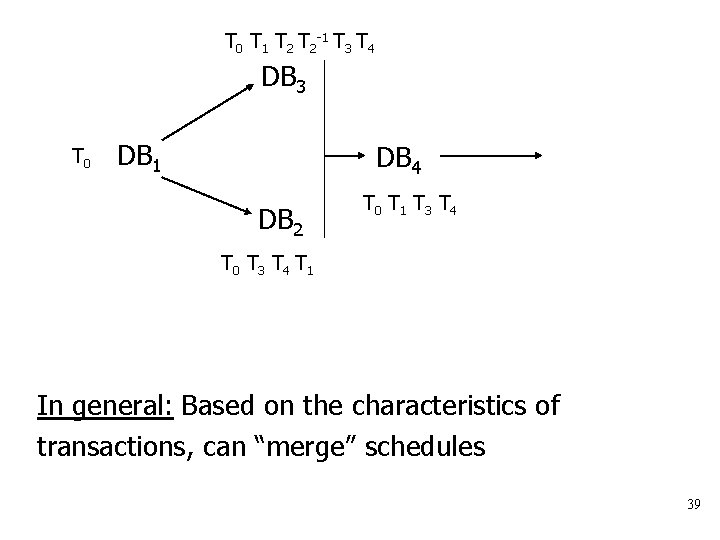
T 0 T 1 T 2 -1 T 3 T 4 DB 3 T 0 DB 1 DB 4 DB 2 T 0 T 1 T 3 T 4 T 0 T 3 T 4 T 1 In general: Based on the characteristics of transactions, can “merge” schedules 39
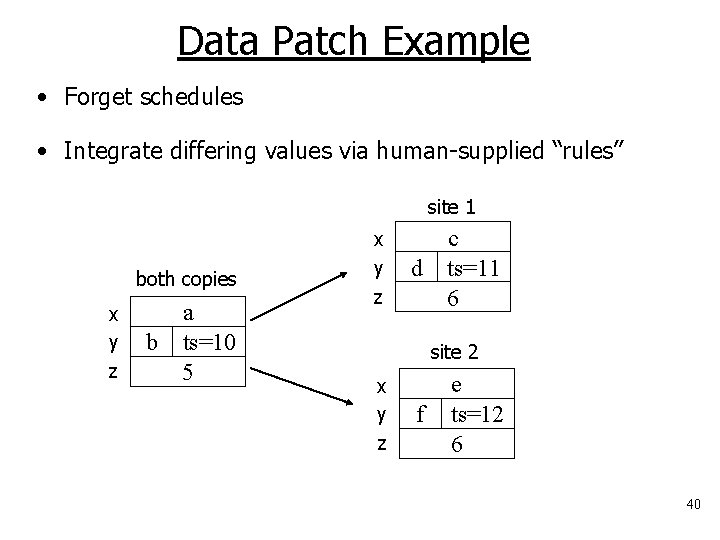
Data Patch Example • Forget schedules • Integrate differing values via human-supplied “rules” site 1 both copies x y z b a ts=10 5 x y z d c ts=11 6 site 2 x y z f e ts=12 6 40
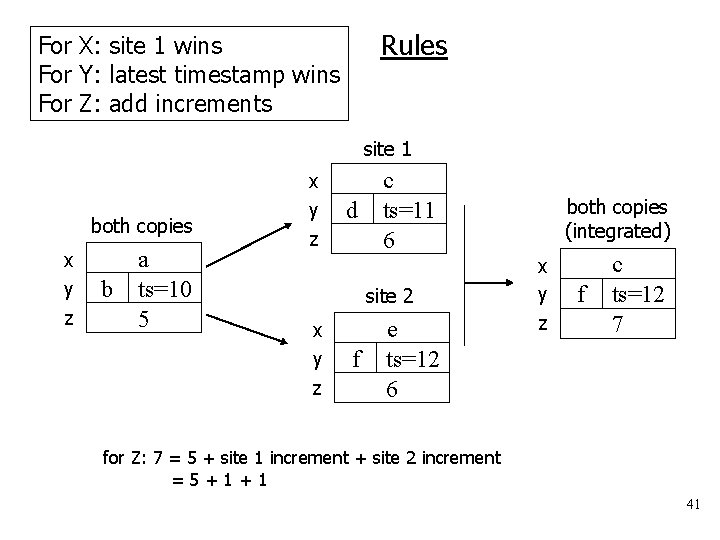
Rules For X: site 1 wins For Y: latest timestamp wins For Z: add increments site 1 both copies x y z b a ts=10 5 x y z d c ts=11 6 site 2 x y z f e ts=12 6 both copies (integrated) x y z f c ts=12 7 for Z: 7 = 5 + site 1 increment + site 2 increment =5+1+1 41
Resources • “Concurrency Control and Recovery” by Bernstein, Hardzilacos, and Goodman – Available at http: //research. microsoft. com/pubs/ccontrol/ 42
- Slides: 42