
Distributed Database Management System Lecture 7 Relational Data
Distributed Database Management System Lecture 7
Relational Data Languages • Two Categories • Relational Algebra based, procedural, user is to specify in terms of certain operations, how result is to be obtained • Relational Calculus based, nonprocedural, user only mentions the relationships among the data Virtual University of Pakistan 2

• Relational Algebra based, Procedural • Relational Calculus based, Non. Procedural • Relational Algebra consists of Five basic operations – Selection, Projection, Union, Set difference and Cartesian Product Virtual University of Pakistan 3
• Five others – Intersection, -join, natural join, semi-join and quotient – Unary and Binary ops – Union Compatibility • A horizontal subset • PREDICATE(RELATION) • Pred. is based on first- order predicate calculus Virtual University of Pakistan 4
• Symbol alphabet 1. Var, constraints, functions, predicate symbols 2. Parentheses 3. Logical connectors 4. Quantifiers Virtual University of Pakistan 5
Example • dep = ‘D 01’(EMP) • (dep = ‘D 01’) ^ sal < 20000 (EMP) Virtual University of Pakistan 6
Projection • Produces vertical subset of a relation • a 1, a 2, . . . , ak (R) • name, adrs (STD) Virtual University of Pakistan 7
Union • All tuples in both the relations • Duplicate tuples rem • Used to insert new records into relation Virtual University of Pakistan 8
Set Difference • (R-S) is the set of tuples in R that are not in S • Used for delete op Virtual University of Pakistan 9
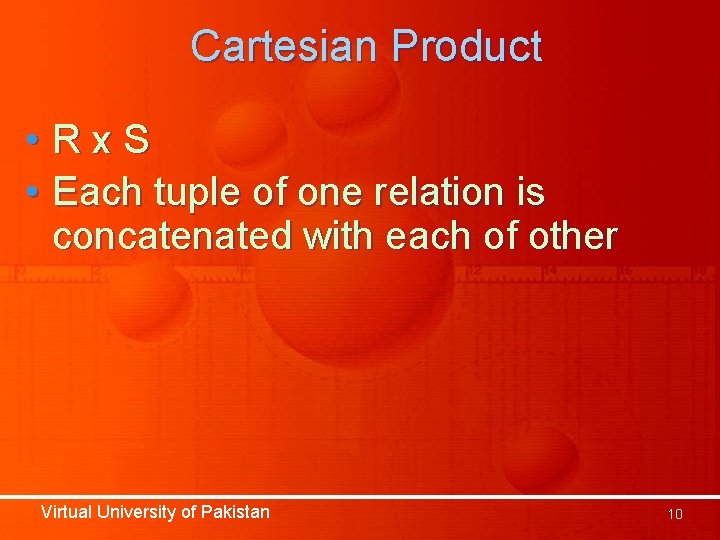
Cartesian Product • Rx. S • Each tuple of one relation is concatenated with each of other Virtual University of Pakistan 10
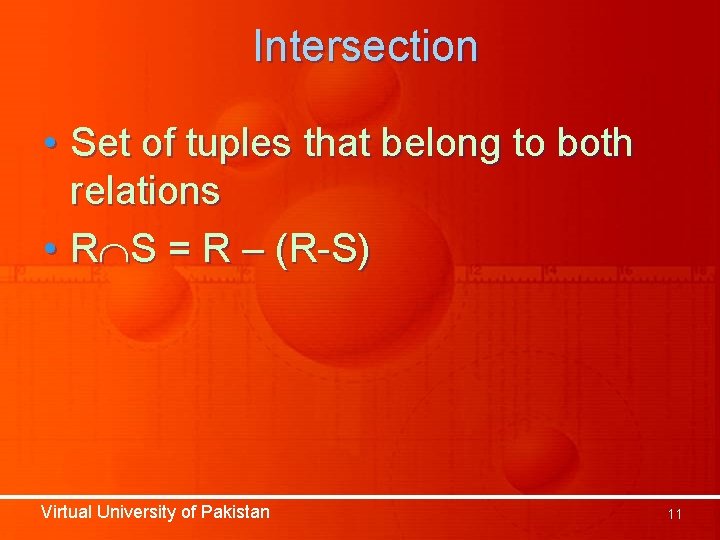
Intersection • Set of tuples that belong to both relations • R S = R – (R-S) Virtual University of Pakistan 11
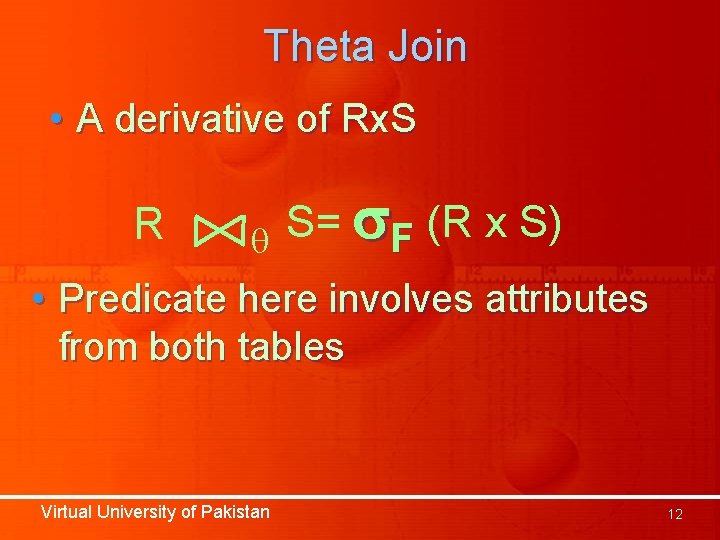
Theta Join • A derivative of Rx. S R S= (R x S) F • Predicate here involves attributes from both tables Virtual University of Pakistan 12
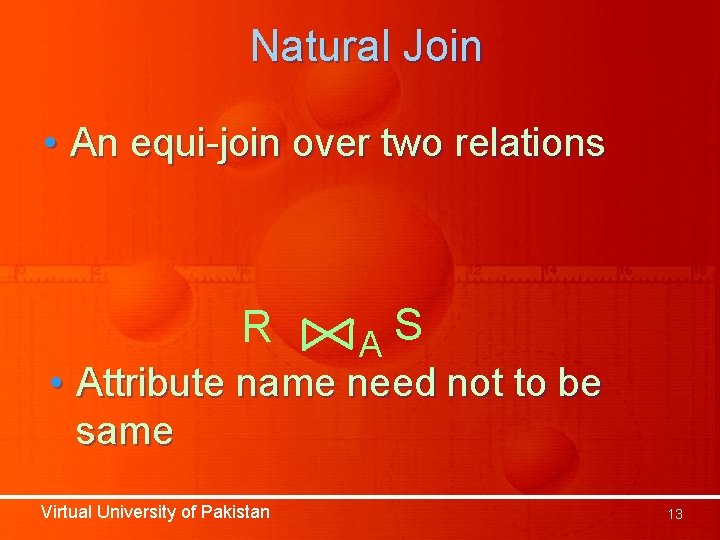
Natural Join • An equi-join over two relations R S A • Attribute name need not to be same Virtual University of Pakistan 13
- Slides: 13