
DISTRIBUTED DATABASE DESIGN Application Info Example 5 10
DISTRIBUTED DATABASE DESIGN Application Info Example 5. 10 BY, AKSHITHA VADDI PRESENTATION ID # 9
OUTLINE Primary Horizontal Fragmentation. Formal Definition of Relevance. Examples of Primary Horizontal Fragmentation.

Fragmentation Horizontal Fragmentation (HF) q Primary Horizontal Fragmentation (PHF) q Derived Horizontal Fragmentation (DHF) Vertical Fragmentation (VF) Hybrid Fragmentation (HF)
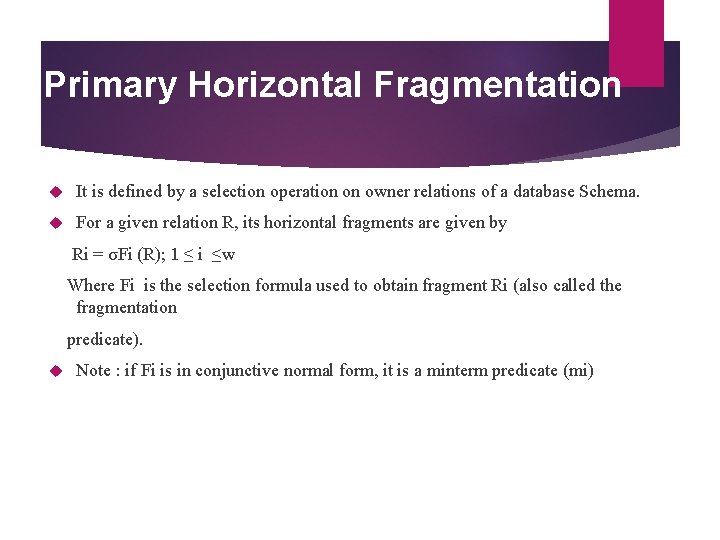
Primary Horizontal Fragmentation It is defined by a selection operation on owner relations of a database Schema. For a given relation R, its horizontal fragments are given by Ri = σFi (R); 1 ≤ i ≤w Where Fi is the selection formula used to obtain fragment Ri (also called the fragmentation predicate). Note : if Fi is in conjunctive normal form, it is a minterm predicate (mi)

Example 5. 7 The decomposition of relation PROJ into horizontal fragments PROJ 1 and PROJ 2 in Example 5. 1 is defined as follows: PROJ PNO PNAME BUDGET LOC P 1 Instrumentati 150000 on Montreal P 2 Database Dev 135000 New York P 3 CAD/CAM 250000 New York P 4 Maintenance 310000 Paris
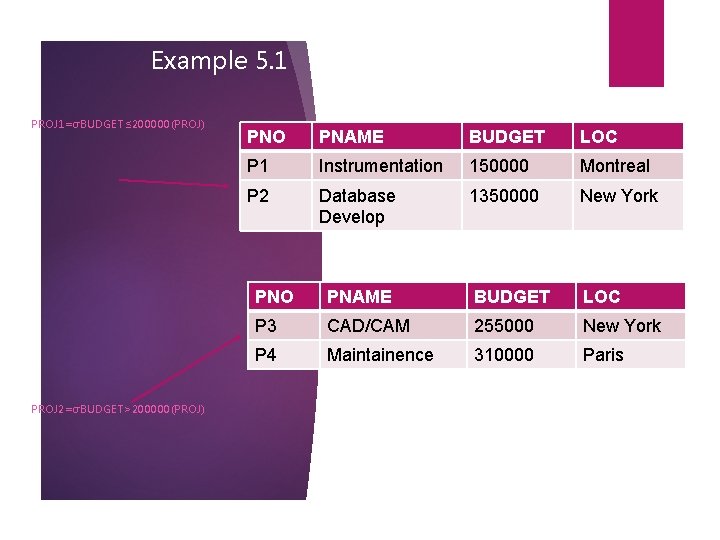
Example 5. 1 PROJ 1=σBUDGET≤ 200000(PROJ) PROJ 2=σBUDGET>200000(PROJ) PNO PNAME BUDGET LOC P 1 Instrumentation 150000 Montreal P 2 Database Develop 1350000 New York PNO PNAME BUDGET LOC P 3 CAD/CAM 255000 New York P 4 Maintainence 310000 Paris

It demonstrates one of the problems of horizontal partitioning. If the domain of the attributes participating in the selection formulas are continuous and infinite, it is quite difficult to define the set of formulas F = {F 1, F 2, …. . , Fn} that would fragment the relation properly. One possible course of action is to define ranges However, there is always the problem of handling the two endpoints. For example, if a new tuple with a BUDGET value of, say, $600, 000 were to be inserted into PROJ, one would have had to review the fragmentation to decide if the new tuple is to go into PROJ 2 or if the fragments need to be revised and a new fragment needs to be defined.

PROJ 2 = σ200000<BUDGET ≤ 400000(PROJ) PROJ 3 = σBUDGET > 400000 (PROJ) Example 5. 8 Consider relation PROJ of Figure 5. 3. We can define the following horizontal fragments based on the project location. The resulting fragments are PROJ 1 = σLOC=“Montreal” (PROJ) PROJ 2 = σLOC=“New York” (PROJ) PROJ 3 = σLOC=“Paris” (PROJ)
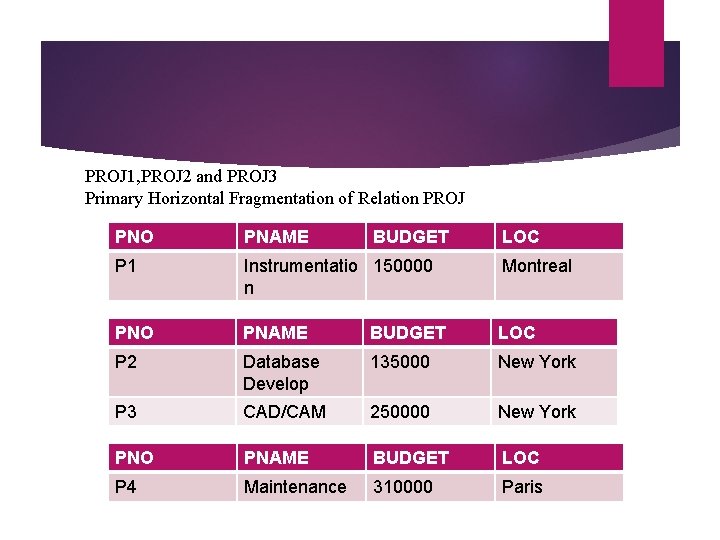
PROJ 1, PROJ 2 and PROJ 3 Primary Horizontal Fragmentation of Relation PROJ PNO PNAME BUDGET LOC P 1 Instrumentatio 150000 n Montreal PNO PNAME BUDGET LOC P 2 Database Develop 135000 New York P 3 CAD/CAM 250000 New York PNO PNAME BUDGET LOC P 4 Maintenance 310000 Paris
Now we can define a horizontal fragment more carefully. A horizontal fragment Ri of relation R consists of all the tuples of R that satisfy a minterm predicate mi. From the foregoing discussion it is obvious that the definition of the horizontal fragments depends on minterm predicates. Therefore, the first step of any fragmentation algorithm is to determine a set of simple predicates that will form the minterm predicates. An important aspect of simple predicates is their completeness; another is their minimality.
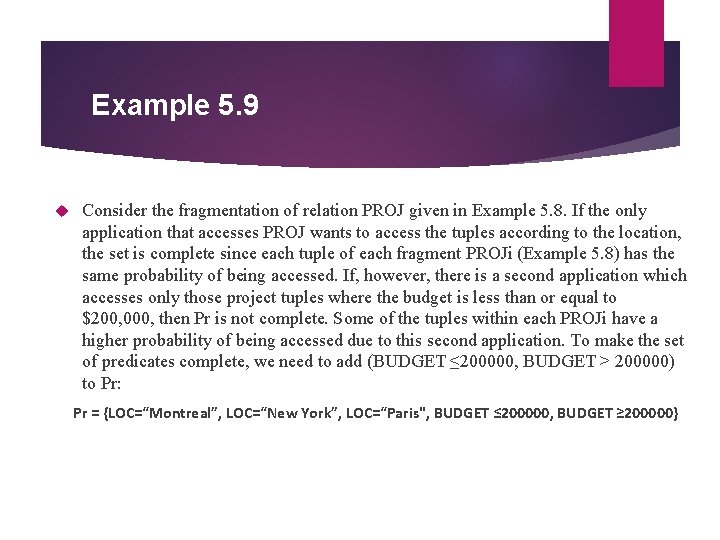
Example 5. 9 Consider the fragmentation of relation PROJ given in Example 5. 8. If the only application that accesses PROJ wants to access the tuples according to the location, the set is complete since each tuple of each fragment PROJi (Example 5. 8) has the same probability of being accessed. If, however, there is a second application which accesses only those project tuples where the budget is less than or equal to $200, 000, then Pr is not complete. Some of the tuples within each PROJi have a higher probability of being accessed due to this second application. To make the set of predicates complete, we need to add (BUDGET ≤ 200000, BUDGET > 200000) to Pr: Pr = {LOC=“Montreal”, LOC=“New York”, LOC=“Paris", BUDGET ≤ 200000, BUDGET ≥ 200000}
The desirable property of the set of predicates, according to which minterm predicates and, in turn, fragments are to be defined, is minimality, It simply states that if a predicate influences how fragmentation is performed (i. e. , causes a fragment f to be further fragmented into, say, fi and f j), there should be at least one application that accesses fi and fj differently.
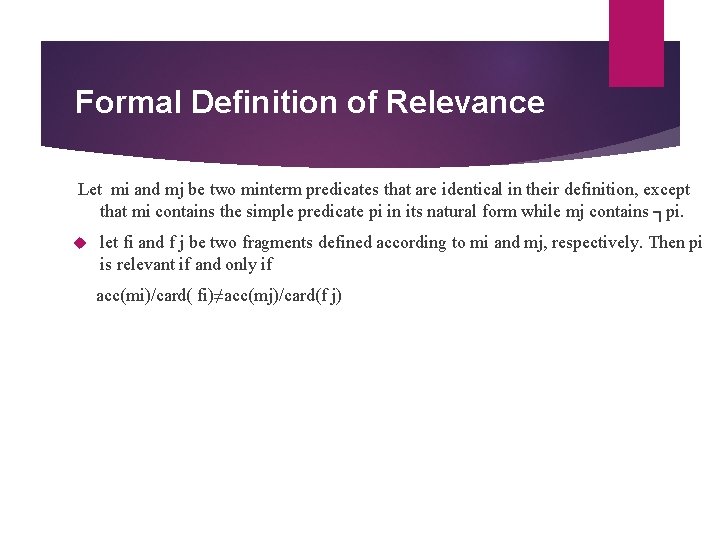
Formal Definition of Relevance Let mi and mj be two minterm predicates that are identical in their definition, except that mi contains the simple predicate pi in its natural form while mj contains ┐pi. let fi and f j be two fragments defined according to mi and mj, respectively. Then pi is relevant if and only if acc(mi)/card( fi)≠acc(mj)/card(f j)
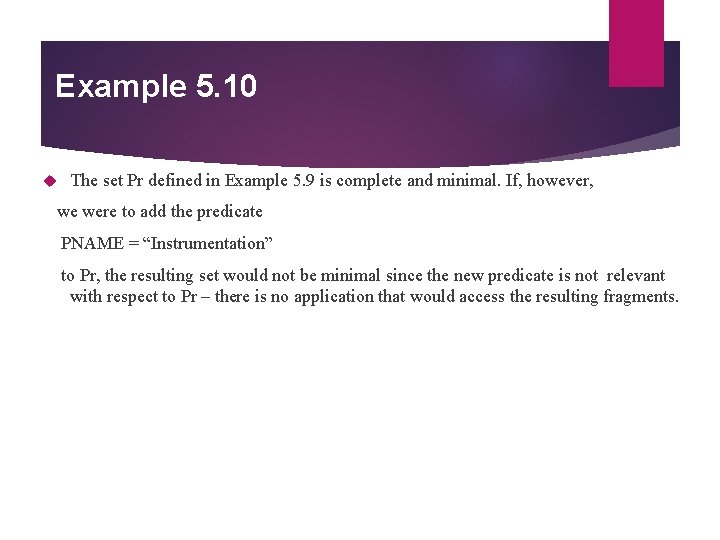
Example 5. 10 The set Pr defined in Example 5. 9 is complete and minimal. If, however, we were to add the predicate PNAME = “Instrumentation” to Pr, the resulting set would not be minimal since the new predicate is not relevant with respect to Pr – there is no application that would access the resulting fragments.

THANK YOU
- Slides: 15