
Distributed Data Access Control Mechanisms and the SRM
Distributed Data Access Control Mechanisms and the SRM Peter Kunszt Manager Swiss Grid Initiative Swiss National Supercomputing Centre CSCS GGF Grid Data Management Working Group Co-Chair HPDC Workshop on Management of Rights in Production Grids Paris, 19 June, 2006
Building the Science Database of the Sloan Digital Sky Survey, Johns Hopkins University Baltimore EU Grid Projects, leading data management middleware development CERN, Geneva Grid Storage Management Working Group Co-Chair Global Grid Forum Manager Swiss Grid Initiative, Swiss National Supercomputing Centre CSCS, Manno HPDC, 19_06_2006, P. Kunszt
Outline Introduction: Distributing Data Security Aspects § Ubiquitous Access to Data(? ) § Semantic models § Trust relationships Discussion of Possible Security Models EGEE and SRM models HPDC, 19_06_2006, P. Kunszt
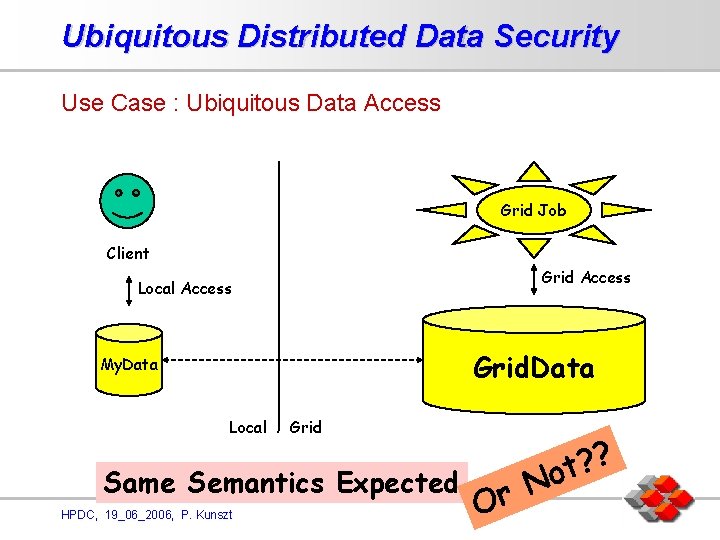
Ubiquitous Distributed Data Security Use Case : Ubiquitous Data Access Grid Job Client Grid Access Local Access Grid. Data My. Data Local Grid ? ? t Same Semantics Expected r No O HPDC, 19_06_2006, P. Kunszt

Data Access Semantics Local: Security fully controlled by the Owner § Setting and Getting of Permissions and ACLs § Changes have Instantaneous effect Distributed: Different Security Models § Single Master, Read-Only Copies § Changes only possible in one place, effect on copies not instantaneous § Multi Master § Changes possible everywhere, complex synchronization § Race Conditions § Resolution of Conflicts may involve human decisions § No Synchronization (Peer-to-Peer) § Any combination of the three above § Hierarchical models § Caches HPDC, 19_06_2006, P. Kunszt
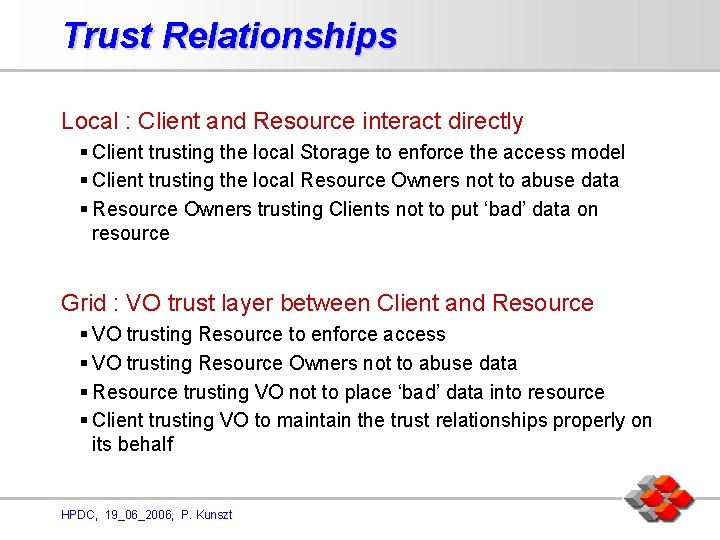
Trust Relationships Local : Client and Resource interact directly § Client trusting the local Storage to enforce the access model § Client trusting the local Resource Owners not to abuse data § Resource Owners trusting Clients not to put ‘bad’ data on resource Grid : VO trust layer between Client and Resource § VO trusting Resource to enforce access § VO trusting Resource Owners not to abuse data § Resource trusting VO not to place ‘bad’ data into resource § Client trusting VO to maintain the trust relationships properly on its behalf HPDC, 19_06_2006, P. Kunszt
Distributed Data Security Models Policy Decision Point PDP § Decisions about Clients being able to access Data Policy Enforcement Point PEP § Enforcing the PDP decision, strong trust relationship between PEP and PDP § Enforcement can only be done by the Recource Owners Models different depending on the placement of PDP and PEP in the Grid Layered Architecture § 5 Models possible HPDC, 19_06_2006, P. Kunszt
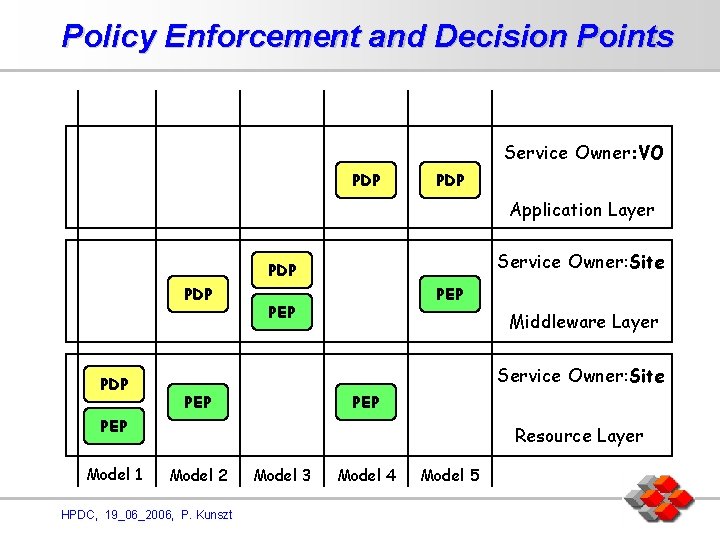
Policy Enforcement and Decision Points Service Owner: VO PDP Application Layer Service Owner: Site PDP PDP PEP Middleware Layer Service Owner: Site PEP PEP Model 1 Resource Layer Model 2 HPDC, 19_06_2006, P. Kunszt Model 3 Model 4 Model 5
Model 1: Site Security Only Both PDP and PEP are in the Resource Layer • Integrated Storage Resource model • Full control of the Storage of the Site/Resource Owner • Mapping necessary between § Grid Users and Site Users § Grid Data names and Site Data names (logical vs. physical names) § Local Namespace is relevant as it holds access semantics • Issues with distributed access § Peer to peer maps well onto this model § For single master and multi master, synchronization between local instances is needed § Job scheduling needs to take individual access capabilities into account in addition of the data being present or not HPDC, 19_06_2006, P. Kunszt
Model 1: Site Security Only Implementation possibility: § Client is accessing each storage individually, directly § Client has proper credentials for each local storage element § For non P 2 P models, synchronization is necessary § Possible standardization problems as individual storages have potentially different ACL interpretations HPDC, 19_06_2006, P. Kunszt
Model 2: Middleware PDP, Site PEP PDP is on site but in the Grid Layer. PEP in the Resource Layer • Storage Resource delegates decision on access to the middleware • On-site middleware so resource owners are still in control § Well suited for sites running local storage with limited semantics • Mappings: same as M 1 § User, filename mappings still needed § ACLs/Security metadata stored now in the Grid Layer • Issues with distributed access § Peer to peer maps well onto this model too § For single master and multi master, synchronization between local instances is still needed § Job scheduling needs to take individual access capabilities into account in addition of the data being present or not. HPDC, 19_06_2006, P. Kunszt
Model 2: Middleware PDP, Site PEP Implementation possibility: § A middleware: File Authorization Service FAS needed as PDP § Client is accessing each storage individually, directly § Client has proper credentials for each local storage element § For non P 2 P models, synchronization is still necessary § Lesser standardization problems as M 1: middleware abstraction HPDC, 19_06_2006, P. Kunszt
Model 3: Middleware Control Middleware Layer controls both PEP and PDP • Storage can only be accessed through the Middleware Layer • On-site middleware so resource owners are still in control • Mappings are managed by the Middleware § Abstraction of local storage semantics and namespace § ACLs/Security metadata stored and enforced in the Grid Layer • Issues with distributed access § Peer to peer is still a good model, each site now has uniform semantics § For single master and multi master, synchronization between local instances is still needed § Job scheduling needs to take individual access capabilities still into account in addition of the data being present or not. HPDC, 19_06_2006, P. Kunszt
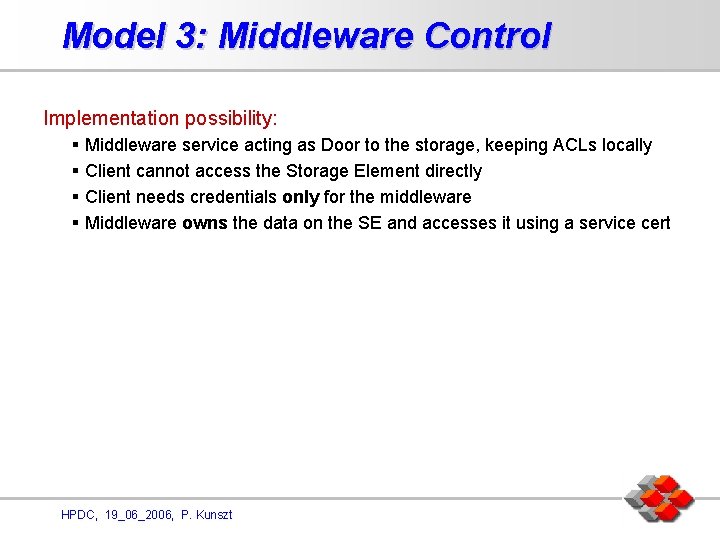
Model 3: Middleware Control Implementation possibility: § Middleware service acting as Door to the storage, keeping ACLs locally § Client cannot access the Storage Element directly § Client needs credentials only for the middleware § Middleware owns the data on the SE and accesses it using a service cert HPDC, 19_06_2006, P. Kunszt
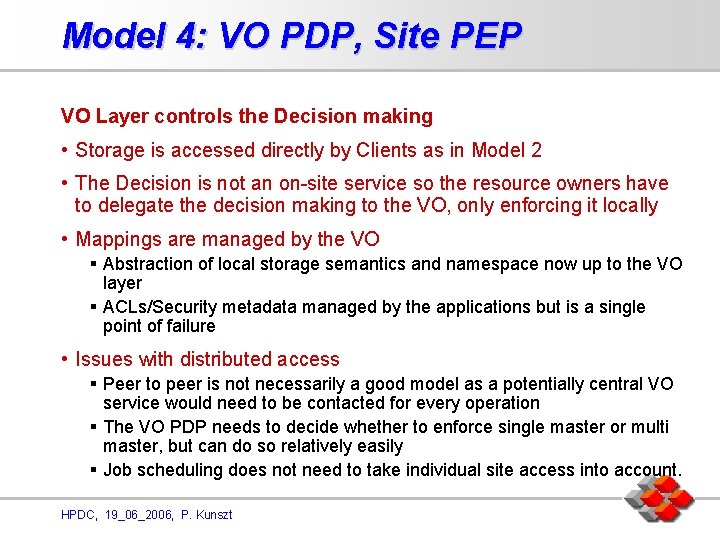
Model 4: VO PDP, Site PEP VO Layer controls the Decision making • Storage is accessed directly by Clients as in Model 2 • The Decision is not an on-site service so the resource owners have to delegate the decision making to the VO, only enforcing it locally • Mappings are managed by the VO § Abstraction of local storage semantics and namespace now up to the VO layer § ACLs/Security metadata managed by the applications but is a single point of failure • Issues with distributed access § Peer to peer is not necessarily a good model as a potentially central VO service would need to be contacted for every operation § The VO PDP needs to decide whether to enforce single master or multi master, but can do so relatively easily § Job scheduling does not need to take individual site access into account. HPDC, 19_06_2006, P. Kunszt
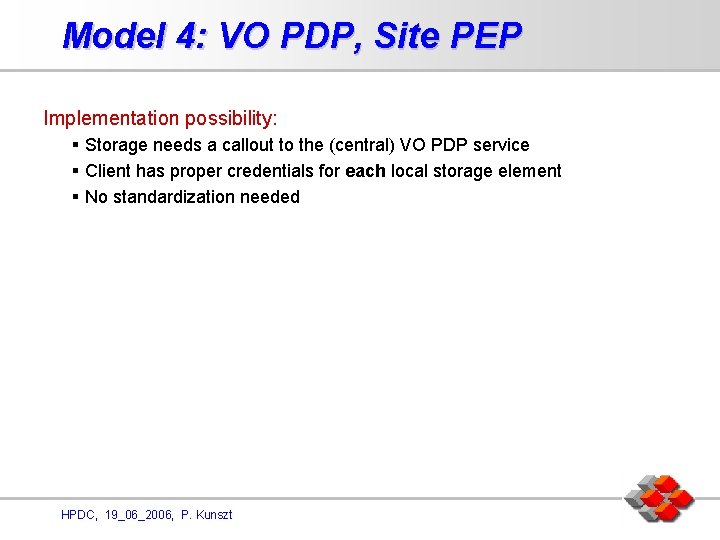
Model 4: VO PDP, Site PEP Implementation possibility: § Storage needs a callout to the (central) VO PDP service § Client has proper credentials for each local storage element § No standardization needed HPDC, 19_06_2006, P. Kunszt
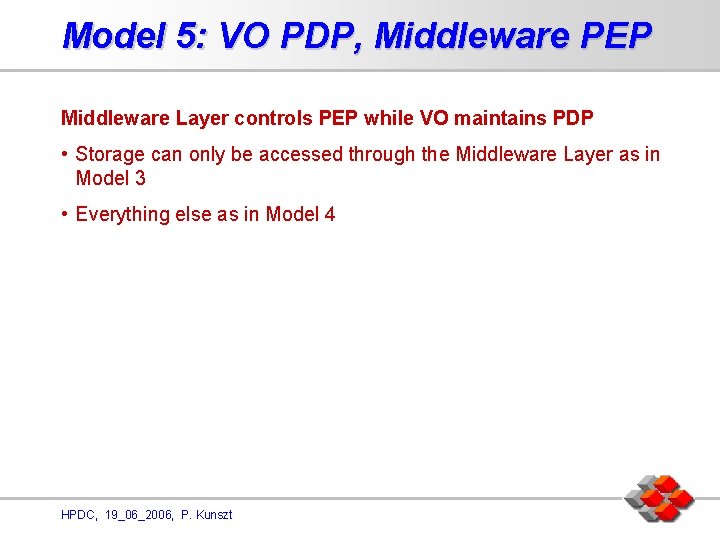
Model 5: VO PDP, Middleware PEP Middleware Layer controls PEP while VO maintains PDP • Storage can only be accessed through the Middleware Layer as in Model 3 • Everything else as in Model 4 HPDC, 19_06_2006, P. Kunszt
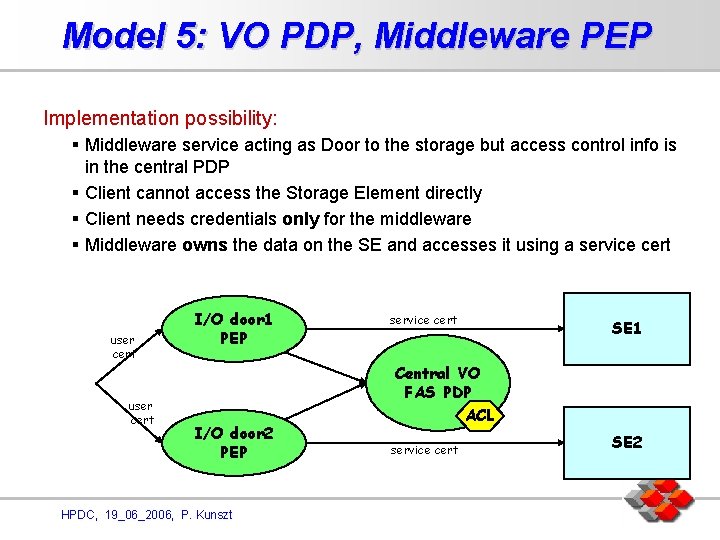
Model 5: VO PDP, Middleware PEP Implementation possibility: § Middleware service acting as Door to the storage but access control info is in the central PDP § Client cannot access the Storage Element directly § Client needs credentials only for the middleware § Middleware owns the data on the SE and accesses it using a service cert user cert I/O door 1 PEP I/O door 2 PEP HPDC, 19_06_2006, P. Kunszt service cert SE 1 Central VO FAS PDP ACL service cert SE 2
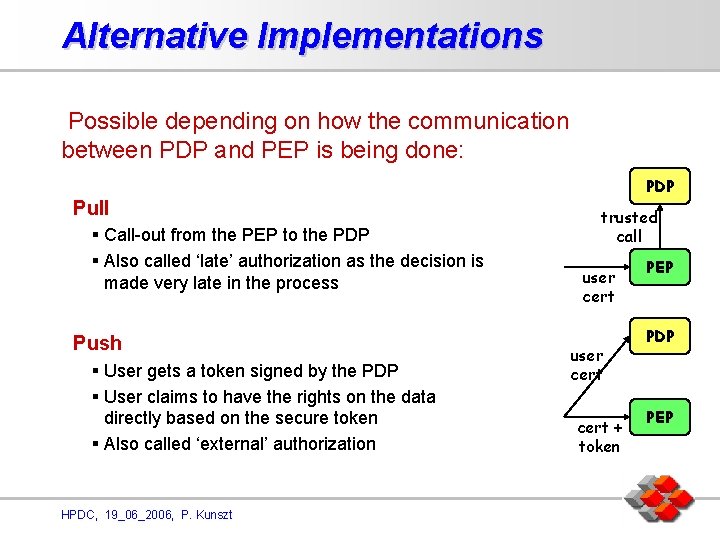
Alternative Implementations Possible depending on how the communication between PDP and PEP is being done: PDP Pull § Call-out from the PEP to the PDP § Also called ‘late’ authorization as the decision is made very late in the process Push § User gets a token signed by the PDP § User claims to have the rights on the data directly based on the secure token § Also called ‘external’ authorization HPDC, 19_06_2006, P. Kunszt trusted call user cert + token PEP PDP PEP
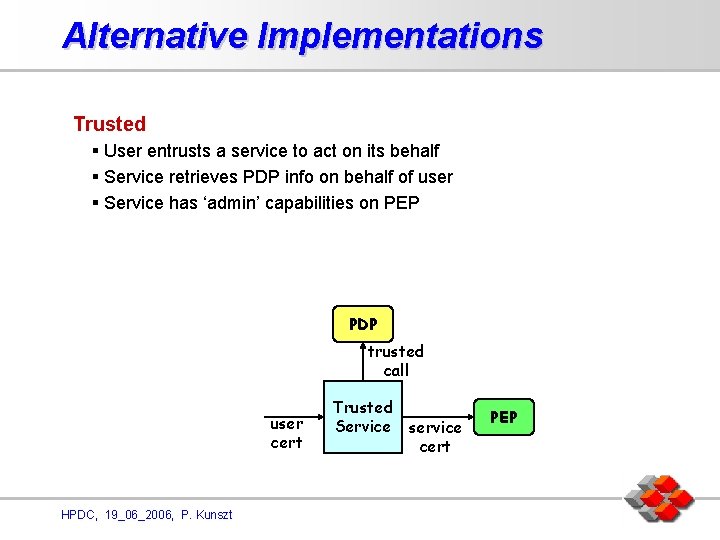
Alternative Implementations Trusted § User entrusts a service to act on its behalf § Service retrieves PDP info on behalf of user § Service has ‘admin’ capabilities on PEP PDP trusted call user cert HPDC, 19_06_2006, P. Kunszt Trusted Service service cert PEP
SRM security The current SRM security runs with Model 1 SRM v 1 and v 2 § Model 1 not by design but by default. For Model 1, the Pull implementation is trivial as the PDP and PEP are the same § Discussions did not even start! § If Srm. Copy is not used, any model can be implemented on top of the SRM. § Srm. Copy in v 1 and v 2 only allows Model 1 by default, using the Peer to Peer security option (no synchronization on update). SRM v 3 § Foresees proper handling of ACLs with the necessary methods § May be extended to include synchronization between sites also for Srm. Copy § Detailed discussions also to be had. SRM v 3 is simply flexible enough to allow for any security model. HPDC, 19_06_2006, P. Kunszt
EGEE security model: g. Lite 1. 5 The EGEE g. Lite versions up to v 1. 5 were designed to run with model 3 or 5. Model 5 § g. Lite I/O: middleware service acting as door (‘trusted’ implementation as the actual enforcement is done by the SE) § g. Lite Fireman Catalog: central VO-owned service Model 3 § g. Lite I/O as door (trusted impl) § g. Lite Fireman deployed locally at each site § Synchronization between Fireman catalogs through a messaging service HPDC, 19_06_2006, P. Kunszt
EGEE security model: LCG and g. Lite 3 The EGEE versions up to LCG 2. 7 and starting g. Lite 3 run with model 1. Model 1 § Just using the SRM § Alternatively, directly talking to the storage at each site over the native interface (dcap, rfio) or over GFAL Not quite Model 2 § LCG File Catalog LFC acting as namespace service only, ACLs but not enforced § Push implementation using VOMS groups but these are not signed by the LFC § No synchronization HPDC, 19_06_2006, P. Kunszt
Ali. En The LHC Alice experiment’s own Grid Middleware called Ali. En that largely influenced the EGEE design is working with model 4 § ‘Push’ implementation with a token given to the service by the Alien System § ‘Central’ Alien File Catalog – distributed instance § Direct access to file through xrootd protocol with the service token HPDC, 19_06_2006, P. Kunszt
SRB The Storage Resource Broker from SDSC seems to be using Model 3 § Central namespace service § Every access goes through the SRB layer and is tightly controlled by it HPDC, 19_06_2006, P. Kunszt
Summary The users of a distributed Grid infrastructure need to be aware of the security semantics of their distributed data access model § Not an easy decision which model to use § Every model has advantages and disadvantages § Possibly no one size fits all solution § SRM v 3 might accommodate any solution on top § Still a lot of thinking/deciding to be done! §. . And I haven’t even touched on the subject of co-scheduling… HPDC, 19_06_2006, P. Kunszt
. . And now for the Really Important Stuff HOPP SCHWIIZ HPDC, 19_06_2006, P. Kunszt
- Slides: 27