
Distributed Cognition http cmapspublic 3 ihmc usrid1 GRQ
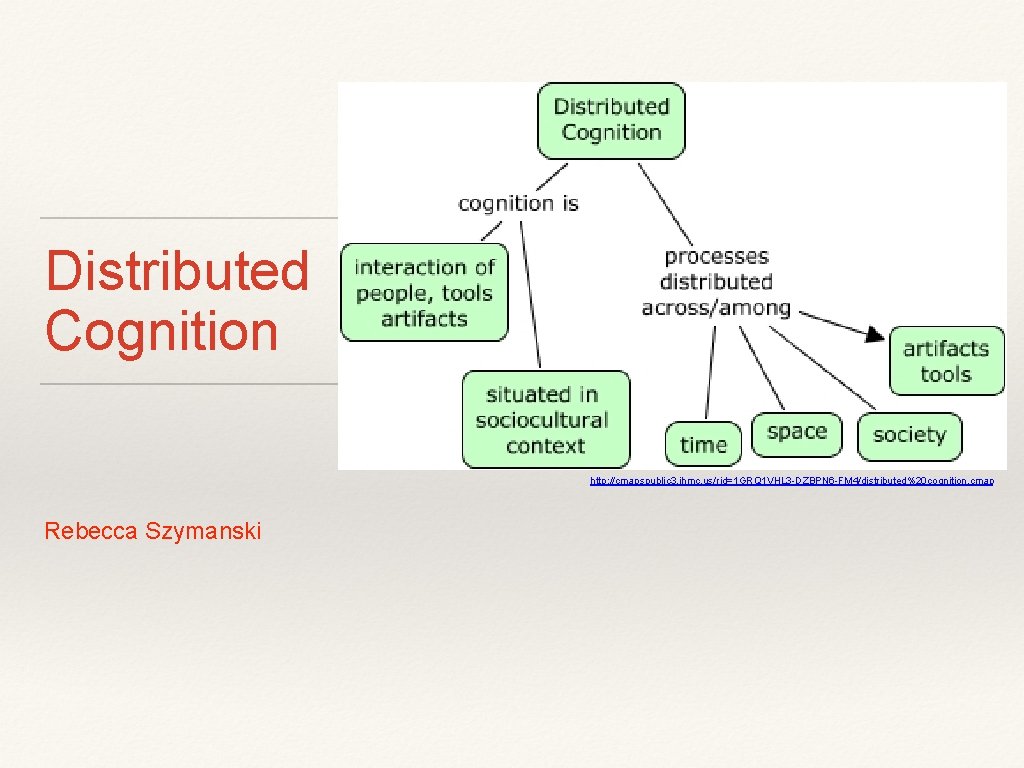
Distributed Cognition http: //cmapspublic 3. ihmc. us/rid=1 GRQ 1 VHL 3 -DZBPN 6 -FM 4/distributed%20 cognition. cmap Rebecca Szymanski
Overview ❖ ❖ “Not just in the head, but in the world” (Norman, 1993) Cognition is not confined to an individual, but is distributed across objects, individuals, artifacts, and tools in a social setting ❖ Developed in the mid 1980 s ❖ New approach to standard cognitive science ❖ Cognition distributed among tools and other individuals ❖ Social and cultural process
Principle Elements ❖ Three major ways cognitive processes are distributed: ❖ within social group ❖ between material or environmental ❖ throughout time
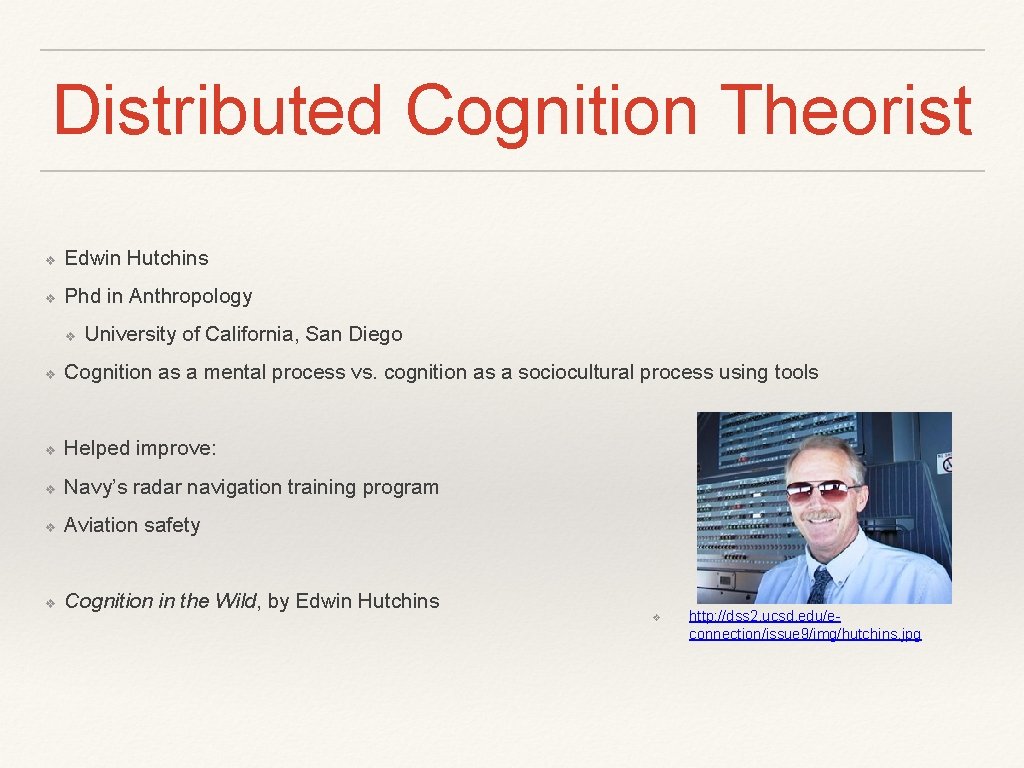
Distributed Cognition Theorist ❖ Edwin Hutchins ❖ Phd in Anthropology ❖ University of California, San Diego ❖ Cognition as a mental process vs. cognition as a sociocultural process using tools ❖ Helped improve: ❖ Navy’s radar navigation training program ❖ Aviation safety ❖ Cognition in the Wild, by Edwin Hutchins ❖ http: //dss 2. ucsd. edu/econnection/issue 9/img/hutchins. jpg
Contributions of the Theory ❖ Collaborative technologies ❖ Intellectual processing outside of the brain ❖ Solving problems ❖ Hutchins contributions: ❖ ❖ Navy’s Radar Navigation Training Program Aviation Safety Training Program
Related Theories ❖ Situated Cognition Theory ❖ ❖ ❖ What people perceive, think and do develops in a social setting Originators and proponents: John Seely Brown, Allan Collins, Paul Duguid Interactional Theories of Cognitive Development ❖ ❖ Individual development is influenced by social cultural context Originators: Lev Vygotsky, Jerome Bruner
Relevance to Teaching and Learning of Adults ❖ Designing instruction ❖ Functionality of training programs ❖ Analysis of collaboration ❖ Searching for objects, individuals artifacts, and tools
Thoughts ❖ ❖ ❖ Distributed cognition is important because… When designing instruction, it is essential to have an understanding of the work that goes beyond the individual, to look at how groups coordinate information with one another, and the collaboration that is needed to perform problem-solving tasks. In the field of education, using tools and artifacts to help with understanding in a social setting has a high impact on the retention of information.
References ❖ ❖ ❖ Carroll, J. (2003). HCI models, theories, and frameworks toward a multidisciplinary science. San Francisco, Calif. : Morgan Kaufmann. Distributed Cognition (DCog). In Learning Theories. Retrieved from URL: http: //www. learning-theories. com/distributed-cognition-dcog. html Driscoll, M. (2005). Psychology of learning for instruction (3 rd ed. ). Boston: Allyn and Bacon. Hutchins, E. (2000). Distributed cognition. International Encyclopedia of the Social and Behavioral Sciences. Elsevier Science. Perry, M. (2003). Distributed cognition. HCI, Models, Theories, and Frameworks, London: Morgan Kaufman. Social Sciences Newsletter. (n. d. ). Retrieved June 6, 2015, from http: //dss 2. ucsd. edu/e-connection/issue 9/spotlight. htm
- Slides: 9