
Distributed Cache Technology in Cloud Computing and its
Distributed Cache Technology in Cloud Computing and its Application in the GIS Software Wang Qi 1155082219 Zhu Yitong 1155082354 Peng Cheng 1155084103
Introduction Basic Concepts Cloud computing Relationships distributed cache . technology Characteristics
definition relationship . Cloud computing describes a new Internet-based IT service, with value add, use and delivery function. lt is a combination of data sharing and service-sharing computing model. Distributed cache make The distance between applications and objectives closer. It is an important way for cloud applications to improve application performance
two main features "distributed" and ”cache” the distribution of data is distributed storage, size and capacity can be great. Cache allow concurrency control: a single node can reach hundreds of thousands of concurrency
Characteristics of distribute caching Connected through a mesh connection Reliability High Scalability Effective transmission of data Latest data Consistency
Characteristics Connected through a mesh connection, so that data are transmitted through multiple copies of the mechanism. Distributed cache technology can achieve high scalability of data distributed cache system ensure the high performance of the effective transmission of data. The reliability of its data to ensure distributed cache system’s high degree of reliability. distributed cache system achieve the consistency of the data.

General tech of distribution cache
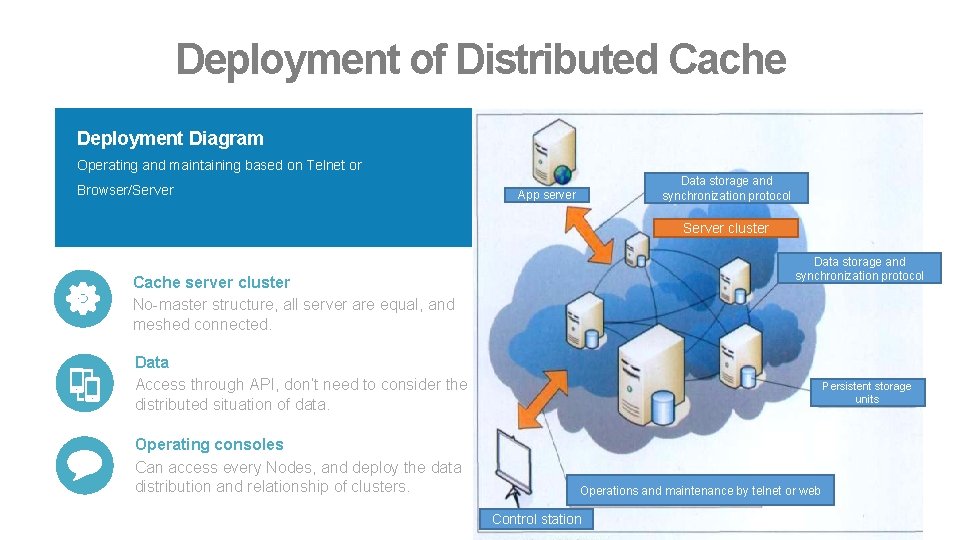
Deployment of Distributed Cache Deployment Diagram Operating and maintaining based on Telnet or Browser/Server Data storage and synchronization protocol App server Server cluster Data storage and synchronization protocol Cache server cluster No-master structure, all server are equal, and meshed connected. Data Access through API, don’t need to consider the distributed situation of data. Operating consoles Can access every Nodes, and deploy the data distribution and relationship of clusters. Persistent storage units Operations and maintenance by telnet or web Control station
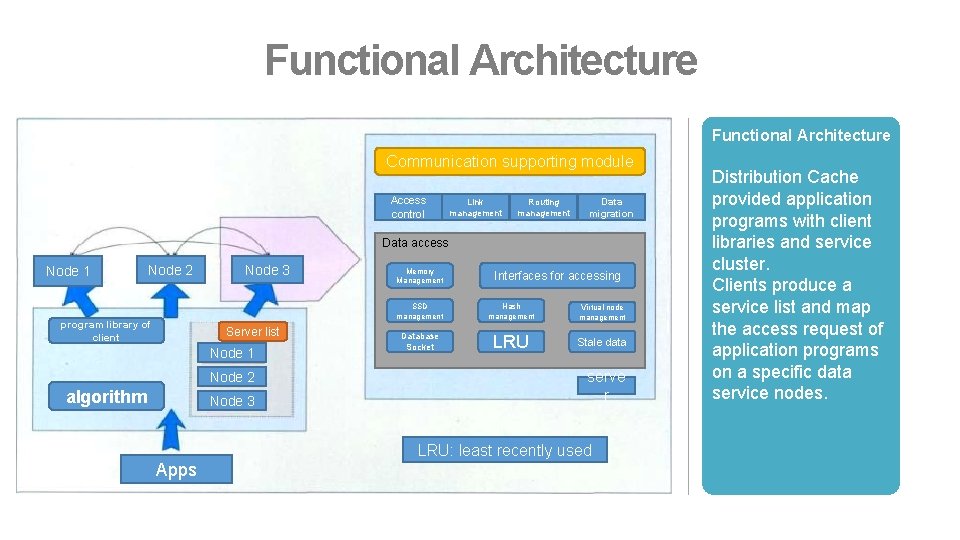
Functional Architecture 70% Functional Architecture 55% Communication supporting module 45% Access control Link management Routing management 40% Data migration Data access Node 1 Node 2 program library of client Node 3 Server list Node 1 Node 2 algorithm Node 3 15% 20% Memory Management Interfaces for accessing SSD management Hash management Virtual node management Database Socket LRU Stale data serve r LRU: least recently used Apps Distribution Cache provided application programs with client libraries and service cluster. Clients produce a service list and map the access request of application programs on a specific data service nodes.
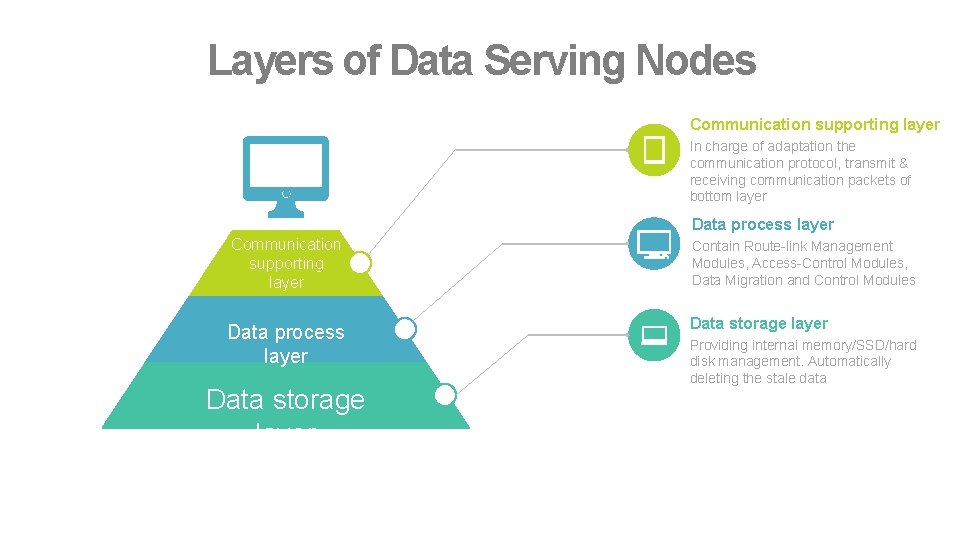
Layers of Data Serving Nodes Communication supporting layer In charge of adaptation the communication protocol, transmit & receiving communication packets of bottom layer Data process layer Communication supporting layer Data process layer Data storage layer Hardware Contain Route-link Management Modules, Access-Control Modules, Data Migration and Control Modules Data storage layer Providing internal memory/SSD/hard disk management. Automatically deleting the stale data
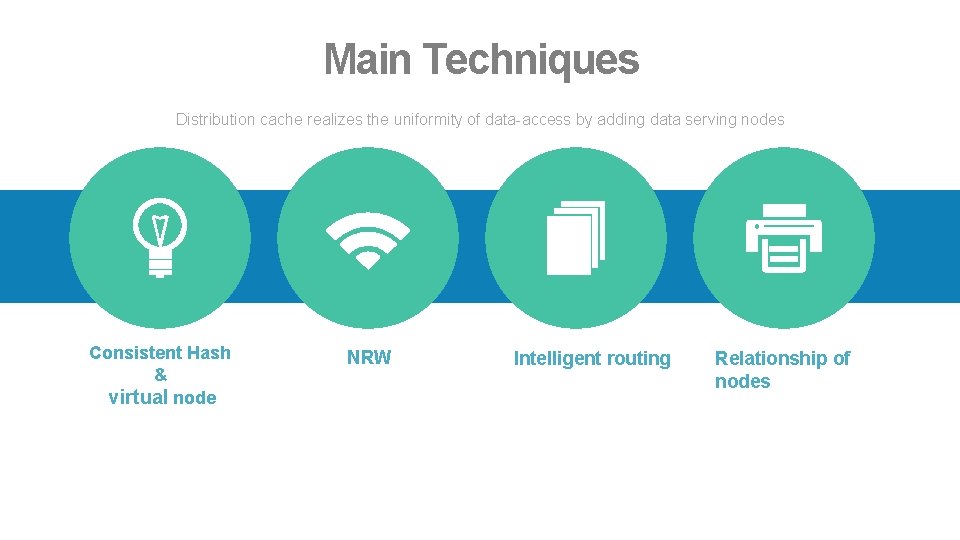
Main Techniques Distribution cache realizes the uniformity of data-access by adding data serving nodes Consistent Hash & virtual node NRW Intelligent routing Relationship of nodes
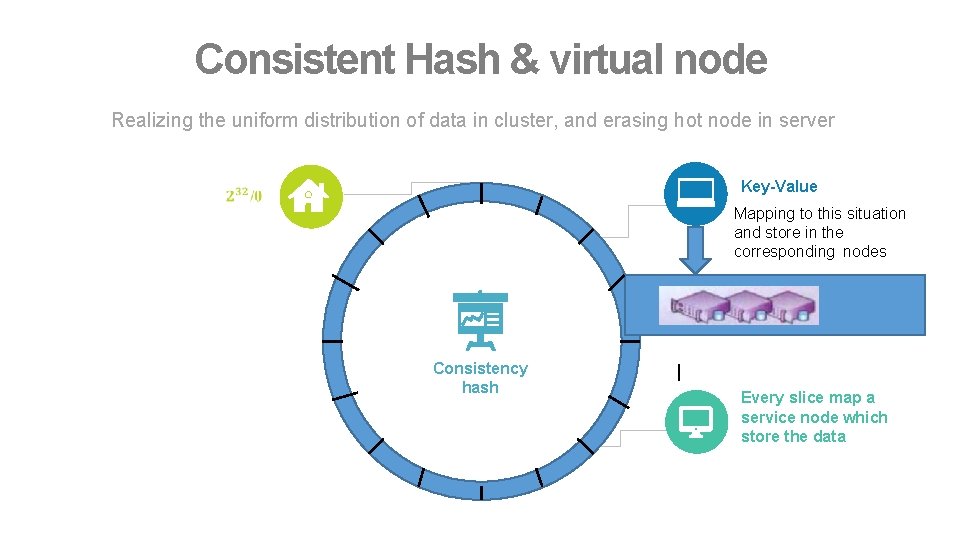
Consistent Hash & virtual node Realizing the uniform distribution of data in cluster, and erasing hot node in server Key-Value Mapping to this situation and store in the corresponding nodes Consistency hash Every slice map a service node which store the data
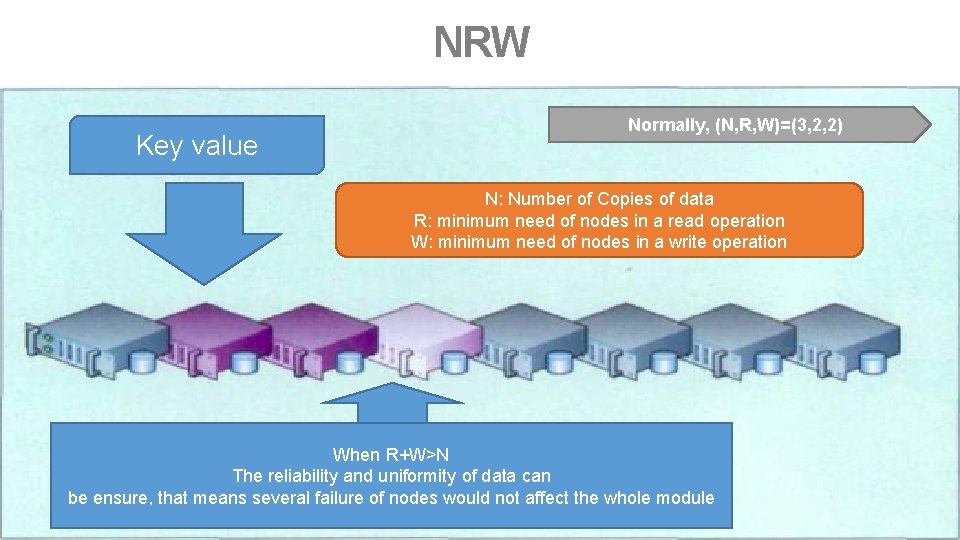
NRW Key value Normally, (N, R, W)=(3, 2, 2) N: Number of Copies of data R: minimum need of nodes in a read operation W: minimum need of nodes in a write operation When R+W>N The reliability and uniformity of data can be ensure, that means several failure of nodes would not affect the whole module
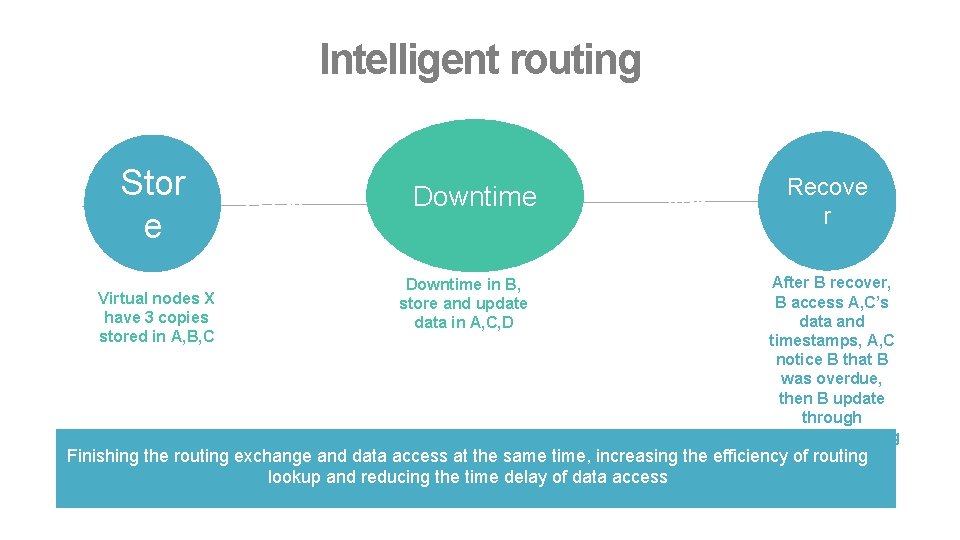
Intelligent routing Stor e Virtual nodes X have 3 copies stored in A, B, C 70% Downtime in B, store and update data in A, C, D 38% Recove r After B recover, B access A, C’s data and timestamps, A, C notice B that B was overdue, then B update through Intelligent routing Finishing the routing exchange and data access at the same time, increasing the efficiency of routing lookup and reducing the time delay of data access
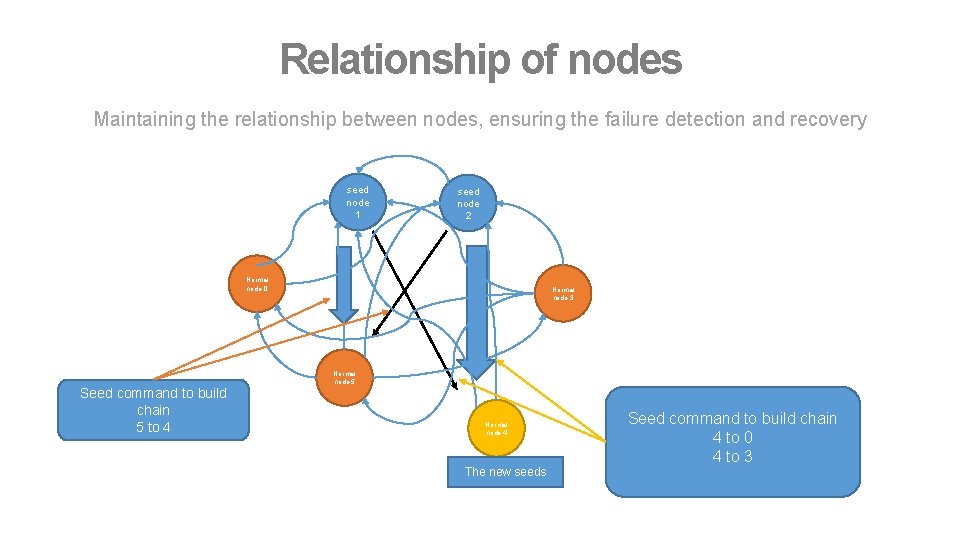
Relationship of nodes Maintaining the relationship between nodes, ensuring the failure detection and recovery seed node 1 seed node 2 15% 40% Normal node 0 Normal node 3 20% Seed command to build chain 5 to 4 Normal node 5 Normal node 4 35% The new seeds Seed command to build chain 4 to 0 4 to 3
PART 3 Cloud GIS: The Distributed Cache System
Geographic information system Geographic Information System is a kind of technology that incorporates geographic features with spatial data in order to map, analyze, and assess real-world situations. Traditional GIS In Traditional GIS Architecture, GIS hardware, software and data reside in-house and are owned, accessed and maintained via a local intranet connection.
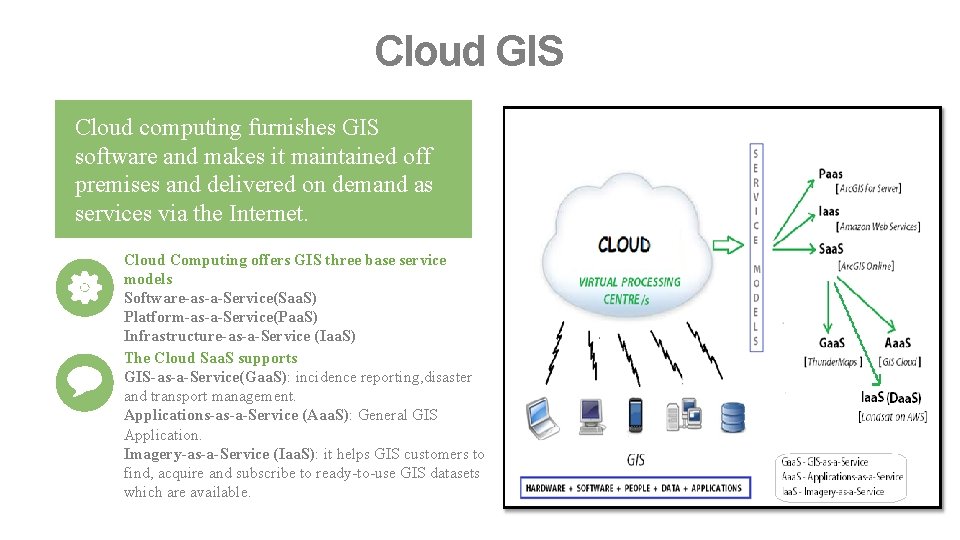
Cloud GIS Cloud computing furnishes GIS software and makes it maintained off premises and delivered on demand as services via the Internet. Cloud Computing offers GIS three base service models Software-as-a-Service(Saa. S) Platform-as-a-Service(Paa. S) Infrastructure-as-a-Service (Iaa. S) The Cloud Saa. S supports GIS-as-a-Service(Gaa. S): incidence reporting, disaster and transport management. Applications-as-a-Service (Aaa. S): General GIS Application. Imagery-as-a-Service (Iaa. S): it helps GIS customers to find, acquire and subscribe to ready-to-use GIS datasets which are available.
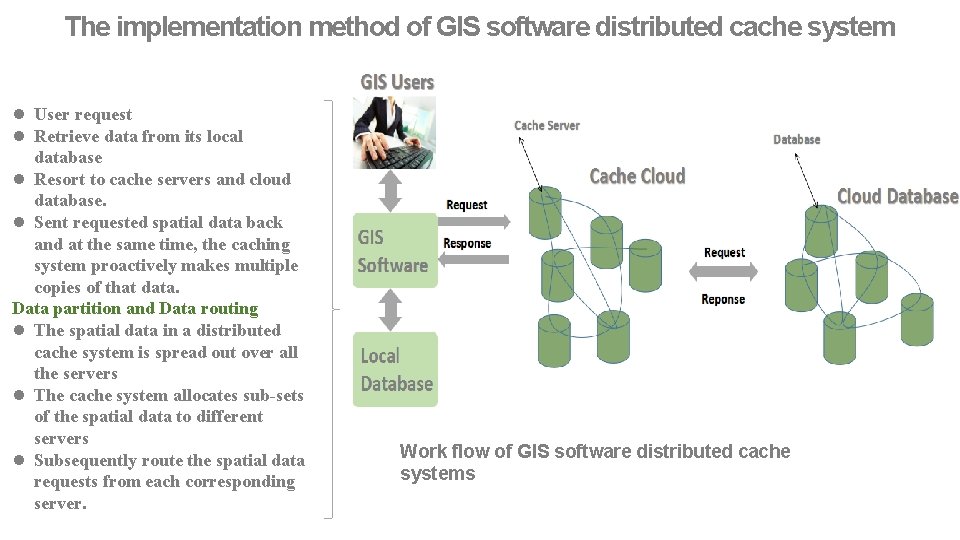
The implementation method of GIS software distributed cache system l User request l Retrieve data from its local database l Resort to cache servers and cloud New Display database. l Sent requested spatial data back and at the same time, the caching system proactively makes multiple copies of that data. Data partition and Data routing l The spatial data in a distributed cache system is spread out over all the servers l The cache system allocates sub-sets of the spatial data to different servers l Subsequently route the spatial data requests from each corresponding server. Work flow of GIS software distributed cache systems
Benefits brought by distributed cache system to Cloud GIS Distributed cache system has greater capability in dealing with the data processing It has the ability to fit the resources needed to cope with loads. Distributed cache system in GIS software can detect unnecessary cache data automatically. High Data Availability

PART 3 Thank you!
- Slides: 21