
Distraction Techniques in Pediatrics During Painful Invasive Procedures
- Slides: 12
+ Distraction Techniques in Pediatrics During Painful Invasive Procedures Kirsten Novak Scientific Writing April 8, 2015
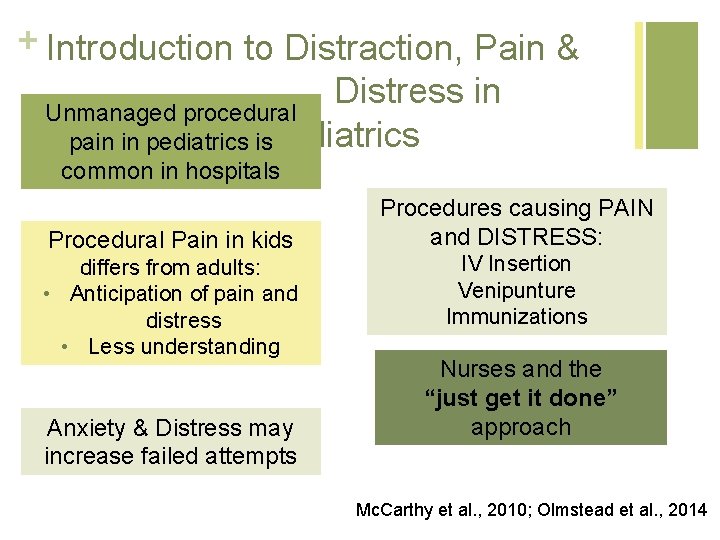
+ Introduction to Distraction, Pain & Distress in Unmanaged procedural pain in pediatrics is. Pediatrics common in hospitals Procedural Pain in kids differs from adults: • Anticipation of pain and distress • Less understanding Anxiety & Distress may increase failed attempts Procedures causing PAIN and DISTRESS: IV Insertion Venipunture Immunizations Nurses and the “just get it done” approach Mc. Carthy et al. , 2010; Olmstead et al. , 2014
+ PICOT Question “In school-aged hospitalized patients, does the use of parental-guided distraction during painful invasive procedures (versus no use of distraction techniques) result in reduction of pain and behavioral distress during the duration of the procedure? ”
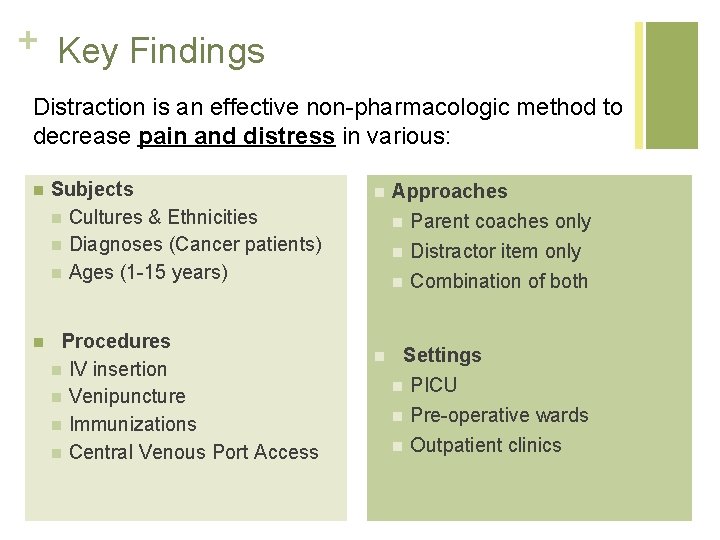
+ Key Findings Distraction is an effective non-pharmacologic method to decrease pain and distress in various: n n Subjects n Cultures & Ethnicities n Diagnoses (Cancer patients) n Ages (1 -15 years) Procedures n IV insertion n Venipuncture n Immunizations n Central Venous Port Access n Approaches n Parent coaches only n n n Distractor item only Combination of both Settings n PICU n Pre-operative wards n Outpatient clinics
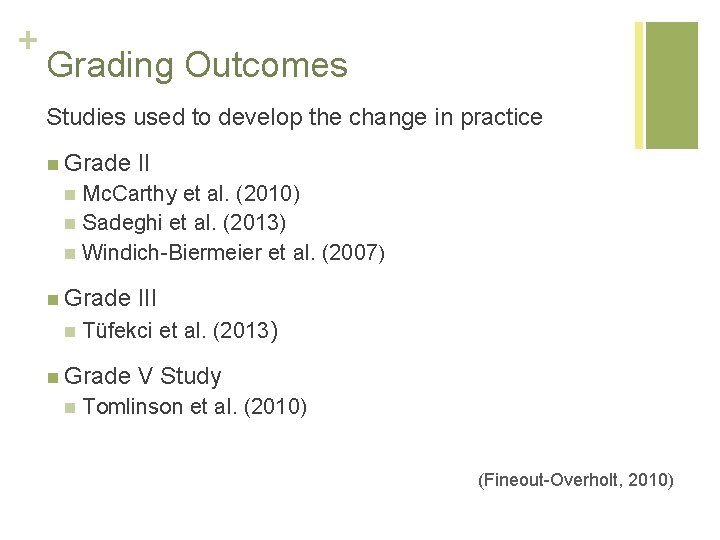
+ Grading Outcomes Studies used to develop the change in practice n Grade II Mc. Carthy et al. (2010) n Sadeghi et al. (2013) n Windich-Biermeier et al. (2007) n n Grade n Tüfekci et al. (2013) n Grade n III V Study Tomlinson et al. (2010) (Fineout-Overholt, 2010)
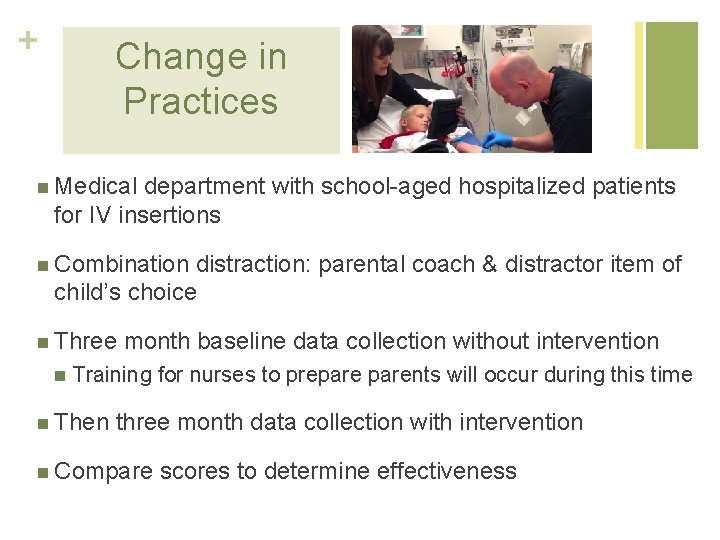
+ Change in Practices n Medical department with school-aged hospitalized patients for IV insertions n Combination distraction: parental coach & distractor item of child’s choice n Three n month baseline data collection without intervention Training for nurses to preparents will occur during this time n Then three month data collection with intervention n Compare scores to determine effectiveness
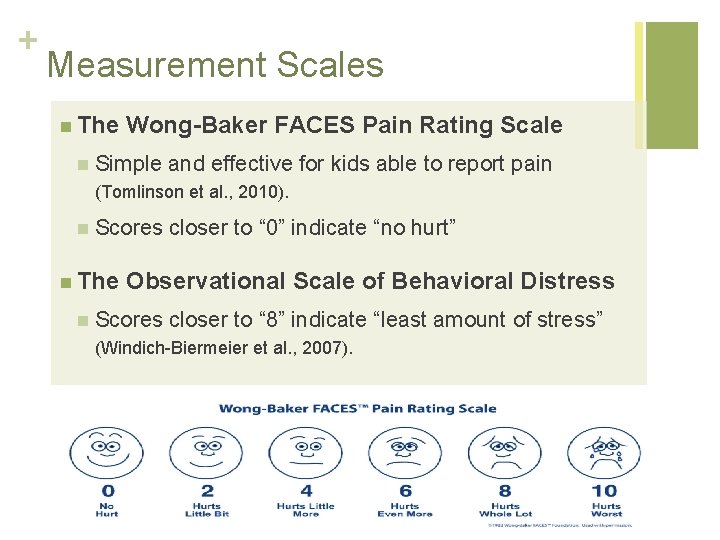
+ Measurement Scales n The n Wong-Baker FACES Pain Rating Scale Simple and effective for kids able to report pain (Tomlinson et al. , 2010). n Scores closer to “ 0” indicate “no hurt” n The n Observational Scale of Behavioral Distress Scores closer to “ 8” indicate “least amount of stress” (Windich-Biermeier et al. , 2007).
+ Potential Barriers n Funding for toys, books, and other distractor items n Patients who do not want their parent in the room during procedure n Parents or nurses disinterested in the intervention n Nurses who are unable to fulfill training n Nurses’ perceived lack of time to participate
+ Ethical Considerations n All patients have the right to controlled and properly managed pain regardless of the cause With the aim to reduce pain and distress n Beneficence n Acting in the best interest of the patient n Non-maleficence n Aims to prevent harm of patient Beauchamp & Childress, 2009
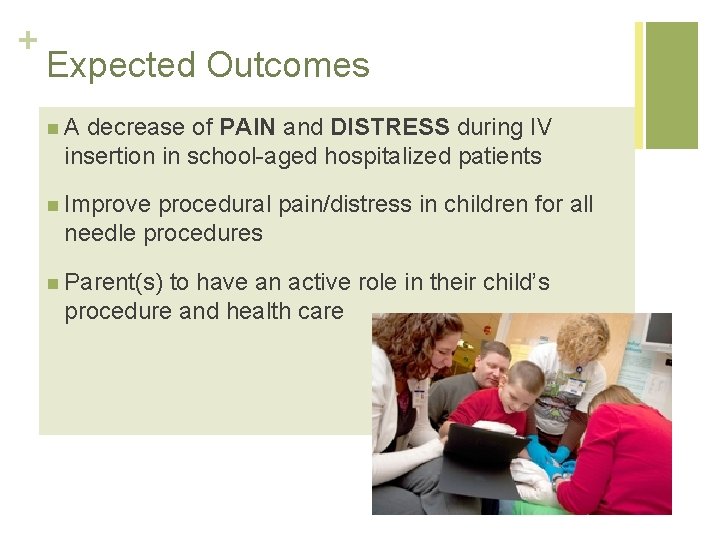
+ Expected Outcomes n. A decrease of PAIN and DISTRESS during IV insertion in school-aged hospitalized patients n Improve procedural pain/distress in children for all needle procedures n Parent(s) to have an active role in their child’s procedure and health care
+ Conclusion PICOT Question Outcome n “In school-aged hospitalized patients the use of parental-guided distraction during painful invasive procedures results in reduced PAIN & DISTRESS during the duration of the procedure versus no distraction techniques” n Recommendations: further implement in departments with needle procedures for school-aged children “An effective, inexpensive, safe, and versatile approach with potential to reduce pain and distress in needle procedures in children” Mc. Carthy et al. , 2010
+ References Fineout-Overholt, E. , Melnyk, B. M. , Stillwell, S. B. , Williamson, K. M. (2010). Critical appraisal of the evidence: Part I. AJN, 110(7). 47 – 52. Mc. Carthy, A. , Kleiber, C. , Hanrahan, K. , Zimmerman, M. , Westhus, N. , & Allen, S. (2010). Impact of parent-provided distraction on child responses to an IV insertion. Children's Health Care, 39(2), 125 -141. doi: 10. 1080/02739611003679915 Olmstead, D. L. , Scott, S. D. , Mayan, M. , Koop, P. M. , & Reid, K. (2014). Influences shaping nurses' use of distraction for children's procedural pain. Journal for Specialists in Pediatric Nursing, 19(2), 162 -171. doi: 10. 1111/jspn. 12067 Sadeghi, T. , Mohammadi, N. , Shamshiri, M. , Bagherzadeh, R. , & Hossinkhani, N. (2013). Effect of distraction on children's pain during intravenous catheter insertion. Journal For Specialists In Pediatric Nursing, 18(2), 109 -114. doi: 10. 1111/jspn. 12018 Tomlinson, D. , von Baeyer, C. , Stinson, J. , & Lillian, S. (2010). A Systematic Review of Faces Scales for the Self-report of Pain Intensity in Children. Pediatrics, 126(5), 999. Tüfekci, F. , Çelebioglu, A. , & Küçükoglu, S. (2009). Turkish children loved distraction: using kaleidoscope to reduce perceived pain during venipuncture. Journal Of Clinical Nursing, 18(15), 2180 -2186. doi: 10. 1111/j. 1365 -2702. 2008. 02775. x Windich-Biermeier, A. , Sjoberg, I. , Dale, J. , Eshelman, D. , & Guzzetta, C. (2007). Effects of distraction on pain, fear, and distress during venous port access and venipuncture in children and adolescents with cancer. Journal Of Pediatric Oncology Nursing, 24(1), 8 -19.