
DISTRACTION OF MAGEC ROD WHY AND WHEN Hilali
- Slides: 11
DISTRACTION OF (MAGEC) ROD WHY AND WHEN ? Hilali Noordeen FRCS Tr & Orth
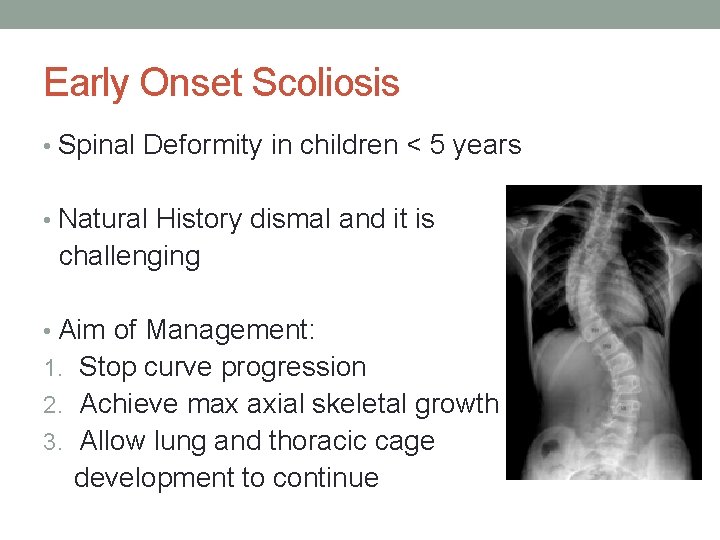
Early Onset Scoliosis • Spinal Deformity in children < 5 years • Natural History dismal and it is challenging • Aim of Management: 1. Stop curve progression 2. Achieve max axial skeletal growth 3. Allow lung and thoracic cage development to continue
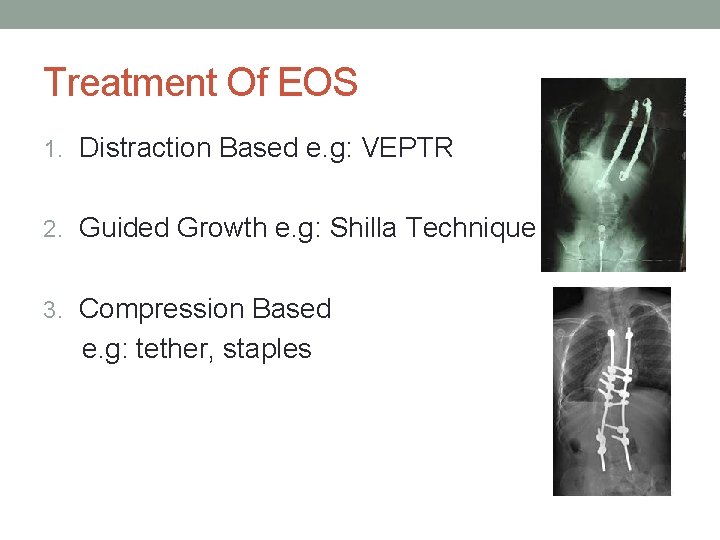
Treatment Of EOS 1. Distraction Based e. g: VEPTR 2. Guided Growth e. g: Shilla Technique 3. Compression Based e. g: tether, staples
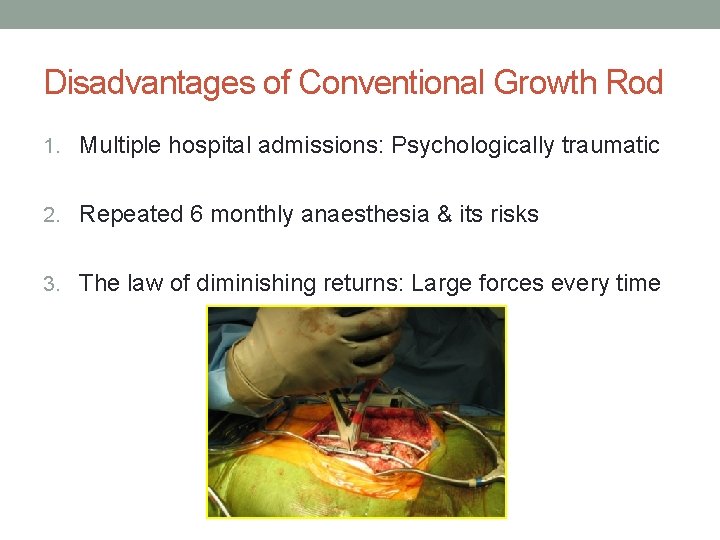
Disadvantages of Conventional Growth Rod 1. Multiple hospital admissions: Psychologically traumatic 2. Repeated 6 monthly anaesthesia & its risks 3. The law of diminishing returns: Large forces every time
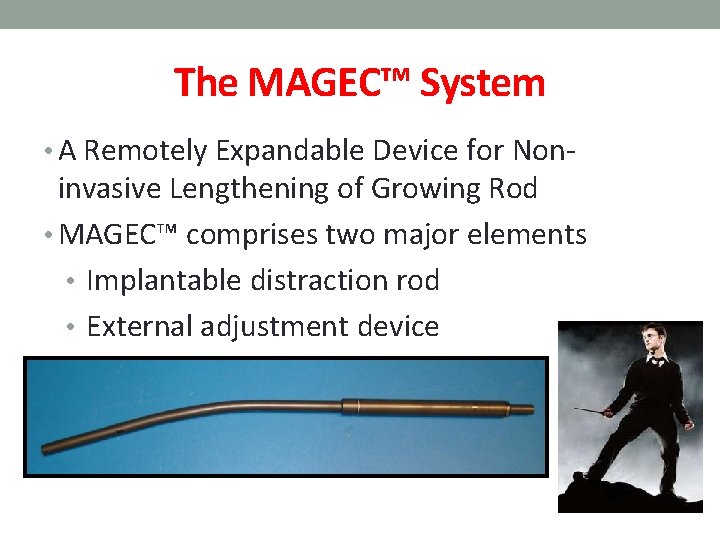
The MAGEC™ System • A Remotely Expandable Device for Non- invasive Lengthening of Growing Rod • MAGEC™ comprises two major elements • Implantable distraction rod • External adjustment device
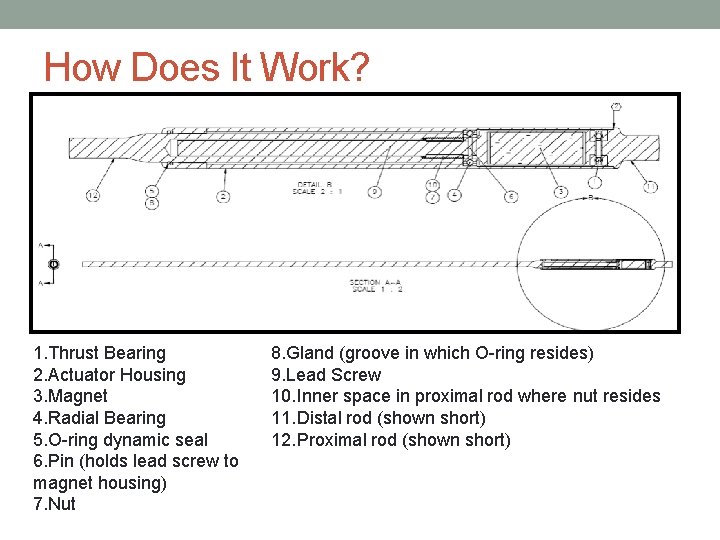
How Does It Work? 1. Thrust Bearing 2. Actuator Housing 3. Magnet 4. Radial Bearing 5. O-ring dynamic seal 6. Pin (holds lead screw to magnet housing) 7. Nut 8. Gland (groove in which O-ring resides) 9. Lead Screw 10. Inner space in proximal rod where nut resides 11. Distal rod (shown short) 12. Proximal rod (shown short)
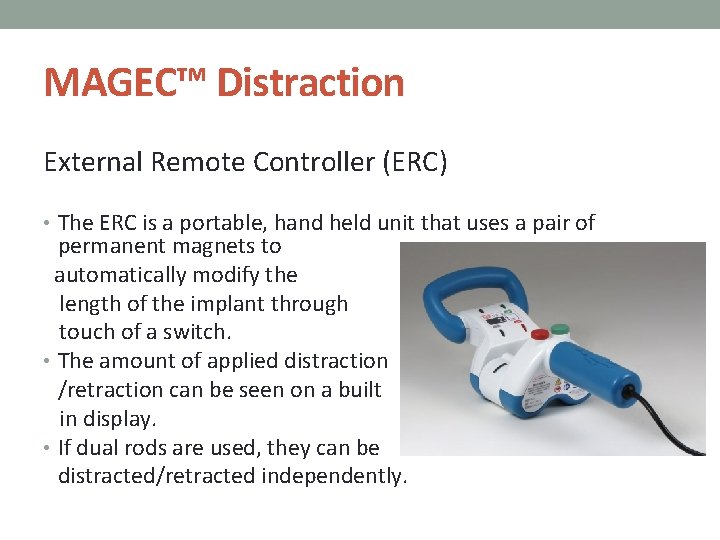
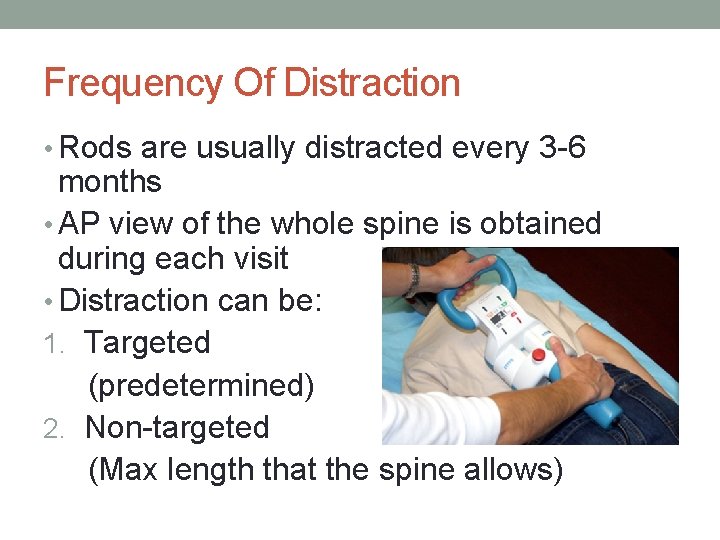
MAGEC™ Distraction External Remote Controller (ERC) • The ERC is a portable, hand held unit that uses a pair of permanent magnets to automatically modify the length of the implant through touch of a switch. • The amount of applied distraction /retraction can be seen on a built in display. • If dual rods are used, they can be distracted/retracted independently.
Advantages of MAGEC 1. One off surgery (EOS in neuromuscular disorders, e. g: SMA) 2. Save theatre time and expenses of repeated surgery 3. Pulmonary Function not compromised 4. Addresses the limitations of VEPTR and Conv. GR
Frequency Of Distraction • Rods are usually distracted every 3 -6 months • AP view of the whole spine is obtained during each visit • Distraction can be: 1. Targeted (predetermined) 2. Non-targeted (Max length that the spine allows)
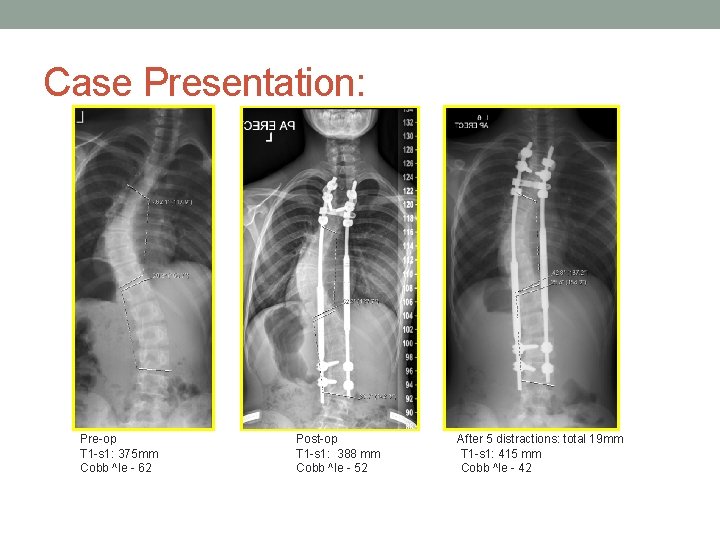
Case Presentation: Pre-op T 1 -s 1: 375 mm Cobb ^le - 62 Post-op T 1 -s 1: 388 mm Cobb ^le - 52 After 5 distractions: total 19 mm T 1 -s 1: 415 mm Cobb ^le - 42
Thank You London 2012 - Opening Ceremony