
Distortion Calibration Vitaliy Orekhov Imaging Robotics Intelligent Systems
Distortion Calibration Vitaliy Orekhov Imaging, Robotics, & Intelligent Systems Laboratory The University of Tennessee Slide
Distortion Calibration 10/28/2020 Slide 2
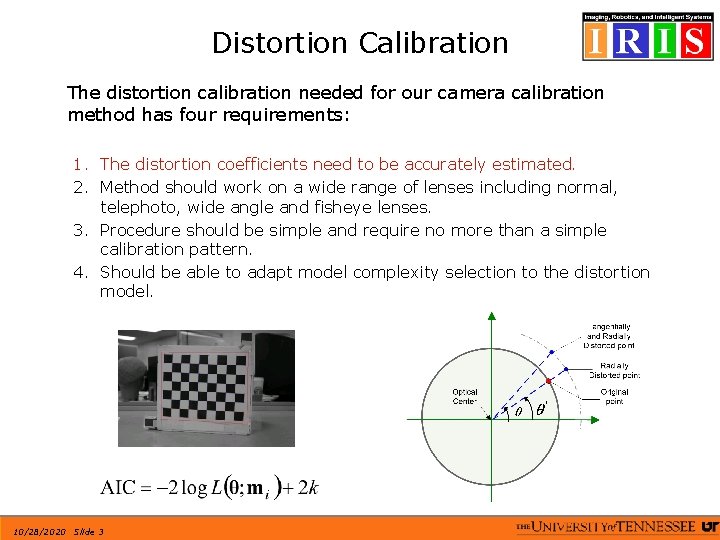
Distortion Calibration The distortion calibration needed for our camera calibration method has four requirements: 1. The distortion coefficients need to be accurately estimated. 2. Method should work on a wide range of lenses including normal, telephoto, wide angle and fisheye lenses. 3. Procedure should be simple and require no more than a simple calibration pattern. 4. Should be able to adapt model complexity selection to the distortion model. 10/28/2020 Slide 3
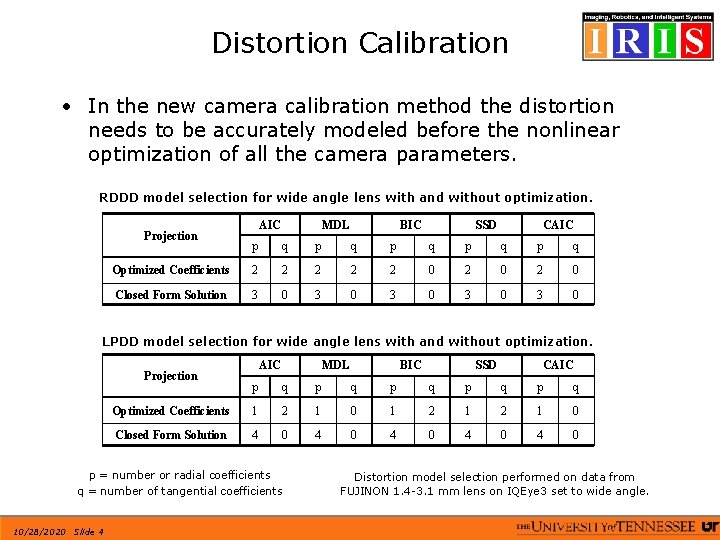
Distortion Calibration • In the new camera calibration method the distortion needs to be accurately modeled before the nonlinear optimization of all the camera parameters. RDDD model selection for wide angle lens with and without optimization. Projection AIC MDL BIC SSD CAIC p q p q p q Optimized Coefficients 2 2 2 0 2 0 Closed Form Solution 3 0 3 0 3 0 LPDD model selection for wide angle lens with and without optimization. Projection AIC MDL SSD CAIC p q p q p q Optimized Coefficients 1 2 1 0 Closed Form Solution 4 0 4 0 4 0 p = number or radial coefficients q = number of tangential coefficients 10/28/2020 Slide 4 BIC Distortion model selection performed on data from FUJINON 1. 4 -3. 1 mm lens on IQEye 3 set to wide angle.
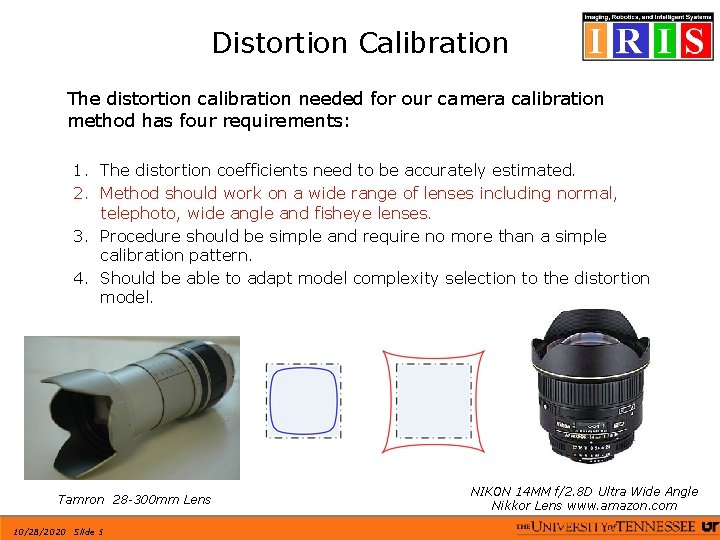
Distortion Calibration The distortion calibration needed for our camera calibration method has four requirements: 1. The distortion coefficients need to be accurately estimated. 2. Method should work on a wide range of lenses including normal, telephoto, wide angle and fisheye lenses. 3. Procedure should be simple and require no more than a simple calibration pattern. 4. Should be able to adapt model complexity selection to the distortion model. Tamron 28 -300 mm Lens 10/28/2020 Slide 5 NIKON 14 MM f/2. 8 D Ultra Wide Angle Nikkor Lens www. amazon. com
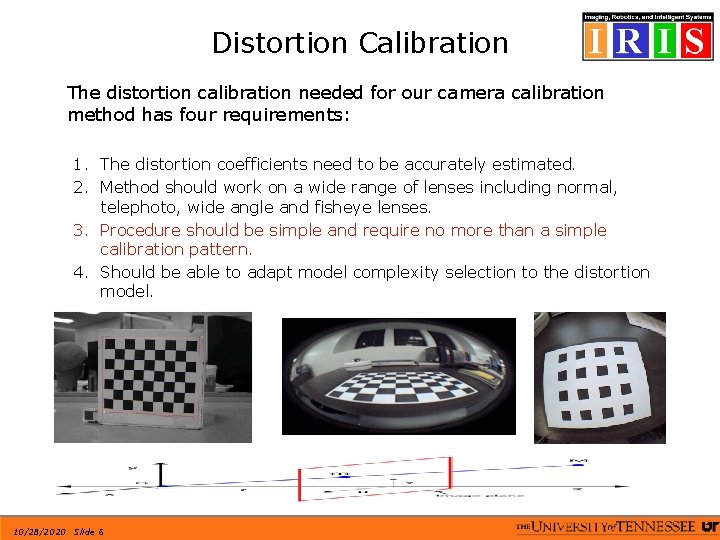
Distortion Calibration The distortion calibration needed for our camera calibration method has four requirements: 1. The distortion coefficients need to be accurately estimated. 2. Method should work on a wide range of lenses including normal, telephoto, wide angle and fisheye lenses. 3. Procedure should be simple and require no more than a simple calibration pattern. 4. Should be able to adapt model complexity selection to the distortion model. 10/28/2020 Slide 6
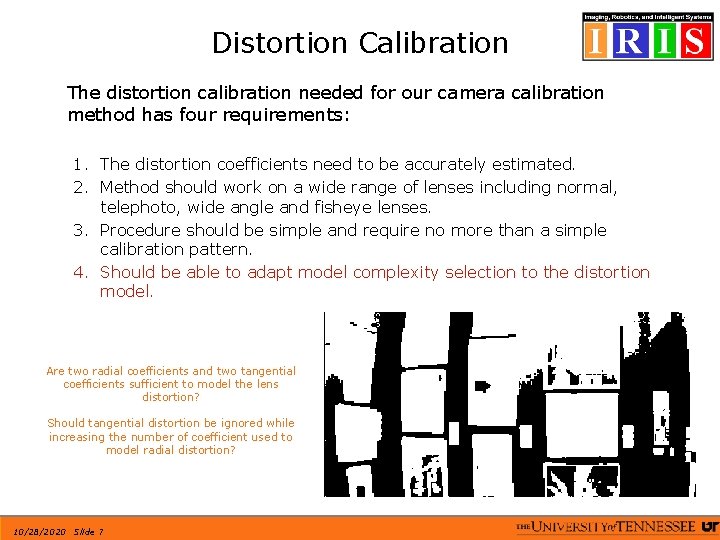
Distortion Calibration The distortion calibration needed for our camera calibration method has four requirements: 1. The distortion coefficients need to be accurately estimated. 2. Method should work on a wide range of lenses including normal, telephoto, wide angle and fisheye lenses. 3. Procedure should be simple and require no more than a simple calibration pattern. 4. Should be able to adapt model complexity selection to the distortion model. Are two radial coefficients and two tangential coefficients sufficient to model the lens distortion? Should tangential distortion be ignored while increasing the number of coefficient used to model radial distortion? 10/28/2020 Slide 7
Distortion Calibration Using Lines Distortion Calibration Using Point Correspondences 10/28/2020 Slide 8
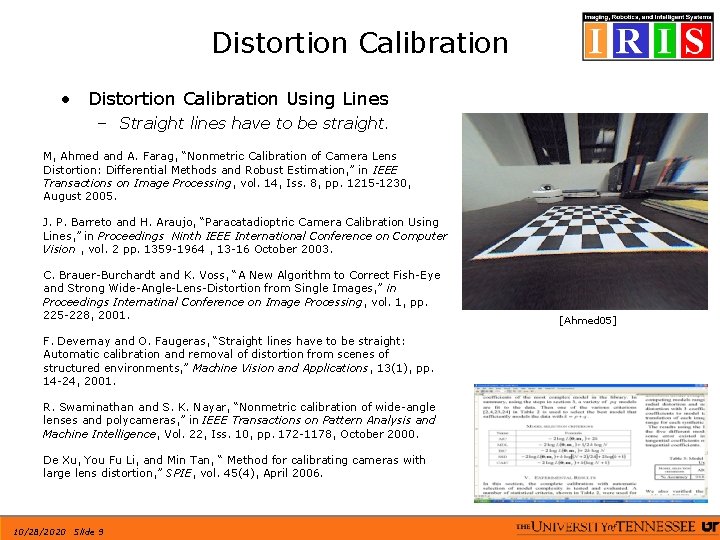
Distortion Calibration • Distortion Calibration Using Lines – Straight lines have to be straight. M, Ahmed and A. Farag, “Nonmetric Calibration of Camera Lens Distortion: Differential Methods and Robust Estimation, ” in IEEE Transactions on Image Processing, vol. 14, Iss. 8, pp. 1215 -1230, August 2005. J. P. Barreto and H. Araujo, “Paracatadioptric Camera Calibration Using Lines, ” in Proceedings Ninth IEEE International Conference on Computer Vision , vol. 2 pp. 1359 -1964 , 13 -16 October 2003. C. Brauer-Burchardt and K. Voss, “A New Algorithm to Correct Fish-Eye and Strong Wide-Angle-Lens-Distortion from Single Images, ” in Proceedings Internatinal Conference on Image Processing, vol. 1, pp. 225 -228, 2001. F. Devernay and O. Faugeras, “Straight lines have to be straight: Automatic calibration and removal of distortion from scenes of structured environments, ” Machine Vision and Applications, 13(1), pp. 14 -24, 2001. R. Swaminathan and S. K. Nayar, “Nonmetric calibration of wide-angle lenses and polycameras, ” in IEEE Transactions on Pattern Analysis and Machine Intelligence, Vol. 22, Iss. 10, pp. 172 -1178, October 2000. De Xu, You Fu Li, and Min Tan, “ Method for calibrating cameras with large lens distortion, ” SPIE, vol. 45(4), April 2006. 10/28/2020 Slide 9 [Ahmed 05]
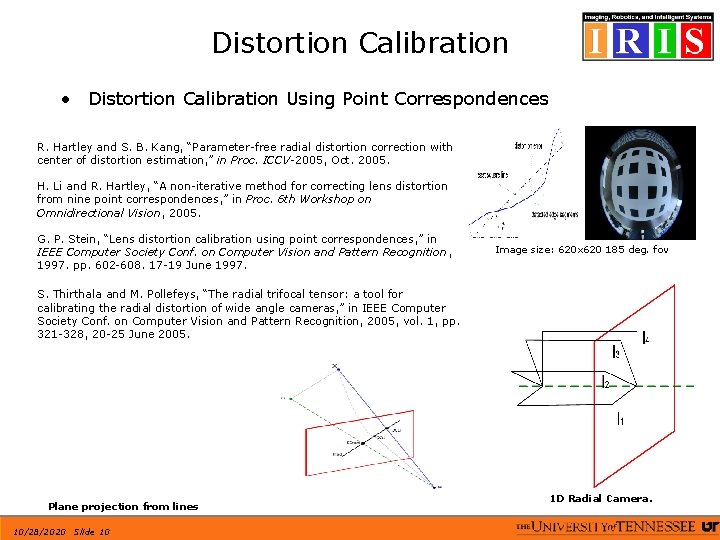
Distortion Calibration • Distortion Calibration Using Point Correspondences R. Hartley and S. B. Kang, “Parameter-free radial distortion correction with center of distortion estimation, ” in Proc. ICCV-2005, Oct. 2005. H. Li and R. Hartley, “A non-iterative method for correcting lens distortion from nine point correspondences, ” in Proc. 6 th Workshop on Omnidirectional Vision, 2005. G. P. Stein, “Lens distortion calibration using point correspondences, ” in IEEE Computer Society Conf. on Computer Vision and Pattern Recognition, 1997. pp. 602 -608. 17 -19 June 1997. Image size: 620 x 620 185 deg. fov S. Thirthala and M. Pollefeys, “The radial trifocal tensor: a tool for calibrating the radial distortion of wide angle cameras, ” in IEEE Computer Society Conf. on Computer Vision and Pattern Recognition, 2005, vol. 1, pp. 321 -328, 20 -25 June 2005. Plane projection from lines 10/28/2020 Slide 10 1 D Radial Camera.
Thank you Suggestions/Comments/Questions 10/28/2020 Slide 11
- Slides: 11