
Distance vs Time Graphs Reaction Force This is
- Slides: 2
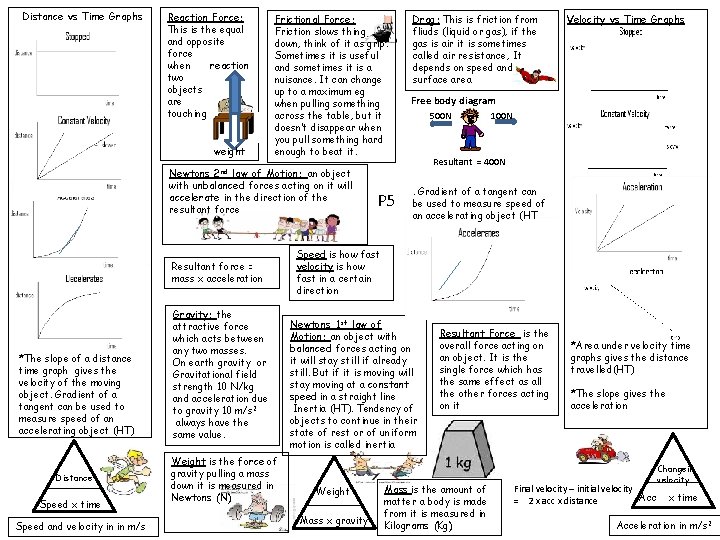
Distance vs Time Graphs Reaction Force: This is the equal and opposite force when reaction two objects are touching weight Frictional Force: Friction slows thing down, think of it as grip. Sometimes it is useful and sometimes it is a nuisance. It can change up to a maximum eg when pulling something across the table, but it doesn’t disappear when you pull something hard enough to beat it. Newtons 2 nd law of Motion: an object with unbalanced forces acting on it will accelerate in the direction of the resultant force Resultant force = mass x acceleration *The slope of a distance time graph gives the velocity of the moving object. Gradient of a tangent can be used to measure speed of an accelerating object (HT) Distance Speed x time Speed and velocity in in m/s Gravity: the attractive force which acts between any two masses. On earth gravity or Gravitational field strength 10 N/kg and acceleration due to gravity 10 m/s 2 always have the same value. Weight is the force of gravity pulling a mass down it is measured in Newtons (N) P 5 Drag: This is friction from fliuds (liquid or gas), if the gas is air it is sometimes called air resistance, It depends on speed and surface area Velocity vs Time Graphs Free body diagram 500 N 100 N Resultant = 400 N. Gradient of a tangent can be used to measure speed of an accelerating object (HT Speed is how fast velocity is how fast in a certain direction Newtons 1 st law of Motion: an object with balanced forces acting on it will stay still if already still. But if it is moving will stay moving at a constant speed in a straight line Inertia (HT). Tendency of objects to continue in their state of rest or of uniform motion is called inertia Weight Mass x gravity Resultant Force is the overall force acting on an object. It is the single force which has the same effect as all the other forces acting on it Mass is the amount of matter a body is made from it is measured in Kilograms (Kg) *Area under velocity time graphs gives the distance travelled(HT) *The slope gives the acceleration Final velocity – initial velocity Acc = 2 x acc x distance Changein velocity x time Acceleration in m/s 2
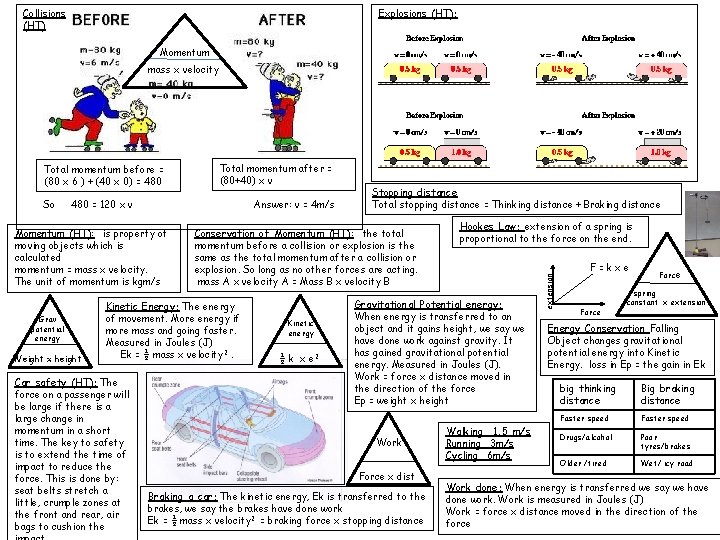
Collisions (HT) Explosions (HT): Momentum mass x velocity So Total momentum after = (80+40) x v 480 = 120 x v Answer: v = 4 m/s Momentum (HT): is property of moving objects which is calculated momentum = mass x velocity. The unit of momentum is kgm/s Grav potential energy Weight x height Conservation of Momentum (HT): the total momentum before a collision or explosion is the same as the total momentum after a collision or explosion. So long as no other forces are acting. mass A x velocity A = Mass B x velocity B Kinetic Energy: The energy of movement. More energy if more mass and going faster. Measured in Joules (J) Ek = ½ mass x velocity 2. Car safety (HT): The force on a passenger will be large if there is a large change in momentum in a short time. The key to safety is to extend the time of impact to reduce the force. This is done by: seat belts stretch a little, crumple zones at the front and rear, air bags to cushion the Stopping distance Total stopping distance = Thinking distance + Braking distance Kinetic energy ½ k x e 2 Hookes Law: extension of a spring is proportional to the force on the end. Gravitational Potential energy: When energy is transferred to an object and it gains height, we say we have done work against gravity. It has gained gravitational potential energy. Measured in Joules (J). Work = force x distance moved in the direction of the force Ep = weight x height Work Force x dist Braking a car: The kinetic energy, Ek is transferred to the brakes, we say the brakes have done work Ek = ½ mass x velocity 2 = braking force x stopping distance Walking 1. 5 m/s Running 3 m/s Cycling 6 m/s extension Total momentum before = (80 x 6 ) + (40 x 0) = 480 F=kxe Force spring constant x extension Energy Conservation Falling Object changes gravitational potential energy into Kinetic Energy. loss in Ep = the gain in Ek big thinking distance Big braking distance Faster speed Drugs/alcohol Poor tyres/brakes Older /tired Wet/ icy road Work done: When energy is transferred we say we have done work. Work is measured in Joules (J) Work = force x distance moved in the direction of the force