
Distance Perception in Real and Virtual Environments Jodie


- Slides: 21
Distance Perception in Real and Virtual Environments Jodie M. Plumert Department of Psychology Joseph K. Kearney James F. Cremer Department Of Computer Science University of Iowa
Virtual Environments as Laboratories for Studying Behavior • Gaining widespread acceptance – Driving (Uc, Rizzo, Shi, Anderson, and Dawson, 2004; Lee, Mc. Gehee, Brown, & Reyes, in press) – Bicycling (Plumert, Kearney, & Cremer, 2004) – Navigating (Murray, Bowers, West, Pettifer, & Gibson, 2000; Warren, Tarr, & Kaebling, NEVLab; Bowman, Davis, Badre, & Hodges, 1999) • Advantages – Near natural – Highly controlled – Safe • Issues – Are virtual environments “real” enough? – How well do people perceive distance in VE?
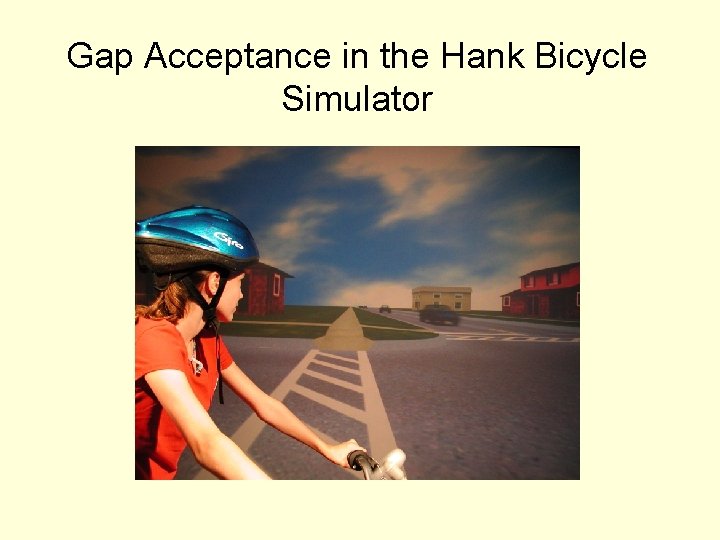
Gap Acceptance in the Hank Bicycle Simulator
Perceiving Distance in the Real World • How well do people perceive absolute distance from self? (egocentric distance) • Visually guided judgments – Matching depth/frontal intervals (Gilinsky, 1951, Harway, 1963, Loomis et al. , 1992) – People typically underestimate distance • Visually directed action – Walking to target with eyes closed (Loomis et al. , 1992, Philbeck & Loomis, 1997, Rieser et al. , 1990) – People quite accurate up to 20 m. – People tend to underestimate beyond 20 m.
Perceiving Distance in Virtual Worlds • Distance perception with HMDs – Triangulation (Loomis & Knapp, 2003) • People view a target, turn and walk a short distance, then point back at target. • Pointing errors indicated that people undershot distances. – Blindfolded walking (Whitmer & Sadowski, 1998) • Compared blindfolded walking in a real hallway with blindfolded walking on a treadmill in a virtual hallway. • Mean error similar, but unsigned relative error greater in virtual than real environment. • People made greater errors in both environments when they experienced the virtual environment first. • Distance perception with large screen immersive display systems (LSIDs)?
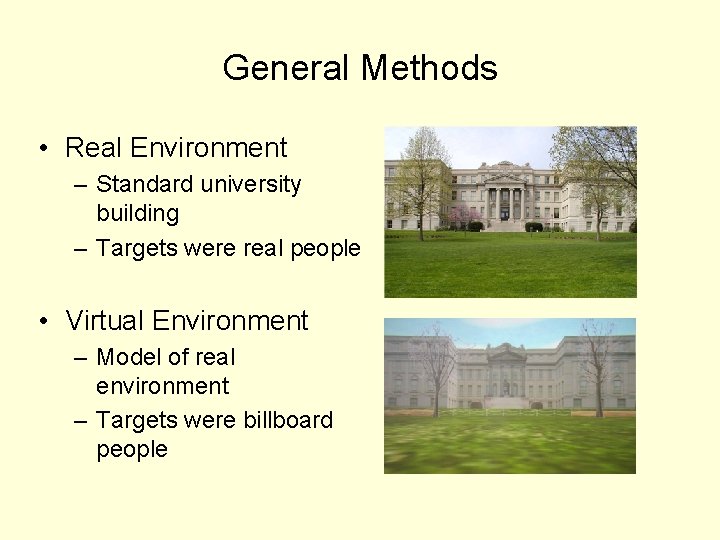
General Methods • Real Environment – Standard university building – Targets were real people • Virtual Environment – Model of real environment – Targets were billboard people
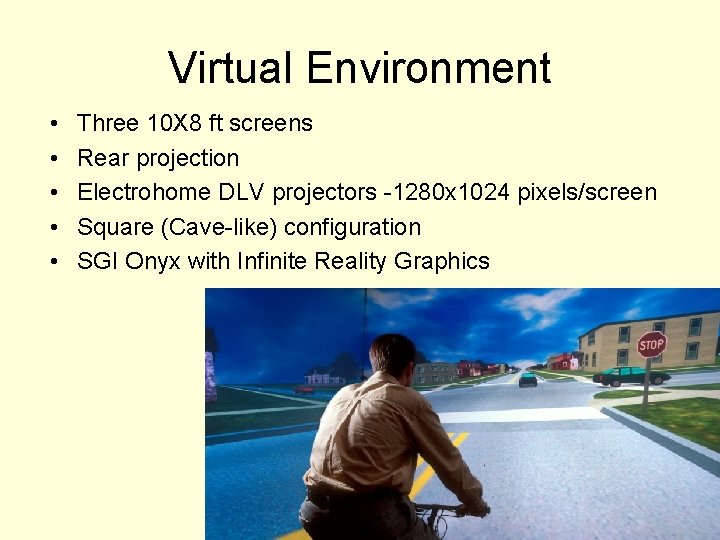
Virtual Environment • • • Three 10 X 8 ft screens Rear projection Electrohome DLV projectors -1280 x 1024 pixels/screen Square (Cave-like) configuration SGI Onyx with Infinite Reality Graphics
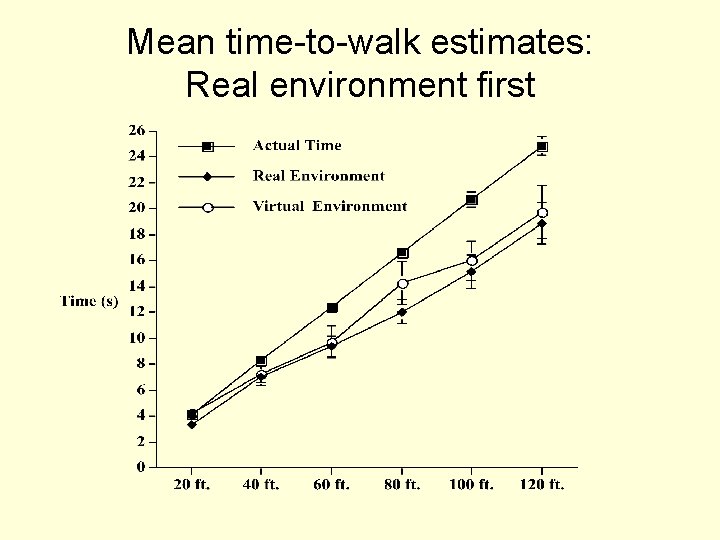
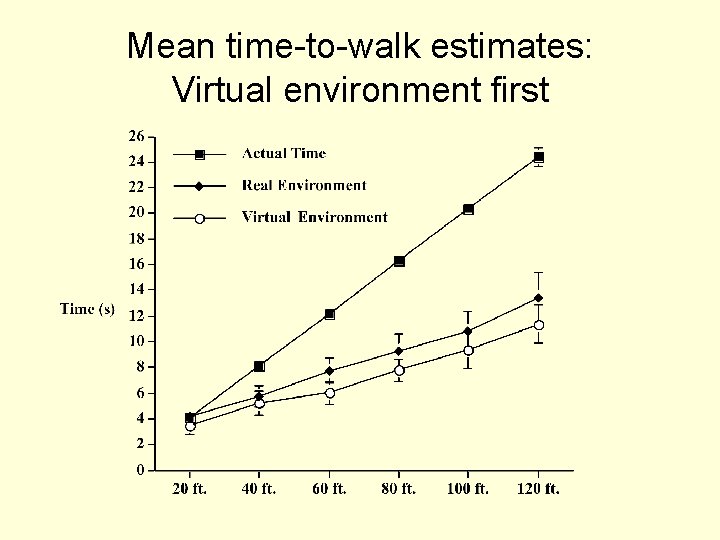
Experiment 1 • Subjects: 24 undergraduates • Procedure – Baseline walking • Timed normal walking to derive estimate of walking speed – Distance estimates • Presented 6 randomly ordered distances (20, 40, 60, 80, 100, and 120 ft) in each environment (order counterbalanced) • Subjects estimated how long it would take to walk to the target by starting and stopping a stopwatch (without looking at the stopwatch) • Measures – Actual time to walk • Calculated expected time to walk each distance from baseline walking speed – Estimated time to walk • Elapsed time on a stop watch
Results Two primary questions: 1. How closely did time-to-walk estimates correspond in real and virtual environments? 2. How closely did time estimates in the real and virtual environments correspond to actual times?
Mean time-to-walk estimates: Real environment first
Mean time-to-walk estimates: Virtual environment first
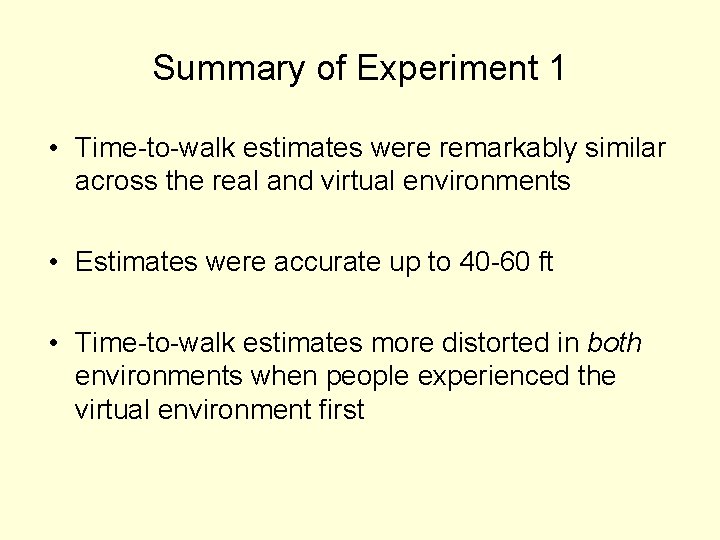
Summary of Experiment 1 • Time-to-walk estimates were remarkably similar across the real and virtual environments • Estimates were accurate up to 40 -60 ft • Time-to-walk estimates more distorted in both environments when people experienced the virtual environment first
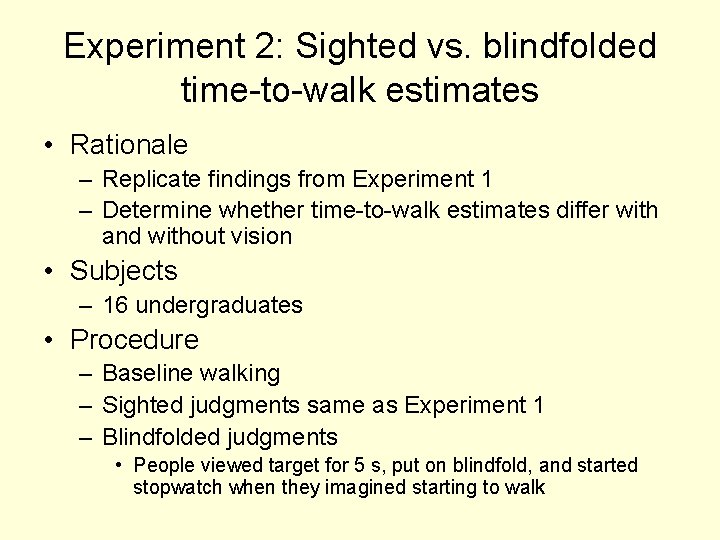
Experiment 2: Sighted vs. blindfolded time-to-walk estimates • Rationale – Replicate findings from Experiment 1 – Determine whether time-to-walk estimates differ with and without vision • Subjects – 16 undergraduates • Procedure – Baseline walking – Sighted judgments same as Experiment 1 – Blindfolded judgments • People viewed target for 5 s, put on blindfold, and started stopwatch when they imagined starting to walk
Mean sighted time-to-walk estimates
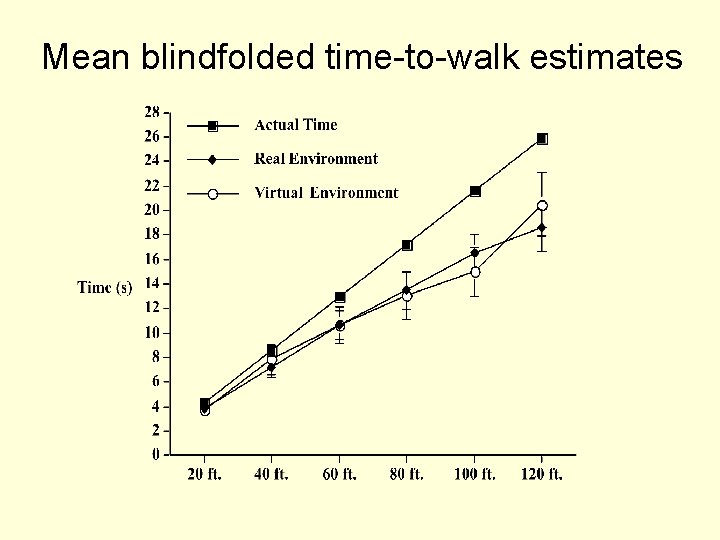
Mean blindfolded time-to-walk estimates
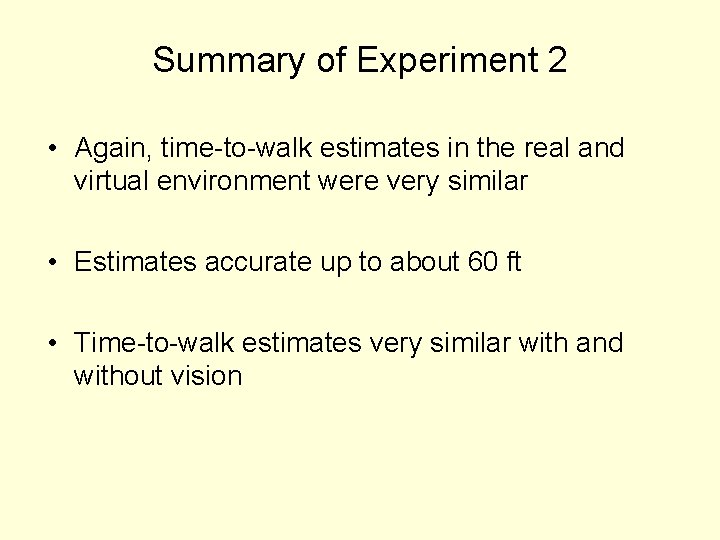
Summary of Experiment 2 • Again, time-to-walk estimates in the real and virtual environment were very similar • Estimates accurate up to about 60 ft • Time-to-walk estimates very similar with and without vision
Conclusions Time-to-walk estimates are: • • • Highly similar in real and virtual environments Accurate for distances of 20 -60 ft Underestimated for distances beyond 60 ft
Why the Difference? • The Environment • Time-to-walk measure
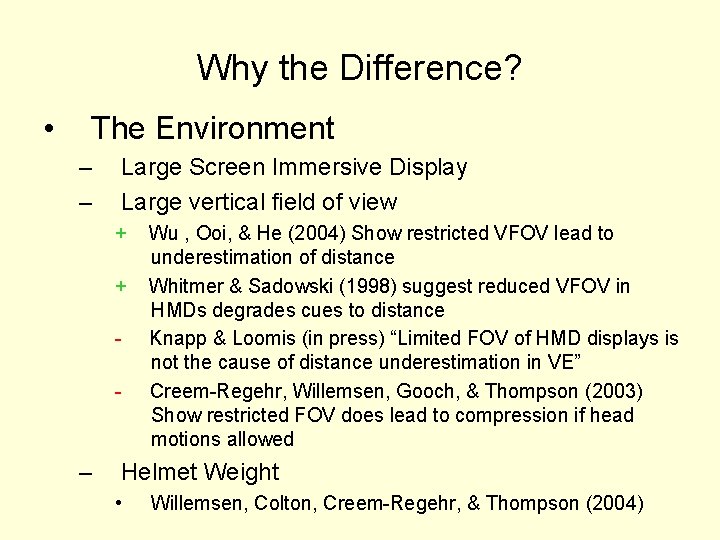
Why the Difference? • The Environment – – Large Screen Immersive Display Large vertical field of view + + - – Wu , Ooi, & He (2004) Show restricted VFOV lead to underestimation of distance Whitmer & Sadowski (1998) suggest reduced VFOV in HMDs degrades cues to distance Knapp & Loomis (in press) “Limited FOV of HMD displays is not the cause of distance underestimation in VE” Creem-Regehr, Willemsen, Gooch, & Thompson (2003) Show restricted FOV does lead to compression if head motions allowed Helmet Weight • Willemsen, Colton, Creem-Regehr, & Thompson (2004)
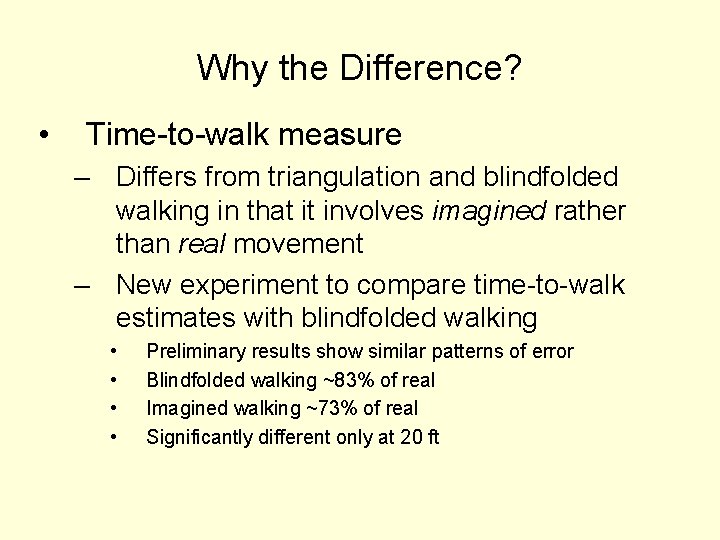
Why the Difference? • Time-to-walk measure – Differs from triangulation and blindfolded walking in that it involves imagined rather than real movement – New experiment to compare time-to-walk estimates with blindfolded walking • • Preliminary results show similar patterns of error Blindfolded walking ~83% of real Imagined walking ~73% of real Significantly different only at 20 ft
Acknowledgments • NSF Support: INT-9724746, EIA-0130864, and IIS-0002535 • Students and staff for helping with this research: David Schwebel Penney Nichols-Whitehead Jennifer Lee Sarah Rains Sara Koschmeder Ben Fraga Kim Schroeder Stephanie Dawes Lloyd Frei Keith Miller Geb Thomas Pete Willemsen Hong. Ling Wang Steffan Munteanu Joan Severson Tom Drewes Forrest Meggers Paul Debbins Bohong Zhang Zhi-hong Wang Xiao-Qian Jiang