
Distance Measurement Three Types of Distances Vertical Horizontal




- Slides: 28
Distance Measurement
Three Types of Distances Vertical Horizontal Slope
Techniques of Distance Measurement Pacing Electronic distance measurement (EDM) Fiberglass tapes Steel tapes
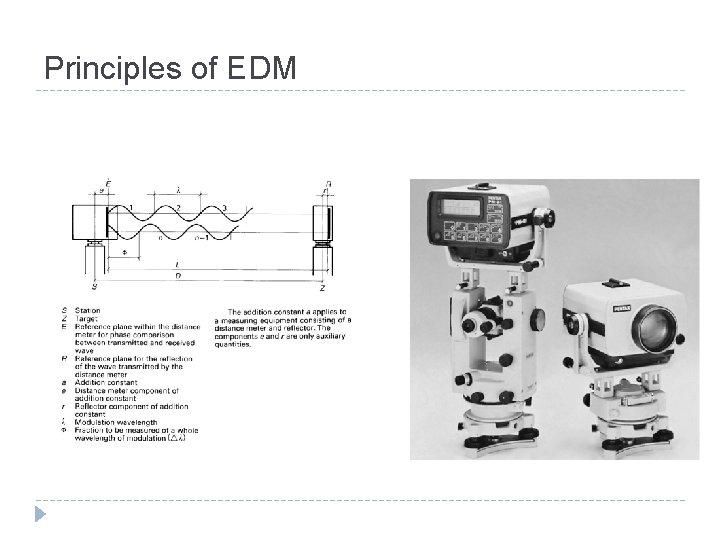
Techniques of Distance Measurement Pacing is a useful method of approximate measure. Another important use for pacing is for a rough check for all key points in construction layouts. Electronic distance measurement (EDM) function by sending a light wave along the path to be measured from the instrument station, and then the instrument measures the difference between the transmitted light wave and the light wave as it is refelected back from the prism.
Principles of EDM
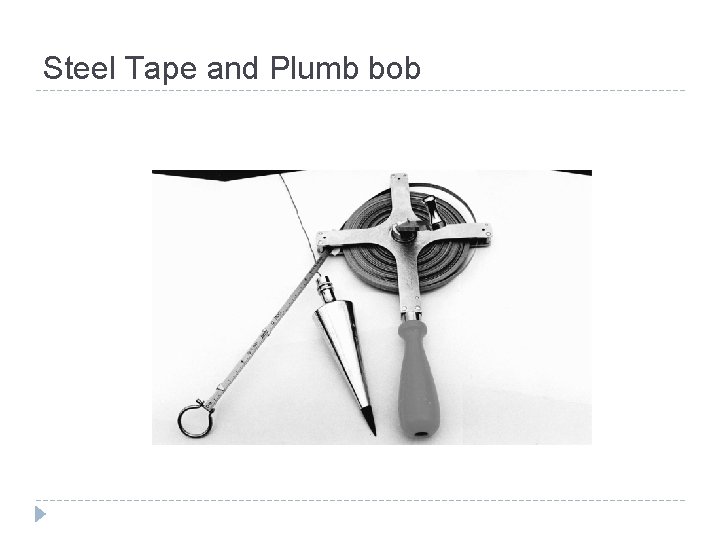
Steel Tape and Plumb bob
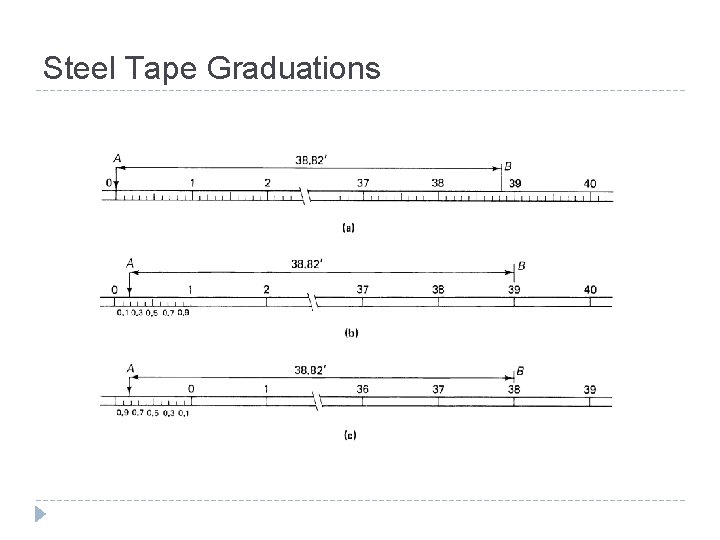
Steel Tape Graduations Graduated throughout Cut tape Add tape
Steel Tape Graduations
Taping Steps 1 - carries the tape forward , ensuring the tape is free of loops. 2 - prepare ground surface for the mark 3 - Applies proper tension after ensuring that the tape is straight. 4 - place marks (wooden stakes, iron bars) 5 - Take and record the measurements of distances
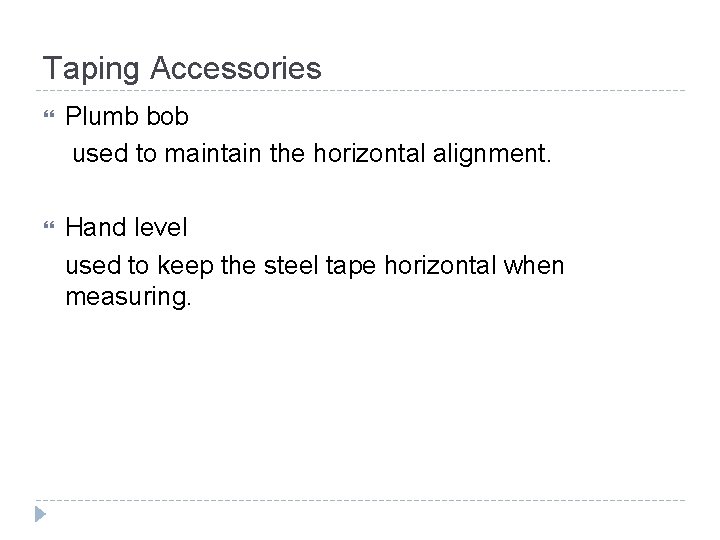
Taping Accessories Plumb bob used to maintain the horizontal alignment. Hand level used to keep the steel tape horizontal when measuring.
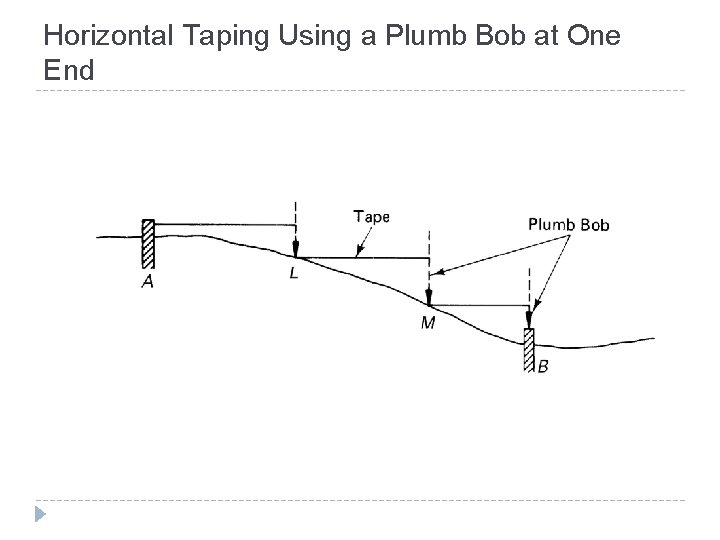
Horizontal Taping Using a Plumb Bob at One End
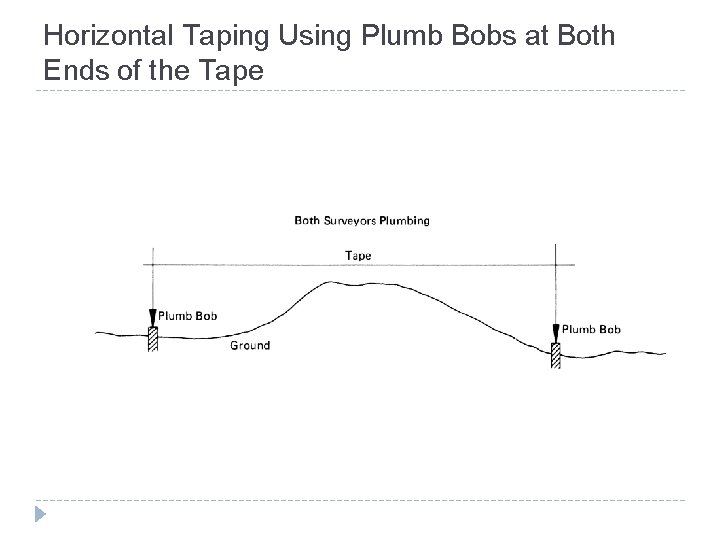
Horizontal Taping Using Plumb Bobs at Both Ends of the Tape
Hand Level
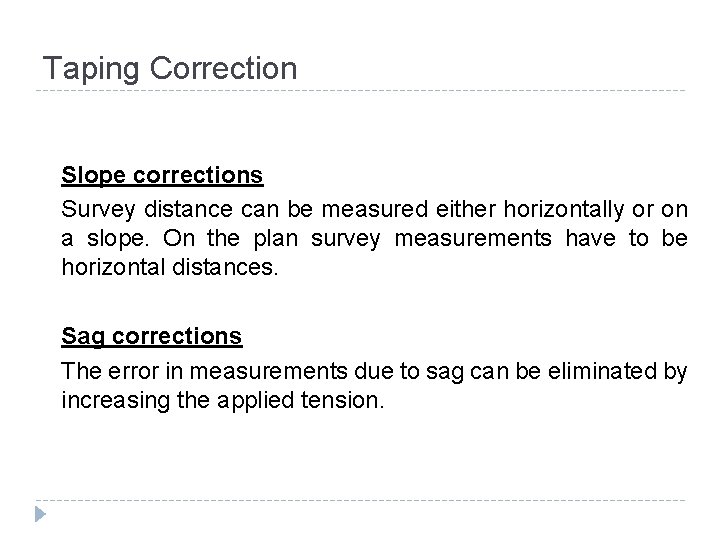
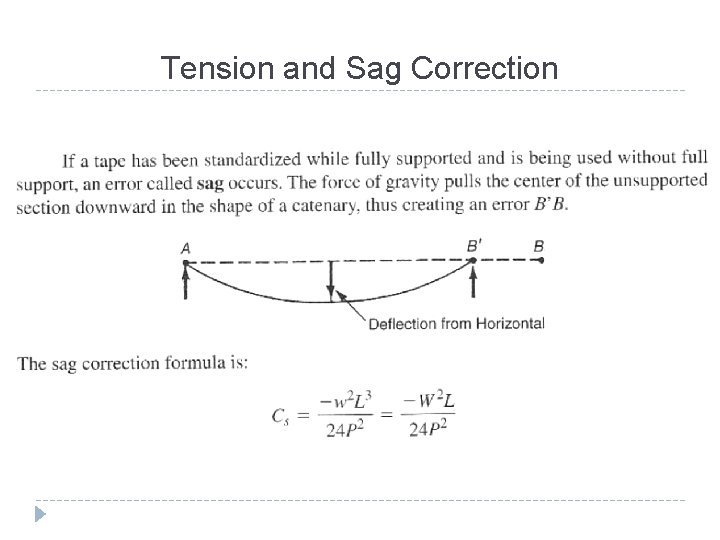
Taping Correction Slope corrections Survey distance can be measured either horizontally or on a slope. On the plan survey measurements have to be horizontal distances. Sag corrections The error in measurements due to sag can be eliminated by increasing the applied tension.
Systematic Taping Errors Slope can be defined as a gradient or rate of grade. The gradient is expressed as a ratio of the vertical distance over the horizontal distance. This ratio when multiplied by 100 will give a percentage gradient. Erroneous length Temperature Tension and Sag
Random Taping errors Slope (Estimating Horizontal) Temperature Tension and sag Alignment Marking and Plumbing
Mistakes Taping Measuring from wrong marker Reading the tape incorrectly or transporting figures Recording the value incorrectly in the notes. Making arithmetic mistakes in some of dimensions and error mistakes. how to avoid this mistake?
Example 1: A road centerline gradient falls from station 0+00 with an elevation of 564. 22 m to station 1+50 at rate -2. 5%. What is the elevation at station 1+50?
Example 2: A road run from a station 1+00 with an elevation of 471. 37 m to station 4+37. 25 m with an elevation of 476. 77 m. What is the slope of grade line?
Example 3: A measurements was recorded as 171. 278 m with a 30 m-tape that was only 29. 996 m under standard conditions. What is the corrected measurements?
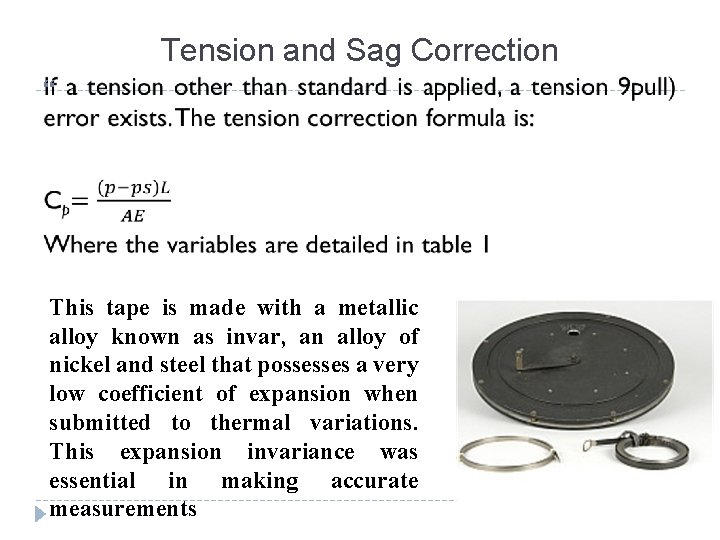
Tension and Sag Correction This tape is made with a metallic alloy known as invar, an alloy of nickel and steel that possesses a very low coefficient of expansion when submitted to thermal variations. This expansion invariance was essential in making accurate measurements
Tension and Sag Correction
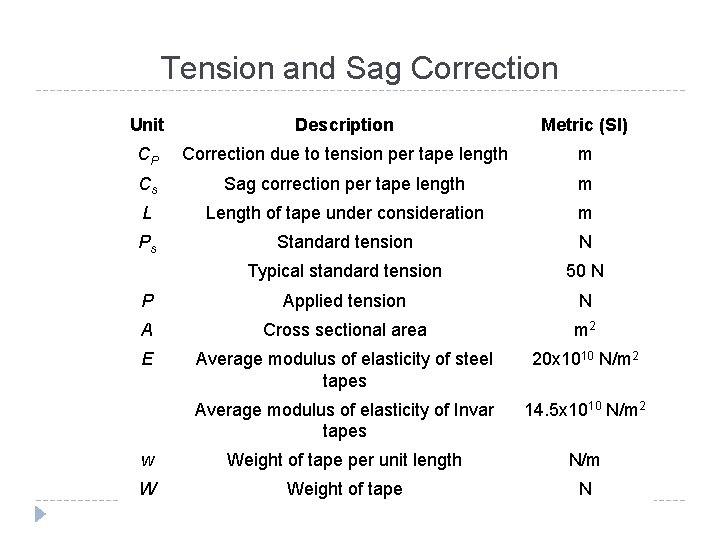
Tension and Sag Correction Unit Description Metric (SI) CP Correction due to tension per tape length m Cs Sag correction per tape length m L Length of tape under consideration m Ps Standard tension N Typical standard tension 50 N P Applied tension N A Cross sectional area m 2 E Average modulus of elasticity of steel tapes 20 x 1010 N/m 2 Average modulus of elasticity of Invar tapes 14. 5 x 10¹⁰ N/m 2 w Weight of tape per unit length N/m W Weight of tape N
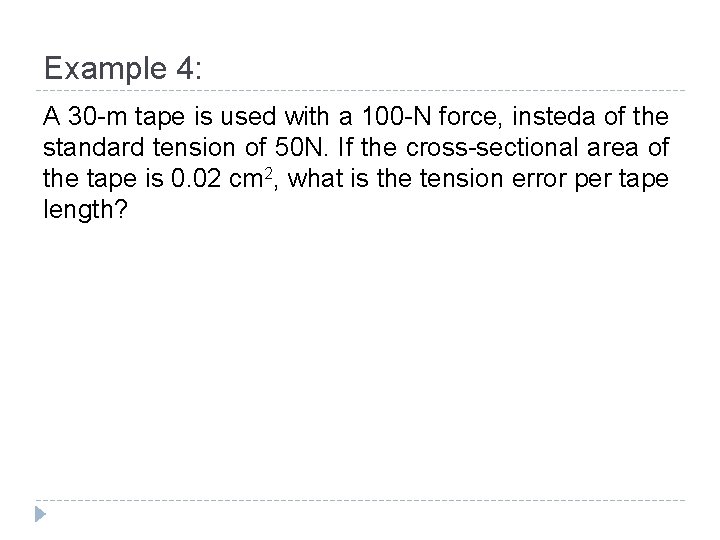
Example 4: A 30 -m tape is used with a 100 -N force, insteda of the standard tension of 50 N. If the cross-sectional area of the tape is 0. 02 cm 2, what is the tension error per tape length?
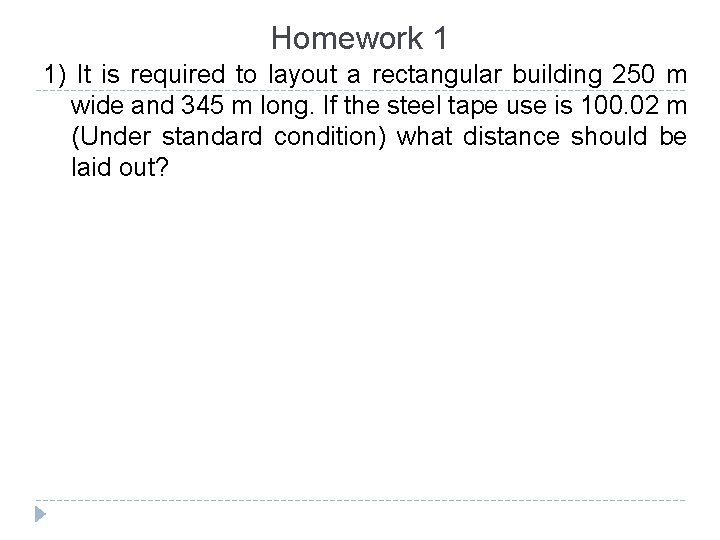
Homework 1 1) It is required to layout a rectangular building 250 m wide and 345 m long. If the steel tape use is 100. 02 m (Under standard condition) what distance should be laid out?
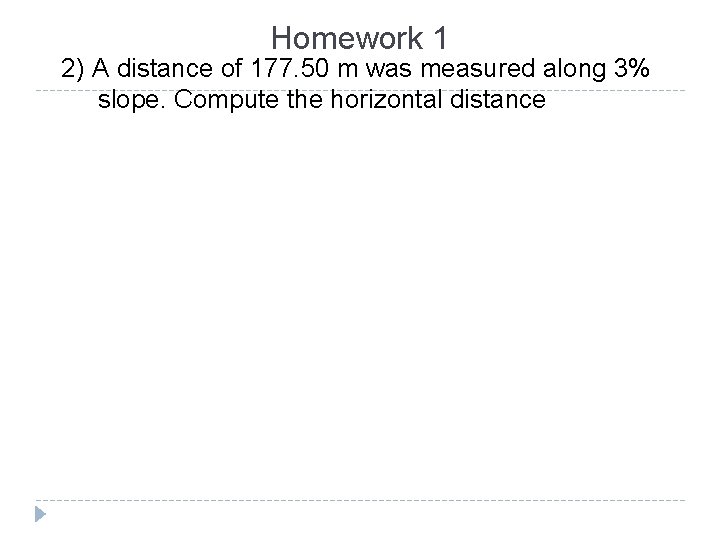
Homework 1 2) A distance of 177. 50 m was measured along 3% slope. Compute the horizontal distance
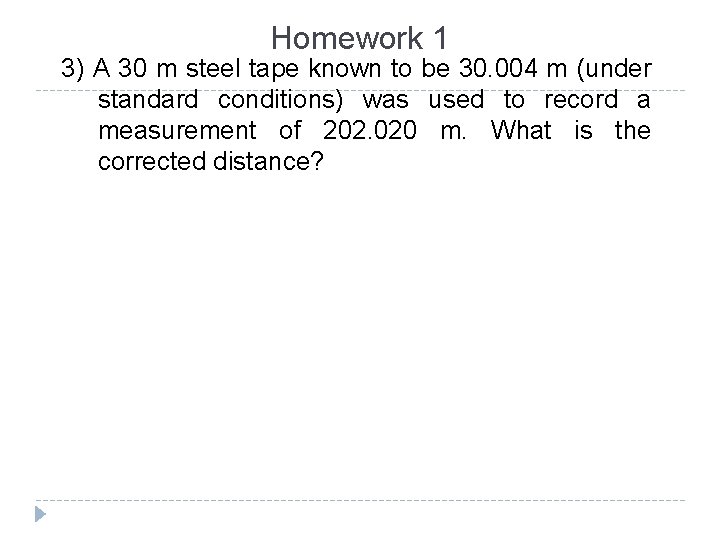
Homework 1 3) A 30 m steel tape known to be 30. 004 m (under standard conditions) was used to record a measurement of 202. 020 m. What is the corrected distance?
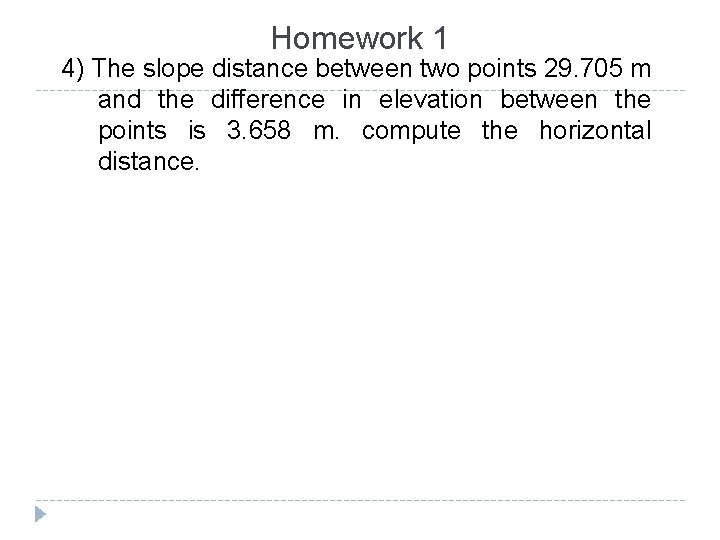
Homework 1 4) The slope distance between two points 29. 705 m and the difference in elevation between the points is 3. 658 m. compute the horizontal distance.