
Dissociative Electron Attachment to H 2 O H
- Slides: 1
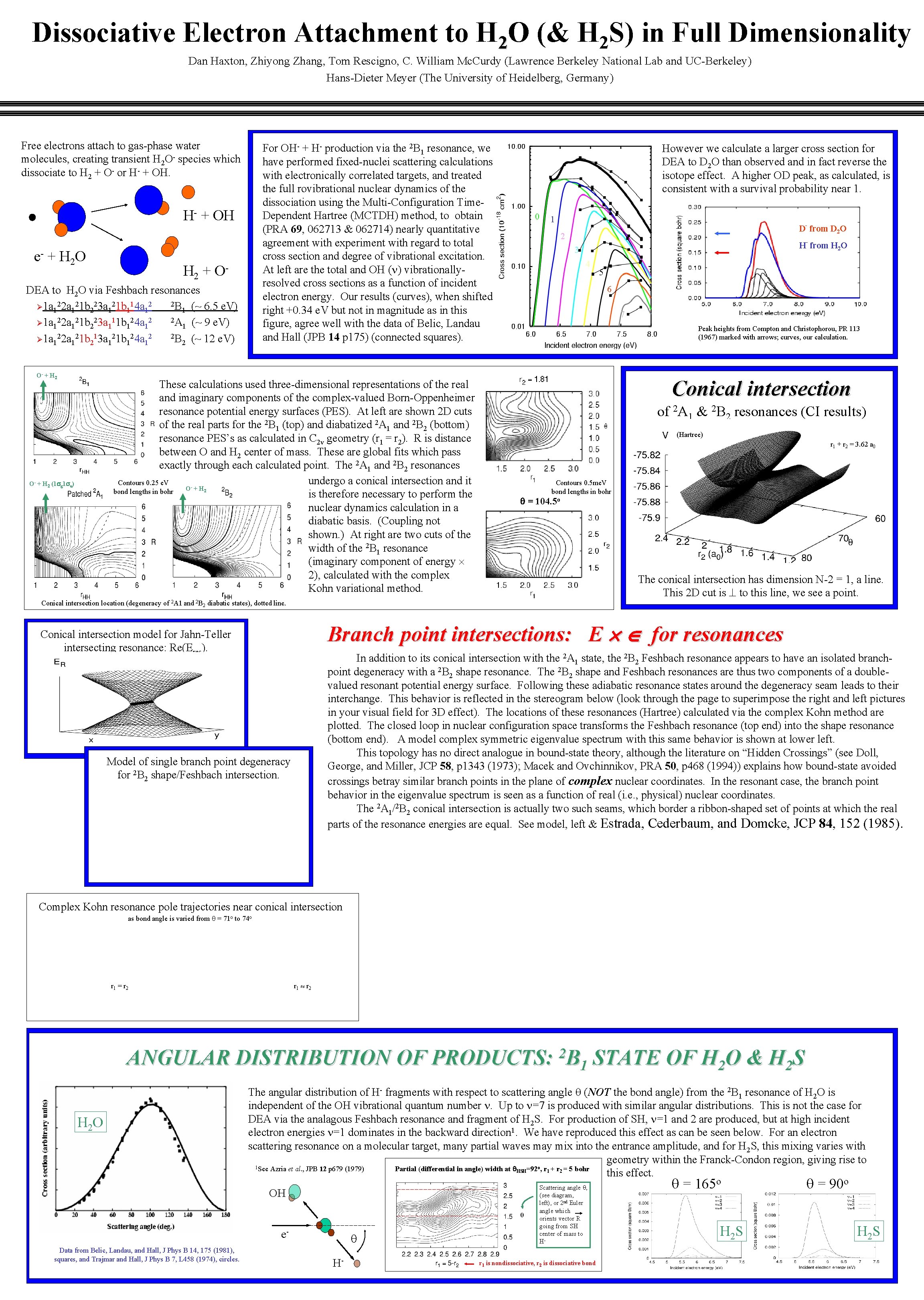
Dissociative Electron Attachment to H 2 O (& H 2 S) in Full Dimensionality Dan Haxton, Zhiyong Zhang, Tom Rescigno, C. William Mc. Curdy (Lawrence Berkeley National Lab and UC-Berkeley) Hans-Dieter Meyer (The University of Heidelberg, Germany) Free electrons attach to gas-phase water molecules, creating transient H 2 O- species which dissociate to H 2 + O- or H- + OH. For OH- + H- production via the 2 B 1 resonance, we have performed fixed-nuclei scattering calculations with electronically correlated targets, and treated the full rovibrational nuclear dynamics of the dissociation using the Multi-Configuration Time. Dependent Hartree (MCTDH) method, to obtain (PRA 69, 062713 & 062714) nearly quantitative agreement with experiment with regard to total cross section and degree of vibrational excitation. At left are the total and OH (n) vibrationallyresolved cross sections as a function of incident electron energy. Our results (curves), when shifted right +0. 34 e. V but not in magnitude as in this figure, agree well with the data of Belic, Landau and Hall (JPB 14 p 175) (connected squares). H- + OH e- + H 2 O H 2 + O- DEA to H 2 O via Feshbach resonances 2 B (~ 6. 5 e. V) Ø 1 a 122 a 121 b 223 a 121 b 114 a 12 1 2 A (~ 9 e. V) Ø 1 a 122 a 121 b 223 a 111 b 124 a 12 1 2 B (~ 12 e. V) Ø 1 a 122 a 121 b 213 a 121 b 124 a 12 2 O- + H 2 These calculations used three-dimensional representations of the real and imaginary components of the complex-valued Born-Oppenheimer resonance potential energy surfaces (PES). At left are shown 2 D cuts of the real parts for the 2 B 1 (top) and diabatized 2 A 1 and 2 B 2 (bottom) resonance PES’s as calculated in C 2 v geometry (r 1 = r 2). R is distance between O and H 2 center of mass. These are global fits which pass exactly through each calculated point. The 2 A 1 and 2 B 2 resonances undergo a conical intersection and it Contours 0. 25 e. V O +H bond lengths in bohr is therefore necessary to perform the nuclear dynamics calculation in a diabatic basis. (Coupling not shown. ) At right are two cuts of the width of the 2 B 1 resonance (imaginary component of energy 2), calculated with the complex Kohn variational method. O- + H 2 (1 sg 1 su) - 2 However we calculate a larger cross section for DEA to D 2 O than observed and in fact reverse the isotope effect. A higher OD peak, as calculated, is consistent with a survival probability near 1. 0 1 D- from D 2 O 2 H- from H 2 O 3 4 5 6 7 Peak heights from Compton and Christophorou, PR 113 (1967) marked with arrows; curves, our calculation. Conical intersection of 2 A 1 & 2 B 2 resonances (CI results) (Hartree) r 1 + r 2 = 3. 62 a 0 Contours 0. 5 me. V bond lengths in bohr q = 104. 5 o The conical intersection has dimension N-2 = 1, a line. This 2 D cut is to this line, we see a point. Conical intersection location (degeneracy of 2 A 1 and 2 B 2 diabatic states), dotted line. Branch point intersections: E for resonances Conical intersection model for Jahn-Teller intersecting resonance: Re(Eres). In addition to its conical intersection with the 2 A 1 state, the 2 B 2 Feshbach resonance appears to have an isolated branchpoint degeneracy with a 2 B 2 shape resonance. The 2 B 2 shape and Feshbach resonances are thus two components of a doublevalued resonant potential energy surface. Following these adiabatic resonance states around the degeneracy seam leads to their interchange. This behavior is reflected in the stereogram below (look through the page to superimpose the right and left pictures in your visual field for 3 D effect). The locations of these resonances (Hartree) calculated via the complex Kohn method are plotted. The closed loop in nuclear configuration space transforms the Feshbach resonance (top end) into the shape resonance (bottom end). A model complex symmetric eigenvalue spectrum with this same behavior is shown at lower left. This topology has no direct analogue in bound-state theory, although the literature on “Hidden Crossings” (see Doll, George, and Miller, JCP 58, p 1343 (1973); Macek and Ovchinnikov, PRA 50, p 468 (1994)) explains how bound-state avoided crossings betray similar branch points in the plane of complex nuclear coordinates. In the resonant case, the branch point behavior in the eigenvalue spectrum is seen as a function of real (i. e. , physical) nuclear coordinates. The 2 A 1/2 B 2 conical intersection is actually two such seams, which border a ribbon-shaped set of points at which the real parts of the resonance energies are equal. See model, left & Estrada, Cederbaum, and Domcke, JCP 84, 152 (1985). Model of single branch point degeneracy for 2 B 2 shape/Feshbach intersection. Complex Kohn resonance pole trajectories near conical intersection as bond angle is varied from = 71 o to 74 o r 1 r 2 r 1 = r 2 ANGULAR DISTRIBUTION OF PRODUCTS: H 2 O STATE OF H 2 O & H 2 S The angular distribution of H- fragments with respect to scattering angle (NOT the bond angle) from the 2 B 1 resonance of H 2 O is independent of the OH vibrational quantum number n. Up to n=7 is produced with similar angular distributions. This is not the case for DEA via the analagous Feshbach resonance and fragment of H 2 S. For production of SH, n=1 and 2 are produced, but at high incident electron energies n=1 dominates in the backward direction 1. We have reproduced this effect as can be seen below. For an electron scattering resonance on a molecular target, many partial waves may mix into the entrance amplitude, and for H 2 S, this mixing varies with geometry within the Franck-Condon region, giving rise to 1 See Azria et al. , JPB 12 p 679 (1979) Partial (differential in angle) width at q. HSH=92 o, r 1 + r 2 = 5 bohr this effect. OH e. Data from Belic, Landau, and Hall, J Phys B 14, 175 (1981), squares, and Trajmar and Hall, J Phys B 7, L 458 (1974), circles. 2 B 1 H- Scattering angle , (see diagram, left), or 2 nd Euler angle which orients vector R going from SH center of mass to Hr 1 is nondissociative, r 2 is dissociative bond = 165 o H 2 S = 90 o H 2 S