
Dissociative Disorders Dissociative Identity Disorder Dissociative Amnesia Dissociative
- Slides: 12
Dissociative Disorders Dissociative Identity Disorder Dissociative Amnesia Dissociative Fugue Depersonalization Disorder
Dissociative Identity Disorder A. The presence of two or more distinct identities or personality states B. At least two of these identities or personality states recurrently take control of the person’s behavior C. Inability to recall important personal information that is too extensive to be explained by ordinary forgetfulness D. Not due to a GMC or substance
Dissociative Identity Disorder p Identities n n At least two of these recurrently take control of a person’s behavior Can be categorized into three types: p Core identity: superego p 1 st alternate identity: id p 2 nd alternate identity: ego
Dissociative Identity Disorder p Prevalence n n Up for debate Rates have increased dramatically over few decades p First case reported in the 1850’s p Several cases in 1880’s-1900’s p By the 1970’s, only about 200 cases in all p Now, some psychologists claim that up to 1% of the general population has this disorder p Individual clinicians are not reporting having dozens to hundreds of such clients
Dissociative Identity Disorder p Explanations for increasing prevalence: n n n p Increased public awareness of the disorder Changes in the diagnostic criteria for schizophrenia Therapists may be actively looking for DID Prevalence, continued… n n n Rates very uneven across countries Rates very uneven across clinicians within countries The rates of this disorder is very controversial…some psychologists doubt its existence at all
Dissociative Identity Disorder p Risk Factors n Severe child abuse, especially sexual abuse (reported in 95% of cases p n Remembered or Recovered? ? ? Having generous psychiatric medical coverage
Dissociative Identity Disorder p Question of Validity n n Studies show differences in psychological test results and physiological states between “alters” Alternative theories: Could be due to distinct personalities p Could be due to role enactments p n Extremely heated controversy over iatrogenesis vs. natural occurrence (iatrogenesis = “caused by treatment”)
Dissociative Identity Disorder Can people actually dissociate? p Have you had a dissociative experience? p Common dissociative experiences p n n n Reading a paragraph and then having no recollection of what you read Driving somewhere and not knowing how you got there Talking to someone and not knowing what you’re actually talking about
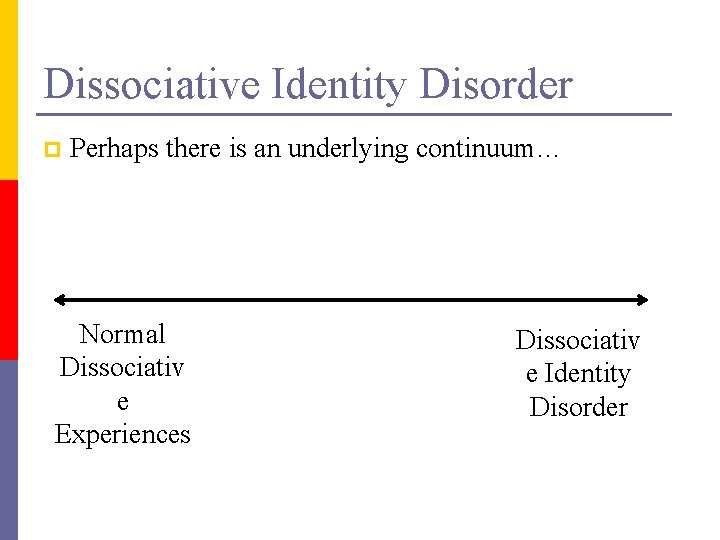
Dissociative Identity Disorder p Perhaps there is an underlying continuum… Normal Dissociativ e Experiences Dissociativ e Identity Disorder
Dissociative Amnesia A. One or more episodes of inability to recall important personal information, usually of a traumatic or stressful nature, that is too extensive to be explained by ordinary forgetfulness B. Not better explained by a another mental disorder and is not due to a GMC or substance C. Symptoms cause clinically significant distress or impairment in functioning
Dissociative Fugue A. Sudden, unexpected travel away from home or one’s customary place of work, with inability to recall one’s past B. Confusion about personal identity or assumption of a new identity (partial or complete) C. Not better explained by a another mental disorder and is not due to a GMC or substance D. Symptoms cause clinically significant distress or impairment in functioning
Depersonalization Disorder A. Persistent or recurrent experiences of feeling detached from, and as if one is an outside observer of, one’s mental processes or body B. During the depersonalization experience, reality testing remains intact C. Not better explained by a another mental disorder and is not due to a GMC or substance D. Symptoms cause clinically significant distress or impairment in functioning