
Dissociation of water n n n Represented by
Dissociation of water n n n Represented by Kw H 2 O H+ + OHor H 2 O + H 2 O H 3 O+ + OHWe will use the first one in most cases Kw = 1. 00 x 10 -14 ¡ This is at about 25 C, Kw changes with temp
Kw n n n Kw = [H+][OH-] If Kw = 1. 00 x 10 -14, what must the concentration of the ions be? In water the ions always have the same concentration ¡ Why?
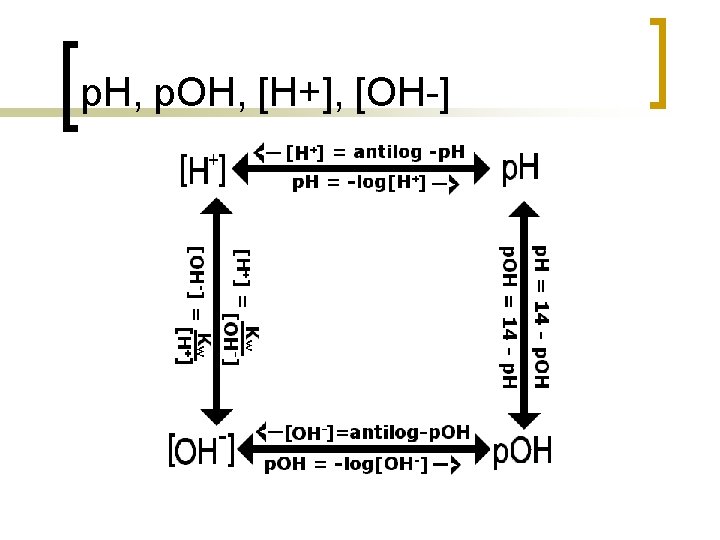
p. H, p. OH, [H+], [OH-]
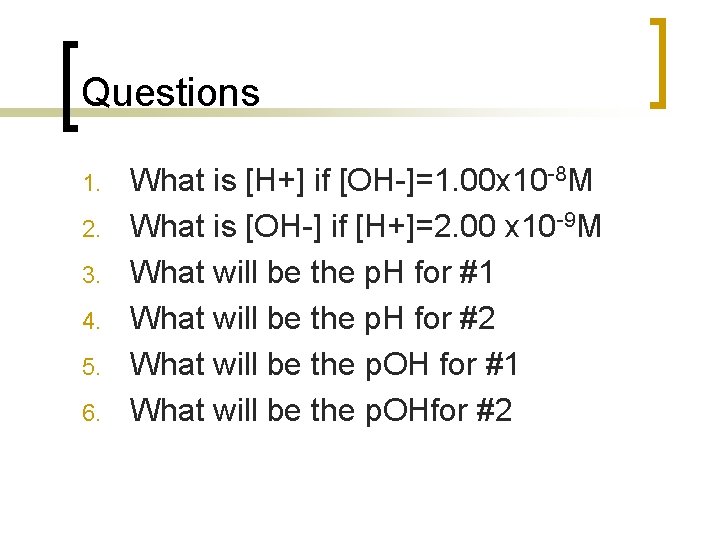
Questions 1. 2. 3. 4. 5. 6. What is [H+] if [OH-]=1. 00 x 10 -8 M What is [OH-] if [H+]=2. 00 x 10 -9 M What will be the p. H for #1 What will be the p. H for #2 What will be the p. OH for #1 What will be the p. OHfor #2
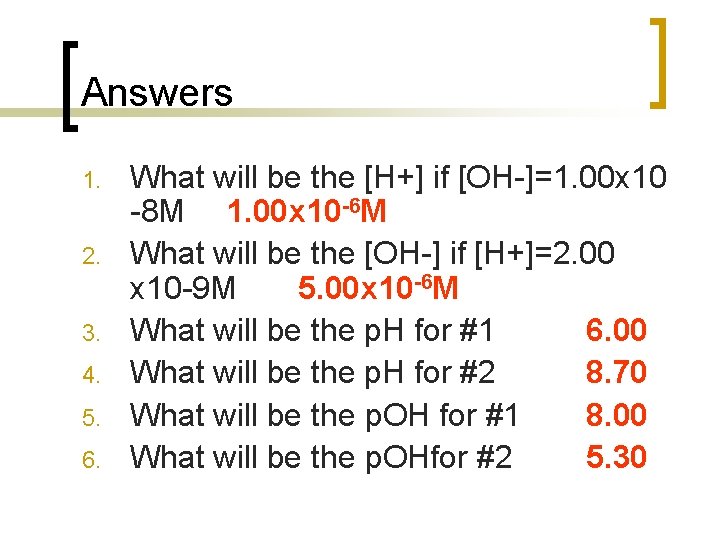
Answers 1. 2. 3. 4. 5. 6. What will be the [H+] if [OH-]=1. 00 x 10 -8 M 1. 00 x 10 -6 M What will be the [OH-] if [H+]=2. 00 x 10 -9 M 5. 00 x 10 -6 M What will be the p. H for #1 6. 00 What will be the p. H for #2 8. 70 What will be the p. OH for #1 8. 00 What will be the p. OHfor #2 5. 30
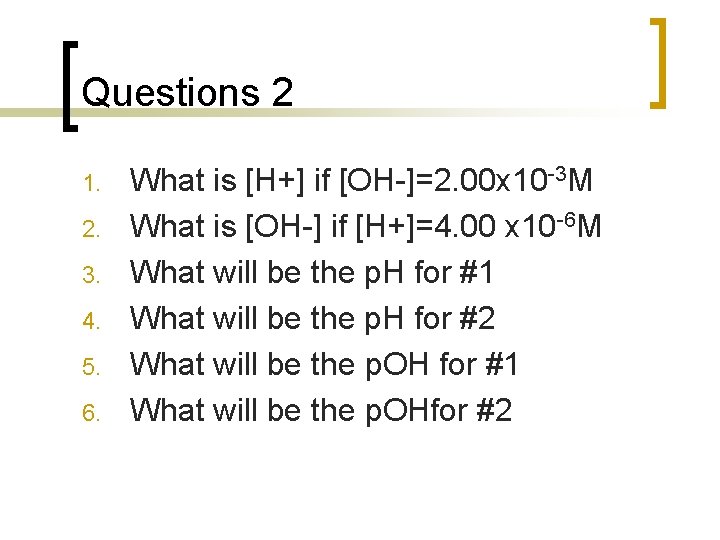
Questions 2 1. 2. 3. 4. 5. 6. What is [H+] if [OH-]=2. 00 x 10 -3 M What is [OH-] if [H+]=4. 00 x 10 -6 M What will be the p. H for #1 What will be the p. H for #2 What will be the p. OH for #1 What will be the p. OHfor #2
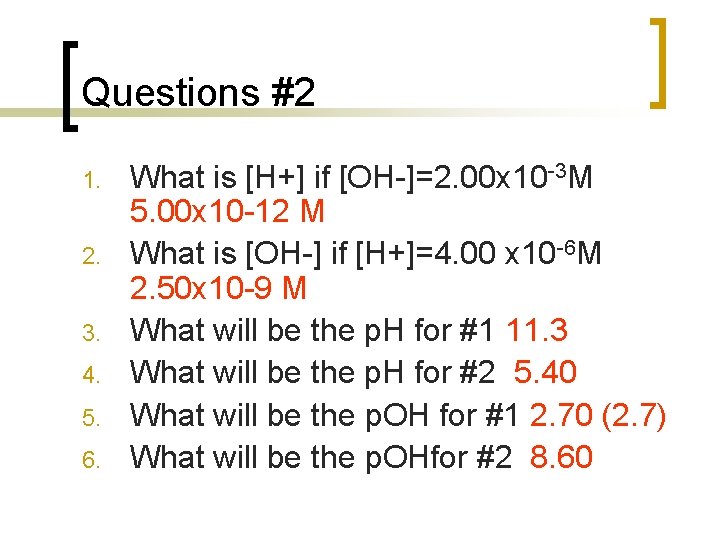
Questions #2 1. 2. 3. 4. 5. 6. What is [H+] if [OH-]=2. 00 x 10 -3 M 5. 00 x 10 -12 M What is [OH-] if [H+]=4. 00 x 10 -6 M 2. 50 x 10 -9 M What will be the p. H for #1 11. 3 What will be the p. H for #2 5. 40 What will be the p. OH for #1 2. 70 (2. 7) What will be the p. OHfor #2 8. 60
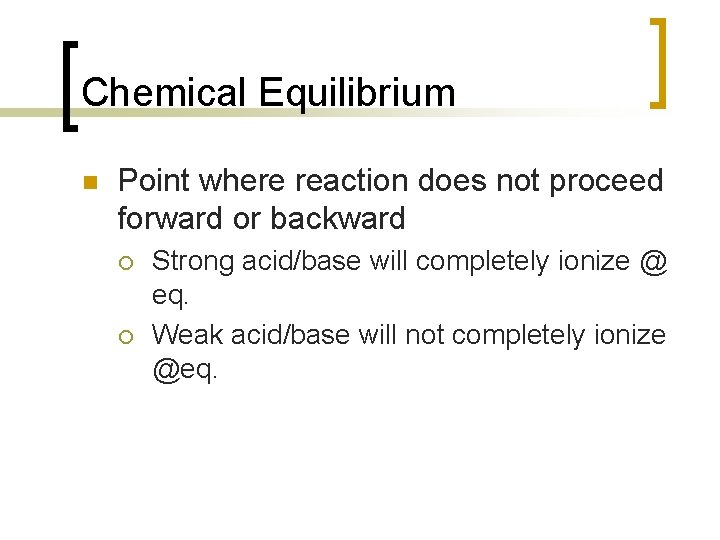
Chemical Equilibrium n Point where reaction does not proceed forward or backward ¡ ¡ Strong acid/base will completely ionize @ eq. Weak acid/base will not completely ionize @eq.
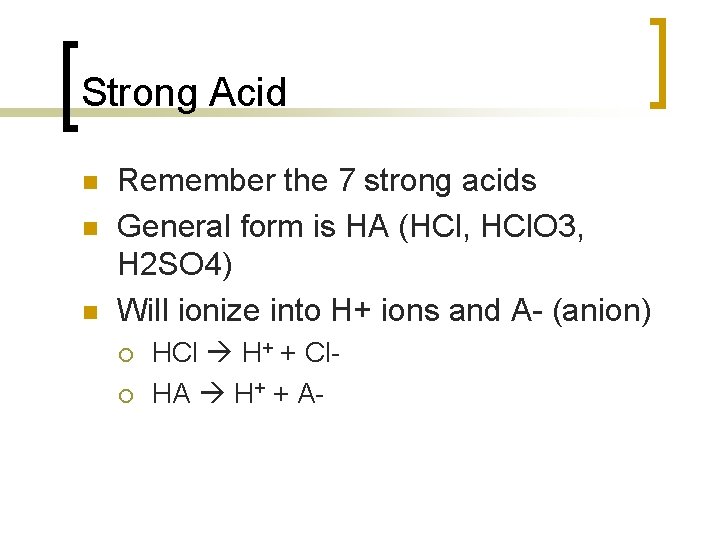
Strong Acid n n n Remember the 7 strong acids General form is HA (HCl, HCl. O 3, H 2 SO 4) Will ionize into H+ ions and A- (anion) ¡ ¡ HCl H+ + Cl. HA H+ + A-
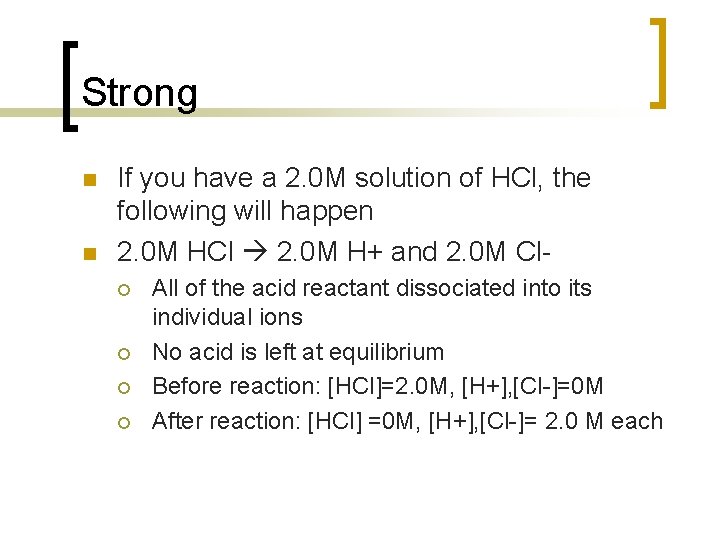
Strong n n If you have a 2. 0 M solution of HCl, the following will happen 2. 0 M HCl 2. 0 M H+ and 2. 0 M Cl¡ ¡ All of the acid reactant dissociated into its individual ions No acid is left at equilibrium Before reaction: [HCl]=2. 0 M, [H+], [Cl-]=0 M After reaction: [HCl] =0 M, [H+], [Cl-]= 2. 0 M each
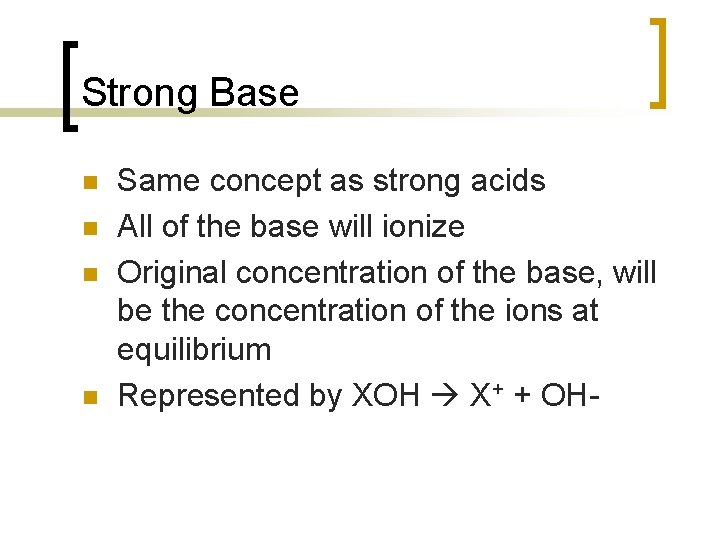
Strong Base n n Same concept as strong acids All of the base will ionize Original concentration of the base, will be the concentration of the ions at equilibrium Represented by XOH X+ + OH-
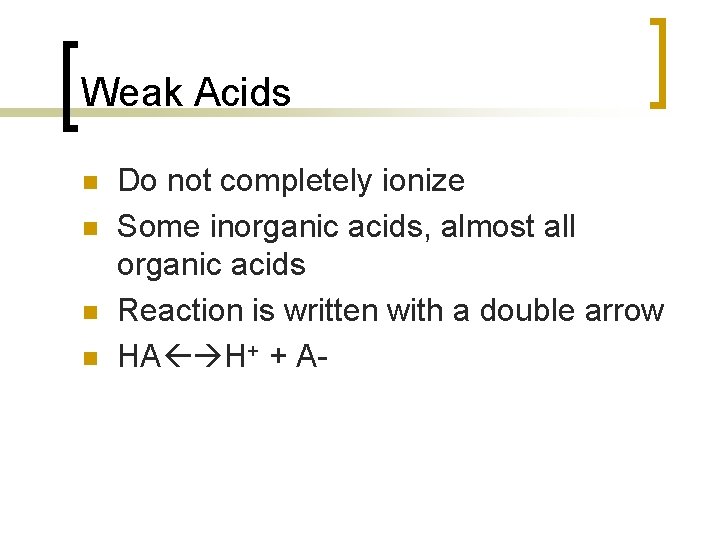
Weak Acids n n Do not completely ionize Some inorganic acids, almost all organic acids Reaction is written with a double arrow HA H+ + A-
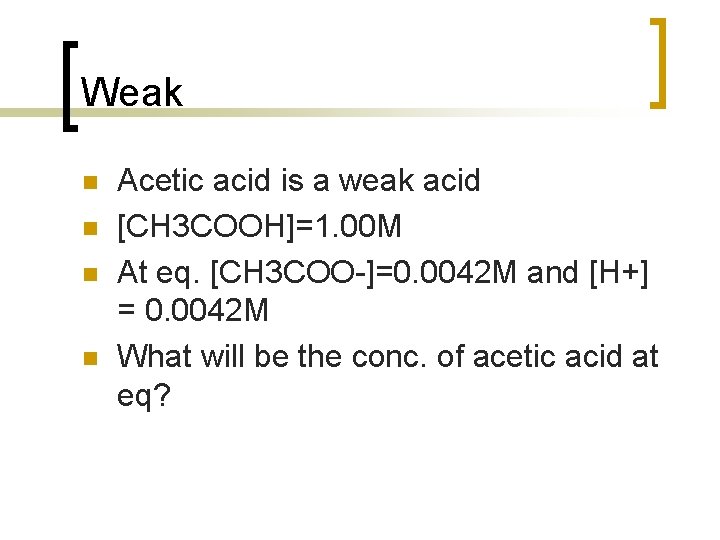
Weak n n Acetic acid is a weak acid [CH 3 COOH]=1. 00 M At eq. [CH 3 COO-]=0. 0042 M and [H+] = 0. 0042 M What will be the conc. of acetic acid at eq?
Ka n n Must use Ka to find concentrations at equilibrium Ka are set for all acids, and depend on temp ¡ ¡ We will always work at 25 C Use your Ka sheet
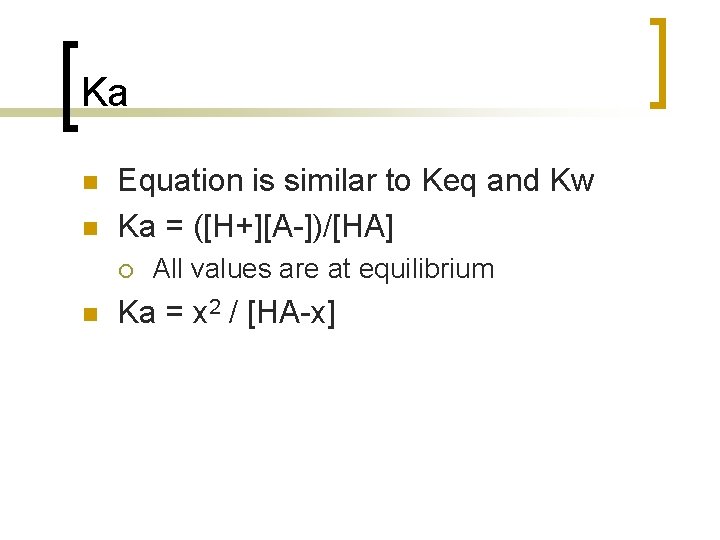
Ka n n Equation is similar to Keq and Kw Ka = ([H+][A-])/[HA] ¡ n All values are at equilibrium Ka = x 2 / [HA-x]
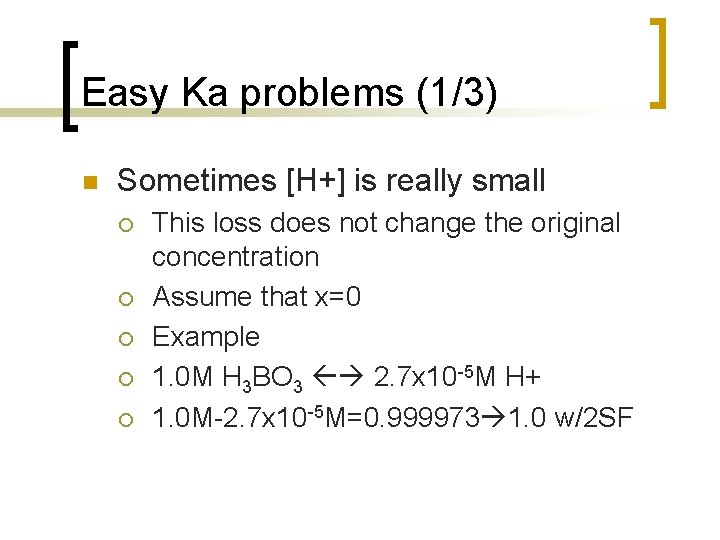
Easy Ka problems (1/3) n Sometimes [H+] is really small ¡ ¡ ¡ This loss does not change the original concentration Assume that x=0 Example 1. 0 M H 3 BO 3 2. 7 x 10 -5 M H+ 1. 0 M-2. 7 x 10 -5 M=0. 999973 1. 0 w/2 SF
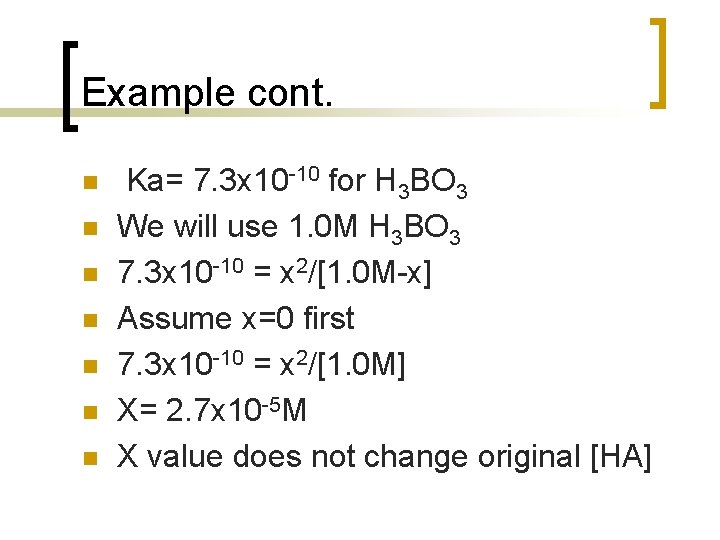
Example cont. n n n n Ka= 7. 3 x 10 -10 for H 3 BO 3 We will use 1. 0 M H 3 BO 3 7. 3 x 10 -10 = x 2/[1. 0 M-x] Assume x=0 first 7. 3 x 10 -10 = x 2/[1. 0 M] X= 2. 7 x 10 -5 M X value does not change original [HA]
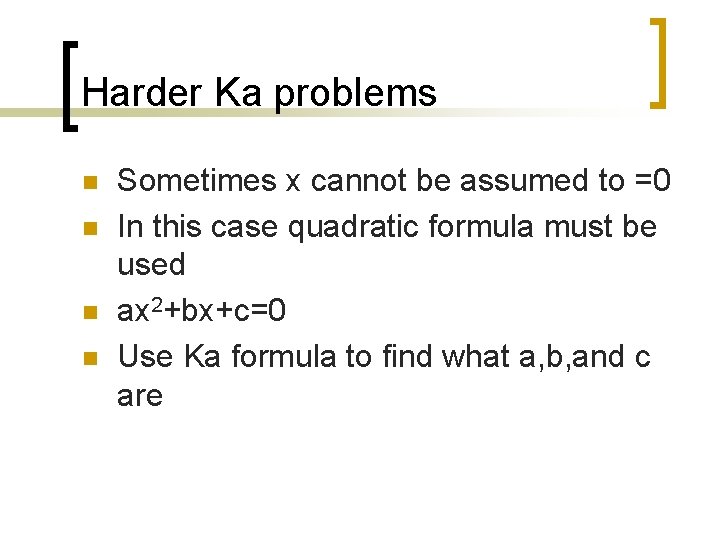
Harder Ka problems n n Sometimes x cannot be assumed to =0 In this case quadratic formula must be used ax 2+bx+c=0 Use Ka formula to find what a, b, and c are
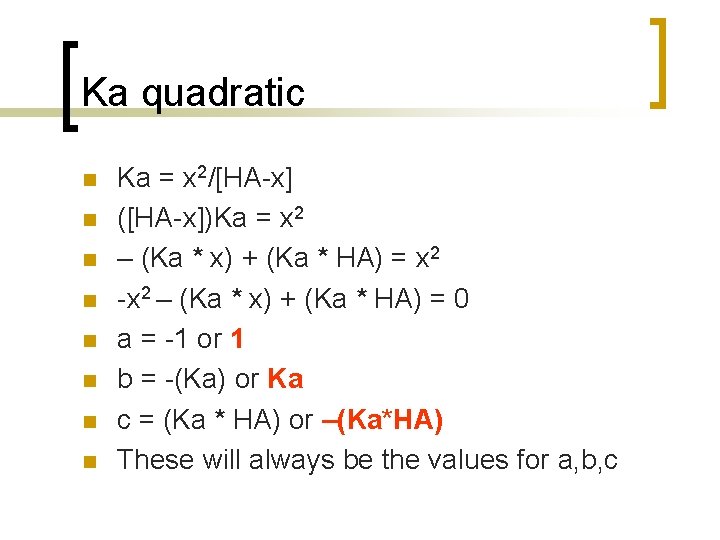
Ka quadratic n n n n Ka = x 2/[HA-x] ([HA-x])Ka = x 2 – (Ka * x) + (Ka * HA) = x 2 -x 2 – (Ka * x) + (Ka * HA) = 0 a = -1 or 1 b = -(Ka) or Ka c = (Ka * HA) or –(Ka*HA) These will always be the values for a, b, c
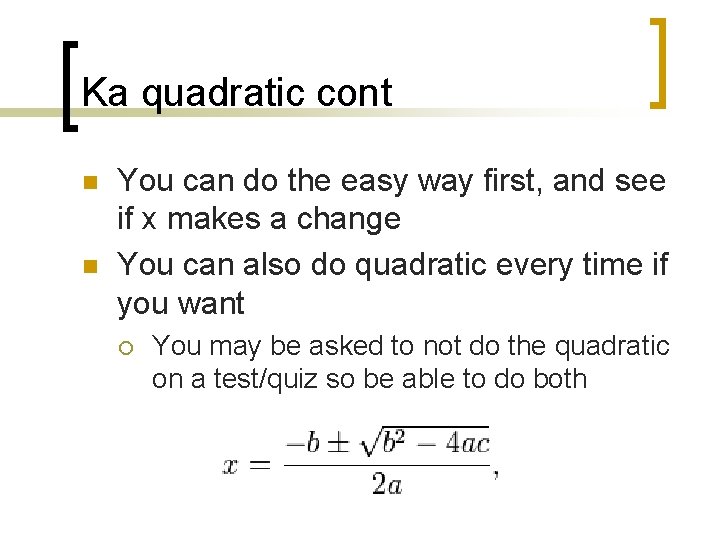
Ka quadratic cont n n You can do the easy way first, and see if x makes a change You can also do quadratic every time if you want ¡ You may be asked to not do the quadratic on a test/quiz so be able to do both
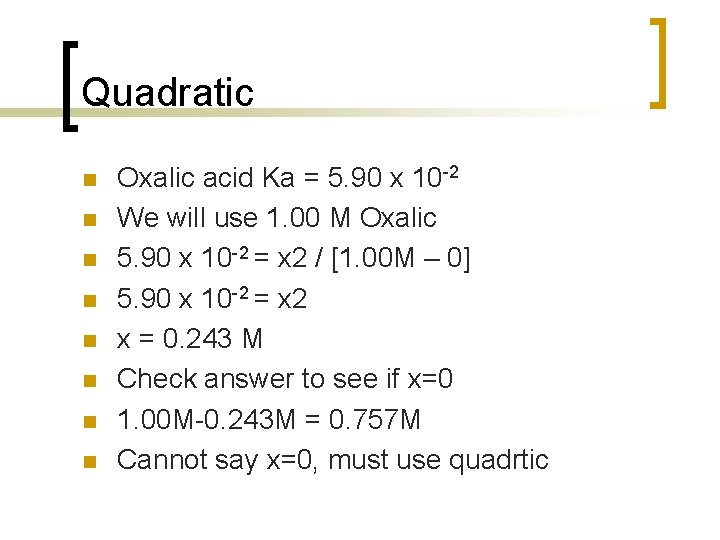
Quadratic n n n n Oxalic acid Ka = 5. 90 x 10 -2 We will use 1. 00 M Oxalic 5. 90 x 10 -2 = x 2 / [1. 00 M – 0] 5. 90 x 10 -2 = x 2 x = 0. 243 M Check answer to see if x=0 1. 00 M-0. 243 M = 0. 757 M Cannot say x=0, must use quadrtic
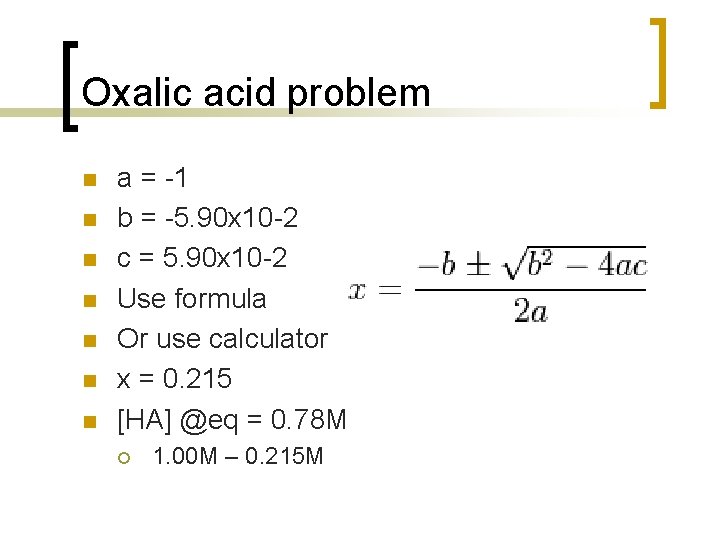
Oxalic acid problem n n n n a = -1 b = -5. 90 x 10 -2 c = 5. 90 x 10 -2 Use formula Or use calculator x = 0. 215 [HA] @eq = 0. 78 M ¡ 1. 00 M – 0. 215 M
Practice (find [H+] and [HA]eq n n n 2. 0 M Benzoic acid 1. 5 M Hydrosulfuric acid 0. 50 M nitrous acid
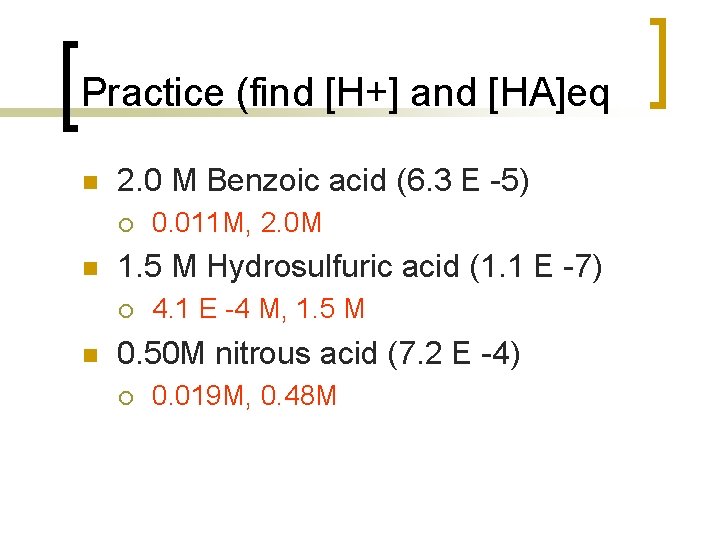
Practice (find [H+] and [HA]eq n 2. 0 M Benzoic acid (6. 3 E -5) ¡ n 1. 5 M Hydrosulfuric acid (1. 1 E -7) ¡ n 0. 011 M, 2. 0 M 4. 1 E -4 M, 1. 5 M 0. 50 M nitrous acid (7. 2 E -4) ¡ 0. 019 M, 0. 48 M
- Slides: 24