
Dissipative quantum dynamics simulations Reinhold Egger Institut fr
- Slides: 29
Dissipative quantum dynamics simulations Reinhold Egger Institut für Theoretische Physik Heinrich-Heine-Universität Düsseldorf C. H. Mak, L. Mühlbacher, S. Hügle
Overview n n Real-time Path Integral Monte Carlo (PIMC) simulations for dissipative quantum systems Application 1: Spin-boson dynamics Application 2: Coherence for double-barrier tunneling in 1 d quantum wires Conclusions
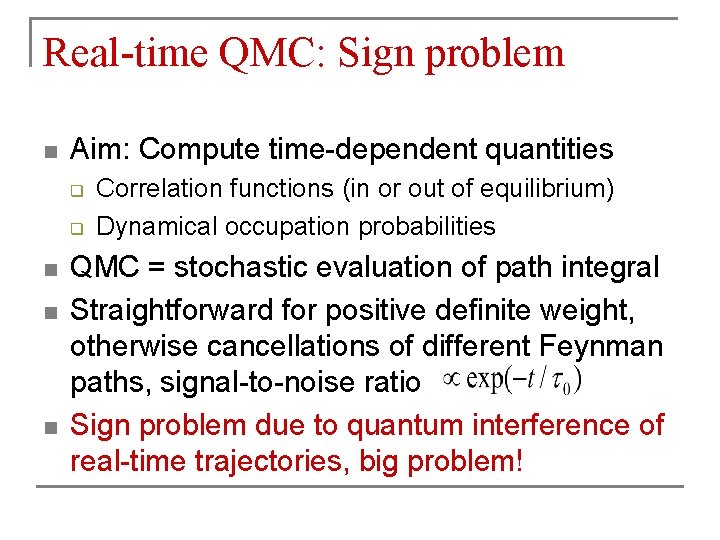
Real-time QMC: Sign problem n Aim: Compute time-dependent quantities q q n n n Correlation functions (in or out of equilibrium) Dynamical occupation probabilities QMC = stochastic evaluation of path integral Straightforward for positive definite weight, otherwise cancellations of different Feynman paths, signal-to-noise ratio Sign problem due to quantum interference of real-time trajectories, big problem!
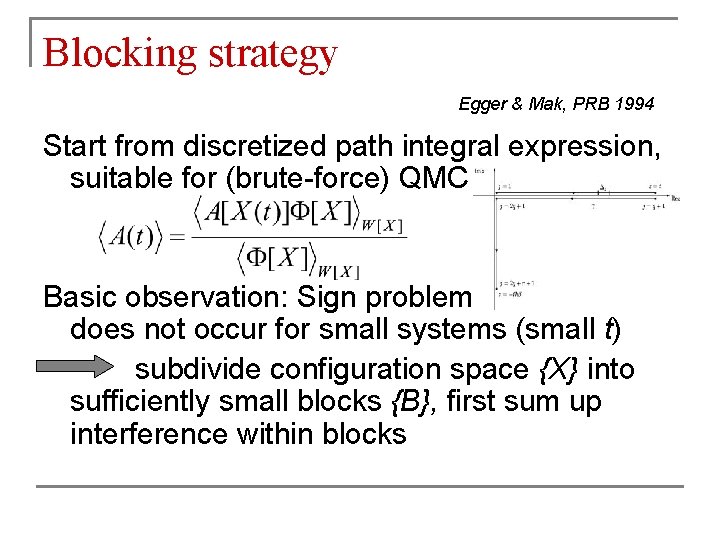
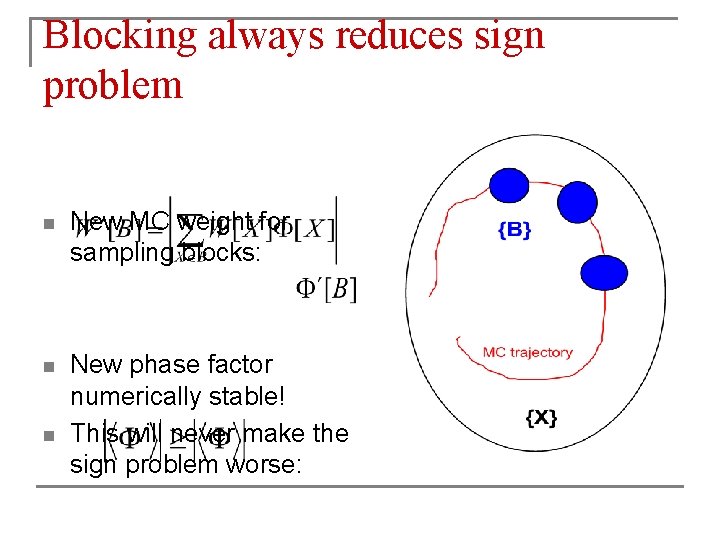
Blocking strategy Egger & Mak, PRB 1994 Start from discretized path integral expression, suitable for (brute-force) QMC Basic observation: Sign problem does not occur for small systems (small t) subdivide configuration space {X} into sufficiently small blocks {B}, first sum up interference within blocks
Blocking always reduces sign problem n New MC weight for sampling blocks: n New phase factor numerically stable! This will never make the sign problem worse: n
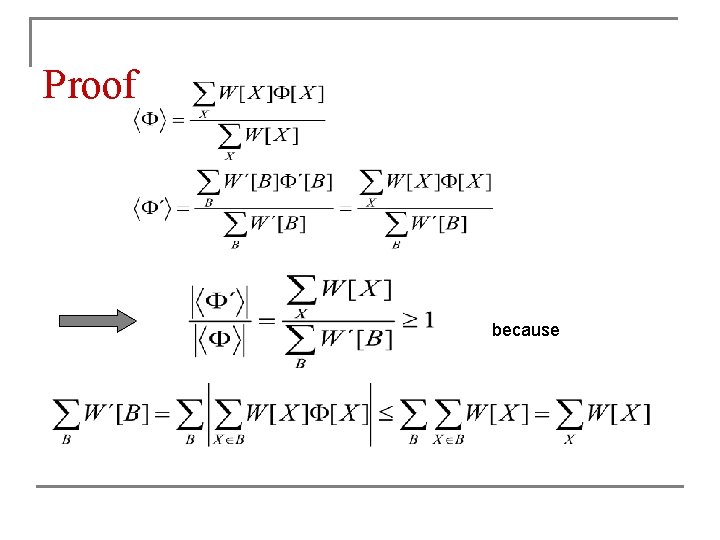
Proof because
Multilevel blocking algorithm Mak, Egger & Weber-Gottschick, PRL 1998 Mak Egger, JCP 1999 n n n For large system (long real time), too many blocks, again exponential sign problem Systematic implementation of blocking strategy using recursive algorithm, solve sign problem on different levels Implementation for dissipative quantum dynamics of spin-boson system has been demonstrated! Egger, Mühlbacher & Mak, PRE 2000
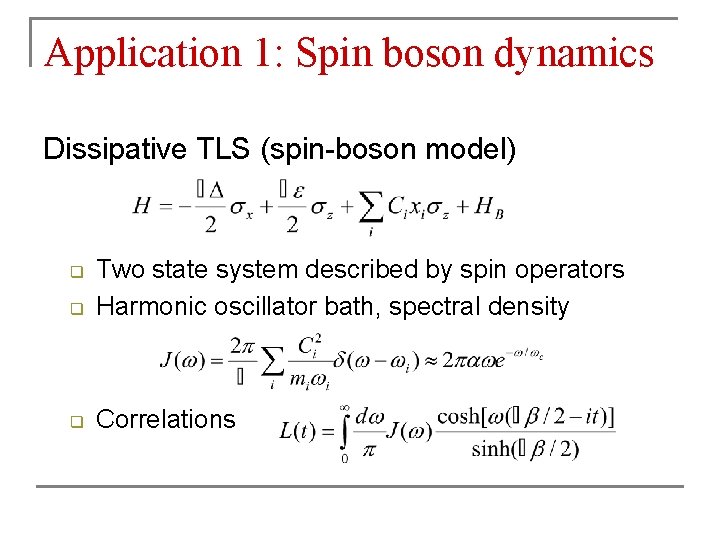
Application 1: Spin boson dynamics Dissipative TLS (spin-boson model) q Two state system described by spin operators Harmonic oscillator bath, spectral density q Correlations q
Spin boson model n n n Simple but (sometimes) microscopic model for decoherence in qubits Close connection to Kondo problem Macroscopic quantum coherence in SQUIDs Electron transfer (ET) reactions in solids or chemical/biological systems For weak system-bath coupling: equivalent to Bloch-Redfield approach
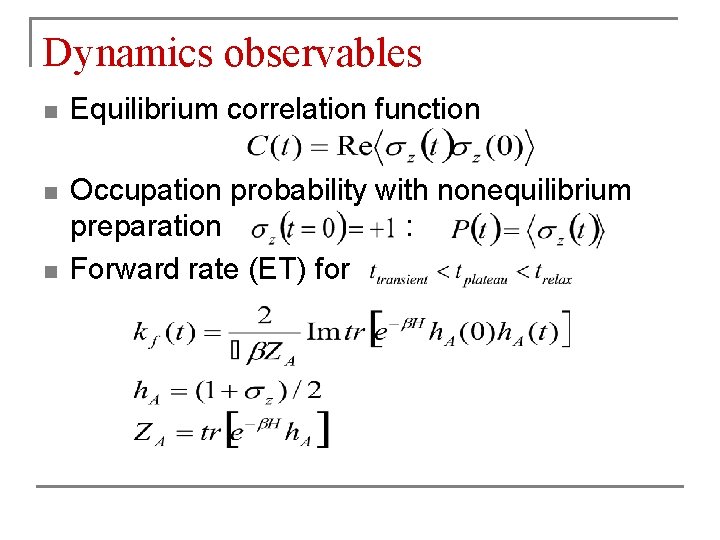
Dynamics observables n Equilibrium correlation function n Occupation probability with nonequilibrium preparation : Forward rate (ET) for n
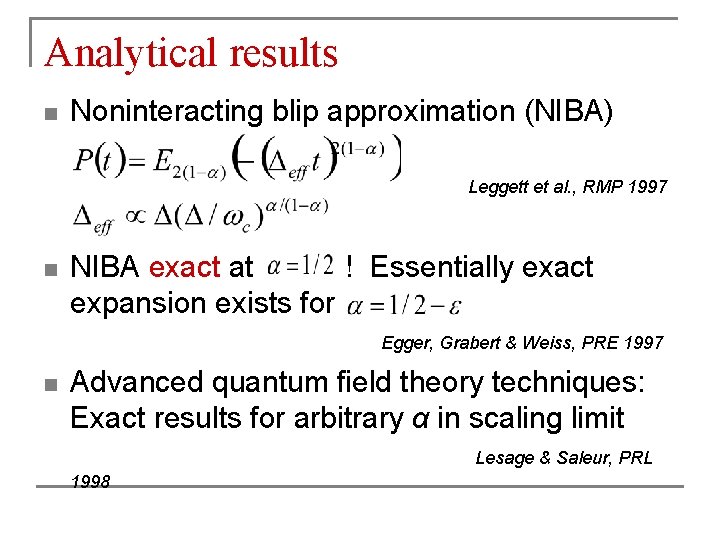
Analytical results n Noninteracting blip approximation (NIBA) Leggett et al. , RMP 1997 n NIBA exact at ! Essentially exact expansion exists for Egger, Grabert & Weiss, PRE 1997 n Advanced quantum field theory techniques: Exact results for arbitrary α in scaling limit Lesage & Saleur, PRL 1998
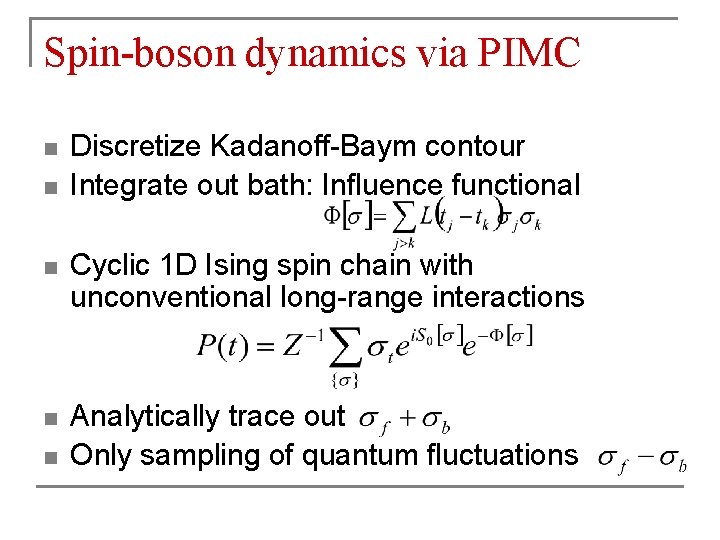
Spin-boson dynamics via PIMC n n Discretize Kadanoff-Baym contour Integrate out bath: Influence functional n Cyclic 1 D Ising spin chain with unconventional long-range interactions n Analytically trace out Only sampling of quantum fluctuations n
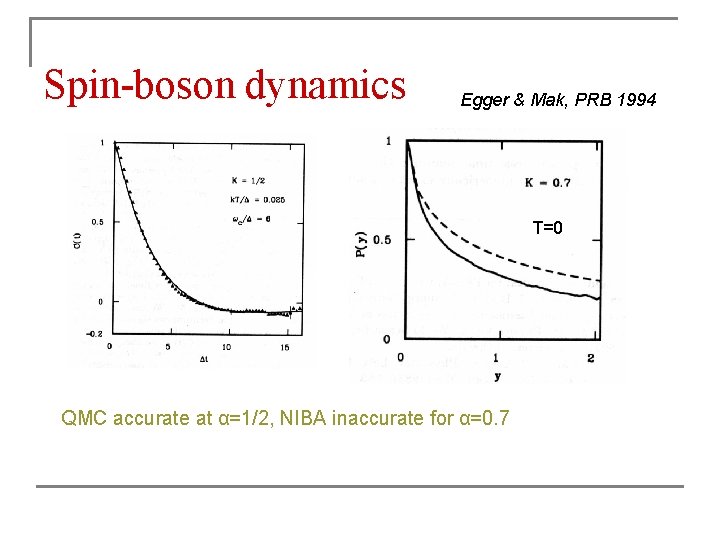
Spin-boson dynamics Egger & Mak, PRB 1994 T=0 QMC accurate at α=1/2, NIBA inaccurate for α=0. 7
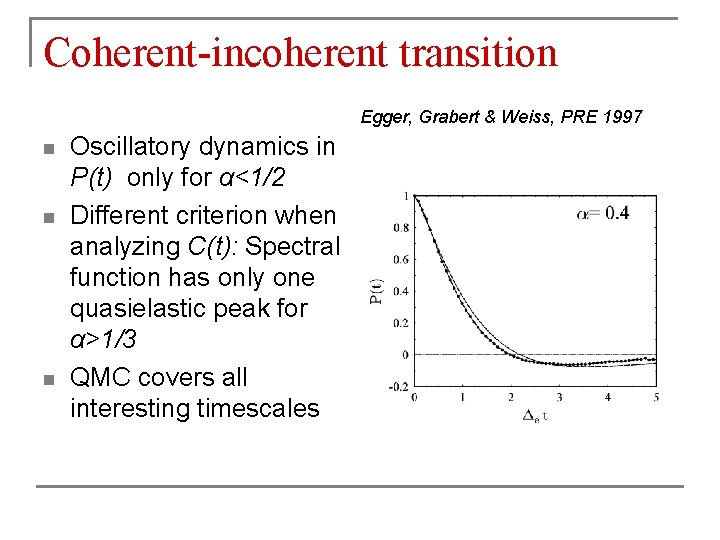
Coherent-incoherent transition Egger, Grabert & Weiss, PRE 1997 n n n Oscillatory dynamics in P(t) only for α<1/2 Different criterion when analyzing C(t): Spectral function has only one quasielastic peak for α>1/3 QMC covers all interesting timescales
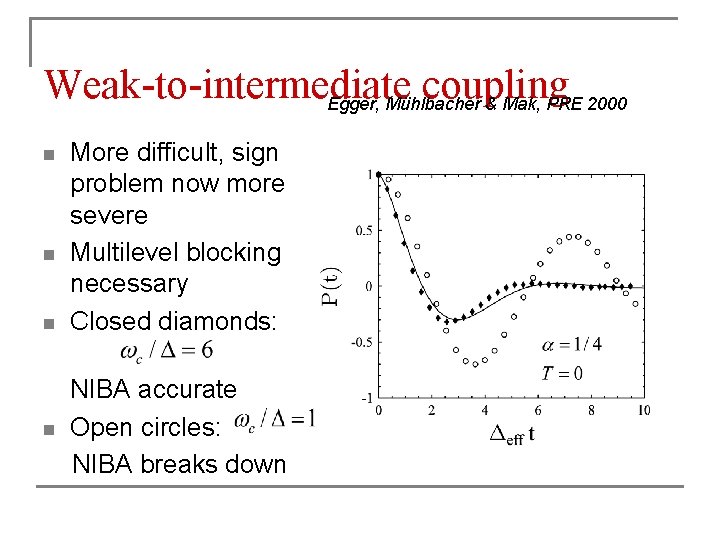
Weak-to-intermediate coupling Egger, Mühlbacher & Mak, PRE 2000 n n More difficult, sign problem now more severe Multilevel blocking necessary Closed diamonds: NIBA accurate Open circles: NIBA breaks down
Spin-boson simulations: PRO and CONTRA n n Numerically exact for arbitrary parameters (e. g. spectral density) Very powerful for intermediate-to-strong dissipation, e. g. ET dissipation helps! Mühlbacher & Egger, JCP 2003, Chem. Phys. 2004 n Arbitrary quantities, in or out of equilibrium n n n Numerically expensive Sign problem can be severe for low T, weak coupling and long times In practice useful even at low T for
Application 2: Coherent and incoherent double-barrier tunneling in 1 d wires n n Tunneling mechanism for transport through double-barrier structure in interacting 1 D quantum wire, e. g. carbon nanotube? Recent nanotube experiments challenge established sequential tunneling theories Postma, Teepen, Yao, Grifoni & Dekker, Science 2001 n Strong transmission: Fabry-Perot resonances observed in nanotubes Liang et al. , Nature 2001
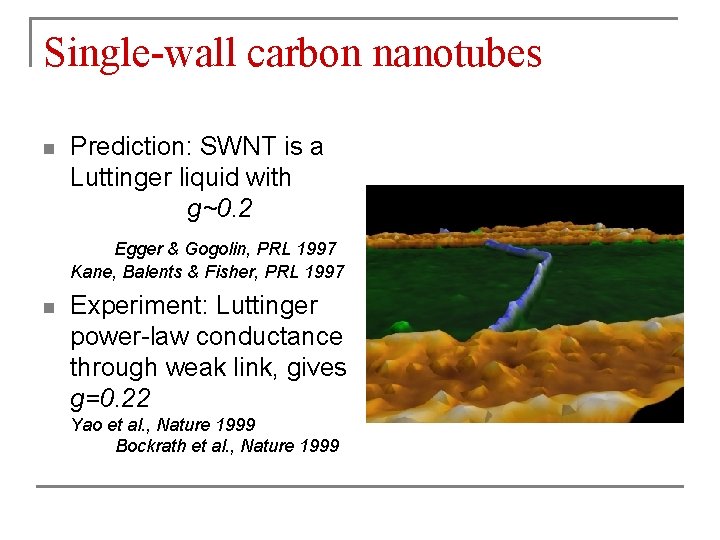
Single-wall carbon nanotubes n Prediction: SWNT is a Luttinger liquid with g~0. 2 Egger & Gogolin, PRL 1997 Kane, Balents & Fisher, PRL 1997 n Experiment: Luttinger power-law conductance through weak link, gives g=0. 22 Yao et al. , Nature 1999 Bockrath et al. , Nature 1999
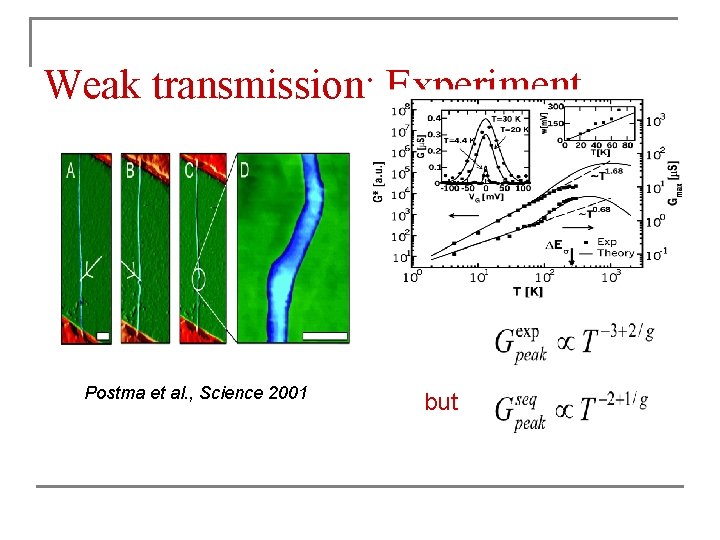
Weak transmission: Experiment Postma et al. , Science 2001 but
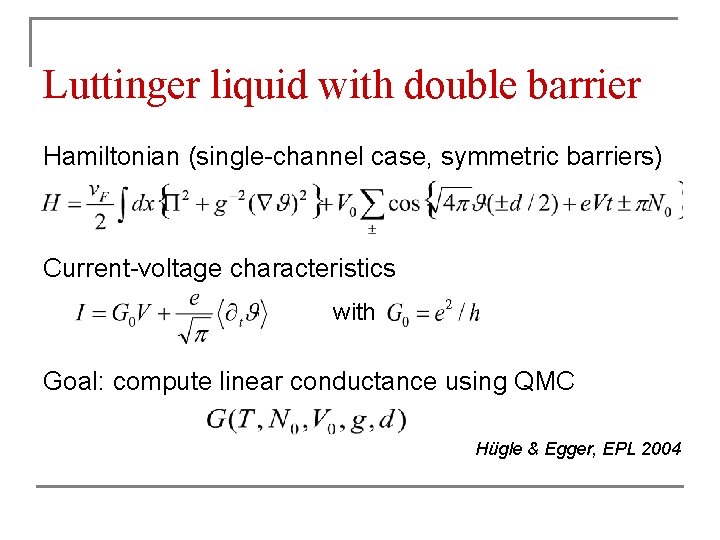
Luttinger liquid with double barrier Hamiltonian (single-channel case, symmetric barriers) Current-voltage characteristics with Goal: compute linear conductance using QMC Hügle & Egger, EPL 2004
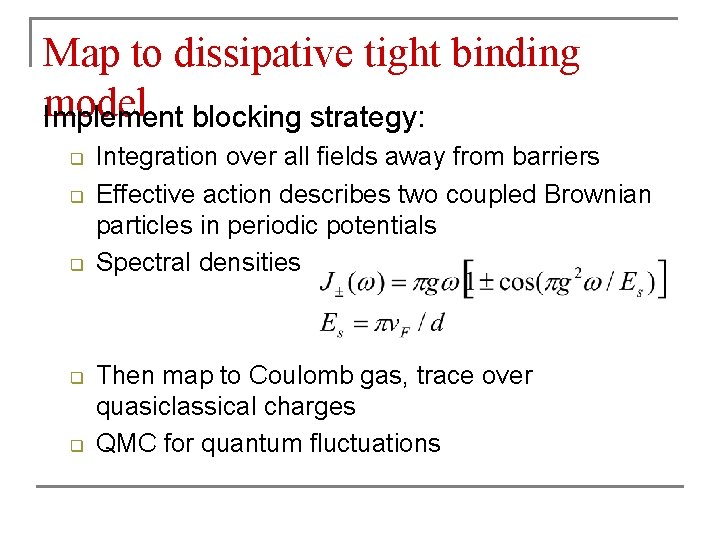
Map to dissipative tight binding model Implement blocking strategy: q q q Integration over all fields away from barriers Effective action describes two coupled Brownian particles in periodic potentials Spectral densities Then map to Coulomb gas, trace over quasiclassical charges QMC for quantum fluctuations
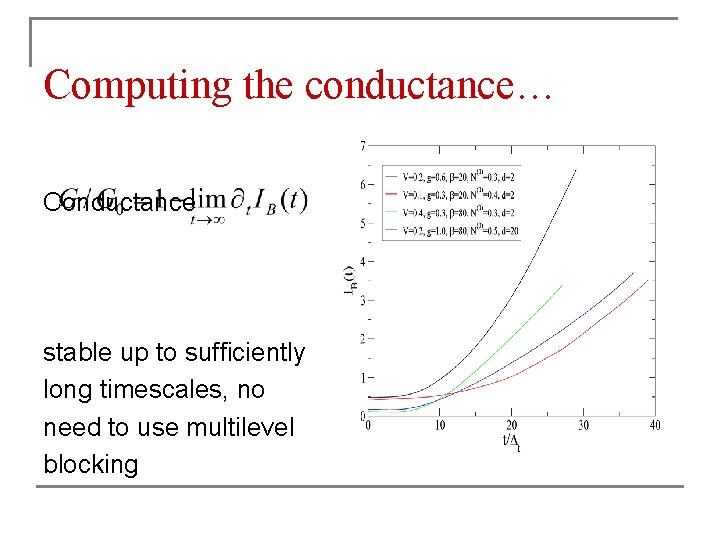
Computing the conductance… Conductance stable up to sufficiently long timescales, no need to use multilevel blocking
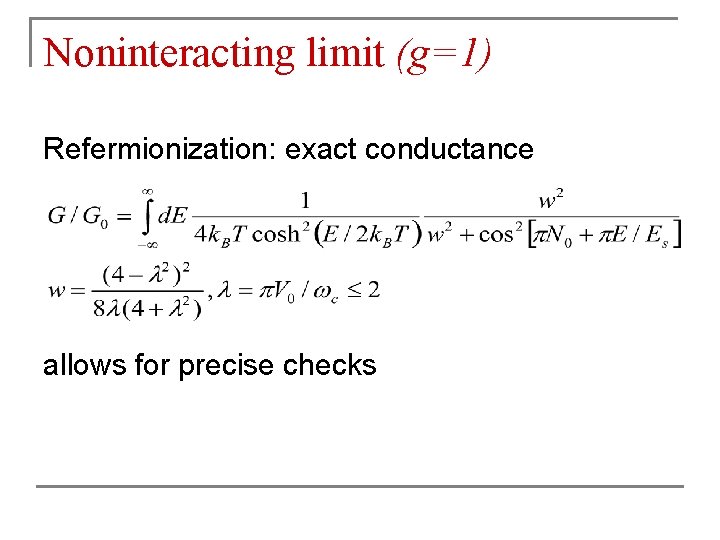
Noninteracting limit (g=1) Refermionization: exact conductance allows for precise checks
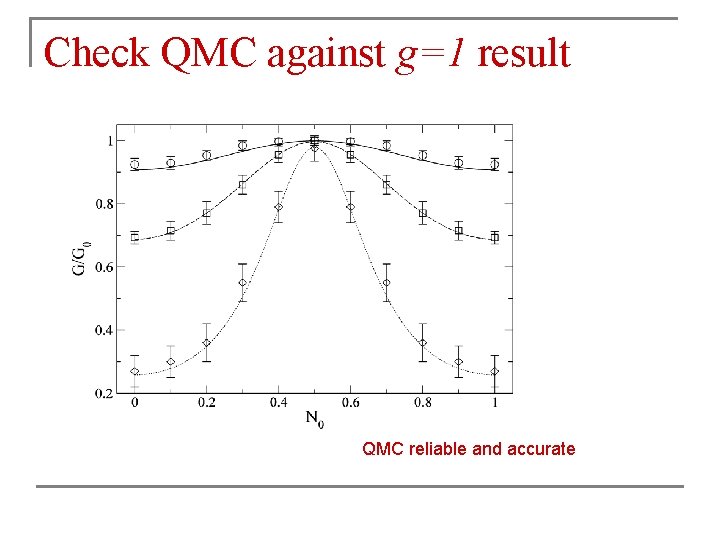
Check QMC against g=1 result QMC reliable and accurate
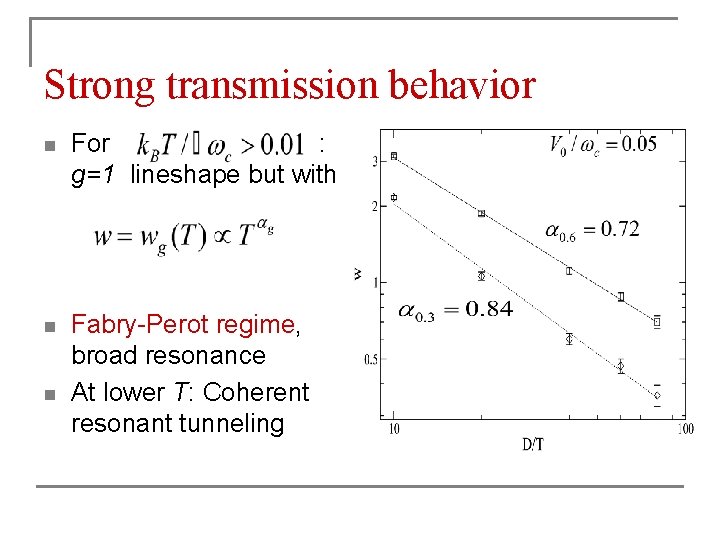
Strong transmission behavior n For : g=1 lineshape but with n Fabry-Perot regime, broad resonance At lower T: Coherent resonant tunneling n
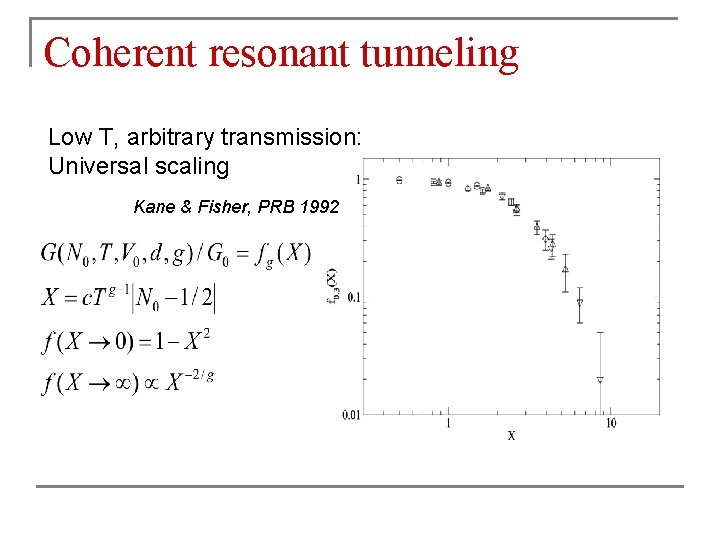
Coherent resonant tunneling Low T, arbitrary transmission: Universal scaling Kane & Fisher, PRB 1992
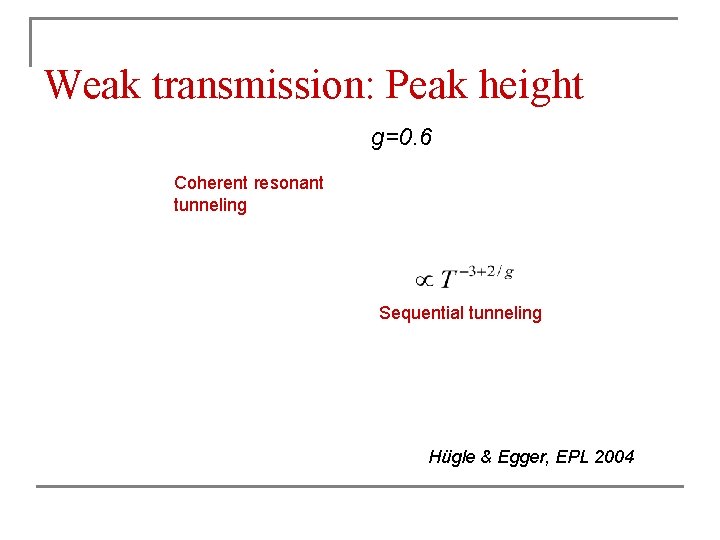
Weak transmission: Peak height g=0. 6 Coherent resonant tunneling Sequential tunneling Hügle & Egger, EPL 2004
Correlated sequential tunneling n n n QMC data appear to invalidate standard sequential tunneling picture Good agreement with experiment Theory proposal: correlated sequential tunneling processes Thorwart, Grifoni et al. , PRL 2002
Conclusions n n n Numerically exact route to dissipative quantum dynamics via real-time QMC Application 1: Spin-boson dynamics. Coherent-incoherent transition, comparison to NIBA. Application 2: Resonant tunneling in a Luttinger liquid. Strong-transmission lineshape, correlated tunneling