
Dissipation phenomena in nuclear fission Intrinsic and collective





- Slides: 53
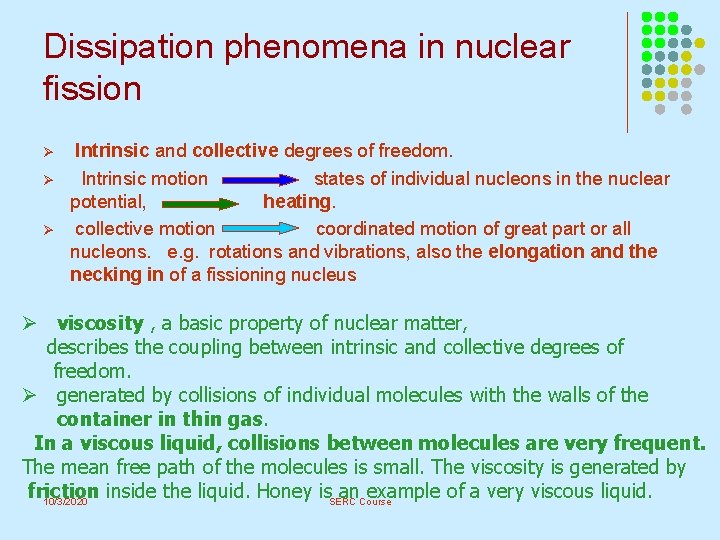
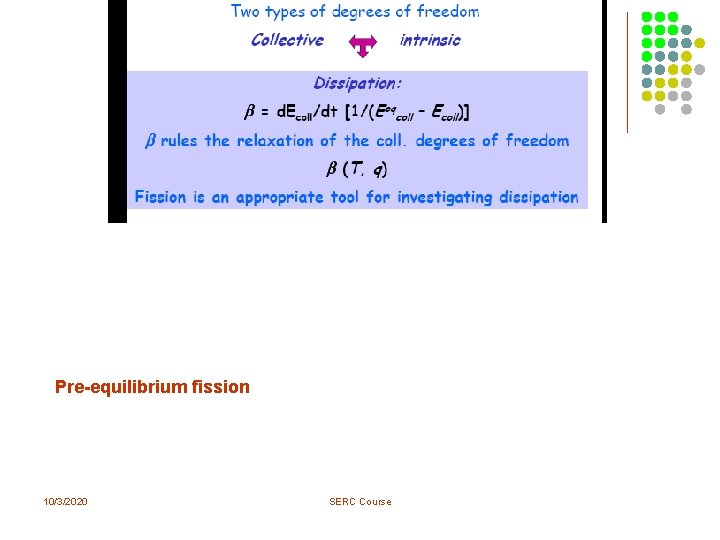
Dissipation phenomena in nuclear fission Ø Ø Ø Intrinsic and collective degrees of freedom. Intrinsic motion states of individual nucleons in the nuclear potential, heating. collective motion coordinated motion of great part or all nucleons. e. g. rotations and vibrations, also the elongation and the necking in of a fissioning nucleus Ø viscosity , a basic property of nuclear matter, describes the coupling between intrinsic and collective degrees of freedom. Ø generated by collisions of individual molecules with the walls of the container in thin gas. In a viscous liquid, collisions between molecules are very frequent. The mean free path of the molecules is small. The viscosity is generated by friction inside the liquid. Honey is an example of a very viscous liquid. 10/3/2020 SERC Course
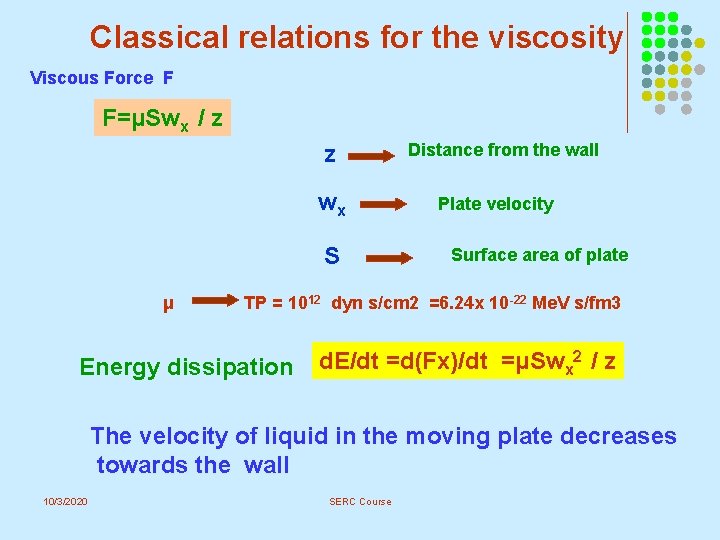
Classical relations for the viscosity Viscous Force F F=μSwx / z z wx S μ Distance from the wall Plate velocity Surface area of plate TP = 1012 dyn s/cm 2 =6. 24 x 10 -22 Me. V s/fm 3 Energy dissipation d. E/dt =d(Fx)/dt =μSwx 2 / z The velocity of liquid in the moving plate decreases towards the wall 10/3/2020 SERC Course
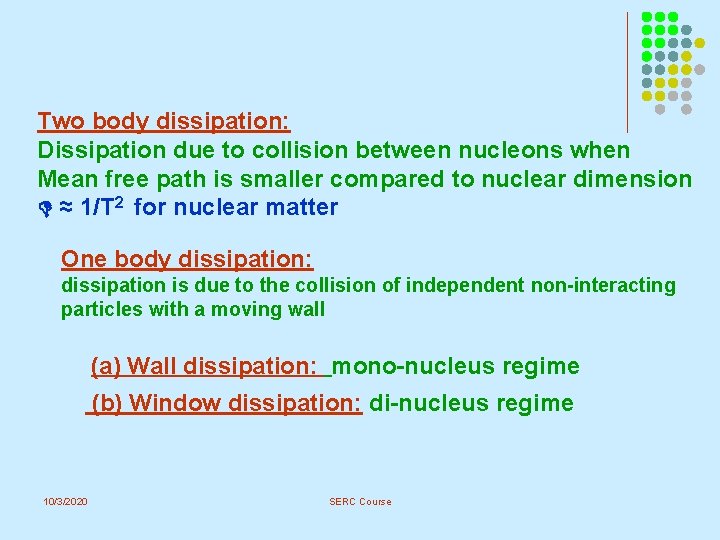
Two body dissipation: Dissipation due to collision between nucleons when Mean free path is smaller compared to nuclear dimension ≈ 1/T 2 for nuclear matter One body dissipation: dissipation is due to the collision of independent non-interacting particles with a moving wall (a) Wall dissipation: mono-nucleus regime (b) Window dissipation: di-nucleus regime 10/3/2020 SERC Course
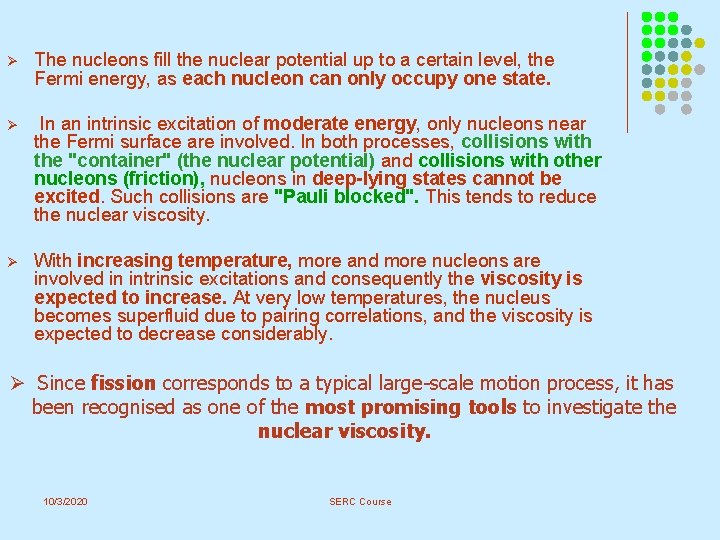
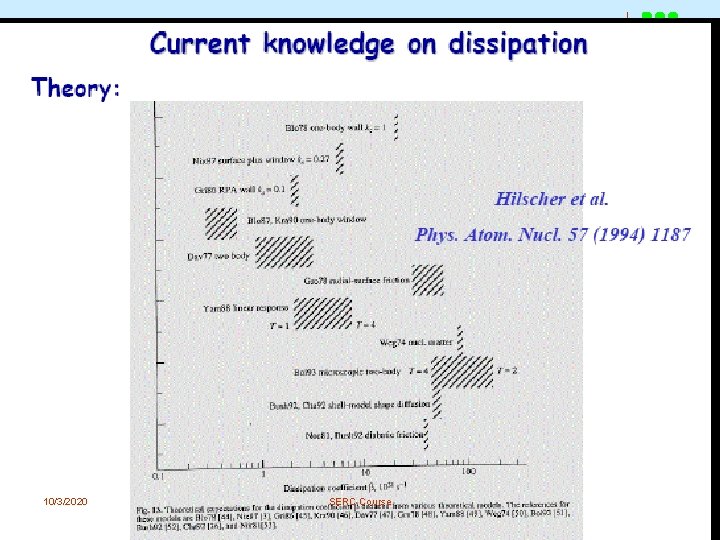
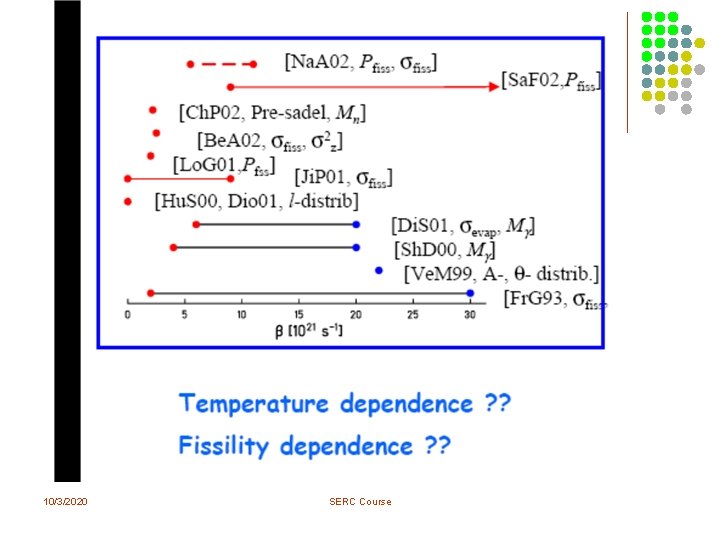
Ø The nucleons fill the nuclear potential up to a certain level, the Fermi energy, as each nucleon can only occupy one state. Ø In an intrinsic excitation of moderate energy, only nucleons near the Fermi surface are involved. In both processes, collisions with the "container" (the nuclear potential) and collisions with other nucleons (friction), nucleons in deep-lying states cannot be excited. Such collisions are "Pauli blocked". This tends to reduce the nuclear viscosity. Ø With increasing temperature, more and more nucleons are involved in intrinsic excitations and consequently the viscosity is expected to increase. At very low temperatures, the nucleus becomes superfluid due to pairing correlations, and the viscosity is expected to decrease considerably. Ø Since fission corresponds to a typical large-scale motion process, it has been recognised as one of the most promising tools to investigate the nuclear viscosity. 10/3/2020 SERC Course
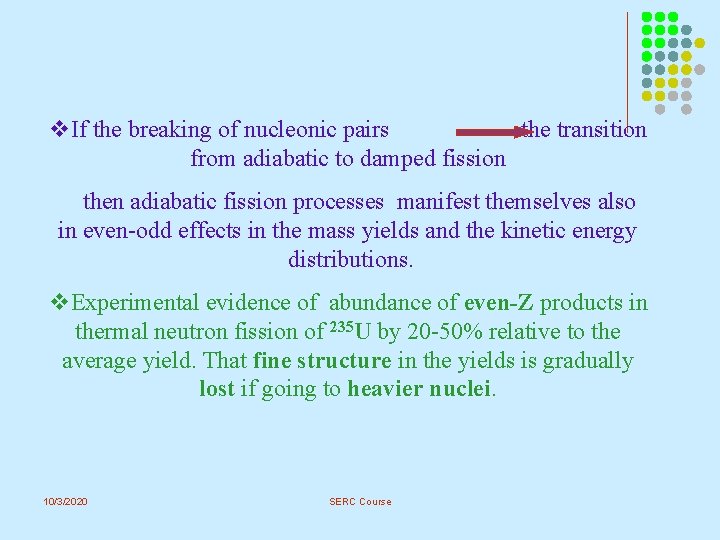
v. If the breaking of nucleonic pairs the transition from adiabatic to damped fission then adiabatic fission processes manifest themselves also in even-odd effects in the mass yields and the kinetic energy distributions. v. Experimental evidence of abundance of even-Z products in thermal neutron fission of 235 U by 20 -50% relative to the average yield. That fine structure in the yields is gradually lost if going to heavier nuclei. 10/3/2020 SERC Course
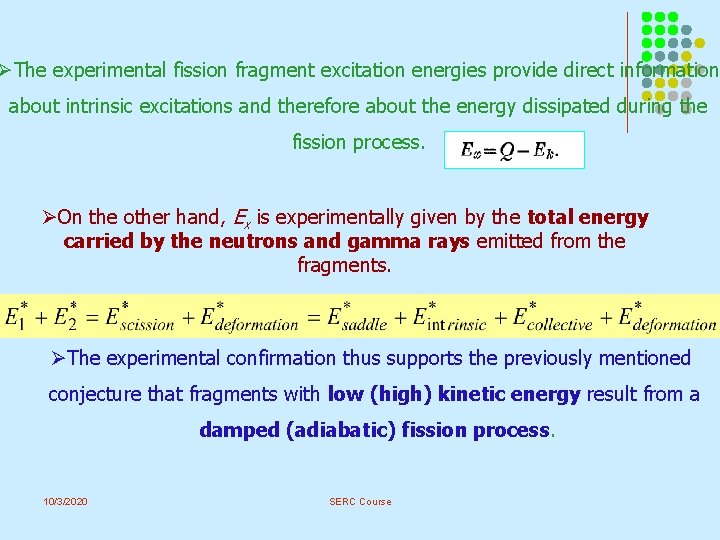
ØThe experimental fission fragment excitation energies provide direct information about intrinsic excitations and therefore about the energy dissipated during the fission process. ØOn the other hand, Ex is experimentally given by the total energy carried by the neutrons and gamma rays emitted from the fragments. ØThe experimental confirmation thus supports the previously mentioned conjecture that fragments with low (high) kinetic energy result from a damped (adiabatic) fission process. 10/3/2020 SERC Course
10/3/2020 SERC Course
10/3/2020 SERC Course
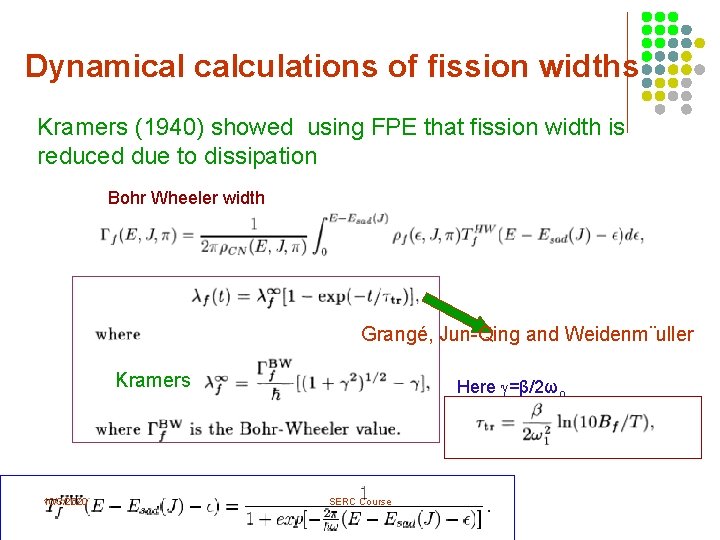
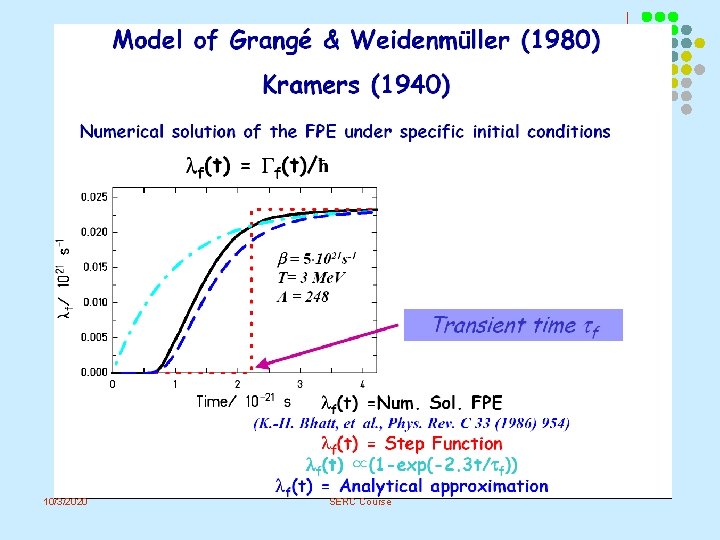
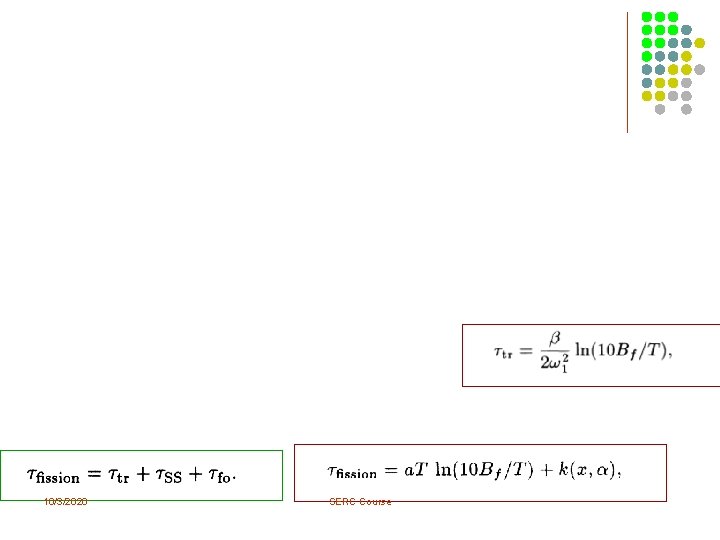
Dynamical calculations of fission widths Kramers (1940) showed using FPE that fission width is reduced due to dissipation Bohr Wheeler width Grangé, Jun-Qing and Weidenm¨uller Kramers 10/3/2020 Here =β/2ωo SERC Course
10/3/2020 SERC Course
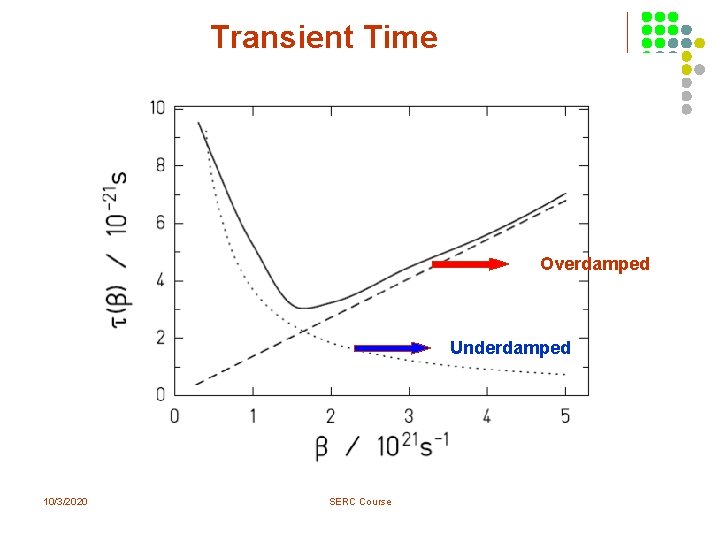
Transient Time Overdamped Underdamped 10/3/2020 SERC Course
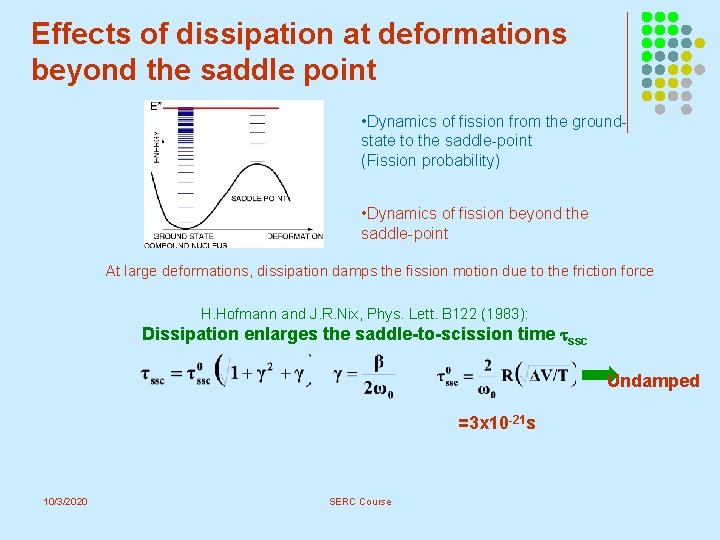
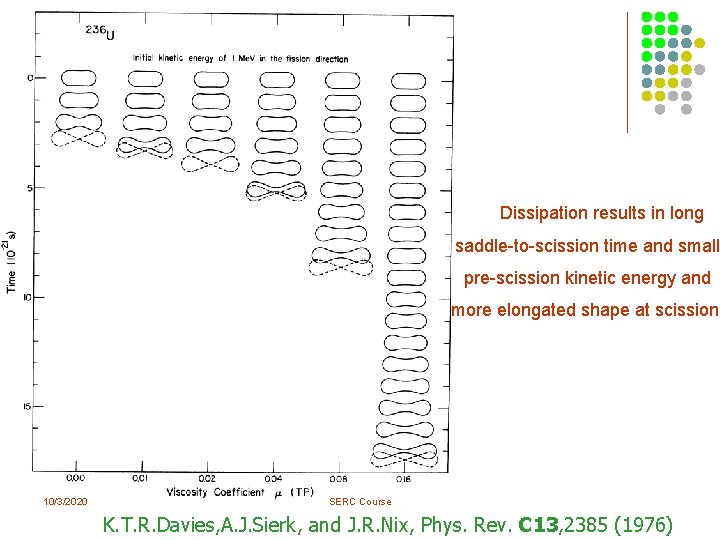
Effects of dissipation at deformations beyond the saddle point • Dynamics of fission from the groundstate to the saddle-point (Fission probability) • Dynamics of fission beyond the saddle-point At large deformations, dissipation damps the fission motion due to the friction force H. Hofmann and J. R. Nix, Phys. Lett. B 122 (1983): Dissipation enlarges the saddle-to-scission time tssc Undamped =3 x 10 -21 s 10/3/2020 SERC Course
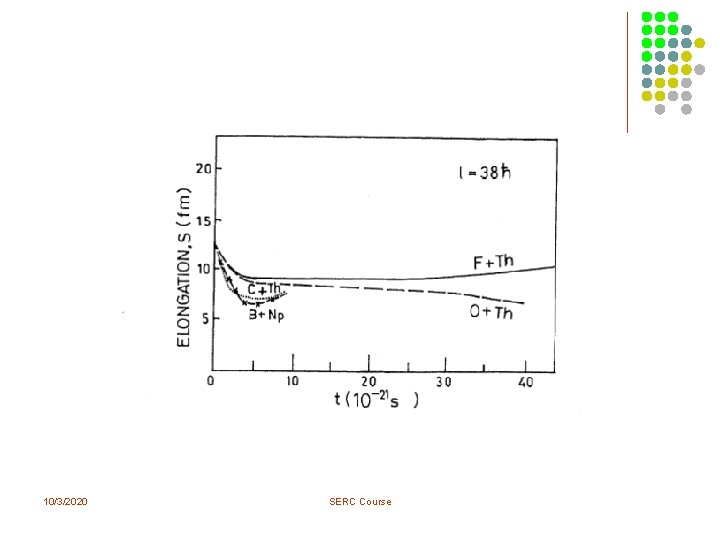
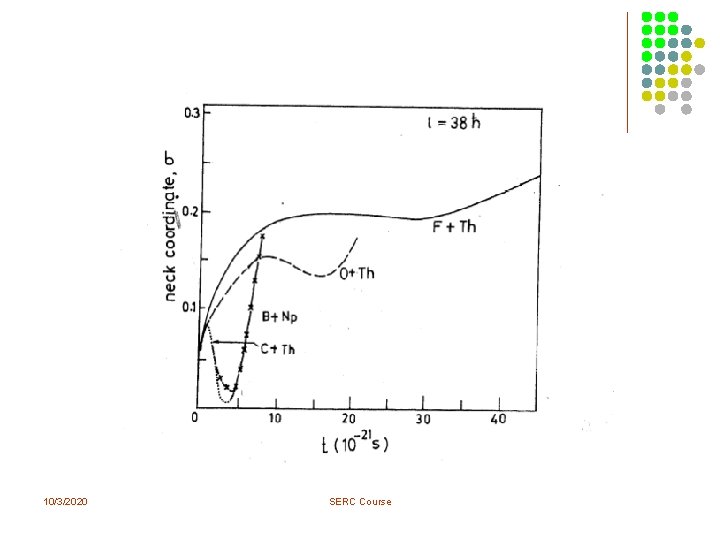
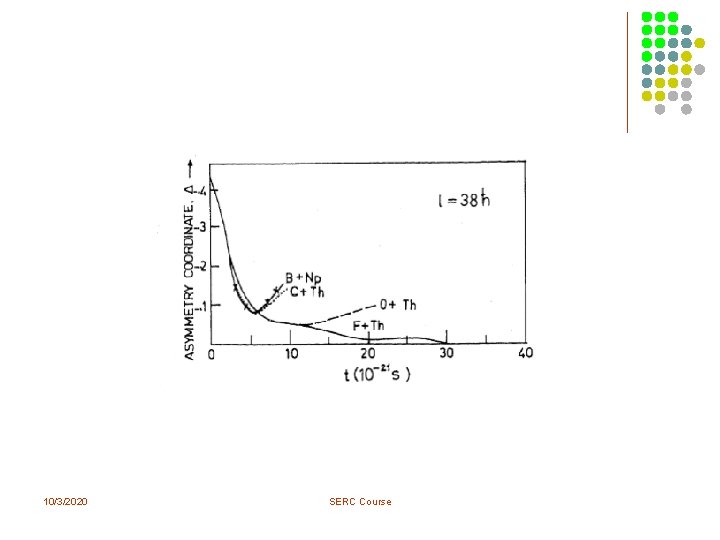
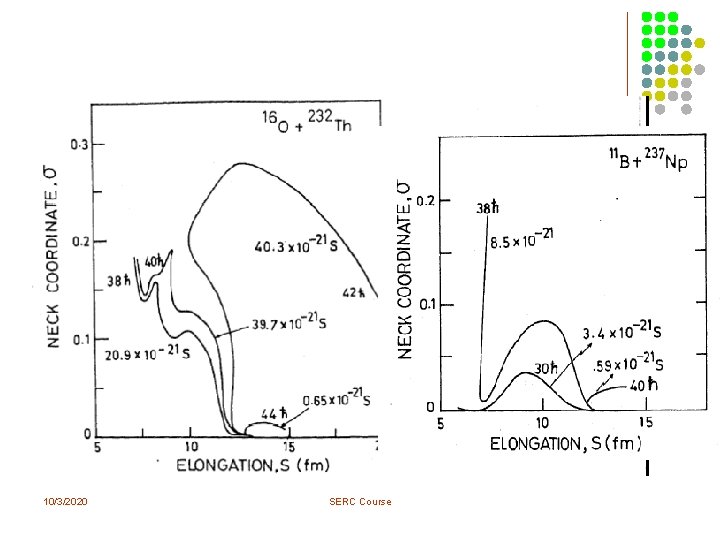
Dissipation results in long saddle-to-scission time and small pre-scission kinetic energy and more elongated shape at scission. 10/3/2020 SERC Course K. T. R. Davies, A. J. Sierk, and J. R. Nix, Phys. Rev. C 13, 2385 (1976)
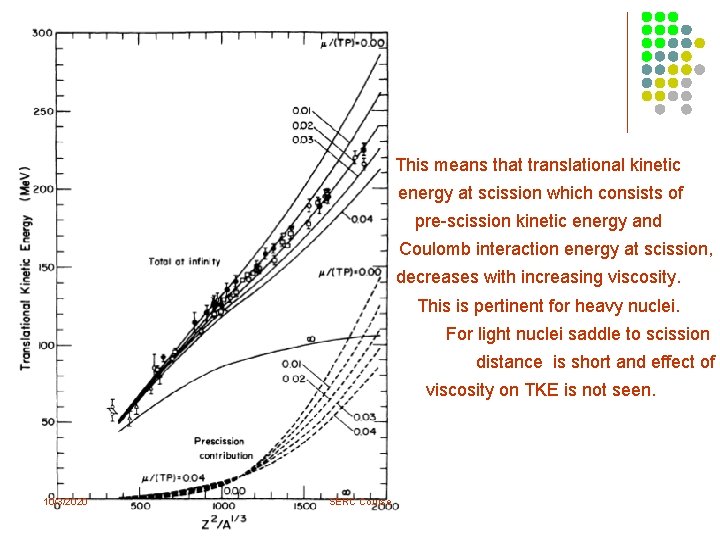
This means that translational kinetic energy at scission which consists of pre-scission kinetic energy and Coulomb interaction energy at scission, decreases with increasing viscosity. This is pertinent for heavy nuclei. For light nuclei saddle to scission distance is short and effect of viscosity on TKE is not seen. 10/3/2020 SERC Course
Pre-equilibrium fission 10/3/2020 SERC Course
10/3/2020 SERC Course
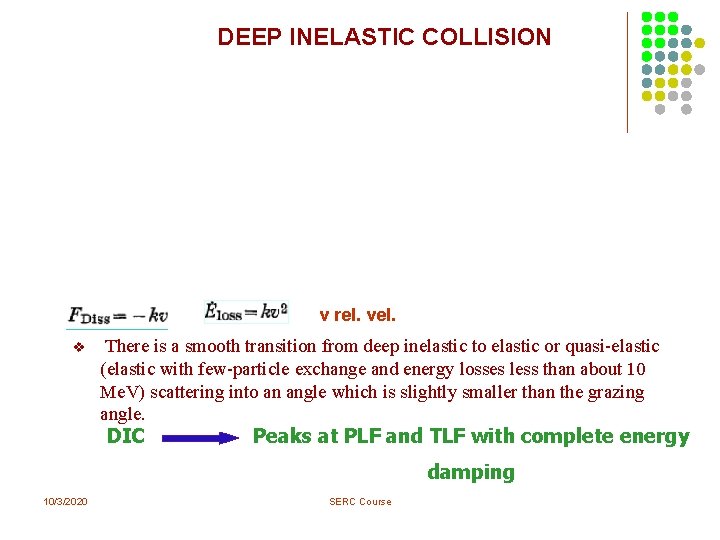
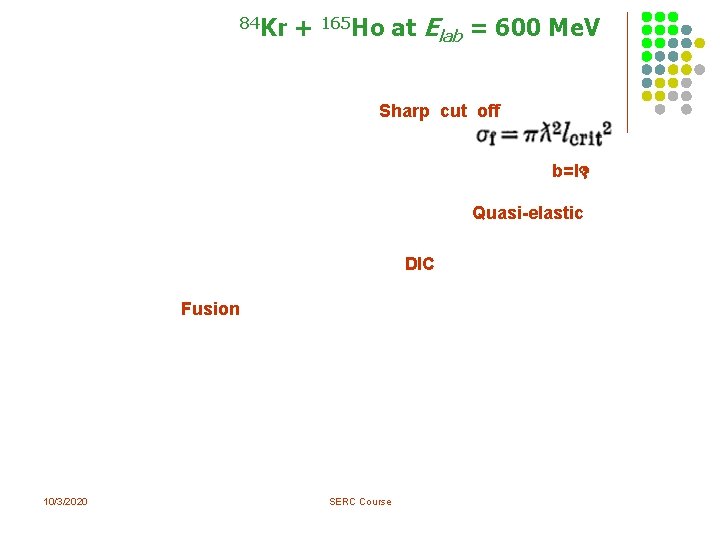
DEEP INELASTIC COLLISION v rel. v There is a smooth transition from deep inelastic to elastic or quasi-elastic (elastic with few-particle exchange and energy losses less than about 10 Me. V) scattering into an angle which is slightly smaller than the grazing angle. DIC Peaks at PLF and TLF with complete energy damping 10/3/2020 SERC Course
84 Kr + 165 Ho at Elab = 600 Me. V Sharp cut off b=l Quasi-elastic DIC Fusion 10/3/2020 SERC Course
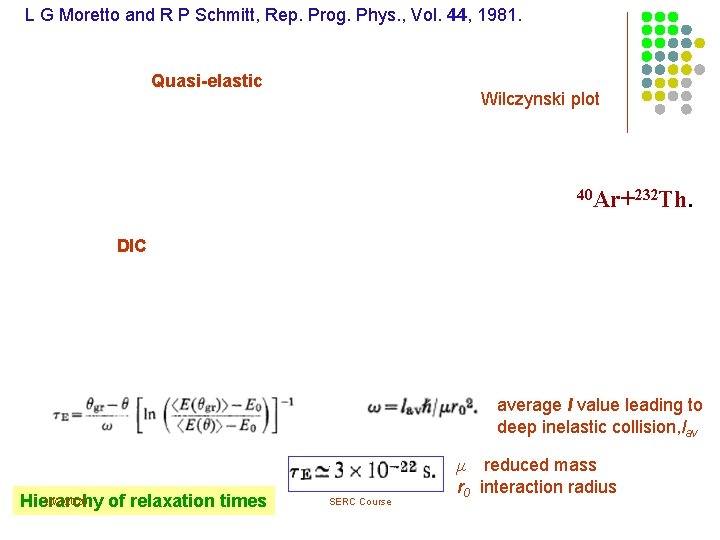
L G Moretto and R P Schmitt, Rep. Prog. Phys. , Vol. 44, 1981. Quasi-elastic Wilczynski plot 40 Ar+232 Th. DIC average I value leading to deep inelastic collision, lav 10/3/2020 Hierarchy of relaxation times SERC Course μ reduced mass r 0 interaction radius
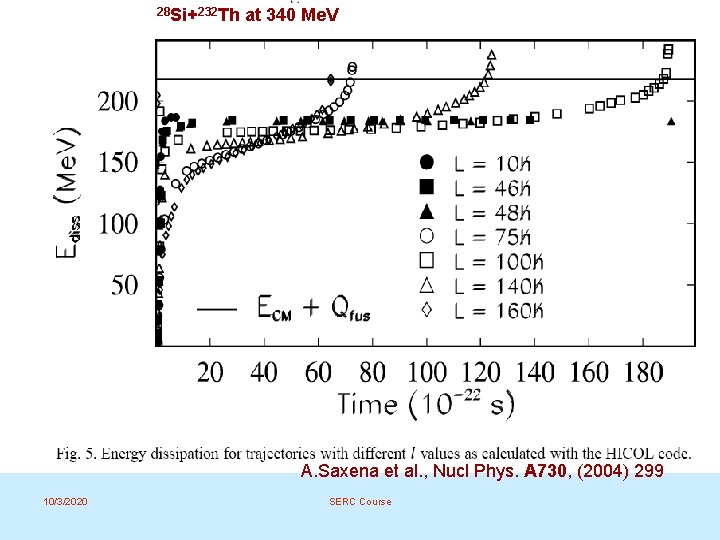
28 Si+232 Th at 340 Me. V A. Saxena et al. , Nucl Phys. A 730, (2004) 299 10/3/2020 SERC Course
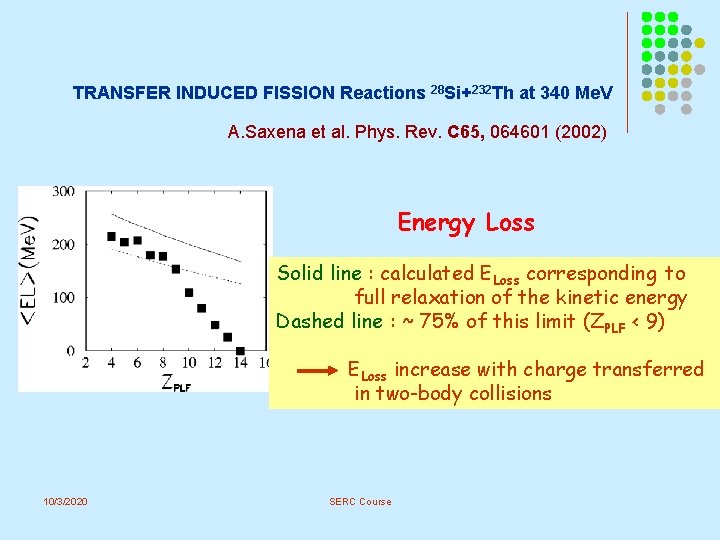
TRANSFER INDUCED FISSION Reactions 28 Si+232 Th at 340 Me. V A. Saxena et al. Phys. Rev. C 65, 064601 (2002) Energy Loss Solid line : calculated ELoss corresponding to full relaxation of the kinetic energy Dashed line : ~ 75% of this limit (ZPLF < 9) ELoss increase with charge transferred in two-body collisions 10/3/2020 SERC Course
R. Vandenbosch et al. PRL, 52 1964(1984) Dynamical calculations This result gives Ex(TLF)≈Ex(PLF) for small Eloss reaching roughly the 80% of thermal equilibrium condition for Eloss=150 Me. V. Equal excitation energy creates temp. Imbalance driving towards temp. equilibration 10/3/2020 SERC Course
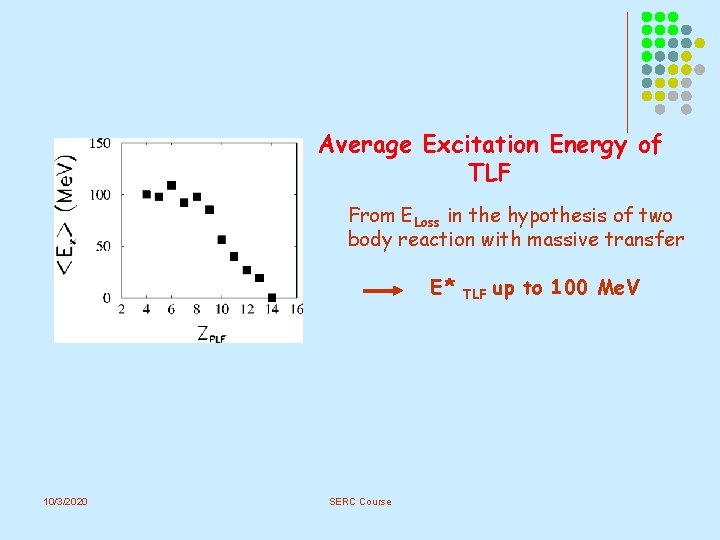
Average Excitation Energy of TLF From ELoss in the hypothesis of two body reaction with massive transfer E* 10/3/2020 SERC Course TLF up to 100 Me. V
Quasi-Fission 64 Ni+197 Au at 418 Me. V J. Velkovska, C. R. Morton, R. L. Mc. Grath, P. Chung, I. Di´oszegi, preprint 10/3/2020 SERC Course
Forward—backward symmetry seen Time period extracted for mass relaxation is much longer than rotational period 10/3/2020 SERC Course
J. Błocki and J. Wilczyński, ACTA PHYSICA POLONICA B 29 (1998) 333 10/3/2020 SERC Course
These values of μ are much larger than those deduced from the analysis of the mean kinetic energies of the fission fragments. This inconsistency of results for two-body dissipation can be used as an argument supporting the idea that at such low energies (below 10 Me. V/nucleon) one-body dissipation still plays a dominating 10/3/2020 SERC Course role.
Nuclear Clocks ØDissipation lengthens the fission time scale, thus an additional approach to study nuclear dissipation is to measure this time. ØSince 80 s- 90 s suitable “nuclear clocks” based on the measurement of particle and γ-ray multiplicities have been developed leading to surprising new insights into fission dynamics. ØThe measurement of neutron multiplicities prior to scission (neutron clock) and the measurement of GDR (Giant Dipole Resonance) γ-ray multiplicities (GDR clock) and charged particles prior scission are the most applied nuclear clocks. The neutron clock and the GDR clock have been extensively described in the review articles of Hilscher and Rossner [ Ann de Physic Fr 17 (1992) 471] and Paul and Thoennessen [Ann. Rev. 44 (1994)65], 10/3/2020 SERC Course
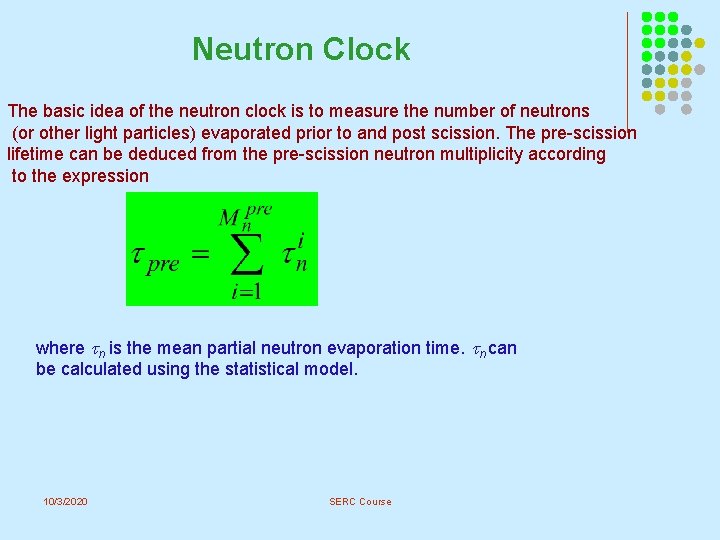
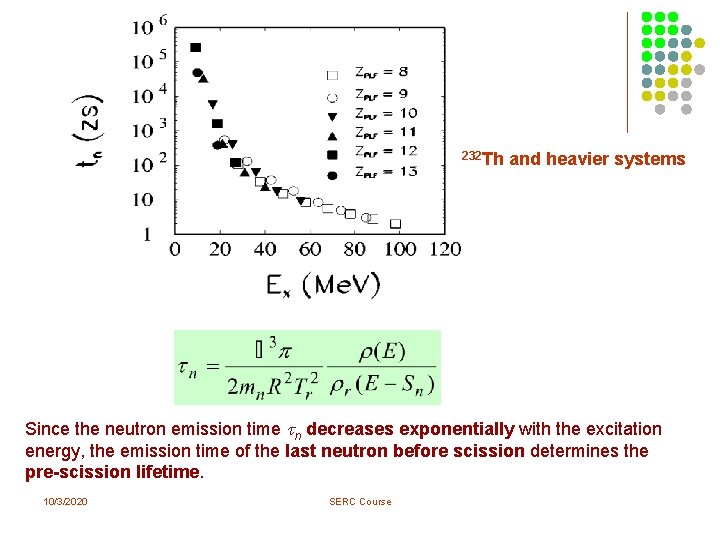
Neutron Clock The basic idea of the neutron clock is to measure the number of neutrons (or other light particles) evaporated prior to and post scission. The pre-scission lifetime can be deduced from the pre-scission neutron multiplicity according to the expression where n is the mean partial neutron evaporation time. n can be calculated using the statistical model. 10/3/2020 SERC Course
232 Th and heavier systems Since the neutron emission time n decreases exponentially with the excitation energy, the emission time of the last neutron before scission determines the pre-scission lifetime. 10/3/2020 SERC Course
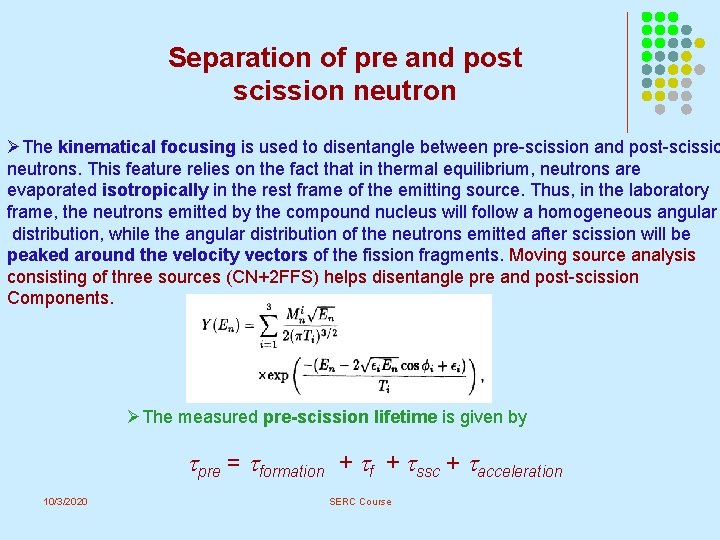
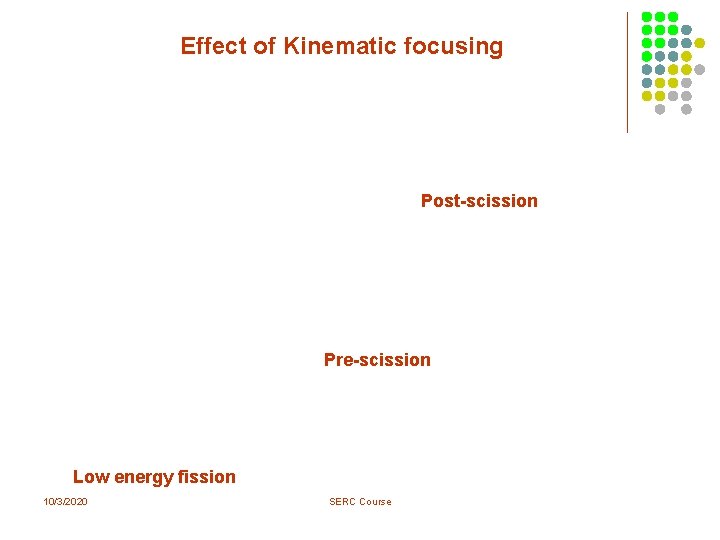
Separation of pre and post scission neutron ØThe kinematical focusing is used to disentangle between pre-scission and post-scissio neutrons. This feature relies on the fact that in thermal equilibrium, neutrons are evaporated isotropically in the rest frame of the emitting source. Thus, in the laboratory frame, the neutrons emitted by the compound nucleus will follow a homogeneous angular distribution, while the angular distribution of the neutrons emitted after scission will be peaked around the velocity vectors of the fission fragments. Moving source analysis consisting of three sources (CN+2 FFS) helps disentangle pre and post-scission Components. ØThe measured pre-scission lifetime is given by pre = formation + f + ssc + acceleration 10/3/2020 SERC Course
Effect of Kinematic focusing Post-scission Pre-scission Low energy fission 10/3/2020 SERC Course
Charged particle Clock The charged-particle clock leads to larger uncertainties in the determination of reaction time scales than the neutron clock. The reason is that the measurement and interpretation of charged particle multiplicities is hindered by the low multiplicity in most reactions, the anisotropic angular distribution, which makes more difficult to apply the kinematical focussing, and the sensitivity of the decay widths to the deformation of the emitting source and to the not well defined emission barriers. 10/3/2020 SERC Course
GDR clock ØHigh energetic γ-rays (E ~ 5 -20 Me. V) originating from the deexcitation of the giant dipole resonance (GDR) during the fission process. ØThoennessen et al. established : GDR γ-ray multiplicities 50% larger than expected by the statistical model. Ø Two sources: the GDR γ-rays emitted from the compound nucleus before scission, and the γ-rays emitted from the fission fragments. Ø Due to the dependence of the energy of the GDR γ-rays on the deformation and the mass of the emitting system, pre-scission GDR γ-rays dominate at energies from 7 to 15 Me. V, the fission fragment component is the strongest at the lowest energies ØThese different contributions cannot be disentangled experimentally and must be extracted by comparing with model calculations. 10/3/2020 SERC Course
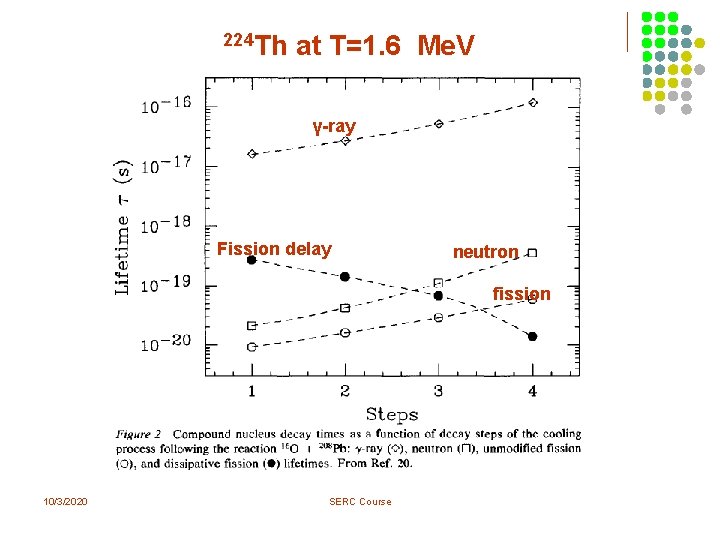
224 Th at T=1. 6 Me. V γ-ray Fission delay neutron fission 10/3/2020 SERC Course
Pre-scission neutron negligible after 10 -17 s whereas fission is quite probable 10/3/2020 SERC Course M. Morjean, GANIL
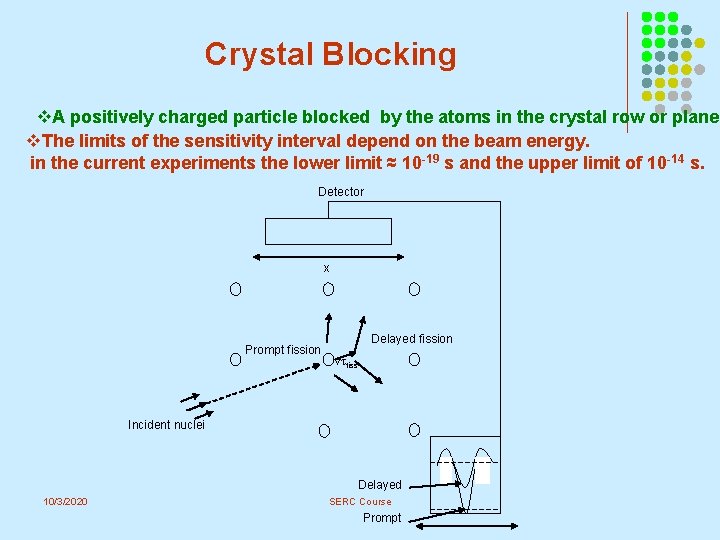
Crystal Blocking v. A positively charged particle blocked by the atoms in the crystal row or plane. v. The limits of the sensitivity interval depend on the beam energy. in the current experiments the lower limit ≈ 10 -19 s and the upper limit of 10 -14 s. Detector x Prompt fission Delayed fission vτfiss Incident nuclei Delayed 10/3/2020 SERC Course Prompt
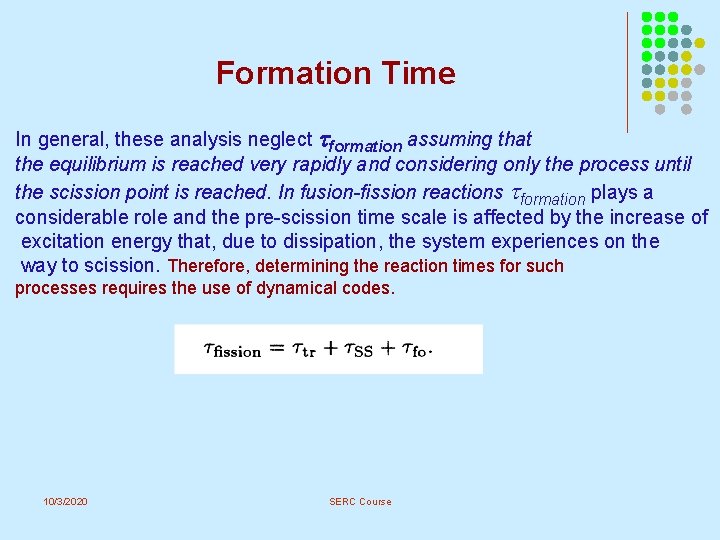
Formation Time In general, these analysis neglect formation assuming that the equilibrium is reached very rapidly and considering only the process until the scission point is reached. In fusion-fission reactions formation plays a considerable role and the pre-scission time scale is affected by the increase of excitation energy that, due to dissipation, the system experiences on the way to scission. Therefore, determining the reaction times for such processes requires the use of dynamical codes. 10/3/2020 SERC Course
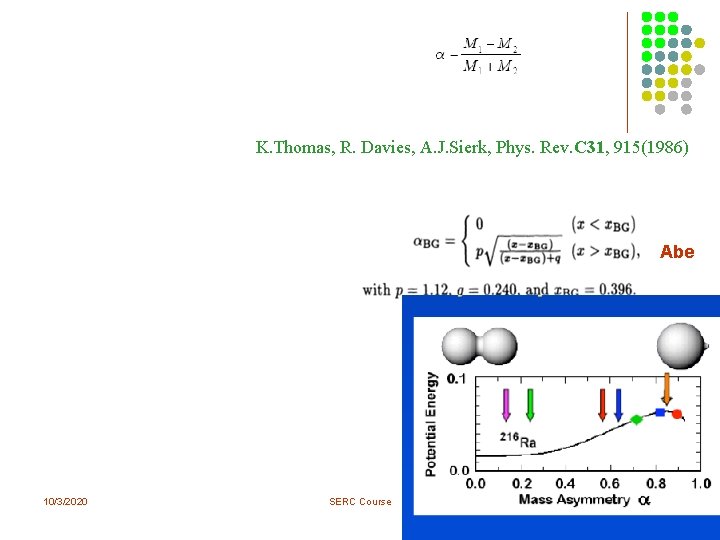
K. Thomas, R. Davies, A. J. Sierk, Phys. Rev. C 31, 915(1986) Abe 10/3/2020 SERC Course
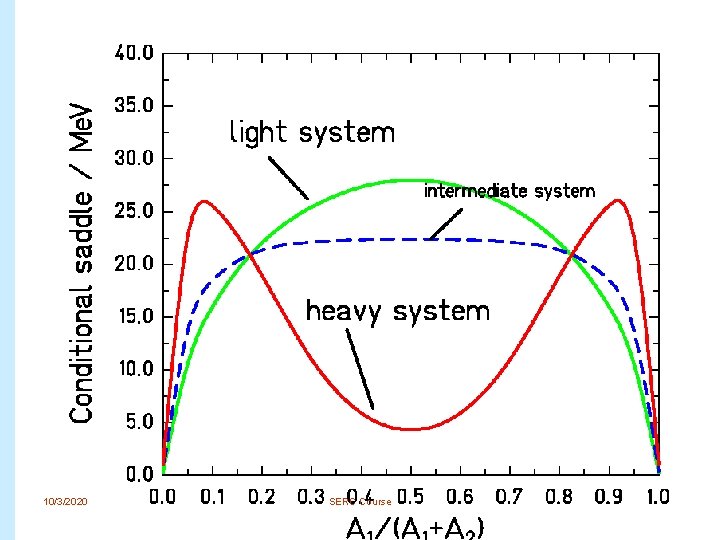
10/3/2020 SERC Course
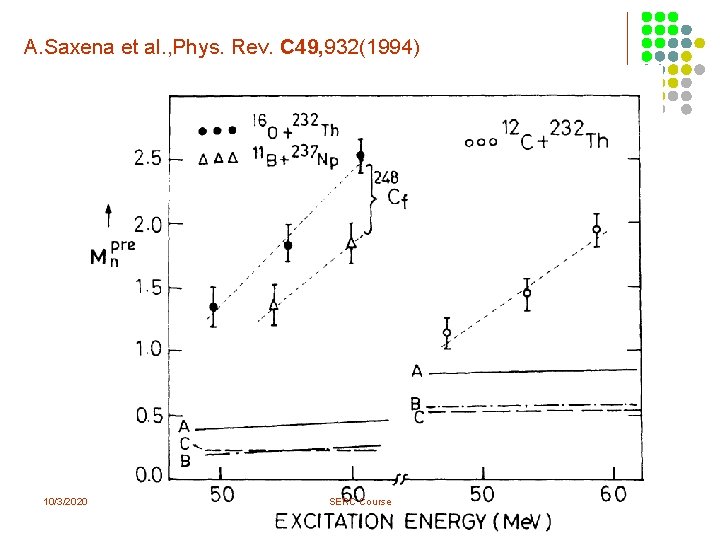
A. Saxena et al. , Phys. Rev. C 49, 932(1994) 10/3/2020 SERC Course
10/3/2020 SERC Course
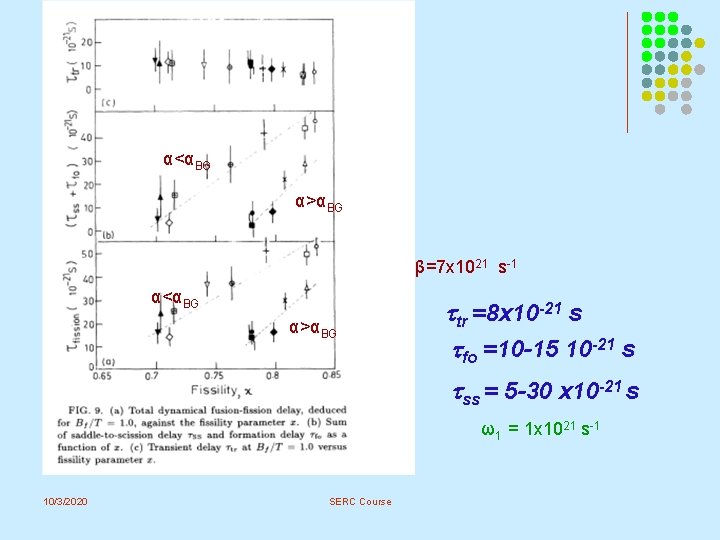
α<αBG α>αBG β=7 x 10²¹ s-1 α<αBG α>αBG tr =8 x 10 -21 s fo =10 -15 10 -21 s ss = 5 -30 x 10 -21 s ω1 = 1 x 10²¹ s-1 10/3/2020 SERC Course
10/3/2020 SERC Course K. Wilczynska et al. Acta Physica Polonica 29, 451 (1999)
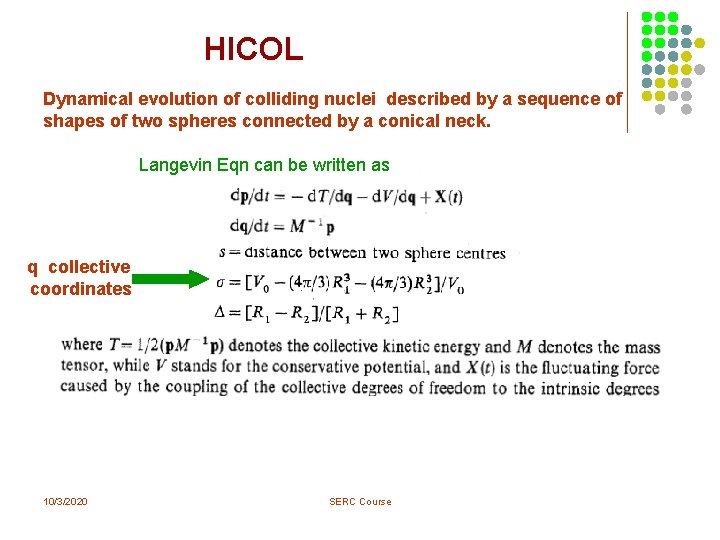
HICOL Dynamical evolution of colliding nuclei described by a sequence of shapes of two spheres connected by a conical neck. Langevin Eqn can be written as q collective coordinates 10/3/2020 SERC Course
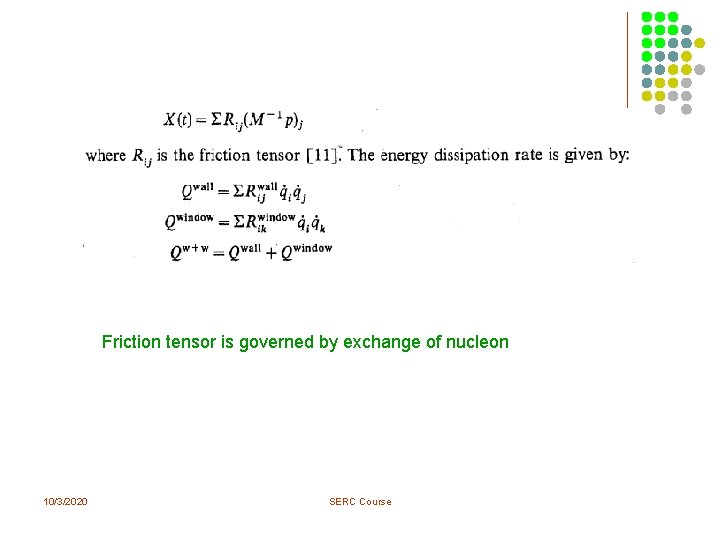
Friction tensor is governed by exchange of nucleon 10/3/2020 SERC Course
10/3/2020 SERC Course
10/3/2020 SERC Course
10/3/2020 SERC Course
10/3/2020 SERC Course
10/3/2020 SERC Course
10/3/2020 SERC Course
10/3/2020 SERC Course