
Dissertation Skills HPSM 044 Basic details information and
Dissertation Skills HPSM 044
Basic details, information and administration n Module co-ordinator: Prof. Jeffrey Karp n Room 204 (Amory) n J. karp@exeter. ac. uk n Office hours: for Dissertation Skills students: Thursdays 10 -12
This course (what it is and what it isn’t) n To equip students with the skills, knowledge and understanding necessary to carry out an independent piece of research and to complete a Masters level dissertation under the guidance of an academic supervisor n This is not a theory or substantive course; nor is it a methodology course per se.
Two Assignments n Dissertation proposal (2000 words/50%) due 28 February n Research design (2000 words/50%) due 24 April.
The Dissertation n n n Dissertation topics must be in your MA field Word length: around 15, 000 words Final due date: 11 September 2008 Supervisors will be allotted in the coming months Supervisor’s role: you should have at least 4 meetings with your supervisor 450 hours independent study time (mostly from June to September)

What is a dissertation? n There is no single or ‘right’ definition of a dissertation n Generally agreed that it has these components: – extended piece of analysis – conducted independently (though with supervision) – indicates understanding of methodological, theoretical and substantive debates
A ‘good’ dissertation Your dissertation demands that you combine two skill sets: n Generic skills - asking good questions, constructing a research design, writing, and analysis. n Subject-specific skills - application of the appropriate theories, operationalising the correct methodologies, developing knowledge in an area
A ‘good’ dissertation (2) THE AIM: n To produce a lengthy piece of research which seeks an answer to a particular, focused research question THIS MEANS n the question, debate or issue needs to be well defined and clearly understood n it must be addressed in a detailed and organised way n this does not mean that each dissertation student must find out something new, but rather a new perspective on a research topic needs to be offered
A ‘good’ dissertation (3) This new perspective can be offered in various ways: n creation of new data - survey data, employing interviews, comparing sources of data which already exist n comparison or analysis of existing arguments or debates Need to go beyond the DESCRIPTIVE - to offer an ANALYTIC account
What are we looking for? n The successful realisation of the aims already discussed n Marking criteria – Clear identification of the subject and the objectives of the dissertation – Relevant, well researched content (a balance of secondary and original material) – Coherent and logical structure – Analysis
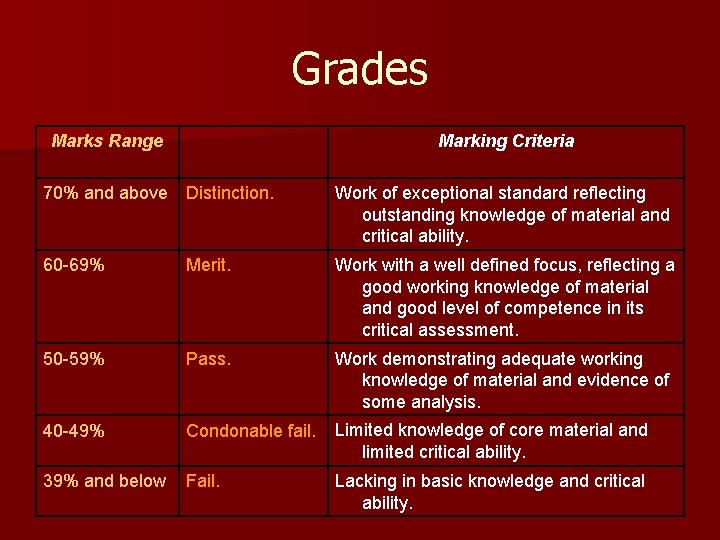
Grades Marks Range Marking Criteria 70% and above Distinction. Work of exceptional standard reflecting outstanding knowledge of material and critical ability. 60 -69% Merit. Work with a well defined focus, reflecting a good working knowledge of material and good level of competence in its critical assessment. 50 -59% Pass. Work demonstrating adequate working knowledge of material and evidence of some analysis. 40 -49% Condonable fail. Limited knowledge of core material and limited critical ability. 39% and below Fail. Lacking in basic knowledge and critical ability.
Common problems Student concern - originality But, common problems are usually: 1. No clear research question 2. Poor justification of the methodology 3. The dissertation lacks sufficient analysis 4. Unclear / contradictory use of terminology Source: Harrison, 2001: 143.
Common problems (2) n These problems are made more likely in topics where a good deal of literature already exists possible for the literature review part of the dissertation to either ‘crowd out’ the rest of the work or to become like separate pieces of work n You must problematise the topic that you pick getting to your final question is an iterative process n ‘relative few researchers end up studying precisely what they set out to study originally’ (Blaxter et al, 1996: 144)
The joy and pain of writing a dissertation Independent research n positive (though sometimes stressful) to be in full charge of your own piece of work n you set the question - research something which interests you specifically (not the lecturer!) n But it can be a lonely experience – it helps to set -up a support network for yourself - peers, supervisor, friends
Supervision (allocation, meetings, duties) n Supervisors will be allotted in the coming months (end of Feb, beginning of March) n Supervisor’s role: you should have at least 4 meetings with your supervisor (approx ½ hour per meeting, possibly more) n Politics Dept: supervision period from the beginning of March to the end of June n July to mid-September – autonomous study
Plan of the course n n n n Introduction The Research Topic: Asking Good Questions The Research Process; from Theory to Evidence Research Design: Making Causal Inferences and Ruling out Rival Explanations Gathering Evidence Using Primary or Secondary Data Literature Review and Citation Methods Discussion and Analysis
- Slides: 16