
Dissent during WWI Reasons for Dissent Opposition to
- Slides: 14
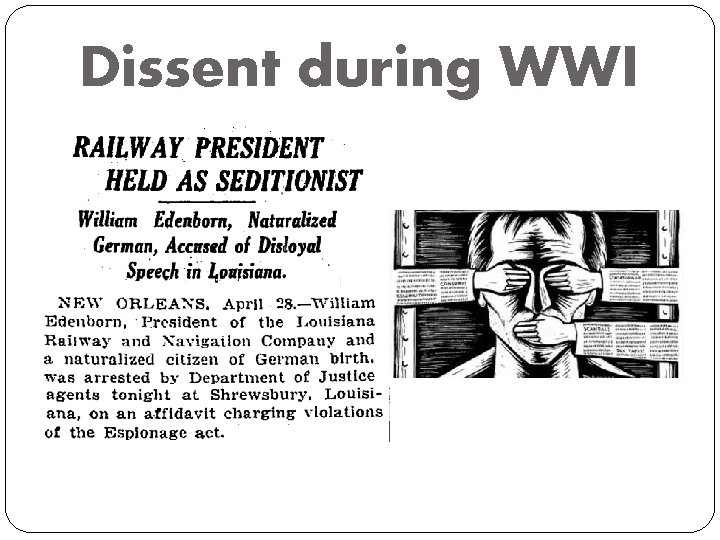
Dissent during WWI
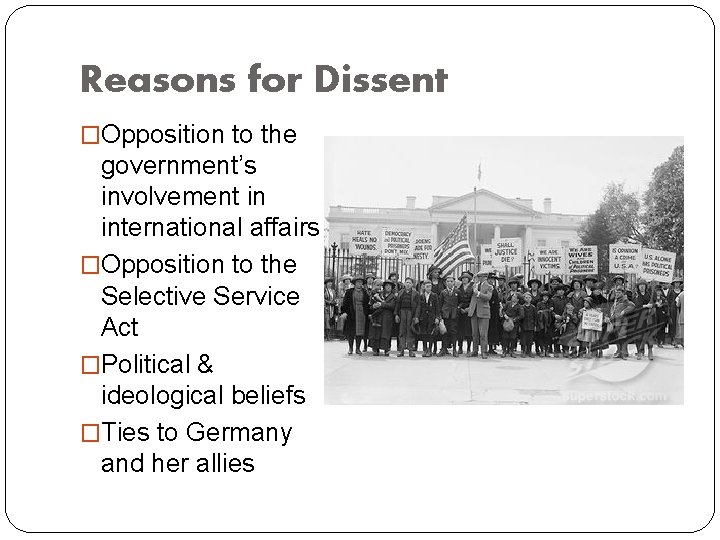
Reasons for Dissent �Opposition to the government’s involvement in international affairs �Opposition to the Selective Service Act �Political & ideological beliefs �Ties to Germany and her allies
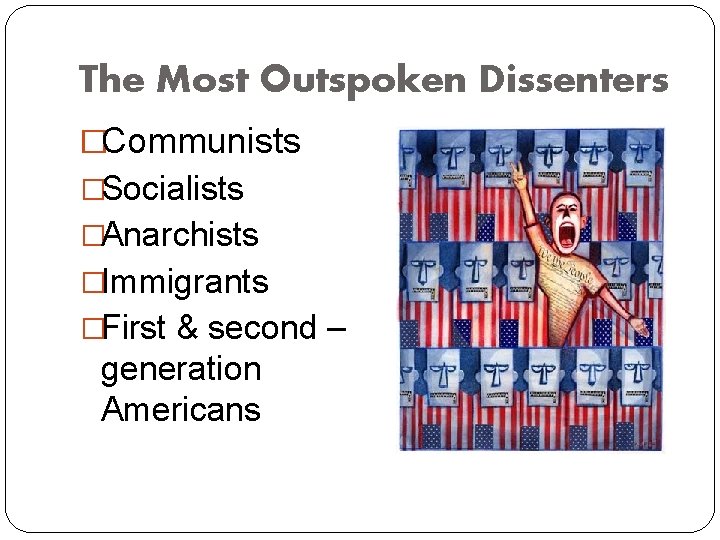
The Most Outspoken Dissenters �Communists �Socialists �Anarchists �Immigrants �First & second – generation Americans
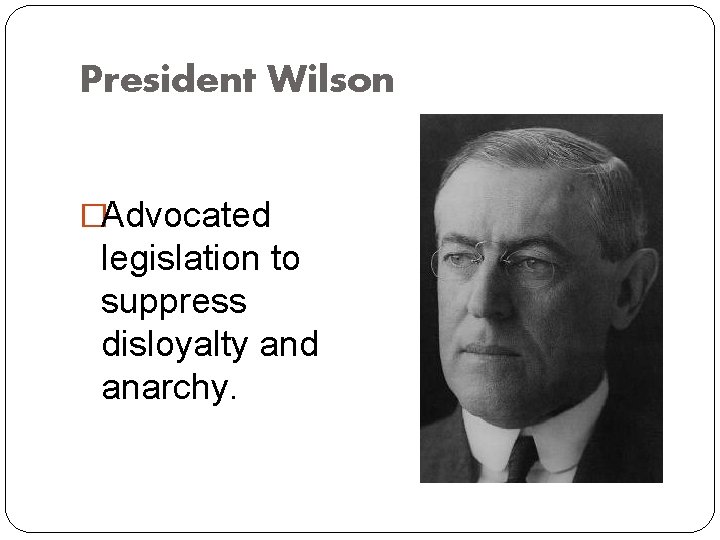
President Wilson �Advocated legislation to suppress disloyalty and anarchy.
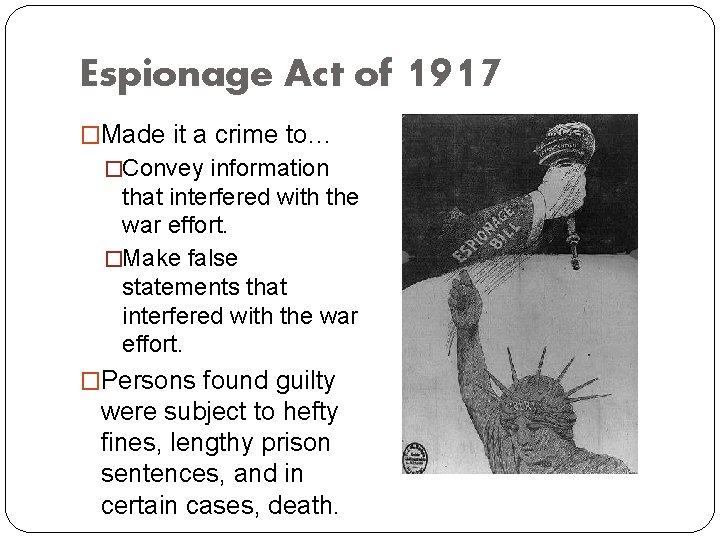
Espionage Act of 1917 �Made it a crime to… �Convey information that interfered with the war effort. �Make false statements that interfered with the war effort. �Persons found guilty were subject to hefty fines, lengthy prison sentences, and in certain cases, death.
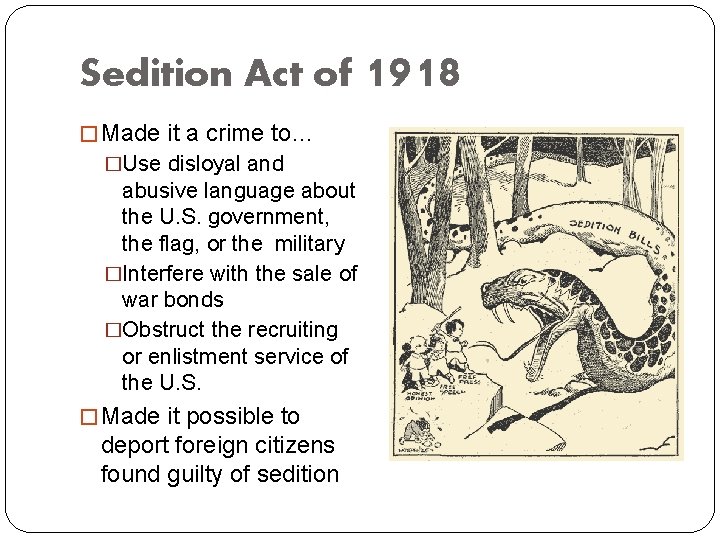
Sedition Act of 1918 � Made it a crime to… �Use disloyal and abusive language about the U. S. government, the flag, or the military �Interfere with the sale of war bonds �Obstruct the recruiting or enlistment service of the U. S. � Made it possible to deport foreign citizens found guilty of sedition
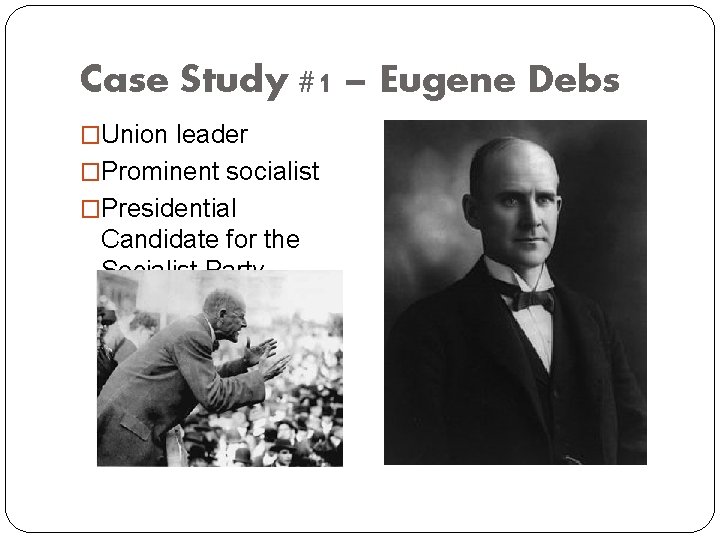
Case Study #1 – Eugene Debs �Union leader �Prominent socialist �Presidential Candidate for the Socialist Party
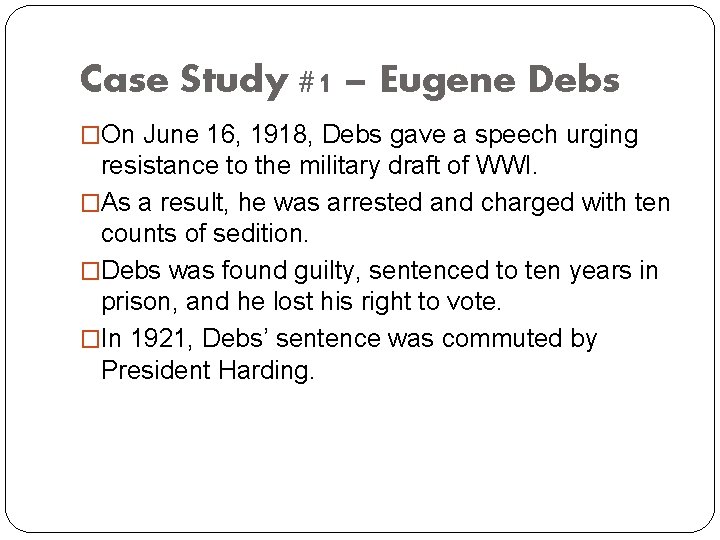
Case Study #1 – Eugene Debs �On June 16, 1918, Debs gave a speech urging resistance to the military draft of WWI. �As a result, he was arrested and charged with ten counts of sedition. �Debs was found guilty, sentenced to ten years in prison, and he lost his right to vote. �In 1921, Debs’ sentence was commuted by President Harding.
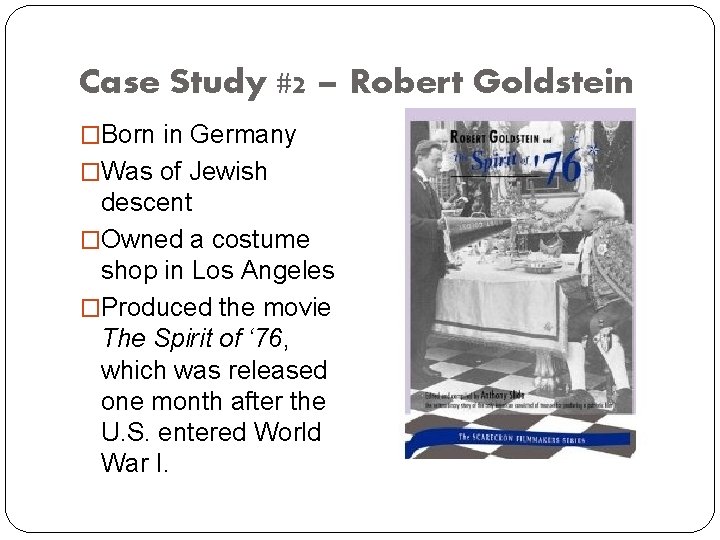
Case Study #2 – Robert Goldstein �Born in Germany �Was of Jewish descent �Owned a costume shop in Los Angeles �Produced the movie The Spirit of ‘ 76, which was released one month after the U. S. entered World War I.
Case Study #2 – Robert Goldstein �Goldstein’s film, The Spirit of ‘ 76, depicted many atrocities committed by the British during the American Revolution. �Goldstein was ordered to delete the offensive scenes, but he snuck them back in for the L. A. premiere of the movie. �The film was seized and Goldstein was charged with attempting to cause insubordination, disloyalty, and mutiny by U. S. troops. �He was sentenced to 10 years in prison. �After the war ended, President Wilson commuted his sentence.
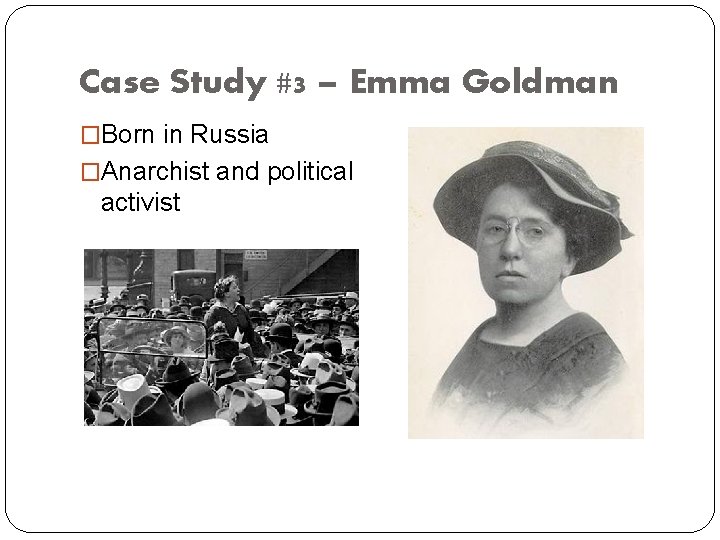
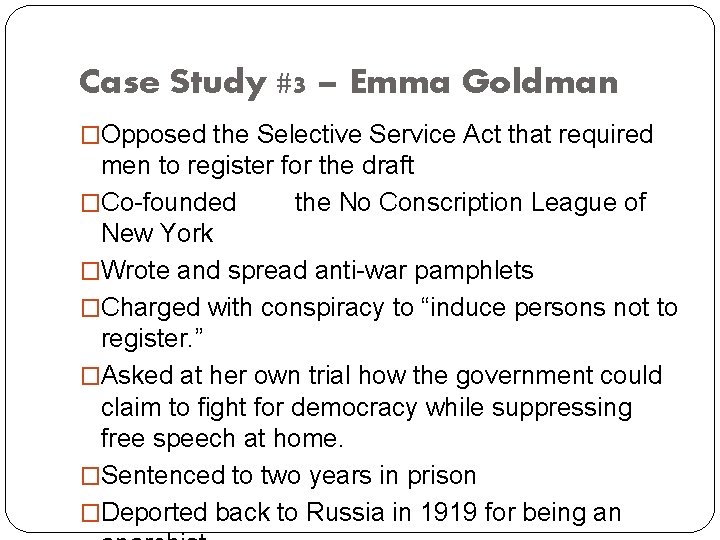
Case Study #3 – Emma Goldman �Born in Russia �Anarchist and political activist
Case Study #3 – Emma Goldman �Opposed the Selective Service Act that required men to register for the draft �Co-founded the No Conscription League of New York �Wrote and spread anti-war pamphlets �Charged with conspiracy to “induce persons not to register. ” �Asked at her own trial how the government could claim to fight for democracy while suppressing free speech at home. �Sentenced to two years in prison �Deported back to Russia in 1919 for being an
As a Result of the Espionage and Sedition Acts… �Approximately 1, 500 people were imprisoned, and of that number, approximately 250 people were deported. �In 1919, the court case Schenck vs. United States ruled that the Espionage Act’s limits on free speech were constitutional. �President Wilson eventually pardoned or commuted the sentences of approximately 200 prisoners convicted under the Espionage and Sedition Acts. �The Sedition Act was repealed in 1920, but the Espionage Act remains a part of U. S. law.
Assignment Scenario �You are a lawyer, and you have been given the option to either prosecute OR defend (you choose) one of the case studies presented in class. �You need to explain how you plan to argue your case, and make sure to include any information that helps support your argument. Your argument should consist of at least 2 paragraphs. �This assignment will be worth 20 points. I will be giving 10 points for accuracy and evidence, and 10 points for focus and clarity.