
Dissecting trust protectors Glenn M Karisch Austin Texas

- Slides: 15
Dissecting trust protectors Glenn M. Karisch Austin, Texas
What is a trust protector? • Called many things • No references to “trust protector” in statutes • Working definition: A non-trustee who has the power to: 1. make changes to the trust, its trustee, its beneficiaries or its situs; 2. direct the trustee to take an action; or 3. prohibit the trustee from taking an action.
Who can be a trust protector? • A beneficiary • The trustee • A third party – Uncle Joe – The attorney – The accountant – The financial advisor? – A bank or trust company?
Common uses • Amend the trust – Tax (otherwise non-substantive) – Nontax (substantive) • • • Change trustee personnel Direct/restrict investments Direct/restrict distributions Change situs Direct the trustee to decant Do any of the things on Shannon’s decanting list
Statutes affecting trust protectors • TTC § 114. 003: Powers to Direct – Trust instrument may give trustee or other person a power to direct the modification or termination of the trust – If the trust gives a person the power to direct actions of the trustee, the trustee shall act in accordance with the direction, unless: • The direction is manifestly contrary to the trust terms; or • The trustee knows the direction would constitute a serious breach of a fiduciary duty that the powerholder owes to the beneficiaries
Statutes affecting trust protectors • TTC § 114. 003: Powers to Direct – A person other than a beneficiary who holds a power to direct is presumptively a fiduciary required to act in good faith with regard to the purposes of the trust and the interests of the beneficiaries. – The holder of a power to direct is liable for any loss that results from a breach of the person’s fiduciary duty
Statutes affecting trust protectors • TTC § 114. 007: Exculpation of Trustee – A trust term relieving the trustee of liability for breach of trust is unenforceable if the breach is committed in bad faith, intentionally or with reckless indifference – This doesn’t prohibit the settlor from relieving the trustee from a duty or directing the trustee to do or not do something that otherwise would be a breach, except as provided by TTC § 111. 0035
Statutes affecting trust protectors • TTC § 111. 0035: Mandatory Rules – The terms of the trust prevail over the TTC, except that the terms of the trust may not limit “the applicability of § 114. 007 to an exculpation term of a trust” • Query: Does § 114. 007 and/or § 111. 0035 affect the settlor’s ability to relieve a trust protector from liability?
Must the trust protector be a fiduciary? • No (not in Texas, at least) • § 114. 003(c): A person, other than a beneficiary, who holds a power to direct is presumptively a fiduciary – A possible inference is that a beneficiary serving as trust protector is presumptively not a fiduciary – For any trust protector, § 114. 003(c) makes no sense if the trust instrument cannot provide that he/she is not a fiduciary
To be, or not to be, a fiduciary? • Arguments for making the trust protector a fiduciary – If he/she is not a fiduciary, the beneficiaries can be left completely without recourse • § 114. 003: Trustee can follow non-fiduciary trust protector’s direction even if it would constitute a serious breach of trust had he/she been a fiduciary – The trust protector should approach his/her responsibilities as a fiduciary – seriously, with the beneficiaries’ interests in mind
To be, or not to be, a fiduciary? • Arguments against making the trust protector a fiduciary – No one will want to be a trust protector if he/she is subjected to fiduciary duties • He/she probably is unpaid • He/she does not have the resources of the trust to mount a defense – If he/she is a fiduciary, he/she may believe it is necessary to use trust resources to investigate before making decisions, “wasting” trust assets
To be, or not to be, a fiduciary? • Karisch’s solution: – Make the trust protector a fiduciary, except for a beneficiary who is given the power to block the sale of a beloved asset – Limit the trust protector’s duties to provide the necessary protection. Examples: • No duty to act, and cannot be compelled to act • No duty to monitor trustee’s activities • Limit the powers to clear choices
Examples – routine provisions • Remove trustees, fill trustee vacancies, designate future successor trustees, appoint co-trustees • Designate future trust protectors • Compensation • No bond
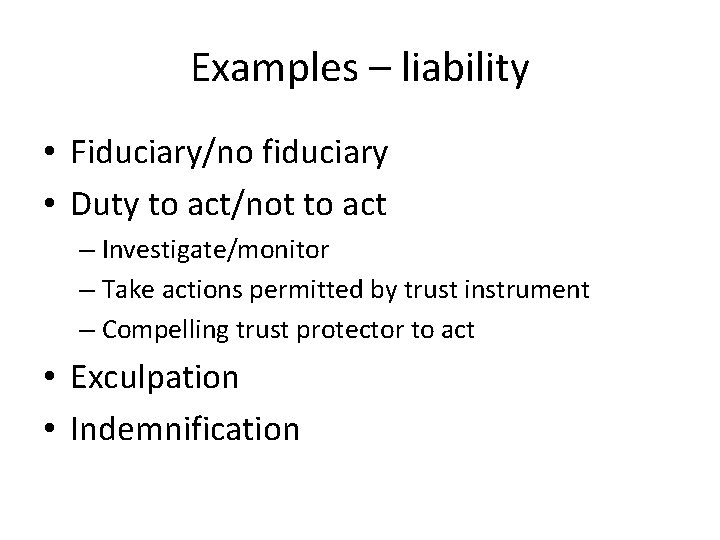
Examples – liability • Fiduciary/no fiduciary • Duty to act/not to act – Investigate/monitor – Take actions permitted by trust instrument – Compelling trust protector to act • Exculpation • Indemnification
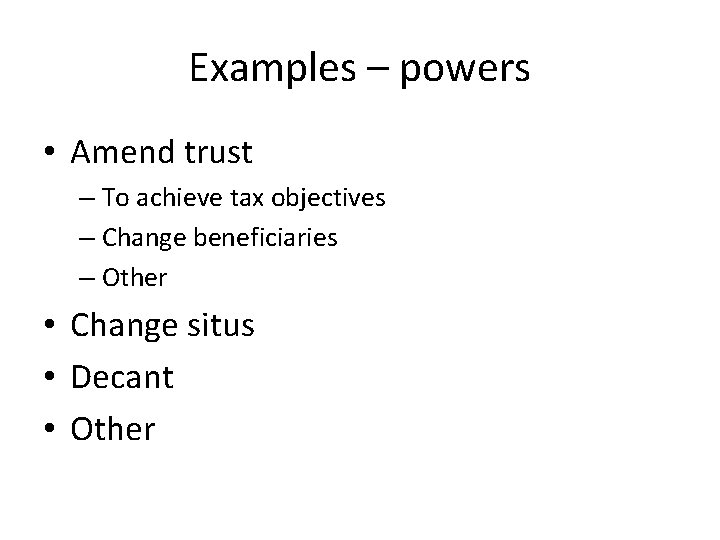
Examples – powers • Amend trust – To achieve tax objectives – Change beneficiaries – Other • Change situs • Decant • Other