
Disruptive Thinking Why How We Read Matters We
- Slides: 27
Disruptive Thinking Why How We Read Matters
“We need to recognize that reading ought to change us. Reading ought to lead to thinking that is disrupting, that shakes us up, that makes us wonder, that changes us. Such thinking sets us on a path to change, if not the world, then at least ourselves. ” -Kylene Beers and Robert E. Probst
Why Read? Let’s brainstorm about what reading does for you: Now let’s look at the research: 9 Reasons to Read - Builds Knowledge Improves Achievement Increases Motivation Increases Vocabulary Improves Writing Builds Background Knowledge Improves Understanding of Text Structures Develops Empathy Develops Personal Identity Choose at least two reasons that you would have for reading this school year. Write them in you journal.
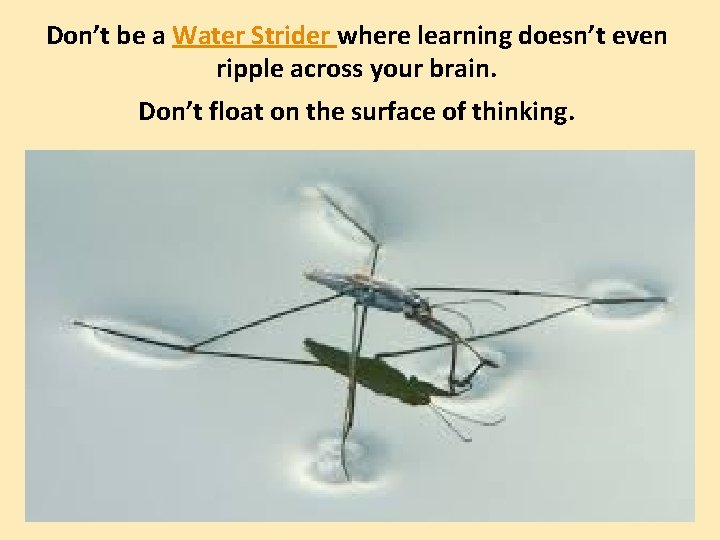
Don’t be a Water Strider where learning doesn’t even ripple across your brain. Don’t float on the surface of thinking.
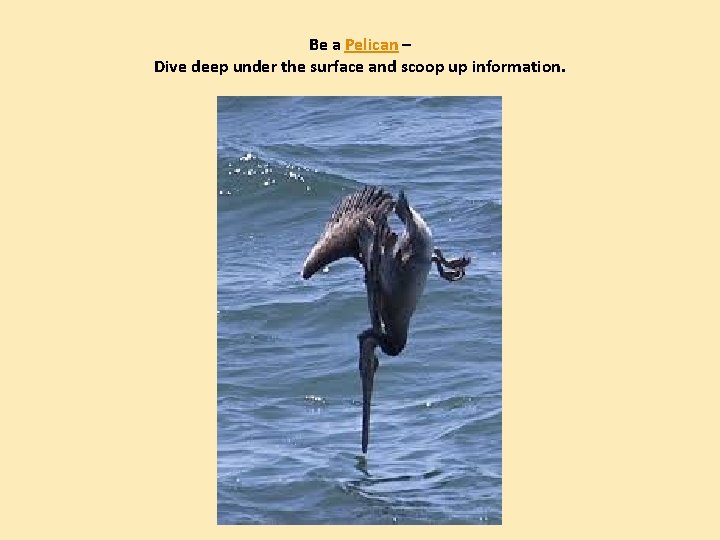
Be a Pelican – Dive deep under the surface and scoop up information.
Disrupt the water.
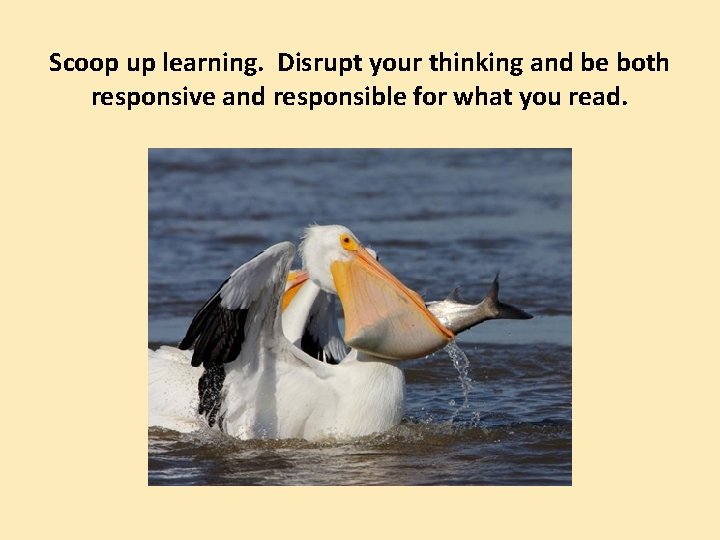
Scoop up learning. Disrupt your thinking and be both responsive and responsible for what you read.
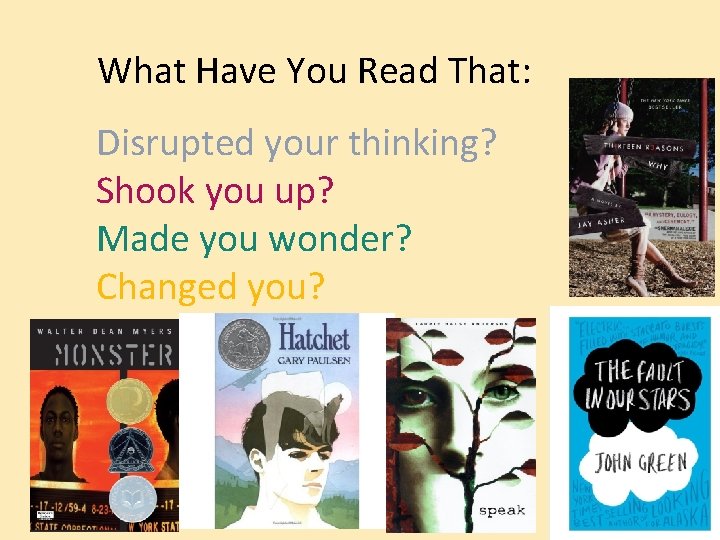
What Have You Read That: Disrupted your thinking? Shook you up? Made you wonder? Changed you?
Three Underlying Principles of Disrupting Thinking when you read. 1. The Reader needs to be RESPONSIVE. v A responsive reader notices what is going on inside himself and feels the emotion or raises questions when the text challenges his beliefs, values or knowledge. v A responsive reader opens himself up to the text, interacts with the text and uses it to help him make sense of his own reading experience. v The responsive reader is present during the reading experience in both mind and heart and is trying to make sense of what he reads. v The responsive reader reads the words on the page, senses his own reactions and then attempts to figure out what his reactions to those words might mean. v The responsive reader allows the text to awaken emotions and inspire thoughts, examines the text to see what caused those reactions then shares the perceptions and understandings with others.
Three Underlying Principles of Disrupting Thinking when you read. 2. A responsive reader needs to be RESPONSIBLE. Responsible to the text v A responsible reader pays close attention to the what the text says and to what they think or feel as they read. Not one or the other, but both. v A responsible reader questions the text and uses text evidence to support their response. v A responsible reader asks the 3 Big Questions to think about their responses that come directly from the text. What surprised me? What did the author think I already know? What changed, challenged or confirmed my thinking?
Three Underlying Principles of Disrupting Thinking when you read. A responsive reader needs to be RESPONSIBLE. Responsibility to Self v A responsible reader is willing to defend own thoughts and values, but is willing to change thinking when evidence is presented that conflicts. v A responsible reader needs to value the change that results from new information that creates a richer understanding and a sharpened perspective. v A responsible reader reads nonfiction ready to sort, to discard, to think, to test, to confirm, to question, to challenge. A responsible reader works to reveal truth.
Three Underlying Principles of Disrupting Thinking when you read. 3. A responsive, responsible reader needs to be COMPASSIONATE. v A compassionate reader has the ability to see other points of view, other perspectives and to imagine the feelings of those who hold them. v A compassionate reader takes the perspective of someone else and thus better understands motivations and thinking. v A compassionate reader is aware of the effects the text is having whether we vicariously experience the action of the text, become the character, or lose ourselves in the experiences of the book. The text may awaken feelings or raise questions, but as compassionate readers we are aware of the effect. We feel it. v In fiction, a compassionate reader will be willing to consider the thoughts and feelings of the character he meets. v In nonfiction, a compassionate reader will approach the text with openness, and a willingness to consider the writer’s point of view, motive, reasoning and evidence.
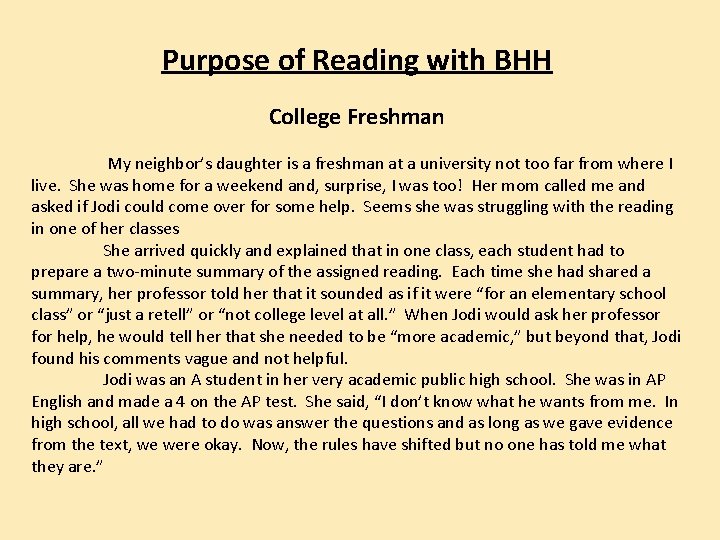
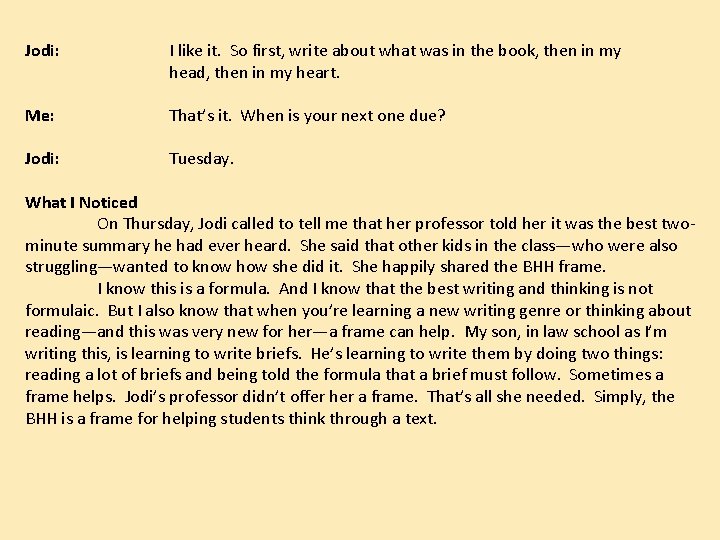
Purpose of Reading with BHH College Freshman My neighbor’s daughter is a freshman at a university not too far from where I live. She was home for a weekend and, surprise, I was too! Her mom called me and asked if Jodi could come over for some help. Seems she was struggling with the reading in one of her classes She arrived quickly and explained that in one class, each student had to prepare a two-minute summary of the assigned reading. Each time she had shared a summary, her professor told her that it sounded as if it were “for an elementary school class” or “just a retell” or “not college level at all. ” When Jodi would ask her professor for help, he would tell her that she needed to be “more academic, ” but beyond that, Jodi found his comments vague and not helpful. Jodi was an A student in her very academic public high school. She was in AP English and made a 4 on the AP test. She said, “I don’t know what he wants from me. In high school, all we had to do was answer the questions and as long as we gave evidence from the text, we were okay. Now, the rules have shifted but no one has told me what they are. ”
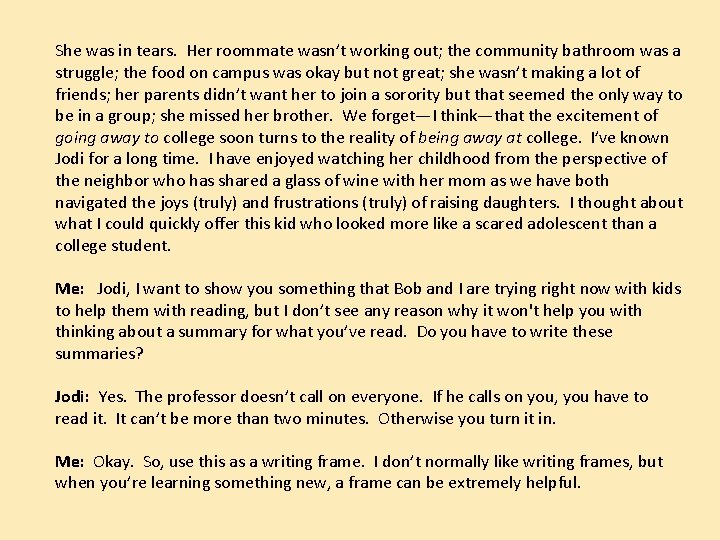
She was in tears. Her roommate wasn’t working out; the community bathroom was a struggle; the food on campus was okay but not great; she wasn’t making a lot of friends; her parents didn’t want her to join a sorority but that seemed the only way to be in a group; she missed her brother. We forget—I think—that the excitement of going away to college soon turns to the reality of being away at college. I’ve known Jodi for a long time. I have enjoyed watching her childhood from the perspective of the neighbor who has shared a glass of wine with her mom as we have both navigated the joys (truly) and frustrations (truly) of raising daughters. I thought about what I could quickly offer this kid who looked more like a scared adolescent than a college student. Me: Jodi, I want to show you something that Bob and I are trying right now with kids to help them with reading, but I don’t see any reason why it won't help you with thinking about a summary for what you’ve read. Do you have to write these summaries? Jodi: Yes. The professor doesn’t call on everyone. If he calls on you, you have to read it. It can’t be more than two minutes. Otherwise you turn it in. Me: Okay. So, use this as a writing frame. I don’t normally like writing frames, but when you’re learning something new, a frame can be extremely helpful.
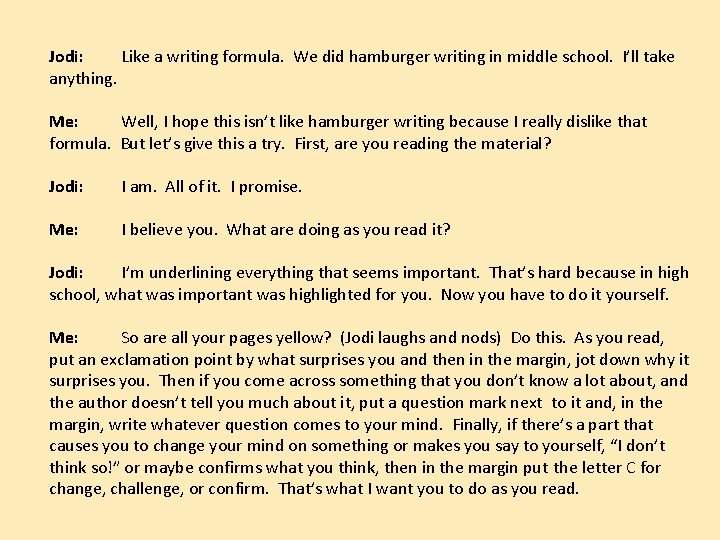
Jodi: Like a writing formula. We did hamburger writing in middle school. I’ll take anything. Me: Well, I hope this isn’t like hamburger writing because I really dislike that formula. But let’s give this a try. First, are you reading the material? Jodi: I am. All of it. I promise. Me: I believe you. What are doing as you read it? Jodi: I’m underlining everything that seems important. That’s hard because in high school, what was important was highlighted for you. Now you have to do it yourself. Me: So are all your pages yellow? (Jodi laughs and nods) Do this. As you read, put an exclamation point by what surprises you and then in the margin, jot down why it surprises you. Then if you come across something that you don’t know a lot about, and the author doesn’t tell you much about it, put a question mark next to it and, in the margin, write whatever question comes to your mind. Finally, if there’s a part that causes you to change your mind on something or makes you say to yourself, “I don’t think so!” or maybe confirms what you think, then in the margin put the letter C for change, challenge, or confirm. That’s what I want you to do as you read.
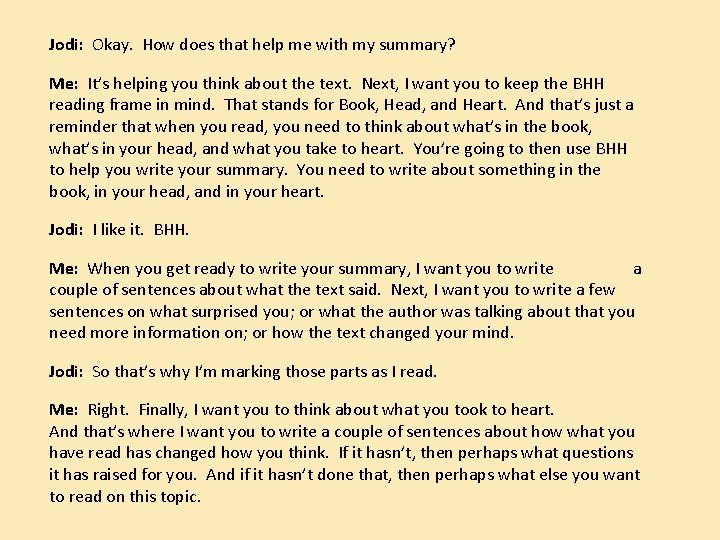
Jodi: Okay. How does that help me with my summary? Me: It’s helping you think about the text. Next, I want you to keep the BHH reading frame in mind. That stands for Book, Head, and Heart. And that’s just a reminder that when you read, you need to think about what’s in the book, what’s in your head, and what you take to heart. You’re going to then use BHH to help you write your summary. You need to write about something in the book, in your head, and in your heart. Jodi: I like it. BHH. Me: When you get ready to write your summary, I want you to write a couple of sentences about what the text said. Next, I want you to write a few sentences on what surprised you; or what the author was talking about that you need more information on; or how the text changed your mind. Jodi: So that’s why I’m marking those parts as I read. Me: Right. Finally, I want you to think about what you took to heart. And that’s where I want you to write a couple of sentences about how what you have read has changed how you think. If it hasn’t, then perhaps what questions it has raised for you. And if it hasn’t done that, then perhaps what else you want to read on this topic.
Jodi: I like it. So first, write about what was in the book, then in my head, then in my heart. Me: That’s it. When is your next one due? Jodi: Tuesday. What I Noticed On Thursday, Jodi called to tell me that her professor told her it was the best twominute summary he had ever heard. She said that other kids in the class—who were also struggling—wanted to know how she did it. She happily shared the BHH frame. I know this is a formula. And I know that the best writing and thinking is not formulaic. But I also know that when you’re learning a new writing genre or thinking about reading—and this was very new for her—a frame can help. My son, in law school as I’m writing this, is learning to write briefs. He’s learning to write them by doing two things: reading a lot of briefs and being told the formula that a brief must follow. Sometimes a frame helps. Jodi’s professor didn’t offer her a frame. That’s all she needed. Simply, the BHH is a frame for helping students think through a text.
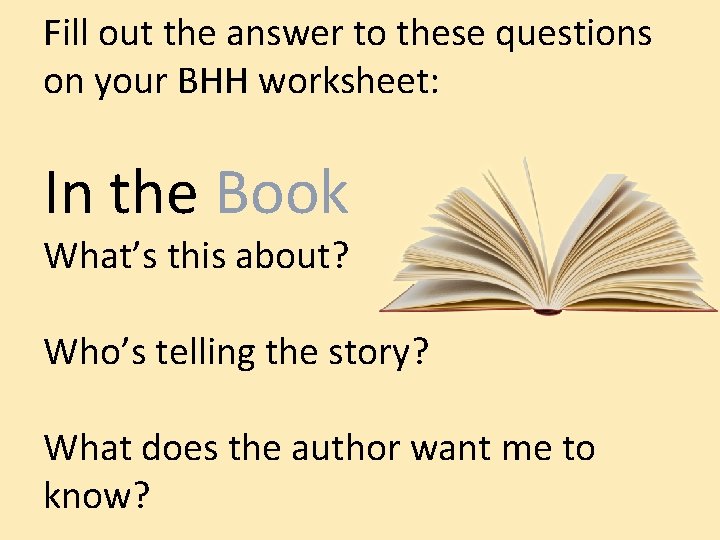
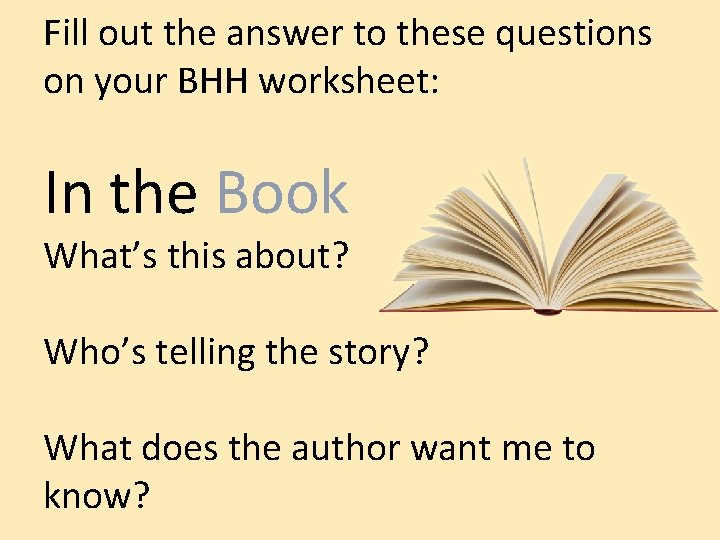
Fill out the answer to these questions on your BHH worksheet: In the Book What’s this about? Who’s telling the story? What does the author want me to know?
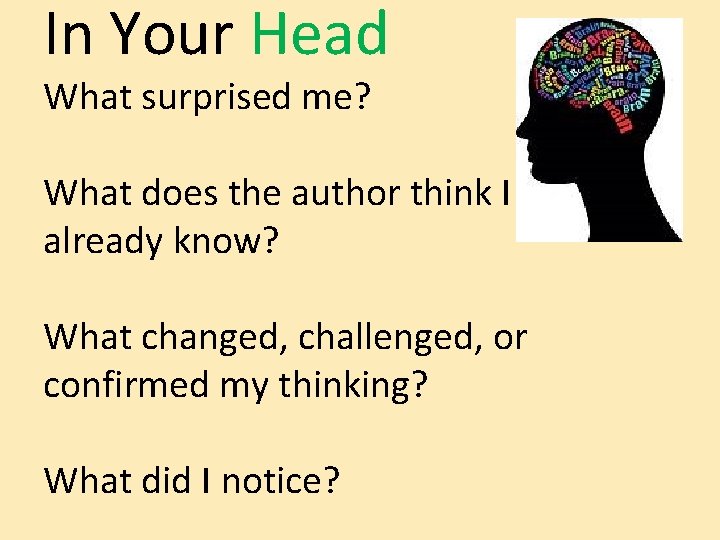
In Your Head What surprised me? What does the author think I already know? What changed, challenged, or confirmed my thinking? What did I notice?
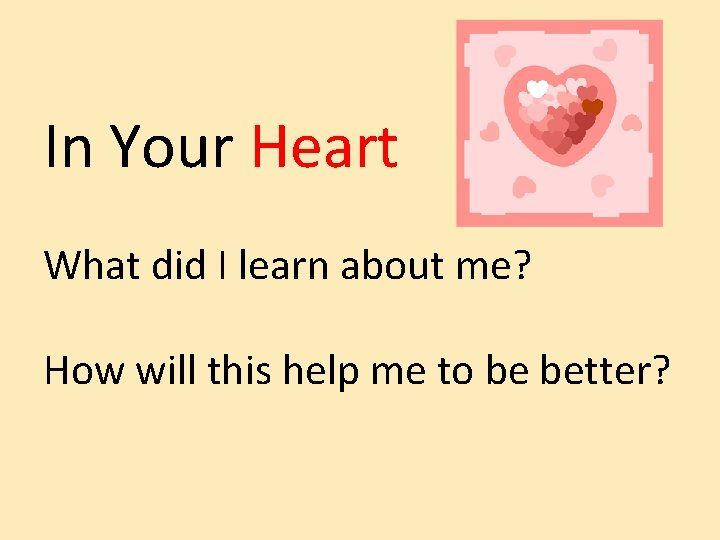
In Your Heart What did I learn about me? How will this help me to be better?
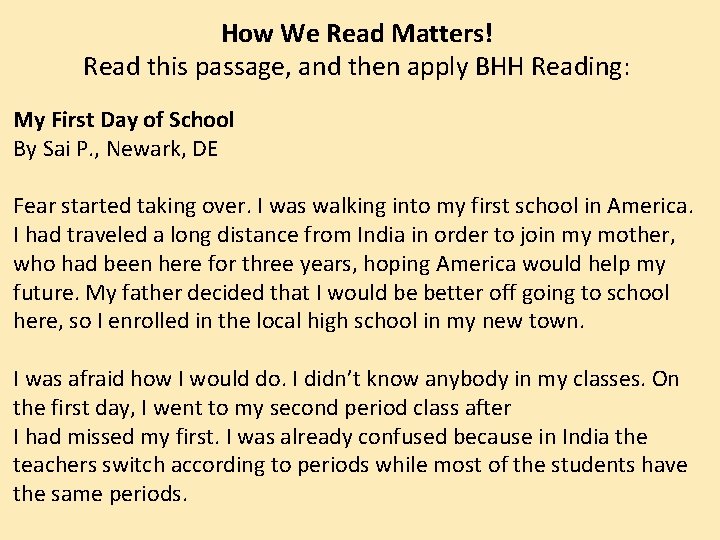
How We Read Matters! Read this passage, and then apply BHH Reading: My First Day of School By Sai P. , Newark, DE Fear started taking over. I was walking into my first school in America. I had traveled a long distance from India in order to join my mother, who had been here for three years, hoping America would help my future. My father decided that I would be better off going to school here, so I enrolled in the local high school in my new town. I was afraid how I would do. I didn’t know anybody in my classes. On the first day, I went to my second period class after I had missed my first. I was already confused because in India the teachers switch according to periods while most of the students have the same periods.
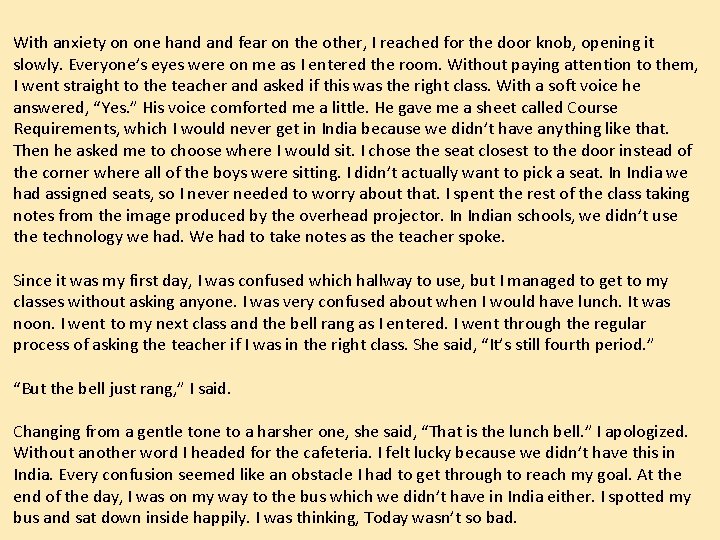
With anxiety on one hand fear on the other, I reached for the door knob, opening it slowly. Everyone’s eyes were on me as I entered the room. Without paying attention to them, I went straight to the teacher and asked if this was the right class. With a soft voice he answered, “Yes. ” His voice comforted me a little. He gave me a sheet called Course Requirements, which I would never get in India because we didn’t have anything like that. Then he asked me to choose where I would sit. I chose the seat closest to the door instead of the corner where all of the boys were sitting. I didn’t actually want to pick a seat. In India we had assigned seats, so I never needed to worry about that. I spent the rest of the class taking notes from the image produced by the overhead projector. In Indian schools, we didn’t use the technology we had. We had to take notes as the teacher spoke. Since it was my first day, I was confused which hallway to use, but I managed to get to my classes without asking anyone. I was very confused about when I would have lunch. It was noon. I went to my next class and the bell rang as I entered. I went through the regular process of asking the teacher if I was in the right class. She said, “It’s still fourth period. ” “But the bell just rang, ” I said. Changing from a gentle tone to a harsher one, she said, “That is the lunch bell. ” I apologized. Without another word I headed for the cafeteria. I felt lucky because we didn’t have this in India. Every confusion seemed like an obstacle I had to get through to reach my goal. At the end of the day, I was on my way to the bus which we didn’t have in India either. I spotted my bus and sat down inside happily. I was thinking, Today wasn’t so bad.
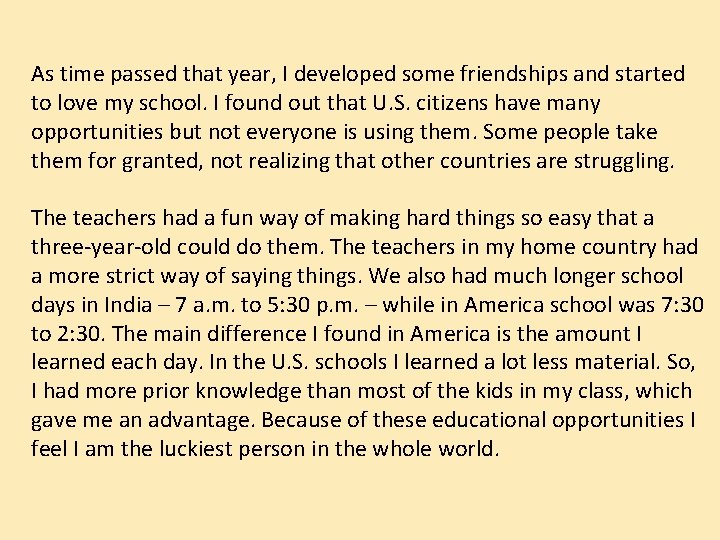
As time passed that year, I developed some friendships and started to love my school. I found out that U. S. citizens have many opportunities but not everyone is using them. Some people take them for granted, not realizing that other countries are struggling. The teachers had a fun way of making hard things so easy that a three-year-old could do them. The teachers in my home country had a more strict way of saying things. We also had much longer school days in India – 7 a. m. to 5: 30 p. m. – while in America school was 7: 30 to 2: 30. The main difference I found in America is the amount I learned each day. In the U. S. schools I learned a lot less material. So, I had more prior knowledge than most of the kids in my class, which gave me an advantage. Because of these educational opportunities I feel I am the luckiest person in the whole world.
Fill out the answer to these questions on your BHH worksheet: In the Book What’s this about? Who’s telling the story? What does the author want me to know?
In Your Head What surprised me? What does the author think I already know? What changed, challenged, or confirmed my thinking? What did I notice?
In Your Heart What did I learn about me? How will this help me to be better?
Extend Your Learning Answer this question in your journal: How did the BHH reading strategy help you confirm your reasons for reading?