
Disruptive technologies and food system NEW ERA FOR
- Slides: 10
Disruptive technologies and food system “NEW ERA FOR FOOD SAFETY” PUBLIC MEETING CONFIDENTIAL AND PROPRIETARY Any use of this material without specific permission of Mc. Kinsey & Company is strictly prohibited
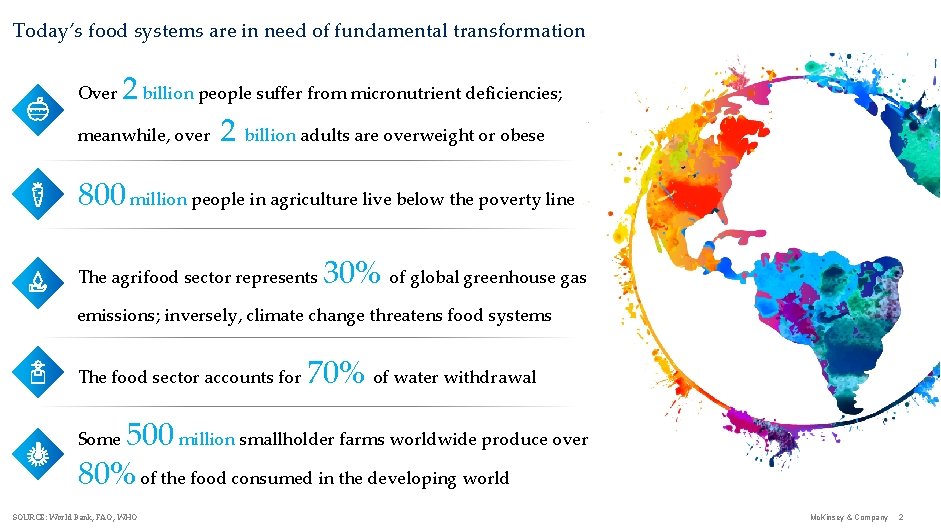
Today’s food systems are in need of fundamental transformation 2 Over billion people suffer from micronutrient deficiencies; meanwhile, over 2 billion adults are overweight or obese 800 million people in agriculture live below the poverty line The agrifood sector represents 30% of global greenhouse gas emissions; inversely, climate change threatens food systems The food sector accounts for 70% of water withdrawal 500 million smallholder farms worldwide produce over 80% of the food consumed in the developing world Some SOURCE: World Bank, FAO, WHO Mc. Kinsey & Company 2
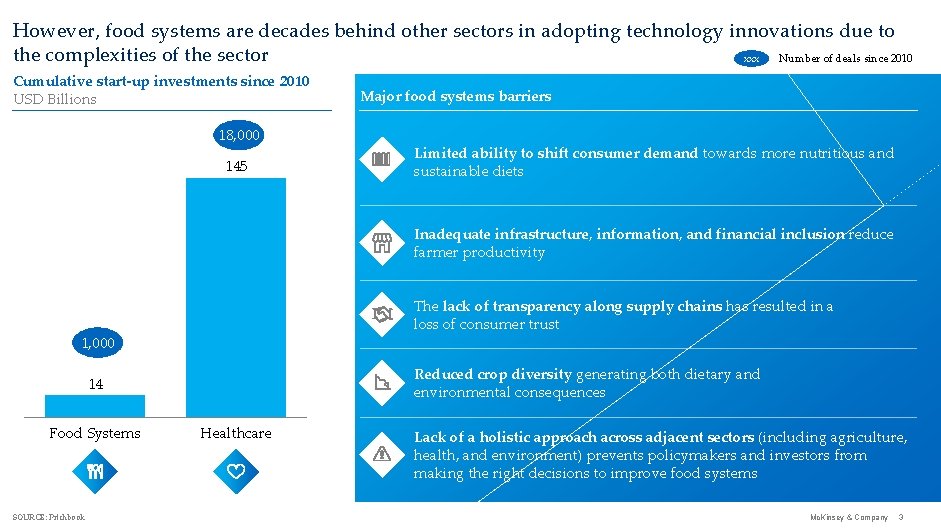
However, food systems are decades behind other sectors in adopting technology innovations due to the complexities of the sector xxx Number of deals since 2010 Cumulative start-up investments since 2010 USD Billions 18, 000 145 Major food systems barriers Limited ability to shift consumer demand towards more nutritious and sustainable diets Inadequate infrastructure, information, and financial inclusion reduce farmer productivity The lack of transparency along supply chains has resulted in a loss of consumer trust 1, 000 Reduced crop diversity generating both dietary and environmental consequences 14 Food Systems SOURCE: Pitchbook Healthcare Lack of a holistic approach across adjacent sectors (including agriculture, health, and environment) prevents policymakers and investors from making the right decisions to improve food systems Mc. Kinsey & Company 3
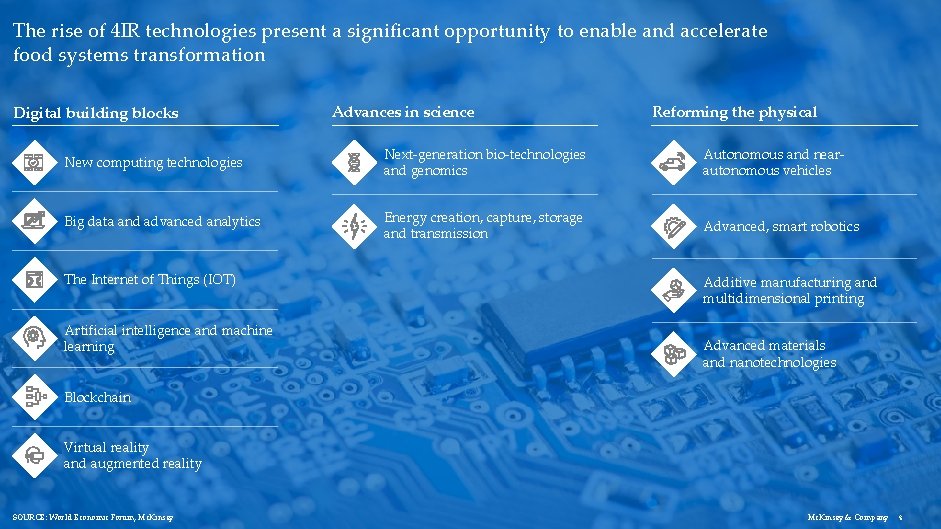
The rise of 4 IR technologies present a significant opportunity to enable and accelerate food systems transformation Digital building blocks Advances in science Reforming the physical New computing technologies Next-generation bio-technologies and genomics Autonomous and nearautonomous vehicles Big data and advanced analytics Energy creation, capture, storage and transmission Advanced, smart robotics The Internet of Things (IOT) Artificial intelligence and machine learning Additive manufacturing and multidimensional printing Advanced materials and nanotechnologies Blockchain Virtual reality and augmented reality SOURCE: World Economic Forum, Mc. Kinsey & Company 4
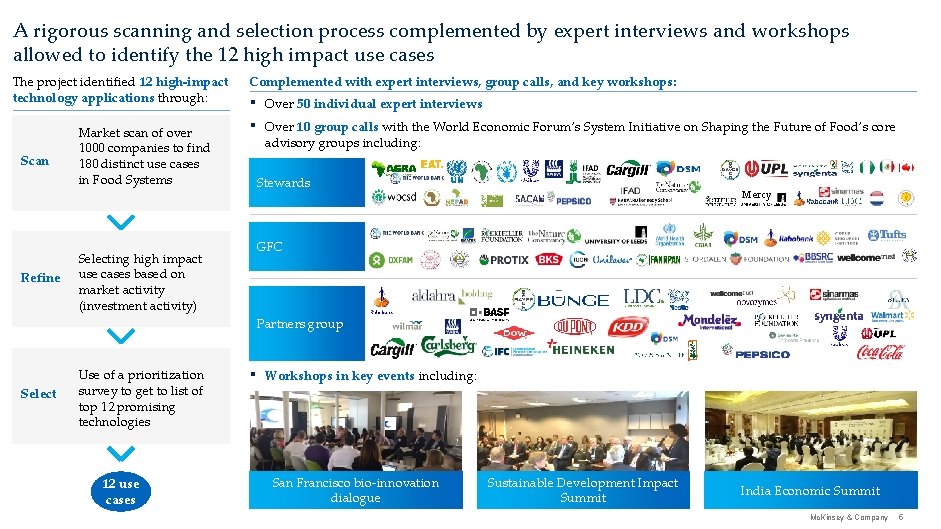
A rigorous scanning and selection process complemented by expert interviews and workshops allowed to identify the 12 high impact use cases The project identified 12 high-impact technology applications through: Scan Refine Market scan of over 1000 companies to find 180 distinct use cases in Food Systems Complemented with expert interviews, group calls, and key workshops: ▪ ▪ Over 50 individual expert interviews Over 10 group calls with the World Economic Forum’s System Initiative on Shaping the Future of Food’s core advisory groups including: Stewards Mercy GFC Selecting high impact use cases based on market activity (investment activity) Partners group Select Use of a prioritization survey to get to list of top 12 promising technologies 12 use cases ▪ Workshops in key events including: San Francisco bio-innovation dialogue Sustainable Development Impact Summit India Economic Summit Mc. Kinsey & Company 5
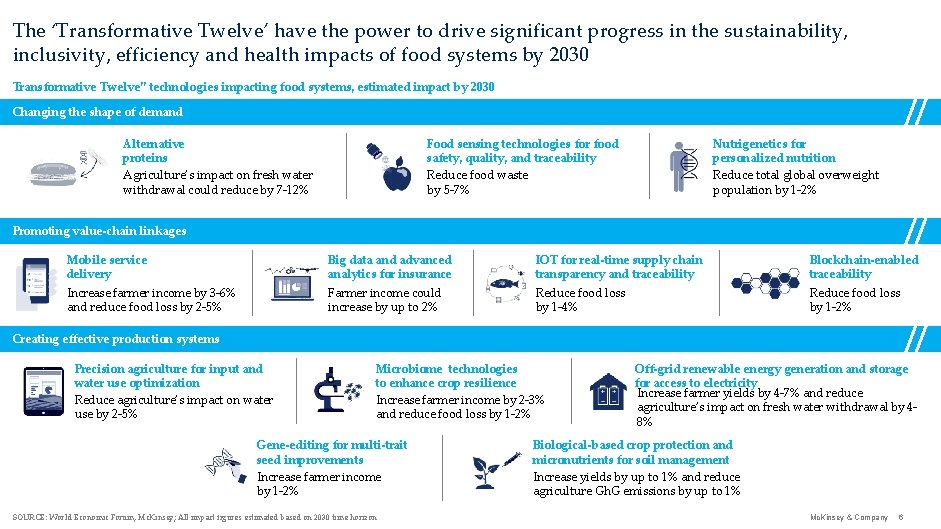
The ‘Transformative Twelve’ have the power to drive significant progress in the sustainability, inclusivity, efficiency and health impacts of food systems by 2030 Transformative Twelve” technologies impacting food systems, estimated impact by 2030 Changing the shape of demand Alternative proteins Agriculture’s impact on fresh water withdrawal could reduce by 7 -12% Food sensing technologies for food safety, quality, and traceability Reduce food waste by 5 -7% Nutrigenetics for personalized nutrition Reduce total global overweight population by 1 -2% Promoting value-chain linkages Mobile service delivery Big data and advanced analytics for insurance IOT for real-time supply chain transparency and traceability Blockchain-enabled traceability Increase farmer income by 3 -6% and reduce food loss by 2 -5% Farmer income could increase by up to 2% Reduce food loss by 1 -4% Reduce food loss by 1 -2% Creating effective production systems Precision agriculture for input and water use optimization Reduce agriculture’s impact on water use by 2 -5% Microbiome technologies to enhance crop resilience Increase farmer income by 2 -3% and reduce food loss by 1 -2% Gene-editing for multi-trait seed improvements Increase farmer income by 1 -2% SOURCE: World Economic Forum, Mc. Kinsey; All impact figures estimated based on 2030 time horizon Off-grid renewable energy generation and storage for access to electricity Increase farmer yields by 4 -7% and reduce agriculture’s impact on fresh water withdrawal by 48% Biological-based crop protection and micronutrients for soil management Increase yields by up to 1% and reduce agriculture Gh. G emissions by up to 1% Mc. Kinsey & Company 6
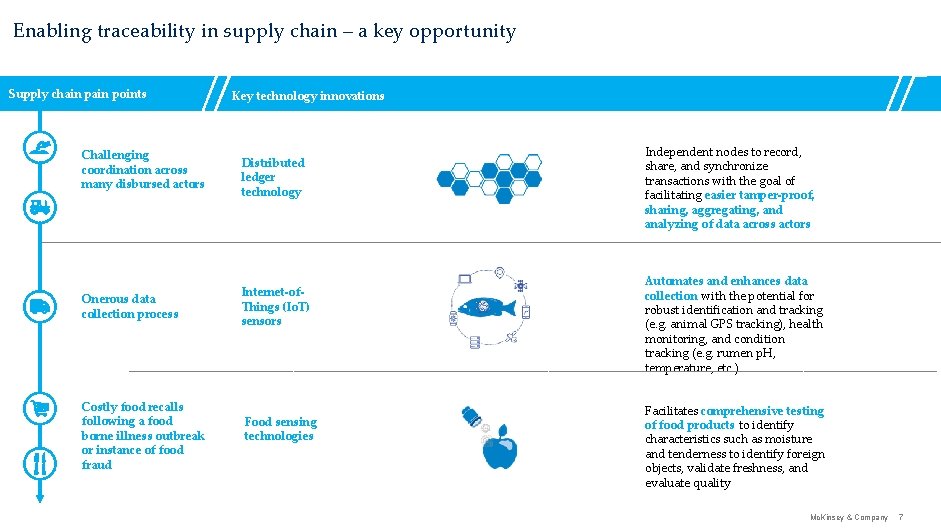
Enabling traceability in supply chain – a key opportunity Supply chain points Challenging coordination across many disbursed actors Onerous data collection process Costly food recalls following a food borne illness outbreak or instance of food fraud Key technology innovations Distributed ledger technology Internet-of. Things (Io. T) sensors Food sensing technologies Independent nodes to record, share, and synchronize transactions with the goal of facilitating easier tamper-proof, sharing, aggregating, and analyzing of data across actors Automates and enhances data collection with the potential for robust identification and tracking (e. g. animal GPS tracking), health monitoring, and condition tracking (e. g. rumen p. H, temperature, etc. ) Facilitates comprehensive testing of food products to identify characteristics such as moisture and tenderness to identify foreign objects, validate freshness, and evaluate quality Mc. Kinsey & Company 7
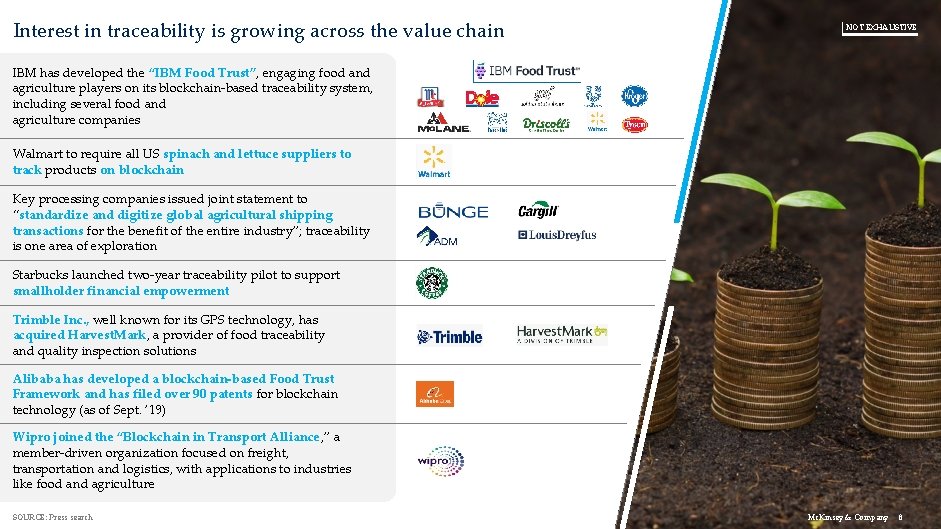
Interest in traceability is growing across the value chain NOT EXHAUSTIVE IBM has developed the “IBM Food Trust”, engaging food and agriculture players on its blockchain-based traceability system, including several food and agriculture companies Walmart to require all US spinach and lettuce suppliers to track products on blockchain Key processing companies issued joint statement to “standardize and digitize global agricultural shipping transactions for the benefit of the entire industry”; traceability is one area of exploration Starbucks launched two-year traceability pilot to support smallholder financial empowerment Trimble Inc. , well known for its GPS technology, has acquired Harvest. Mark, a provider of food traceability and quality inspection solutions Alibaba has developed a blockchain-based Food Trust Framework and has filed over 90 patents for blockchain technology (as of Sept. ’ 19) Wipro joined the “Blockchain in Transport Alliance, ” a member-driven organization focused on freight, transportation and logistics, with applications to industries like food and agriculture SOURCE: Press search Mc. Kinsey & Company 8
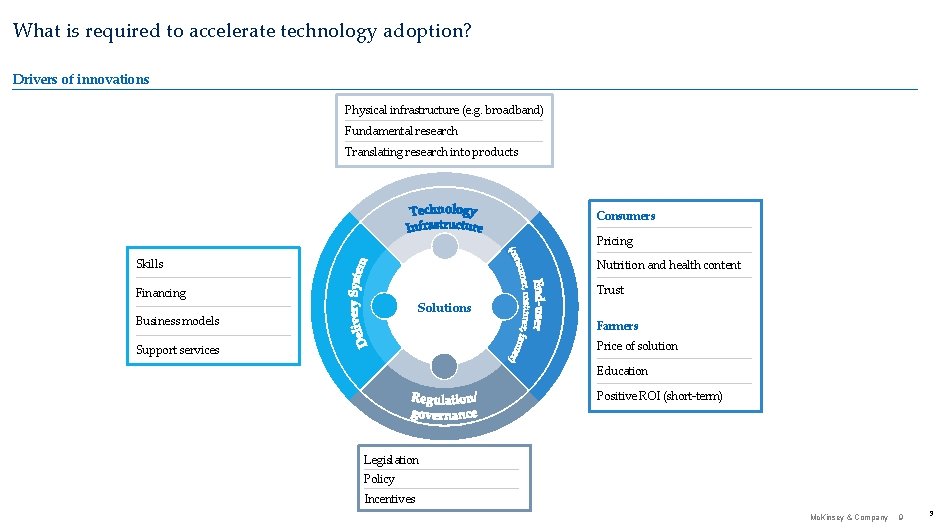
What is required to accelerate technology adoption? Drivers of innovations Physical infrastructure (e. g. broadband) Fundamental research Translating research into products Consumers Pricing Skills Nutrition and health content Financing Trust Solutions Business models Farmers Price of solution Support services Education Positive ROI (short-term) Legislation Policy Incentives Mc. Kinsey & Company 9 9
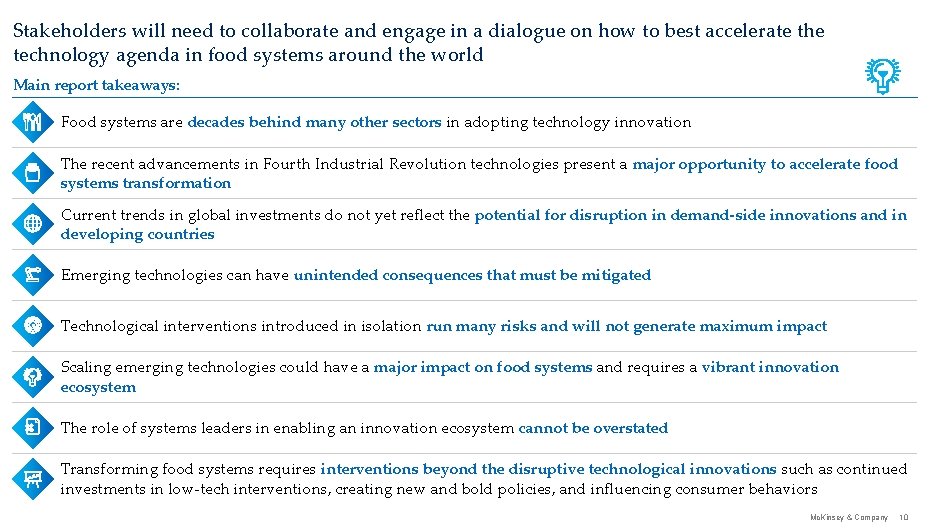
Stakeholders will need to collaborate and engage in a dialogue on how to best accelerate the technology agenda in food systems around the world Main report takeaways: Food systems are decades behind many other sectors in adopting technology innovation The recent advancements in Fourth Industrial Revolution technologies present a major opportunity to accelerate food systems transformation Current trends in global investments do not yet reflect the potential for disruption in demand-side innovations and in developing countries Emerging technologies can have unintended consequences that must be mitigated Technological interventions introduced in isolation run many risks and will not generate maximum impact Scaling emerging technologies could have a major impact on food systems and requires a vibrant innovation ecosystem The role of systems leaders in enabling an innovation ecosystem cannot be overstated Transforming food systems requires interventions beyond the disruptive technological innovations such as continued investments in low-tech interventions, creating new and bold policies, and influencing consumer behaviors Mc. Kinsey & Company 10