
Disruption of Frontal Activity Asymmetry Using t ACS
- Slides: 1
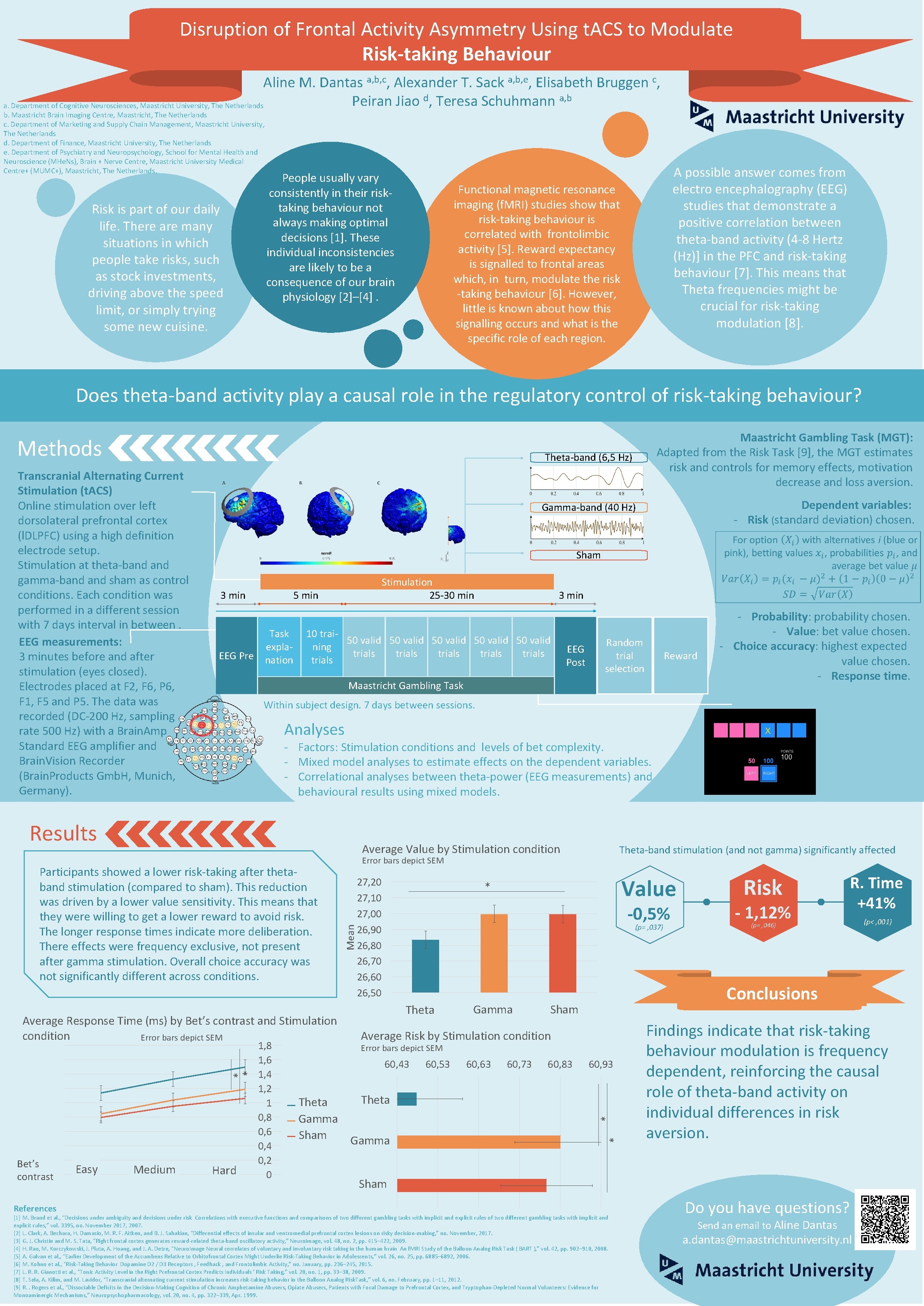
Disruption of Frontal Activity Asymmetry Using t. ACS to Modulate Risk-taking Behaviour Aline M. Dantas a, b, c, Alexander T. Sack a, b, e, Elisabeth Bruggen c, d, Teresa Schuhmann a, b Peiran Jiao a. Department of Cognitive Neurosciences, Maastricht University, The Netherlands b. Maastricht Brain Imaging Centre, Maastricht, The Netherlands c. Department of Marketing and Supply Chain Management, Maastricht University, The Netherlands d. Department of Finance, Maastricht University, The Netherlands e. Department of Psychiatry and Neuropsychology, School for Mental Health and Neuroscience (MHe. Ns), Brain + Nerve Centre, Maastricht University Medical Centre+ (MUMC+), Maastricht, The Netherlands. Risk is part of our daily life. There are many situations in which people take risks, such as stock investments, driving above the speed limit, or simply trying some new cuisine. People usually vary consistently in their risktaking behaviour not always making optimal decisions [1]. These individual inconsistencies are likely to be a consequence of our brain physiology [2]–[4]. A possible answer comes from electro encephalography (EEG) studies that demonstrate a positive correlation between theta-band activity (4 -8 Hertz (Hz)] in the PFC and risk-taking behaviour [7]. This means that Theta frequencies might be crucial for risk-taking modulation [8]. Functional magnetic resonance imaging (f. MRI) studies show that risk-taking behaviour is correlated with frontolimbic activity [5]. Reward expectancy is signalled to frontal areas which, in turn, modulate the risk -taking behaviour [6]. However, little is known about how this signalling occurs and what is the specific role of each region. Does theta-band activity play a causal role in the regulatory control of risk-taking behaviour? Methods Theta-band (6, 5 Hz) Transcranial Alternating Current Stimulation (t. ACS) Online stimulation over left dorsolateral prefrontal cortex (l. DLPFC) using a high definition electrode setup. Stimulation at theta-band gamma-band sham as control conditions. Each condition was performed in a different session with 7 days interval in between. EEG measurements: 3 minutes before and after stimulation (eyes closed). Electrodes placed at F 2, F 6, P 6, F 1, F 5 and P 5. The data was recorded (DC-200 Hz, sampling rate 500 Hz) with a Brain. Amp Standard EEG amplifier and Brain. Vision Recorder (Brain. Products Gmb. H, Munich, Germany). Sham EEG Pre Stimulation 25 -30 min 5 min 3 min Task explanation EEG Post Random trial selection - Probability: probability chosen. - Value: bet value chosen. - Choice accuracy: highest expected value chosen. - Response time. Within subject design. 7 days between sessions. Analyses - Factors: Stimulation conditions and levels of bet complexity. - Mixed model analyses to estimate effects on the dependent variables. - Correlational analyses between theta-power (EEG measurements) and behavioural results using mixed models. Average Value by Stimulation condition * * Mean Error bars depict SEM 27, 20 27, 10 27, 00 26, 90 26, 80 26, 70 26, 60 26, 50 -0, 5% (p= , 037) Theta Gamma Sham Error bars depict SEM 60, 53 60, 63 60, 73 60, 83 60, 93 1 Theta Gamma 2 Risk - 1, 12% R. Time +41% (p= , 046) (p< , 001) Conclusions Average Risk by Stimulation condition 60, 43 1 Theta 2 Gamma 3 Sham Value * * Hard 1, 8 1, 6 1, 4 1, 2 1 0, 8 0, 6 0, 4 0, 2 0 Theta-band stimulation (and not gamma) significantly affected * Medium Reward Maastricht Gambling Task Average Response Time (ms) by Bet’s contrast and Stimulation condition Error bars depict SEM References 3 min 10 trai 50 valid 50 valid ning trials trials Participants showed a lower risk-taking after thetaband stimulation (compared to sham). This reduction was driven by a lower value sensitivity. This means that they were willing to get a lower reward to avoid risk. The longer response times indicate more deliberation. There effects were frequency exclusive, not present after gamma stimulation. Overall choice accuracy was not significantly different across conditions. Easy Dependent variables: - Risk (standard deviation) chosen. Gamma-band (40 Hz) Results Bet’s contrast Maastricht Gambling Task (MGT): Adapted from the Risk Task [9], the MGT estimates risk and controls for memory effects, motivation decrease and loss aversion. Findings indicate that risk-taking behaviour modulation is frequency dependent, reinforcing the causal role of theta-band activity on individual differences in risk aversion. Sham 3 [1] M. Brand et al. , “Decisions under ambiguity and decisions under risk Correlations with executive functions and comparisons of two different gambling tasks with implicit and explicit rules, ” vol. 3395, no. November 2017, 2007. [2] L. Clark, A. Bechara, H. Damasio, M. R. F. Aitken, and B. J. Sahakian, “Differential effects of insular and ventromedial prefrontal cortex lesions on risky decision-making, ” no. November, 2017. [3] G. J. Christie and M. S. Tata, “Right frontal cortex generates reward-related theta-band oscillatory activity, ” Neuroimage, vol. 48, no. 2, pp. 415– 422, 2009. [4] H. Rao, M. Korczykowski, J. Pluta, A. Hoang, and J. A. Detre, “Neuro. Image Neural correlates of voluntary and involuntary risk taking in the human brain An f. MRI Study of the Balloon Analog Risk Task ( BART ), ” vol. 42, pp. 902– 910, 2008. [5] A. Galvan et al. , “Earlier Development of the Accumbens Relative to Orbitofrontal Cortex Might Underlie Risk-Taking Behavior in Adolescents, ” vol. 26, no. 25, pp. 6885– 6892, 2006. [6] M. Kohno et al. , “Risk-Taking Behavior Dopamine D 2 / D 3 Receptors , Feedback , and Frontolimbic Activity, ” no. January, pp. 236– 245, 2015. [7] L. R. R. Gianotti et al. , “Tonic Activity Level in the Right Prefrontal Cortex Predicts Individuals ’ Risk Taking, ” vol. 20, no. 1, pp. 33– 38, 2009. [8] T. Sela, A. Kilim, and M. Lavidor, “Transcranial alternating current stimulation increases risk-taking behavior in the Balloon Analog Risk. Task, ” vol. 6, no. February, pp. 1– 11, 2012. [9] R. . Rogers et al. , “Dissociable Deficits in the Decision-Making Cognition of Chronic Amphetamine Abusers, Opiate Abusers, Patients with Focal Damage to Prefrontal Cortex, and Tryptophan-Depleted Normal Volunteers: Evidence for Monoaminergic Mechanisms, ” Neuropsychopharmacology, vol. 20, no. 4, pp. 322– 339, Apr. 1999. Do you have questions? Send an email to Aline Dantas a. dantas@maastrichtuniversity. nl