
DISPUTE RESOLUTION IN WIPO THE UNIFORM DOMAIN NAME
- Slides: 44
DISPUTE RESOLUTION IN WIPO – THE UNIFORM DOMAIN NAME DISPUTE RESOLUTION POLICY Santa Clara University School of Law Summer Program in Geneva July 2017 By Edward Kwakwa
2 WIPO Arbitration and Mediation Center HISTORY Established in 1994 to provide alternative dispute resolution (ADR) services for the time and cost effective resolution of intellectual property (IP) disputes between private parties outside of court Classical Arbitration & Mediation Services Tailor-Made Dispute Resolution Procedures, e. g. Leading provider of domain name dispute resolution services under the Uniform Domain Name Dispute Resolution Policy on a not-for-profit basis. 2
WIPO CENTER CASELOAD 300+ mediations and arbitrations Contractual: research & devpt. agmts. joint-ventures financing agmts. merchandising/licensing agmts. insurance agmts. new media agmts. copyright related agmts. Cases referred by courts to mediation Specialized schemes (e. g. WIPO Expedited Mediation and Expedited Arbitration for Film and Media, Mediations for International Trademark Oppositions (e. g. Singapore, Brazil)
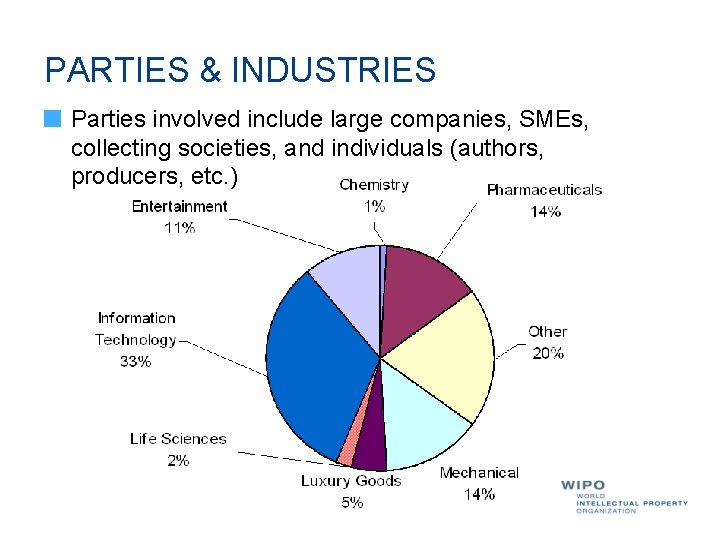
PARTIES & INDUSTRIES Parties involved include large companies, SMEs, collecting societies, and individuals (authors, producers, etc. )
5 Arbitration is a procedure in which a dispute is submitted, by agreement of the parties, to an arbitrator, who gives a decision on the dispute that is binding on the parties In contrast to mediation, once the parties have freely agreed to submit a dispute to arbitration, a party cannot unilaterally withdraw from the arbitration
6 Mediation is an informal procedure in which a mediator endeavors, at the request of the parties to a dispute, to assist them in reaching a mutually satisfactory settlement of the dispute The mediator does not have any power to impose a decision on the parties Mediation is also voluntary in the sense that either party may, if it so chooses, abandon the mediation at any stage prior to the signing of an agreed resolution
7 Mediation (ctnued) Many IP disputes have characteristics that favor mediation. Eg in disputes in context of existing business relationship created by license, franchise, distributorship, publishing, sound recording etc, mediation offers nonconfrontational procedure conducive to further development of the business relationship Time and Cost-effective, and low-risk, therefore more IP lawyers/clients including mediation in contracts as pre-condition to resorting to arbitration/litigation
8 Benefits of ADR (Arb/Med. ) Compared to Litigation Rapid relief cannot easily be obtained through the courts. Alternative procedures offering temporary emergency relief therefore required International character of disputes: ADR offers a single forum In case of Arbitration, finality of the arbitral award. It is not subject to institutionalized appeal Autonomy in selecting the decision-makers. Neutrality: choice of procedural rules, applicable law, language, place Confidentiality; and saves time and money
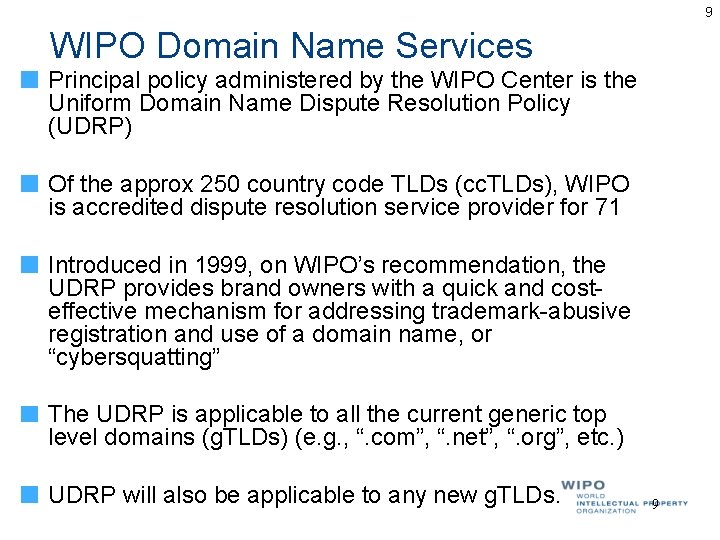
9 WIPO Domain Name Services Principal policy administered by the WIPO Center is the Uniform Domain Name Dispute Resolution Policy (UDRP) Of the approx 250 country code TLDs (cc. TLDs), WIPO is accredited dispute resolution service provider for 71 Introduced in 1999, on WIPO’s recommendation, the UDRP provides brand owners with a quick and costeffective mechanism for addressing trademark-abusive registration and use of a domain name, or “cybersquatting” The UDRP is applicable to all the current generic top level domains (g. TLDs) (e. g. , “. com”, “. net”, “. org”, etc. ) UDRP will also be applicable to any new g. TLDs. 9
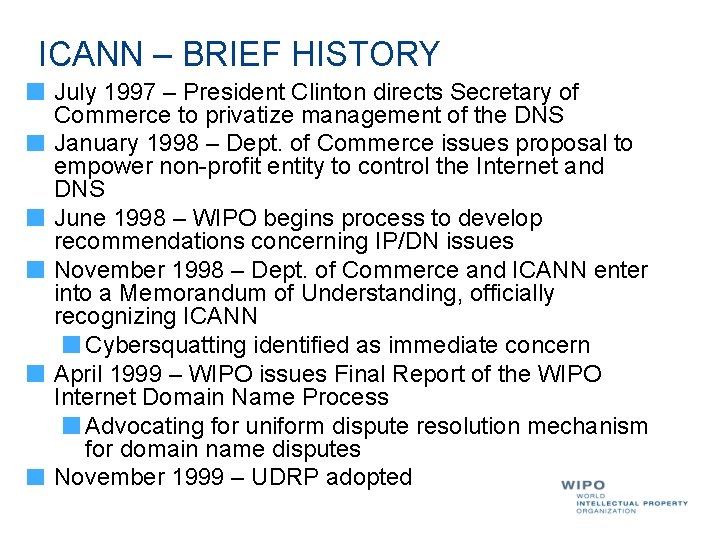
ICANN – BRIEF HISTORY July 1997 – President Clinton directs Secretary of Commerce to privatize management of the DNS January 1998 – Dept. of Commerce issues proposal to empower non-profit entity to control the Internet and DNS June 1998 – WIPO begins process to develop recommendations concerning IP/DN issues November 1998 – Dept. of Commerce and ICANN enter into a Memorandum of Understanding, officially recognizing ICANN Cybersquatting identified as immediate concern April 1999 – WIPO issues Final Report of the WIPO Internet Domain Name Process Advocating for uniform dispute resolution mechanism for domain name disputes November 1999 – UDRP adopted
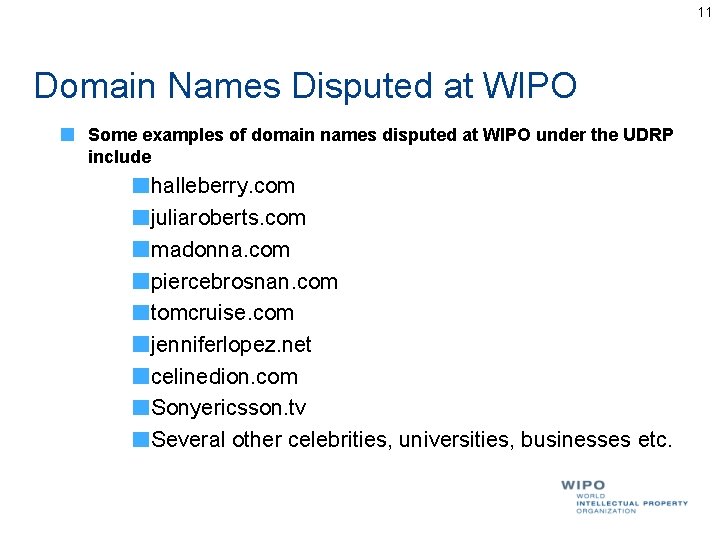
11 Domain Names Disputed at WIPO Some examples of domain names disputed at WIPO under the UDRP include halleberry. com juliaroberts. com madonna. com piercebrosnan. com tomcruise. com jenniferlopez. net celinedion. com Sonyericsson. tv Several other celebrities, universities, businesses etc.
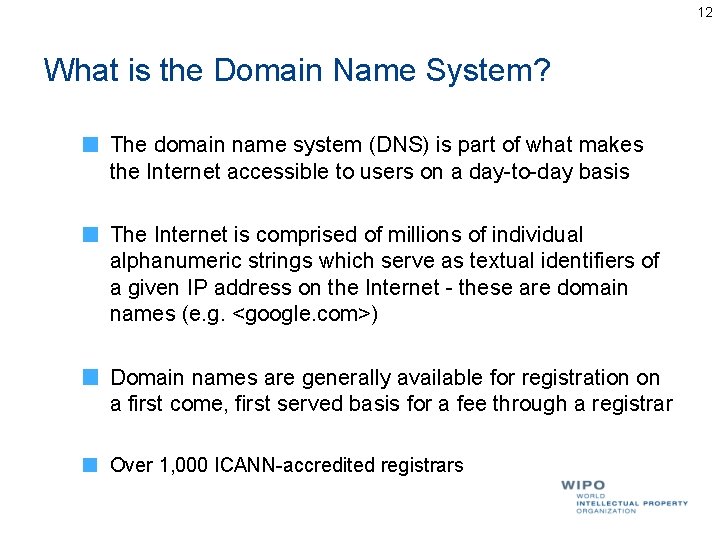
12 What is the Domain Name System? The domain name system (DNS) is part of what makes the Internet accessible to users on a day-to-day basis The Internet is comprised of millions of individual alphanumeric strings which serve as textual identifiers of a given IP address on the Internet - these are domain names (e. g. <google. com>) Domain names are generally available for registration on a first come, first served basis for a fee through a registrar Over 1, 000 ICANN-accredited registrars
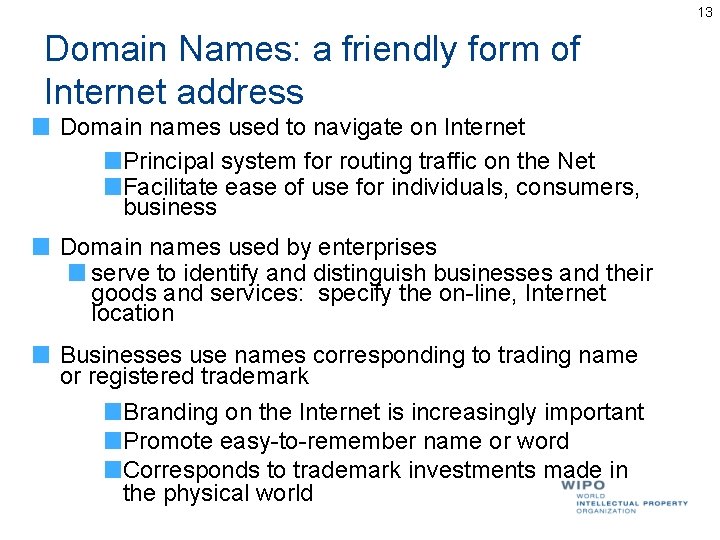
13 Domain Names: a friendly form of Internet address Domain names used to navigate on Internet Principal system for routing traffic on the Net Facilitate ease of use for individuals, consumers, business Domain names used by enterprises serve to identify and distinguish businesses and their goods and services: specify the on-line, Internet location Businesses use names corresponding to trading name or registered trademark Branding on the Internet is increasingly important Promote easy-to-remember name or word Corresponds to trademark investments made in the physical world
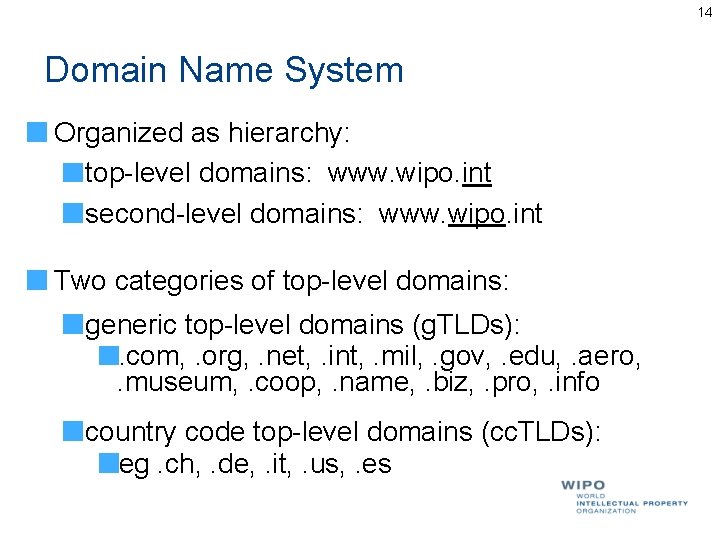
14 Domain Name System Organized as hierarchy: top-level domains: www. wipo. int second-level domains: www. wipo. int Two categories of top-level domains: generic top-level domains (g. TLDs): . com, . org, . net, . int, . mil, . gov, . edu, . aero, . museum, . coop, . name, . biz, . pro, . info country code top-level domains (cc. TLDs): eg. ch, . de, . it, . us, . es
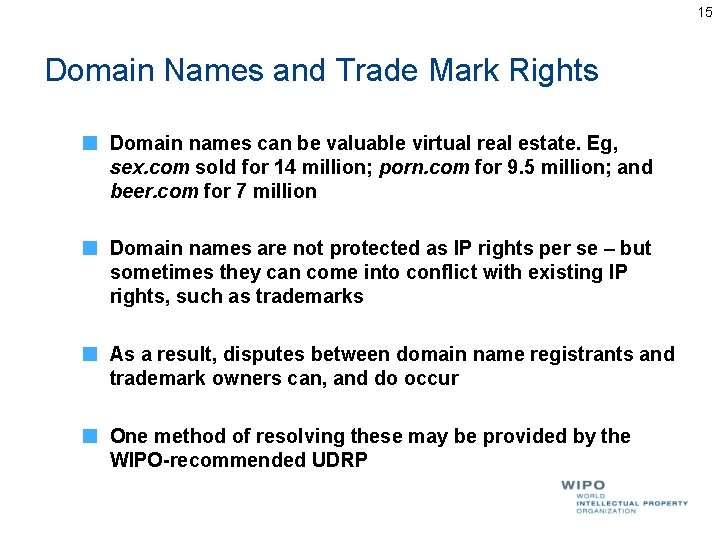
15 Domain Names and Trade Mark Rights Domain names can be valuable virtual real estate. Eg, sex. com sold for 14 million; porn. com for 9. 5 million; and beer. com for 7 million Domain names are not protected as IP rights per se – but sometimes they can come into conflict with existing IP rights, such as trademarks As a result, disputes between domain name registrants and trademark owners can, and do occur One method of resolving these may be provided by the WIPO-recommended UDRP
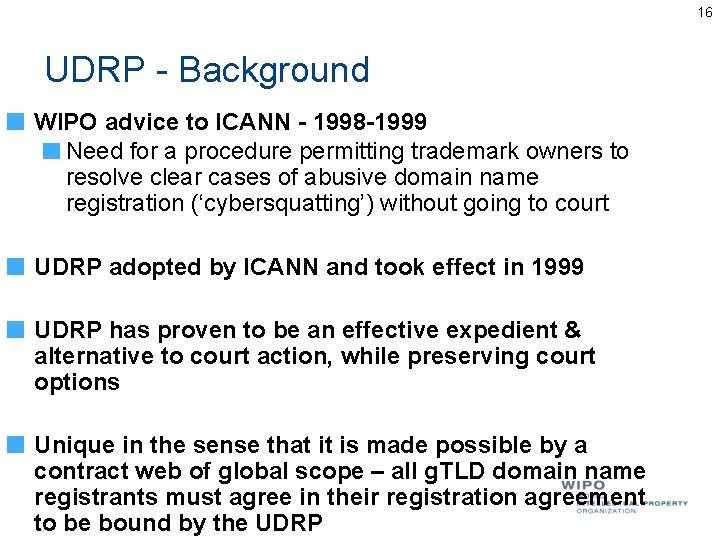
16 UDRP - Background WIPO advice to ICANN - 1998 -1999 Need for a procedure permitting trademark owners to resolve clear cases of abusive domain name registration (‘cybersquatting’) without going to court UDRP adopted by ICANN and took effect in 1999 UDRP has proven to be an effective expedient & alternative to court action, while preserving court options Unique in the sense that it is made possible by a contract web of global scope – all g. TLD domain name registrants must agree in their registration agreement to be bound by the UDRP
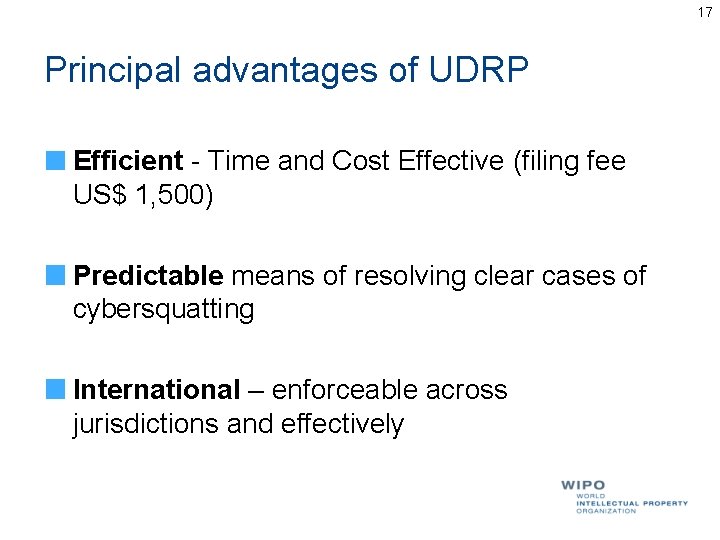
17 Principal advantages of UDRP Efficient - Time and Cost Effective (filing fee US$ 1, 500) Predictable means of resolving clear cases of cybersquatting International – enforceable across jurisdictions and effectively
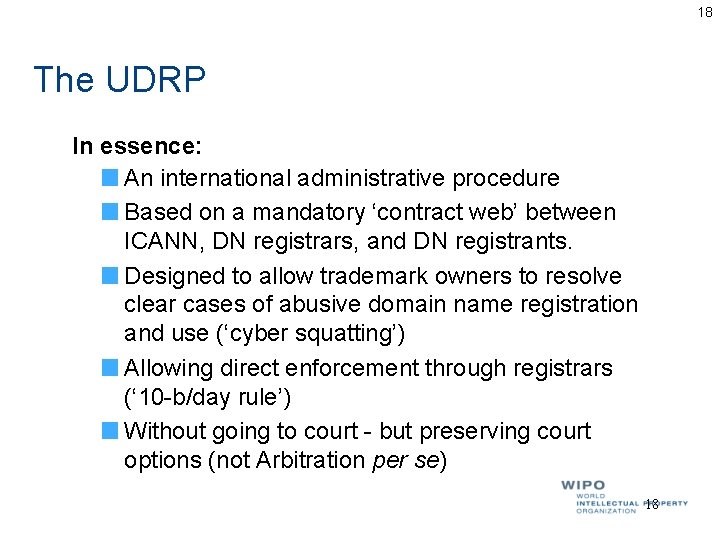
18 The UDRP In essence: An international administrative procedure Based on a mandatory ‘contract web’ between ICANN, DN registrars, and DN registrants. Designed to allow trademark owners to resolve clear cases of abusive domain name registration and use (‘cyber squatting’) Allowing direct enforcement through registrars (‘ 10 -b/day rule’) Without going to court - but preserving court options (not Arbitration per se) 18
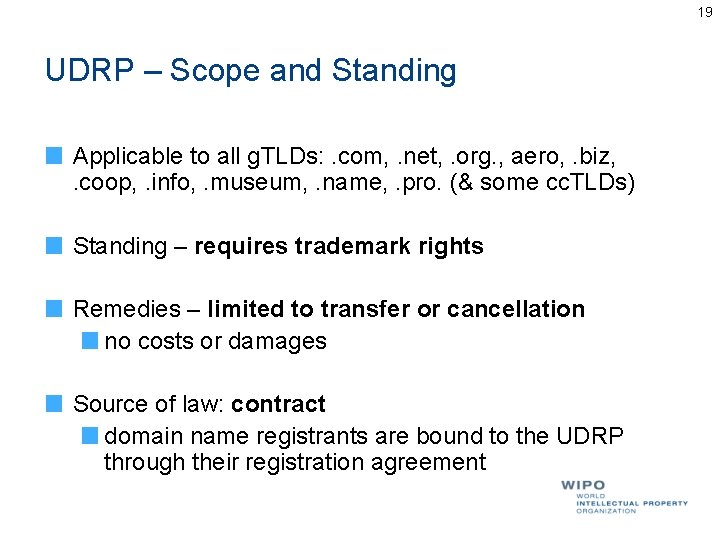
19 UDRP – Scope and Standing Applicable to all g. TLDs: . com, . net, . org. , aero, . biz, . coop, . info, . museum, . name, . pro. (& some cc. TLDs) Standing – requires trademark rights Remedies – limited to transfer or cancellation no costs or damages Source of law: contract domain name registrants are bound to the UDRP through their registration agreement
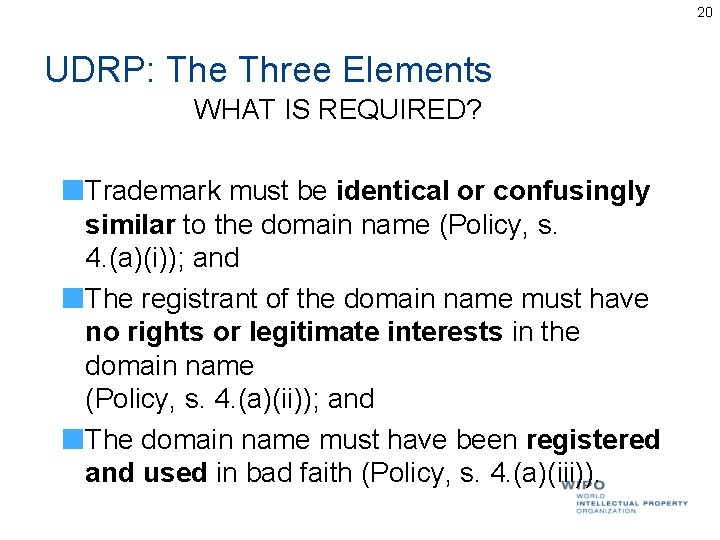
20 UDRP: The Three Elements WHAT IS REQUIRED? Trademark must be identical or confusingly similar to the domain name (Policy, s. 4. (a)(i)); and The registrant of the domain name must have no rights or legitimate interests in the domain name (Policy, s. 4. (a)(ii)); and The domain name must have been registered and used in bad faith (Policy, s. 4. (a)(iii)).
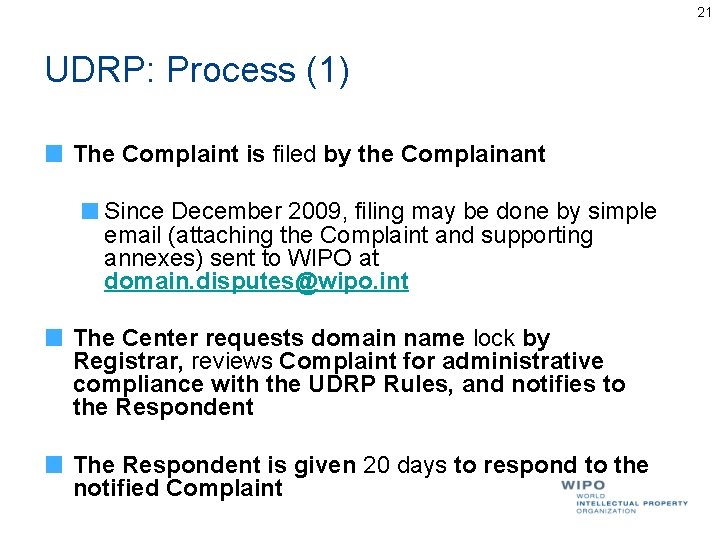
21 UDRP: Process (1) The Complaint is filed by the Complainant Since December 2009, filing may be done by simple email (attaching the Complaint and supporting annexes) sent to WIPO at domain. disputes@wipo. int The Center requests domain name lock by Registrar, reviews Complaint for administrative compliance with the UDRP Rules, and notifies to the Respondent The Respondent is given 20 days to respond to the notified Complaint
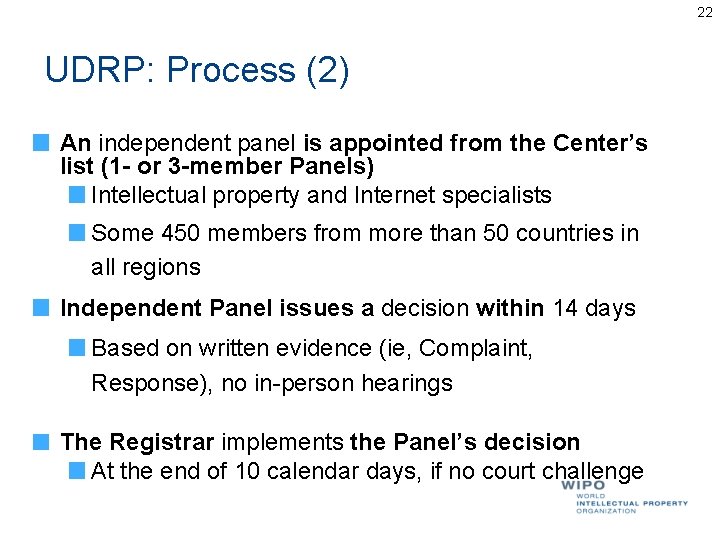
22 UDRP: Process (2) An independent panel is appointed from the Center’s list (1 - or 3 -member Panels) Intellectual property and Internet specialists Some 450 members from more than 50 countries in all regions Independent Panel issues a decision within 14 days Based on written evidence (ie, Complaint, Response), no in-person hearings The Registrar implements the Panel’s decision At the end of 10 calendar days, if no court challenge
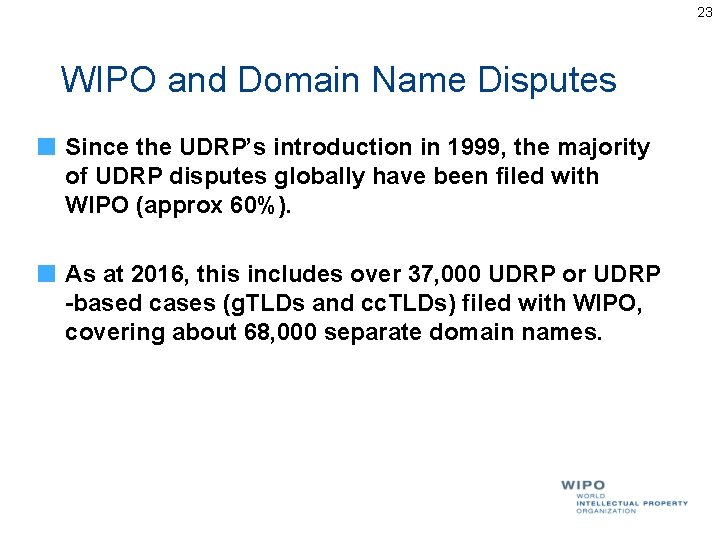
23 WIPO and Domain Name Disputes Since the UDRP’s introduction in 1999, the majority of UDRP disputes globally have been filed with WIPO (approx 60%). As at 2016, this includes over 37, 000 UDRP or UDRP -based cases (g. TLDs and cc. TLDs) filed with WIPO, covering about 68, 000 separate domain names.
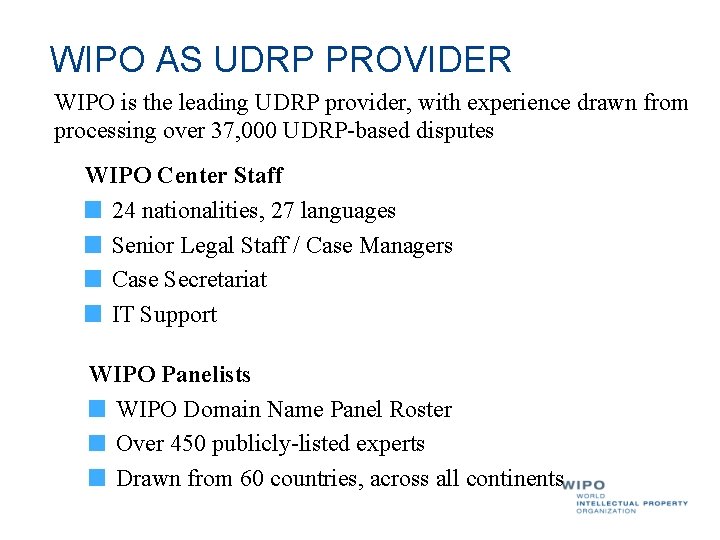
WIPO AS UDRP PROVIDER WIPO is the leading UDRP provider, with experience drawn from processing over 37, 000 UDRP-based disputes WIPO Center Staff 24 nationalities, 27 languages Senior Legal Staff / Case Managers Case Secretariat IT Support WIPO Panelists WIPO Domain Name Panel Roster Over 450 publicly-listed experts Drawn from 60 countries, across all continents
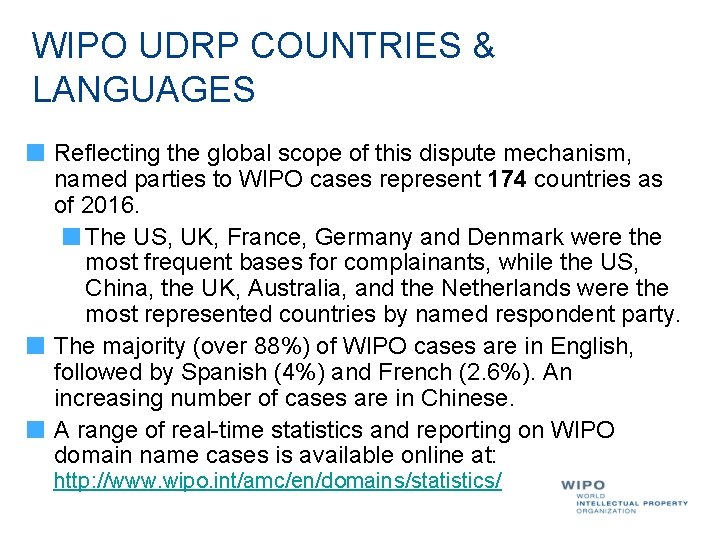
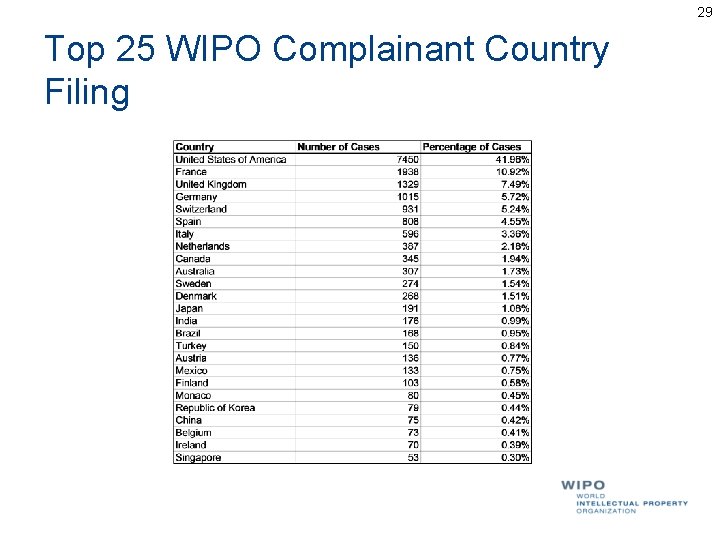
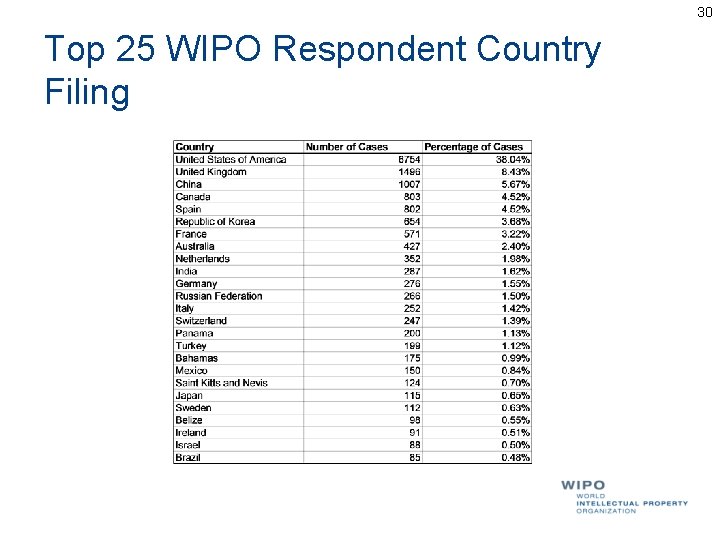
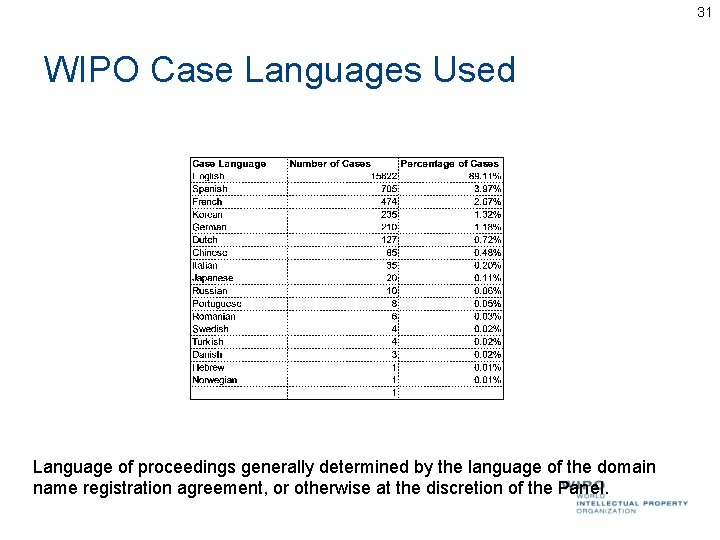
WIPO UDRP COUNTRIES & LANGUAGES Reflecting the global scope of this dispute mechanism, named parties to WIPO cases represent 174 countries as of 2016. The US, UK, France, Germany and Denmark were the most frequent bases for complainants, while the US, China, the UK, Australia, and the Netherlands were the most represented countries by named respondent party. The majority (over 88%) of WIPO cases are in English, followed by Spanish (4%) and French (2. 6%). An increasing number of cases are in Chinese. A range of real-time statistics and reporting on WIPO domain name cases is available online at: http: //www. wipo. int/amc/en/domains/statistics/
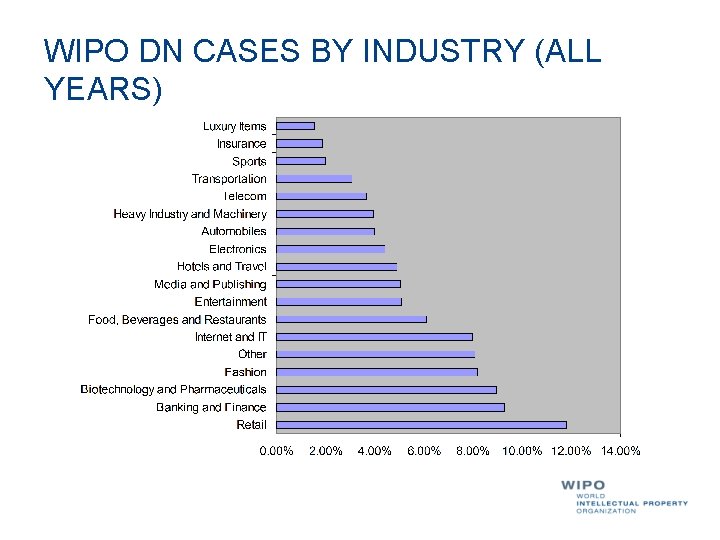
WIPO DN CASES BY INDUSTRY (ALL YEARS)
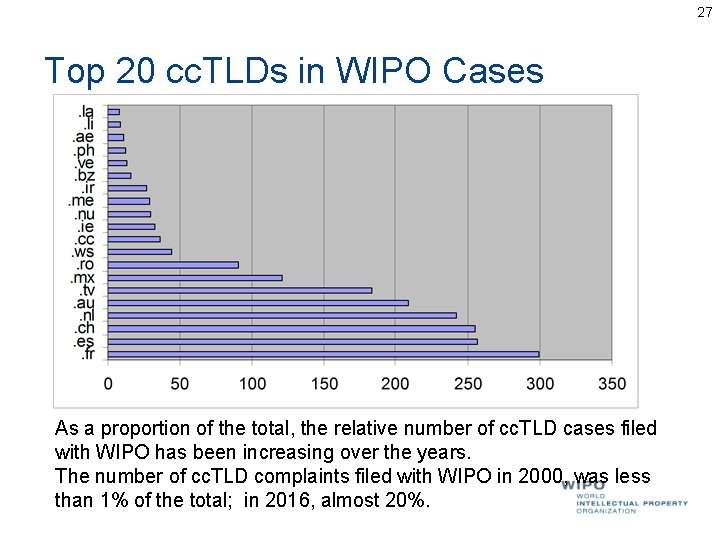
27 Top 20 cc. TLDs in WIPO Cases As a proportion of the total, the relative number of cc. TLD cases filed with WIPO has been increasing over the years. The number of cc. TLD complaints filed with WIPO in 2000, was less than 1% of the total; in 2016, almost 20%.
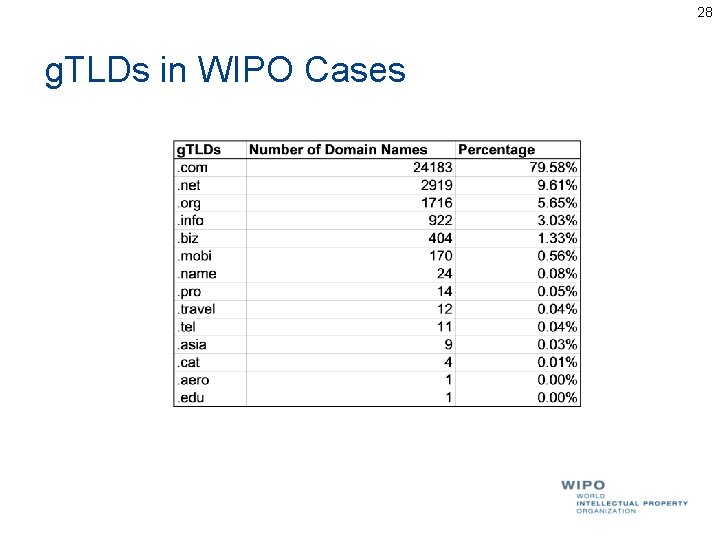
28 g. TLDs in WIPO Cases
29 Top 25 WIPO Complainant Country Filing
30 Top 25 WIPO Respondent Country Filing
31 WIPO Case Languages Used Language of proceedings generally determined by the language of the domain name registration agreement, or otherwise at the discretion of the Panel.
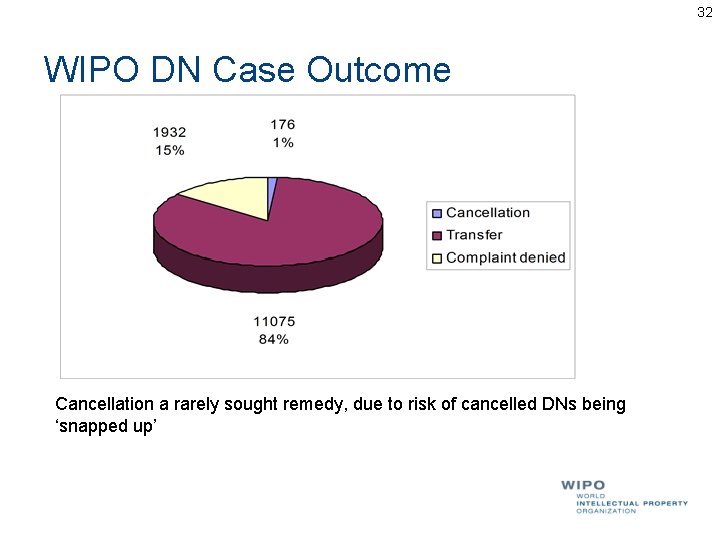
32 WIPO DN Case Outcome Cancellation a rarely sought remedy, due to risk of cancelled DNs being ‘snapped up’
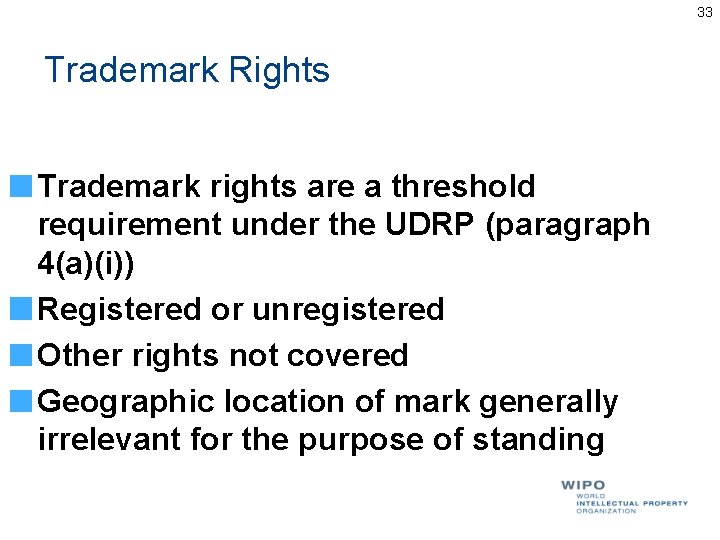
33 Trademark Rights Trademark rights are a threshold requirement under the UDRP (paragraph 4(a)(i)) Registered or unregistered Other rights not covered Geographic location of mark generally irrelevant for the purpose of standing
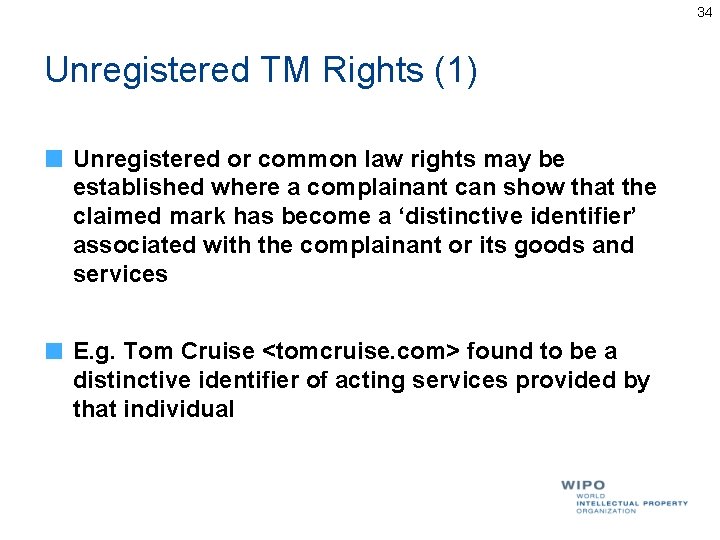
34 Unregistered TM Rights (1) Unregistered or common law rights may be established where a complainant can show that the claimed mark has become a ‘distinctive identifier’ associated with the complainant or its goods and services E. g. Tom Cruise <tomcruise. com> found to be a distinctive identifier of acting services provided by that individual
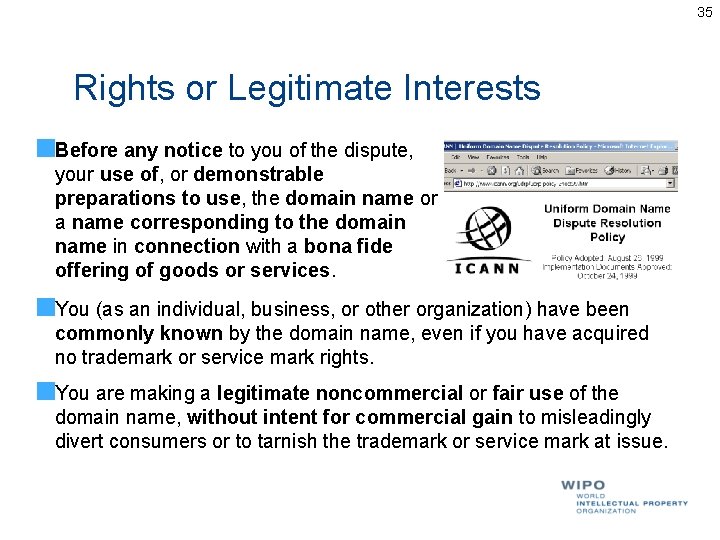
35 Rights or Legitimate Interests Before any notice to you of the dispute, your use of, or demonstrable preparations to use, the domain name or a name corresponding to the domain name in connection with a bona fide offering of goods or services. You (as an individual, business, or other organization) have been commonly known by the domain name, even if you have acquired no trademark or service mark rights. You are making a legitimate noncommercial or fair use of the domain name, without intent for commercial gain to misleadingly divert consumers or to tarnish the trademark or service mark at issue.
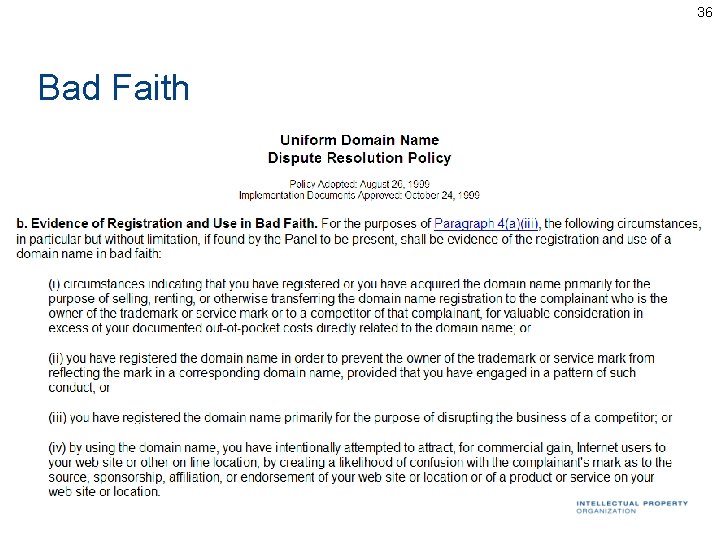
36 Bad Faith
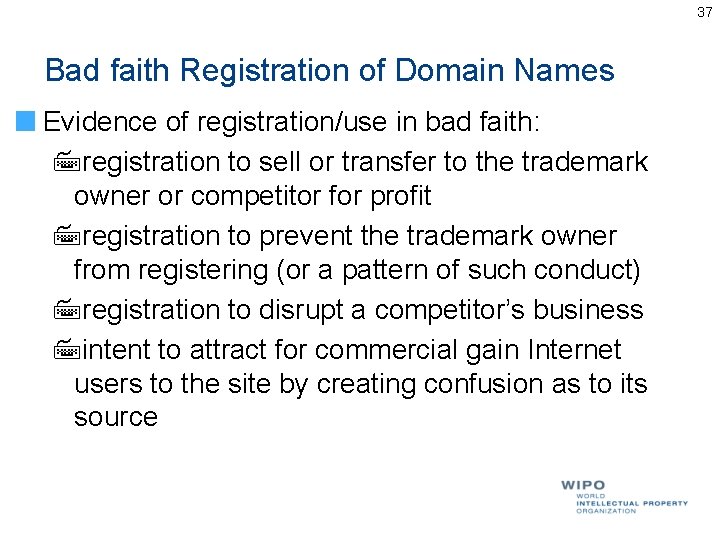
37 Bad faith Registration of Domain Names Evidence of registration/use in bad faith: 7 registration to sell or transfer to the trademark owner or competitor for profit 7 registration to prevent the trademark owner from registering (or a pattern of such conduct) 7 registration to disrupt a competitor’s business 7 intent to attract for commercial gain Internet users to the site by creating confusion as to its source
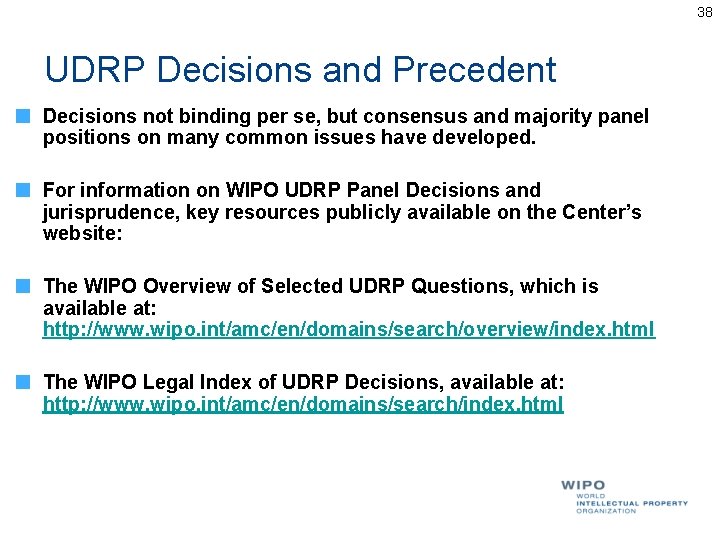
38 UDRP Decisions and Precedent Decisions not binding per se, but consensus and majority panel positions on many common issues have developed. For information on WIPO UDRP Panel Decisions and jurisprudence, key resources publicly available on the Center’s website: The WIPO Overview of Selected UDRP Questions, which is available at: http: //www. wipo. int/amc/en/domains/search/overview/index. html The WIPO Legal Index of UDRP Decisions, available at: http: //www. wipo. int/amc/en/domains/search/index. html
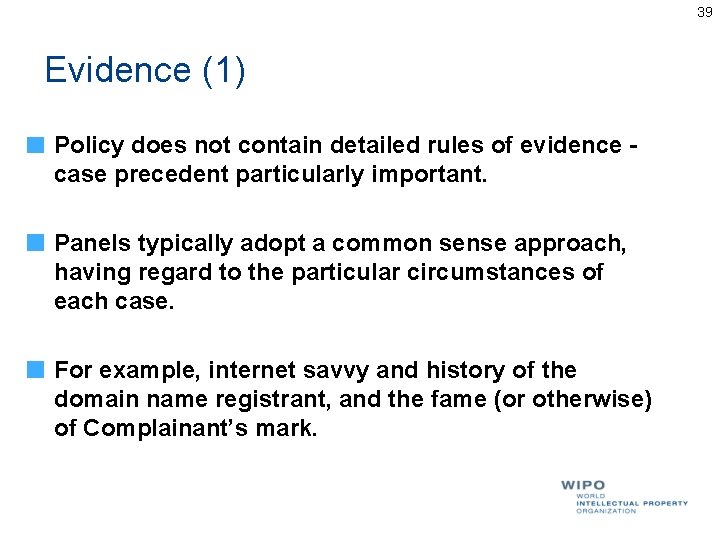
39 Evidence (1) Policy does not contain detailed rules of evidence case precedent particularly important. Panels typically adopt a common sense approach, having regard to the particular circumstances of each case. For example, internet savvy and history of the domain name registrant, and the fame (or otherwise) of Complainant’s mark.
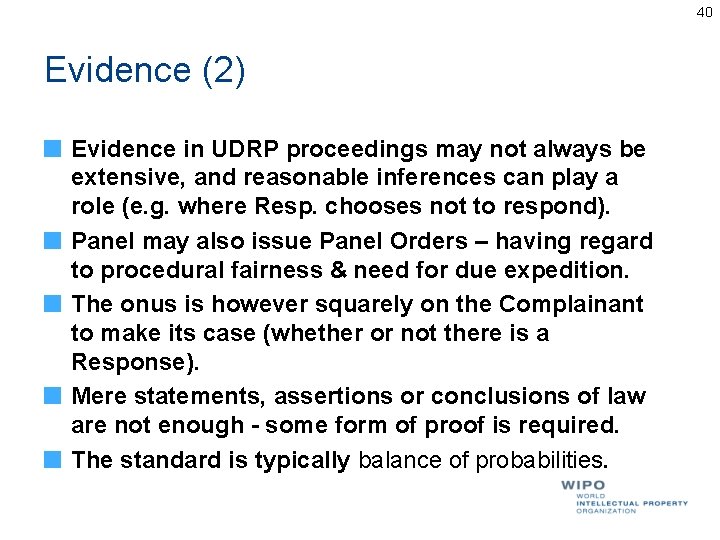
40 Evidence (2) Evidence in UDRP proceedings may not always be extensive, and reasonable inferences can play a role (e. g. where Resp. chooses not to respond). Panel may also issue Panel Orders – having regard to procedural fairness & need for due expedition. The onus is however squarely on the Complainant to make its case (whether or not there is a Response). Mere statements, assertions or conclusions of law are not enough - some form of proof is required. The standard is typically balance of probabilities.
41 Some Practice Points UDRP is designed to resolve clear cases of abusive cyber squatting relatively inexpensively - may be less suited to more complex disputes. As an expedited administrative process, typically involves a single round of written pleadings, without in-person hearings. Panels only rarely issue orders requesting additional information or evidence. Important for each party to - as far as possible - get it right and present appropriate evidence the first time. Parties encouraged to make use of freely available WIPO resources and information regarding UDRP decision precedent (including the widely-used WIPO Overview and Legal Index), model pleadings, and filing guidelines.
42 Contact and Further Info WIPO website: http: //www. wipo. int/amc Domain Name Disputes and Resources: http: //www. wipo. int/amc/en/domains/index. html Domain Name Complaints filed at: domain. disputes@wipo. int Emails and general queries: arbiter. mail@wipo. int To subscribe to WIPO UDRP Decision Mailing list: http: //arbiter. wipo. int/subscribe
43 Country names Fact: current registration policies allow any person to appropriate, as DNs, names of countries, places etc. for themselves. southafrica. com (Virtual Countries, Inc. , USA licensed to New. Media Holdings Inc. /Paley Media Inc. ). Also own algeria. com, morocco. com, etc. mali. com (on sale for 1. 5 million U$), cameroon. com, mauritania. com (Domain Market. com), on sale for 700, 000 and 500, 000 U$. Case of New Zealand
Others - IGOs See, eg, www. gatt. org, which is almost identical to website of wto (www. wto. org)