
Displacement Power Factor Source voltage waveform is assumed
- Slides: 4
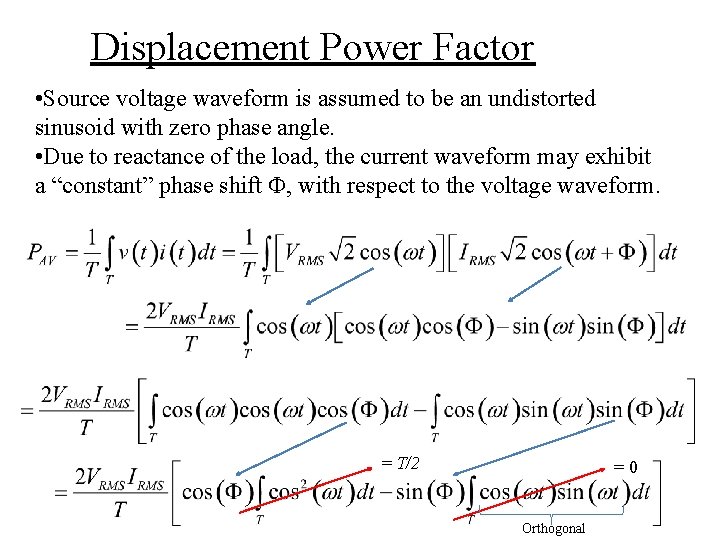
Displacement Power Factor • Source voltage waveform is assumed to be an undistorted sinusoid with zero phase angle. • Due to reactance of the load, the current waveform may exhibit a “constant” phase shift F, with respect to the voltage waveform. = T/2 =0 Orthogonal
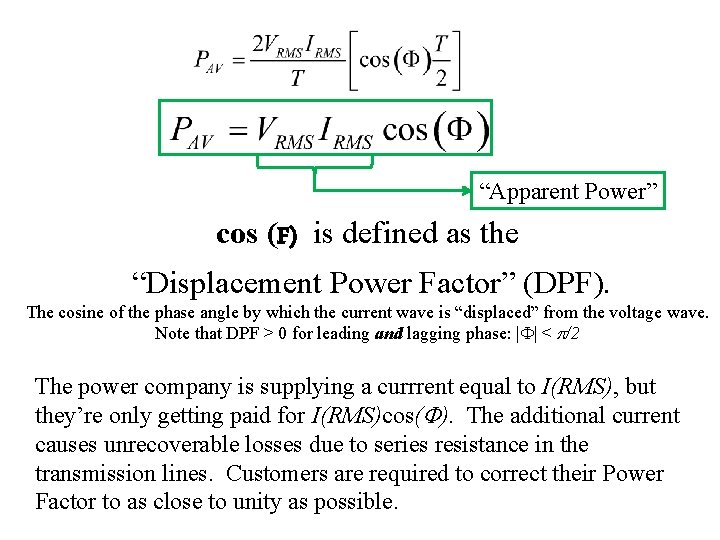
“Apparent Power” cos (F) is defined as the “Displacement Power Factor” (DPF). The cosine of the phase angle by which the current wave is “displaced” from the voltage wave. Note that DPF > 0 for leading and lagging phase: |F| < p/2 The power company is supplying a currrent equal to I(RMS), but they’re only getting paid for I(RMS)cos(F). The additional current causes unrecoverable losses due to series resistance in the transmission lines. Customers are required to correct their Power Factor to as close to unity as possible.
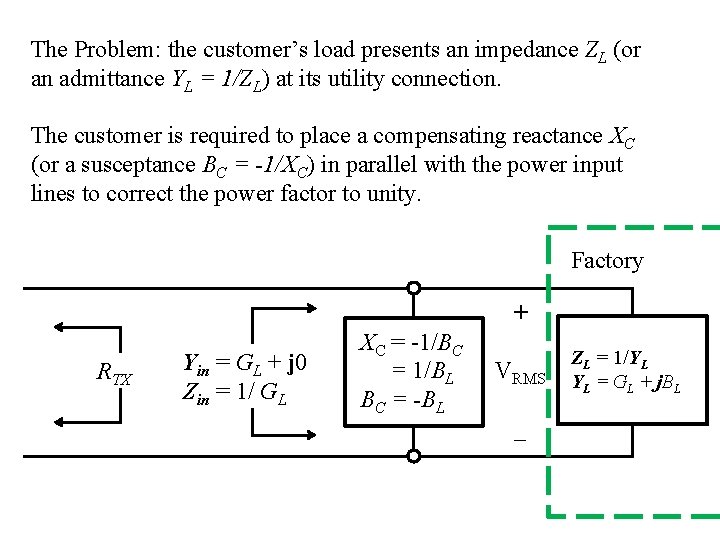
The Problem: the customer’s load presents an impedance ZL (or an admittance YL = 1/ZL) at its utility connection. The customer is required to place a compensating reactance XC (or a susceptance BC = -1/XC) in parallel with the power input lines to correct the power factor to unity. Factory + RTX Yin = GL + j 0 Zin = 1/ GL XC = -1/BC = 1/BL BC = -BL VRMS _ ZL = 1/YL YL = GL + j. BL
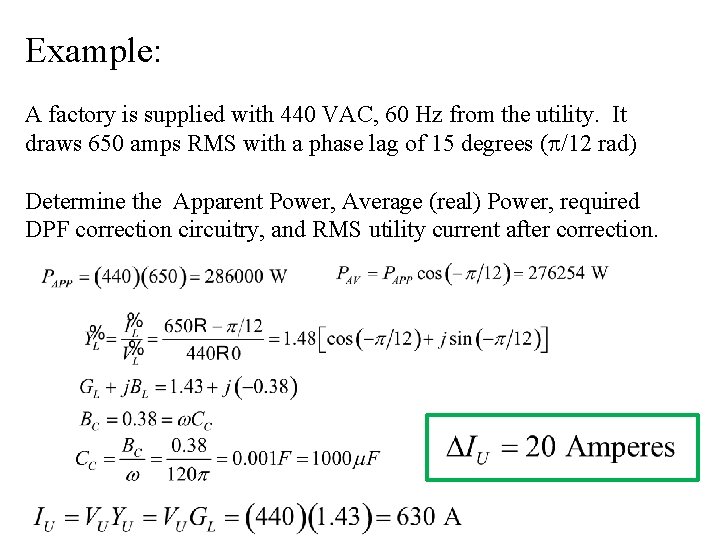
Example: A factory is supplied with 440 VAC, 60 Hz from the utility. It draws 650 amps RMS with a phase lag of 15 degrees (p/12 rad) Determine the Apparent Power, Average (real) Power, required DPF correction circuitry, and RMS utility current after correction.